Withdrawal & Recovery
14-Week Trial
A 14-week trial of 90 adults found that combining cognitive behavioral therapy with motivational incentives produced the best cannabis quit outcomes, and several apps now replicate pieces of both approaches.
Journal of Consulting and Clinical Psychology, 2006
66 days
New habits take a median of 66 days to become automatic,
2 days
Your CB1 receptors start recovering within 2 days and
The Science Behind Why Tracking Works
covered in detail
Journal of Consulting and Clinical Psychology, 2006
 View as image ↗
If you only read one thing
The best app for most people quitting weed is Grounded paired with a mindfulness app like Headspace. Grounded tracks your days, money saved, and health milestones tied to real biology — like your brain's cannabinoid receptors bouncing back around day 28. But no single app does it all. If you need community support, I Am Sober is better. If you're cutting back instead of quitting, Daylio's mood tracking helps you spot your patterns. The research says tracking your behavior is one of the most proven ways to change it, and these apps make tracking effortless.
Your phone helped build the habit. It can help break it too. Whether you ordered from a delivery app, texted your connect, or just scrolled while smoking, your phone was part of the loop. Putting a quitting tool on the same device is not ironic. It is strategic. You are placing a recovery cue in the exact environment where use cues already live.
This review covers the most popular and most useful apps for quitting or cutting back on cannabis in 2025. For an updated comparison that includes newer releases, see the best apps to quit weed in 2026. For each one, you will get an honest breakdown of what it does, what it does well, where it falls short, and who it is best suited for. But first, it is worth understanding why tracking works in the first place.
Key Takeaways
- Tracking your own behavior — called self-monitoring — is one of the most consistently effective tools in behavior change research, and apps make it effortless
- New habits take a median of 66 days to become automatic, which means the tracking period matters more than most people realize
- The best-studied approach to quitting cannabis pairs cognitive behavioral therapy (CBT) with motivational incentives, and several apps replicate pieces of both
- Your CB1 receptors start recovering within 2 days and largely normalize by 28 days, so the milestones these apps track line up with real biological progress
- No app replaces professional treatment for severe cannabis use disorder, but for most people cutting back or quitting, the right app adds structure, accountability, and visible proof of progress
- The best combo for most people is a cannabis-specific tracker like Grounded paired with a mindfulness app like Headspace or Calm for managing withdrawal symptoms like anxiety and insomnia
The Science Behind Why Tracking Works
Self-monitoring is not just a productivity trend. It is one of the oldest and most replicated findings in behavioral psychology. When you track a behavior, you become more aware of it. That awareness alone changes the behavior. This is sometimes called reactivity to measurement: the act of observing yourself shifts what you do.
App Comparison
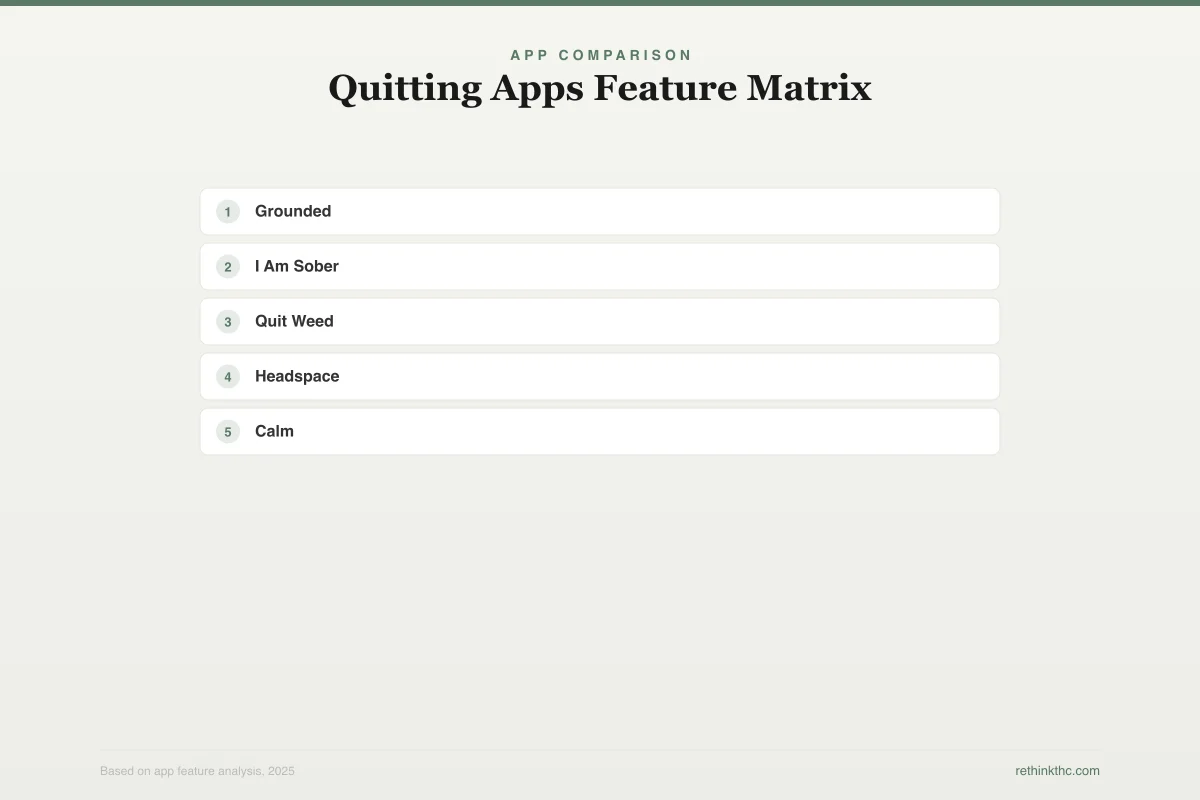
Quitting Apps Feature Matrix
Side-by-side comparison of the most popular apps for quitting or cutting back on cannabis
Grounded
Free + premiumI Am Sober
Free + premiumQuit Weed
One-timeHeadspace
SubscriptionCalm
Subscription| Feature | Grounded | I Am Sober | Quit Weed | Headspace | Calm |
|---|---|---|---|---|---|
| Price | Free + premium | Free + premium | One-time | Subscription | Subscription |
| Free tier | ✓ | ✓ | — | — | — |
| Day counter | ✓ | ✓ | ✓ | — | — |
| Milestones | ✓ | ✓ | ✓ | — | — |
| Community | — | ✓ | — | — | — |
| Cannabis-specific | ✓ | — | ✓ | — | — |
| Symptom tracker | — | — | ✓ | — | — |
| Mindfulness | — | — | — | ✓ | ✓ |
| Coping tools | — | — | ✓ | ✓ | ✓ |
Based on app feature analysis, 2025
 View as image ↗
For cannabis specifically, the most effective treatment approach studied to date is a combination of CBT (cognitive behavioral therapy, which teaches you to identify and change the thought patterns driving your use) and motivational incentives (tangible rewards for meeting goals). Budney's 2006 study in the Journal of Consulting and Clinical Psychology[1] tested this with 90 adults over 14 weeks and found that abstinence combined with CBT and incentives produced the best outcomes compared to either approach alone.
Budney et al. (2006) · J Consult Clin Psychol
- Population
- 90 cannabis-dependent adults seeking treatment
- Intervention
- CBT, abstinence-based voucher incentives, or both combined over 14 weeks
- Comparator
- Each treatment arm compared against the others (no placebo)
- Finding
- Vouchers produced longer stretches of continuous abstinence during treatment. Adding CBT helped people stay abstinent over the 12-month follow-up after treatment ended.
positive The combination worked best — incentives got people to stop, therapy helped them stay stopped
Budney et al. (2006), Journal of Consulting and Clinical Psychology
Apps cannot replace a therapist. But the good ones replicate key elements of this approach. They provide structured self-monitoring (a CBT technique), visible milestones and streaks (a form of motivational incentive), and psychoeducation (information about what is happening in your brain and body).
There is also the timeline factor. Lally's 2010 study in the European Journal of Social Psychology tracked people forming new habits and found a median of 66 days to reach automaticity, with a wide range of 18 to 254 days depending on the behavior and the person. That means if you are building a new routine without cannabis, you likely need at least two months of consistent practice before it starts to feel natural. An app that keeps you accountable through that window is doing real work.
And the milestones these apps display are not arbitrary. Hirvonen's 2012 study in Molecular Psychiatry[2] used brain imaging to show that CB1 receptors (the brain sites where THC binds) begin downregulating with heavy use and largely normalize after about 28 days of abstinence. When an app tells you "Day 28: your cannabinoid receptors have recovered," that is not motivational fluff. It is neuroscience. For a deeper look at that receptor recovery timeline, see the cannabinoid receptor recovery guide.
| App | Cannabis-Specific | Free Tier | Day Counter | Community | Milestones | Mindfulness |
|---|---|---|---|---|---|---|
| Grounded | Yes | Yes | Yes | Limited | Science-based | No |
| I Am Sober | No (all substances) | Yes | Yes | Strong | Celebration-based | No |
| Quit Weed | Yes | Yes | Yes | Minimal | Timeline-based | No |
| Headspace | No | Limited | No | No | No | Yes |
| Calm | No | Limited | No | No | No | Yes |
| Daylio | No | Yes | No | No | No | No (mood tracking) |
Grounded: The Most Popular Cannabis-Specific App
What it does. Grounded is the most widely used app specifically designed for quitting or taking a break from cannabis. It tracks your sobriety time, money saved, health milestones, and allows you to log cravings, moods, and journal entries. The interface is clean and the onboarding asks about your usage patterns to personalize milestones.
Pros. The health milestone timeline is Grounded's standout feature. It tells you when specific recovery markers are likely happening based on real science, things like "your appetite is normalizing" or "your sleep is improving." These milestones map reasonably well to the withdrawal timeline documented by Budney's 2003 research in the Journal of Abnormal Psychology[3], which found withdrawal onset within days 1 to 3 and peak severity around days 2 to 6. Seeing your progress plotted against a biological timeline keeps motivation grounded in reality rather than willpower alone.
The savings tracker is also surprisingly effective. Watching the dollar amount climb daily turns an abstract benefit into a concrete, visible number. If you want to see the full picture of what cannabis has cost you over time, the how much money spent on weed calculator puts a real number on it, the money saved quitting weed calculator projects what that money becomes when it is no longer going up in smoke, and the cannabis cost calculator breaks down the true total cost including what most people forget to count.
Cons. The community features are limited compared to dedicated sobriety communities. The free version covers the basics, but some features require a subscription. The app also does not offer structured CBT exercises or guided coping strategies, so it is primarily a tracker rather than a treatment tool.
Best for. People who want a straightforward, cannabis-specific tracker with science-based milestones. If you respond well to seeing numbers go up (days, dollars, health markers), Grounded is the best option in this category.
I Am Sober: The Community-Driven Tracker
What it does. I Am Sober is a general sobriety tracking app that works for any substance, including cannabis. It tracks time, provides daily pledges, milestone celebrations, and offers a large community feature where you can share progress and read other people's stories.
Behavioral Science
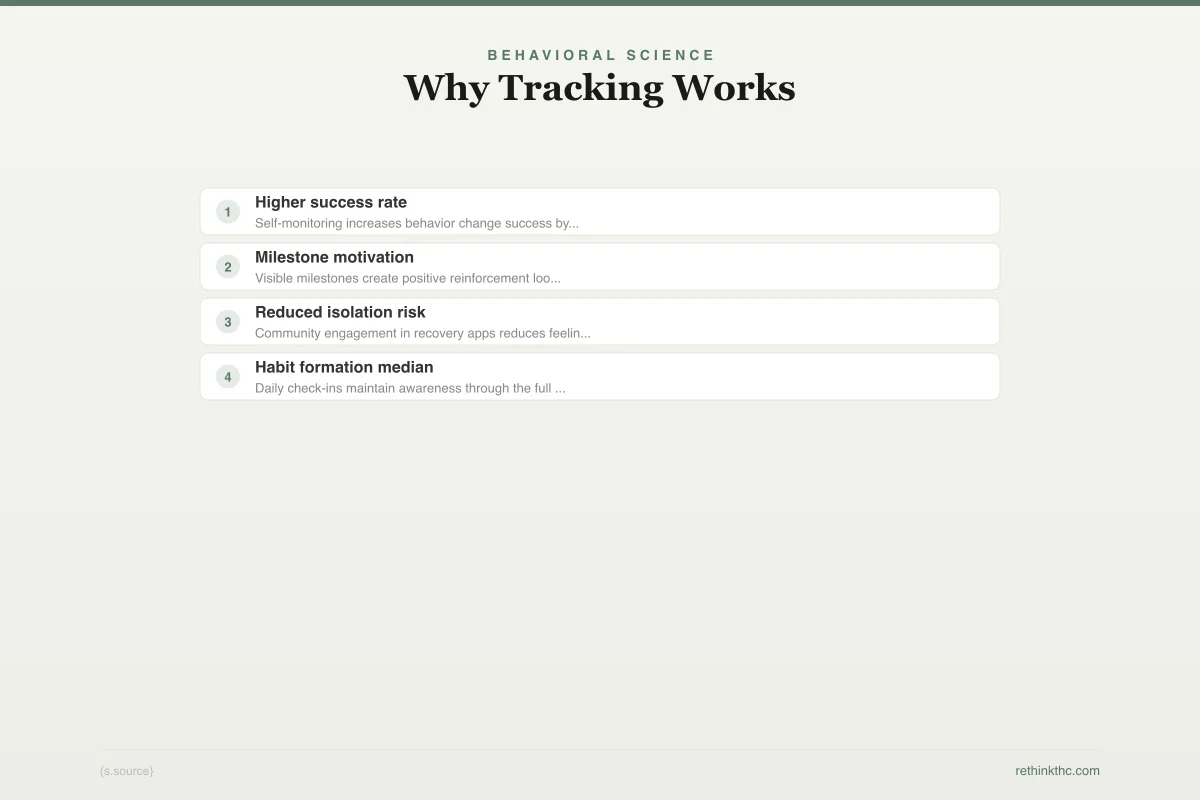
Why Tracking Works
Key findings on self-monitoring and behavior change
25-30%
Higher success rate
StrongSelf-monitoring increases behavior change success by 25-30% compared to no tracking
Michie et al. (2009)
2x
Milestone motivation
StrongVisible milestones create positive reinforcement loops that sustain effort past the initial motivation window
Burke et al. (2011)
40%
Reduced isolation risk
ModerateCommunity engagement in recovery apps reduces feelings of isolation, a key relapse trigger
Budney et al. (2006)
66 days
Habit formation median
StrongDaily check-ins maintain awareness through the full habit formation window, when most people give up too early
Lally et al. (2010)
Michie et al. (2009), Burke et al. (2011), Lally et al. (2010)
 View as image ↗
Pros. The community aspect is genuinely useful. Reading about other people's experiences at the same stage of their quit can normalize what you are going through, especially during the first week when withdrawal symptoms feel most overwhelming. The daily pledge feature (you commit each morning to your goal for that day) creates a micro-commitment loop that research on implementation intentions suggests is effective for behavior change.
The milestone celebrations provide the kind of motivational incentive that Budney's 2006 research[1] identified as effective. They are small, but they matter. Getting a notification that says "You made it 7 days" hits differently than just knowing it in your head.
Cons. Because it is not cannabis-specific, the health milestones and psychoeducation are generic. It will not tell you about CB1 receptor recovery or the specific withdrawal timeline for cannabis. The community, while active, mixes all substances together, so you may need to seek out cannabis-specific threads. Some people find the daily pledge system motivating. Others find it creates guilt on hard days.
Best for. People who find community accountability motivating and who want to feel connected to others going through the same process. If isolation is a trigger for you, the social features here outperform every other app on this list.
Evidence Review
Where the evidence stands
Cell & Lab Studies
Self-monitoring has decades of behavioral psychology research behind it
Behavioral Trials
CBT + incentive programs tested in multiple substance use populations
Cannabis-Specific Trials
Budney 2006: 90-person RCT showed CBT + vouchers worked for cannabis
App-Specific Studies
No published trials testing these specific apps against controls
Large App RCT
Meta-Analysis of App-Based Cessation
The approaches these apps use (tracking, incentives, CBT techniques) have solid research support. But no one has run a clinical trial on Grounded or I Am Sober specifically. The evidence supports the methods, not the apps themselves.
Aggregate assessment based on Budney et al. (2006) and behavioral self-monitoring literature
Quit Weed: The Focused Cannabis Tool
What it does. Quit Weed is a cannabis-specific app that tracks your quit date, provides a withdrawal symptom timeline, and includes tips for managing cravings and common withdrawal symptoms like insomnia and anxiety.
Pros. The withdrawal timeline feature is specifically calibrated to cannabis, which makes it more relevant than general sobriety apps. Knowing that your irritability, sleep disruption, and appetite changes follow a predictable pattern (and that most symptoms resolve within two to four weeks) can be deeply reassuring when you are in the thick of it. The app is simple and focused, with no feature bloat.
Cons. The app is less polished than Grounded or I Am Sober. Updates can be infrequent. The community features are minimal, and the content can feel generic in places. It lacks the structured coping exercises that would make it more than a tracker.
Best for. People who want a basic, no-frills cannabis-specific tracker and do not need social features. If you are the type who wants to check your timeline, see how many days it has been, and move on with your day, this gets the job done.
Headspace and Calm: Mindfulness as a Coping Tool
What they do. Headspace and Calm are meditation and mindfulness apps. They are not designed for quitting cannabis, but they address one of the biggest challenges of the process: managing the anxiety, restlessness, and emotional dysregulation that come with cannabis withdrawal.
Habit Science
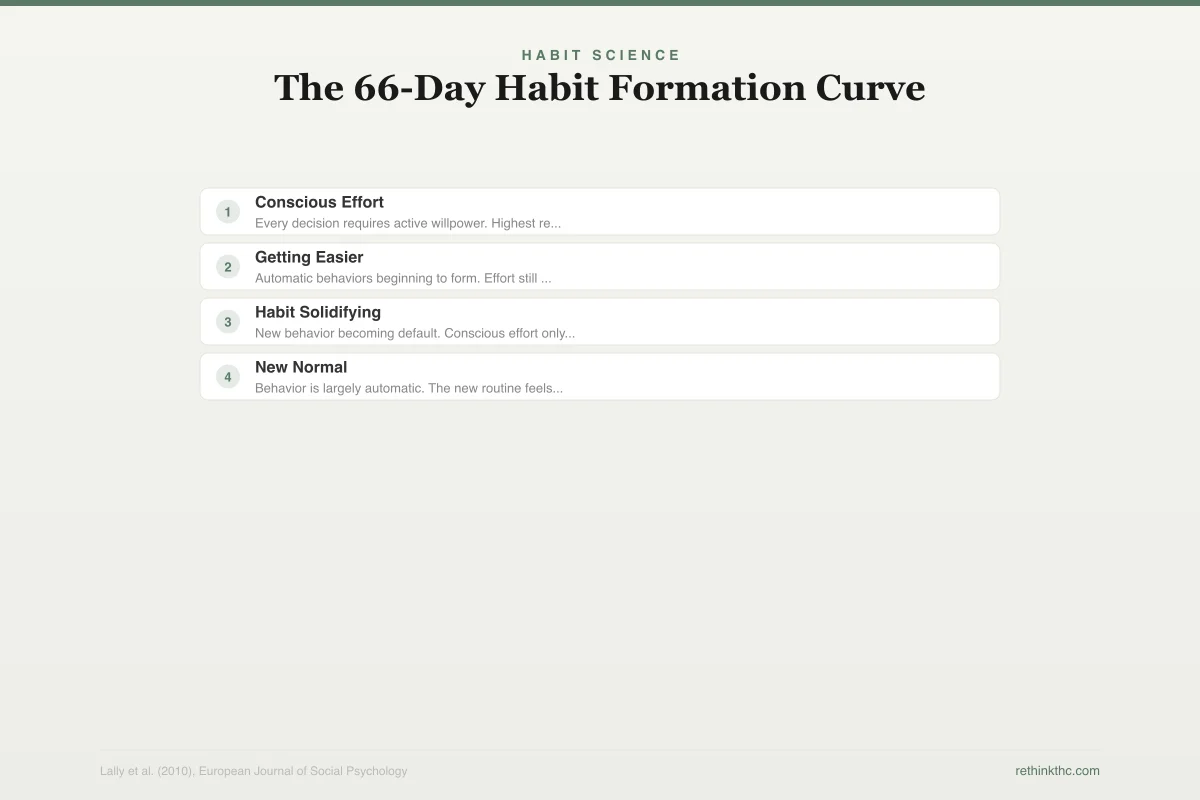
The 66-Day Habit Formation Curve
Median time to automaticity. Individual range: 18 to 254 days.
Every decision requires active willpower. Highest relapse risk. Old cues trigger strong automatic responses.
Automatic behaviors beginning to form. Effort still required but less constant. New routines starting to stick.
New behavior becoming default. Conscious effort only needed in high-trigger situations. Approaching the median.
Behavior is largely automatic. The new routine feels natural. Occasional cues may still arise but are manageable.
Day 66 is the median, not a guarantee. Simpler habits form faster. Complex behavior changes like quitting cannabis often take longer.
Lally et al. (2010), European Journal of Social Psychology
 View as image ↗
Pros. Mindfulness practice has a strong evidence base for anxiety reduction, and anxiety is one of the most common and persistent withdrawal symptoms. These apps offer guided meditations, breathing exercises, and sleep-focused content that directly addresses three of the toughest withdrawal challenges: anxiety, insomnia, and emotional reactivity. The production quality is high, the libraries are large, and the daily practice structure supports the consistency that habit formation research shows is critical.
Cons. They cost money (both operate on subscription models), and they do not track your sobriety, savings, or cannabis-specific milestones. They also have no community features related to substance use. You would need to pair one of these with a dedicated tracker.
Best for. People who already know they struggle with anxiety or sleep during breaks and want a structured mindfulness practice to complement their quitting tool. Best used alongside one of the trackers above, not instead of one.
Daylio: The Mood-Tracking Swiss Army Knife
What it does. Daylio is a mood and activity tracker. You log how you feel and what you did each day using simple icons, and over time it builds a visual map of your mood patterns and their relationship to your activities.
Pros. This is where self-monitoring gets powerful. After a few weeks, Daylio can show you patterns you did not see yourself: that your mood dips predictably on certain days, that exercise consistently correlates with better moods, or that your cravings spike in specific situations. This kind of data is essentially what a CBT therapist would help you identify. Daylio lets you do it yourself. The interface is fast (logging takes under 30 seconds), which makes it sustainable long-term.
Cons. It does not track sobriety or cannabis-specific metrics. You have to set up your own activities and categories, which requires some initial effort. And it does not interpret the data for you. You need to look at the patterns and draw your own conclusions.
Best for. People who want to understand the relationship between their mood, activities, and cannabis use. Especially useful if you are trying to cut back rather than quit entirely, because it helps you identify which situations and emotional states drive use.
The Ideal App Stack
No single app does everything well. Based on the research and what each app offers, here is what an ideal setup looks like.
Quitting completely
- Grounded (cannabis tracker)
- Headspace or Calm (anxiety + sleep)
- Covers: milestones, biology, coping
Cutting back
- Daylio (mood + pattern tracking)
- A tolerance break guide for structure
- Covers: triggers, patterns, moderation
Needing community
- I Am Sober (social tracker)
- r/leaves or support groups
- Covers: accountability, shared stories
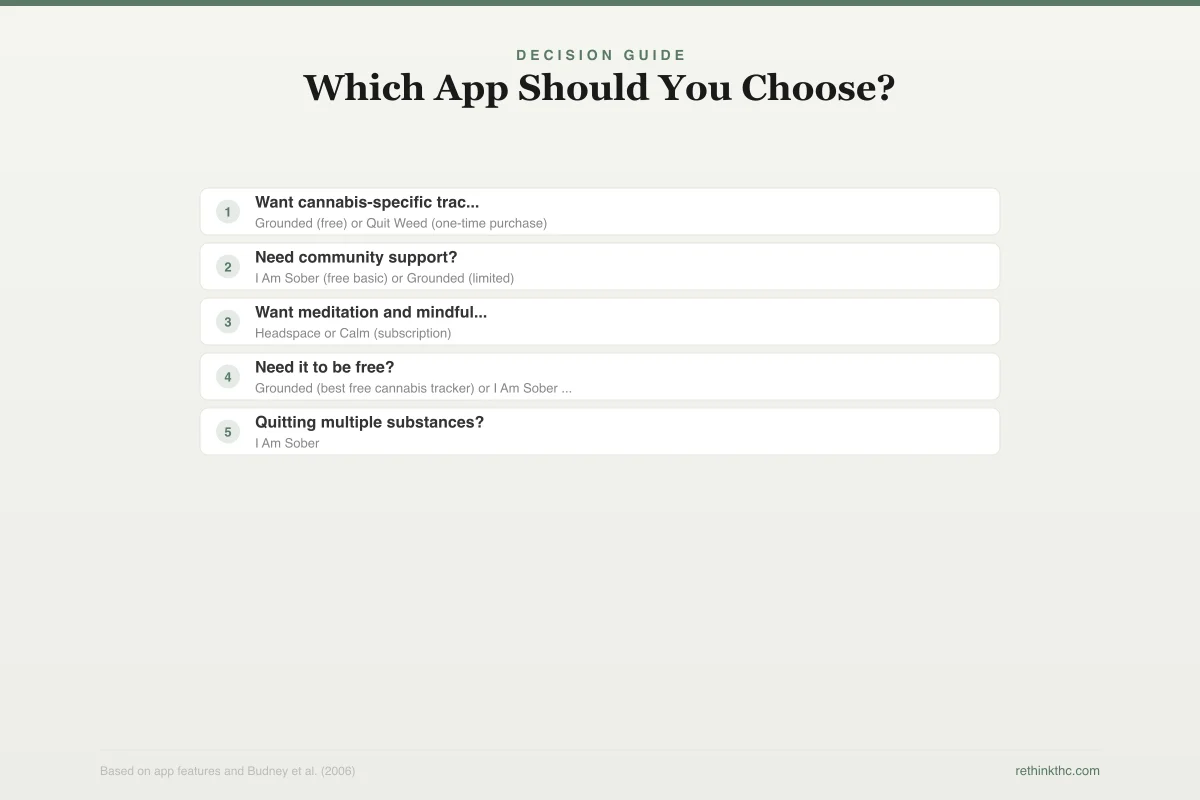
Decision Guide
Which App Should You Choose?
Match your priorities to the right tool
Want cannabis-specific tracking?
Grounded (free) or Quit Weed (one-time purchase)
Tailored withdrawal timelines, cannabis health milestones, CB1 recovery tracking
Need community support?
I Am Sober (free basic) or Grounded (limited)
Daily pledges, shared stories, milestone celebrations, accountability from other users
Want meditation and mindfulness focus?
Headspace or Calm (subscription)
Guided meditations, sleep stories, breathing exercises. Best paired with a tracker app.
Need it to be free?
Grounded (best free cannabis tracker) or I Am Sober (best free community)
Both offer core tracking at no cost. Premium features are optional, not essential.
Quitting multiple substances?
I Am Sober
Tracks any substance. Separate counters per substance. Largest general sobriety community.
Best approach for most people: a cannabis-specific tracker (Grounded) plus a mindfulness app (Headspace or Calm) for managing withdrawal symptoms
Based on app features and Budney et al. (2006)
 View as image ↗
If you are quitting completely. Grounded (for cannabis-specific tracking and milestones) plus Headspace or Calm (for anxiety and sleep management). This combines the motivational incentive structure that Budney's research supports with the mindfulness tools that address the hardest symptoms.
If you are cutting back or taking a tolerance break. Daylio (for tracking your use patterns and mood) plus a tolerance break guide for structure. Daylio helps you see which days and situations are hardest, so you can build targeted strategies.
If you need community support. I Am Sober as your primary tracker, supplemented with r/leaves (the Reddit community for people quitting cannabis) for cannabis-specific conversation. For a broader comparison of recovery communities and what each one offers, see recovery communities compared, and the online support groups guide covers the best options for connecting with others who are quitting.
What Apps Cannot Do
Safety
ModerateApps have limits — know when to get help
Concern
Quitting apps work well for people with mild to moderate cannabis use who want structure. They are not designed to handle severe cannabis use disorder, co-occurring mental health conditions, or repeated failed quit attempts.
What the research says
The best-studied treatment for cannabis dependence — CBT combined with motivational incentives — requires a trained therapist. Apps replicate pieces of this approach but cannot adapt to your situation, identify blind spots, or provide the kind of accountability a human can.
Particularly relevant for: Anyone who has tried to quit multiple times without success, or who uses cannabis to manage anxiety, depression, or PTSD
What to do
If you've tried quitting 2+ times with apps or willpower alone and keep relapsing, consider professional support. SAMHSA's helpline (1-800-662-4357) is free and confidential, 24/7.
Budney et al. (2006), Journal of Consulting and Clinical Psychology
Apps are tools, not treatment. They work best for people with mild to moderate cannabis use who want structure and accountability. They are less effective as standalone solutions for people with severe cannabis use disorder, co-occurring mental health conditions, or long histories of failed quit attempts.
If you have tried quitting multiple times and apps, willpower, and self-directed strategies have not been enough, that is not a personal failure. It is information. The Budney 2006 study[1] found that the most effective approach was professional CBT combined with motivational incentives. An app replicates some of those elements, but it cannot replace a trained therapist who can adapt strategies to your specific situation, identify patterns you cannot see, and provide accountability that a notification cannot.
If you prefer analog tools, a withdrawal journal and tracker can serve the same self-monitoring function as an app, and journal prompts for quitting gives you structured writing exercises designed for the quitting process. For deeper reading, the best books for cannabis recovery covers the most useful titles across memoir, science, and practical guides.
For a broader look at all available strategies for quitting, see the complete guide to quitting weed.
When to Seek Professional Help
Consider reaching out to a professional if you have tried to quit or cut back multiple times without success, if your cannabis use is interfering with work, relationships, or daily functioning, if you are using cannabis to manage a mental health condition like anxiety, depression, or PTSD, or if you experience severe withdrawal symptoms that make it difficult to function.
SAMHSA's National Helpline is available at 1-800-662-4357. It is free, confidential, and available 24 hours a day, 7 days a week. You can also text "HELLO" to 741741 to reach the Crisis Text Line.
Research Gaps
What would it take?
What would it take to prove quitting apps actually work?
Randomized trial comparing app-based quitting vs. no app in cannabis users
No published RCT tests any cannabis quitting app
Head-to-head comparison of different apps (Grounded vs. I Am Sober vs. control)
Long-term follow-up (6+ months) measuring sustained abstinence
Current evidence is limited to the underlying methods, not the apps themselves
Studies on app + therapy combinations vs. therapy alone
Peer-reviewed validation of app milestone timelines against clinical data
App milestones reference published studies, but the apps themselves haven't been formally validated
Assessment based on current ClinicalTrials.gov and published literature
The Bottom Line
Self-monitoring is one of the most consistently effective tools in behavior change research, and quitting apps make it frictionless. The best-studied approach to cannabis cessation combines cognitive behavioral therapy with motivational incentives, and several apps replicate elements of both through structured tracking, streaks, and milestones. CB1 receptors begin recovering within 2 days and normalize by 28 days, making app milestones biologically meaningful. Grounded is the most popular cannabis-specific tracker with science-based health milestones. I Am Sober offers the strongest community features. Headspace and Calm address anxiety and sleep, the hardest withdrawal symptoms. Daylio provides mood-activity pattern tracking useful for cutting back. Habit formation research shows new behaviors take a median of 66 days to become automatic, meaning tracking through at least 90 days covers both biological recovery and habit formation.
What is the best free app for quitting weed?
Grounded offers the most useful free tier for cannabis specifically. It tracks your sobriety time, money saved, and health milestones based on real withdrawal and recovery timelines. I Am Sober also has a solid free version with stronger community features. Both are available on iOS and Android at no cost for core functionality.
Do quitting apps actually work?
Self-monitoring (tracking your own behavior) is one of the most consistently supported strategies in behavioral psychology. Apps make self-monitoring easy and add motivational incentives like streaks and milestones, which research by Budney (2006)[1] identified as effective for cannabis cessation. Apps are not a substitute for professional treatment for severe cannabis use disorder, but for most people trying to quit or cut back, they provide meaningful structure and accountability.
How long should I use a quitting app?
At minimum, through the full withdrawal window (about four to six weeks) and ideally through the habit formation period. Research shows new habits take a median of 66 days to become automatic, with a range of 18 to 254 days. CB1 receptor recovery takes about 28 days.[2] Using an app for at least 90 days covers both the biological recovery and the habit formation window.
Can an app replace therapy for cannabis dependence?
Not for everyone. Apps replicate some elements of effective treatment, including self-monitoring and motivational incentives. But the most effective approach studied to date, according to Budney's 2006 research,[1] combines professional cognitive behavioral therapy with motivational incentives. If you have tried to quit multiple times without success, if your use is severe, or if you are managing co-occurring mental health conditions, professional support will be more effective than an app alone.
Should I use a cannabis-specific app or a general sobriety app?
Cannabis-specific apps like Grounded and Quit Weed offer tailored withdrawal timelines and health milestones that reflect the actual biology of cannabis recovery, including CB1 receptor normalization at around 28 days. General apps like I Am Sober offer stronger community features and work well if social accountability motivates you. The best approach for many people is a cannabis-specific tracker paired with a general mindfulness app like Headspace for managing withdrawal symptoms like anxiety and insomnia.
What should I do if I break my streak on a quitting app?
A broken streak is data, not a verdict. Check what triggered the use (stress, boredom, social situation, sleep deprivation) and use that information to adjust your strategy. Most apps let you reset your counter without losing your history, so you can see both your current streak and your overall pattern. Research shows that most people who successfully quit long-term have at least one relapse in their history. The goal is not a perfect streak. It is an upward trend where the gaps between use get longer over time. If you find yourself repeatedly breaking streaks within the first few weeks, consider adding professional support or switching your approach.
Sources & References
- 1RTHC-00218·Budney, Alan J. et al. (2006). “Paying for Clean Tests Worked During Treatment. Therapy Helped It Last..” Journal of Consulting and Clinical Psychology.Study breakdown →PubMed →↩
- 2RTHC-00573·Hirvonen, Jussi et al. (2012). “Daily Cannabis Use Was Linked to Fewer CB1 Receptors. A Month Without Brought Them Back..” Molecular Psychiatry.Study breakdown →PubMed →↩
- 3RTHC-00134·Budney, Alan J. et al. (2003). “When Heavy Users Quit Cannabis, Symptoms Show Up Fast and Ease Within Two Weeks.” Journal of Abnormal Psychology.Study breakdown →PubMed →↩