Withdrawal & Recovery
2 Days
PET brain imaging shows CB1 receptors start recovering within 2 days off cannabis and return to near-normal density by 28 days, making a science-based tolerance break the most effective way to reset your brain's response to THC.
Hirvonen et al., Molecular Psychiatry, 2012
2 days
PET brain imaging shows CB1 receptors start recovering
1 to 2 weeks
Withdrawal symptoms peak around days 2 to 3 and usually
Choosing Your Break Duration
covered in detail
Hirvonen et al., Molecular Psychiatry, 2012
 View as image ↗
If you only read one thing
Brain scans show daily cannabis users have about 15% fewer THC receptors than non-users — that's tolerance visible on a PET scan. The good news: your brain starts putting receptors back within 48 hours of stopping. By day 28, scans can't tell the difference between you and someone who never smoked. A 2-week break is the sweet spot for most people. The most important thing nobody tells you: a t-break is also a diagnostic tool. If you can't finish a planned break, that's useful information about where you stand — not a personal failure.
Your tolerance has crept up again. The same dose that used to produce a full, satisfying experience now barely registers. You are spending more, using more frequently, and getting less out of it. This is not a mystery, and it is not something wrong with you. It is a well-documented neurobiological process, and it is reversible. A tolerance break (commonly called a t-break) is the most effective way to reset it. This guide covers the science behind why tolerance develops, how to plan a break based on receptor recovery research, what to expect during the break, and how to return to use at a level that actually works.
If you have read our introductory t-break guide, this article goes deeper into the receptor science and provides a more detailed framework for planning, especially for heavy or long-term users.
Key Takeaways
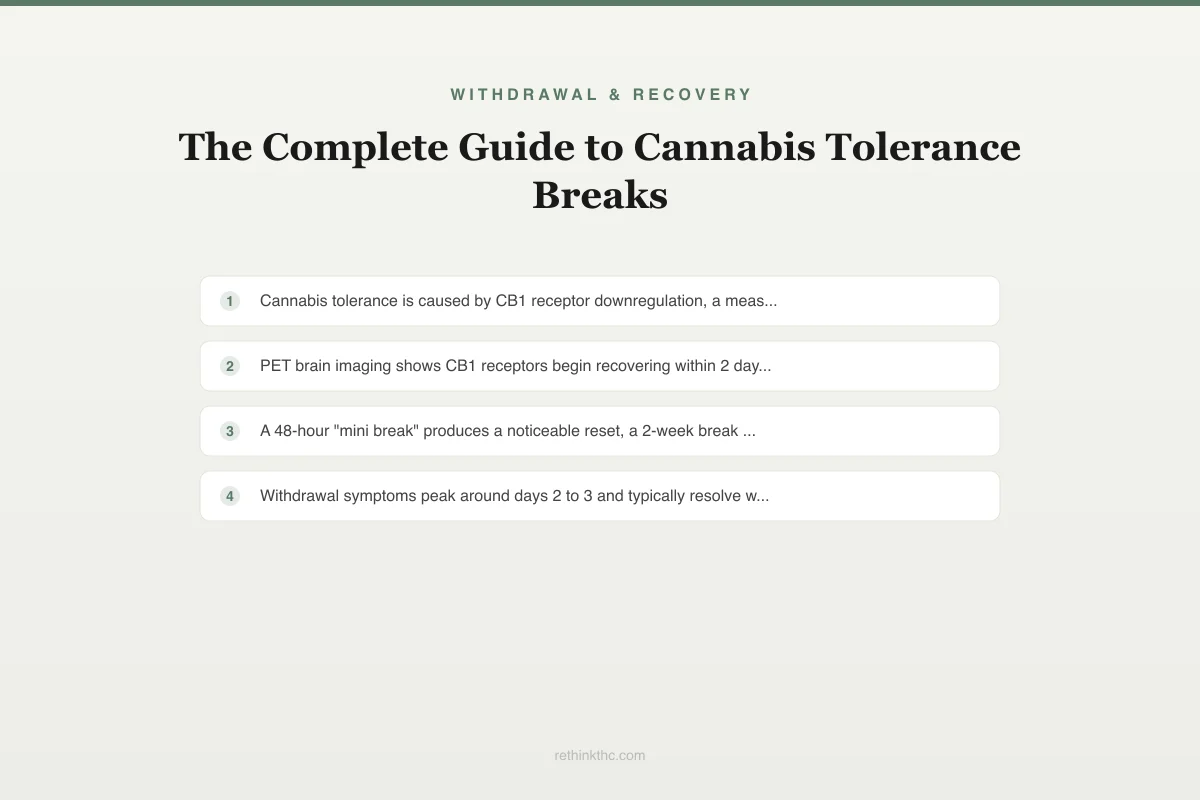
- Cannabis tolerance is caused by CB1 receptor downregulation — a measurable drop in the number and sensitivity of brain receptors that THC activates
- PET brain imaging shows CB1 receptors start recovering within 2 days off cannabis and return to near-normal density by about 28 days
- A 48-hour mini break gives you a noticeable reset, a 2-week break delivers major recovery, and a 4-week break gets you the most complete receptor normalization
- Withdrawal symptoms peak around days 2 to 3 and usually clear up within 1 to 2 weeks, with sleep problems often hanging on the longest
- If you cannot finish a planned tolerance break despite genuinely wanting to, that is useful information about your relationship with cannabis — not a personal failure
- Coming back at half your pre-break dose or less is essential because your restored CB1 receptors make the same amount hit significantly harder
What Tolerance Actually Is (at the Receptor Level)
Tolerance is not a vague concept. It is a specific, measurable change in your brain.
Receptor Science
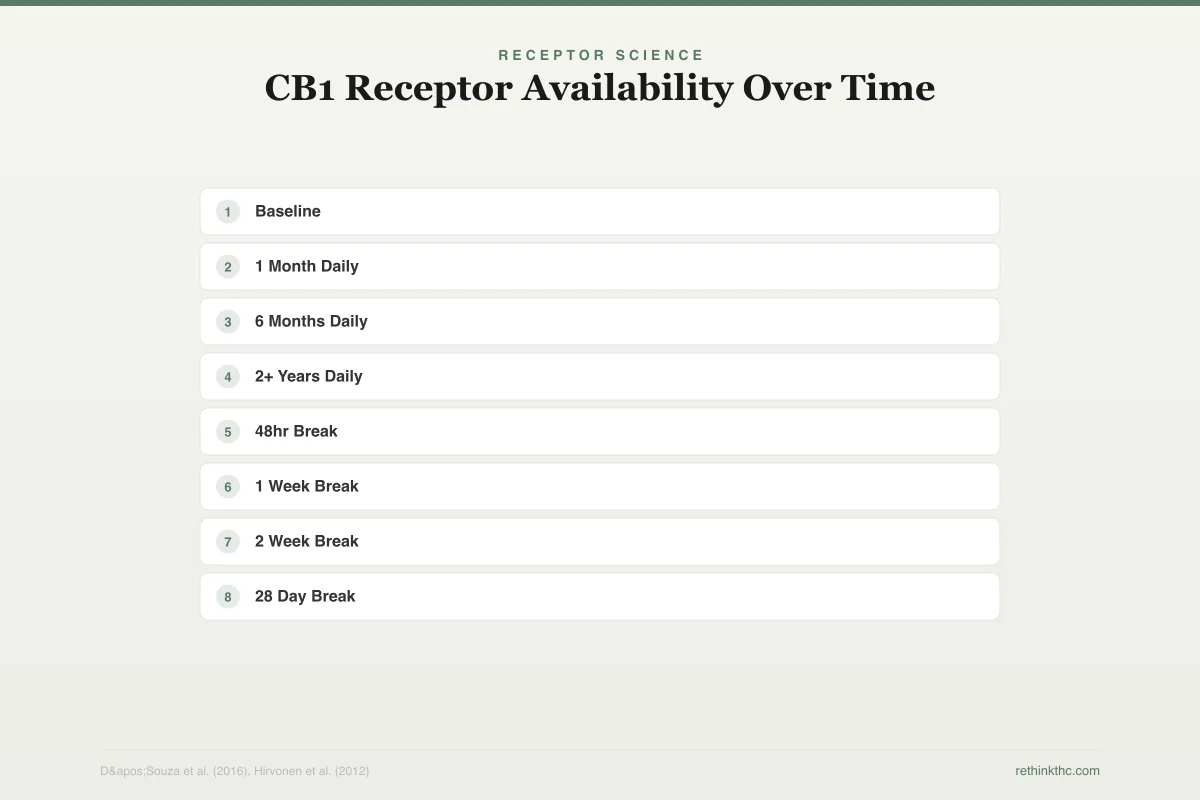
CB1 Receptor Availability Over Time
Tolerance develops as receptors downregulate — and reverses during a break
D'Souza et al. (2016), Hirvonen et al. (2012)
 View as image ↗
THC produces its effects by binding to CB1 receptors, which are part of your endocannabinoid system. These receptors are found throughout the brain, with high concentrations in areas governing pleasure, memory, coordination, appetite, and time perception. When THC attaches to a CB1 receptor, it triggers the cascade of effects you experience as being high.
Your brain monitors receptor activity constantly. When CB1 receptors are being activated more than usual (because you are regularly introducing THC), the brain responds with a process called downregulation. It pulls CB1 receptors off the surface of neurons, reducing the total number available. It also decreases the sensitivity of the receptors that remain. This is your brain's attempt to maintain equilibrium in the face of a repeated external signal.
A 2016 study by D'Souza and colleagues, published in Biological Psychiatry: Cognitive Neuroscience and Neuroimaging, used PET imaging to quantify this process.[1] Daily cannabis users showed approximately 15% lower CB1 receptor availability compared to non-users. The reduction was most pronounced in brain regions associated with the subjective effects of cannabis. This is not abstract. It is visible on brain scans. Fewer receptors means you need more THC to produce the same activation, which is exactly the experience of tolerance.
D'Souza et al. (2016) · Biological Psychiatry: Cognitive Neuroscience and Neuroimaging
- Population
- Daily cannabis users vs. healthy non-user controls
- Intervention
- PET brain imaging to measure CB1 receptor availability
- Comparator
- Non-cannabis-using controls
- Finding
- Daily users showed approximately 15% lower CB1 receptor availability — visible on brain scans — with the reduction greatest in brain regions governing pleasure, memory, and coordination. Recovery began within just 2 days of abstinence.
positive Direct PET imaging evidence — you can literally see tolerance on a brain scan, and you can see it reversing
D'Souza et al. (2016), Biological Psychiatry: CNNI
The good news from D'Souza's research: CB1 receptor recovery began within just 2 days of abstinence. Your brain starts bringing receptors back online quickly once the external THC signal stops. For a deeper look at how the endocannabinoid system responds to cannabis cessation, see our article on endocannabinoid system withdrawal.
The Recovery Timeline: What Brain Imaging Tells Us
The most important study for anyone planning a tolerance break is the Hirvonen 2012 study, published in Molecular Psychiatry.[2] This research used PET brain imaging to track CB1 receptor density in daily cannabis users at multiple time points after they stopped using.
Here is what they found, broken into practical decision points.
48 hours (the mini break). D'Souza's 2016 research confirmed that CB1 receptor upregulation begins within the first two days. You will not be back to baseline, but the process has started. If your schedule or circumstances do not allow for a longer break, even 48 hours produces a difference you can feel when you return. For moderate users (a few times per week rather than daily), a 48-hour break may provide a surprisingly noticeable reset.
1 week. Hirvonen's study showed significant receptor recovery by day 7. For most regular users, a one-week break represents a meaningful reset. The first session back will feel distinctly different from where you left off. This is a practical option for people who want a substantial reset but are not ready to commit to a full month.
2 weeks. Substantial receptor normalization has occurred. For the majority of regular users, two weeks is the sweet spot that balances effectiveness with feasibility. Most withdrawal symptoms have peaked and are subsiding by this point. If you are choosing a single duration for your break, two weeks is a strong default choice.
28 days (the full reset). Hirvonen's study found that CB1 receptor density in daily users was statistically indistinguishable from non-users after approximately four weeks. This is as close to a complete receptor reset as the research documents. If you are a heavy daily user, particularly of concentrates or high-potency products, four weeks gives you the most thorough recovery possible.
Beyond 28 days. Diminishing returns for tolerance specifically. Your receptors have largely normalized by week four. Additional time is not harmful and can be valuable for establishing new habits, but from a pure receptor-recovery standpoint, most of the work is done. For a detailed breakdown of how to choose the right duration based on your usage pattern, see optimal tolerance break length and reset timing.
For a detailed look at the receptor science, see our article on cannabinoid receptor recovery time.
| Break Duration | CB1 Receptor Recovery | Best For | What to Expect |
|---|---|---|---|
| 48 hours | Recovery begins; noticeable difference | Moderate users, first-time breaks | Mild irritability, slight sleep disruption |
| 1 week | Significant recovery | Regular users wanting a meaningful reset | Peak withdrawal days 2-3, then improving |
| 2 weeks | Substantial normalization | Daily users; the practical sweet spot | Most symptoms resolved by end of week 2 |
| 4 weeks | Near-complete (indistinguishable from non-users) | Heavy/concentrate users; full reset | Sleep and mood fully stabilized |
| Beyond 4 weeks | Diminishing returns for tolerance | Evaluating your relationship with cannabis | Habits and routines fully adjusted |
Choosing Your Break Duration
The right length for your t-break depends on several factors that are specific to your situation.
Duration Framework
Choosing Your T-Break Length
Longer breaks produce more complete recovery — but shorter breaks still help
48 Hours
Noticeable sensitivity increase. Easiest commitment to keep.
Best for: Quick reset, first-timers
1 Week
Significant receptor recovery. First session back feels distinctly different.
Best for: Regular users wanting a meaningful reset
2 Weeks
Major recovery. Most withdrawal symptoms have peaked and are subsiding.
Best for: The practical sweet spot for most users
28 Days
Near-complete receptor normalization. Indistinguishable from non-users.
Best for: Heavy daily users, concentrate users
Hirvonen et al. (2012), D'Souza et al. (2016)
 View as image ↗
Your usage frequency. A weekend-only user has less CB1 downregulation than a daily user. Weekend users may get a meaningful reset from a one-week break. Daily users, especially those using multiple times per day, benefit from two to four weeks.
Your product potency. This is often overlooked. A 2016 analysis by ElSohly and colleagues, published in Biological Psychiatry, documented[3] that average THC content roughly tripled between 1995 and 2014. If you are using concentrates (60-90% THC), your CB1 downregulation is likely more severe than someone using moderate-potency flower. Higher potency means more aggressive receptor reduction, which means a longer break is needed for full recovery.
Your goals. If you want a noticeable difference without committing to a major break, 48 hours to one week will deliver that. If you want the most complete reset possible, aim for four weeks. If you are trying to determine whether your relationship with cannabis needs a bigger change, a four-week break gives you enough distance to evaluate clearly.
Your practical constraints. A perfect four-week break that you abandon on day three is less useful than a one-week break that you actually complete. Be honest about what is realistic given your life, your stress levels, and your track record with previous attempts. Starting with a shorter break and building up to longer ones over time is a legitimate strategy.
Planning Your Break
Preparation is the difference between a completed t-break and an abandoned one.
Set specific dates. "March 1 through March 28" is a plan. "I should probably take a break" is a wish. Define the start and end dates and put them somewhere visible. Having a concrete endpoint makes the hard days manageable because you can see exactly how far you have come and how much remains.
Choose your timing strategically. Withdrawal symptoms peak around days 2 to 3. If possible, plan your start date so that the peak falls during a period when you are busy, structured, and away from your usual use triggers. Starting on a Thursday means the hardest days fall on the weekend, which is ideal if your weekends are active but problematic if your weekends are unstructured downtime where cannabis was the main activity.
Manage your access. You do not have to throw your supply away. Give it to a friend to hold, put it in a locked box, store it somewhere that requires effort to reach. The goal is to create friction between the impulse and the action. Cravings during a t-break are real but typically short-lived (10 to 20 minutes). Even a small barrier is often enough to outlast them.
Line up alternatives. The evenings and downtime where cannabis was your default activity will feel empty if you have not identified replacements. Exercise, social plans, projects, games, cooking, reading. The specific activity matters less than having something lined up so you are not sitting in silence wondering what to do with yourself.
Tell the right people. Some people benefit from accountability. Others find that announcing a t-break invites unsolicited advice, pressure, or social situations designed to test their resolve. Choose carefully. Tell people who will support the plan, not people who will make it harder.
What to Expect: Withdrawal Symptoms
If you are a daily user, a t-break will produce withdrawal symptoms. This is normal and expected. It does not mean you are addicted (though it does mean you are physically dependent, which is a related but distinct concept). It means your endocannabinoid system adapted to regular THC input and is now recalibrating without it.
Preparation
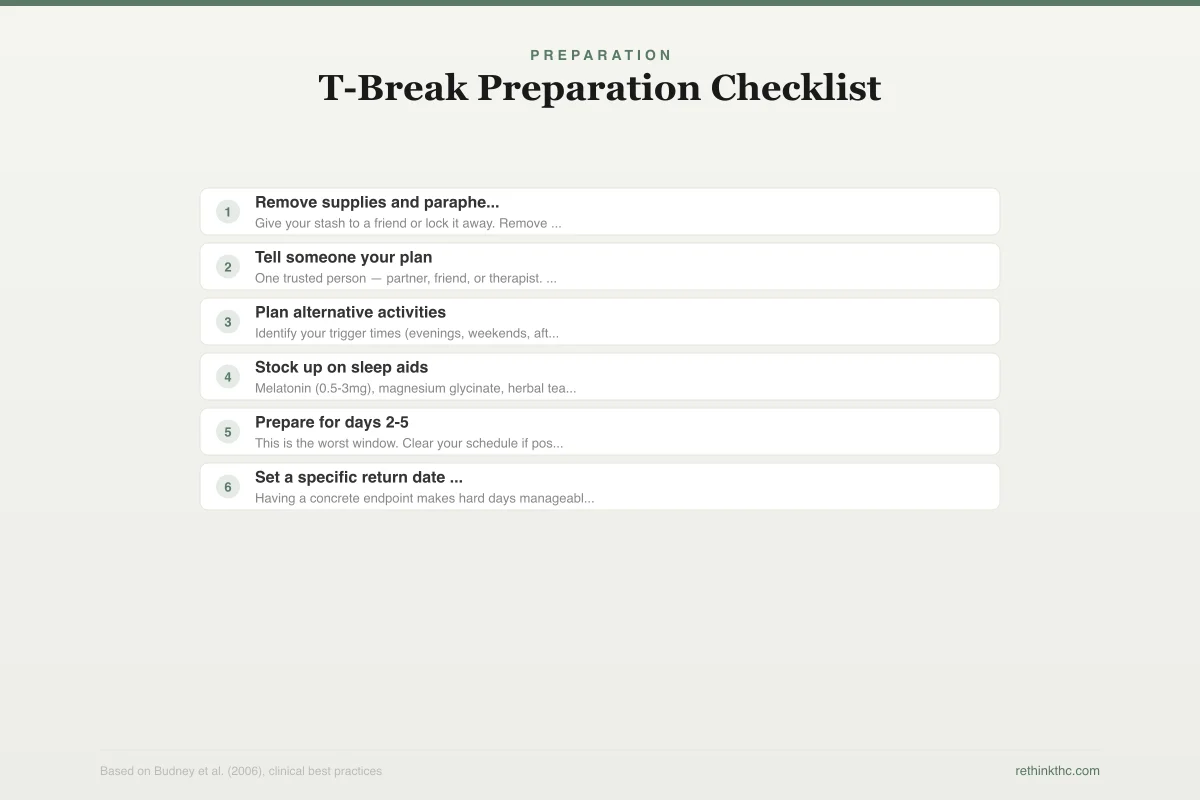
T-Break Preparation Checklist
Preparation is the difference between a completed t-break and an abandoned one
Remove supplies and paraphernalia
Give your stash to a friend or lock it away. Remove pipes, papers, vapes, and edibles from easy reach.
1-2 days before
Tell someone your plan
One trusted person — partner, friend, or therapist. Accountability significantly improves follow-through.
1-2 days before
Plan alternative activities
Identify your trigger times (evenings, weekends, after work) and schedule specific replacements: exercise, cooking, games, social plans.
2-3 days before
Stock up on sleep aids
Melatonin (0.5-3mg), magnesium glycinate, herbal tea. Sleep disruption is the most common and persistent symptom.
2-3 days before
Prepare for days 2-5
This is the worst window. Clear your schedule if possible. Have comfort foods, exercise plans, and distraction activities ready.
Day of start
Set a specific return date (optional)
Having a concrete endpoint makes hard days manageable. You can see exactly how far you have come and how much remains.
Day of start
Based on Budney et al. (2006), clinical best practices
 View as image ↗
Here is the typical timeline. For a comprehensive day-by-day breakdown, see the complete cannabis withdrawal guide.
Days 1 to 3: Peak discomfort. The most commonly reported symptoms are irritability, anxiety, decreased appetite, and restlessness. Things that normally would not bother you feel disproportionately frustrating. You may feel on edge without a clear reason. Appetite often drops noticeably, and food may seem unappealing. These symptoms peak around day 2 or 3 and begin improving thereafter.
Days 2 to 7: Sleep disruption. THC suppresses REM sleep. When you stop, your brain overcorrects with a surge of vivid dreaming called REM rebound. Dreams can be intense, emotionally charged, and strange enough to wake you up. Falling asleep may take longer than usual. Sleep disruption is typically the most disruptive symptom and can persist into week two or beyond, though it improves steadily.
Days 3 to 7: Cravings and boredom. The acute physical symptoms are fading, but the psychological pull remains. You know cannabis would make the evening more enjoyable, and the question becomes whether to stick with the plan. This is where having a defined endpoint and pre-planned activities pays off. Boredom during a t-break is not a personality trait. It is a gap in your routine that THC was filling.
Week 2 and beyond: Gradual normalization. Most symptoms have resolved or significantly diminished by the end of week two. Sleep is improving. Appetite is returning. The psychological cravings are less frequent and less intense. If you have committed to a four-week break, the second half is substantially easier than the first.
Strategies for Getting Through the Hard Days
Exercise daily, especially in the first week. Physical activity directly supports the neurochemical adjustment happening in your brain. It promotes natural endocannabinoid and dopamine release, improves sleep quality, and reduces the irritability and anxiety that peak early. Even a 20-minute walk counts.
Maintain sleep hygiene. Your sleep will be disrupted regardless, but you can minimize the severity. Consistent bedtime and wake time. No caffeine after noon. Cool, dark bedroom. Screens off 30 minutes before bed. These will not eliminate the disruption, but they give your circadian rhythm the best conditions for stabilizing.
Stay hydrated and eat regularly. Appetite loss is common in the first few days. Even if you are not hungry, eating small, regular meals prevents the compounding effect of low blood sugar on top of withdrawal irritability. Hydration supports every system in your body that is adjusting.
Use the craving window. Cannabis cravings during a t-break typically last 10 to 20 minutes. When one hits, check the time. Tell yourself you will reassess in 20 minutes. In most cases, the craving will have passed or substantially weakened by then. This is not a trick. It reflects the actual neurochemical lifespan of a craving impulse.
Track your progress. A journal, a notes app, or a habit-tracking app like Grounded all serve the same purpose: making your progress visible. On the hardest days, being able to see that you have already completed 40% or 60% of your planned break provides concrete motivation that your feelings alone will not generate.
Accept the discomfort. Trying to eliminate every unpleasant sensation during a t-break (through alcohol, excessive eating, or other quick fixes) usually creates new problems. The discomfort is temporary, it has a known timeline, and it is a sign that the reset is working. Sitting with it, rather than fighting it, is the most reliable path through.
Returning to Use After Your Break
This is the section that determines whether your t-break delivers lasting value or was just an uncomfortable pause before resuming the same pattern.
Return Protocol
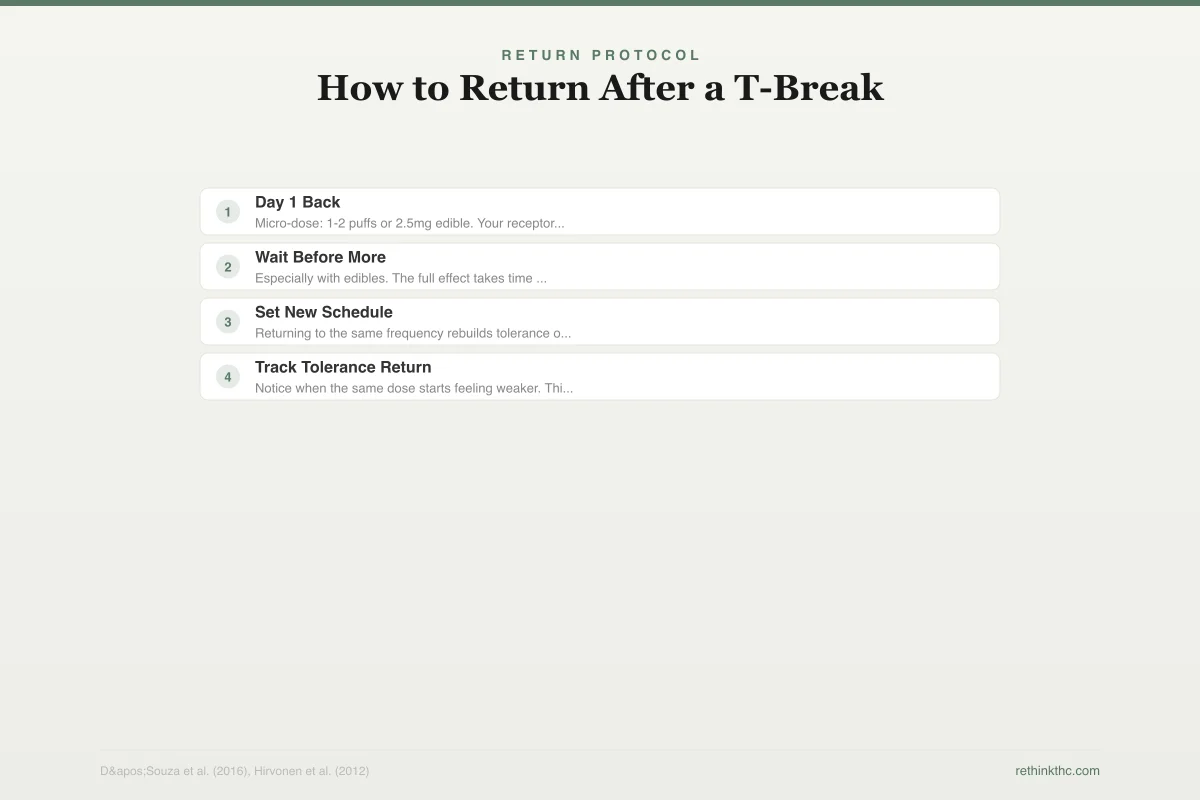
How to Return After a T-Break
Your tolerance is reset — start low to avoid an overwhelming experience
Key Principle
Your CB1 receptors have recovered. Start at 25-50% of your previous dose. The amount you were using before will now produce a significantly stronger effect.
Micro-dose: 1-2 puffs or 2.5mg edible. Your receptors are sensitive again — the old dose will hit much harder.
Especially with edibles. The full effect takes time to develop. Adding more too soon is the most common mistake.
Returning to the same frequency rebuilds tolerance on the same timeline. Use your reset as a chance to establish a sustainable pattern.
Notice when the same dose starts feeling weaker. This is your signal that CB1 downregulation is resuming. Plan your next mini-break.
D'Souza et al. (2016), Hirvonen et al. (2012)
 View as image ↗
Start at half your pre-break dose or less. Your CB1 receptors have recovered. They are sensitive again. The amount you were using before the break will now produce a significantly stronger effect. This is not a suggestion, it is important for avoiding an overwhelming experience. Take one hit and wait. With edibles, take half your usual dose and give it the full onset window before considering more.
Pay attention. A t-break gives you something valuable: a reference point. You now know what cannabis feels like with a fresher receptor system. Notice the quality of the experience. Is it what you were looking for? Is it more enjoyable at this lower dose than your pre-break sessions were at a higher dose? Use this information to make intentional choices rather than drifting back to autopilot.
Plan for maintenance. If you return to the exact same frequency and dose as before, your tolerance will rebuild on roughly the same timeline. Some strategies for slower tolerance accumulation include using less frequently (every other day or weekends only rather than daily), using lower-potency products, taking regular scheduled mini-breaks (48 hours every two weeks, or one week every two months), and avoiding concentrate products that deliver very high THC doses. The 10 lower-risk cannabis use guidelines offer a research-based framework for keeping your use in a range that minimizes harm.
Consider whether a t-break is enough. If you find that your tolerance rebuilds rapidly every time, that each break gets harder to complete, or that the pattern of escalation and reset is itself becoming exhausting, these are worth paying attention to. The line between "I use cannabis and occasionally need a tolerance reset" and "my use has become compulsive" is not always obvious from the inside. Our article on how to cut back on weed covers moderation strategies. If cutting back feels impossible, that is information worth exploring with a professional.
Evidence Review
Where the evidence stands
Cell & Lab Studies
CB1 receptor downregulation and upregulation mechanisms fully characterized at molecular level
Animal Studies
Tolerance and receptor recovery replicated in multiple animal models with consistent timelines
Clinical Observations
Withdrawal symptoms documented by Budney (2003) — consistent, replicable pattern in daily users
Human PET Imaging
D'Souza 2016 — 15% fewer CB1 receptors in daily users, recovery within 2 days. Hirvonen 2012 — full normalization by day 28.
Potency Tracking
ElSohly 2016 — THC tripled 1995-2014, explaining why modern tolerance builds faster
Replicated Across Studies
Multiple independent PET imaging studies confirm the same receptor recovery timeline
Tolerance breaks are backed by gold-standard brain imaging evidence. PET scans show exactly how many receptors you've lost and exactly when they come back. The timeline is replicated across multiple studies. This isn't guesswork — the science gives you a precise roadmap.
D'Souza et al. (2016), Hirvonen et al. (2012), ElSohly et al. (2016)
When a T-Break Reveals Something Bigger
A tolerance break can function as a diagnostic tool. The experience of taking one tells you something about your relationship with cannabis that daily use obscures.
If you planned a two-week break and completed it with moderate difficulty, that is a normal experience consistent with physical dependence that resolved as expected. If you planned a two-week break and could not make it past day three despite genuinely wanting to, or if you found yourself rationalizing an early end ("two days is basically the same as two weeks"), that is different information.
Approximately 9% of people who try cannabis develop Cannabis Use Disorder, a figure that comes from foundational research by Anthony and colleagues published in 1994 in Experimental and Clinical Psychopharmacology. Among daily users, the rates are considerably higher. A t-break that you cannot complete is not a moral failure. It is a signal that the neurological adaptation may be significant enough to benefit from structured support beyond self-directed abstinence.
When to Seek Professional Help
Safety
LowWhen the break reveals something bigger
Concern
Most t-breaks are uncomfortable but completable. If you repeatedly can't finish planned breaks, if you rationalize ending them early, or if cannabis is the thing holding together your management of anxiety, depression, or PTSD — the break itself is surfacing information that daily use was hiding.
What the research says
A healthcare provider can help you determine if you're dealing with physical dependence (normal, resolves with time), Cannabis Use Disorder (treatable, ~9% of users), or underlying mental health conditions that cannabis was masking. These are different situations with different solutions.
Particularly relevant for: Anyone who has failed multiple planned t-breaks, or who discovers severe anxiety/depression emerging during the break
What to do
SAMHSA's National Helpline: 1-800-662-4357 (free, confidential, 24/7). A t-break you can't complete is the best reason to make that call.
Anthony et al. (1994), clinical guidelines for cannabis use disorder
Most people complete a tolerance break with manageable discomfort. But some situations warrant professional guidance.
If withdrawal symptoms are severe enough to interfere with your ability to work or handle daily responsibilities, if you have attempted multiple breaks without being able to complete them, if you are using cannabis to manage underlying anxiety, depression, PTSD, or other mental health conditions that become unmanageable without it, or if you experience thoughts of self-harm during the break, reach out to a healthcare provider. These are not signs that you are broken. They are signs that your brain's adaptation to cannabis is interacting with other factors that a professional can help you sort out.
SAMHSA's National Helpline is available at 1-800-662-4357. It is free, confidential, and available 24 hours a day, 7 days a week.
The Bottom Line
Cannabis tolerance is caused by CB1 receptor downregulation, a measurable reduction in receptor availability confirmed by PET brain imaging. A 2016 study by D'Souza and colleagues showed daily users had approximately 15% lower CB1 receptor availability, with recovery beginning within just 2 days of abstinence. Hirvonen's 2012 study found receptor density returned to near-normal by approximately day 28. A 48-hour mini-break produces a noticeable reset, 2 weeks is the practical sweet spot, and 4 weeks achieves the most complete recovery. Withdrawal symptoms peak around days 2 to 3, with sleep disruption lasting the longest. Returning to use at half the pre-break dose or less is essential to avoid overwhelming effects from restored receptor sensitivity. If tolerance rebuilds rapidly or breaks become impossible to complete, that signals a relationship with cannabis that may benefit from professional support.
How long should a cannabis tolerance break be?
It depends on your usage pattern and goals. Research by D'Souza (2016) showed CB1 receptor recovery begins within 2 days. Hirvonen (2012) found that daily users had near-normal receptor density after approximately 28 days. A 48-hour break gives a noticeable difference, one week gives significant recovery, two weeks is the practical sweet spot for most regular users, and four weeks provides the most complete reset the research supports.
Is a 2-day tolerance break worth it?
Yes. PET imaging research confirmed that CB1 receptor upregulation begins within 48 hours of stopping THC. You will not be at baseline, but you will notice a meaningful difference in sensitivity when you resume. For people who cannot commit to a longer break, a 48-hour break is a legitimate starting point. Even this minimal duration is better than continuing to escalate use against rising tolerance.
What helps with sleep during a tolerance break?
Sleep disruption, driven by REM rebound, is the most common and persistent symptom. Consistent sleep and wake times, avoiding caffeine after noon, keeping the bedroom cool and dark, and cutting screens 30 minutes before bed all help. Exercise during the day improves sleep quality at night. The vivid dreams that come with REM rebound are temporary and typically peak in the first week before gradually normalizing.
Will my tolerance come back after a break?
If you return to the same frequency and dose as before, tolerance will rebuild on a similar timeline. The break resets your receptors, but it does not change the biological process that caused downregulation in the first place. Maintaining lower tolerance after a break requires changes: less frequent use, lower doses, lower-potency products, or scheduled periodic mini-breaks. Without at least one of these adjustments, you will end up back where you started.
How do I know if I need a tolerance break or if I should quit entirely?
A tolerance break is appropriate when your primary concern is that cannabis is not working the way you want it to and you want to reset your sensitivity. If your concerns go beyond tolerance (if cannabis is causing problems in your relationships, work, finances, or mental health, or if you cannot stop despite wanting to), a tolerance break may not address the underlying issue. Completing a t-break successfully and then evaluating how you feel during and after can help clarify which situation applies to you.
Does using concentrates require a longer tolerance break than flower?
Yes. Concentrates deliver 60 to 90% THC compared to flower at 15 to 30%, meaning they produce more aggressive CB1 receptor downregulation. The greater the downregulation, the more recovery time needed. Concentrate users should plan for a minimum of two weeks and ideally four weeks for a meaningful reset. When returning to use after the break, switching to lower-potency flower rather than resuming concentrates can help maintain the benefits of the reset for longer.
Sources & References
- 1RTHC-01134·D'Souza, Deepak Cyril et al. (2016). “Brain Cannabinoid Receptors Drop With Heavy Use, Then Rebound Within Days of Stopping.” Biological Psychiatry: Cognitive Neuroscience and Neuroimaging.Study breakdown →PubMed →↩
- 2RTHC-00573·Hirvonen, Jussi et al. (2012). “Daily Cannabis Use Was Linked to Fewer CB1 Receptors. A Month Without Brought Them Back..” Molecular Psychiatry.Study breakdown →PubMed →↩
- 3RTHC-01144·ElSohly, Mahmoud A. et al. (2016). “U.S. Cannabis Potency Tripled Over Two Decades While CBD Nearly Vanished.” Biological Psychiatry.Study breakdown →PubMed →↩