Withdrawal & Recovery
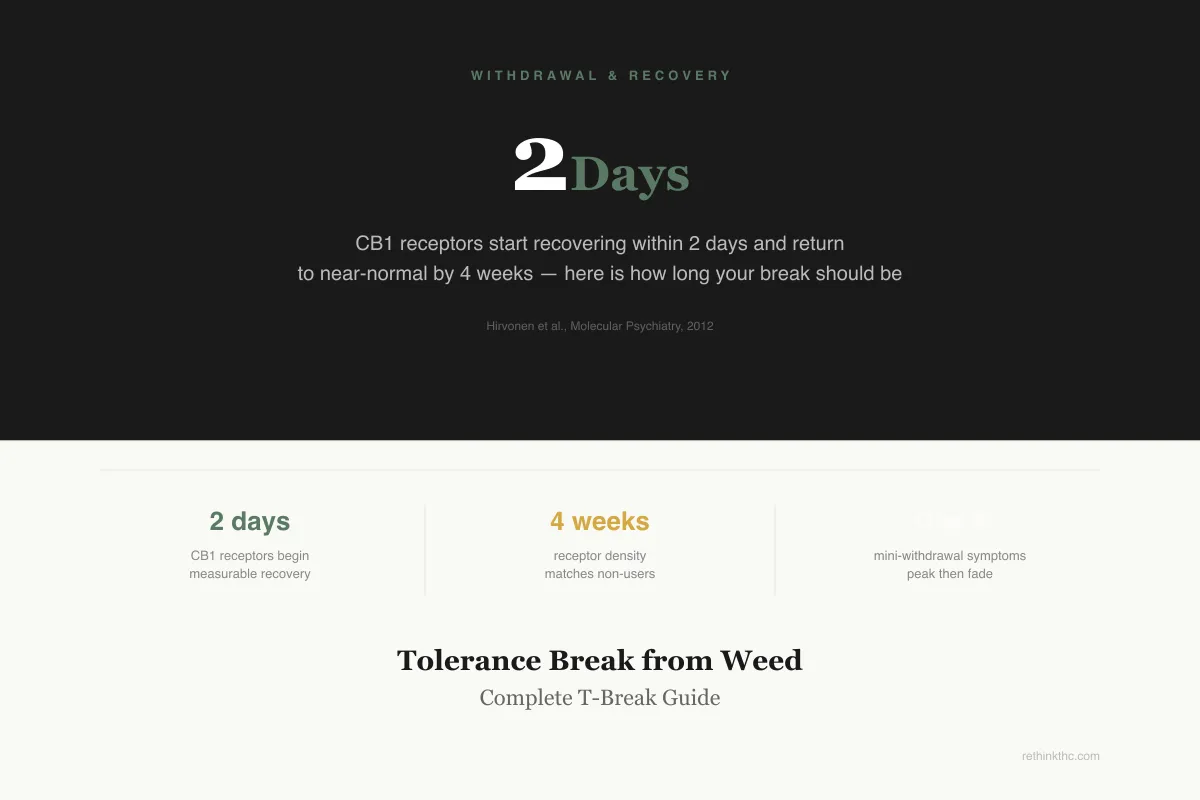
2 Days
CB1 receptors start recovering within 2 days and return to near-normal by 4 weeks. Here is exactly how long your tolerance break should be.
Hirvonen et al., Molecular Psychiatry, 2012
2 days
CB1 receptors begin measurable recovery
4 weeks
receptor density matches non-users
Day 3
mini-withdrawal symptoms peak then fade
Hirvonen et al., Molecular Psychiatry, 2012
 View as image ↗
If you only read one thing
Your brain starts resetting its THC receptors within 2 days of stopping. By 4 weeks, brain scans show you're back to the receptor density of someone who never smoked. For most people, a 2-week break is the sweet spot — long enough for a real reset, short enough to actually commit to. The first 3 days are the worst (irritability, sleep problems, boredom), then it gets much easier. The most important thing: when you come back, start at half your old dose or less. Your reset brain will hit way harder than you expect.
You used to get high from half a bowl. Now you are going through a full gram and barely feeling it. You have tried switching strains, tried edibles, tried concentrates. The highs are shorter, duller, and require more product to reach. You are not imagining this. Your brain has physically changed in response to regular THC exposure, and no amount of strain-switching will fix it. What will fix it is time without THC. That is what a tolerance break is, and this is how to do one properly.
Key Takeaways
- Cannabis tolerance happens because your brain reduces the number of CB1 receptors that THC can bind to — a process called downregulation
- A 2012 brain imaging study showed that CB1 receptors start recovering within 2 days and get back to near-normal by 4 weeks off
- Even a 48-hour tolerance break makes a noticeable difference, but 2 to 4 weeks gives you the biggest reset
- The first 3 days are the hardest because of mini-withdrawal symptoms like sleep problems, irritability, and boredom
- When you come back after a t-break your old dose will hit much harder, so start low
- Scheduling regular breaks into your routine keeps tolerance from climbing right back to where it was
Why Your Tolerance Built in the First Place
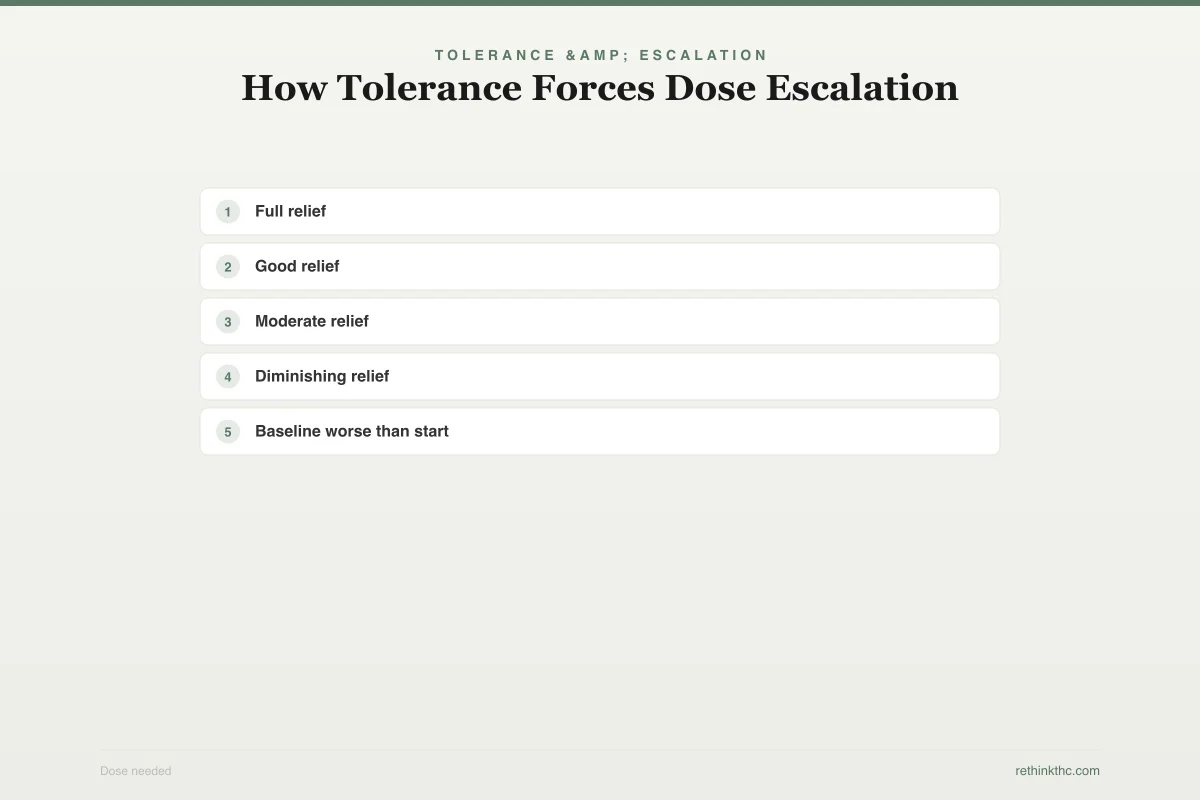
Tolerance is not about willpower or how "strong" the weed is. It is a measurable biological process happening in your brain. The chart below shows how dose escalation works as your receptors progressively shut down.
Tolerance & Escalation
How Tolerance Forces Dose Escalation
More cannabis needed over time while relief steadily declines
Week 1
1 hit
Full relief
Month 1
2–3 hits
Good relief
Month 3
Full joint
Moderate relief
Month 6
Concentrates / multiple sessions
Diminishing relief
Month 12+
High-potency / constant use
Baseline worse than start
CB1 receptor downregulation means more THC is needed to achieve the same effect, while baseline anxiety and depression worsen with prolonged use.
Based on Colizzi & Bhattacharyya (2020)
 View as image ↗
THC works by binding to CB1 receptors in your endocannabinoid system. These receptors are concentrated in areas of your brain responsible for pleasure, memory, coordination, and time perception. When THC locks into a CB1 receptor, it triggers the cascade of effects you experience as being high.
When you use cannabis regularly, your brain notices that these receptors are being activated far more than normal. It responds by doing two things. First, it reduces the total number of CB1 receptors available on the surface of your neurons, a process called downregulation. Second, it decreases the sensitivity of the receptors that remain. Fewer receptors, and the ones still there are harder to activate.
A 2016 study led by D'Souza and published in Biological Psychiatry: Cognitive Neuroscience and Neuroimaging[1] used PET imaging to measure CB1 receptor availability in daily cannabis users. The results were clear: chronic users showed significantly reduced CB1 receptor density compared to non-users, particularly in brain regions associated with the effects people use cannabis for. Your brain is not broken. It is adapting to a constant external signal by turning down the volume.
This is why tolerance is progressive. The more you use, the more receptors get pulled offline. The more receptors get pulled offline, the more you need to use. It is a cycle, and the only way to reverse it is to give your brain time without THC so it can bring those receptors back.
How Long Does a T-Break Need to Be
This is the most common question, and the research gives us a surprisingly specific answer.
A landmark 2012 study by Hirvonen and colleagues at the National Institutes of Health, published in Molecular Psychiatry,[2] used PET brain imaging to track CB1 receptor recovery in daily cannabis users after they stopped. This is the most direct evidence we have for what happens to your receptors during a break, and the timeline is encouraging.
| T-Break Length | CB1 Receptor Recovery | Best For | What to Expect |
|---|---|---|---|
| 48 hours | Receptors begin upregulating | Weekend users; minimal commitment | Noticeable difference but not full reset |
| 1 week | Significant recovery | Moderate users (few times/week) | Meaningful tolerance reduction; withdrawal peaks and passes |
| 2 weeks | Substantial normalization | Regular daily users | Sweet spot of effectiveness vs. practicality |
| 4 weeks | Near-complete reset | Heavy daily users; concentrate users | Receptor density matches non-users; full reset |
| Beyond 4 weeks | Diminishing returns | Those wanting habit change too | Extra time helps build new routines, not more receptor recovery |
48 hours. CB1 receptors begin upregulating (returning to the cell surface) within the first two days. You will not be back to baseline, but if you use after a 48-hour break, you will notice a difference. For people who cannot commit to a longer break, even two days is not nothing.
1 week. The Hirvonen study found significant CB1 receptor recovery by day 7. Most people who take a one-week break report that their first session back feels meaningfully different from where they left off. If you are a moderate user (a few times per week), a week may be enough for a solid reset.
2 weeks. Substantial receptor normalization. For most regular users, two weeks is the sweet spot between effectiveness and practicality. The majority of receptor recovery has occurred, and the withdrawal symptoms (more on those below) have passed their peak.
4 weeks. The Hirvonen study found that CB1 receptor density in daily users was statistically indistinguishable from non-users after approximately 28 days. This is as close to a full reset as the research supports. If you are a heavy daily user, especially of concentrates or high-THC products, four weeks is the target that gives you the most complete recovery.
Beyond 4 weeks. There are diminishing returns after the four-week mark. Your receptors have largely normalized by then. Taking a longer break is not harmful, but you are not getting significantly more receptor recovery past day 28. If you are comfortable extending it, the additional time can help solidify new habits around use. But from a pure tolerance-reset perspective, four weeks does the heavy lifting.
Hirvonen et al. (2012) · Molecular Psychiatry
- Population
- Chronic daily cannabis smokers monitored during abstinence
- Intervention
- Continuous monitored abstinence from cannabis over 4 weeks
- Comparator
- Healthy non-user controls
- Finding
- CB1 receptor density began increasing within 2 days, showed significant recovery by 1 week, and was statistically indistinguishable from non-users by approximately day 28
positive Gold-standard PET imaging — the most direct evidence for t-break timing available
Hirvonen et al. (2012), Molecular Psychiatry
The right length depends on your usage pattern and your goals. A weekend user taking a 48-hour break will get a different result than a daily dabber taking a two-week break. Match the duration to your actual situation, not to an arbitrary standard.
Planning Your T-Break
A t-break that starts with "I will just stop tomorrow" usually does not go well. Some basic planning makes a significant difference.
Choose your length in advance and commit to a specific date range. "I am not using from March 1 through March 14" is a plan. "I should probably take a break soon" is not. Put the dates in your phone. Having a defined endpoint makes the hard days easier because you know exactly how far you have to go.
Think about timing. The first three days are the most uncomfortable for daily users. Starting your break during a busy work week can be helpful because you have built-in structure and distraction. Starting during a vacation where you are sitting around with nothing to do is typically harder. Avoid launching a t-break during a period you know will be high-stress or full of social situations where people will be smoking around you.
Decide who to tell. Some people do better announcing their break to friends or a partner because the accountability helps. Others find that telling people invites unwanted commentary, questions, or pressure to extend the break beyond what they intended. There is no right answer here. Do what supports you, not what looks good.
Deal with your stash. You do not have to throw it away. This is a break, not a bonfire. But having it within arm's reach makes the first few days harder than they need to be. Give it to a friend to hold, lock it in your car, put it in a box in your closet. Create even a small layer of friction between the impulse and the access. The cravings during a t-break are real but short-lived, usually lasting 10 to 20 minutes. A small barrier is often enough.
What to Expect During a T-Break
If you are a daily user, a t-break will come with a mini version of cannabis withdrawal. This does not mean you are addicted or that anything is wrong. It means your brain adapted to regular THC and is now readjusting. The National Institute on Drug Abuse (NIDA) recognizes cannabis withdrawal as a documented clinical phenomenon that occurs in approximately half of daily users.[3]
Here is what the first week typically looks like.
Days 1 to 3: The peak of discomfort. This is when symptoms are most noticeable. Irritability is the most commonly reported symptom.[4] Things that would normally roll off your back feel disproportionately aggravating. You may also experience decreased appetite, restlessness, and a pervasive sense of boredom that is hard to shake. Knowing this phase has a three-day shelf life makes it more tolerable.
Sleep disruption. THC suppresses REM sleep. When you stop using, your brain overcorrects with a flood of extra-vivid dreaming called REM rebound. The dreams can be intense, emotionally loaded, and sometimes bizarre enough to wake you up. Falling asleep may also take longer than usual. This is the single most disruptive symptom for most people during a t-break, and it peaks in the first week.
Boredom. This one catches people off guard. If cannabis has been your default way to make downtime enjoyable, removing it exposes how few alternative activities you have set up. Boredom during a t-break is not a personality flaw. It is a gap in your routine that THC was filling. The good news is that this is the symptom that resolves fastest once you find other things to do.
Vivid dreams. Even people who only take a one-week break report strikingly vivid dreams, often starting on night two or three. This is the REM rebound mentioned above. The dreams are a sign your sleep architecture is recalibrating. They are temporary and they are not harmful, just strange.
For a detailed day-by-day breakdown, see our weed withdrawal timeline. But keep in mind that a t-break is not the same as quitting. You are looking at a compressed, milder version of that timeline, and you have a defined endpoint ahead of you.
Tips for Getting Through It
The first three days are the gatekeepers. If you can get through day three, the rest of the break gets substantially easier. Here is what consistently helps.
Stay busy. This is the single most effective strategy. Idle time is when cravings and boredom team up. Fill your schedule more than you normally would for the first few days. Work, errands, projects, social plans, whatever keeps your brain occupied. You are not distracting yourself from a problem. You are giving your brain something to do while it recalibrates.
Exercise. Physical activity directly supports the neurochemical adjustment your brain is going through. It promotes dopamine release through natural pathways, improves sleep quality, and reduces the irritability and restlessness that peak in the first few days. A 20-minute walk counts. You do not need to run a marathon. Move your body daily, especially during the first week.
Prioritize sleep hygiene. Your sleep will be disrupted regardless, but you can minimize the damage. Keep a consistent bedtime and wake time. Avoid caffeine after noon. Keep your bedroom cool and dark. Cut screens 30 minutes before bed. These basics will not eliminate the sleep disruption, but they give your circadian rhythm the best possible conditions to stabilize.
Track your progress. Whether you use a journal, a notes app, or a dedicated app like Grounded or T-Break Timer, marking off each day provides a sense of momentum that your feelings alone will not give you. On day three, when irritability is peaking and everything feels pointless, being able to see that you are already halfway through the worst part is genuinely useful.
Let yourself be uncomfortable. This sounds unhelpful, but accepting that the first few days will be somewhat unpleasant is more effective than trying to make them feel good. You are not in danger. You are experiencing a temporary neurochemical adjustment. Trying to eliminate the discomfort entirely (by substituting with alcohol, excessive eating, or other quick fixes) usually backfires. Sitting with it and knowing it has an expiration date is the most reliable path through.
Coming Back After a T-Break
This is the part most guides skip, and it is arguably the most important. How you return to cannabis after a break determines whether the break was worth taking.
Coming back after your t-break
Start at half your old dose or less
Use the reset as a data point
Don't rush back to daily use
Schedule your next break
Peer-reviewed research
Start low. This is not a suggestion. It is a safety issue. Your CB1 receptors have recovered. They are sensitive again. The dose that barely registered before your break will now hit you significantly harder. If you were using half a gram per session before, start with a quarter or less. Take one hit and wait. Especially with edibles, where the delayed onset makes it easy to overshoot. People consistently underestimate how much their tolerance has actually changed, and an overwhelming experience on the first session back is the most common regret.
Pay attention to the experience. One benefit of a t-break is that it gives you a reference point. You now know what cannabis feels like with a fresh receptor system. Use that information. Is the effect what you wanted? Is the dose right? Is the experience actually enjoyable, or were you on autopilot before the break? A t-break is a rare opportunity to make deliberate choices about your use instead of following the inertia of habit. The 10 lower-risk cannabis use guidelines can help you build a more intentional pattern going forward.
Think about maintenance. If you go straight back to daily use at your pre-break level, your tolerance will rebuild to exactly where it was, on roughly the same timeline. Some people build regular t-breaks into their calendar (one week every two months, for example). Others use the post-break period to shift toward less frequent use, finding that every-other-day or weekend-only use keeps their tolerance from climbing back as quickly. There is no single right pattern, but doing nothing different guarantees the same result.
T-Break vs. Quitting: Different Goals, Same Biology
A tolerance break and quitting weed entirely involve the same biological process: removing THC and letting your endocannabinoid system recalibrate. The withdrawal symptoms overlap. The receptor recovery timeline is identical. Many of the coping strategies are the same.
The difference is intention. A t-break is a reset with a planned return. Quitting is a permanent change. Neither is inherently better than the other. They are different tools for different goals.
If you are taking a t-break and find yourself thinking about whether your relationship with cannabis needs a bigger change, that is worth exploring. Our guide on what happens when you stop smoking weed covers the longer-term picture. But there is nothing wrong with a t-break being exactly what it is: a practical strategy to make cannabis work the way you want it to.
Evidence Review
Where the evidence stands
Cell & Lab Studies
CB1 receptor downregulation and upregulation mechanisms fully characterized at molecular level
Animal Studies
THC tolerance and receptor recovery replicated in rodent models with consistent timelines
Clinical Observations
Withdrawal time course documented — Budney 2003, Allsop 2012 — consistent symptom patterns
Human PET Imaging
D'Souza 2016 — daily users show reduced CB1 availability; Hirvonen 2012 — receptors normalize by day 28
Replicated Findings
Multiple independent imaging studies confirm the same receptor recovery timeline
Clinical Recognition
NIDA recognizes cannabis withdrawal; DSM-5 includes formal diagnostic criteria since 2013
The science behind tolerance breaks is rock solid. PET brain imaging has directly measured receptor recovery, the timeline is replicated across studies, and the withdrawal symptoms are formally recognized. You're not guessing — the research tells you exactly when your receptors come back.
Hirvonen et al. (2012), D'Souza et al. (2016), Budney et al. (2003)
When to Seek Professional Help
Safety
LowWhen a t-break reveals something bigger
Concern
If you genuinely cannot make it through a planned t-break despite wanting to — or if the idea of going even a few days without cannabis causes significant anxiety — that's useful information about your relationship with the substance. It doesn't mean you're a bad person. It means the neurological adaptation may be more significant than a simple tolerance issue.
What the research says
A healthcare provider can help you assess whether your use pattern has crossed from tolerance into dependence, and what kind of support would make the difference. This is information, not judgment.
Particularly relevant for: Anyone who repeatedly fails planned t-breaks, or anyone whose withdrawal symptoms significantly interfere with work or daily functioning
What to do
SAMHSA's National Helpline: 1-800-662-4357 (free, confidential, 24/7). If t-breaks keep failing, it's worth a conversation — not because something is wrong with you, but because better tools exist.
Clinical guidelines for cannabis use disorder assessment
For most people, a t-break produces mild, manageable discomfort that resolves within a week. But if you find that you cannot make it through a planned break despite genuinely wanting to, if withdrawal symptoms are severe enough to interfere with work or daily function, or if the idea of going without cannabis for even a few days causes significant anxiety, it may be worth talking to someone.
These are not judgments. They are data points about your relationship with a substance, and a healthcare provider can help you interpret them without an agenda.
SAMHSA's National Helpline is available at 1-800-662-4357. It is free, confidential, and available 24 hours a day, 7 days a week.
The Bottom Line
A tolerance break (t-break) resets your brain's CB1 receptors by removing THC long enough for them to recover. PET imaging studies show that receptors begin recovering within 48 hours, show significant recovery by one week, and return to near-normal levels by four weeks of abstinence. Daily users will experience mild withdrawal symptoms that peak around days 2 to 3 and resolve within a week. The most important part is coming back at a lower dose — your reset receptors will respond to significantly less cannabis than before the break.
How long should a tolerance break from weed be?
It depends on your usage and goals. A 48-hour break produces a noticeable difference. One week delivers significant CB1 receptor recovery. Two weeks is a practical sweet spot for most regular users. Four weeks brings receptor density back to near-normal levels based on PET imaging research by Hirvonen et al. (2012). Beyond four weeks, there are diminishing returns for tolerance specifically.
Will I have withdrawal symptoms during a tolerance break?
If you are a daily user, you will likely experience mild withdrawal symptoms, especially in the first three days. The most common are irritability, sleep disruption, vivid dreams, decreased appetite, and boredom. These are the same symptoms documented in cannabis withdrawal research, just typically milder because daily users who take t-breaks tend to have shorter use histories. Symptoms peak around day two to three and improve significantly by day seven.
How do I know if my tolerance break is working?
You will know when you use again. The most reliable indicator is that your first session after the break feels noticeably stronger than your sessions before the break at the same dose. During the break itself, there is no way to "feel" your receptors recovering. Trust the timeline. A 2012 PET imaging study confirmed that CB1 receptor density measurably increases within the first week and normalizes by four weeks.
Can I take CBD during a tolerance break?
CBD does not bind strongly to CB1 receptors the way THC does, so it is unlikely to interfere with CB1 receptor recovery. Some people use CBD during a t-break to help with anxiety or sleep disruption. However, be aware that many CBD products, especially full-spectrum ones, contain trace amounts of THC that could slow your reset. If you use CBD during your break, choose a THC-free isolate product.
How do I keep my tolerance low after a t-break?
The most effective strategy is reducing your frequency of use. Daily use will rebuild tolerance on roughly the same timeline as before. Using every other day, or only on weekends, significantly slows receptor downregulation. Using lower doses per session also helps. Some people build scheduled t-breaks into their routine, such as one week off every six to eight weeks, to prevent tolerance from climbing back to pre-break levels.
Is a tolerance break the same as quitting weed?
Biologically, the same process occurs — your CB1 receptors recover during the absence of THC, and you may experience mild withdrawal symptoms. The difference is intention. A t-break is a planned reset with a defined return date. Quitting is a permanent change. Many people find that taking a successful t-break helps them evaluate their relationship with cannabis from a clearer headspace, which sometimes leads to a decision to quit, cut back, or continue with more intentional use patterns.
Sources & References
- 1RTHC-01134·D'Souza, Deepak Cyril et al. (2016). “Brain Cannabinoid Receptors Drop With Heavy Use, Then Rebound Within Days of Stopping.” Biological Psychiatry: Cognitive Neuroscience and Neuroimaging.Study breakdown →PubMed →↩
- 2RTHC-00573·Hirvonen, Jussi et al. (2012). “Daily Cannabis Use Was Linked to Fewer CB1 Receptors. A Month Without Brought Them Back..” Molecular Psychiatry.Study breakdown →PubMed →↩
- 3RTHC-00538·Allsop, David J. et al. (2012). “Withdrawal That Disrupted Daily Life Was Tied to Relapse in a Small Study.” PLOS ONE.Study breakdown →PubMed →↩
- 4RTHC-00134·Budney, Alan J. et al. (2003). “When Heavy Users Quit Cannabis, Symptoms Show Up Fast and Ease Within Two Weeks.” Journal of Abnormal Psychology.Study breakdown →PubMed →↩