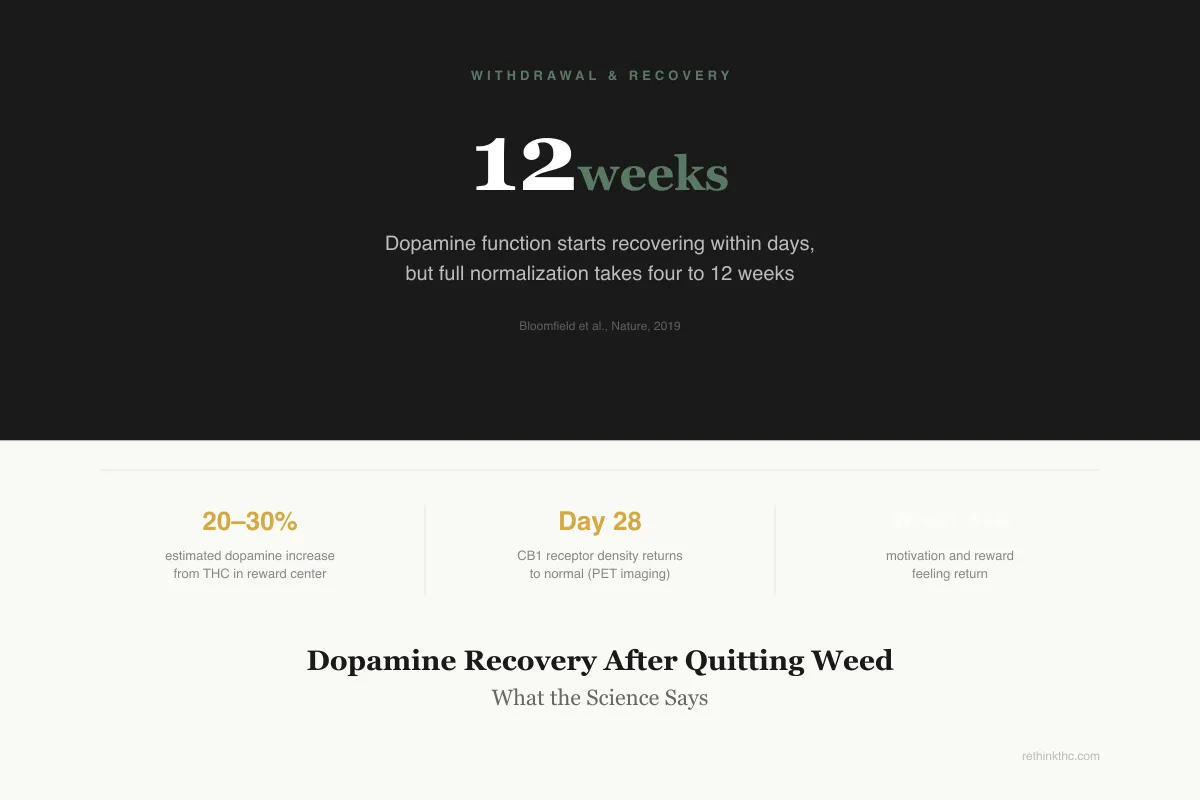
Withdrawal & Recovery
12 weeks
After quitting, dopamine function starts recovering within days, but full normalization takes about four to 12 weeks.
Bloomfield et al., Nature, 2019
20–30%
Estimated dopamine increase from THC in the brain's reward center
Day 28
CB1 receptor density returns to normal levels (PET imaging)
Week 4–8
Most people report motivation and reward feeling return
Bloomfield et al., Nature, 2019
 View as image ↗
If you only read one thing
That flat, gray, nothing-feels-good feeling after quitting weed is real and it has a name: anhedonia. It happens because your brain turned down its own reward system to compensate for THC boosting it from the outside. Now the THC is gone but your brain hasn't turned the volume back up yet. The worst of it lasts about one to two weeks. Most people feel noticeably better by week four, and full recovery takes about eight to 12 weeks. It is not permanent, and exercise is the single best thing you can do to speed it up.
You quit weed and now nothing feels good. Music you loved sounds flat. Food is boring. Your favorite show cannot hold your attention for five minutes. You are not depressed in the way you have always understood depression. It is more like the color has been drained from everything. People in cannabis recovery communities have a phrase for it: "the gray period." This is one of the most common marijuana withdrawal symptoms, and it is part of the normal cannabis withdrawal process. Here is what is actually happening in your brain and, more importantly, when it ends.
Key Takeaways
- THC gives your brain an artificial dopamine boost, which is why weed makes things feel more rewarding than they normally would
- Over time your brain turns down its own dopamine sensitivity — which is why you need more THC to feel the same effect
- After quitting, dopamine function starts recovering within days, but full recovery takes about four to 12 weeks
- That "nothing feels good" phase is a direct, measurable result of your reward system recalibrating
- Exercise is the single best evidence-backed way to speed up dopamine recovery
- These dopamine changes are fully reversible — there is no evidence of permanent impairment from cannabis
Why Everything Feels Flat
The short answer is dopamine, and the system that connects it all is your endocannabinoid system. Dopamine is a chemical your brain uses as a reward signal. It is not exactly a "pleasure chemical," despite how it is often described. It is more like a "this matters, pay attention" chemical. It is what makes you feel motivated to start a task, interested in a conversation, or excited about plans. When dopamine is working normally, everyday life has texture. When it is not, everything feels like it is behind glass.
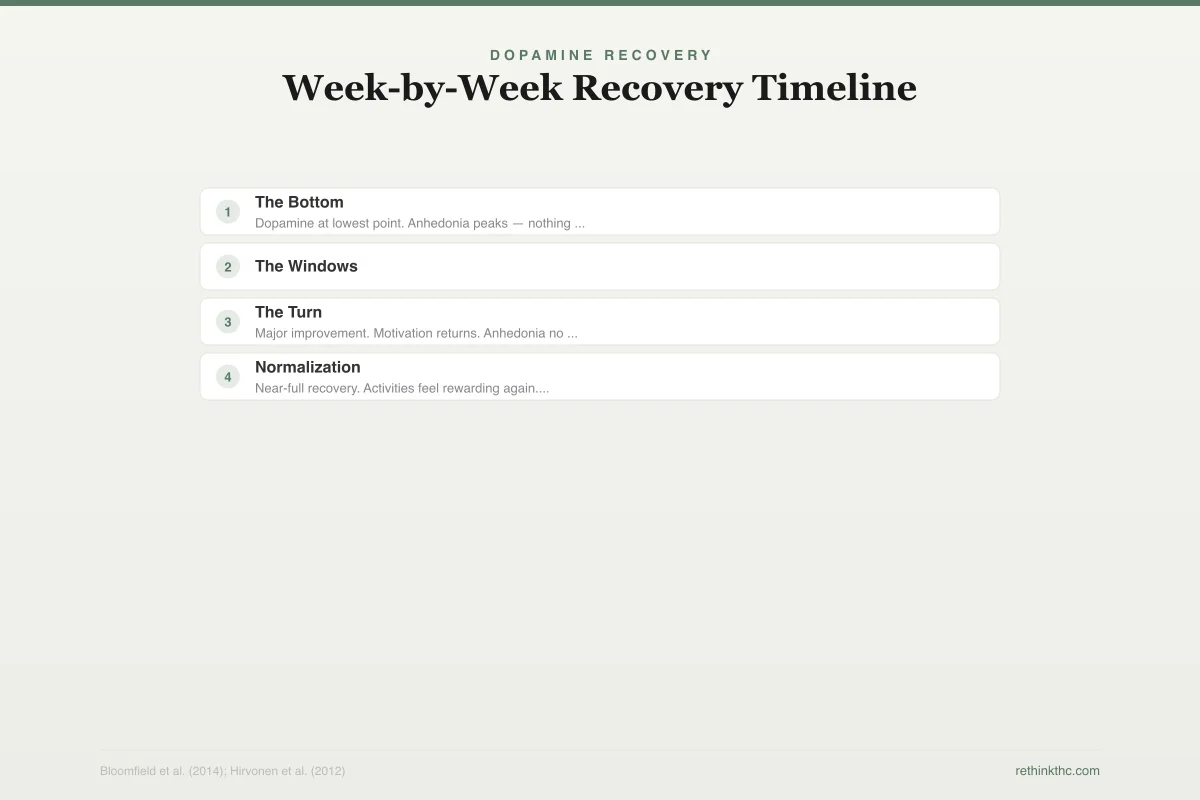
The timeline below maps out the full dopamine recovery arc — from the initial crash through the weeks it takes your reward system to come back online.
Dopamine Recovery
Week-by-Week Recovery Timeline
Dopamine function returns to baseline within 4-12 weeks for most people.
Dopamine at lowest point. Anhedonia peaks — nothing feels rewarding.
"Windows of normalcy" appear — brief moments of genuine enjoyment.
Major improvement. Motivation returns. Anhedonia no longer defines the day.
Near-full recovery. Activities feel rewarding again. The color comes back.
Bloomfield et al. (2014); Hirvonen et al. (2012)
 View as image ↗
THC increases dopamine release in a part of your brain called the nucleus accumbens, which is your brain's primary reward center. It is the same region that responds to food, sex, social connection, and every other naturally rewarding experience. Preclinical studies using microdialysis (a technique that measures neurotransmitter levels in real time) have found that THC can boost dopamine output substantially.[1] Human brain imaging studies confirm that THC increases dopamine activity in the striatum, though the magnitude in humans appears more modest than in animal models.[2]
The increase is enough that your brain notices the surplus and adjusts. It is nowhere near the dopamine surge produced by cocaine or methamphetamine, but it is a consistent, repeated elevation that triggers your brain's adaptation mechanisms over time.
| Substance | Approximate Dopamine Increase | Mechanism |
|---|---|---|
| Cannabis (THC) | Moderate (estimated 20–30% above baseline in humans) | Indirect — THC activates CB1 receptors, which disinhibit dopamine neurons |
| Nicotine | Moderate (~25–40% above baseline) | Direct — stimulates nicotinic acetylcholine receptors on dopamine neurons |
| Alcohol | Moderate (~40–60% above baseline) | Indirect — affects GABA and opioid systems that modulate dopamine |
| Cocaine | Very high (~150–300% above baseline) | Direct — blocks dopamine reuptake, flooding the synapse |
| Methamphetamine | Extreme (~1,000%+ above baseline) | Direct — forces dopamine release and blocks reuptake simultaneously |
This comparison matters because it explains why cannabis withdrawal is uncomfortable but not dangerous. The dopamine disruption is real but modest compared to stimulants, which is why the recovery timeline is weeks rather than months.
How Your Brain Adapted to THC
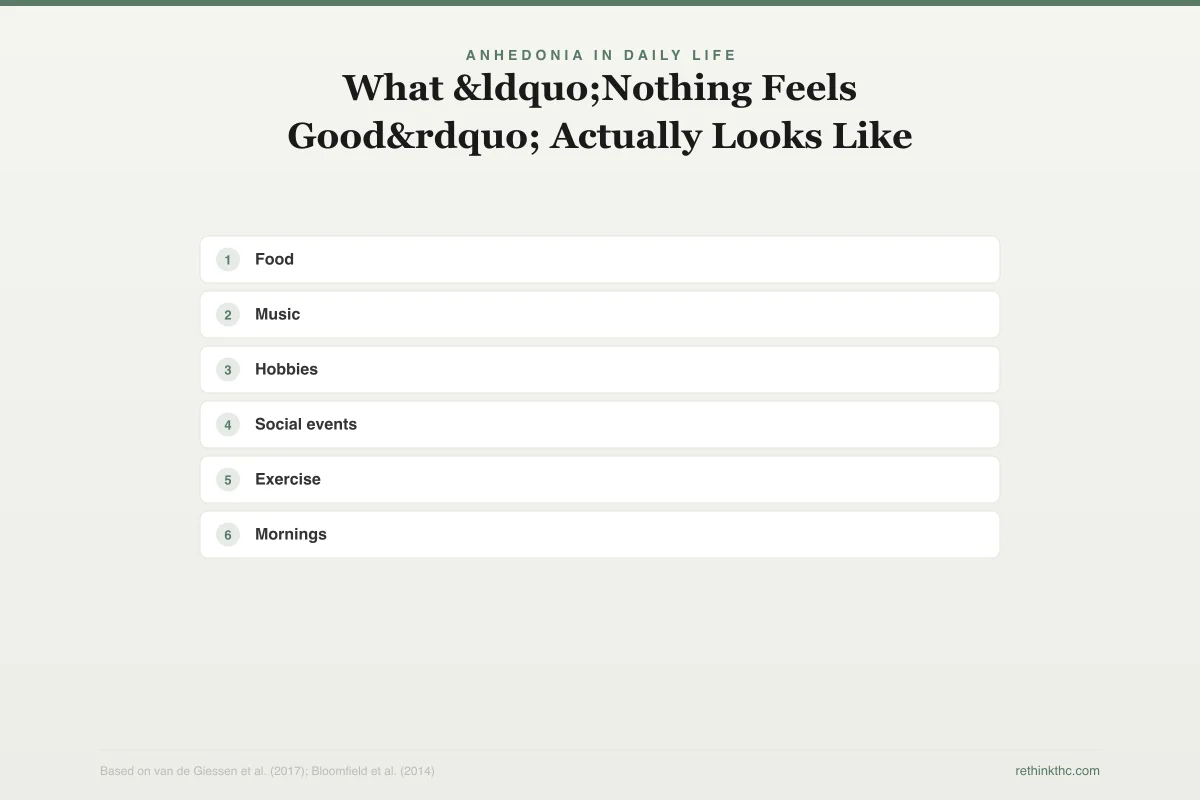
Your brain does not like being overstimulated. When any chemical floods a system repeatedly, the brain compensates by dialing down its sensitivity. This is how tolerance works at a biological level. The map below shows how that adaptation ripples out into the specific symptoms you feel during withdrawal.
Anhedonia In Daily Life
What “Nothing Feels Good” Actually Looks Like
Reward signal across daily activities — during use, early recovery, and after normalization.
Food
Music
Hobbies
Social events
Exercise
Mornings
The “during use” bar is artificially inflated by THC. Recovery does not mean returning to that level — it means returning to natural, sustainable enjoyment.
Based on van de Giessen et al. (2017); Bloomfield et al. (2014)
 View as image ↗
With regular cannabis use, your brain reduces the number and sensitivity of dopamine D2 receptors in the striatum, a larger brain region that includes the reward center and also handles motivation, habit formation, and motor control. Think of D2 receptors as antennas that pick up the dopamine signal. Fewer antennas means you need a louder signal (more THC) to get the same response.
A study in the journal Psychopharmacology used PET imaging, a type of brain scan that can visualize receptor activity in real time, and confirmed that chronic cannabis users have measurably reduced dopamine synthesis capacity in the striatum.[3] In plain terms: your brain is producing less dopamine AND is less capable of hearing the dopamine it does produce.
The endocannabinoid system and dopamine system are tightly coupled. A 2021 review described this relationship as a "pas de deux" — a coordinated dance where the endocannabinoid 2-AG gates dopamine release during reward-seeking behavior.[8] When THC floods the CB1 receptors, it disrupts this partnership, forcing dopamine signaling into an artificially elevated state that the brain then compensates for.
This is not damage. This is adaptation. Your brain was doing exactly what brains are designed to do when exposed to a persistent external chemical. The problem is that this adaptation only works while the THC keeps flowing.
Bloomfield et al. (2014) · Psychopharmacology
- Population
- 14 regular cannabis users scanned with PET imaging
- Intervention
- Measurement of dopamine synthesis capacity using [18F]-DOPA PET
- Comparator
- Normative data from non-cannabis-using populations
- Finding
- All cannabis users showed significant apathy. Lower dopamine synthesis capacity in the striatum was directly correlated with greater apathy — the less dopamine the brain was producing, the less motivated the person felt.
positive Small sample but uses gold-standard PET imaging — directly measures the dopamine deficit that causes the 'gray period'
Bloomfield et al. (2014), Psychopharmacology
What Happens When You Remove the THC
When you quit, the artificial dopamine boost disappears. But your receptors are still turned down. You are now producing normal amounts of dopamine (or slightly less than normal), but your brain cannot fully register that dopamine because the antennas have been reduced. Here is what that downregulation actually looks like at the receptor level.
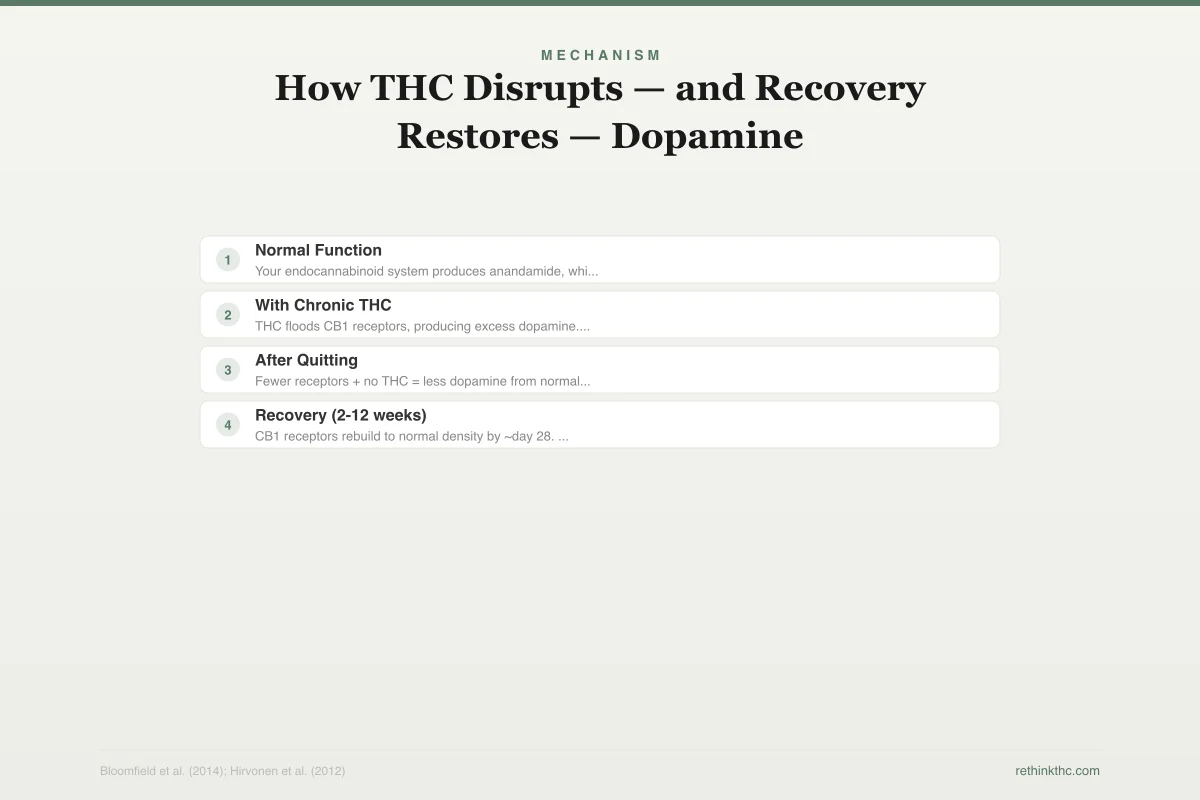
Mechanism
How THC Disrupts — and Recovery Restores — Dopamine
The CB1 → dopamine pathway in 4 stages.
Normal Function
Your endocannabinoid system produces anandamide, which modulates dopamine release naturally. Everyday rewards feel proportional.
With Chronic THC
THC floods CB1 receptors, producing excess dopamine. Brain compensates by reducing receptor density and sensitivity.
After Quitting
Fewer receptors + no THC = less dopamine from normal stimuli. This is anhedonia — the "gray period" where nothing feels rewarding.
Recovery (2-12 weeks)
CB1 receptors rebuild to normal density by ~day 28. Dopamine sensitivity follows. Natural reward response fully returns.
Bloomfield et al. (2014); Hirvonen et al. (2012)
 View as image ↗
The result is what clinicians call anhedonia, which literally means "without pleasure." It is the inability to feel reward from activities that used to be rewarding. Research has found that heavy cannabis users showed blunted dopamine release in response to reward cues compared to non-users.[4] Their brains were physically less responsive to things that should feel good.
Common signs of dopamine-related anhedonia during cannabis withdrawal include:
- Loss of interest — hobbies, music, shows, and conversations feel meaningless
- Low motivation — tasks feel disproportionately effortful, even simple ones
- Emotional flatness — neither happy nor sad, just blank
- Inability to anticipate pleasure — you cannot get excited about plans or events
- Social withdrawal — people feel draining because interactions do not generate the usual reward
- Decision paralysis — nothing seems worth choosing because nothing seems worth doing
This is the "gray period." This is why you can be sitting in front of something you know you enjoy and feel absolutely nothing. It is not a character flaw. It is not laziness. It is a measurable, temporary state in your brain's reward circuitry, and it resolves on a predictable timeline.
Evidence Review
Where the evidence stands
Cell & Lab Studies
THC-dopamine interaction mechanisms well-characterized at the molecular level
Animal Studies
Microdialysis studies showing THC increases dopamine release in nucleus accumbens
Clinical Observations
Anhedonia and amotivation widely documented in cannabis users and during withdrawal
Human Brain Imaging
PET scans confirm reduced dopamine synthesis capacity and blunted dopamine release in users
Recovery Evidence
CB1 receptors normalize by day 28 (Hirvonen 2012); reward response partially recovers with abstinence
Comprehensive Reviews
Bloomfield 2019 (Nature) — no evidence for permanent dopamine impairment from cannabis
The dopamine changes from cannabis use are well-documented at every level of evidence — from molecular mechanisms to human brain scans. Critically, the evidence also confirms that these changes reverse with abstinence. This is one of the best-studied aspects of cannabis neuroscience.
Bloomfield et al. (2019), Nature; Hirvonen et al. (2012), Molecular Psychiatry
The Recovery Timeline, Week by Week
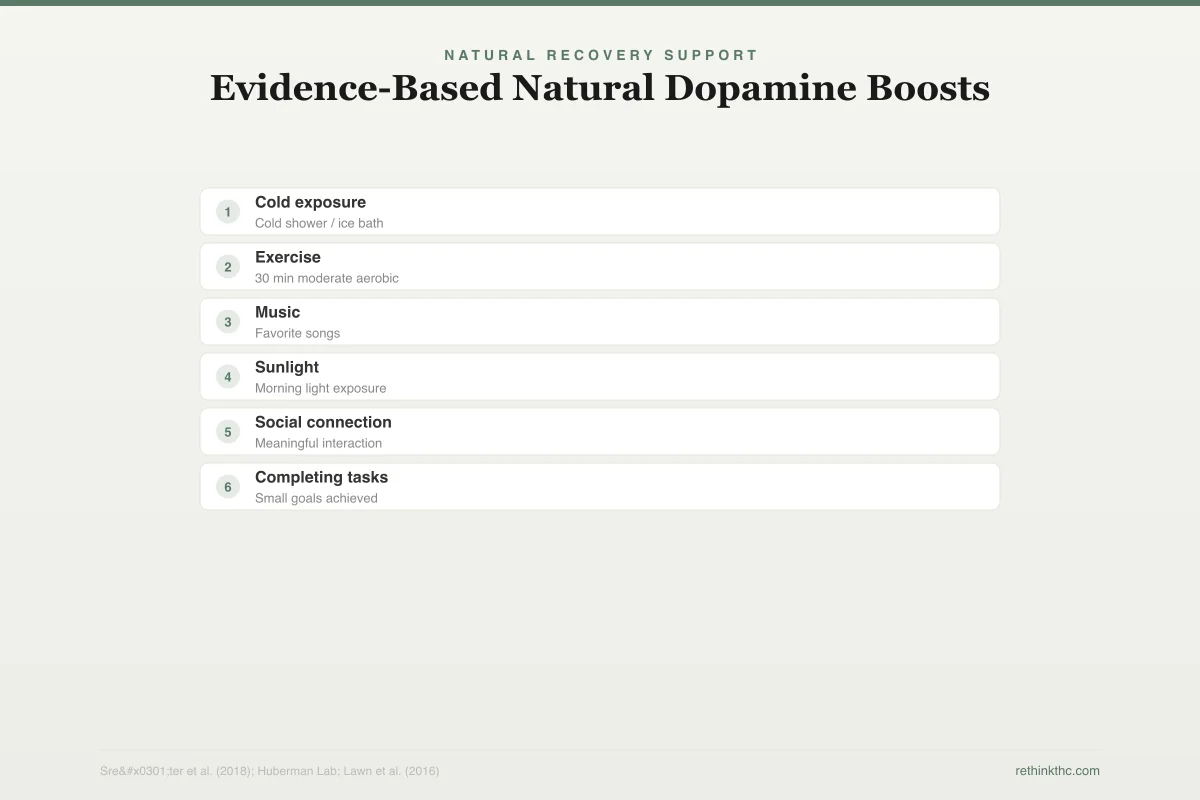
Dopamine recovery is not instant, but it follows a consistent pattern documented across multiple studies. Your individual timeline depends on how long and how heavily you used, but the trajectory is the same for everyone: it gets better, and it does not go backwards. Before we walk through it week by week, here is what the research says about natural activities that support your dopamine system during recovery.
Natural Recovery Support
Evidence-Based Natural Dopamine Boosts
Activities that increase dopamine without substances — ranked by relative impact.
2-3 min cold water
Walking, cycling, jogging
Peak moments in music
10-15 min after waking
Conversation, physical touch
To-do lists, daily wins
Exercise is the most practical during recovery — it directly increases dopamine receptor availability in the striatum, the exact region depleted by cannabis use.
Sréter et al. (2018); Huberman Lab; Lawn et al. (2016)
 View as image ↗
~20–30%
THC dopamine boost
above baseline in the brain's reward center
Days 1–7
The bottom
lowest dopamine function, strongest cravings
Day 28
CB1 receptors normalize
dopamine receptor recovery follows close behind
8–12 weeks
Full recovery
reward system returns to pre-cannabis baseline
Bloomfield et al. 2014, Hirvonen et al. 2012, Bloomfield et al. 2019
| Phase | Timeframe | Dopamine Status | What You Feel |
|---|---|---|---|
| The Bottom | Days 1–7 | Lowest functional point. THC boost gone, receptors still downregulated. | Everything feels effortful. Profound boredom. Strongest cravings. |
| The Windows | Weeks 2–4 | CB1 receptors begin normalizing. Dopamine sensitivity starts recovering. | Brief moments of normal feeling. Good days mixed with bad days. |
| The Turn | Weeks 4–8 | Baseline meaningfully shifted. Reward response partially restored. | Anhedonia no longer dominant. Motivation returns in functional amounts. |
| Full Normalization | Weeks 8–12 | Receptor density and dopamine synthesis return to pre-cannabis levels. | Activities feel rewarding again. Sustained motivation. Color comes back. |
Week One: The Bottom
This is the hardest stretch for motivation and mood. Your dopamine system is at its lowest functional point. The THC boost is gone, the receptors are still turned down, and your brain has not yet begun rebuilding. A 2022 study tracking THC abstinence found that dopamine release in the striatum drops significantly during the first days of withdrawal, with the decline paralleling disrupted sleep patterns.[9]
Everything feels effortful. Getting out of bed feels like a project. People in recovery communities describe this phase as "moving through mud" or "watching life from the backseat." You might find yourself staring at your phone for an hour without actually doing anything because nothing generates enough reward signal to feel worth starting.
This is also the phase where cravings are most strongly linked to dopamine. Your brain knows that THC would immediately restore the reward signal. The craving is not weakness. It is your dopamine-depleted brain identifying the fastest available fix. Recognizing this for what it is, a neurochemical pull and not a personal failure, makes it easier to ride out. For strategies to manage this phase, see how to deal with weed cravings.
Weeks Two to Four: The Windows
Somewhere in the second week, most people start noticing brief moments of normal feeling. A joke lands and you actually laugh. A meal tastes good. A conversation holds your interest. These moments are short at first, but they represent real, measurable receptor recovery.
A 2012 study in the journal Molecular Psychiatry found that CB1 receptor density (the THC receptors) normalizes by about day 28.[5] Dopamine receptor recovery follows a parallel timeline, though it can lag slightly behind. The "windows" of normalcy grow wider and more frequent through this phase. Many people describe it as the feeling slowly coming back in patches.
One thing that catches people off guard: the windows are not linear. You might feel great on Tuesday, terrible on Wednesday, and fine again on Thursday. This is normal. Recovery is not a steady upward line. It is an upward trend with daily fluctuations. Judge your progress by the week, not by the day. For the full picture of what else is happening during this period, see the cannabis withdrawal timeline.
Weeks Four to Eight: The Turn
By week four, most people report that the baseline has meaningfully shifted. The gray period is no longer the dominant state. You can sustain interest in activities. Motivation returns in functional amounts. The anhedonia is still present in moments, but it no longer defines your day.
Research has found that the blunted reward response observed in heavy users shows signs of recovery after a period of abstinence.[6] "Partially reversed" is important to understand. Four weeks is significant progress, not full recovery. But the difference between week one and week four is enormous, and most people feel it clearly.
Weeks Eight to Twelve: Full Normalization
For most people, dopamine function returns to pre-cannabis baseline somewhere in this range. The gray period is over. Activities feel rewarding again. Motivation is self-sustaining. The world has its color back.
Heavy, long-term users (daily use for multiple years, especially high-potency products like concentrates and dabs) may take the full 12 weeks or slightly longer. But the research is clear: cannabis-related dopamine changes reverse with abstinence. Current research, including multiple neuroimaging studies, has found no evidence for permanent dopamine impairment from cannabis use.[2]
What You Can Do to Support Recovery
You cannot force your brain to rebuild receptors faster than biology allows. But you can create the conditions that support the fastest possible recovery, and avoid the things that slow it down. The ranked chart earlier in this article shows the natural dopamine boosts with the strongest evidence — exercise, cold exposure, music, sunlight, and social connection. Here is how to put them into practice during the hardest weeks.
Exercise is the most important thing you can do. This is not a generic wellness suggestion. Research on exercise and the dopamine system has found that aerobic exercise directly increases dopamine receptor availability in the striatum, the exact region where cannabis depleted them.[7] A 20-minute walk counts. A bike ride counts. You do not need to train like an athlete. You need to move your body enough to trigger the neurochemical cascade that supports receptor repair.
The challenge during the gray period is that exercise itself does not feel rewarding at first. You are asking a dopamine-depleted brain to do something that requires dopamine to initiate. People in recovery communities consistently describe this as the hardest and most important habit to push through. It gets easier by week two as the reward signal starts coming back online.
Protect your sleep. Dopamine receptor sensitivity is tightly linked to sleep quality. Research has shown that even one night of sleep deprivation reduces D2 receptor availability, directly worsening the anhedonia you are already experiencing.[9] During withdrawal, your sleep is already disrupted by REM rebound and general insomnia. You cannot fix that entirely, but you can protect it: consistent sleep times, dark and cool room, no caffeine after noon, no screens before bed. For a full guide, see how to sleep without weed.
Seek out novel experiences, even small ones. Your brain's dopamine system responds to novelty, newness, and unpredictability through different pathways than substance use. A new walking route, a different genre of music, cooking a recipe you have never tried, a conversation with someone you do not usually talk to. These are small, but they engage the reward circuitry in ways that support rebuilding. People who stay in exactly the same routine they had while using often find the gray period harder because every environment is associated with the old dopamine source.
Be careful with dopamine substitutes. In the gray period, your brain is hungry for reward and will latch onto anything that provides it quickly. Doomscrolling, binge-eating junk food, excessive gaming, or picking up another substance can temporarily fill the gap but interfere with the recalibration process. None of these are moral failures. They are predictable behaviors from a reward-seeking brain that is running low. Being aware of the pattern is usually enough to moderate it. For more on this risk, see cross-addiction when quitting weed.
Do not judge your progress daily. The gray period tricks you into thinking nothing is changing. It is. The changes are happening at a receptor level that you cannot feel in real time. If you kept a symptom log from day one and read it at day 14, you would see a difference that is invisible from inside the experience. Track it. The data will reassure you on the hard days.
Safety
ModerateWhen the gray period might be something else
Concern
The dopamine-related anhedonia from quitting cannabis normally resolves within 4 to 12 weeks. If the flat, joyless feeling persists beyond that window with no improvement at all, it may indicate pre-existing depression that cannabis was masking rather than withdrawal alone.
What the research says
Many people use cannabis to self-medicate mood conditions without realizing it. Quitting reveals what was underneath. This is not a failure of recovery — it is useful diagnostic information that a provider can help with.
Particularly relevant for: Anyone whose anhedonia, low motivation, or depressed mood shows zero improvement after 12 weeks of abstinence
What to do
If you experience persistent hopelessness, inability to function, or thoughts of self-harm at any point during withdrawal, seek help immediately. SAMHSA helpline: 1-800-662-4357 (free, confidential, 24/7).
Bloomfield et al. (2019), Pharmacology & Therapeutics
When to Get Help
The gray period from dopamine recalibration typically resolves within four to 12 weeks. If anhedonia, low motivation, or depressed mood persist beyond that window with no improvement at all, it may indicate a pre-existing mood condition that was masked by cannabis use. This is not uncommon. Many people use cannabis to self-medicate depression, and quitting reveals the underlying condition.
If you experience persistent hopelessness, inability to function at work or in relationships, or thoughts of self-harm at any point, reach out to a healthcare provider. These symptoms warrant professional support regardless of the timeline. SAMHSA's National Helpline is available at 1-800-662-4357. It is free, confidential, and available 24 hours a day. You can also text HOME to 741741 to reach the Crisis Text Line.
The Reframe
Your brain is not broken. It adapted to a chemical that was artificially inflating your reward signal, and now it is recalibrating to operate without it. The flat, gray, joyless feeling is not your new normal. It is a temporary state with a clear neurological basis, a documented recovery timeline, and a guaranteed endpoint. Every day you are not using is a day your receptors are rebuilding. You cannot feel it happening, but it is happening. The color comes back.
The Bottom Line
Dopamine recovery after quitting cannabis follows a predictable neurological timeline. THC artificially elevates dopamine signaling in the brain's reward center, and chronic use causes the brain to reduce its dopamine sensitivity through receptor downregulation. When you quit, the result is anhedonia — a temporary inability to feel pleasure from everyday activities. This "gray period" typically peaks in the first one to two weeks, shows measurable improvement by weeks two to four, and resolves to pre-cannabis baseline within eight to 12 weeks. Aerobic exercise is the most evidence-supported way to accelerate the process.
How long does it take for dopamine to recover after quitting weed?
Most people experience significant improvement in mood and motivation within four to eight weeks. Full dopamine receptor normalization can take up to 12 weeks for heavy, long-term users. The most acute "gray period" typically occurs in the first one to two weeks and steadily improves from there. CB1 receptor density normalizes by about day 28, with dopamine receptor recovery following a parallel timeline.
Does weed permanently damage dopamine?
No. Current research, including PET imaging studies that directly measure receptor density, shows that dopamine function recovers after a period of abstinence. Multiple neuroimaging studies have found no evidence for permanent dopamine impairment from cannabis use. The changes are adaptations, not damage, and they reverse when the THC is removed.
What helps dopamine recovery after quitting cannabis?
Aerobic exercise is the most evidence-supported intervention, directly increasing dopamine receptor availability in the brain's reward center. Consistent sleep, novel experiences, and social connection also support recovery. Maintaining a rigid sleep schedule is especially important because sleep deprivation further reduces dopamine receptor availability. Supplements like L-tyrosine are sometimes recommended online but lack strong clinical evidence for this specific context.
Why do I feel so bored after quitting weed?
THC artificially increased your dopamine output each time you used. Your brain adapted by reducing its dopamine sensitivity through receptor downregulation. When you quit, normal activities produce normal dopamine levels, but your desensitized receptors cannot fully register the signal. The result is anhedonia — a temporary inability to feel reward from things that used to be enjoyable. It resolves as your receptors recover, typically within four to 12 weeks.
Is the flat feeling after quitting weed depression?
It can feel identical to depression, but it has a different cause. Cannabis withdrawal anhedonia is caused by temporary dopamine receptor downregulation that resolves within four to 12 weeks. Clinical depression is a separate condition with different neurological underpinnings. If the flat feeling persists beyond 12 weeks with no improvement, it may indicate underlying depression that was masked by cannabis use, and a healthcare provider can help distinguish between the two.
Does CBD affect dopamine recovery after quitting THC?
CBD works through different mechanisms than THC and does not appear to suppress dopamine recovery. Some preclinical research suggests CBD may actually support addiction recovery through D1 dopamine receptor pathways, potentially facilitating the extinction of drug-seeking behavior. However, this research is still early-stage and primarily from animal models. CBD does not produce the dopamine surge that THC does and is not known to interfere with the receptor recalibration process.
Sources & References
- 1RTHC-00148·Tanda, Gianluigi et al. (2003). “How THC Creates Reward and Dependence in the Brain.” Psychopharmacology.Study breakdown →PubMed →↩
- 2RTHC-01951·Bloomfield, Michael A P et al. (2019). “A comprehensive review of human brain imaging reveals how cannabis affects executive function, emotion, memory, and reward.” Pharmacology & therapeutics.Study breakdown →PubMed →↩
- 3RTHC-00773·Bloomfield, Michael A P et al. (2014). “Lower Dopamine Production Tracked With Higher Apathy Scores in Regular Cannabis Users.” Psychopharmacology.Study breakdown →PubMed →↩
- 4RTHC-01542·van de Giessen, E et al. (2017). “Cannabis-Dependent People Had Significantly Blunted Dopamine Release in the Brain's Reward System.” Molecular psychiatry.Study breakdown →PubMed →↩
- 5RTHC-00573·Hirvonen, Jussi et al. (2012). “Daily Cannabis Use Was Linked to Fewer CB1 Receptors. A Month Without Brought Them Back..” Molecular Psychiatry.Study breakdown →PubMed →↩
- 6RTHC-04232·Skumlien, Martine et al. (2022). “Largest fMRI study found no reward processing differences between cannabis users and non-users.” Neuropsychopharmacology : official publication of the American College of Neuropsychopharmacology.Study breakdown →PubMed →↩
- 7RTHC-01205·Lawn, Will et al. (2016). “First Rigorous Study Confirms THC Causes Temporary Amotivation, But Cannabis Dependence Does Not Reduce Overall Motivation.” Psychopharmacology.Study breakdown →PubMed →↩
- 8RTHC-03270·Laksmidewi, A A A Putri et al. (2021). “The Endocannabinoid-Dopamine Partnership: From Basic Survival Drives to Achievement and Addiction.” Journal of neural transmission (Vienna.Study breakdown →PubMed →↩
- 9RTHC-03952·Kesner, Andrew J et al. (2022). “THC withdrawal in mice disrupts dopamine, sleep, and behavior, especially in males.” Neuropsychopharmacology : official publication of the American College of Neuropsychopharmacology.Study breakdown →PubMed →↩