Withdrawal & Recovery
47%
Roughly 47% of regular cannabis users experience withdrawal symptoms, but severity falls on a spectrum from mild to severe depending on duration of use, product potency, and co-occurring mental health conditions.
Allsop et al. (2012)
47%
Roughly 47% of regular cannabis users experience withdrawal
What Determines Your Withdrawal Severity
covered in detail
What Mild Cannabis Withdrawal Looks Like
covered in detail
Allsop et al. (2012)
 View as image ↗
If you only read one thing
Cannabis withdrawal is not one experience — it's a spectrum from mild to severe, and where you land is largely decided by your use history, not your willpower. The strongest predictors of severe withdrawal are daily use for over a year, high-potency products (concentrates, dabs), and an underlying mental health condition. Mild withdrawal is manageable with self-care. Moderate benefits from some structure and social support. Severe usually calls for professional help — white-knuckling it at that level tends to end in relapse.
You know cannabis withdrawal is real, but the information you find online tends to treat it as one uniform experience. It is not. The person who smoked a joint most evenings for six months and the person who used high-potency concentrates multiple times a day for three years are both going to experience withdrawal, but their experiences will look nothing alike. Understanding cannabis withdrawal severity levels, whether yours is mild, moderate, or severe, changes how you approach the process, what kind of support makes sense, and what you can realistically expect from the first few weeks.
This is not about the full list of withdrawal symptoms or the clinical DSM-5 criteria. This is about figuring out where you fall on the severity spectrum and what to do with that information.
Key Takeaways
- Cannabis withdrawal severity falls on a spectrum from mild to severe, and where you land depends on measurable factors like how long you used, how much you used daily, and how potent the products were
- Roughly 47% of regular cannabis users experience withdrawal symptoms, but only a subset hits moderate or severe levels that interfere with daily functioning
- The strongest predictors of severe withdrawal are daily use for more than a year, high-potency products like concentrates and dabs, and co-occurring mental health conditions
- Mild withdrawal is usually manageable with self-care, while moderate and severe levels benefit from structured support or professional guidance
- Severity is not a measure of willpower or character — it is a biological outcome shaped by how your brain adapted to THC over time
- Allsop et al. (2012, PLOS ONE) found that the amount and frequency of cannabis use before quitting were among the strongest predictors of withdrawal severity, with daily users experiencing significantly more intense symptoms than less frequent users
Fact Check
'If quitting weed wrecks you, you're weak' vs. the research
The claim
“People who have a hard time quitting cannabis just need more willpower”
The lingering cultural idea that cannabis is harmless, so any difficulty quitting must be personal weakness
What research shows
UnsupportedWithdrawal severity is a biological outcome — determined by how long and heavily you used, how potent your products were, and your neurochemistry. Two people with identical motivation can have completely different withdrawal experiences because their brains adapted differently.
Willpower matters for showing up and asking for help. It doesn't determine whether your brain has to rebuild 30% of its CB1 receptor density or 60%. Calling severe withdrawal 'weakness' is like calling a long bone fracture 'lazy' because the cast takes longer to come off.
Allsop et al. (2012) PLOS ONE; Bahji et al. (2020) withdrawal severity and relapse review
What Determines Your Withdrawal Severity
Withdrawal severity is not random. Research has identified several factors that reliably predict whether your experience will be on the milder or more intense end. Knowing these can help you assess your own situation before symptoms even start.
Severity Levels
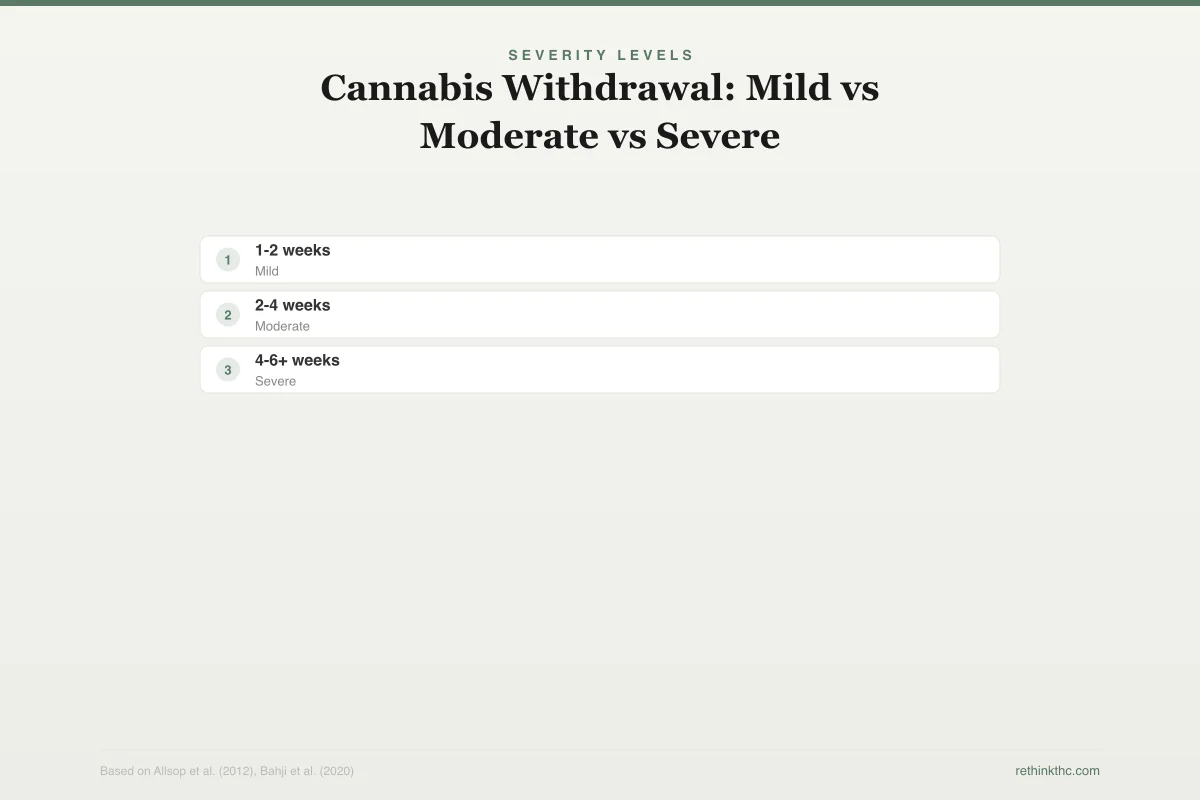
Cannabis Withdrawal: Mild vs Moderate vs Severe
Symptoms, functioning, and typical duration at each level
Mild
1-2 weeksIrritability that comes and goes
Mild insomnia (30-60 min to fall asleep)
Slightly reduced appetite
Occasional manageable cravings
Functioning: Can work, maintain relationships, handle responsibilities
Support needed: Self-care strategies usually sufficient
Moderate
2-4 weeksSignificant mood swings affecting relationships
Insomnia with middle-of-night waking
Vivid, disruptive dreams
Noticeable appetite loss
Headaches, sweating, stomach discomfort
Functioning: Can function but takes real effort. Concentration suffers.
Support needed: Structured plan, support group, consider counseling
Severe
4-6+ weeksPanic attacks and intense anxiety
Deep depressed mood or emotional numbness
Severe insomnia (2-3 nights with little sleep)
Marked weight loss
Anger outbursts damaging relationships
Near-impossible cravings
Functioning: Significantly impaired. May need time off work.
Support needed: Professional support strongly recommended
Based on Allsop et al. (2012), Bahji et al. (2020)
 View as image ↗
Duration and Frequency of Use
The longer and more frequently you used cannabis, the more your brain adapted to its presence. A 2012 study published in PLOS ONE by Allsop and colleagues followed 49 cannabis-dependent individuals through withdrawal and found that the amount and frequency of use before quitting were among the strongest predictors of symptom severity.[1] Daily users experienced more intense symptoms than those who used several times a week.
Your brain's CB1 receptors (the receptors THC binds to) downregulate more extensively with longer, heavier exposure. More downregulation means a bigger gap between where your brain is when you stop and where it needs to get back to.
Allsop et al. (2012) · PLOS ONE
- Population
- 49 cannabis-dependent adults tracked through supervised quit attempts
- Intervention
- Daily symptom tracking using the Cannabis Withdrawal Scale across multiple weeks
- Comparator
- Comparison of symptom severity against individual use history (frequency, amount, duration)
- Finding
- Amount and frequency of use before quitting were among the strongest predictors of withdrawal severity — daily users had significantly more intense symptoms than less frequent users
positive This is the basis for why 'how long and how often did you use?' is the first question any withdrawal plan should ask
Allsop et al. (2012), PLOS ONE
THC Potency and Product Type
Not all cannabis use is equal in terms of what it does to your receptor system. Someone using flower with 15% THC is delivering a very different dose to their brain than someone dabbing concentrates at 80% THC. Research has found that daily use of high-potency cannabis is associated with significantly higher rates of cannabis use disorder compared to lower-potency products. Higher potency means deeper receptor downregulation, which translates directly to more intense withdrawal.
If your primary products were concentrates, vape cartridges with high THC content, or edibles with large doses, your withdrawal is likely to be more intense than someone who used moderate-potency flower.
Co-Occurring Mental Health Conditions
If you have anxiety, depression, PTSD, ADHD, or another mental health condition alongside cannabis dependence, your withdrawal experience is likely to be more complex and more severe. Research in Neuroscience and Biobehavioral Reviews found that individuals with co-occurring psychiatric conditions reported higher withdrawal symptom intensity. There are two reasons for this. First, the withdrawal symptoms themselves (anxiety, depressed mood, irritability) layer on top of existing symptoms of the same type. Second, cannabis may have been partially managing those conditions, and stopping removes that buffer while withdrawal adds new distress.
Concurrent Tobacco or Nicotine Use
Many cannabis users also use tobacco, either mixed with cannabis or separately. If you stop both at the same time, you are dealing with two concurrent withdrawal syndromes that stack on each other. Nicotine withdrawal produces its own irritability, anxiety, and sleep disruption. Even if you only stop cannabis, concurrent nicotine use has been associated with more severe cannabis withdrawal in several studies.
Individual Biology
Genetics play a role in how quickly your endocannabinoid system recovers. Some people metabolize THC faster, clear it from fat stores sooner, and rebuild receptor density more quickly. Others are slower. This is why two people with similar use histories can have genuinely different withdrawal experiences. You cannot control this factor, but knowing it exists can help you avoid comparing your timeline to someone else's.
What Mild Cannabis Withdrawal Looks Like
Mild withdrawal is the most common experience, especially among people who used moderate-potency products, did not use daily for extended periods, or who have no significant co-occurring mental health conditions.
Risk Factors
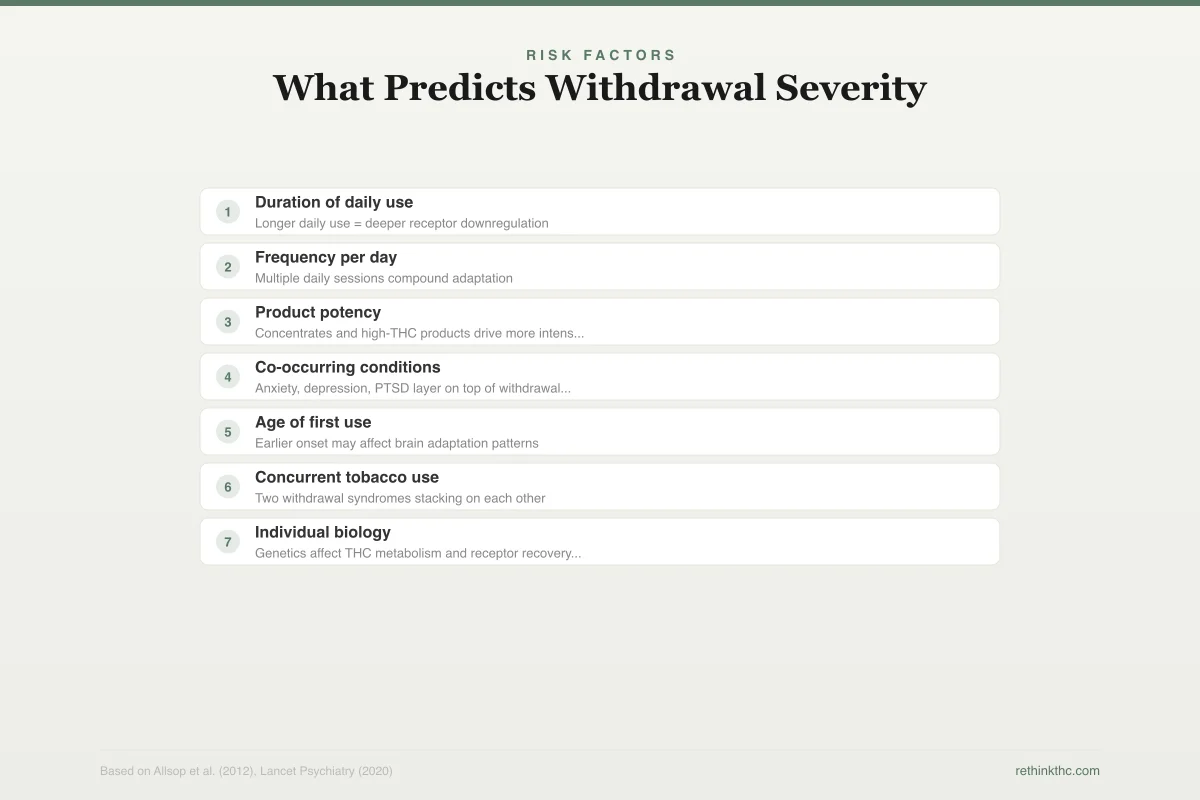
What Predicts Withdrawal Severity
These factors compound. Multiple high-impact factors = prepare for more intense withdrawal.
Duration of daily use
Longer daily use = deeper receptor downregulation
Frequency per day
Multiple daily sessions compound adaptation
Product potency
Concentrates and high-THC products drive more intense withdrawal
Co-occurring conditions
Anxiety, depression, PTSD layer on top of withdrawal symptoms
Age of first use
Earlier onset may affect brain adaptation patterns
Concurrent tobacco use
Two withdrawal syndromes stacking on each other
Individual biology
Genetics affect THC metabolism and receptor recovery speed
Severity is not a character test. It is a biological outcome determined by receptor downregulation, neurochemistry, genetics, and use history.
Based on Allsop et al. (2012), Lancet Psychiatry (2020)
 View as image ↗
Typical symptoms at the mild level: Noticeable irritability that comes and goes. Mild sleep disruption, maybe taking 30 to 60 minutes longer to fall asleep or waking up once during the night. Slightly reduced appetite for the first several days. Some restlessness, particularly in the evenings when you would normally have used. Occasional cravings that are distracting but manageable.
What daily life looks like: You can still go to work, maintain relationships, and handle responsibilities. The symptoms are uncomfortable but do not derail your functioning.
What helps at this level: Self-care strategies are usually sufficient. Exercise, consistent sleep schedules, staying hydrated, and having a plan for cravings cover most of what mild withdrawal demands. The complete guide to cannabis withdrawal covers these strategies in detail.
Typical duration: Most people at the mild level see symptoms peak around days 3 to 5 and resolve substantially within 10 to 14 days.
What Moderate Cannabis Withdrawal Looks Like
Moderate withdrawal is where symptoms start to genuinely interfere with parts of your life. This is common among daily users of a year or more, users of higher-potency products, or people with some degree of underlying anxiety or mood issues.
Self-Assessment
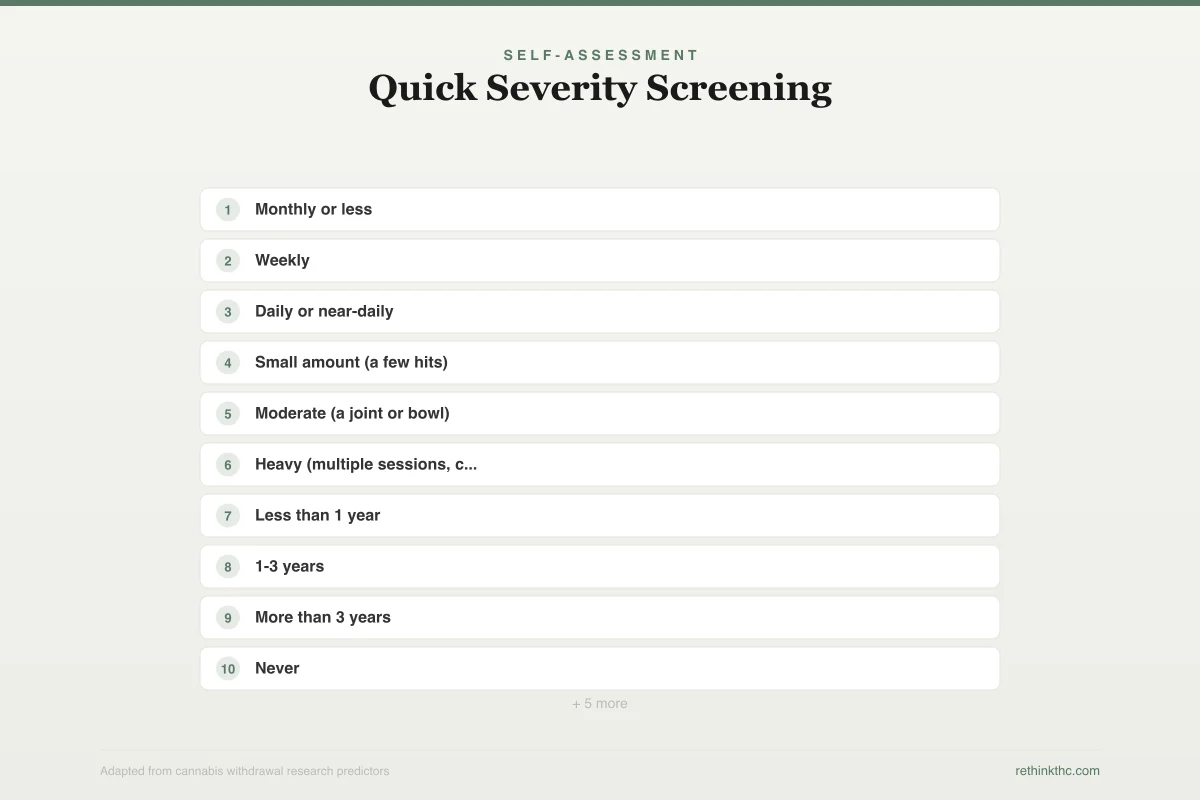
Quick Severity Screening
Score each question 1, 3, or 5. Add your total to estimate your likely severity level.
1.How often do you use cannabis?
1
Monthly or less
3
Weekly
5
Daily or near-daily
2.How much per session?
1
Small amount (a few hits)
3
Moderate (a joint or bowl)
5
Heavy (multiple sessions, concentrates)
3.How many years of regular use?
1
Less than 1 year
3
1-3 years
5
More than 3 years
4.Do you use first thing in the morning?
1
Never
3
Sometimes
5
Most days
5.Previous failed quit attempts?
1
None or first attempt
3
1-2 attempts
5
3 or more attempts
Your Score Indicates
5-10
Likely Mild
Self-care strategies are a reasonable starting point
11-18
Likely Moderate
Build in support before you quit. Consider counseling.
19-25
Prepare for Severe
Professional support is strongly recommended.
This is a rough screening tool, not a clinical diagnosis. If you are unsure, a healthcare provider can offer a more precise assessment.
Adapted from cannabis withdrawal research predictors
 View as image ↗
Typical symptoms at the moderate level: Significant irritability and mood swings that affect your relationships. Anxiety that is hard to shake, including physical symptoms like a tight chest or racing heart. Insomnia lasting multiple nights, not just difficulty falling asleep but waking at 2 or 3 AM and not being able to get back down. Vivid, intense dreams that disrupt sleep quality even when you do sleep. Noticeable appetite loss, possibly losing a few pounds in the first week. Physical symptoms like headaches, sweating, or stomach discomfort.
What daily life looks like: You can function, but it takes real effort. Concentration at work suffers. Sleep deprivation compounds other symptoms, making everything harder.
What helps at this level: Self-care strategies are still important, but you benefit from additional structure. Tell someone you trust what you are going through. Use relaxation techniques or guided breathing for anxiety. Some people at this level find that short-term use of over-the-counter sleep aids (with a doctor's awareness) helps break the insomnia cycle. If symptoms are not improving by week 3, consider reaching out to a healthcare provider. The question of whether formal treatment makes sense depends partly on whether moderate symptoms are resolving on their own or staying stuck.
Typical duration: Moderate symptoms usually peak in the first week and take 2 to 4 weeks to resolve meaningfully. Sleep disturbances may linger for 4 to 6 weeks.
What Severe Cannabis Withdrawal Looks Like
Severe withdrawal is less common, but it is very real for the people who experience it. This tends to affect long-term daily users of high-potency products, people with significant co-occurring mental health conditions, or people who have tried to quit before and found withdrawal consistently overwhelming.
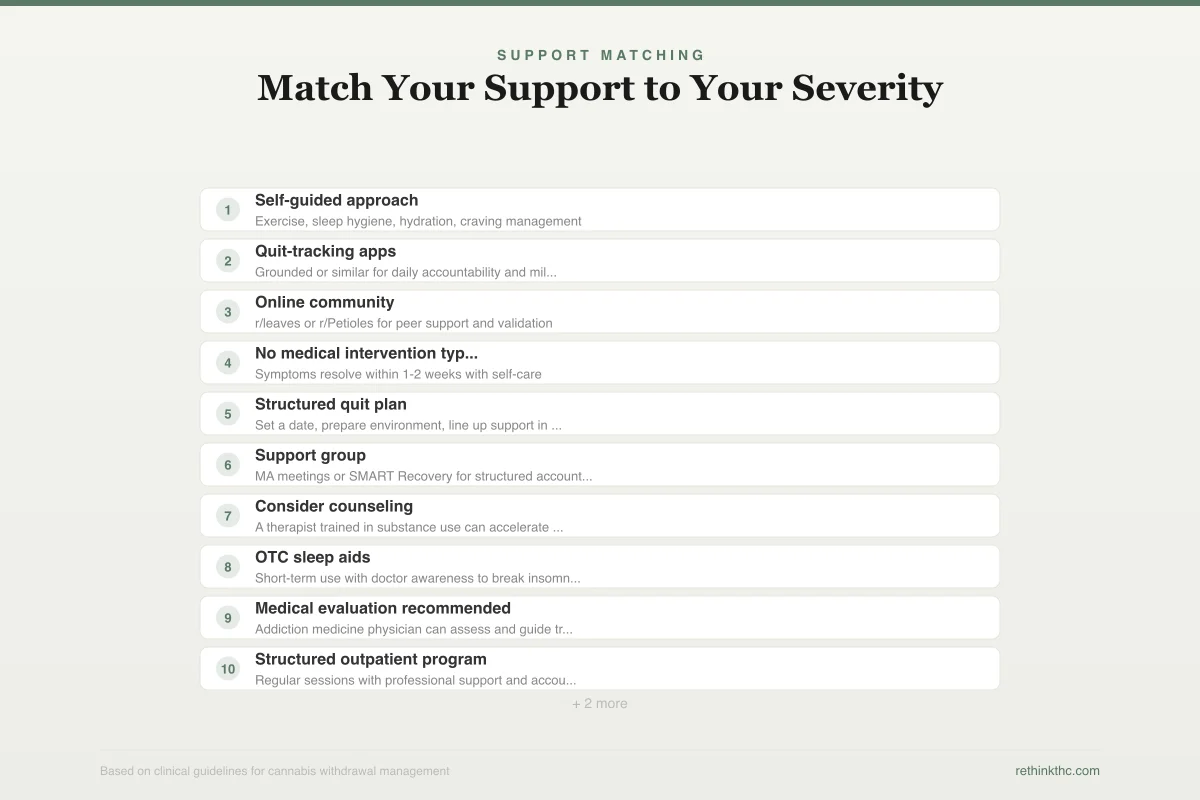
Support Matching
Match Your Support to Your Severity
Higher severity does not mean tougher it out harder. It means different tools.
Mild Withdrawal
Self-guided approach
Exercise, sleep hygiene, hydration, craving management
Quit-tracking apps
Grounded or similar for daily accountability and milestones
Online community
r/leaves or r/Petioles for peer support and validation
No medical intervention typically needed
Symptoms resolve within 1-2 weeks with self-care
Moderate Withdrawal
Structured quit plan
Set a date, prepare environment, line up support in advance
Support group
MA meetings or SMART Recovery for structured accountability
Consider counseling
A therapist trained in substance use can accelerate recovery
OTC sleep aids
Short-term use with doctor awareness to break insomnia cycle
Severe Withdrawal
Medical evaluation recommended
Addiction medicine physician can assess and guide treatment
Structured outpatient program
Regular sessions with professional support and accountability
Possible medication
Gabapentin for sleep and anxiety; other options as indicated
CBT therapy
Strongest evidence base for cannabis use disorder and withdrawal
Based on clinical guidelines for cannabis withdrawal management
 View as image ↗
Typical symptoms at the severe level: Intense, persistent anxiety that may include panic attacks. Deep depressed mood, potentially including hopelessness or emotional numbness. Severe insomnia, sometimes going 2 to 3 nights with very little sleep. Marked appetite loss and notable weight loss. Physical symptoms that are hard to ignore: heavy sweating, stomach cramping, nausea, headaches. Anger outbursts that feel out of character and may damage relationships. Strong, persistent cravings that feel nearly impossible to resist.
What daily life looks like: Functioning is significantly impaired. You might need to take time off work. The combination of sleep deprivation, emotional instability, and physical discomfort creates a situation that feels unsustainable. Research has found that withdrawal severity is a significant predictor of relapse among people trying to quit.[2]
What helps at this level: Professional support is strongly recommended. This could mean working with a therapist experienced in cannabis cessation, consulting an addiction medicine physician, or entering a structured outpatient program. Cognitive behavioral therapy (CBT) has the strongest evidence base for cannabis use disorder and withdrawal management. Some clinicians use short-term medications for specific symptoms like insomnia or acute anxiety. If you have signs of cannabis use disorder, a structured treatment approach addresses both the withdrawal and the underlying patterns.
Safety
ModerateSevere withdrawal is not the time to go it alone
Concern
Severe cannabis withdrawal can include panic attacks, deep depression, and thoughts of self-harm — especially in people with existing mental health conditions. Research has also shown withdrawal severity directly predicts relapse risk, which means white-knuckling severe symptoms often ends in starting to use again.
What the research says
This is not dangerous the way severe alcohol or benzo withdrawal can be, but it is the category where professional support meaningfully changes outcomes.
Particularly relevant for: Long-term daily users of high-potency products, or anyone with co-occurring anxiety, depression, PTSD, or ADHD
What to do
Line up support before quitting: a therapist, addiction medicine physician, or structured outpatient program. If thoughts of self-harm arise, call SAMHSA at 1-800-662-4357 or text HELLO to 741741.
Bahji et al. (2020) systematic review; SAMHSA National Helpline guidance
Typical duration: The acute phase of severe withdrawal lasts 1 to 2 weeks, with significant improvement usually starting in week 2. However, post-acute symptoms (lingering sleep disruption, intermittent mood dips, periodic cravings) can persist for 6 to 12 weeks in heavy, long-term users. The weed withdrawal timeline covers this day-by-day progression.
How to Self-Assess Your Severity Level
You do not need a clinician to get a rough sense of where you fall. Consider these questions honestly:
Usage factors. How long have you been using daily or near-daily? How potent are the products you use? How many times per day do you typically use? If your answers are "over a year," "concentrates or high-potency products," and "multiple times daily," you are more likely to experience moderate to severe withdrawal.
Mental health factors. Do you have a diagnosed or suspected anxiety disorder, depression, PTSD, or ADHD? Were you using cannabis partly to manage those symptoms? If yes, your withdrawal is more likely to be complicated by the re-emergence of those conditions.
Previous quit attempts. If previous attempts were derailed specifically by withdrawal symptoms, that history is a meaningful data point about what to expect this time.
Support system. Do you have people who know what you are going through? Do you have access to a therapist or doctor if you need one? Available support does not change the biological severity of withdrawal, but it significantly changes how manageable that severity feels.
If your answers point toward the milder end, self-directed strategies are a reasonable starting point. If they point toward moderate or severe, building in support before you quit is not weakness. It is strategy.
Severity Is Not a Character Test
One of the most damaging ideas around quitting cannabis is that struggling means you are doing it wrong. That severe withdrawal is somehow a failure of willpower. It is not. Severity is a biological outcome. It is determined by receptor downregulation, neurochemistry, genetics, and use history. Two people can have identical motivation and identical commitment and still have radically different withdrawal experiences.
Understanding your severity level is not about labeling yourself. It is about matching your approach to your actual situation. The person with mild withdrawal who white-knuckles through it with no support is not tougher than the person with severe withdrawal who works with a therapist. They just have different biology and different use histories demanding different responses.
When to Seek Professional Help
If your withdrawal symptoms are preventing you from functioning at work, maintaining basic self-care, or keeping you in a cycle of quitting and relapsing within the first week, professional support can change the outcome. If you are experiencing intense anxiety, deep depression, or any thoughts of self-harm during withdrawal, do not try to manage that alone.
SAMHSA's National Helpline is free, confidential, and available 24 hours a day at 1-800-662-4357. You can also text "HELLO" to 741741 to reach the Crisis Text Line.
Knowing Your Level Gives You an Advantage
Most people enter cannabis withdrawal blind. They do not know what to expect, they do not know why their experience is more or less intense than someone else's, and they do not know what kind of support matches their situation. You now have information that most people going through this process do not. Your severity level is not fixed and it is not a verdict. It is a starting point that tells you what you are working with and what tools are most likely to help. The better you understand what your brain is doing and why, the less power the process has over you.
The Bottom Line
Cannabis withdrawal severity falls on a measurable spectrum from mild to severe, determined by specific factors: duration/frequency of use (Allsop 2012, PLOS ONE — amount and frequency are strongest predictors of symptom severity), THC potency (concentrates/dabs drive deeper CB1 receptor downregulation than moderate-potency flower), co-occurring mental health conditions (anxiety, depression, PTSD layer onto withdrawal symptoms and remove cannabis's buffering effect), concurrent tobacco/nicotine use (stacks two withdrawal syndromes), and individual biology (genetic variation in THC metabolism and receptor recovery speed). Roughly 47% of regular users experience withdrawal symptoms, but only a subset reaches moderate or severe levels. Mild withdrawal: irritability, slight sleep disruption, reduced appetite, manageable cravings — peaks days 3-5, resolves in 10-14 days, self-care strategies sufficient. Moderate withdrawal: significant mood swings, hard-to-shake anxiety with physical symptoms, multi-night insomnia, vivid dreams, appetite loss with weight loss, headaches/sweating — peaks week 1, resolves meaningfully in 2-4 weeks (sleep may linger 4-6 weeks), benefits from structured support. Severe withdrawal: panic attacks, deep depressed mood, 2-3 nights with minimal sleep, marked weight loss, anger outbursts, intense persistent cravings — acute phase 1-2 weeks, post-acute symptoms 6-12 weeks, professional support strongly recommended (CBT has strongest evidence). Withdrawal severity is a significant predictor of relapse (Bahji 2020). Self-assessment framework: usage factors, mental health factors, previous quit attempt history, support system availability. Severity is biological, not a character test.
What determines whether cannabis withdrawal is mild, moderate, or severe?
The main factors are how long and how frequently you used, the THC potency of your products, whether you have co-occurring mental health conditions, and your individual biology.[1] Daily use of high-potency products for over a year is associated with more severe withdrawal, while shorter durations and lower potency tend to produce milder symptoms.
Can mild cannabis withdrawal become severe?
Mild withdrawal does not typically escalate to severe. Severity is largely determined before you quit, based on your use history and individual factors. However, if you are managing a mental health condition that cannabis was partially treating, stopping can unmask symptoms that make the overall experience feel more intense than expected.
Do I need professional help for cannabis withdrawal?
Most people with mild withdrawal manage well with self-care strategies. Moderate withdrawal may benefit from some support, such as a therapist or a trusted person to lean on. Severe withdrawal, particularly when it involves intense anxiety, depression, or repeated failed quit attempts, is a strong signal that professional support will meaningfully improve your outcome.
How long does severe cannabis withdrawal last?
The acute phase of severe withdrawal typically lasts 1 to 2 weeks, with the worst symptoms peaking around days 3 to 7. Significant improvement usually begins in week 2. However, post-acute symptoms like sleep disruption, intermittent cravings, and periodic mood dips can persist for 6 to 12 weeks in heavy, long-term users.
Does using concentrates or dabs make withdrawal worse?
Research suggests yes. High-potency products deliver significantly more THC per session, which drives deeper downregulation of your brain's CB1 receptors. A 2020 study in The Lancet Psychiatry found that daily use of high-potency cannabis was associated with higher rates of dependence. More receptor downregulation generally means more intense withdrawal when you stop.
Can withdrawal severity predict whether I will relapse?
Research indicates yes. A 2020 systematic review by Bahji and colleagues found that withdrawal severity is a significant predictor of relapse among people attempting to quit cannabis.[2] This does not mean severe withdrawal guarantees relapse — it means people experiencing severe symptoms benefit most from structured support, professional guidance, and realistic expectations about the timeline. Matching your support level to your severity level is the most effective way to improve your odds of sustained abstinence.
Sources & References
- 1RTHC-00538·Allsop, David J. et al. (2012). “Withdrawal That Disrupted Daily Life Was Tied to Relapse in a Small Study.” PLOS ONE.Study breakdown →PubMed →↩
- 2RTHC-02407·Bahji, Anees et al. (2020). “About Half of Heavy Cannabis Users Experience Withdrawal. This Meta-Analysis Measured It..” JAMA Network Open.Study breakdown →PubMed →↩