Withdrawal & Recovery
2013 DSM-5
Cannabis withdrawal syndrome earned formal DSM-5 recognition in 2013 after landmark studies documented its predictable symptom pattern in 47 percent of regular users.
Budney et al., Journal of Abnormal Psychology, 2004
2 days
CB1 receptor recovery — which starts within 2 days and
What the DSM-5 Is and Why Inclusion Matters
covered in detail
The Exact DSM-5 Criteria
covered in detail
Budney et al., Journal of Abnormal Psychology, 2004
 View as image ↗
If you only read one thing
Cannabis withdrawal is a real, officially recognized medical condition — it's been in the DSM-5 (the manual psychiatrists use to diagnose everything) since 2013. If you're experiencing irritability, anxiety, sleep problems, appetite loss, or depression after quitting, you have a documented condition that 47% of regular users go through. It's not in your head, it's not weakness, and it has a predictable timeline: symptoms start within a few days, peak in the first week, and mostly resolve within a month as your brain's receptors rebuild.
Cannabis withdrawal syndrome spent decades in a strange position: millions of people experienced it, clinicians observed it, and researchers documented it, yet it lacked an official diagnostic home until 2013. That year, the fifth edition of the Diagnostic and Statistical Manual of Mental Disorders (DSM-5) formally added it, giving the condition specific criteria, a diagnostic code, and the same clinical legitimacy as any other recognized withdrawal syndrome. Understanding the DSM-5 framework is not just academic. It shapes how clinicians diagnose you, how treatment gets structured, and whether your experience gets taken seriously in a medical setting.
Key Takeaways
- Cannabis withdrawal syndrome is an officially recognized diagnosis in the DSM-5 — the psychiatric manual released in 2013 — with specific criteria clinicians use today
- To qualify, you need three or more defined symptoms showing up within about a week of stopping heavy, prolonged cannabis use
- Two landmark studies by researcher Alan Budney in 2003 and 2004 built the evidence base that finally got cannabis withdrawal into the DSM-5
- Getting diagnosed involves ruling out other conditions and looking at your usage history — not just checking boxes on a symptom list
- Clinical recognition matters because it affects your access to treatment, insurance coverage, and the simple relief of having a named, understood condition
- CB1 receptor recovery — which starts within 2 days and largely finishes by day 28 — is the biological engine behind cannabis withdrawal syndrome's predictable symptom arc
What the DSM-5 Is and Why Inclusion Matters
The DSM-5 is the standard reference that psychiatrists, psychologists, and other mental health professionals in the United States use to diagnose every recognized psychological and psychiatric condition. Depression is in there. Generalized anxiety disorder is in there. Post-traumatic stress disorder is in there. When a condition gets added to the DSM, it signals that the scientific and clinical community has agreed that the evidence for its existence meets the bar required for formal recognition.
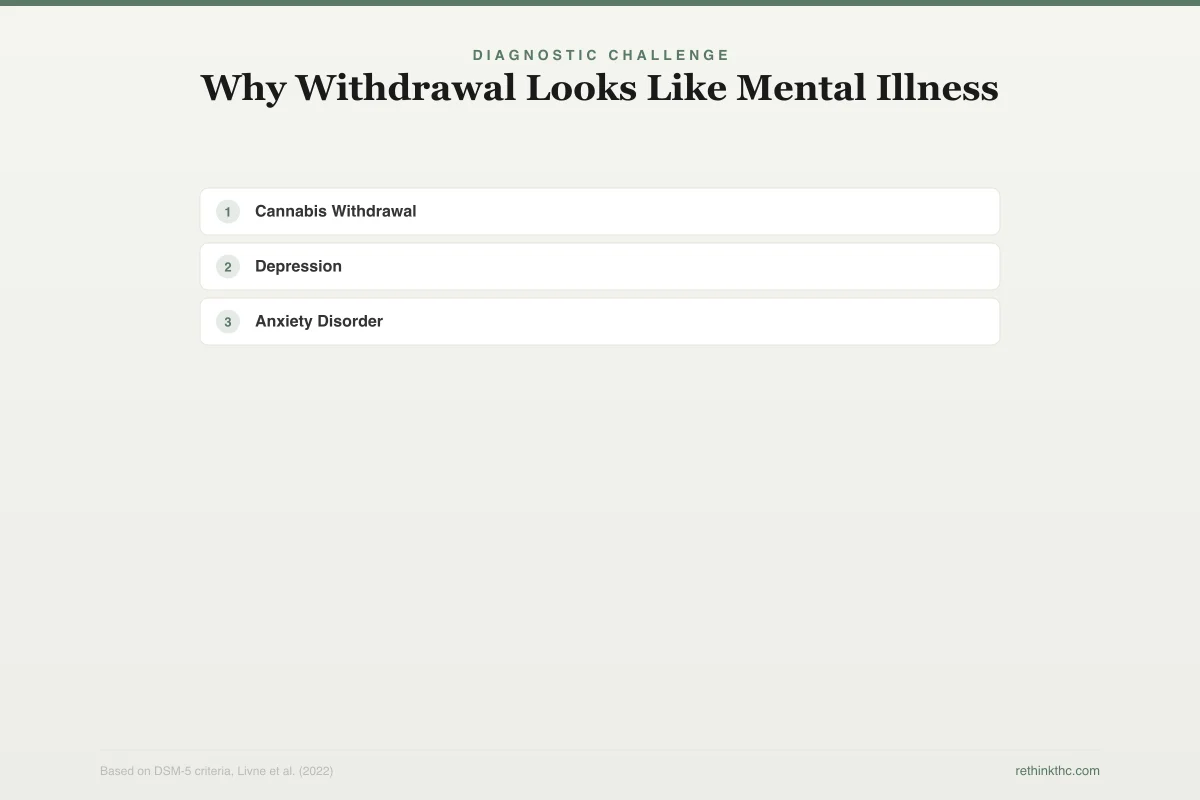
Diagnostic Challenge
Why Withdrawal Looks Like Mental Illness
Symptom overlap makes diagnosis nearly impossible during active use
Insomnia
Irritability
Anxiety
Appetite changes
Depressed mood
Low motivation
Anhedonia
Restlessness
Concentration problems
Insomnia and irritability appear in all three categories. A 4–6 week abstinence period is typically needed to distinguish withdrawal from an underlying condition.
Based on DSM-5 criteria, Livne et al. (2022)
 View as image ↗
That bar is high. For a condition to be included, researchers must demonstrate that it is distinct from other conditions, that it follows a predictable and consistent pattern, and that it causes meaningful distress or functional impairment. The process involves extensive review by committees of specialists who examine the accumulated research literature.
Before 2013, cannabis withdrawal existed in a diagnostic gray zone. Clinicians knew it happened. Researchers had been documenting it. But it was not formally in the manual, which meant that in medical and clinical contexts, it did not officially exist. This had real consequences. Patients who described withdrawal symptoms might be told their symptoms were psychosomatic (meaning they were imagining them) or that they reflected a pre-existing anxiety or mood disorder. Treatment programs lacked a recognized diagnostic framework to address it. Insurance coverage for cannabis-related treatment was harder to justify. And culturally, the absence of an official diagnosis reinforced the popular narrative that cannabis withdrawal was not real.
The 2013 inclusion changed all of that. Cannabis withdrawal syndrome now has a diagnostic code (F12.288 in the ICD-10-CM coding system), which means it can be billed, tracked, and treated as a recognized medical condition.
The Exact DSM-5 Criteria
The DSM-5 diagnostic criteria for cannabis withdrawal syndrome are worth knowing precisely, because they explain what clinicians are actually looking for and why. The full criteria are:
Criterion A: Cessation of cannabis use that has been heavy and prolonged, meaning frequent, high-dose use over an extended period.
Criterion B: Three or more of the following symptoms develop within approximately one week of stopping use:
- Irritability, anger, or aggression
- Nervousness or anxiety
- Sleep difficulty (trouble falling asleep, staying asleep, or disturbing dreams)
- Decreased appetite or weight loss
- Restlessness
- Depressed mood
- At least one of the following physical symptoms causing significant discomfort: stomach pain, shakiness or tremors, sweating, fever, chills, or headache
Criterion C: The symptoms cause clinically significant distress or impairment in social, occupational, or other important areas of functioning.
Criterion D: The symptoms are not attributable to another medical condition and are not better explained by another mental disorder, including intoxication or withdrawal from another substance.
That last criterion is important. If your anxiety during cannabis cessation is actually the re-emergence of a pre-existing anxiety disorder that cannabis was suppressing, that is not cannabis withdrawal syndrome, even if the timing looks similar. Part of a proper clinical evaluation involves distinguishing between these possibilities.
The physical symptoms listed under Criterion B (stomach pain, tremors, sweating, fever, chills, headache) are notable because they are often left out of the popular discussion of cannabis withdrawal. Most people know about the irritability and insomnia. Fewer people know that physical discomfort is formally recognized as part of the syndrome, which means that when you feel physically sick during the first week of quitting, you are not imagining it or adding drama to an emotional situation. Physical malaise is a documented component of the clinical picture.
Fact Check
The claim that held back recognition for decades
The claim
“Cannabis withdrawal isn't real — it's not physically addictive like alcohol or opioids”
Cultural narrative reinforced by the absence of dramatic physical withdrawal symptoms
What research shows
Misleading47 studies involving 23,518 participants confirm that 47% of regular users experience clinically significant withdrawal. The DSM-5 — the gold standard for psychiatric diagnosis — formally recognized it in 2013 with specific diagnostic criteria.
Cannabis withdrawal is less dramatic than opioid or alcohol withdrawal, which is why it was dismissed for so long. But 'less severe' and 'not real' are completely different claims. The symptoms are measurable, predictable, and cause genuine functional impairment.
Bahji et al. (2020), JAMA Network Open; DSM-5, American Psychiatric Association, 2013
Why Recognition Took Until 2013
Cannabis has been in use for thousands of years, but systematic clinical research into cannabis withdrawal is relatively recent. For most of the 20th century, the prevailing view in both clinical medicine and popular culture was that cannabis was not addictive in any meaningful sense. This was partly driven by the fact that cannabis withdrawal does not produce the dramatic, acute physical symptoms associated with alcohol or opioid withdrawal, and partly driven by political and cultural dynamics that shaped cannabis research in ways that are still being untangled.
Research on withdrawal syndromes typically relies on well-controlled studies where participants stop using a substance under observation, and symptoms are carefully measured over time. Conducting this kind of research with cannabis required navigating a complex regulatory environment, and for decades, the funding and institutional support for serious cannabis withdrawal research was limited.
The situation began to change in the 1990s, as researchers started applying more rigorous methodology to the question. What they found was consistent: heavy cannabis users who stopped did experience a predictable cluster of symptoms that looked nothing like pre-existing baseline states.
Alan Budney and his colleagues at the University of Vermont were among the most influential researchers in this period. Their 2003 study, published in the Journal of Abnormal Psychology, followed 18 frequent cannabis users over 50 days under controlled conditions.[1] The study documented withdrawal onset in the first one to three days of abstinence, with symptoms peaking between days two and six and most effects resolving within four to fourteen days. The controlled design allowed the researchers to establish that these symptoms were genuine withdrawal phenomena rather than the surfacing of underlying conditions.
The 2004 follow-up, published in the American Journal of Psychiatry, went further.[2] Rather than just documenting symptoms in a small sample, this paper reviewed the full available literature and made the case for validity of cannabis withdrawal as a clinical syndrome. It specifically argued that the combination of emotional and behavioral symptoms (irritability, anxiety, depression, restlessness) alongside physical symptoms (appetite loss, weight loss, physical discomfort) and sleep disruption constituted a coherent, recognizable syndrome that warranted formal diagnostic status. This paper was directly influential on the DSM-5 review process.
Evidence Review
Where the evidence stands
Mechanistic Understanding
CB1 receptor downregulation and recovery pathway fully characterized
Animal Models
THC withdrawal produces consistent symptom clusters in rodent models
Early Clinical Observations
Clinicians documented withdrawal patterns for decades before formal recognition
Controlled Human Studies
Budney 2003: 18 users tracked 50 days under controlled conditions, documenting predictable symptom onset and resolution
Validity & Replication Studies
Budney 2004 review + Allsop 2012 (49 participants): replicated symptom patterns, correlated severity with usage intensity
Meta-Analysis
Bahji 2020: 47 studies, 23,518 participants, 47% prevalence — the basis for DSM-5 inclusion
Cannabis withdrawal syndrome has the strongest possible evidence base. It cleared every hurdle the DSM requires: mechanistic explanation, animal models, controlled human trials, replication, and meta-analysis. The 2013 inclusion wasn't premature — if anything, it was overdue.
Budney 2003, Budney 2004, Allsop 2012, Bahji 2020
The scale of the evidence was confirmed by a 2020 meta-analysis published in JAMA Network Open. This analysis examined 47 separate studies involving 23,518 participants and found that approximately 47 percent of regular cannabis users experience clinically significant withdrawal symptoms when they stop.[3] At that prevalence rate, the question of whether to formally recognize the syndrome became straightforward.
How the Diagnosis Works in Practice
Getting a clinical diagnosis of cannabis withdrawal syndrome is not a matter of filling out a form. It involves a clinical evaluation, typically with a psychiatrist, psychologist, or addiction medicine specialist, who will assess several things.
Usage history. The clinician needs to establish that you have been using cannabis heavily and chronically. This means regular use over an extended period, generally months to years, rather than occasional or recent use. The phrase "heavy and prolonged" in Criterion A is intentionally broad, but in practice, clinicians are looking for daily or near-daily use over at least several months.
Symptom presence and onset timing. The clinician will ask about your symptoms and when they started relative to stopping cannabis use. The DSM-5 specifies approximately one week as the onset window. If your symptoms began three weeks after stopping, that timing does not fit the criteria as cleanly, though clinical judgment still plays a role.
Functional impairment. Criterion C requires that the symptoms cause real distress or get in the way of your normal functioning. Mild irritability that does not affect your work or relationships might not meet the clinical threshold, even if it is genuine.
Ruling out other causes. This is the most complex part. The clinician needs to assess whether your symptoms are better explained by a pre-existing condition, another substance withdrawal, or a medical issue. Someone with a long history of panic disorder may have anxiety during cannabis cessation, but whether that anxiety is cannabis withdrawal or the return of the pre-existing condition requires careful evaluation. The same applies to depression, insomnia, and other symptoms that have multiple potential causes.
In practice, many people with cannabis withdrawal syndrome are never formally diagnosed. They quit cannabis, experience symptoms, struggle through them without medical support, and never interact with a clinician at all. The formal diagnosis is most relevant when you are seeking professional treatment, when insurance coverage is involved, when you have pre-existing conditions that complicate the picture, or when your symptoms are severe enough to require medical management.
The Severity Spectrum
Cannabis withdrawal syndrome is not one uniform experience. The DSM-5 criteria describe the threshold for clinical recognition, but within the population of people who meet that threshold, severity varies enormously.
At the mild end, someone might experience noticeable irritability, mild sleep disruption, and reduced appetite for about a week before things return to normal. They clearly meet the criteria, but the experience is manageable without major intervention.
At the more severe end, someone might experience debilitating insomnia for weeks, intense anxiety, significant mood disruption, and physical symptoms that interfere with work and relationships. Both people have cannabis withdrawal syndrome, but their experiences and their need for support look very different.
Research has identified several factors that predict where on the severity spectrum you are likely to fall. A 2012 study published in PLOS ONE by Allsop and colleagues followed 49 cannabis-dependent participants through withdrawal and found that the most impairing symptoms were trouble sleeping, angry outbursts, cravings, appetite loss, irritability, and nightmares.[4] The researchers noted that symptom severity correlated significantly with the amount and frequency of cannabis use in the period before stopping.
Other factors that influence severity include the potency of the products you used, your personal biology and genetic makeup, whether you also use tobacco (which adds a concurrent nicotine withdrawal), and the presence of underlying mental health conditions. The complete guide to cannabis withdrawal covers these factors in detail.
Overlap With Other Conditions
One of the clinically complex aspects of cannabis withdrawal syndrome is that its symptoms overlap significantly with several other recognized conditions. This can create genuine diagnostic uncertainty, even for experienced clinicians.
Generalized anxiety disorder. The nervousness, restlessness, and physical tension of cannabis withdrawal closely resemble anxiety disorders. The key differentiator is timing. True generalized anxiety disorder is not time-limited to the first weeks after stopping cannabis. If anxiety was present before you started using cannabis heavily, or if it persists substantially beyond four to six weeks of abstinence, the anxiety may be a separate condition that requires its own treatment.
Major depressive disorder. The depressed mood and low motivation of withdrawal can look like depression. Again, timing is the key. Withdrawal-induced mood disturbance has a predictable onset, peaks in the first week, and then gradually improves. A depressive episode that deepens over weeks or fails to improve after a month of abstinence is likely not withdrawal alone. It is worth noting that some people used cannabis heavily because it was providing temporary relief from underlying depression, and stopping can reveal that the underlying condition still needs treatment.
Insomnia disorder. Sleep disruption is one of the longest-lasting cannabis withdrawal symptoms. Clinical research has documented sleep disturbances persisting for 40 to 45 days after stopping.[5] If sleep problems existed before you started using cannabis (and cannabis was how you were managing them), stopping will bring back the original insomnia alongside the withdrawal-related insomnia. These two phenomena stack.
Cannabis use disorder. Cannabis withdrawal syndrome and cannabis use disorder are related but distinct diagnoses. Cannabis use disorder is the broader condition involving problematic patterns of cannabis use that cause significant impairment. Withdrawal syndrome is specifically the cluster of symptoms that occur after stopping. You can meet criteria for cannabis use disorder without experiencing withdrawal, and in theory you could experience withdrawal without meeting the full criteria for use disorder, though in practice they frequently co-occur. For more on cannabis use disorder as a separate diagnosis, see signs of cannabis use disorder.
What Clinical Recognition Actually Means for You
If you are experiencing cannabis withdrawal and wondering why any of this matters to your daily life, consider a few practical implications.
Validation. Having a named, formally recognized condition with published diagnostic criteria means your experience is real and documented. This is not a small thing. Many people who experience cannabis withdrawal spend weeks wondering if they are weak, making it up, or dealing with something that only happens to them. The DSM-5 criteria represent thousands of research participants whose documented symptoms form the basis of the diagnosis. Your experience has company and scientific backing.
Treatment access. A formal diagnosis opens doors to treatment options. Behavioral therapies, particularly cognitive behavioral therapy and motivational enhancement therapy, have evidence for helping with cannabis use disorder and withdrawal management. Having a recognized diagnosis makes it easier to access these through both clinical channels and insurance coverage. See how to quit weed for a practical overview of approaches.
Informed self-management. Understanding the specific diagnostic criteria helps you understand your own experience more clearly. If you know that irritability, sleep disruption, and appetite loss are all part of a recognized, time-limited syndrome with a predictable arc, you can approach each symptom as a phase to move through rather than a permanent new reality.
Communication with healthcare providers. If your doctor dismisses cannabis withdrawal, knowing the DSM-5 criteria gives you specific, authoritative information to bring to that conversation. The diagnostic manual your doctor uses contains the diagnosis. You are not advocating for fringe science. You are referring to the standard clinical reference.
The CB1 Receptor Picture Behind the Diagnosis
The DSM-5 criteria describe the symptoms clinicians look for. The neuroscience explains why those symptoms occur with the specific pattern and timing they do.
Your brain contains a network of receptors called CB1 receptors, which are the primary sites where THC produces its effects. These receptors are concentrated in brain regions responsible for mood, sleep, appetite, memory, stress response, and pain processing. When you use cannabis regularly, your brain adapts by reducing the number and sensitivity of CB1 receptors available, a process called downregulation. It is your brain's way of maintaining balance in the presence of constant external stimulation.
When you stop, the external THC disappears, but your brain's receptor population has not yet recovered. Every function those receptors normally help regulate, including your sleep cycle, appetite signals, emotional stability, and stress response, operates below its natural capacity. That is why the DSM-5 symptom list maps so precisely to CB1 receptor function. The specific symptoms are not random. They are a direct readout of which brain systems are temporarily running without proper receptor support.
Research published in Molecular Psychiatry in 2012 confirmed through PET brain imaging that CB1 receptors begin recovering within two days of abstinence.[6] Research published in Biological Psychiatry: CNNI in 2016 extended this picture, showing that receptor recovery is active from the earliest days of abstinence and continues progressively over several weeks.[7] By approximately 28 days of abstinence, CB1 receptor density approaches normal levels. This biological recovery timeline is the underlying mechanism that gives cannabis withdrawal syndrome its predictable arc.
For a deeper look at how receptor recovery drives your experience day by day, see cannabinoid receptors recovery time and the endocannabinoid system and withdrawal.
The Diagnostic Journey in Context
The 10-year process from Budney's 2003 research to the 2013 DSM-5 inclusion is not unusual for the field. Getting a new diagnosis added to the DSM requires not just original research, but replication, independent validation, large-scale epidemiological data, and committee review. The 47 studies and 23,518 participants in the Bahji 2020 meta-analysis represent the accumulated weight of that research literature.
Understanding this process is relevant for one reason: it means the diagnosis you have is not based on one study, one researcher's opinion, or a political decision. It is based on the convergent findings of decades of independent research across different populations, different methodologies, and different research groups. When clinicians, researchers, and diagnostic committees from different institutions all arrive at the same conclusion, the conclusion is reliable.
Cannabis withdrawal syndrome is real. It is documented. It has specific criteria. It has a biological mechanism. And if you are experiencing it, you are experiencing a recognized medical condition that deserves the same clinical seriousness as any other.
When to Seek Professional Help
Most people move through cannabis withdrawal without formal medical support, and most do fine. But there are situations where professional support is genuinely useful rather than optional.
Reach out to a clinician if your symptoms are severe enough to prevent you from working, maintaining relationships, or caring for yourself. If withdrawal-associated anxiety or depression is intense or worsening rather than improving after the first two weeks, professional evaluation can help distinguish between withdrawal that is running its normal course and an underlying condition that needs separate treatment.
If you have tried to quit multiple times and withdrawal consistently pulls you back before you can stabilize, structured support from an addiction medicine specialist or therapist trained in cannabis cessation can change the outcome significantly.
If you are experiencing any thoughts of self-harm, reach out immediately.
SAMHSA's National Helpline is available at 1-800-662-4357. It is free, confidential, and available 24 hours a day, 7 days a week. You can also text "HELLO" to 741741 to reach the Crisis Text Line.
The Bottom Line
Cannabis withdrawal syndrome was formally added to the DSM-5 in 2013, requiring three or more defined symptoms within approximately one week of stopping heavy, prolonged cannabis use. Recognized symptoms include irritability, anxiety, sleep difficulty, decreased appetite, restlessness, depressed mood, and physical symptoms like stomach pain, sweating, and headache. Two landmark studies by Alan Budney in 2003 and 2004 were central to building the evidence base for inclusion. A 2020 meta-analysis of 47 studies covering 23,518 participants found that 47% of regular cannabis users experience clinically significant withdrawal. Symptom severity correlates with the amount and frequency of pre-cessation use, product potency, concurrent tobacco use, and underlying mental health conditions. The biological mechanism is CB1 receptor downregulation and recovery, which begins within 2 days and largely completes by day 28 of abstinence. Clinical recognition provides access to treatment, insurance coverage, and validation.
What are the official DSM-5 criteria for cannabis withdrawal syndrome?
The DSM-5 requires cessation of heavy, prolonged cannabis use followed by three or more of the following within approximately one week: irritability or aggression, nervousness or anxiety, sleep difficulty, decreased appetite or weight loss, restlessness, depressed mood, and at least one physical symptom (stomach pain, shakiness, sweating, fever, chills, or headache). The symptoms must cause significant distress or functional impairment and must not be better explained by another condition.
Why was cannabis withdrawal syndrome not in the DSM before 2013?
The main reasons were a lack of well-controlled research studies through most of the 20th century, regulatory obstacles to cannabis research, and cultural assumptions that cannabis was not meaningfully addictive. As rigorous studies accumulated in the 1990s and 2000s, particularly work by Budney and colleagues in 2003 and 2004,[1][2] the evidence base for a distinct, consistent withdrawal syndrome became strong enough to meet the DSM inclusion standard.
How is cannabis withdrawal diagnosed differently from general anxiety or depression?
The key differentiator is timing. Cannabis withdrawal symptoms onset within approximately one week of stopping heavy use and follow a predictable trajectory of peaking in the first week and gradually improving over two to four weeks. Anxiety or depressive disorders that precede cannabis use or that persist or worsen beyond six weeks of abstinence suggest a condition independent of withdrawal that requires separate evaluation and treatment.
Does a formal diagnosis of cannabis withdrawal syndrome change my treatment options?
Yes. A recognized diagnosis supports access to behavioral therapies with evidence for cannabis cessation, including cognitive behavioral therapy and motivational enhancement therapy. It also helps with insurance coverage for treatment and provides a clinical framework that therapists and prescribers can work within. Even without formal diagnosis, many treatment options are accessible, but having the diagnosis documented can remove practical barriers.
How long does it take to fully recover from cannabis withdrawal syndrome?
Most acute symptoms resolve within two to four weeks. Physical symptoms and mood disturbances typically improve first, within the first one to two weeks. Sleep disruption is the most persistent symptom, sometimes lasting 40 to 45 days.[5] For heavy, long-term users, mild residual effects can occasionally linger beyond 45 days, though these are significantly less disruptive than the acute phase. The biological basis for this timeline is CB1 receptor recovery, which research has shown largely completes by approximately day 28.[6]
Can you have cannabis withdrawal if you only use a few times a week?
The DSM-5 specifies "heavy and prolonged" use as the prerequisite, which in practice generally means daily or near-daily use over months. People who use a few times per week may experience some withdrawal-like symptoms (irritability, sleep disruption), but they are less likely to meet the full clinical threshold of three or more symptoms causing significant functional impairment. That said, the distinction is not absolute. Some people who use three to four times per week with high-potency products report noticeable withdrawal symptoms. The severity depends on total THC exposure, not just frequency alone.
Sources & References
- 1RTHC-00134·Budney, Alan J. et al. (2003). “When Heavy Users Quit Cannabis, Symptoms Show Up Fast and Ease Within Two Weeks.” Journal of Abnormal Psychology.Study breakdown →PubMed →↩
- 2RTHC-00159·Budney, Alan J. et al. (2004). “Yes, Cannabis Withdrawal Is Real. This 2004 Review Mapped What It Looks Like..” American Journal of Psychiatry.Study breakdown →PubMed →↩
- 3RTHC-02407·Bahji, Anees et al. (2020). “About Half of Heavy Cannabis Users Experience Withdrawal. This Meta-Analysis Measured It..” JAMA Network Open.Study breakdown →PubMed →↩
- 4RTHC-00538·Allsop, David J. et al. (2012). “Withdrawal That Disrupted Daily Life Was Tied to Relapse in a Small Study.” PLOS ONE.Study breakdown →PubMed →↩
- 5RTHC-00301·Bolla, Karen I. et al. (2008). “Stopping Heavy Cannabis Use Was Linked to Poorer Sleep. The Second Night Looked Worse..” Sleep.Study breakdown →PubMed →↩
- 6RTHC-00573·Hirvonen, Jussi et al. (2012). “Daily Cannabis Use Was Linked to Fewer CB1 Receptors. A Month Without Brought Them Back..” Molecular Psychiatry.Study breakdown →PubMed →↩
- 7RTHC-01134·D'Souza, Deepak Cyril et al. (2016). “Brain Cannabinoid Receptors Drop With Heavy Use, Then Rebound Within Days of Stopping.” Biological Psychiatry: Cognitive Neuroscience and Neuroimaging.Study breakdown →PubMed →↩