Balanced Cannabis Science
2x Since 2001
Cannabis Use Disorder doubled among American adults between 2001 and 2013, and you only need to meet 2 of the DSM-5's 11 criteria within a year to qualify.
Hasin et al., JAMA Psychiatry, 2015
9%
Around 9% of people who try cannabis develop dependence,
What Cannabis Use Disorder Actually Is
covered in detail
The 11 DSM-5 Criteria, in Plain Language
covered in detail
Hasin et al., JAMA Psychiatry, 2015
 View as image ↗
If you only read one thing
Cannabis Use Disorder isn't about being 'addicted' or 'not addicted' — it's a spectrum. You only need 2 of 11 signs within a year to qualify for mild CUD, and the most common ones (tolerance, using more than you planned, wanting to cut back but not being able to) are things most regular users have experienced. About 9% of people who try weed develop a problem. It doesn't mean you're broken or you have to quit forever. It means the pattern is worth looking at honestly.
Key Takeaways
- Doctors diagnose Cannabis Use Disorder (CUD) using 11 DSM-5 criteria, and you only need to meet 2 of them within a year to qualify as mild CUD
- Around 9% of people who try cannabis develop dependence, but that jumps to about 17% if you started as a teenager
- The number of American adults with CUD doubled between 2001 and 2013 — from 1.5% to 2.9% of the population — so this is not a shrinking problem
- A CUD diagnosis does not mean you have to quit forever — it means your use pattern has crossed a clinical line that is worth taking seriously
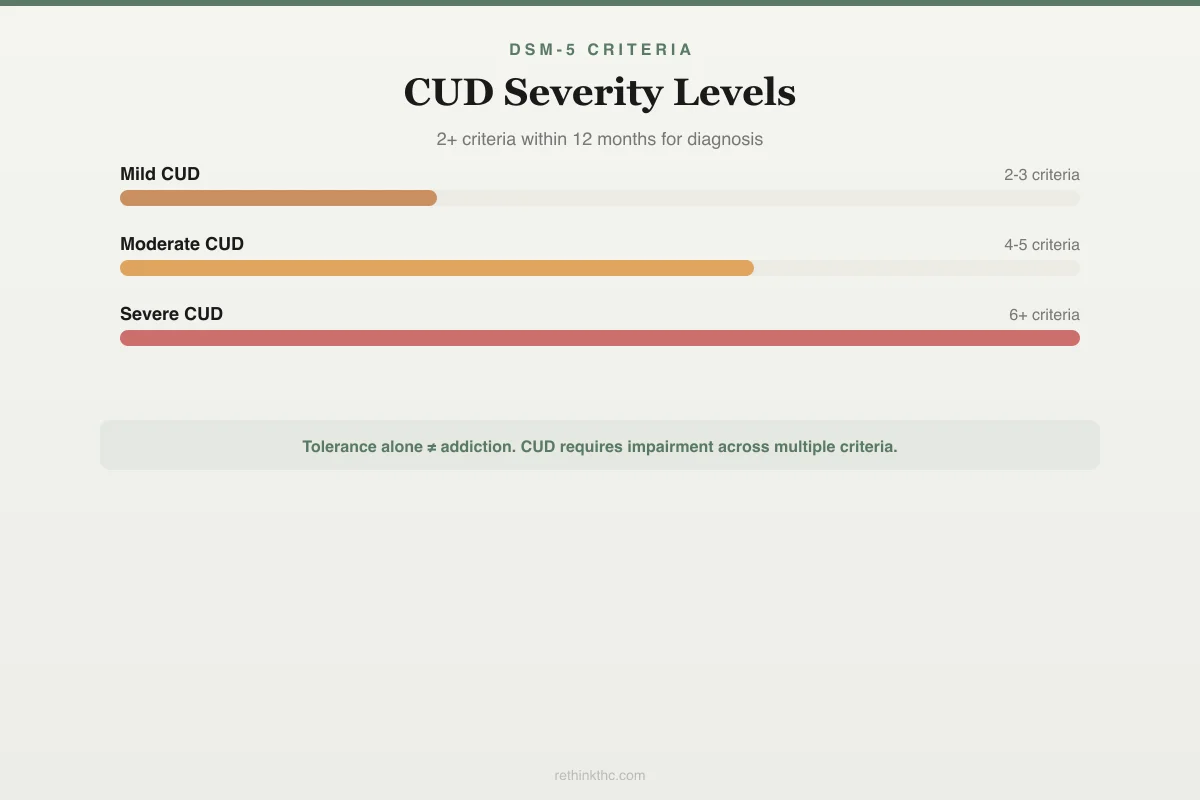
- CUD exists on a spectrum: mild (2-3 criteria), moderate (4-5 criteria), and severe (6 or more criteria), so not every diagnosis looks the same
- Nearly half — 47% — of regular cannabis users get clinically significant withdrawal symptoms when they stop, which is itself one of the 11 DSM-5 criteria
There is a version of this article that tries to scare you into thinking you have a serious problem. This is not that article. There is another version that dismisses the entire concept of cannabis addiction as propaganda. This is not that article either. What follows is a straightforward walk through the clinical criteria for Cannabis Use Disorder, translated into language that actually makes sense, so you can evaluate your own situation with clarity rather than fear or denial.
What Cannabis Use Disorder Actually Is
Cannabis Use Disorder (CUD) is the clinical term used in the DSM-5, which is the Diagnostic and Statistical Manual of Mental Disorders, the standard reference guide used by psychiatrists and psychologists to diagnose mental health conditions. It replaced the older categories of "cannabis abuse" and "cannabis dependence" with a single, spectrum-based diagnosis.
DSM-5 Criteria
Cannabis Use Disorder Severity Levels
Diagnosis requires 2+ criteria within a 12-month period. Severity depends on how many you meet.
- •Using more than intended
- •Unsuccessful efforts to cut down
- •Craving cannabis
- •Tolerance developed
- •Withdrawal symptoms
- •Giving up activities
- •More time spent using/recovering
- •Continued use despite problems
- •Social/occupational impairment
- •Use in hazardous situations
- •Use despite physical/psychological harm
Tolerance alone ≠ addiction. CUD requires a pattern of impairment or distress across multiple criteria.
Based on DSM-5, Hasin et al. (2015)
 View as image ↗
The shift to a spectrum model was important because it reflects reality. Problematic cannabis use is not an on-off switch. You do not go from "totally fine" to "addicted" overnight. It is a gradient, and the DSM-5 acknowledges that by sorting CUD into three severity levels based on how many criteria you meet.
A 2015 study by Hasin and colleagues, published in JAMA Psychiatry, found that CUD prevalence among American adults doubled between 2001 and 2013, rising from 1.5% to 2.9% of the population.[1] That increase coincided with rising potency, increased availability, and shifting cultural norms around cannabis use. More people are using, more people are using heavily, and more people are meeting criteria for a use disorder.
Prevalence Data
Cannabis Use Disorder Doubled in 12 Years
More people using + higher potency = more people crossing the clinical threshold
2001–02
2012–13
9%
of all people who try cannabis develop dependence
17%
if they started as teenagers
Hasin et al. (2015), JAMA Psychiatry · Volkow et al. (2014), NEJM
 View as image ↗
The 11 DSM-5 Criteria, in Plain Language
The DSM-5 lists 11 criteria for Cannabis Use Disorder. Meeting 2 or more within a 12-month period qualifies for a diagnosis. Below is each criterion in its clinical form, followed by what it actually looks like in everyday life.
1. Using more than intended
Clinical language: Taking cannabis in larger amounts or over a longer period than was intended.
What it looks like: You tell yourself you are going to take two hits and end up smoking the whole bowl. You plan to use only at night and find yourself lighting up in the afternoon. You pick up an eighth thinking it will last a week and it is gone in three days. The pattern is not about one isolated instance of overdoing it. It is about a consistent gap between what you plan and what actually happens.
2. Wanting to cut down but being unable to
Clinical language: A persistent desire or unsuccessful efforts to cut down or control cannabis use.
What it looks like: You have told yourself (or others) that you are going to cut back. Maybe you have tried. Maybe you have tried multiple times. You set rules, and you break them. You delete your dealer's number, then get it back. You throw out your stash, then buy more the next day. The wanting is real. The follow-through keeps failing. This is one of the most telling criteria because it reveals a disconnect between intention and action.
3. Spending significant time on cannabis-related activities
Clinical language: A great deal of time spent in activities necessary to obtain, use, or recover from cannabis effects.
What it looks like: Your day is organized around use. You spend time planning when and where you will smoke, making sure your supply is stocked, arranging your schedule so you can be high without consequences, or spending mornings feeling foggy and slow from the night before. If cannabis-related activities occupy a meaningful portion of your waking hours, this criterion is likely met.
4. Cravings
Clinical language: Craving, or a strong desire or urge to use cannabis.
What it looks like: You think about using when you are not using. You feel a pull toward it, especially in certain situations (after work, when bored, when stressed, when socializing). The thought of not having access to cannabis produces anxiety or restlessness. Cravings are different from simply enjoying something. They involve an urgency that feels more like need than want.
5. Failing to fulfill major responsibilities
Clinical language: Recurrent cannabis use resulting in a failure to fulfill major role obligations at work, school, or home.
What it looks like: You have called in sick because you were too high or too foggy. You have missed deadlines, forgotten commitments, or underperformed at work because of your use. Your grades have slipped. Household tasks pile up. You are showing up to your life, but you are showing up impaired or depleted in ways that are affecting your performance.
6. Continued use despite social problems
Clinical language: Continued cannabis use despite having persistent or recurrent social or interpersonal problems caused or exacerbated by use.
What it looks like: Your partner has expressed concern about your use, and you keep using. Friends have pulled away because they find you less present or engaged when you are high. Family relationships are strained. Arguments about cannabis have become a recurring theme. The key is not that other people disapprove (that alone does not mean much). The key is that your use is causing real friction in relationships, and you continue anyway.
7. Giving up important activities
Clinical language: Important social, occupational, or recreational activities are given up or reduced because of cannabis use.
What it looks like: You used to exercise regularly and stopped. You used to paint, play music, go hiking, see friends. Now you mostly stay home and smoke. Hobbies have narrowed. Your social life has contracted. The things that used to matter have gradually been replaced by getting high, not because you made a conscious decision to stop doing them, but because cannabis became the default activity and everything else faded.
8. Use in physically hazardous situations
Clinical language: Recurrent cannabis use in situations in which it is physically hazardous.
What it looks like: Driving while high. Operating machinery while impaired. Using in situations where your reflexes and judgment need to be sharp. Many regular users normalize driving after smoking because they believe they have "built a tolerance" to the impairment, but research consistently shows that cannabis impairs reaction time and divided attention regardless of tolerance level.
9. Continued use despite physical or psychological problems
Clinical language: Cannabis use is continued despite knowledge of having a persistent or recurrent physical or psychological problem that is likely to have been caused or exacerbated by cannabis.
What it looks like: You know cannabis is making your anxiety worse, but you keep using. Your chronic cough is clearly related to smoking, but you continue. You have been told that cannabis is interacting poorly with your mental health, and you use anyway. This is not about ignorance. It is about continuing a behavior you already know is causing harm.
10. Tolerance
Clinical language: Tolerance, as defined by either a need for markedly increased amounts to achieve the desired effect, or a markedly diminished effect with continued use of the same amount.
What it looks like: The amount that used to get you high barely produces a buzz now. You have moved from flower to concentrates because flower stopped being strong enough. You have steadily increased your dose over months or years to chase the same effect. This is the most commonly experienced criterion among regular users. Research by Hirvonen and colleagues (2012, Molecular Psychiatry) documented the biological basis: chronic use causes CB1 receptor downregulation, meaning your brain literally has fewer receptors available for THC to activate.
11. Withdrawal
Clinical language: Withdrawal, as manifested by either the characteristic cannabis withdrawal syndrome, or cannabis is taken to relieve or avoid withdrawal symptoms.
What it looks like: When you go without cannabis for a day or more, you experience irritability, sleep disruption, decreased appetite, restlessness, anxiety, or physical discomfort. Or you keep using specifically to avoid those symptoms. A 2020 meta-analysis by Bahji and colleagues, published in JAMA Network Open, found that approximately 47% of regular cannabis users experience clinically significant withdrawal symptoms.[2] If you have ever felt noticeably worse after a day without cannabis and then felt better immediately after using, withdrawal is likely in play.
Bahji et al. (2020) · JAMA Network Open
- Population
- 27,461 regular or dependent cannabis users across 23 studies
- Intervention
- Systematic review and meta-analysis of withdrawal prevalence
- Comparator
- N/A — pooled analysis of existing research
- Finding
- 47% of regular cannabis users experience clinically significant withdrawal symptoms — irritability, anxiety, sleep difficulty, decreased appetite, and restlessness were most common
positive Large meta-analysis confirming that withdrawal is a real, common phenomenon — not rare or minor
Bahji et al. (2020), JAMA Network Open, 3(4), e202370
Severity Levels: Where Do You Fall?
The DSM-5 classifies CUD severity based on how many criteria you meet within a 12-month period.
Mild CUD (2-3 criteria). This is the entry level of the diagnosis. Many people with mild CUD experience tolerance and one or two other criteria, like using more than intended or wanting to cut down without success. Mild CUD does not mean your life is falling apart. It means a pattern has developed that is worth your attention.
Moderate CUD (4-5 criteria). At this level, cannabis use is causing problems across multiple areas of your life. You are likely experiencing both physical symptoms (tolerance, possibly withdrawal) and behavioral patterns (giving up activities, failing responsibilities, continued use despite problems). Moderate CUD typically benefits from some form of structured support, whether that is professional help, a guided break, or a deliberate change plan.
Severe CUD (6 or more criteria). Severe CUD indicates that cannabis use has become a dominant force in your daily life, affecting your health, relationships, responsibilities, and psychological well-being simultaneously. At this level, professional support is strongly recommended, and moderation is significantly less likely to be a successful strategy compared to a period of full abstinence.
An Honest Self-Reflection Framework
This is not a diagnostic tool. Only a qualified professional can diagnose CUD. But you can use the following questions for honest self-assessment.
Read each question and sit with it before answering. The goal is not to label yourself. The goal is clarity.
Over the past 12 months, have you repeatedly used more cannabis than you planned to? Have you tried to cut back and found yourself unable to follow through? Is a significant portion of your day spent using, planning to use, or recovering from use? Do you experience strong urges to use that feel hard to ignore? Has your use caused you to miss work, underperform, or neglect responsibilities? Have relationships been strained or damaged by your cannabis use? Have you dropped activities you used to care about? Have you used in situations where it put your safety or others' safety at risk? Have you continued using despite knowing it was making a physical or psychological problem worse? Do you need more cannabis to achieve the same effect? Do you feel worse (irritable, unable to sleep, anxious, restless) when you go without it?
Count honestly. Two or more "yes" answers suggests it is worth exploring further, whether through self-directed change, reading more, or talking to someone qualified.
Evidence Review
Where the evidence stands
Cell & Lab Studies
CB1 receptor downregulation and dopamine signaling changes well-documented at cellular level
Animal Studies
Animal models confirm tolerance, withdrawal, and dependence mechanisms from chronic THC exposure
Clinical Observations
Decades of clinical practice and case documentation informed DSM-5 criteria development
Epidemiological Studies
Hasin (2015): 36,000+ adults; Bahji (2020): 27,461 users across 23 studies
Large Population Surveys
National Epidemiologic Survey on Alcohol and Related Conditions (NESARC) — gold standard data
Meta-Analyses & Reviews
Volkow (2014) NEJM review; Bahji (2020) withdrawal meta-analysis; DSM-5 committee review
Cannabis Use Disorder is one of the best-established substance use diagnoses in psychiatry. The evidence base spans cellular neuroscience through massive population surveys. The DSM-5 criteria were validated across multiple large studies. This is not a controversial or speculative diagnosis.
Hasin et al. (2015), Bahji et al. (2020), Volkow et al. (2014), DSM-5
Why People Resist the Label
If you counted a few "yes" answers and immediately felt defensive, that is normal. There are real reasons people resist thinking of themselves as having a use disorder.
Cultural stigma. Despite progress, the word "disorder" still carries weight. It sounds clinical, permanent, and heavy. Many people hear "Cannabis Use Disorder" and translate it into the worst-case scenario, associating it with the most extreme end of substance use. But mild CUD is not the same as severe CUD, just as mild depression is not the same as severe depression. The spectrum exists for a reason.
Identity threat. If cannabis is part of your identity, your social circle, or your culture, a CUD diagnosis can feel like an attack on who you are. It is not. A diagnosis describes a pattern of behavior, not a permanent character trait. You are not your use pattern.
Minimization by peers. If everyone around you uses as much as you do, your use feels normal. The criteria above exist precisely because peer comparison is unreliable. "Everyone I know does this" is not a clinical benchmark.
Fear of what it means. Some people avoid the assessment because they are afraid of what the answer implies. If I have CUD, does that mean I have to quit? Does it mean I have been lying to myself? Does it mean all the good experiences I associate with cannabis were actually a problem? The answer to all three is: not necessarily. But ignoring information because you are afraid of it has never been a good strategy.
What a CUD Diagnosis Does and Does Not Mean
It does not mean you are weak. Dependence involves neurobiological changes, particularly CB1 receptor downregulation and alterations in dopamine signaling. Research by Volkow and colleagues, published in 2014 in the New England Journal of Medicine, established that approximately 9% of people who use cannabis develop dependence, and that this rate rises to roughly 17% for those who begin using as adolescents. These are not rates that reflect personal failure. They reflect biological variability in how brains respond to THC.
It does not mean you must quit forever. Some people with mild CUD can successfully transition to lower-risk use patterns after a period of abstinence and structured change. Others find that abstinence is the only approach that works for them. The diagnosis tells you where you are. What you do about it is a decision you make with full information.
It does mean the pattern is worth addressing. Left unexamined, problematic use patterns tend to intensify rather than resolve on their own. If you meet criteria for CUD, doing nothing is itself a choice, and it is rarely the choice that leads to the outcome you want. Whether you pursue quitting, professional support, or a structured change plan, the fact that you are assessing your use honestly puts you ahead of where you were before.
It is a starting point, not a verdict. A CUD diagnosis opens doors to strategies, support, and understanding. It does not close doors. Knowing that weed is addictive for some people and understanding the science behind that addictive potential gives you a foundation for making choices that are informed rather than reactive.
The Numbers in Context
Understanding how common CUD is can help normalize the assessment rather than making it feel like a personal failing.
Hasin et al. (2015) · JAMA Psychiatry
- Population
- Over 36,000 American adults surveyed in 2001-02 and again in 2012-13 (NESARC)
- Intervention
- National population survey comparing CUD prevalence across two time points
- Comparator
- Same methodology applied 12 years apart
- Finding
- Past-year cannabis use rose from 4.1% to 9.5% of adults; CUD prevalence doubled from 1.5% to 2.9% — about 1 in 34 American adults met criteria by 2012-13
positive Gold-standard epidemiological data from the largest US survey of its kind
Hasin et al. (2015), JAMA Psychiatry, 72(12), 1235-1242
The Anthony 1994 study found that about 9% of ever-users develop cannabis dependence. That is roughly 1 in 11. If you know 11 people who have tried cannabis, statistically, one of them will develop a use disorder. This is not rare, and it is not something that only happens to people with obvious problems.
The Volkow 2014 review in the New England Journal of Medicine noted that the rate climbs to about 17% among those who started using as teenagers, which highlights that age of onset matters significantly.
And the Hasin 2015 data[1] showing that CUD prevalence doubled in just over a decade suggests the problem is growing, likely driven by higher-potency products, more frequent use patterns, and greater availability. The weed your parents smoked is not the weed available today.
Next Steps
If this assessment raised questions, here is where to go next.
If you think you may have mild CUD and want to try changing your pattern on your own, our guide on whether you should quit weed can help you think through your options.
If you want to understand the clinical and scientific basis for cannabis addiction in more depth, is weed addictive covers the research comprehensively.
If you decide that a period of abstinence is the right call, how to quit weed provides a structured, realistic approach.
Whatever you decide, the fact that you read this far and answered honestly matters. Most people never get past denial. You did.
When to Seek Professional Help
If you meet criteria for moderate or severe CUD, if you have tried to quit or cut back repeatedly without success, or if your cannabis use is significantly affecting your mental health, relationships, or ability to function, professional support can make a real difference. Therapists and counselors who specialize in substance use disorders can provide strategies and support tailored to your specific situation.
SAMHSA's National Helpline is available at 1-800-662-4357. It is free, confidential, and available 24 hours a day, 7 days a week. You can also text "HELLO" to 741741 to reach the Crisis Text Line.
The Bottom Line
Cannabis Use Disorder (CUD) is diagnosed using 11 DSM-5 criteria spanning tolerance, withdrawal, using more than intended, inability to cut down, cravings, neglected responsibilities, social problems, abandoned activities, hazardous use, and continued use despite harm. Meeting just 2 criteria within a 12-month period qualifies as mild CUD. About 9% of people who try cannabis develop dependence, rising to 17% for adolescent-onset users. CUD prevalence doubled between 2001 and 2013. A 2020 meta-analysis found that 47% of regular users experience clinically significant withdrawal. CUD does not mean you must quit forever. It means a pattern has crossed a clinical threshold worth addressing. Severity exists on a spectrum, and the appropriate response ranges from structured moderation to professional support depending on where you fall.
What is Cannabis Use Disorder?
Cannabis Use Disorder is the clinical diagnosis in the DSM-5 for problematic cannabis use. It is defined by meeting 2 or more of 11 criteria within a 12-month period, including symptoms like using more than intended, inability to cut down, tolerance, withdrawal, and continued use despite negative consequences. It exists on a spectrum from mild (2-3 criteria) to moderate (4-5) to severe (6 or more).
How common is Cannabis Use Disorder?
About 9% of people who have ever used cannabis develop dependence. Among current regular users, the rate is significantly higher. A major study found that CUD prevalence among American adults doubled between 2001 and 2013, from 1.5% to 2.9%. People who start using as teenagers have a higher risk, with approximately 17% developing dependence.
Can you have Cannabis Use Disorder and still function normally?
Yes, particularly at the mild end of the spectrum. Many people with mild CUD hold jobs, maintain relationships, and appear to function well from the outside. The criteria measure patterns like tolerance, using more than intended, and unsuccessful attempts to cut down, which can all exist alongside outward functioning. "Functional" use and problematic use are not mutually exclusive.
Does having Cannabis Use Disorder mean I am addicted to weed?
CUD is the clinical framework that replaced the older term "cannabis dependence." Whether you use the word "addicted" is partly a matter of language. What CUD means clinically is that your use pattern meets specific criteria for a substance use disorder. Mild CUD is a lower threshold than what most people picture when they hear "addiction," but it still indicates a pattern that is worth addressing.
Can Cannabis Use Disorder be treated without quitting completely?
For some people with mild CUD, transitioning to a lower-risk use pattern is possible, especially after a period of abstinence that allows the brain to reset. However, for moderate to severe CUD, research suggests that abstinence-based approaches tend to produce better outcomes. A professional can help you assess which approach is most realistic for your specific situation and severity level.
Why has Cannabis Use Disorder become more common?
CUD prevalence doubled between 2001 and 2013, driven by several converging factors. THC potency tripled between 1995 and 2014, concentrates pushed potency even higher, cultural normalization reduced perceived risk, and increased availability (through legalization and broader access) expanded the user population. Higher potency means faster tolerance development and more aggressive receptor downregulation, which accelerates the progression toward dependence. The cannabis available today produces a different neurochemical experience than what was available a generation ago.
Sources & References
- 1RTHC-00975·Hasin, Deborah S. et al. (2015). “The Largest Study of Cannabis Addiction in America.” JAMA Psychiatry.Study breakdown →PubMed →↩
- 2RTHC-02407·Bahji, Anees et al. (2020). “About Half of Heavy Cannabis Users Experience Withdrawal. This Meta-Analysis Measured It..” JAMA Network Open.Study breakdown →PubMed →↩