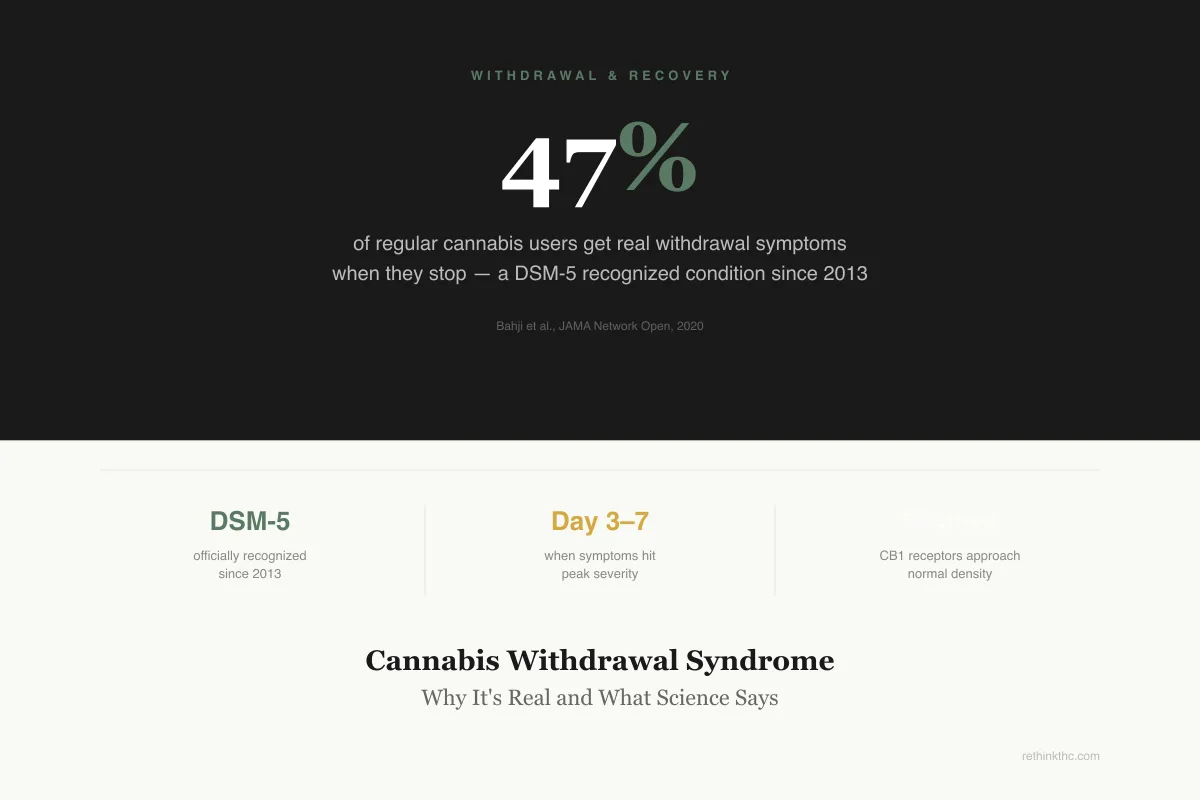
Withdrawal & Recovery
47%
About 47% of regular cannabis users get real withdrawal symptoms when they stop — a DSM-5 recognized condition since 2013.
Bahji et al., JAMA Network Open, 2020
DSM-5
Cannabis withdrawal officially recognized since 2013
Day 3–7
When withdrawal symptoms hit their peak severity
28 days
CB1 receptors approach normal density (PET imaging)
Bahji et al., JAMA Network Open, 2020
 View as image ↗
If you only read one thing
Cannabis withdrawal is real. It's in the DSM-5 (the manual doctors use to diagnose every mental health condition) and it affects about 47% of regular users. When you quit, your brain has fewer cannabinoid receptors than normal because it pulled them back while you were using. That gap is what causes the insomnia, irritability, anxiety, and appetite loss. It peaks around days 3 to 7 and mostly resolves within a month. It's not dangerous like alcohol withdrawal — but it's genuinely miserable, and you're not imagining it.
Someone told you weed is not addictive. Maybe a friend, maybe the internet, maybe the person who sold it to you. Then you tried to quit, and your body responded with insomnia, irritability, nausea, and a general misery that does not match what you were told to expect. If you are here because you feel like something is wrong with you, nothing is wrong with you. Cannabis withdrawal syndrome is a medically recognized condition with decades of research behind it. The disconnect is not between your experience and reality. The disconnect is between your experience and what popular culture has been saying for 50 years.
Key Takeaways
- Cannabis withdrawal syndrome is a real medical condition — it has been in the DSM-5 (the standard psychiatric diagnostic manual) since 2013
- About 47% of regular cannabis users get real withdrawal symptoms when they stop
- This is caused by measurable changes in your brain's endocannabinoid system, not a lack of willpower
- How bad it gets depends on how much you used, how long, the potency of your products, and your individual biology
- Cannabis withdrawal is not dangerous the way alcohol or benzodiazepine withdrawal can be, but it is genuinely disruptive and deserves to be taken seriously
- Your CB1 receptors start recovering within two days of quitting and get close to normal by about four weeks
Fact Check
The claim you've probably heard a hundred times
The claim
“Weed isn't addictive and doesn't cause withdrawal — it's just a plant”
Decades of legalization advocacy that overcorrected by minimizing all risks
What research shows
MisleadingA meta-analysis of 47 studies covering 23,518 people found that 47% of regular cannabis users experience clinically significant withdrawal symptoms. Cannabis withdrawal has been in the DSM-5 since 2013 and the ICD-10 internationally. The mechanism — CB1 receptor downregulation — is confirmed by PET brain imaging.
Cannabis withdrawal is genuinely less dangerous than alcohol or benzodiazepine withdrawal. It won't kill you. But 'less dangerous' got compressed into 'doesn't exist,' which is a completely different claim. Nearly half of regular users would disagree.
Bahji et al. (2020), JAMA Network Open — 47 studies, 23,518 participants
You Are Not Imagining This
This needs to be said plainly: what you are going through is real. It has a name. It has diagnostic criteria. It has been studied in peer-reviewed research for over two decades. The reason so many people doubt cannabis withdrawal syndrome exists is not because the science is unclear. It is because cultural narratives about cannabis have lagged decades behind the research.
For most of the 20th century, cannabis was framed in one of two extremes. One side said it was a dangerous gateway drug that would ruin your life. The other side pushed back by insisting it was completely harmless, non-addictive, and basically a plant-based vitamin. Neither side was accurate, and both made it harder for people to get honest information.
The truth is in the middle. Cannabis is not heroin. Quitting will not kill you. But regular use changes your brain chemistry in measurable, predictable ways, and stopping after extended use produces a real withdrawal syndrome that affects nearly half of frequent users. A 2020 meta-analysis in JAMA Network Open analyzing data from 47 studies found that approximately 47% of regular cannabis users experience clinically significant withdrawal symptoms.[1]
The DSM-5 Diagnostic Criteria
In 2013, the American Psychiatric Association added cannabis withdrawal to the DSM-5 (Diagnostic and Statistical Manual of Mental Disorders, Fifth Edition). This is the standard reference that psychiatrists, psychologists, and therapists across the country use to diagnose every recognized mental health condition. Depression is in there. Anxiety is in there. PTSD is in there. And now cannabis withdrawal is in there.
The DSM-5 diagnostic criteria for cannabis withdrawal syndrome require three or more of the following symptoms developing within approximately one week of stopping heavy, prolonged use:[2]
| DSM-5 Criterion | What It Feels Like | Why It Happens |
|---|---|---|
| Irritability, anger, or aggression | Short fuse, snapping at people, rage over minor things | ECS normally dampens stress response; without THC, stress signals are amplified |
| Nervousness or anxiety | Racing thoughts, feeling on edge, dread without cause | CB1 receptors in the amygdala (fear center) are underactivated |
| Sleep difficulty | Cannot fall asleep, vivid dreams, waking frequently | ECS regulates sleep architecture; disruption causes insomnia and REM rebound |
| Decreased appetite or weight loss | Food is unappealing, nausea at mealtimes | CB1 receptors in the hypothalamus normally stimulate hunger signals |
| Restlessness | Cannot sit still, pacing, fidgeting | Autonomic nervous system recalibrating without cannabinoid modulation |
| Depressed mood | Flat affect, nothing feels good, the "gray period" | Dopamine system downregulation reduces reward signaling |
| Physical symptoms | Stomach pain, sweating, fever, chills, headache, shakiness | Autonomic nervous system and temperature regulation disrupted |
The inclusion in the DSM-5 was not political. It was the result of accumulated clinical evidence that became too strong to exclude. A 2003 controlled-abstinence study published in the Journal of Abnormal Psychology was among the early research demonstrating that cannabis withdrawal produces a consistent, replicable symptom pattern distinct from general discomfort or pre-existing conditions.[3] A 2022 study further validated the DSM-5 diagnostic construct, confirming that cannabis use disorder severity levels meaningfully distinguish between different levels of impairment.[4]
Cannabis withdrawal is also recognized in the ICD-10 (International Classification of Diseases), the diagnostic system used by most countries outside the United States. A 2016 study found strong diagnostic concordance between DSM-5 and ICD-10 cannabis use disorder criteria, meaning both systems identify largely the same population of people with problematic use patterns.[5]
If a doctor or therapist tells you cannabis withdrawal is not real, they are working from outdated information. The diagnostic manuals they use every day disagree with them.
Why So Many People Still Do Not Believe It
The cultural dismissal of cannabis withdrawal has a few roots.
Comparison to "hard drugs." When people think of withdrawal, they picture the dramatic portrayals of heroin or alcohol withdrawal from movies and television. Shaking, seizures, medical emergencies. Cannabis withdrawal does not look like that. It does not send you to the emergency room. So people conclude it must not be real. This is like saying a broken finger is not a real injury because it is not a broken leg. The comparison is irrelevant to the person experiencing it.
| Withdrawal Type | Medical Danger | Typical Duration | Key Symptoms | Medication Required? |
|---|---|---|---|---|
| Cannabis | Not dangerous | 1–4 weeks (sleep up to 45 days) | Irritability, insomnia, appetite loss, anxiety, vivid dreams | No, but supportive care helps |
| Nicotine | Not dangerous | 2–4 weeks | Irritability, cravings, difficulty concentrating, increased appetite | Optional (NRT, varenicline) |
| Alcohol | Potentially fatal | 3–7 days (acute), weeks (PAWS) | Tremors, seizures, delirium tremens, anxiety, hallucinations | Often required; medical supervision recommended |
| Opioids | Rarely dangerous | 5–10 days (acute), months (PAWS) | Muscle pain, vomiting, diarrhea, insomnia, intense cravings | Often required (buprenorphine, methadone) |
| Benzodiazepines | Potentially fatal | Weeks to months | Seizures, rebound anxiety, insomnia, tremors, psychosis | Required; must taper under medical supervision |
Decades of counter-messaging. Cannabis legalization advocacy, for understandable political reasons, often emphasized safety and minimized risks. The message "cannabis is safer than alcohol" is true when it comes to overdose potential and acute medical danger. But it got compressed into "cannabis has no downsides," which is a different claim entirely.
Individual variation. Not everyone who quits weed experiences withdrawal. About 47% of regular users do.[1] If you are in the 53% who quit without major symptoms, you might genuinely not understand what the other half is going through. This does not mean their experience is fake. It means withdrawal severity exists on a spectrum, just like every other physiological response.
Bahji et al. (2020) · JAMA Network Open
- Population
- 23,518 regular cannabis users across 47 studies
- Intervention
- Cessation or reduction of regular cannabis use
- Comparator
- Stratified by setting: population-based, outpatient, and inpatient samples
- Finding
- Overall 47% prevalence. Broke down to 17% in general population samples, 54% in outpatient settings, and 87% in inpatient settings. Daily use and tobacco co-use both significantly increased risk.
positive Largest meta-analysis on cannabis withdrawal — published in a top-tier JAMA journal
Bahji et al. (2020), JAMA Network Open
Underdiagnosis. Research has found that cannabis use disorders are significantly underdiagnosed, even in clinical settings where screening should be routine. A study of military veterans found that cannabis use disorders were among the most commonly underdiagnosed substance use conditions.[6] If clinicians are not screening for it, they are certainly not warning patients about withdrawal.
The Neuroscience: What Is Actually Happening in Your Brain
Your body has a built-in system called the endocannabinoid system (ECS). It was there before you ever used cannabis. It helps regulate mood, sleep, appetite, pain perception, stress response, and immune function. It does this using chemicals your body naturally produces, called endocannabinoids, and a network of receptors where those chemicals attach. For a deeper explanation, see your endocannabinoid system explained simply.
The most important receptor for understanding withdrawal is the CB1 receptor. These receptors are concentrated in areas of your brain responsible for mood, memory, appetite, and sleep. THC, the primary psychoactive compound in cannabis, activates CB1 receptors powerfully — much more powerfully than your body's own endocannabinoids. The diagram below walks through what happens to this system in four stages — from your pre-cannabis baseline through active use, withdrawal, and recovery.
Neuroscience
Why Withdrawal Happens: The ECS Mechanism
How your endocannabinoid system adapts to THC — and what breaks when you stop
Before Cannabis Use
CB1 Receptors
Full density
Normal population across brain regions
Endocannabinoids
Self-produced
Anandamide and 2-AG at baseline levels
System Status
Balanced
Mood, sleep, appetite, stress all regulated
During Regular Use
CB1 Receptors
Downregulated
Brain reduces receptor count to compensate
Endocannabinoids
Suppressed
Natural production decreases — THC replaces them
System Status
THC-dependent
Functions normally only with external THC
After Quitting (Withdrawal)
CB1 Receptors
Depleted
Fewer receptors + no THC = underactive system
Endocannabinoids
Not yet restored
Natural production takes days to weeks to resume
System Status
Disrupted
Sleep, mood, appetite, stress all dysregulated
2–4 Weeks: Recovery
CB1 Receptors
Rebuilding
Recovery begins within 2 days, near-normal by ~4 weeks
Endocannabinoids
Resuming
Natural production gradually restores
System Status
Rebalancing
Symptoms fade as system comes back online
Hirvonen et al. (2012), Molecular Psychiatry
View as image ↗When you use cannabis regularly, your brain adapts to the constant flood of THC by doing two things. First, it reduces the number of CB1 receptors available. This is called downregulation. Second, it decreases its own production of natural endocannabinoids. Your brain is essentially saying: "There is plenty of this chemical coming from outside. I do not need to make my own or maintain all these receptors."
A landmark 2012 study published in Molecular Psychiatry used PET brain imaging to confirm that chronic cannabis users show significantly reduced CB1 receptor availability compared to non-users. The study also found that these receptors begin recovering within just two days of abstinence and approach normal levels by approximately four weeks.[7]
Here is where withdrawal comes in. When you stop using cannabis, the external THC disappears. But your brain has not yet rebuilt its receptor population or restored its natural endocannabinoid production. You are left with a system that is running on reduced hardware and reduced fuel. Every function the endocannabinoid system manages (sleep, appetite, mood, stress regulation, temperature control) gets disrupted because the system is temporarily impaired.
That is why withdrawal symptoms map so precisely to the functions of the endocannabinoid system. Cannot sleep? The ECS regulates sleep. No appetite? The ECS regulates hunger signaling. Irritable and anxious? The ECS modulates stress response. Sweating at night? The ECS helps regulate body temperature. Each symptom has a direct biological explanation.
This is the same basic mechanism behind every substance withdrawal syndrome. The brain adapts to an external chemical, becomes dependent on it for normal function, and then struggles temporarily when it is removed. The pattern is the same whether the substance is caffeine, nicotine, alcohol, or cannabis. The severity and danger vary enormously, but the mechanism is universal.
For a deeper look at each specific symptom and why it occurs, see the complete guide to cannabis withdrawal. For more on what happens to your reward system specifically, see dopamine recovery after quitting weed.
Evidence Review
Where the evidence stands
Cell & Lab Studies
CB1 receptor downregulation and endocannabinoid system disruption well-characterized at molecular level
Animal Studies
THC withdrawal syndrome replicated in rodent models with predictable symptom patterns
Controlled Abstinence Studies
Budney 2003 — inpatient monitoring confirmed consistent, replicable withdrawal pattern
Human Brain Imaging
Hirvonen 2012 — PET scans confirm CB1 receptor downregulation and recovery timeline
Large Meta-Analysis
Bahji 2020 — 47 studies, 23,518 participants. 47% prevalence confirmed.
Diagnostic Manual Recognition
DSM-5 (2013) and ICD-10 both include cannabis withdrawal as an official diagnosis
Cannabis withdrawal syndrome has one of the strongest evidence bases in addiction medicine. It's confirmed by brain imaging, replicated in controlled studies, validated by the largest meta-analysis in the field, and recognized in both major diagnostic manuals worldwide. The science is settled — withdrawal is real.
Bahji et al. (2020), Hirvonen et al. (2012), Budney et al. (2003), DSM-5 (2013)
Why Severity Varies So Much From Person to Person
You might know someone who quit after years of daily use and felt "mostly fine." You might also know someone who used for six months and had a brutal withdrawal. Both of those experiences can be true. Research has identified several factors that influence withdrawal severity.
| Risk Factor | Effect on Withdrawal | Why |
|---|---|---|
| Daily use (vs. occasional) | Significantly increases severity | More consistent CB1 receptor exposure leads to deeper downregulation |
| Years of use | Longer duration correlates with more symptoms | Neuroadaptation becomes more entrenched over time |
| High-potency products | Associated with more severe withdrawal | Higher THC delivery causes more aggressive receptor changes |
| Concurrent tobacco use | Compounds withdrawal symptoms | Nicotine withdrawal runs alongside cannabis withdrawal |
| Genetics | Explains individual variation | CB1 receptor gene variants influence adaptation and recovery rate |
| Mental health conditions | May intensify certain symptoms | Pre-existing anxiety or depression amplifies overlapping withdrawal symptoms |
Frequency of use. Daily users are significantly more likely to experience withdrawal than occasional users. The more consistently you exposed your brain to THC, the more thoroughly it adapted.
Duration of use. Years of daily use produces deeper neuroadaptation than months. This does not mean short-term users are immune to withdrawal, but longer duration generally correlates with more pronounced symptoms. Inpatient monitoring of chronic cannabis users during detoxification has confirmed that withdrawal follows a predictable trajectory, with symptom severity correlating to THC metabolite levels in blood.[8]
Potency of products. This is an increasingly relevant factor. Concentrates, high-THC flower, and edibles deliver far more THC per session than the cannabis available 20 or 30 years ago. A 2025 systematic review found that daily use of high-potency cannabis is associated with significantly elevated health risks, including more aggressive neuroadaptation and greater withdrawal severity.[9] Higher THC exposure means more aggressive CB1 downregulation, which means a wider gap when you quit. For more on this, see dab and concentrate addiction and withdrawal.
Genetics and individual biology. Your endocannabinoid system has a genetically determined baseline. A 2013 genetic study found that variations in the genes coding for CB1 receptors and endocannabinoid-metabolizing enzymes influence both susceptibility to cannabis withdrawal and symptom severity.[10] This is why two people with identical usage patterns can have very different withdrawal experiences.
Concurrent use of other substances. Tobacco use in particular has been shown to worsen cannabis withdrawal symptoms. Research has confirmed that tobacco dependence worsens the cannabis withdrawal trajectory, with co-users experiencing more severe and prolonged symptoms.[11] If you smoke blunts or mix tobacco with cannabis, your withdrawal may be compounded by nicotine withdrawal running alongside it.
Putting It in Context (Without Minimizing It)
Cannabis withdrawal is not medically dangerous. It will not cause seizures. It will not cause delirium. It is not life-threatening. This distinguishes it sharply from alcohol withdrawal and benzodiazepine withdrawal, both of which can be fatal without medical supervision.
But "not dangerous" does not mean "not significant." Cannabis withdrawal syndrome is genuinely disruptive. It interferes with work, relationships, and daily functioning. The insomnia alone can be debilitating. The irritability can strain every relationship in your life. The anxiety can feel indistinguishable from a clinical anxiety disorder. And because so many people do not know withdrawal is real, they often lack any framework for understanding what they are experiencing, which makes it worse.
The sleep disruption in particular deserves attention. Clinical research has found that sleep disturbances can persist for 40 to 45 days after quitting.[12] That is over six weeks. The intense, vivid dreaming that many people experience is a phenomenon called REM sleep rebound, and understanding why it happens makes it much easier to tolerate.
If you want a detailed day-by-day breakdown of what to expect, see the marijuana withdrawal symptoms guide and the cannabis withdrawal timeline.
What You Can Do Right Now
Understanding the biology does not make withdrawal comfortable, but it does change how you interpret what is happening. When you know the irritability is caused by a temporarily disrupted endocannabinoid system and not by a personal flaw, it becomes easier to wait it out instead of acting on it.
A few evidence-supported strategies that can help:
Exercise. Physical activity is the single most consistently supported intervention for easing withdrawal symptoms. It promotes natural endocannabinoid production (your body's own version of what THC was providing), supports dopamine recovery, and directly improves sleep quality. Even a 20-minute walk makes a measurable difference.
Sleep hygiene. Keep a consistent sleep and wake schedule, even when you are not sleeping well. Avoid screens for an hour before bed. Keep your room cool and dark. These steps will not eliminate the insomnia, but they give your brain the best possible conditions to rebuild its sleep regulation. For a full guide, see how to sleep without weed.
Nutrition and hydration. Your appetite may be suppressed, but eating regular, balanced meals supports the neurochemical recovery process. Dehydration worsens headaches and irritability. For specific strategies, see appetite loss during weed withdrawal.
Ride the waves. Withdrawal symptoms are not constant. They come and go in waves, especially after the first week. Remind yourself during the hard moments that they are temporary. Judging your recovery by the week rather than the hour gives a much more accurate picture.
When to Seek Professional Help
Safety
ModerateWhen to get professional support
Concern
Most people get through cannabis withdrawal without medical help. But if symptoms are severe enough to disrupt your ability to work or care for yourself — or if you're experiencing intense anxiety, depression, or any thoughts of self-harm — that crosses the line from uncomfortable to clinically significant.
What the research says
Professional support doesn't mean you failed. It means your brain's adaptation was significant enough to need more tools. A doctor can help with sleep, a therapist can help with anxiety and coping strategies, and structured programs exist for people who've tried to quit multiple times.
Particularly relevant for: Anyone with withdrawal symptoms severe enough to interfere with daily functioning, or anyone experiencing thoughts of self-harm
What to do
SAMHSA's National Helpline: 1-800-662-4357 (free, confidential, 24/7). Crisis Text Line: text HOME to 741741. If you've tried to quit multiple times and withdrawal keeps pulling you back, structured support can make the difference.
Clinical consensus; Bonn-Miller et al. (2012) on underdiagnosis of cannabis use disorders
Most people get through cannabis withdrawal on their own. But there are situations where professional support makes a real difference.
Talk to a doctor or therapist if withdrawal symptoms are severe enough to disrupt your ability to work or care for yourself. If you are experiencing intense anxiety or depression that feels unmanageable, particularly any thoughts of self-harm, reach out to a professional immediately.
If you have attempted to quit multiple times and withdrawal keeps pulling you back, that is a sign that structured support could help. There is no shame in that. It means the neurological adaptation was significant, not that you are failing. Research has found that cannabis use disorder is significantly underdiagnosed, meaning many people who would benefit from clinical support are not receiving it.[6]
SAMHSA's National Helpline is available at 1-800-662-4357. It is free, confidential, and available 24 hours a day, 7 days a week. You can also text HOME to 741741 to reach the Crisis Text Line.
You Are Not Weak. Your Brain Is Recalibrating.
The fact that you looked up cannabis withdrawal syndrome means you are trying to understand what is happening to you. That is the opposite of weakness. Cannabis withdrawal is a temporary neurological adjustment with a known mechanism, a predictable timeline, and a definite endpoint. The people who told you it was not real were not lying to hurt you. They simply did not have the information. Now you do. The discomfort you are feeling is not a sign that something is broken. It is a sign that your brain is actively repairing itself. And it will finish the job.
The Bottom Line
Cannabis withdrawal syndrome is a medically recognized condition included in both the DSM-5 and ICD-10 diagnostic manuals. Approximately 47% of regular cannabis users experience clinically significant withdrawal symptoms when they stop, including irritability, insomnia, appetite loss, and anxiety. These symptoms result from measurable changes in the brain's endocannabinoid system — specifically CB1 receptor downregulation — not from a lack of willpower. The syndrome typically peaks between days three and seven, with most symptoms resolving within two to four weeks, though sleep disturbances can persist for up to 45 days.
Is cannabis withdrawal syndrome officially recognized by doctors?
Yes. Cannabis withdrawal syndrome was added to the DSM-5, the standard diagnostic manual used by psychiatrists and therapists, in 2013. It is also recognized in the ICD-10, the international diagnostic system used by most countries. It has specific diagnostic criteria requiring three or more defined symptoms within approximately one week of stopping heavy use. It is as officially recognized as any other withdrawal syndrome.
How long does cannabis withdrawal syndrome last?
Most acute symptoms peak between days three and seven and resolve substantially within two to four weeks. Sleep disturbances can persist for up to 45 days. The overall timeline depends on your usage patterns, with heavier and longer-term users generally experiencing a longer withdrawal period. For the full timeline, see the cannabis withdrawal timeline guide.
Can you have withdrawal from edibles or concentrates?
Yes. In fact, high-potency products like concentrates and strong edibles may produce more significant withdrawal because they deliver higher levels of THC, causing more aggressive CB1 receptor downregulation. A 2025 systematic review linked daily high-potency cannabis use to significantly elevated health risks, including greater withdrawal severity.
Is cannabis withdrawal dangerous?
Cannabis withdrawal is not medically dangerous. It does not cause seizures, delirium, or life-threatening complications. This is a key difference from alcohol and benzodiazepine withdrawal, both of which can be fatal without medical supervision. However, cannabis withdrawal can be very uncomfortable and disruptive to daily life, and it deserves proper support and understanding.
Why did I not have withdrawal the first time I quit but I do now?
Withdrawal severity depends on the degree of neurological adaptation your brain has undergone. If your earlier quit followed lighter or shorter-term use, your CB1 receptors may not have been as significantly downregulated. Heavier use, longer duration, and higher-potency products all increase the likelihood and severity of withdrawal upon stopping. Genetic factors also play a role in individual variation.
Does smoking tobacco with weed make withdrawal worse?
Yes. Research has confirmed that tobacco dependence worsens the cannabis withdrawal trajectory. If you smoke blunts, spliffs, or otherwise combine tobacco and cannabis, quitting means going through two withdrawal syndromes simultaneously. Nicotine withdrawal adds its own irritability, cravings, and concentration difficulties on top of the cannabis withdrawal symptoms.
Sources & References
- 1RTHC-02407·Bahji, Anees et al. (2020). “About Half of Heavy Cannabis Users Experience Withdrawal. This Meta-Analysis Measured It..” JAMA Network Open.Study breakdown →PubMed →↩
- 2RTHC-01172·Hasin, Deborah S et al. (2016). “National Survey Finds 2.5% of US Adults Had Cannabis Use Disorder in the Past Year, and Most Never Got Treatment.” The American journal of psychiatry.Study breakdown →PubMed →↩
- 3RTHC-00134·Budney, Alan J. et al. (2003). “When Heavy Users Quit Cannabis, Symptoms Show Up Fast and Ease Within Two Weeks.” Journal of Abnormal Psychology.Study breakdown →PubMed →↩
- 4RTHC-03842·Fink, David S et al. (2022). “The DSM-5 cannabis use disorder diagnosis holds up well, especially for severe cases.” Journal of psychiatric research.Study breakdown →PubMed →↩
- 5RTHC-01243·Proctor, Steven L et al. (2016). “DSM-5 and ICD-10 Diagnose Cannabis Use Disorders Differently at the Moderate Level.” Addictive behaviors.Study breakdown →PubMed →↩
- 6RTHC-00544·Bonn-Miller, Marcel O et al. (2012). “Cannabis use disorders and PTSD were significantly underdiagnosed in military veterans.” Military medicine.Study breakdown →PubMed →↩
- 7RTHC-00573·Hirvonen, Jussi et al. (2012). “Daily Cannabis Use Was Linked to Fewer CB1 Receptors. A Month Without Brought Them Back..” Molecular Psychiatry.Study breakdown →PubMed →↩
- 8RTHC-00774·Bonnet, U et al. (2014). “Cannabis withdrawal peaked at day 4 and THC lingered in blood for over two weeks.” Drug and alcohol dependence.Study breakdown →PubMed →↩
- 9RTHC-06887·Lake, Stephanie et al. (2025). “Systematic Review Finds High-Potency Cannabis Linked to Problem Use, But Evidence Is Very Low Quality.” The American journal of psychiatry.Study breakdown →PubMed →↩
- 10RTHC-00750·Verweij, K J H et al. (2013). “Cannabis withdrawal is heritable and shares genetic roots with abuse and dependence.” Psychological medicine.Study breakdown →PubMed →↩
- 11RTHC-05046·Yeap, Zac J S et al. (2023). “Tobacco co-use worsened cannabis withdrawal in both people with and without schizophrenia.” The American journal on addictions.Study breakdown →PubMed →↩
- 12RTHC-00301·Bolla, Karen I. et al. (2008). “Stopping Heavy Cannabis Use Was Linked to Poorer Sleep. The Second Night Looked Worse..” Sleep.Study breakdown →PubMed →↩