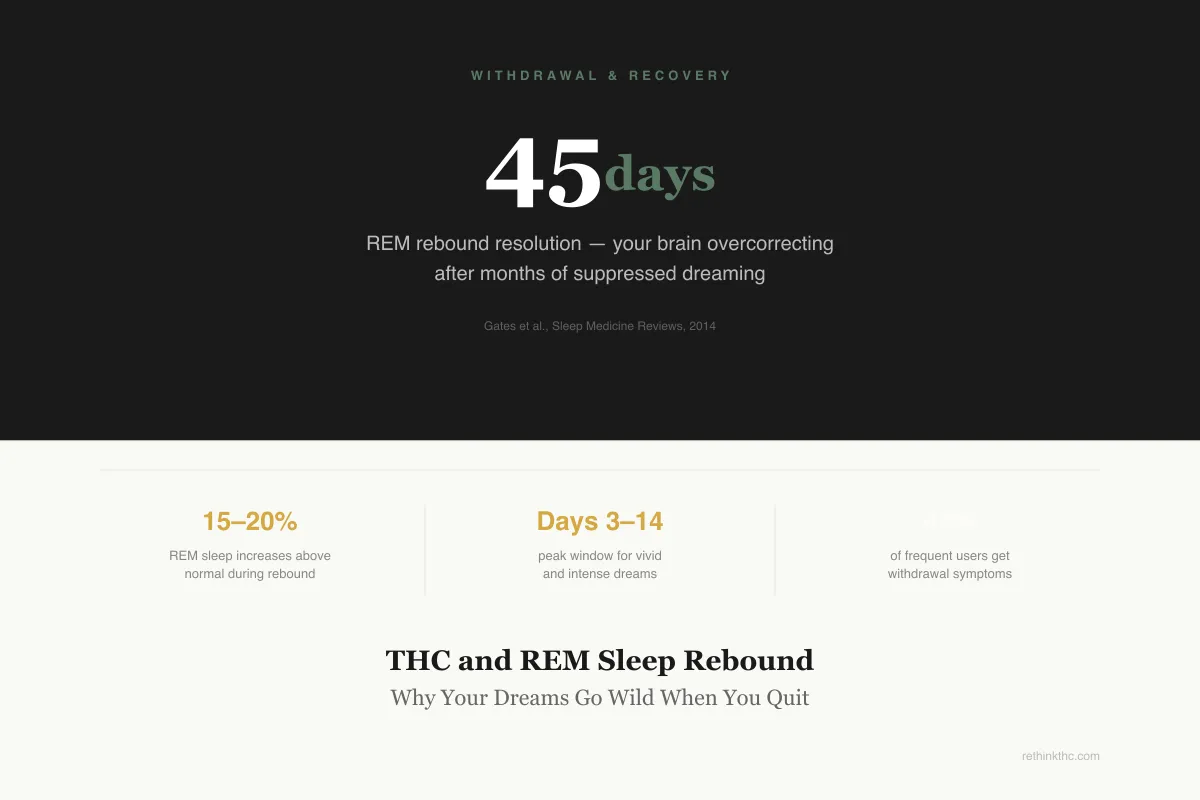
Withdrawal & Recovery
45 days
Quit weed and now your dreams are terrifyingly vivid? That is REM rebound — your brain overcorrecting after months of suppressed dreaming.
Gates et al., Sleep Medicine Reviews, 2014
15–20%
REM sleep increases above normal baseline during rebound
Days 3–14
Peak window for the most vivid and emotionally intense dreams
47%
Of frequent cannabis users experience clinically significant withdrawal
Gates et al., Sleep Medicine Reviews, 2014
 View as image ↗
If you only read one thing
Those crazy vivid dreams after quitting weed are called REM rebound, and they are completely normal. THC was suppressing the dreaming stage of your sleep for months. Now that it is gone, your brain is overcorrecting — flooding you with extra dream time to catch up. The dreams peak around days 3 to 14, start fading by week 3, and are usually gone within 45 days. They feel wild and sometimes scary, but they are actually a sign your brain is healing, not breaking.
You stopped smoking a few days ago and last night you had a dream so vivid you could smell it. Maybe it was a nightmare that woke you up gasping. Maybe it was an emotionally loaded scene from your past, replayed in high definition. Maybe you woke up confused about whether it actually happened. If this sounds familiar, you are experiencing one of the most common and most disorienting marijuana withdrawal symptoms. It is called REM rebound, it is part of the predictable cannabis withdrawal process, and it has a straightforward biological explanation.
Key Takeaways
- THC cuts way back on REM sleep — the stage where dreaming happens — so regular users barely dream at all
- When you quit, your brain overcorrects by flooding you with extra-long, extra-vivid dream periods called REM rebound
- Those intense, emotionally loaded, and sometimes scary dreams are the most common result
- REM rebound usually peaks in weeks 1 to 3 and wraps up within 45 days
- This is a normal and well-documented brain process — not a sign that something is wrong with you
- "Using dreams" where you dream about relapsing are extremely common and do not mean you will actually relapse
Why You Stopped Dreaming in the First Place
If you used cannabis regularly, you probably noticed that you rarely dreamed, or at least rarely remembered dreaming. You were not imagining that. THC directly suppresses the stage of sleep where most dreaming happens.[1]
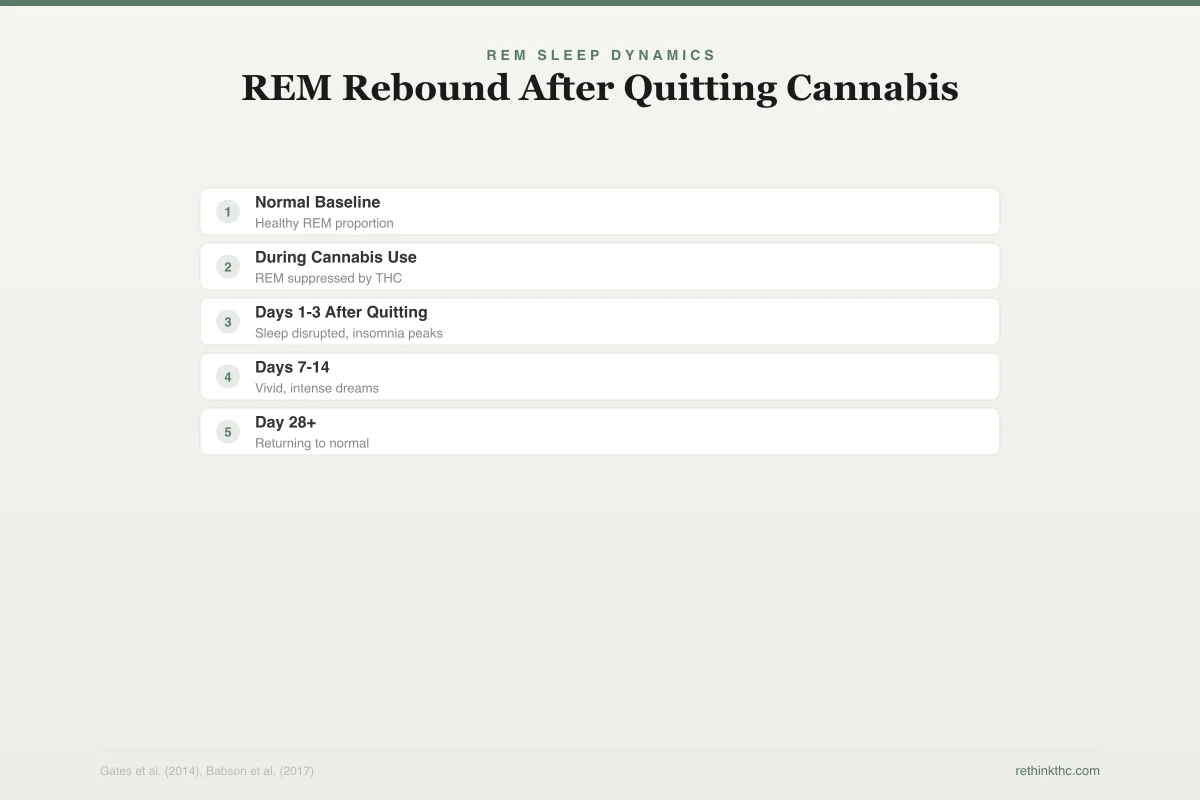
The chart below shows exactly what happens to your REM sleep percentage — from normal baseline, through active use, into withdrawal, and out the other side.
REM Sleep Dynamics
REM Rebound After Quitting Cannabis
REM sleep percentage through use and withdrawal
Normal Baseline
Before use
During Cannabis Use
Active THC
Days 1-3 After Quitting
Acute withdrawal
Days 7-14
REM rebound
Day 28+
Recovery
REM rebound produces dreams so vivid they can wake you repeatedly -- this is temporary and typically resolves within 2-6 weeks
Gates et al. (2014), Babson et al. (2017)
 View as image ↗
To understand why that rebound hits so hard, it helps to know what REM sleep actually is and how THC disrupts it. Your sleep is divided into cycles, and each cycle contains several stages. The one that matters here is called REM sleep, which stands for rapid eye movement. REM is when your brain is most active during sleep. It is the stage responsible for dreaming, emotional processing, and memory consolidation (the process of moving experiences from short-term to long-term memory).
| Sleep Stage | What It Does | THC's Effect |
|---|---|---|
| Stage 1 (N1) | Light sleep, transition from wakefulness | Minimal effect |
| Stage 2 (N2) | Core sleep, memory consolidation begins | May increase time in this stage |
| Stage 3 (N3 / Deep Sleep) | Physical repair, immune function, growth hormone | THC may increase initially, decreases with chronic use |
| REM | Dreaming, emotional processing, memory integration | Significantly suppressed by THC |
THC interferes with REM by binding to CB1 receptors in your brainstem, the region at the base of your brain that acts as a control tower for sleep stage transitions.[2] For a broader look at how THC reshapes every stage of sleep, see cannabis and sleep: does it actually help? When THC activates these receptors, it shortens your REM periods and pushes your brain toward deeper, non-REM sleep instead.
A study in the journal Sleep measured this effect directly: regular cannabis users showed measurable reductions in REM sleep duration compared to non-users, and when they stopped, sleep worsened further on the second night of abstinence.[3] You were still cycling through sleep stages, but your brain was cutting the dreaming portions short, every single night.
This is why many daily users say they "do not dream." You do dream. Your brain just spends so little time in REM that the dreams are brief, fragmented, and rarely remembered.
What Your Brain Does When the THC Stops
Here is where it gets intense. When you quit cannabis, your brain does not gently return to its normal REM schedule. It overcorrects. Hard.
This overcorrection is called REM rebound. Your brain, deprived of the REM time it has been missing, floods your sleep with extended, intensified REM periods. An inpatient study monitoring chronic cannabis smokers during sustained abstinence found that while most withdrawal symptoms peaked in the first three days and then improved, sleep problems followed a different trajectory — they actually got worse over time.[4] Your time in REM can increase 15 to 20 percent above normal baseline levels. Not back to normal. Above normal.
Think of it this way. If you held your arm in one position for hours and then released it, it would not just move back to neutral. It would swing past center before settling. Your brain's REM system is doing the same thing. It was suppressed, and now it is overproducing to compensate for the deficit.
Lee et al. (2014) · American Journal on Addictions
- Population
- 29 chronic cannabis smokers monitored on a closed research unit during sustained abstinence
- Intervention
- Sustained abstinence with daily symptom tracking and plasma cannabinoid measurements
- Comparator
- Self-comparison from admission through weeks of abstinence
- Finding
- Most withdrawal symptoms peaked in days 0-3 and improved. But strange dreams and difficulty sleeping moved in the opposite direction — they got worse over time, not better. Only 34% of participants remained at 4 weeks, partly because sleep disruption was so persistent.
positive Well-controlled inpatient setting eliminates outside variables, though high dropout limits long-term conclusions
Lee et al. (2014), American Journal on Addictions, 23(3), 234-42
This is not a malfunction. It is a correction mechanism. Your brain is catching up on the dreaming, emotional processing, and memory consolidation that was disrupted during months or years of nightly THC use. A 2025 systematic review of polysomnography studies noted that while cannabis withdrawal clearly disrupts sleep, the degree to which THC actually suppresses REM during regular use may be less consistent than previously believed — making the rebound all the more unpredictable.[8]
Why the Dreams Feel So Different from Normal Dreams
REM rebound dreams are not like regular dreams that you vaguely remember over coffee. They are qualitatively different in ways that can be genuinely alarming if you do not know what is happening.
The dreams are longer because your REM periods are longer. They are more vivid because the neurochemical environment during rebound REM is more intense than normal REM. And they are more emotionally charged because your brain is processing a backlog of emotional material that was not fully processed during THC-suppressed sleep.
People in cannabis recovery communities describe these dreams in remarkably consistent terms:
- Dreams that feel more real than waking life
- Dreams about people they have not thought about in years
- Dreams with physical sensations — smells, textures, sounds
- Emotional dreams that leave a residue carried for hours after waking
- Dreams that feel like they last for hours (individual REM periods are typically 10 to 30 minutes)
The nightmares are the hardest part for most people. REM rebound does not filter for pleasant content. If anything, the emotional intensity amplifies negative dreams disproportionately. A lot of people experience dreams about relapse (using cannabis in the dream and feeling guilty about it), which is so common in substance withdrawal of all kinds that researchers have a name for it: "using dreams." These are not predictions or signs that you will relapse. They are your brain processing the significance of the change you are making.
Safety
ModerateREM rebound can intensify PTSD and trauma-related nightmares
Concern
If you have a history of trauma, PTSD, or an anxiety disorder, REM rebound can temporarily amplify nightmare frequency and emotional intensity beyond what most people experience. THC may have been suppressing the REM processing that trauma conditions require — and that processing resurfaces all at once during rebound.
What the research says
This intensification is temporary and follows the same rebound timeline (peaking days 3-14, resolving by week 6). It does not mean your PTSD or anxiety is getting worse — it means suppressed processing is catching up. Prazosin, a blood pressure medication, has evidence for reducing trauma-related nightmares and is sometimes prescribed during this phase.
Particularly relevant for: Anyone with PTSD, trauma history, or anxiety disorders who is quitting cannabis
What to do
Talk to your prescriber or therapist before quitting if you have a trauma history. Ask about prazosin for nightmare management. Do not try to white-knuckle through severe trauma-related nightmares alone — professional support makes a meaningful difference during this window.
Steenkamp et al. (2017), cannabis and PTSD; Babson et al. (2017), cannabis and sleep review
For people with a history of trauma, PTSD, or anxiety, REM rebound can temporarily worsen nightmare frequency and intensity. Systematic reviews have found that nabilone (a synthetic cannabinoid) specifically reduces PTSD-related nightmares, which helps explain why stopping cannabinoids causes nightmare resurgence.[5] This does not mean that cannabis was "treating" these conditions. It means THC was suppressing the REM processing that these conditions require. That processing was delayed, not eliminated, and it resurfaces during rebound.
The REM Rebound Timeline
REM rebound follows a predictable arc. Knowing where you are on that arc makes the experience significantly more tolerable.
| Phase | Days | What to Expect |
|---|---|---|
| Onset | 1–3 | Vivid dreams begin, often from night 1. Sleep onset may be delayed as brain adjusts to initiating sleep without THC. |
| Peak | 3–14 | Most vivid, most frequent dreams. Multiple intense dreams per night. Nightmares most likely to be severe. Night waking common. |
| Plateau | 14–30 | Dream intensity gradually decreases. Still more vivid than pre-cannabis baseline. Emotional charge lessens. Sleeping through the night more consistently. |
| Resolution | 30–45 | Dream activity and sleep quality return to normal. Occasional vivid dreams may still occur but no longer disrupt sleep. |
A systematic review of 36 withdrawal studies confirmed that sleep disruption is a consistent feature of cannabis withdrawal, though the exact timeline varies by individual.[6] The longest-lasting effects are observed in daily users of high-potency products like concentrates and dabs.
Evidence Review
Where the evidence stands
Cell & Lab Studies
CB1 receptor role in sleep stage regulation well established in brainstem models
Animal Studies
THC suppresses REM sleep in rodent models; rebound documented after cessation
Clinical Observations
Consistent reports of vivid dreams and sleep disruption during withdrawal across 36+ studies
Inpatient Monitoring Studies
Lee 2014 and Bolla 2008 confirmed REM rebound and worsening sleep with polysomnography
Large-Scale Sleep Architecture Studies
Velzeboer 2025 meta-analysis of 18 polysomnography studies — withdrawal disruption confirmed, though active-use REM suppression less consistent than previously thought
Comprehensive Meta-Analysis
Multiple systematic reviews confirm the pattern, though exact magnitude and timeline vary by individual
REM rebound during cannabis withdrawal is one of the best-documented phenomena in cannabis research. The mechanism is understood, inpatient studies confirm it with objective measurements, and multiple systematic reviews validate the pattern. The remaining uncertainty is about degree — how much THC actually suppresses REM during active use may be less consistent than early small studies suggested.
Gates et al. (2016), Lee et al. (2014), Velzeboer et al. (2025)
The total duration depends on how long and how heavily you used. Someone who smoked occasionally for a few months may experience mild REM rebound for a week. Someone who used concentrates daily for years may have vivid dreams for the full 45 days or slightly beyond. For the full sleep recovery arc, see our sleep recovery timeline after quitting weed.
What Actually Helps
You cannot prevent REM rebound. It is a necessary part of your brain's recovery process, and trying to suppress it (with alcohol, antihistamines, or other sleep aids) often creates new problems without shortening the timeline. But you can make the experience more manageable.
Keep your sleep schedule rigid. Go to bed and wake up at the same time every day, including weekends. Your circadian rhythm (your internal sleep-wake clock) is recalibrating along with your REM cycle. Consistency gives it a stable target to recalibrate toward. Irregular sleep times make both the dreams and the insomnia worse.
Cut screens 30 minutes before bed. Blue light from phones and laptops suppresses melatonin production (the hormone your brain uses to signal that it is time for sleep). During withdrawal, your melatonin system is already disrupted. Adding blue light on top of that pushes your sleep onset later and compresses your sleep architecture in ways that can intensify rebound dreams.
Write the dreams down. This sounds counterintuitive, but keeping a brief dream journal in the morning can reduce the emotional weight of vivid dreams. The act of writing externalizes the experience. It moves the dream from something that happened to you into something you observed and recorded. People in recovery communities who use this technique consistently report that the dreams feel less distressing within a few days of starting, even before the dreams themselves actually decrease in intensity.
Exercise early in the day. Physical activity improves sleep quality across the board, but the timing matters during withdrawal. Exercise raises core body temperature and cortisol levels, both of which need to drop for sleep onset. Working out within three hours of bedtime can delay sleep and worsen the first-night insomnia that many people experience during rebound. Morning or afternoon exercise is significantly more helpful. For more practical techniques, see our guide on how to sleep without weed.
Cool your bedroom down. Night sweats are common during cannabis withdrawal (your autonomic nervous system is recalibrating), and a warm room compounds them. A room temperature of 65 to 68°F (18 to 20°C) is optimal for sleep. A fan helps with both temperature and white noise, which can soften the jarring effect of waking from an intense dream.
Consider melatonin short-term. Low-dose melatonin (0.5 to 1 mg) taken 30 to 60 minutes before bed may help with sleep onset during the acute phase. It is not a sedative — it signals your brain that it is time to sleep. Higher doses are not more effective and can cause morning grogginess. See melatonin and weed withdrawal sleep for more detail.
Avoid alcohol as a sleep aid. Alcohol may help you fall asleep faster, but it severely fragments sleep architecture and suppresses REM in its own way — creating a secondary rebound effect on top of the cannabis one. This is a common trap during withdrawal. For more on this risk, see cross-addiction when quitting weed.
When to Get Help
REM rebound is temporary and not dangerous. But if nightmares are severe enough that you dread going to sleep, if sleep disruption is affecting your ability to function at work or care for yourself, or if the dreams are triggering significant anxiety or panic upon waking, a healthcare provider can help.
Cognitive behavioral therapy for insomnia (CBT-I) is the gold-standard treatment for sleep disruption during withdrawal. It is more effective than sleep medication for long-term outcomes and does not carry the dependency risk that sleep aids do.[7] Some providers may offer short-term, low-dose sleep medication for the acute phase if insomnia is severe enough to be debilitating.
If you have pre-existing PTSD or an anxiety disorder and REM rebound is intensifying those symptoms, talk to your prescriber or therapist. Prazosin, a blood pressure medication, has evidence for reducing trauma-related nightmares and is sometimes prescribed off-label during this phase.
If you need immediate support, SAMHSA's National Helpline is available at 1-800-662-4357. It is free, confidential, and available 24 hours a day. You can also text HOME to 741741 to reach the Crisis Text Line.
What This Actually Means
Your brain spent months or years being told to skip the dreaming stage. Now it is making up for lost time. The vivid dreams, the emotional intensity, the nightmares that feel absurdly real — all of it is your sleep architecture rebuilding itself into a pattern it was designed to follow.
This is not a side effect of quitting. It is a sign of recovery. Your brain is doing exactly what a healthy brain does when you remove the thing that was interfering with its most essential maintenance cycle. Six weeks from now, you will dream normally and sleep normally. Right now, your job is to get through the overcorrection.
The Bottom Line
REM rebound is a well-documented neurological process that occurs when you stop using cannabis after regular use. THC suppresses REM sleep — the dreaming stage — and when it is removed, your brain overcorrects with extended, intensified dream periods. Vivid dreams typically peak in weeks 1 to 3 and resolve within 45 days. It is a sign of recovery, not a sign that something is wrong.
How long do vivid dreams last after quitting weed?
Vivid dreams from REM rebound typically peak during the first two to three weeks after quitting. Most people report that dream intensity returns to normal by day 45. Daily users of high-potency products like concentrates may experience them slightly longer. The timeline is predictable even if the experience feels chaotic — research consistently shows resolution within 6 weeks.
Why do I have nightmares after quitting cannabis?
THC suppresses REM sleep, the stage where dreaming and emotional processing occur. When you quit, your brain overcorrects with extended, intensified REM periods called REM rebound. This produces more vivid, more frequent, and more emotionally charged dreams, including nightmares. It is a normal neurological correction, not a psychological disorder. The nightmares tend to be most intense during days 3 to 14.
Are vivid dreams after quitting weed a sign of something wrong?
No. Vivid dreams after quitting cannabis are one of the most well-documented withdrawal symptoms. They are caused by REM rebound, a measurable neurological process confirmed by polysomnography (sleep lab) studies. The dreams feel abnormal because they are temporarily more intense than baseline. They are a sign your brain is recovering its normal sleep architecture, not malfunctioning.
Can I stop the vivid dreams after quitting weed?
You cannot prevent REM rebound, and suppressing it with alcohol or sedatives typically creates new problems. You can reduce the emotional impact by maintaining a consistent sleep schedule, keeping a dream journal, exercising early in the day, and keeping your bedroom cool (65–68°F). Low-dose melatonin may help with sleep onset. If nightmares are severe enough to prevent sleep entirely, a healthcare provider can offer evidence-based options like CBT-I or prazosin.
Why did I stop dreaming when I was smoking weed?
THC binds to CB1 receptors in your brainstem that regulate sleep stage transitions, significantly shortening your REM periods. REM is the stage where most dreaming occurs. With less time in REM, you produced fewer dreams and remembered even fewer. You did not actually stop dreaming entirely, but the dreams were too brief and fragmented to register.
Is it normal to dream about smoking weed after quitting?
Yes. "Using dreams" — dreams about relapsing and feeling guilty about it — are extremely common during substance withdrawal of all kinds. Researchers have documented this phenomenon across cannabis, alcohol, and nicotine cessation. These dreams are your brain processing the significance of the behavioral change, not a prediction of actual relapse. They typically decrease as REM rebound resolves.
Sources & References
- 1RTHC-00331·Schierenbeck, Thomas et al. (2008). “How Cannabis, Cocaine, and Ecstasy Each Affect Sleep Differently.” Sleep medicine reviews.Study breakdown →PubMed →↩
- 2RTHC-01241·Pava, Matthew J et al. (2016). “The Endocannabinoid System Keeps Sleep Stable But Does Not Drive the Need to Sleep.” PloS one.Study breakdown →PubMed →↩
- 3RTHC-00301·Bolla, Karen I. et al. (2008). “Stopping Heavy Cannabis Use Was Linked to Poorer Sleep. The Second Night Looked Worse..” Sleep.Study breakdown →PubMed →↩
- 4RTHC-00820·Lee, Dayong et al. (2014). “Cannabis withdrawal symptoms peaked in days 0-3 but sleep problems got worse over time.” The American journal on addictions.Study breakdown →PubMed →↩
- 5RTHC-01528·Steenkamp, Maria M. et al. (2017). “Cannabis for PTSD: Promising Biology, Very Little Proof It Actually Works as Treatment.” Depression and Anxiety.Study breakdown →PubMed →↩
- 6RTHC-01161·Gates, Peter et al. (2016). “Systematic Review Confirms Cannabis Withdrawal Disrupts Sleep, but Specific Mechanisms Remain Unclear.” Substance abuse.Study breakdown →PubMed →↩
- 7RTHC-03863·Geagea, Luna et al. (2022). “Cognitive behavioral therapy for insomnia improved sleep, mood, and reduced cannabis use.” Sleep medicine.Study breakdown →PubMed →↩
- 8RTHC-07860·Velzeboer, Rob et al. (2025). “Cannabis Doesn't Consistently Change Sleep Patterns — But Withdrawal Clearly Disrupts Sleep.” Sleep medicine reviews.Study breakdown →PubMed →↩