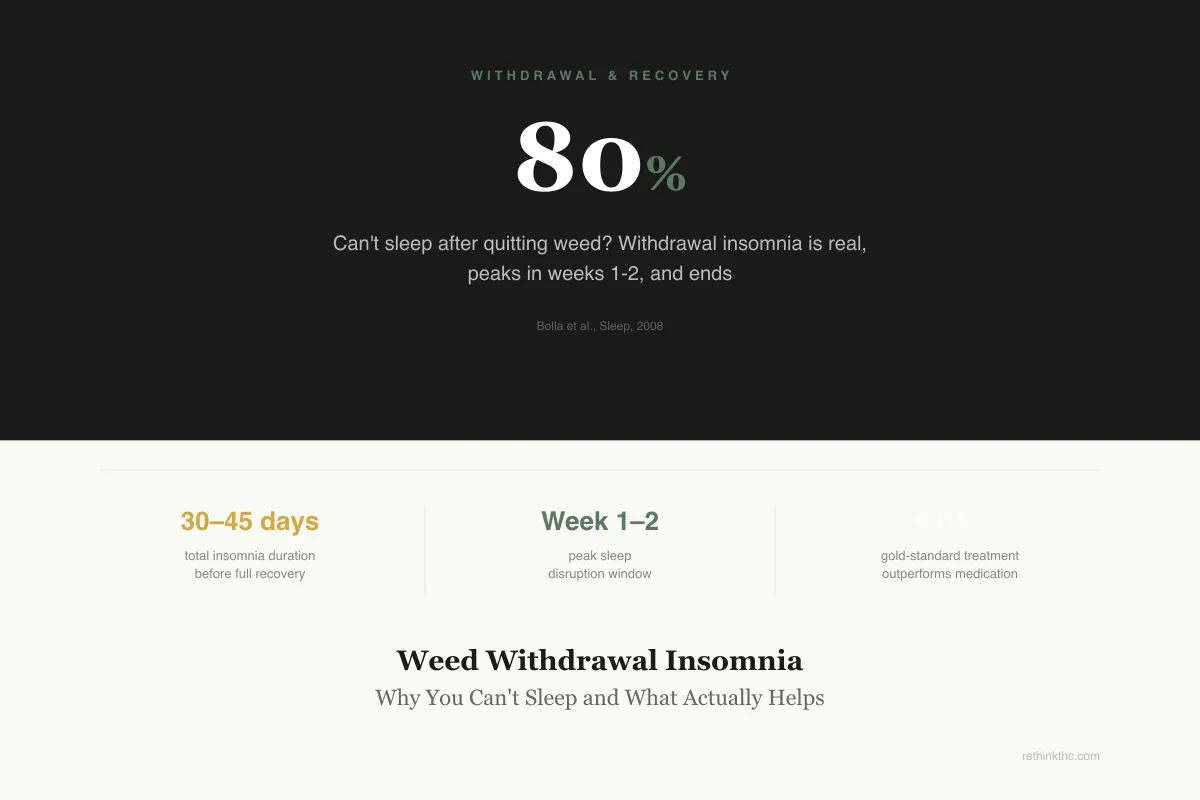
Withdrawal & Recovery
Weeks 1-2
Withdrawal insomnia peaks in weeks 1 to 2 and resolves within 30 to 45 days, and CBT-I outperforms sleep medication for long-term results.
Bolla et al., Sleep, 2008
30–45 days
total insomnia duration before full recovery
Week 1–2
peak sleep disruption window
CBT-I
gold-standard treatment outperforms medication
Bolla et al., Sleep, 2008
 View as image ↗
If you only read one thing
Your brain forgot how to fall asleep on its own because THC was doing the job for it. Now that the THC is gone, your natural sleep system is rebooting — and that takes 2 to 6 weeks. The worst nights are in weeks 1 and 2. By week 3 it starts getting better. By day 30 to 45, most people are sleeping normally again. Tonight: get out of bed if you've been lying there 20 minutes, go to another room, read something boring, and go back when you're drowsy. Every night without THC is one night closer to real sleep.
If you are reading this right now, there is a decent chance it is the middle of the night and you have been staring at the ceiling for hours. You quit weed recently and now you cannot sleep. Not "having a little trouble" sleeping. Actually cannot sleep. You are exhausted, your body is tired, but the moment you close your eyes your brain refuses to shut off.
You are not broken. This is one of the most common and most researched symptoms of cannabis withdrawal, and it connects directly to the complicated relationship between cannabis and sleep. A 2025 meta-analysis of 120 studies confirmed that recreational cannabis use is consistently associated with worse sleep quality, more insomnia, and disrupted sleep timing.[1] More importantly, it ends. Here is what is going on and what you can actually do about it tonight.
Key Takeaways
- Weed withdrawal insomnia hits most people who quit regular cannabis use — it is the single most common sleep-related withdrawal symptom
- THC was taking a shortcut past your brain's natural sleep process, so now your brain has to relearn how to fall asleep on its own
- Insomnia is worst during weeks one and two, gets noticeably better by week three, and usually resolves within 30 to 45 days
- REM rebound can make sleep feel unrestful even on nights when you do manage to fall asleep
- A method called CBT-I (cognitive behavioral therapy for insomnia) is the gold-standard treatment and works better than sleep medication for long-term results
- Your brain's natural sleep system fully recovers — every night without THC is one night closer to sleeping normally again
Fact Check
The reason you started using weed for sleep in the first place
The claim
“Weed is a good sleep aid — it helps you fall asleep faster and sleep better”
Personal experience and cannabis marketing
What research shows
Partly TrueA 2025 meta-analysis of 120 studies confirmed that recreational cannabis use is consistently associated with worse sleep quality, more insomnia, and disrupted sleep timing. THC speeds up sleep onset but suppresses REM sleep, reduces sleep efficiency, and degrades overall sleep architecture.
THC does make you feel sleepy faster — that part is real. But it's replacing your brain's natural sleep process with a chemical shortcut. Over time, your brain stops bothering to maintain its own sleep system. When you quit, the shortcut is gone and the natural system needs weeks to reboot. You weren't sleeping well on weed — you just didn't know it.
Mao et al. (2025), meta-analysis of 120 studies
Why THC-Dependent Sleep Falls Apart When You Quit
To understand why you cannot sleep right now, you need to understand what THC was doing to your sleep for the last however many months or years.
Your brain has a natural process for making you fall asleep. It involves a chemical called adenosine, which builds up in your brain throughout the day. The longer you are awake, the more adenosine accumulates, and the stronger your sleep pressure becomes. This is the same system that caffeine blocks, which is why coffee keeps you awake. By bedtime, adenosine levels are high enough to trigger sleep onset.
THC shortcuts this entire process. When you smoke or consume cannabis before bed, THC binds to CB1 receptors in your brain and essentially forces relaxation and sedation through a different pathway. It increases activity in your GABA system (the brain's primary inhibitory network, which calms neural activity) and suppresses your arousal circuits. You feel sleepy not because your brain naturally worked its way toward sleep, but because THC flipped the switch manually.
A 2017 review by Babson and colleagues, published in Current Psychiatry Reports, confirmed that while cannabis users often report using THC as a sleep aid, chronic use actually degrades sleep quality over time, even though it speeds up sleep onset.[2] Your brain adapts. It reduces its own GABA sensitivity, dials back its natural sleep-promoting mechanisms, and starts depending on THC to initiate the process.
When you quit, your brain is stuck. The THC is gone, but the natural sleep system it replaced has been running on minimum for months. Your adenosine signaling is disrupted. Your GABA receptors are downregulated. Your brain literally forgot how to fall asleep on its own. That is why you are lying there, exhausted but wide awake.
What Is Happening Each Night
Weed withdrawal insomnia is not just one problem. It is several sleep problems stacking on top of each other. The diagram below breaks down the four overlapping mechanisms that keep you awake during withdrawal.
Sleep Science
Four Problems Stacking Against Your Sleep
Each disruption has a different mechanism — and a different timeline
Sleep Onset Delay
Days 1–14Takes 1–3 hours to fall asleep instead of minutes
Adenosine system disrupted — the same system caffeine blocks. Without THC sedation, your brain cannot shut down on schedule.
REM Rebound
Weeks 1–6Vivid, intense, sometimes disturbing dreams that make sleep feel unrestful
THC suppressed REM for months. Your brain floods you with extra REM to compensate — up to 20% above normal baseline.
Night Sweats
Days 1–14Waking up drenched, sometimes multiple times per night
Your endocannabinoid system regulates body temperature. Without THC, thermoregulation is haywire.
Racing Thoughts
Days 3–21Mind will not quiet down; anxiety spikes at bedtime
Cortisol elevated, GABA reduced. The brain's calming system is temporarily offline.
Sleep Recovery Timeline
Days 1–3
3–5 hrs
Fragmented
Days 3–14
3–5 hrs
Peak disruption
Weeks 2–3
5–6 hrs
First full nights
Weeks 3–6
6–7 hrs
Near normal
Babson et al. (2017), Budney et al. (2003)
View as image ↗You Cannot Fall Asleep
Bolla et al. (2008) · Sleep
- Population
- Daily cannabis users assessed in a sleep lab
- Intervention
- Monitored sleep after cannabis cessation
- Comparator
- Pre-cessation sleep patterns
- Finding
- Within 48 hours of quitting, sleep became shorter, lighter, and more fragmented, with measurable increases in the time it took to fall asleep
positive Lab-confirmed — this isn't subjective complaints. Sleep genuinely deteriorates in measurable ways before recovering.
Bolla et al. (2008), Sleep
This is the most immediate issue. Sleep onset latency (the clinical term for how long it takes you to fall asleep) increases significantly during cannabis withdrawal. A 2008 study by Bolla and colleagues, published in the journal Sleep, found that daily cannabis users experienced a measurable increase in the time it took to fall asleep after quitting, with sleep becoming shorter, lighter, and more fragmented in the first 48 hours of abstinence.[3] Where you used to be out in minutes, you might now lie awake for an hour or more.
The reason is the gap described above. Your brain's natural sleep onset machinery is offline, and the external agent that was doing the job is gone. This gap is widest in the first two weeks.
Your Sleep Feels Unrestful
Even on the nights you manage to fall asleep, you might wake up feeling like you did not sleep at all. This is largely because of REM rebound. THC suppresses REM sleep (the dreaming stage) significantly in regular users. When you quit, your brain overcorrects with extended, extra-intense REM periods.
This matters because excessive REM sleep at the expense of deep sleep (stages 3 and 4, also called slow-wave sleep) leaves you feeling unrested. An inpatient study monitoring chronic cannabis users found that while most withdrawal symptoms peaked in the first three days, sleep problems actually worsened over time — a trajectory unlike any other withdrawal symptom.[4] Your brain is spending too much time dreaming and not enough time in the physically restorative stages. You might sleep six or seven hours and feel like you slept two.
Night Sweats Keep Waking You Up
Your autonomic nervous system, the part of your brain that controls involuntary functions like temperature regulation, heart rate, and sweating, is recalibrating during withdrawal. A controlled study found that just three nights off cannabis reduced sleep efficiency, cut total sleep time, and shifted REM architecture measurably.[5] One of the most common results is night sweats. You wake up drenched, kick off the covers, get cold, pull them back on, and the cycle repeats. Each wake-up resets your sleep onset, making it harder to accumulate the continuous sleep your body needs.
Racing Thoughts and Anxiety at Bedtime
THC suppresses cortisol, your primary stress hormone. When you remove THC, cortisol levels temporarily spike. A systematic review by Gates and colleagues, published in Sleep Medicine Reviews, documented that sleep disturbance and associated stress responses are among the most consistent findings during the first two weeks of cannabis cessation.[6]
This cortisol spike hits hardest at night when there are no distractions. During the day, you are busy enough that anxiety stays manageable. At 2 AM, lying in a dark room with nothing else to focus on, every worry you have ever had decides to show up at full volume. This is not a character flaw. It is a temporary neurochemical imbalance, and it resolves as your stress response system recalibrates.
The Insomnia Timeline
Knowing when this ends matters when you are in the middle of it. Research gives us a reliable map.
| Phase | Timeframe | Sleep Quality | What Is Happening |
|---|---|---|---|
| Acute onset | Days 1–3 | Severely disrupted; 1–3 hour sleep onset delay | Natural sleep mechanisms offline; THC still clearing |
| Peak disruption | Days 3–14 | 3–5 hours per night; fragmented, unrestful | REM rebound at maximum; night sweats; cortisol spike |
| Early recovery | Weeks 2–3 | Improving; first full nights of sleep | Sleep pressure rebuilding; night sweats fading |
| Normalization | Weeks 3–6 | Near-normal; occasional vivid dreams | Sleep architecture reorganizing; REM ratios stabilizing |
Days 1 to 3. Sleep onset gets harder almost immediately. You might lie awake for one to three hours past your normal bedtime. Some people do not sleep at all on nights one or two. Night sweats may begin.
Days 3 to 14. This is the worst stretch. Sleep is fragmented, short, and unrestful. You might average three to five hours on a good night. REM rebound dreams make whatever sleep you do get feel chaotic. The anxiety-at-bedtime cycle is at its peak. This is the window where most people relapse specifically because of sleep.
Weeks 2 to 3. Things start to shift. You fall asleep a little faster. Total sleep time increases. The night sweats become less frequent. You might get a full night of sleep for the first time and feel a noticeable difference in your daytime functioning.
Weeks 3 to 6. Sleep quality continues improving. Most people report that their sleep feels "normal" or close to it by day 30 to 45. Clinical research confirms that sleep disturbances are the longest-lasting cannabis withdrawal symptom, but they do resolve.[7] If you used high-potency products daily for years, your timeline might extend slightly past 45 days, but you will still see steady improvement week over week. For the full arc, see sleep recovery timeline after quitting weed.
The key point: this is temporary. Your brain is rebuilding its natural sleep system, and it takes weeks, not days. But it does rebuild.
What Actually Helps
You have probably already seen generic sleep advice and thought "I know, sleep hygiene, thanks." Here is what the evidence actually supports, with specifics that apply to withdrawal insomnia rather than normal insomnia.
| Intervention | Evidence Level | Best For | Caution |
|---|---|---|---|
| CBT-I | Gold standard | All insomnia types; prevents chronic insomnia | Requires 4–8 sessions; app versions available |
| Consistent sleep schedule | Strong | Circadian recalibration | Hard to follow when not sleeping; stick with it |
| Exercise (morning/afternoon) | Strong | Sleep quality, dopamine recovery | Avoid within 3–4 hours of bedtime |
| Cool bedroom (65–68°F) | Moderate | Night sweats, sleep onset | Use fan for both temperature and white noise |
| Low-dose melatonin (0.5–1 mg) | Limited | Sleep onset only | Not a sedative; OTC products overdosed at 5–10 mg |
| Alcohol | Avoid | — | Fragments sleep; creates secondary rebound |
| Benadryl / antihistamines | Avoid | — | Rebound insomnia; cognitive side effects |
CBT-I (Cognitive Behavioral Therapy for Insomnia)
Geagea et al. (2022) · Cannabis and Cannabinoid Research
- Population
- People with insomnia and cannabis use
- Intervention
- CBT-I (cognitive behavioral therapy for insomnia)
- Comparator
- Standard care
- Finding
- CBT-I improved sleep and reduced depression, and 80% of participants also reduced their cannabis use at 3 months — even though reducing cannabis wasn't the goal
positive CBT-I doesn't just fix sleep — it removes the main reason people use weed at night in the first place
Geagea et al. (2022), Cannabis and Cannabinoid Research
This is the single most effective intervention for insomnia, including withdrawal-related insomnia. A 2022 study found that CBT-I improved sleep, reduced depression scores, and — notably — 80 percent of participants also reduced their cannabis use at three months.[8] CBT-I is a structured program (usually four to eight sessions) that targets the thoughts and behaviors that keep insomnia going. It includes techniques like stimulus control (only using your bed for sleep, getting out of bed if you have not fallen asleep in 20 minutes) and sleep restriction (temporarily limiting time in bed to build stronger sleep pressure).
The reason CBT-I matters here is that withdrawal insomnia can easily become chronic insomnia if you develop bad habits around sleep during the acute phase. Lying in bed for hours, napping during the day, and building anxiety about bedtime are all patterns that CBT-I directly addresses. Many therapists offer it, and there are app-based versions if in-person is not accessible.
Consistent Sleep and Wake Times
This one is hard to follow when you are not sleeping, but it is critical. Go to bed and wake up at the same time every day, even on weekends, even if you barely slept. Your circadian rhythm (your internal 24-hour clock) needs a stable anchor point to recalibrate. Sleeping in on Saturday because you were up until 4 AM shifts your clock and makes Sunday night worse.
If you cannot fall asleep within 20 to 30 minutes, get up. Go to another room. Do something quiet and non-stimulating (reading a physical book, not scrolling your phone). Go back to bed when you feel sleepy. This prevents your brain from associating your bed with lying awake and stressing about not sleeping.
Temperature Regulation
Keep your bedroom at 65 to 68 degrees Fahrenheit. This matters more during withdrawal than usual because of the night sweats. Use breathable sheets (cotton, not synthetic). A fan provides both cooling and white noise. If night sweats are severe, keep a dry shirt next to the bed so you can change without fully waking up.
Exercise (Timed Correctly)
Physical activity improves sleep quality. This is one of the most consistent findings in sleep research. But during withdrawal, timing matters. Exercise raises your core body temperature and cortisol levels, both of which need to drop for sleep. Work out in the morning or early afternoon. Exercising within three to four hours of bedtime can make sleep onset worse.
Even 20 to 30 minutes of moderate activity (a walk, a bike ride) makes a meaningful difference. You do not need an intense gym session. The goal is to burn off some of the excess cortisol and physical restlessness that build up during the day.
Melatonin
The evidence for melatonin specifically during cannabis withdrawal is limited, but some people find it helpful for sleep onset. If you try it, use a low dose (0.5 to 1 mg) 30 to 60 minutes before bed. Most over-the-counter melatonin is dosed at 5 to 10 mg, which is far higher than what research supports for sleep onset. Melatonin signals your brain that it is time to sleep. It is not a sedative and will not knock you out.
What NOT to Do
Safety
ModerateAlcohol and Benadryl make withdrawal insomnia worse
Concern
Alcohol may make you feel sleepy but it fragments sleep architecture and suppresses REM sleep in the same way THC does — delaying your brain's recovery. Benadryl (diphenhydramine) causes rebound insomnia, cognitive impairment, and can create its own dependency cycle.
What the research says
Neither is a safe or effective substitute for THC as a sleep aid during withdrawal. If insomnia is severe enough to impair functioning, talk to a doctor about short-term, non-addictive options like low-dose trazodone or gabapentin.
Particularly relevant for: Anyone experiencing severe withdrawal insomnia
What to do
If you're reaching for alcohol or OTC sleep aids nightly, that's a signal to talk to a provider about better options. CBT-I is more effective than any medication for long-term insomnia.
Babson et al. (2017), Current Psychiatry Reports
Alcohol. It might make you feel sleepy initially, but alcohol fragments sleep architecture and suppresses REM sleep in the same way THC does. You are essentially replacing one problem with another and delaying your brain's recovery. For more on this risk, see cross-addiction when quitting weed.
Benadryl and antihistamines. Diphenhydramine (the active ingredient in Benadryl, ZzzQuil, and most OTC sleep aids) is not intended for long-term use and carries side effects including grogginess, cognitive impairment, and rebound insomnia when you stop. Using it nightly during withdrawal can create a secondary dependency cycle.
Excessive caffeine. This should be obvious, but it is worth saying directly: if you cannot sleep at night, drinking coffee past noon is working against you. Caffeine has a half-life of five to six hours, meaning half the caffeine from your 2 PM coffee is still in your system at 8 PM. During withdrawal, when your adenosine system is already compromised, even moderate caffeine use late in the day can have an outsized effect on sleep onset.
Evidence Review
Where the evidence stands
Neuroscience & Pharmacology
THC's effects on GABA receptors, adenosine signaling, and sleep architecture thoroughly characterized
Animal Sleep Studies
Rodent models confirm THC disrupts natural sleep-wake cycling and REM architecture
Clinical Observations
Insomnia consistently identified as the most common and longest-lasting withdrawal symptom
Sleep Lab Studies
Bolla et al. (2008) measured sleep disruption in a controlled lab within 48 hours of cessation
CBT-I Treatment Trials
Geagea et al. (2022): CBT-I improved sleep and 80% of participants also reduced cannabis use
Meta-Analysis & Systematic Reviews
Mao et al. (2025): 120 studies confirming cannabis degrades sleep quality; Gates et al. reviews confirming withdrawal insomnia timeline
Withdrawal insomnia is one of the most studied aspects of cannabis cessation. We know exactly why it happens (GABA/adenosine disruption), exactly when it peaks (weeks 1-2), exactly when it resolves (30-45 days), and exactly what treats it best (CBT-I over medication). The science here is settled.
Mao et al. (2025), Bolla et al. (2008), Geagea et al. (2022), Gates et al. (2014, 2016)
When Sleep Aids Might Be Appropriate
If your insomnia is severe enough that you are not functioning (unable to work, drive safely, or care for yourself), it is reasonable to talk to a doctor about short-term pharmacological help. Some providers prescribe low-dose trazodone, gabapentin, or other non-addictive sleep medications for the acute withdrawal phase. The emphasis is on short-term and doctor-supervised. The goal is to get you through the worst two weeks, not to replace one sleep crutch with another.
When to Seek Professional Help
Talk to a healthcare provider if your insomnia persists beyond six weeks without improvement, if you are experiencing severe anxiety or depression alongside the sleep disruption, or if the lack of sleep is creating safety concerns (falling asleep while driving, inability to focus at work in a safety-sensitive role).
If you need support and are not sure where to start, the SAMHSA National Helpline is available 24/7 at 1-800-662-4357. It is free, confidential, and available in English and Spanish.
For dopamine-related symptoms like low motivation and anhedonia that often accompany sleep problems during withdrawal, or to understand the full withdrawal timeline, those resources cover the broader picture.
Tonight
If you are reading this at 3 AM, here is what to do right now. Get out of bed. Go to a different room. Read this or something else for 15 to 20 minutes. Do not look at the clock. When you feel drowsy, go back to bed. If you are still awake in 20 minutes, repeat the cycle.
You will not sleep well tonight. That is okay. You are in the hardest part of a process that has a known endpoint. Your brain is rebuilding a system that THC was running for it, and that rebuild takes time. But every night you get through without smoking is a night closer to sleeping normally again.
The Bottom Line
Weed withdrawal insomnia is caused by the temporary shutdown of your brain's natural sleep onset mechanisms after months or years of THC doing the job. It typically peaks in weeks one and two, begins improving in week three, and resolves within 30 to 45 days. The disruption involves multiple overlapping problems — increased sleep onset latency, REM rebound, night sweats, and cortisol-driven anxiety — each with its own recovery timeline. CBT-I is the most effective treatment, outperforming sleep medication for long-term outcomes.
How long does insomnia last after quitting weed?
Insomnia from cannabis withdrawal is typically worst during weeks one and two, begins improving during week three, and resolves for most people within 30 to 45 days. Sleep onset difficulty and fragmented sleep are the longest-lasting withdrawal symptoms. Daily users of high-potency products may experience disruption slightly beyond 45 days, but steady improvement is visible week over week. A 2008 study in the journal Sleep confirmed this timeline across multiple participants (Bolla et al., 2008).
Why can't I sleep after quitting weed?
THC was shortcutting your brain's natural sleep onset process by activating GABA receptors and suppressing arousal circuits. When you quit, your brain's natural sleep system (which relies on adenosine buildup and endogenous GABA signaling) has been downregulated from months or years of THC doing the job. It takes two to six weeks for these systems to fully recover. You are exhausted but unable to fall asleep because the mechanism that initiates sleep is temporarily offline.
Does melatonin help with weed withdrawal insomnia?
Evidence for melatonin specifically during cannabis withdrawal is limited, but some people find it helpful for reducing sleep onset time. If you try it, use a low dose of 0.5 to 1 mg taken 30 to 60 minutes before bed. Most over-the-counter melatonin products are dosed much higher than what research supports. Melatonin signals your brain that it is time to sleep but is not a sedative. It will not address the fragmented sleep or REM rebound components of withdrawal insomnia.
Is it normal to have night sweats when you stop smoking weed?
Yes. Night sweats are one of the most commonly reported cannabis withdrawal symptoms. They occur because your autonomic nervous system, which controls temperature regulation, sweating, and heart rate, is recalibrating after chronic THC exposure. Night sweats typically peak during the first two weeks and gradually resolve. Keeping your bedroom cool (65 to 68 degrees Fahrenheit), using breathable sheets, and keeping a dry shirt nearby can reduce their impact on sleep.
Should I take sleeping pills during cannabis withdrawal?
Over-the-counter sleep aids like Benadryl (diphenhydramine) are not recommended for nightly use during withdrawal because they carry side effects and can create rebound insomnia. If your insomnia is severe enough to impair daily functioning, talk to a doctor about short-term, non-addictive options like low-dose trazodone or gabapentin. The gold-standard treatment for withdrawal insomnia is CBT-I (cognitive behavioral therapy for insomnia), which addresses the root behavioral patterns and is more effective than medication for long-term outcomes (Babson et al., 2017).
Will my sleep be better than before I started smoking once withdrawal ends?
Many people report that their sleep quality after full recovery is actually better than it was during regular cannabis use. THC speeds up sleep onset but degrades overall sleep architecture — reducing REM sleep, decreasing sleep efficiency, and increasing next-day grogginess. Once your brain's natural sleep system fully recovers, you may find that you sleep more deeply, dream normally, and wake up feeling more rested than you did while using. The recovery period is temporary; the improved sleep quality is lasting.
Sources & References
- 1RTHC-07046·Mao, Fangxiang et al. (2025). “Recreational Cannabis Use Was Linked to Worse Sleep Across 120 Studies.” Sleep medicine reviews.Study breakdown →PubMed →↩
- 2RTHC-01329·Babson, Kimberly A et al. (2017). “Why Quitting Cannabis Wrecks Your Sleep — and Why It Gets Better.” Current psychiatry reports.Study breakdown →PubMed →↩
- 3RTHC-00301·Bolla, Karen I. et al. (2008). “Stopping Heavy Cannabis Use Was Linked to Poorer Sleep. The Second Night Looked Worse..” Sleep.Study breakdown →PubMed →↩
- 4RTHC-00820·Lee, Dayong et al. (2014). “Cannabis withdrawal symptoms peaked in days 0-3 but sleep problems got worse over time.” The American journal on addictions.Study breakdown →PubMed →↩
- 5RTHC-00529·Vandrey, Ryan et al. (2011). “Three Nights Without Cannabis Disrupted Sleep. Extended-release Zolpidem Blunted Much of It..” Drug and alcohol dependence.Study breakdown →PubMed →↩
- 6RTHC-00797·Gates, Peter J. et al. (2014). “39 Studies Later, the Evidence That Cannabis Helps You Sleep Is Weaker Than You Think.” Sleep Medicine Reviews.Study breakdown →PubMed →↩
- 7RTHC-01161·Gates, Peter et al. (2016). “Systematic Review Confirms Cannabis Withdrawal Disrupts Sleep, but Specific Mechanisms Remain Unclear.” Substance abuse.Study breakdown →PubMed →↩
- 8RTHC-03863·Geagea, Luna et al. (2022). “Cognitive behavioral therapy for insomnia improved sleep, mood, and reduced cannabis use.” Sleep medicine.Study breakdown →PubMed →↩