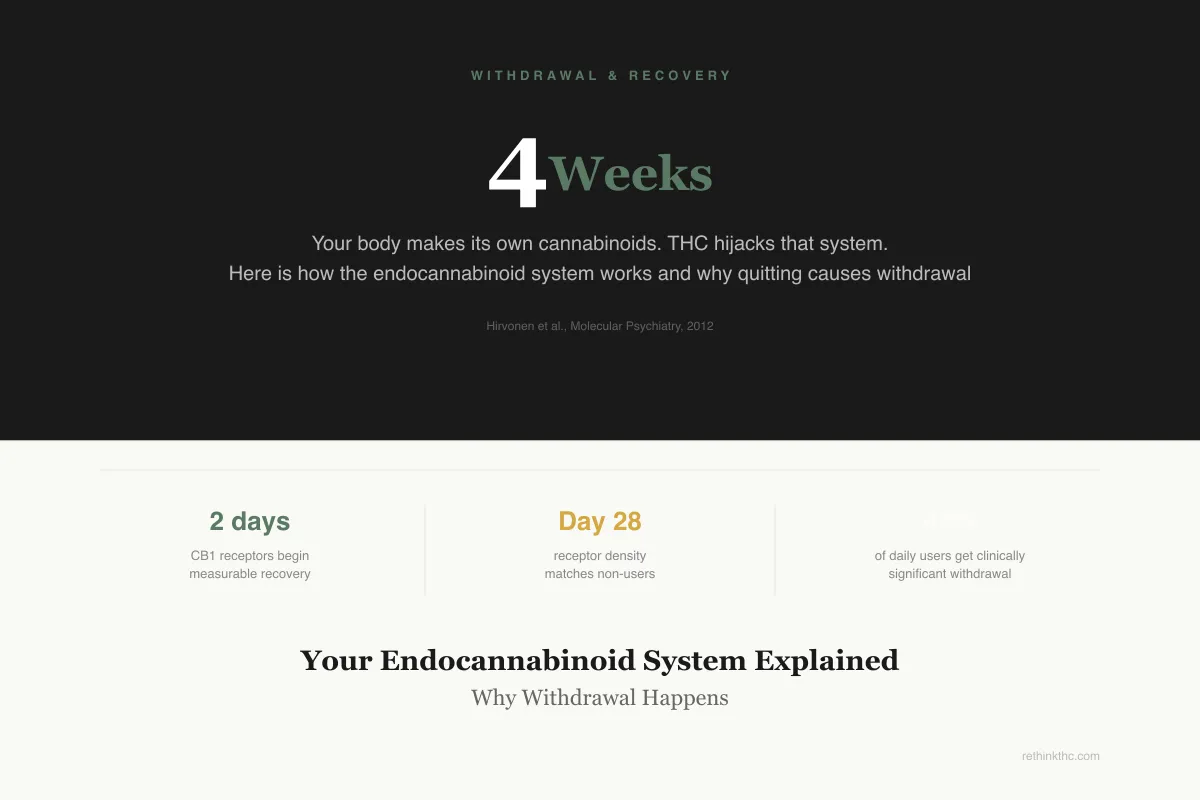
Withdrawal & Recovery
4 Weeks
Your body makes its own cannabinoids, and when you quit THC, every withdrawal symptom maps directly to the endocannabinoid system rebuilding itself over about 4 weeks.
Hirvonen et al., Molecular Psychiatry, 2012
2 days
CB1 receptors begin measurable recovery
Day 28
receptor density matches non-users
47%
of daily users get clinically significant withdrawal
Hirvonen et al., Molecular Psychiatry, 2012
 View as image ↗
If you only read one thing
Your body makes its own version of cannabis — chemicals called endocannabinoids that control your mood, sleep, appetite, and stress response. When you use weed regularly, THC takes over that job. Your brain responds by dialing down its own production and removing receptors. When you quit, your brain's natural system is running on empty. That's withdrawal — not a punishment, just a temporary gap while your body rebuilds what it outsourced. Brain scans show the rebuilding starts within 2 days and is essentially complete by day 28.
Key Takeaways
- Your body has a built-in system called the endocannabinoid system (ECS) that controls mood, sleep, appetite, pain, memory, and immune function
- You naturally make your own cannabinoids — called endocannabinoids — that keep this system running every day
- THC works because it copies your natural endocannabinoids and plugs into the same receptors, but hits them much harder
- Regular THC use causes your brain to dial back its own cannabinoid production and shut down receptors, which is why you become dependent on the outside supply
- Withdrawal is what happens when you take away THC before your ECS has rebuilt itself — and every symptom maps directly to something the ECS controls
- The system fully recovers, with CB1 receptors getting back to normal within about four weeks
Your Body Makes Its Own Cannabinoids
In 1992, a Czech chemist named Lumir Hanus, working in the lab of Israeli researcher Raphael Mechoulam at Hebrew University, discovered something that changed neuroscience. The human body produces its own cannabis-like chemicals. They named the first one anandamide, from the Sanskrit word "ananda," meaning bliss. A few years later, researchers identified a second one called 2-AG (2-arachidonoylglycerol). These are your endocannabinoids, meaning cannabinoids that originate inside you.
Mechoulam's discovery, published in the journal Science, revealed that cannabis does not create a new experience in your brain.[1] It amplifies and hijacks a system that was already there. Your body was running on its own cannabinoids long before external THC entered the picture.
Anandamide and 2-AG are not stored in your brain the way some chemicals are. They are manufactured on demand, exactly when and where they are needed, and then quickly broken down by enzymes. This on-demand system is precise. It delivers just the right amount of cannabinoid signaling to just the right location at just the right time. Remember that precision. It becomes important when we talk about what THC does differently.
The Receptors: CB1 and CB2
Endocannabinoids need somewhere to land. That is where cannabinoid receptors come in. There are two main types, and they do very different things in very different places.
CB1 receptors are concentrated in your brain and central nervous system. They are among the most abundant receptors in the entire human brain. You will find them in areas that control mood, memory, appetite, pain perception, motor coordination, and sleep. When endocannabinoids bind to CB1 receptors, they modulate the activity of those brain regions, turning signals up or down as needed to maintain balance.
CB2 receptors are found primarily in your immune system and gut. They play a role in inflammation, immune response, and digestive function. CB2 receptors are less directly involved in the psychological aspects of cannabis use and withdrawal, but they matter for the physical symptoms, particularly the gut disruption and inflammatory responses some people experience when quitting.
Together, these receptors and the endocannabinoids that activate them form the endocannabinoid system (ECS). A comprehensive 2016 review by Lu and Mackie in the journal Biological Psychiatry documented the ECS as one of the most widespread and important modulatory systems in the human body.[2] It is not a minor player. It is a master regulatory network.
What the ECS Actually Does
The ECS does not do one thing. It keeps many things in balance. Neuroscientists describe it as a homeostatic regulator, which means its primary job is to maintain stability across multiple systems. Here is what it manages.
Mood and stress response. Endocannabinoids help regulate the release of serotonin, dopamine, and GABA, the chemicals that control how you feel emotionally. When your ECS is functioning normally, it acts as a buffer against stress, preventing your emotional responses from overreacting.
Sleep. The ECS influences your sleep-wake cycle by modulating activity in the hypothalamus and brainstem. Anandamide, in particular, has been shown to promote sleep.
Appetite and digestion. CB1 receptors in the hypothalamus regulate hunger signaling. CB2 receptors in the gut influence digestion and gut motility. This is why cannabis gives you the munchies, and why quitting can destroy your appetite.
Pain perception. Endocannabinoids modulate pain signals at multiple levels, from the peripheral nerves to the spinal cord to the brain. The ECS does not eliminate pain. It adjusts the volume.
Memory. CB1 receptors in the hippocampus (your brain's memory center) help regulate which memories get encoded and how strongly. This is why THC affects short-term memory and why memory often sharpens after quitting.
Immune function and inflammation. CB2 receptors throughout the immune system help regulate inflammatory responses, keeping them strong enough to fight threats but controlled enough to avoid causing damage.
Body temperature. The ECS contributes to thermoregulation. This becomes very relevant when you are waking up drenched in sweat during the first week of withdrawal.
THC: The Master Key
Here is the analogy that makes everything click. Your endocannabinoids are keys designed to fit specific locks (the CB1 and CB2 receptors). They are custom-cut keys. They open the locks gently, do their job, and then get broken down quickly. The system stays in balance because the keys are made on demand, used once, and recycled.
THC is a master key. It fits the same locks, particularly CB1 receptors, but it is not custom-cut. It is blunter, stronger, and far more persistent than your natural keys. Where anandamide activates a CB1 receptor briefly and precisely, THC activates it more intensely and for much longer. And unlike your endocannabinoids, which are broken down in seconds, THC lingers for hours because your enzymes are not designed to clear it as efficiently.
The result is that THC produces a much louder, longer signal than your body's own cannabinoids ever would. This is what being high is. It is your ECS being activated far beyond its normal operating range by a chemical that fits the hardware but ignores all the software controls.
How Chronic Use Disrupts the System
The cycle below shows how chronic THC exposure triggers receptor downregulation, tolerance, and ultimately dependence — step by step.
ECS Science
How THC Disrupts Your Endocannabinoid System
The 5-stage cycle from normal function → adaptation → withdrawal → recovery
Normal ECS Function
Your body produces anandamide and 2-AG on demand. CB1 receptors fire at normal density. Mood, sleep, appetite, pain, and stress are all regulated.
THC Floods the System
THC activates CB1 receptors far more intensely than your natural endocannabinoids. Effects feel amplified — calm, euphoria, hunger, sedation.
Brain Adapts (Downregulation)
Brain reduces CB1 receptor count by ~15–20%. Cuts natural endocannabinoid production. Now requires THC for functions it used to handle alone.
THC Removed → Withdrawal
No external THC + fewer receptors + low natural production = system running on empty. Every ECS-regulated function (mood, sleep, appetite, stress) disrupted.
Recovery (~4 Weeks)
CB1 receptors begin rebuilding within 48 hours. Natural endocannabinoid production resumes. By day 28, receptor density matches non-users.
Hirvonen et al. (2012), Hanus & Mechoulam (1992)
View as image ↗Your brain does not tolerate being overstimulated. When CB1 receptors get hammered by THC repeatedly, your brain does two things to protect itself.
First, it reduces CB1 receptor availability. This is called downregulation. Your brain physically removes receptors from the cell surface or makes them less responsive. A 2012 study using PET brain imaging, published in Molecular Psychiatry, showed that chronic cannabis users have significantly fewer available CB1 receptors compared to non-users.[3] Fewer receptors means a weaker response to the same amount of stimulation. This is tolerance at a biological level.
Second, it reduces natural endocannabinoid production. When THC is flooding the system from outside, your brain scales back its own manufacturing. Why produce anandamide and 2-AG when there is already a surplus of cannabinoid activity? This is efficient adaptation, not dysfunction. Your brain is doing exactly what it is designed to do.
Hillard's 2018 review in Neuropsychopharmacology described this process in detail, documenting how chronic cannabis exposure fundamentally alters endocannabinoid tone[4], meaning the baseline level of cannabinoid signaling your brain maintains at rest. Heavy users operate with a different biochemical baseline than non-users. Their ECS has been recalibrated around the assumption that THC will keep arriving.
This is the trap. Over time, you are not just using THC to get high. You are using THC to maintain normal ECS function, because your brain has stopped maintaining it on its own.
Withdrawal: Your ECS Running on Empty
When you stop using cannabis, the THC clears out. But your downregulated receptors and reduced endocannabinoid production do not bounce back immediately. You are left with an ECS that has fewer receptors, less natural cannabinoid supply, and no external THC to compensate. The system that regulates your mood, sleep, appetite, pain, temperature, and digestion is temporarily running at reduced capacity.
This is withdrawal. It is not random suffering. It is a specific, predictable set of disruptions caused by an impaired endocannabinoid system trying to function without the chemical it had been redesigned around. For a complete walkthrough of what to expect and when, the complete guide to cannabis withdrawal covers the full process.
Every Symptom Maps to an ECS Function
Once you understand the ECS, every withdrawal symptom makes sense. There is no mystery. There is only biology.
| Withdrawal Symptom | ECS Function Disrupted | Receptor/Region Involved | Typical Resolution |
|---|---|---|---|
| Insomnia, vivid dreams | Sleep-wake regulation | CB1 in hypothalamus/brainstem | 2–6 weeks |
| Irritability, anxiety | Stress buffering | CB1 modulating GABA/serotonin | 1–3 weeks |
| Loss of appetite, nausea | Hunger signaling, digestion | CB1 in hypothalamus; CB2 in gut | 1–2 weeks |
| Night sweats, chills | Thermoregulation | CB1 in hypothalamus | 1–2 weeks |
| Low mood, anhedonia | Dopamine/serotonin modulation | CB1 in reward circuitry | 4–12 weeks |
| Brain fog, poor memory | Cognitive processing | CB1 in hippocampus | 2–4 weeks |
| Restlessness | Motor coordination/arousal | CB1 in basal ganglia | 1–2 weeks |
Insomnia and sleep disruption. The ECS regulates your sleep-wake cycle. With reduced cannabinoid signaling, your brain struggles to initiate and maintain sleep. This is also why REM sleep rebounds so aggressively after quitting, producing the vivid, intense dreams that catch so many people off guard. For more on this specific symptom, see marijuana withdrawal symptoms.
Irritability and anxiety. The ECS buffers your stress response. When that buffer is weakened, normal stressors produce outsized emotional reactions. The anxiety is not "in your head" in the dismissive sense. It is the measurable result of your stress regulation system being temporarily impaired.
Loss of appetite and nausea. CB1 receptors in the hypothalamus drive hunger signaling. CB2 receptors in the gut support digestion. Both are compromised during withdrawal. Food becomes unappealing and eating can feel physically uncomfortable.
Night sweats and temperature swings. The ECS contributes to thermoregulation. Disrupted cannabinoid signaling means your body's temperature controls are less precise, resulting in the sweating and chills that are especially common during the first week.
Low mood and anhedonia. The ECS modulates dopamine and serotonin release. When endocannabinoid tone is low, your reward and mood systems underperform. This is the flat, gray, "nothing feels good" experience described in detail in the dopamine recovery after quitting weed article.
Brain fog and memory issues. CB1 receptors in the hippocampus are involved in cognitive processing. During withdrawal, cognitive function can feel sluggish as these receptors recalibrate.
The cannabis withdrawal syndrome article covers the clinical diagnostic criteria for these symptoms and what separates normal withdrawal from something that warrants medical attention.
The Recovery Timeline
Hirvonen et al. (2012) · Molecular Psychiatry
- Population
- Chronic daily cannabis users imaged with PET scans
- Intervention
- Monitored abstinence with serial brain imaging tracking CB1 receptor density
- Comparator
- Healthy non-using controls
- Finding
- CB1 receptors began recovering within 2 days of abstinence and returned to levels statistically indistinguishable from non-users by day 28
positive This is the definitive evidence that ECS damage from cannabis is fully reversible — your brain rebuilds completely
Hirvonen et al. (2012), Molecular Psychiatry
Here is the good news. Your ECS rebuilds itself. The same 2012 Molecular Psychiatry study that documented CB1 receptor downregulation in chronic users also tracked what happened after they stopped.[3] CB1 receptor density began recovering within just two days of abstinence. By approximately 28 days, receptor availability had returned to levels statistically indistinguishable from people who had never used cannabis.
This receptor recovery timeline maps remarkably well to the withdrawal experience most people report. The first week is the hardest. Weeks two through four show steady improvement. By week four, most people feel substantially better. For a detailed day-by-day breakdown of this process, see the weed withdrawal timeline.
Natural endocannabinoid production also recovers, though this process is less precisely measured in current research. The general finding is that endocannabinoid tone normalizes over a similar timeframe as receptor recovery, with some individual variation based on duration and intensity of prior use.
Full cannabinoid receptor recovery depends on several factors, including how long you used, how heavily you used, the potency of your products, and your individual genetics. But the trajectory is always the same: the ECS comes back online.
Evidence Review
Where the evidence stands
Cell & Lab Studies
Endocannabinoid synthesis, receptor binding, and enzyme breakdown fully characterized
Animal Studies
CB1 downregulation, tolerance, and recovery mapped extensively in rodent models
Case Reports
Thousands of clinical observations matching the predicted ECS recovery pattern
Human Imaging Studies
Hirvonen 2012: PET scans proving CB1 recovery by day 28; D'Souza 2016: recovery starts within 2 days
Comprehensive Reviews
Lu & Mackie 2016 (Biological Psychiatry): ECS as master regulatory system; Hillard 2018: endocannabinoid tone
Meta-Analysis
Multiple meta-analyses confirm withdrawal prevalence, timeline, and cognitive recovery patterns
The endocannabinoid system is one of the most thoroughly studied regulatory networks in neuroscience. Its role in withdrawal is confirmed by PET brain imaging, comprehensive reviews, and meta-analyses. The evidence is unambiguous: the system fully recovers after sustained abstinence.
Hirvonen et al. (2012); Lu & Mackie (2016); Hillard (2018); Devane et al. (1992)
How to Support Your ECS Recovery
You cannot force your endocannabinoid system to rebuild faster than biology allows. But you can create the conditions that support recovery and avoid things that interfere with it.
Exercise is the most powerful tool available to you. This is not a generic health recommendation. Aerobic exercise directly increases endocannabinoid levels. Research has found that exercise triggers a significant increase in circulating anandamide, your body's natural bliss molecule.[5] This is what researchers now believe accounts for the "runner's high," not endorphins, as was previously assumed. When you exercise during withdrawal, you are literally supplying your ECS with the natural cannabinoids it is missing.
Omega-3 fatty acids support endocannabinoid synthesis. Your body builds endocannabinoids from fatty acid precursors, particularly arachidonic acid and its metabolic relatives. Omega-3 rich foods like fatty fish, walnuts, flaxseed, and chia seeds provide the raw materials for endocannabinoid production. This is not a cure. It is giving your body what it needs to manufacture its own supply.
Prioritize sleep, even when sleep is hard. The ECS and sleep have a bidirectional relationship. Good sleep supports ECS recovery, and ECS recovery improves sleep. During the first two weeks, sleep will be disrupted regardless of what you do. But maintaining consistent sleep and wake times, keeping your room dark and cool, and avoiding caffeine after noon give your body the best possible environment for both systems to heal.
Manage stress actively. Chronic stress depletes endocannabinoid tone. During withdrawal, your stress buffer is already weakened. Adding unmanaged stress on top of that compounds the problem. Deep breathing, cold exposure, time in nature, and social connection have all been shown to support healthy ECS function.
Be patient with the process. The most important thing to understand about ECS recovery is that it is not optional and it is not in question. Your endocannabinoid system will rebuild itself. The receptors will return. The natural cannabinoid production will resume. The only variable is time.
When to Seek Professional Help
Safety
ModerateWhen ECS recovery needs professional support
Concern
Most people navigate ECS recovery without medical intervention. However, if withdrawal symptoms are severe enough to impair daily functioning, or if anxiety or depression persist beyond 8-12 weeks without improvement, an underlying condition may be present.
What the research says
A healthcare provider can manage specific symptoms during the transition and assess whether pre-existing conditions (anxiety, depression, sleep disorders) were being masked by cannabis use. These need their own treatment beyond ECS recovery.
Particularly relevant for: Anyone whose symptoms impair work or daily life, who shows no improvement by week 8, or who has a history of mental health conditions
What to do
Seek help if anxiety or depression persist beyond 8-12 weeks without improvement. If you experience thoughts of self-harm at any point, reach out immediately: SAMHSA National Helpline 1-800-662-4357 (free, confidential, 24/7).
Clinical consensus; Hirvonen et al. (2012)
Most people navigate ECS recovery without medical intervention. The system rebuilds itself, the symptoms resolve, and normal function returns within four to eight weeks. But there are situations where professional support is appropriate.
If withdrawal symptoms are severe enough to interfere with your ability to work, maintain relationships, or care for yourself, a healthcare provider can help manage specific symptoms during the transition. If anxiety or depression persist beyond eight to 12 weeks without any improvement, it may indicate a pre-existing condition that was being masked by cannabis use. And if you experience thoughts of self-harm at any point during the process, reach out immediately.
SAMHSA's National Helpline is available at 1-800-662-4357. It is free, confidential, and available 24 hours a day, seven days a week.
The Reframe
Your endocannabinoid system is not broken. It was doing exactly what it was designed to do: adapting to a persistent external chemical by adjusting its own operations. The withdrawal you are experiencing is not your body failing. It is your body reclaiming a system that was outsourced. Every day without THC is a day your receptors are coming back online, your natural cannabinoid production is ramping up, and your ECS is remembering how to run itself. You had this system before cannabis. You will have it after. It just needs time to come home.
The Bottom Line
Your body has a built-in regulatory network called the endocannabinoid system (ECS) that controls mood, sleep, appetite, pain, memory, and body temperature using naturally produced cannabinoids. THC works by mimicking these natural chemicals and activating the same CB1 receptors, but far more intensely and for longer. Chronic use causes your brain to reduce receptor availability (downregulation) and cut its own cannabinoid production, creating dependence on the external supply. When you stop using cannabis, the ECS is temporarily running at reduced capacity — which is exactly what withdrawal is. Every symptom maps directly to an ECS function. PET brain imaging shows CB1 receptors begin recovering within two days and normalize by approximately day 28, confirming that the system fully rebuilds itself.
What is the endocannabinoid system and what does it do?
The endocannabinoid system (ECS) is a biological regulatory network found throughout your brain and body. It consists of endocannabinoids (chemicals your body naturally produces), cannabinoid receptors (CB1 in the brain, CB2 in the immune system and gut), and enzymes that break down the endocannabinoids after use. The ECS regulates mood, sleep, appetite, pain perception, memory, immune function, and body temperature. It exists in all mammals and was present in your body long before any cannabis exposure.
How does THC affect the endocannabinoid system?
THC mimics your natural endocannabinoids and binds to the same CB1 receptors in your brain, but it activates them more intensely and for longer durations than your body's own chemicals. With chronic use, your brain adapts by reducing the number of available CB1 receptors (downregulation) and decreasing its natural endocannabinoid production. This creates a state where normal ECS function becomes dependent on the external THC supply.
How long does the endocannabinoid system take to recover after quitting cannabis?
Research using brain imaging shows that CB1 receptors begin recovering within two days of abstinence and reach levels comparable to non-users by approximately 28 days. Most people experience substantial symptom improvement within four to six weeks. Full normalization of all ECS functions, including natural endocannabinoid production, may take up to eight to 12 weeks for heavy, long-term users.
Can you speed up endocannabinoid system recovery?
You cannot override the biological timeline for receptor recovery, but you can support the process. Aerobic exercise is the most evidence-supported intervention, as it directly increases natural endocannabinoid levels. Omega-3 fatty acids provide the raw materials for endocannabinoid synthesis. Consistent sleep, stress management, and time in nature also support healthy ECS function. Avoiding other substances that stress the system helps ensure the smoothest recovery.
Does everyone experience endocannabinoid system withdrawal?
Not everyone who quits cannabis experiences clinically significant withdrawal. Research suggests approximately 47 percent of regular users do. Severity depends on frequency of use, duration of use, potency of products consumed, and individual genetic factors that influence how your specific ECS responds to chronic THC exposure. Occasional users are much less likely to experience significant withdrawal because their ECS has not undergone the same degree of adaptation.
Is the endocannabinoid system permanently damaged by heavy cannabis use?
No. All available research, including PET brain imaging studies, indicates that the endocannabinoid system fully recovers after sustained abstinence. CB1 receptors return to normal density by approximately day 28, and natural endocannabinoid production resumes over a similar timeframe. Even years of heavy daily use does not cause permanent ECS damage. The system was designed to adapt, and it adapts in both directions — down when overwhelmed by THC, and back up when the external supply is removed.
Sources & References
- 1RTHC-00046·Devane, William A. et al. (1992). “The Discovery of Anandamide — Your Brain's Own Cannabis Molecule.” Science.Study breakdown →PubMed →↩
- 2RTHC-01218·Lu, Hui-Chen et al. (2016). “Your Brain Already Makes Its Own Cannabinoids. Here's How the System Works..” Biological Psychiatry.Study breakdown →PubMed →↩
- 3RTHC-00573·Hirvonen, Jussi et al. (2012). “Daily Cannabis Use Was Linked to Fewer CB1 Receptors. A Month Without Brought Them Back..” Molecular Psychiatry.Study breakdown →PubMed →↩
- 4RTHC-01691·Hillard, Cecilia J. (2018). “Your Blood Carries Endocannabinoids That Track Exercise, Stress, Sleep, and Inflammation.” Neuropsychopharmacology.Study breakdown →PubMed →↩
- 5RTHC-03802·Desai, Shreya et al. (2022). “Exercise consistently raises endocannabinoid levels in the body.” Cannabis and cannabinoid research.Study breakdown →PubMed →↩