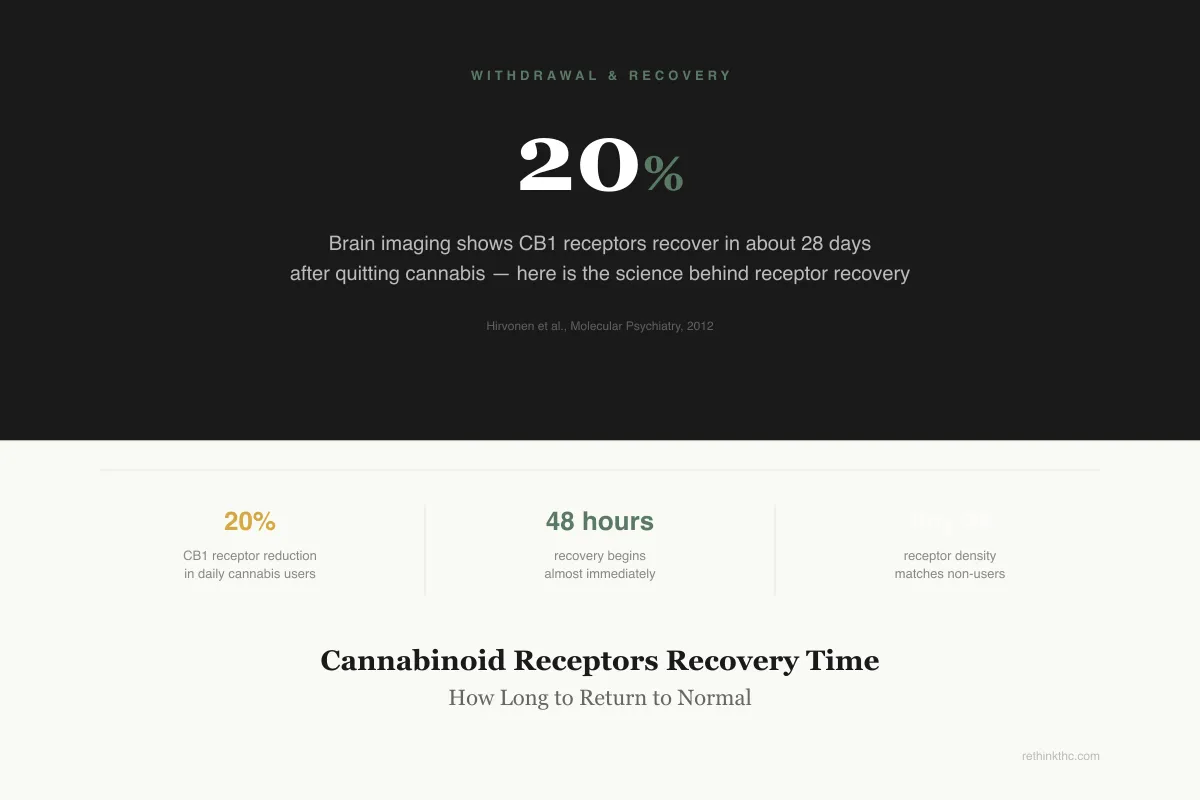
Withdrawal & Recovery
28 Days
Daily cannabis use reduces CB1 receptor density by about 20%, but recovery begins within 48 hours and reaches non-user levels by day 28.
Hirvonen et al., Molecular Psychiatry, 2012
20%
CB1 receptor reduction in daily cannabis users
48 hours
recovery begins almost immediately
Day 28
receptor density matches non-users
Hirvonen et al., Molecular Psychiatry, 2012
 View as image ↗
If you only read one thing
Your brain receptors start recovering within 48 hours of quitting, and they're back to normal by day 28. Daily weed use reduces the number of receptors THC binds to by about 20% — that's what tolerance is. But it's not damage. It's your brain turning down the volume because THC was too loud. When you stop, it turns the volume back up. Brain scans prove this: after 4 weeks off, daily users' brains look identical to people who never used.
Your brain did not break. That is the first thing worth saying, because when you are three days into quitting and your mood is on the floor, your sleep is wrecked, and food tastes like cardboard, "brain damage" is exactly where your mind goes. The reality is more specific and more encouraging. Your cannabinoid receptors adapted to a constant flood of THC by reducing their numbers and sensitivity. When you stop, they come back. The question everyone wants answered is how long that takes, and the research gives us surprisingly precise numbers.
Key Takeaways
- Regular cannabis use shrinks CB1 receptor density by about 15 to 20 percent — and brain imaging can measure that directly
- A landmark 2012 PET imaging study found that CB1 receptors get back to normal after about 28 days off cannabis
- Recovery kicks in within 48 hours and moves fastest in the thinking regions of your brain before deeper structures catch up
- Your receptors recovering and you feeling normal are not the same thing — receptors can normalize before your mood and motivation fully return
- These changes are your brain turning down its sensitivity (downregulation), not damage, and they fully reverse with time
- Different brain regions recover at different speeds — thinking areas normalize first, while deeper emotional and reward areas take longer
What CB1 Receptors Are and Why They Matter
Your brain has its own cannabis-like system called the endocannabinoid system, which we cover in depth in our guide to the endocannabinoid system explained simply. It uses naturally produced chemicals called endocannabinoids (the two main ones are anandamide and 2-AG) to regulate mood, appetite, pain, memory, and sleep. These chemicals work by binding to CB1 receptors, which are the most abundant receptor type in the human brain.
CB1 receptors are concentrated in the prefrontal cortex (decision-making and impulse control), the hippocampus (memory), the amygdala (emotional processing), the basal ganglia (movement and habits), and the cerebellum (coordination). This distribution map is basically a list of everything that feels off when you quit cannabis. That is not a coincidence.
THC works because its molecular shape is close enough to anandamide that it fits into the same CB1 receptors. The difference is that THC activates them far more intensely and for far longer than your natural endocannabinoids do. Your brain notices the overstimulation and responds by adjusting. For a deeper look at the whole system and how withdrawal disrupts it, see our guide on the endocannabinoid system and withdrawal.
How THC Changes Your Receptors
When CB1 receptors are hammered with THC day after day, your brain does two things to protect itself. First, it pulls CB1 receptors off the surface of neurons and stores them internally, a process called downregulation. Fewer receptors on the surface means fewer places for THC (or your natural endocannabinoids) to bind. Second, the remaining receptors become less responsive, a process called desensitization. The receptors are still there, but they require a stronger signal to activate. A 2005 review by Gonzalez and colleagues documented both processes in detail, showing that tolerance to cannabinoids involves region-specific patterns of downregulation and desensitization.[3]
This is the biological mechanism behind tolerance. It is the reason your first experience with cannabis felt so different from your hundredth. Your brain had a full complement of sensitive receptors that first time. By the hundredth session, it had significantly fewer receptors and the remaining ones were partially muted.
The key thing to understand is that this is adaptation, not injury. Your brain has not lost the ability to produce or maintain CB1 receptors. It has temporarily reduced them in response to an external signal. When the signal stops, the receptors come back. The evidence for this is direct, measured, and replicated.
The Research: Actual Brain Scans, Actual Numbers
Two studies stand out because they did not rely on surveys or behavioral observations. They used PET imaging (positron emission tomography) to directly visualize and count CB1 receptors in living human brains.
The Hirvonen 2012 Study
Hirvonen et al. (2012) · Molecular Psychiatry
- Population
- 30 chronic daily cannabis smokers and 28 non-using controls
- Intervention
- PET brain imaging with CB1-specific radiotracer, then re-scanned after ~28 days of monitored abstinence on a secure research unit
- Comparator
- Non-cannabis-using healthy controls
- Finding
- Daily users showed ~20% fewer CB1 receptors in cortical regions. After 28 days of verified abstinence, receptor density was statistically indistinguishable from controls — full recovery
positive First direct human evidence of reversible CB1 downregulation; secure unit ensured genuine abstinence
Hirvonen et al. (2012), Molecular Psychiatry, 17(6), 642-649
In 2012, Jussi Hirvonen and colleagues at the National Institute on Alcohol Abuse and Alcoholism published a study in the journal Molecular Psychiatry.[1] They used PET scans with a radiotracer that binds specifically to CB1 receptors, allowing them to quantify receptor density in specific brain regions.
The findings were striking. Daily cannabis users showed approximately 20 percent less CB1 receptor availability compared to non-users. The reductions were widespread but most pronounced in cortical regions, the outer layers of the brain responsible for higher-order thinking, planning, and emotional regulation.
Then came the recovery data. A subset of users abstained from cannabis and were re-scanned. After approximately 28 days of abstinence, their CB1 receptor density was statistically indistinguishable from the control group. The receptors came back. Not partially, not mostly. Fully.
This study is the reason "four weeks" has become the standard recommendation for a meaningful tolerance break. It is not an arbitrary number. It is based on direct imaging of receptor recovery in human brains.
The D'Souza 2016 Study
D'Souza et al. (2016) · Biological Psychiatry: CNNI
- Population
- Chronic daily cannabis users with PET imaging
- Intervention
- CB1 receptor measurement before and during early abstinence
- Comparator
- Same subjects tracked over time during cessation
- Finding
- CB1 receptor recovery began within just 2 days of abstinence. Recovery was fastest in the first week and gradually plateaued — explaining why even a 48-hour break produces a noticeable difference
positive Confirmed and extended Hirvonen's findings with early-recovery timeline data
D'Souza et al. (2016), Biol Psychiatry: CNNI
A second key study, led by Deepak D'Souza and published in Biological Psychiatry: Cognitive Neuroscience and Neuroimaging, added important detail to the timeline.[2] This study also used PET imaging to measure CB1 availability in chronic cannabis users. A third PET imaging study by Ceccarini and colleagues, using a different radiotracer, independently confirmed the same pattern of regional downregulation in chronic users.[4]
D'Souza's team found approximately 15 percent reduction in CB1 receptor availability in daily users. The slightly lower number compared to Hirvonen likely reflects differences in participant usage patterns and imaging methods, but the direction was identical: chronic use means fewer available receptors.
The critical contribution of this study was documenting the speed of early recovery. CB1 receptor availability began increasing within just two days of abstinence. The recovery was not linear, it was fastest in the first week and then gradually plateaued, but the process started almost immediately after the last use. This aligns with what people report experientially: even a 48-hour break produces a noticeable difference.
CB1 Receptor Recovery Timeline
| Time Point | CB1 Recovery Status | What You Typically Feel |
|---|---|---|
| 48 hours | Receptors begin upregulating | Slight reduction in tolerance; withdrawal symptoms starting |
| 1 week | Significant cortical recovery | Thinking starts clearing; emotional symptoms still intense |
| 2 weeks | Cortical regions near baseline; subcortical catching up | Focus and attention improved; mood still fluctuating |
| 4 weeks (day 28) | Receptor density matches non-users | Most withdrawal symptoms resolved; emotional baseline returning |
| 6–8 weeks | Full receptor function restored; downstream systems adjusting | Dopamine/serotonin normalization; motivation returning |
| 8–12 weeks | Complete neurological normalization for most people | Subjective recovery complete; stable mood and sleep |
Recovery Is Not the Same Everywhere in Your Brain
One of the most useful findings from the imaging research is that different brain regions recover at different speeds. The map below shows which regions bounce back first and which take the longest.
Brain Region Recovery
Not All Brain Regions Recover at the Same Speed
Cortical regions (thinking) recover first — subcortical (emotions, motivation) follow
Decision-making, impulse control, planning
Attention, spatial awareness
Memory formation, learning
Emotional processing, fear, anxiety
Motivation, reward, habits
Reward, pleasure, motivation
The gap: CB1 receptors may normalize by day 28, but downstream systems (dopamine, emotional regulation) take 6–12 weeks to fully recalibrate. Receptor recovery ≠ feeling normal.
Hirvonen et al. (2012), D'Souza et al. (2016)
View as image ↗Cortical regions recover fastest. The prefrontal cortex, parietal cortex, and other outer brain areas showed the most rapid return to baseline CB1 density. These areas handle executive function, attention, and abstract thinking. This is why cognitive clarity tends to return relatively early in the quitting process, often within the first two weeks.
Subcortical regions take longer. Deeper structures like the hippocampus (memory), amygdala (emotional processing), and parts of the limbic system showed slower recovery. These are the areas most closely tied to mood regulation, emotional reactivity, and the "gut feelings" that govern motivation and reward. This explains a common experience: your thinking sharpens before your emotions stabilize. You might feel mentally clear at week two but emotionally flat until week four or beyond.
For a complete overview of what this process looks like day by day, our weed withdrawal timeline maps the typical progression of symptoms as receptor recovery unfolds.
The Gap Between Receptor Recovery and Feeling Normal
This is where people get tripped up. Receptor recovery and subjective recovery are related but not identical.
Your CB1 receptors can be measurably back to baseline by day 28, but you might not feel fully "normal" until week six, eight, or even twelve. There are several reasons for this. First, receptor density and receptor function are not the same thing. Having the right number of receptors back on the surface is step one. Those receptors then need to re-establish proper signaling patterns with the rest of the brain's chemistry.
Second, CB1 recovery is only one piece of the puzzle. Dopamine recovery runs on a parallel but slightly delayed timeline. THC's effect on dopamine is indirect, working through the CB1 system, but dopamine receptor changes can take four to 12 weeks to fully normalize. So even after your cannabinoid receptors have recovered, your reward and motivation circuitry may still be recalibrating.
Third, your endocannabinoid system does not operate in isolation. It interacts with serotonin, GABA, glutamate, and cortisol systems. All of these were affected by chronic cannabis use, and they each have their own recovery timelines. The subjective experience of "feeling normal" requires all of these systems to settle into a new equilibrium, not just one.
This is important to know because it sets realistic expectations. If you hit day 28 and still do not feel great, that does not mean the research is wrong or that your brain is different. It means receptor recovery is the foundation, and the rest of the building takes a bit longer.
Factors That Affect Your Personal Timeline
The 28-day figure from the Hirvonen study is a population average. Your individual timeline depends on several variables.
Duration of use. Someone who used daily for six months will likely recover faster than someone who used daily for six years. Longer exposure means more entrenched downregulation.
Frequency and potency. Daily use of high-THC concentrates (70 to 90 percent THC) pushes receptors harder than weekend use of flower (15 to 25 percent THC). The more intense and frequent the CB1 stimulation, the deeper the downregulation.
Age. Younger brains, particularly those under 25 where development is still occurring, appear more plastic and may recover faster. But they may also be more susceptible to disruption in the first place. The research here is still evolving.
Genetics. Variations in the genes that code for CB1 receptors (particularly the CNR1 gene) influence baseline receptor density and likely affect recovery speed. Some people naturally have more CB1 receptors and may tolerate both the downregulation and the recovery period differently. You cannot test for this in any practical way, but it helps explain why two people with similar use histories can have different recovery experiences.
Overall health. Sleep quality, exercise, nutrition, and stress levels all influence neuroplasticity, your brain's ability to reorganize and rebuild. The healthier the conditions, the better the environment for receptor recovery.
Evidence Review
Where the evidence stands
Cell & Lab Studies
CB1 receptor downregulation and desensitization mechanisms well-characterized (Gonzalez 2005)
Animal Studies
Reversible CB1 downregulation confirmed across multiple rodent models over decades
Clinical Observations
Consistent tolerance reversal reported by cannabis users after breaks
PET Imaging Studies
Hirvonen 2012: full recovery by day 28. D'Souza 2016: recovery starts within 48 hours. Ceccarini 2015: independent confirmation
Replicated Across Methods
Three independent PET studies using different radiotracers all confirm the same pattern
Scientific Consensus
CB1 receptor recovery after cannabis cessation is one of the most well-established findings in cannabis neuroscience
This is about as solid as neuroscience gets. Three independent brain imaging studies using different methods all show the same thing: daily use reduces CB1 receptors by 15-20%, recovery starts within 48 hours, and receptors fully normalize by about day 28. The finding is replicated, consistent, and directly measured in living human brains.
Hirvonen (2012), D'Souza (2016), Ceccarini (2015), Gonzalez (2005)
Why This Science Matters Practically
Understanding receptor recovery explains several things that otherwise seem random.
It explains why tolerance breaks work. A t-break is not a willpower exercise. It is a biological reset. Four weeks of abstinence allows your CB1 receptors to return to pre-use density, which means THC hits a full complement of sensitive receptors again.
It explains why the first two weeks are the hardest. The maximum gap between your depleted receptor state and normal function exists in the first few days. As receptors rebuild through week one and two, withdrawal symptoms track the recovery curve, intense at first and gradually easing.
It explains why "full recovery" is the right framing. You are not healing from damage. You are waiting for an adaptation to reverse. Your brain downregulated in response to an external chemical, and it upregulates when that chemical is removed. The endpoint is not "as good as it gets." The endpoint is your original baseline. For a broader view of all the changes that happen when you stop, see what happens when you stop smoking weed.
When to Seek Professional Help
Receptor recovery follows a predictable timeline, and most people move through it without medical intervention. However, if you experience severe anxiety, depression, or inability to function in daily life beyond six to eight weeks of abstinence, it is worth talking to a healthcare provider. In some cases, chronic cannabis use masks a pre-existing condition like generalized anxiety or depression, and quitting reveals what was already there.
If you experience thoughts of self-harm at any point, reach out immediately. SAMHSA's National Helpline is available at 1-800-662-4357. It is free, confidential, and available 24 hours a day, seven days a week.
For a comprehensive look at the full withdrawal process, including symptoms beyond receptor recovery, our cannabis withdrawal complete guide covers everything from the science to practical coping strategies.
The Reframe
Your cannabinoid receptors are not gone. They are tucked away, waiting for the signal to come back. The brain imaging proves this in the most literal way possible: researchers watched them disappear under chronic THC exposure, then watched them return after 28 days of abstinence. The flat feelings, the disrupted sleep, the emotional volatility of early withdrawal are not signs that something is permanently wrong. They are signs that recovery is in progress. Your brain built this adaptation over months or years. It undoes it in weeks. That is not fragility. That is a system working exactly as designed.
The Bottom Line
Brain imaging studies provide direct evidence for cannabinoid receptor recovery after quitting cannabis. A 2012 PET imaging study found that daily users have approximately 20% fewer available CB1 receptors compared to non-users, but after 28 days of abstinence, receptor density returned to levels statistically indistinguishable from controls. Recovery begins within 48 hours, progresses fastest in cortical thinking regions, and reaches deeper emotional and reward structures last. This explains why cognitive clarity often returns before mood and motivation fully stabilize. Receptor recovery is not the same as subjective recovery — feeling fully normal may take 6 to 12 weeks because dopamine, serotonin, and other neurotransmitter systems have their own parallel recovery timelines.
How long does it take for CB1 receptors to return to normal after quitting weed?
PET imaging research shows CB1 receptor density begins recovering within 48 hours of abstinence and returns to levels indistinguishable from non-users after approximately 28 days. This timeline comes from a 2012 study published in Molecular Psychiatry that directly measured receptor availability in daily cannabis users before and after quitting.
Are cannabinoid receptor changes from cannabis use permanent?
No. The changes are downregulation, a reversible adaptation, not damage. Brain imaging studies confirm that CB1 receptor density fully normalizes after a period of abstinence, typically around four weeks for daily users. There is no evidence in current research that cannabis causes permanent receptor loss.
Why do I still feel bad after 4 weeks of not smoking?
CB1 receptor recovery is only one component of returning to normal. Dopamine receptor recovery can take four to 12 weeks. Other neurotransmitter systems (serotonin, GABA, cortisol) also need time to recalibrate. Your receptors may be back to baseline while your overall brain chemistry is still settling into its new equilibrium. Feeling fully normal can take six to 12 weeks for heavy, long-term users.
Does the potency of cannabis affect how long receptor recovery takes?
Higher-potency products (concentrates, high-THC flower) cause more intense CB1 stimulation and likely deeper downregulation. While the 28-day average applies broadly, heavy users of concentrates may find that subjective recovery takes longer than someone who used lower-potency flower. The receptors still come back, but the depth of the adaptation affects the timeline.
Can I speed up cannabinoid receptor recovery?
You cannot force receptors to rebuild faster than biology allows. But you can support the process by optimizing the conditions for neuroplasticity: regular exercise, consistent sleep, proper nutrition, and stress management. Exercise in particular has been shown to support endocannabinoid system function. The most important factor, though, is sustained abstinence from THC.
Do different brain regions recover at different speeds?
Yes. PET imaging shows that cortical regions (the outer brain areas responsible for thinking, planning, and attention) recover CB1 receptor density fastest, often within the first two weeks. Deeper subcortical structures like the hippocampus (memory), amygdala (emotional processing), and limbic system take longer. This explains the common experience of cognitive clarity returning before emotional stability — your thinking sharpens first, while mood and motivation take additional weeks to fully normalize.
Sources & References
- 1RTHC-00573·Hirvonen, Jussi et al. (2012). “Daily Cannabis Use Was Linked to Fewer CB1 Receptors. A Month Without Brought Them Back..” Molecular Psychiatry.Study breakdown →PubMed →↩
- 2RTHC-01134·D'Souza, Deepak Cyril et al. (2016). “Brain Cannabinoid Receptors Drop With Heavy Use, Then Rebound Within Days of Stopping.” Biological Psychiatry: Cognitive Neuroscience and Neuroimaging.Study breakdown →PubMed →↩
- 3RTHC-00188·González, Sara et al. (2005). “Comprehensive Review of Cannabis Tolerance and Dependence in Laboratory Animals.” Pharmacology.Study breakdown →PubMed →↩
- 4RTHC-00933·Ceccarini, Jenny et al. (2015). “Brain scans showed chronic cannabis users had about 12% fewer CB1 receptors in key brain regions.” Addiction biology.Study breakdown →PubMed →↩