Withdrawal & Recovery
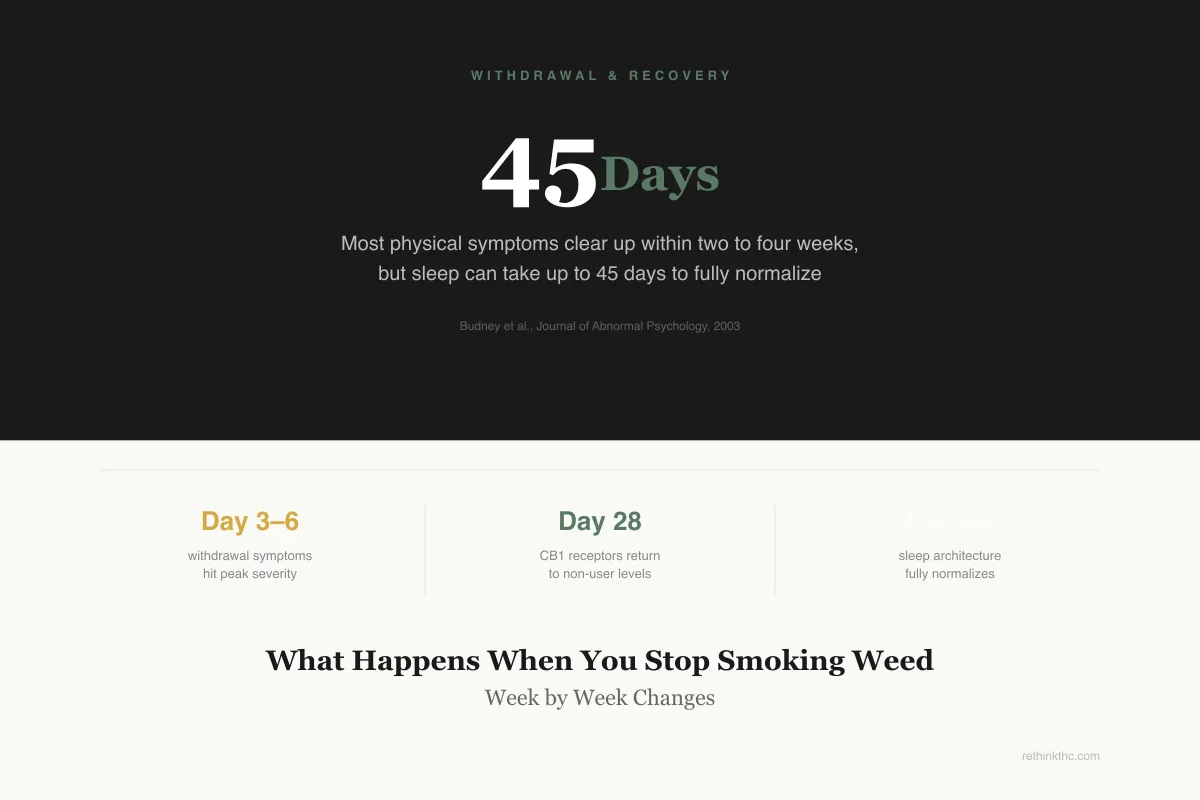
45 Days
Most physical symptoms clear up within two to four weeks, but sleep can take up to 45 days to fully normalize.
Budney et al., Journal of Abnormal Psychology, 2003
Day 3–6
withdrawal symptoms hit peak severity
Day 28
CB1 receptors return to non-user levels
45 days
sleep architecture fully normalizes
Budney et al., Journal of Abnormal Psychology, 2003
 View as image ↗
If you only read one thing
The first week is the hardest part — it peaks around days 3 to 6, then starts getting better. Your brain's receptors fully heal by day 28. Sleep takes the longest, up to 45 days to normalize. By month two, most people say they feel genuinely better than they did while using. Everything that changes is reversible. The rough part is real, but it's also temporary and predictable.
You are thinking about quitting, or you already did, and you want to know what actually happens. Not the scare tactics. Not the "weed is harmless" dismissal either. Just the real sequence of changes, good and bad, that your body and brain go through when you stop smoking weed.
The short version: the first week is rough, the second week is better, and by month two most people are genuinely surprised by how much has changed. Here is the longer version, broken down week by week, based on what clinical research and thousands of people who have been through it actually report.
Key Takeaways
- The first week is the hardest — symptoms peak around days 3 to 6 and then steadily improve
- Your body, brain, and lungs all recover on different timelines, and some things get worse before they get better
- Most physical symptoms clear up within two to four weeks, but sleep can take up to 45 days to fully normalize
- Memory, focus, and motivation measurably come back within weeks of stopping
- By month three, most people say they feel better than they did while using — not just "back to normal"
- All cannabis-related changes are fully reversible — CB1 receptors normalize by day 28 and cognitive function recovers within weeks
Timeline at a Glance
| Phase | What Gets Harder | What Gets Better |
|---|---|---|
| Week 1 | Sleep, appetite, irritability, cravings, brain fog | Lungs begin clearing; cilia reactivate |
| Week 2 | Sleep still disrupted; situational cravings | Appetite returns; emotional volatility decreases; focus improves in patches |
| Weeks 3–4 | Occasional vivid dreams; residual mood dips | CB1 receptors normalize; physical symptoms resolve; concentration returns |
| Month 2 | Intermittent cravings; occasional boredom | Memory improves; emotional baseline restores; sleep normalizes |
| Month 3+ | Rare situational cravings | Full cognitive recovery; dopamine normalized; sustained motivation |
The visual below maps these same milestones against your receptor recovery timeline, so you can see where each improvement connects to the biology.
Recovery Science
Your Body Recovers on Five Different Timelines
Sources: Hirvonen (2012), Scott (2018), Bolla (2008), Reid (2010)
 View as image ↗
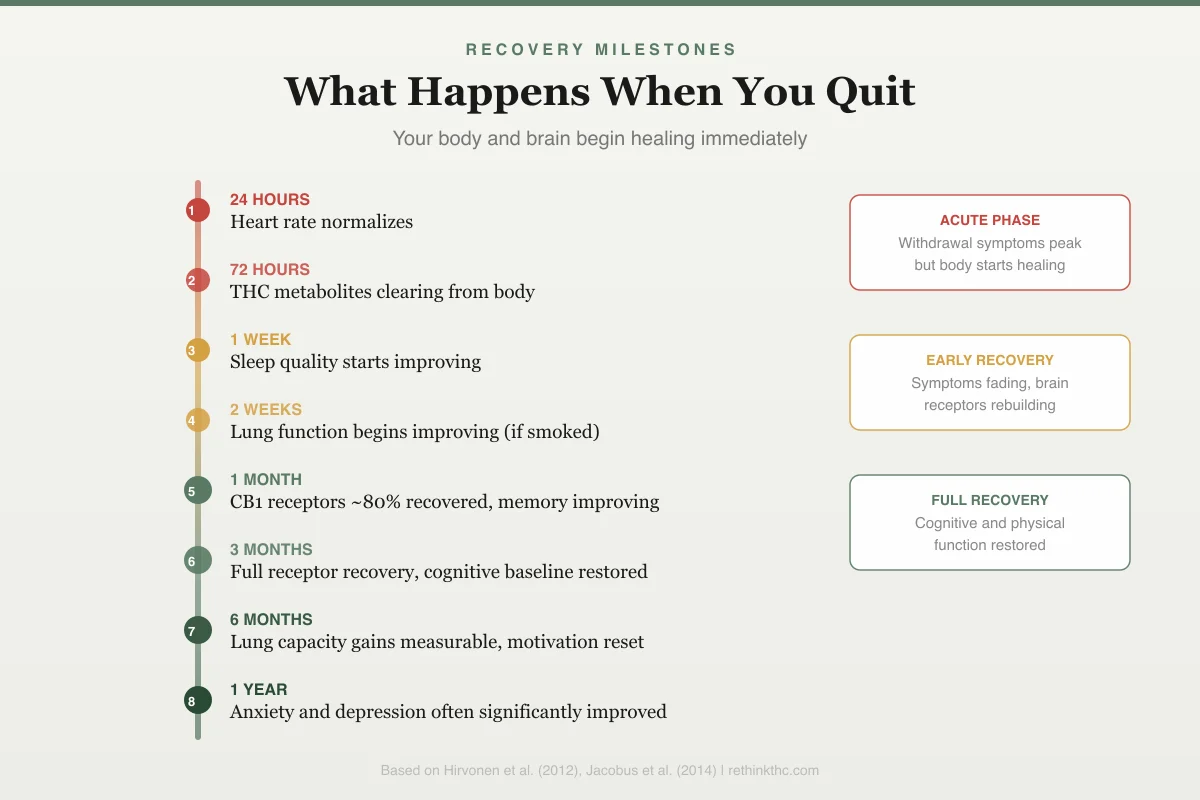
Recovery Milestones
What Happens When You Quit
Your body and brain begin healing immediately
24 hours
Heart rate normalizes
72 hours
THC metabolites clearing
1 week
Sleep quality starts improving
2 weeks
Lung function begins improving (if smoked)
1 month
CB1 receptors ~80% recovered, memory improving
3 months
Full receptor recovery, cognitive baseline restored
6 months
Lung capacity gains measurable, motivation reset
1 year
Anxiety and depression often significantly improved
Based on Hirvonen et al. (2012), Jacobus et al. (2014)
 View as image ↗
Week 1: The Hard Part
There is no way around it. The first week is the worst part of the process. If you are in it right now, this is the peak. It does get better from here. The dual-track breakdown below shows what is happening in your body and brain simultaneously during these first seven days.
Week 1 Breakdown
What Gets Harder vs. What Gets Better
The first week is the hardest — but recovery is happening simultaneously
Day 1
Gets Harder
• Mild restlessness begins
• Sleep onset delayed
Gets Better
• THC metabolites clearing
• Decision momentum builds
Days 2–3
Gets Harder
• Irritability spikes
• Appetite drops sharply
• Insomnia worsens
Gets Better
• CB1 receptors start upregulating
• Lung cilia reactivating
Days 3–6
Gets Harder
• Peak symptoms — anxiety, sweats, brain fog
• Dopamine at lowest point
• Vivid dreams begin
Gets Better
• Receptor recovery accelerating
• Each hour = measurable progress
Day 7
Gets Harder
• Sleep still fragmented
• Emotional waves continue
Gets Better
• Worst is behind you
• Appetite returning
• Cognitive fog lifting
Budney et al. (2003), Hirvonen et al. (2012)
View as image ↗Your Body
Withdrawal symptoms typically begin within the first 24 hours. A 2003 study by Budney and colleagues in the Journal of Abnormal Psychology[1] documented that irritability, sleep disruption, and appetite loss are among the earliest and most consistent symptoms. They tend to peak between days three and six.
Sleep is usually the first casualty. You may lie awake for hours, or fall asleep and wake up two hours later drenched in sweat. When you do sleep, the dreams are vivid and sometimes disturbing. This is called REM rebound. THC suppresses your dreaming sleep, and when you remove it, your brain floods you with the REM cycles it has been missing. It feels alarming, but it is your brain catching up on something it needs.
Your appetite may vanish entirely. THC stimulates hunger directly through receptor activation, and without it, your body temporarily forgets how to feel hungry on its own. Some people lose a few pounds in the first week simply because eating feels like a chore.
If you smoked (as opposed to edibles or vapes), you may actually start coughing more. This seems counterintuitive, but your lungs are beginning to clear out. The respiratory epithelium, the lining of your airways, starts repairing itself within days. That repair process involves pushing out accumulated debris, and that means more mucus and coughing before it gets better.
Your Brain
Mentally, this week is a roller coaster. Irritability is the most commonly reported symptom, and it is not subtle. Small things feel enormous. You may snap at people who do not deserve it, then feel guilty about it an hour later. This is your brain's emotional regulation system operating without THC for the first time in however long you have been using.
Cravings are at their most intense. Your dopamine system is at its lowest point because THC was artificially boosting dopamine output, and now that boost is gone while your receptors are still turned down. Everything feels flat, pointless, or just annoying.
Brain fog is real. You might read the same email three times without absorbing it. Concentration feels like trying to hold water in your hands.
What People Say About This Week
If you spend any time in cannabis recovery communities, the week one descriptions are remarkably consistent. "Everything is annoying." "I cannot eat anything." "I had the most insane dream of my life." "I feel like I have a low-grade flu." "I cried three times today and I do not even know why."
All of it is normal. None of it is permanent.
Week 2: The Shift
The second week is where most people notice the first real change. It is not that everything is suddenly fine. It is that you start having windows. A few hours here, maybe a full afternoon there, where you feel like yourself again.
Your Body
Appetite starts creeping back. It may not be your full pre-use appetite yet, but food becomes something you can tolerate and occasionally even want. Some people describe food tasting different. Flavors seem sharper or more distinct. This is likely related to your endocannabinoid system recalibrating the sensory processing that THC was modulating.
Sleep is still rough, but it is better than week one. You are getting more total sleep, even if the quality is poor and the dreams are still intense. Night sweats typically begin easing up. Energy fluctuates throughout the day. You might have a burst of motivation in the morning and crash by 3 PM, or feel exhausted until evening when you suddenly feel wired.
If you were a smoker, the coughing is starting to decrease. Your lungs are making progress. You might notice that climbing stairs or walking uphill feels slightly easier, even this early.
Your Brain
The emotional volatility from week one has not disappeared, but it has lost some of its edge. You are less likely to explode over minor things. The mood swings are still there, but they are less extreme and shorter in duration.
Cravings are still present, but they are changing character. In week one, cravings felt urgent and physical, almost like hunger. In week two, they are more situational. You think about smoking when you encounter a trigger (a certain time of day, a specific activity, stress) rather than constantly.
The fog is lifting in patches. You might notice you can hold a conversation without losing your train of thought, or that you finished a task at work without needing to restart it three times.
What People Say About This Week
"I had one genuinely good day." "Food tastes different, in a good way." "I actually laughed at something and meant it." "Still not sleeping great, but I slept." "The cravings are not gone but they do not feel like emergencies anymore."
Weeks 3 to 4: The Turn
This is the phase where the balance tips. The bad days still happen, but the good days start outnumbering them. Most of the acute physical symptoms are winding down, and the cognitive improvements become hard to ignore.
Your Body
Sleep is normalizing. A 2012 study by Hirvonen and colleagues in Molecular Psychiatry[2] found that CB1 receptor density, the brain receptors that THC binds to, returns to normal levels by approximately day 28. As those receptors come back online, the systems they regulate (including sleep) stabilize. You are falling asleep faster, staying asleep longer, and the dreams, while still more vivid than they were when you were using, are no longer nightmares every night.
Hirvonen et al. (2012) · Molecular Psychiatry
- Population
- Chronic daily cannabis smokers vs. non-using controls
- Intervention
- Monitored abstinence with PET brain scans before and after
- Comparator
- Healthy non-using control group
- Finding
- CB1 receptors in chronic users were measurably lower than controls at baseline. After about 4 weeks of verified abstinence, receptor levels rose to match non-users — the change was fully reversible.
positive Gold-standard neuroimaging evidence that cannabis-related brain changes are not permanent
Hirvonen et al. (2012), Molecular Psychiatry, 17(6), 642-649
Appetite has stabilized for most people. You feel hungry at normal times and can eat regular meals. Some people notice their weight shifting during this phase, either regaining what they lost in week one or, if THC-driven munchies were a factor, starting to lose weight as their calorie intake normalizes.
Physical withdrawal symptoms are largely gone. The headaches, stomach issues, sweating, and restlessness that marked the first two weeks have mostly resolved.
For smokers, lung function is measurably improved. Research has consistently shown that cannabis smoke has measurable effects on lung tissue, and that respiratory symptoms improve within weeks of stopping inhalation.[4] You can take deeper breaths. The chronic cough is fading or gone.
Your Brain
This is where cognitive recovery starts becoming obvious. Research examining brain function in adolescent cannabis users has confirmed that regular use affects cognition in measurable ways that improve with cessation.[5]
Motivation is returning. Not all at once, but you find yourself wanting to do things rather than having to force yourself. The anhedonia (the flat, "nothing is interesting" feeling) is lifting. This maps directly to your dopamine system recovering. Your brain is rebuilding the receptors that register reward, and everyday activities are starting to generate a normal signal again.
Focus improves. You can read a chapter of a book. You can sit through a movie. Work tasks that required enormous willpower in week one now feel manageable.
What People Say About This Phase
"I woke up before my alarm." "I actually wanted to exercise, which has literally never happened." "My short-term memory is noticeably better." "I can think clearly for the first time in months." "I did not think about smoking at all yesterday."
Month 2: The New Normal
By the second month, the acute process is over for most people. What you are experiencing now is not recovery from withdrawal. It is what life feels like when your brain is running on its own chemistry.
Your Body and Brain
Sleep has normalized for the majority of people, though some heavy, long-term users may still have occasional disrupted nights. The vivid dreams have settled into a normal dreaming pattern. You are getting quality REM sleep, the kind that consolidates memories and restores cognitive function.
Your emotional baseline is back. This does not mean you never feel sad or anxious. It means your emotions are proportionate to what is actually happening in your life, rather than being amplified or dampened by THC. You can feel stressed about a stressful situation without it spiraling into a crisis. You can feel happy without needing a substance to generate the feeling.
Memory continues improving. People consistently report that this is one of the most surprising changes. Names come to you faster. You remember conversations from earlier in the week. You walk into a room and actually remember why you went in there. A 2018 meta-analysis in JAMA Psychiatry confirmed[3] that cognitive deficits associated with cannabis use largely resolve with sustained abstinence, with memory showing some of the most robust recovery.
Scott et al. (2018) · JAMA Psychiatry
- Population
- 69 studies, 2,152 cannabis users and 6,575 controls (mean age ~21)
- Intervention
- Meta-analysis of cognitive testing across 10 domains
- Comparator
- Non-using matched controls
- Finding
- Cannabis users showed a small overall reduction in cognitive function. But when studies required at least 72 hours of abstinence before testing, the difference disappeared entirely — suggesting most deficits reflect recent use, not permanent damage.
positive The strongest evidence yet that cannabis-related cognitive changes are reversible
Scott et al. (2018), JAMA Psychiatry, 75(6), 585-595
Beyond Your Body
Some of the most significant changes at this stage are not neurological. They are practical.
Money. If you were spending $200 to $400 a month on cannabis (a common range for daily users), you have saved $400 to $800 by month two. That number adds up fast, and seeing it accumulate in your bank account is a concrete reminder that things have changed.
Relationships. Multiple people in your life may comment that you seem more present. More engaged in conversations. More reliable. More emotionally available. These changes often happen gradually enough that you do not notice them yourself, but other people do.
Time. The ritual of smoking, the time spent high, the recovery from being high, the trips to buy more. When you add it up, daily users frequently report gaining back one to three hours per day. By month two, that is 60 to 90 hours of reclaimed time.
What People Say About This Phase
"My memory is so much better, it is actually embarrassing how bad it was." "I dream every night now and I forgot what that was like." "I saved over $500 and I keep looking at my bank account." "My partner said I seem like a different person." "I am bored sometimes, but it is normal boredom, not the flat gray nothing."
Month 3 and Beyond: Full Recovery
By the three-month mark, the biological recovery process is essentially complete for most people. The Hirvonen 2012 study confirmed CB1 receptor normalization by day 28, and the downstream effects on dopamine, serotonin, and other neurotransmitter systems continue resolving through months two and three.
What Full Recovery Looks Like
Your dopamine system has normalized. Activities generate normal levels of reward. Motivation is self-sustaining rather than something you have to manufacture through willpower. The anhedonia is gone.
Your sleep architecture is fully restored. You cycle through light sleep, deep sleep, and REM in normal patterns. You wake up feeling rested. The nightmares and night sweats are distant memories.
Cognitive function is at your baseline. For younger users (under 25), some studies suggest that cognitive improvements may continue beyond three months as the brain completes its normal developmental processes without THC interference. Research suggests that younger users may show particularly robust cognitive recovery with sustained abstinence.
The Longer View
Beyond the biological changes, people who have been abstinent for three months or longer consistently report improvements in areas that are harder to measure but no less real.
Self-image shifts. You start seeing yourself as someone who does not need a substance to manage your day, your stress, your boredom, or your emotions. That identity change is subtle, but it compounds.
Career and productivity improve. With better memory, focus, and motivation, performance at work or school tends to increase. Projects get finished. Deadlines get met. Opportunities that require sustained effort become accessible in a way they were not before.
Financial stability builds. At $300 per month (a moderate estimate for daily users), you have saved $900 by month three. Over a year, that is $3,600. For some people, that is a vacation. For others, it is getting out of debt or building an emergency fund.
Evidence Review
Where the evidence stands
Cell & Lab Studies
CB1 receptor mechanisms, dopamine pathways, and sleep architecture changes well characterized
Animal Studies
THC withdrawal, receptor recovery, and cognitive recovery confirmed in animal models
Case Reports & Surveys
Thousands of consistent self-reports documenting the week-by-week recovery pattern
Small Human Trials
Hirvonen 2012 PET imaging, Budney 2003 withdrawal timeline, Bolla 2008 sleep studies
Large Controlled Trials
Some larger observational studies, but no large RCTs specifically on recovery timelines
Meta-Analysis
Scott 2018 meta-analysis of 69 studies confirms cognitive recovery with abstinence
The recovery timeline after quitting cannabis is one of the best-documented areas in cannabis research. PET imaging, polysomnography, and a large meta-analysis all converge on the same conclusion: changes are reversible, and most recovery happens within 4 to 12 weeks.
Hirvonen et al. (2012); Scott et al. (2018); Budney et al. (2003); Bolla et al. (2008)
The Honest Summary
Not every week after quitting is better than every week while using. The first week is genuinely harder than most days you had as a regular user. Anyone who tells you quitting is easy is either lying or was not a daily user.
But the trajectory is clear and consistent across clinical research and the experiences of thousands of people who have done it. The hard part is early, it is finite, and what comes after it, for most people, is meaningfully better than what came before.
You do not have to view quitting as a moral victory or a defeat of addiction. It is a decision that produces a specific, predictable set of outcomes. Now you know what those outcomes are, week by week. Whatever you decide to do with that information is up to you.
When to Seek Professional Help
The changes described in this article reflect the typical experience. But if your withdrawal symptoms are severe enough to interfere with work, relationships, or basic daily functioning, professional support is available. If anxiety or depression during the process feels unmanageable, or if you experience thoughts of self-harm at any point, reach out immediately.
Safety
ModerateWithdrawal that goes beyond uncomfortable
Concern
Most withdrawal symptoms are unpleasant but manageable. However, if anxiety or depression during the process feels unmanageable, if you are unable to eat or sleep for more than a few days, or if you experience thoughts of self-harm at any point, this is beyond normal withdrawal.
What the research says
These symptoms can indicate a pre-existing condition that cannabis was masking, or a more severe withdrawal response. Either way, professional support can make the process safer and more manageable.
Particularly relevant for: Anyone whose withdrawal symptoms interfere with work, relationships, or basic daily functioning
What to do
SAMHSA National Helpline: 1-800-662-4357 (free, confidential, 24/7). You do not need to be in crisis to call.
Budney et al. (2003), Journal of Abnormal Psychology
SAMHSA's National Helpline is available at 1-800-662-4357. It is free, confidential, and available 24 hours a day. You can also visit how to quit weed for practical strategies that complement what your body is already doing on its own.
The Bottom Line
When you stop smoking weed, your body and brain go through a predictable sequence of changes. The first week is the hardest, with withdrawal symptoms peaking around days 3 to 6. Week two brings the first "windows" of normalcy. By weeks 3 to 4, CB1 receptors return to normal levels and most physical symptoms resolve. By month two, cognitive improvements in memory, focus, and motivation become obvious. Month three marks full neurological recovery for most people. The trajectory is consistently toward improvement, even though the first week is genuinely difficult.
What are the first things you notice when you stop smoking weed?
The most immediate changes are sleep disruption, appetite loss, and irritability. Most people notice something within the first 24 hours. Sleep is typically the first thing affected, with difficulty falling asleep and vivid dreams when you do. Appetite suppression and emotional volatility follow closely. These peak around days three to six and begin improving during week two.
How long until you feel normal after quitting weed?
Most acute symptoms resolve within two to four weeks. Dopamine function and motivation typically normalize between four and 12 weeks. Sleep can take up to 45 days to fully stabilize. By month two, the majority of people report feeling at or better than their pre-use baseline. Heavy, long-term users may take closer to three months for complete normalization.
Do your lungs recover after you stop smoking weed?
Yes. Research published in the Annals of the American Thoracic Society shows measurable improvements in lung function within 30 days of stopping cannabis inhalation. You may cough more in the first week as your lungs clear out accumulated debris, but breathing capacity improves steadily after that. Most people notice significantly easier breathing by weeks three to four.
Does your memory come back after quitting weed?
Yes. Research has found measurable improvements in memory, attention, and processing speed within weeks of abstinence. A 2018 meta-analysis in JAMA Psychiatry confirmed that cognitive deficits from cannabis use largely resolve with sustained abstinence. Verbal memory, the ability to learn and recall spoken or written information, tends to show the most notable recovery.
Is it normal to feel worse before feeling better after quitting weed?
Yes, and this is one of the most important things to understand about the process. Week one is harder than most days you experienced while using. Withdrawal symptoms peak around days three to six before improving. Some physical symptoms like coughing also get temporarily worse as your lungs begin clearing out. The trajectory is consistently toward improvement, but the first week is a valley you have to walk through to reach the other side.
Will I gain or lose weight after quitting weed?
Both are possible, depending on your eating patterns while using. If THC-driven munchies caused you to overeat, quitting may lead to weight loss as your calorie intake normalizes. If you are among those who lose appetite during withdrawal, you may lose a few pounds in the first two weeks before appetite returns. Most people stabilize at a healthier weight by month two as their appetite regulation system fully recovers.
Sources & References
- 1RTHC-00134·Budney, Alan J. et al. (2003). “When Heavy Users Quit Cannabis, Symptoms Show Up Fast and Ease Within Two Weeks.” Journal of Abnormal Psychology.Study breakdown →PubMed →↩
- 2RTHC-00573·Hirvonen, Jussi et al. (2012). “Daily Cannabis Use Was Linked to Fewer CB1 Receptors. A Month Without Brought Them Back..” Molecular Psychiatry.Study breakdown →PubMed →↩
- 3RTHC-01832·Scott, J. Cobb et al. (2018). “Cannabis Cognitive Effects Are Small and Largely Disappear After 72 Hours of Abstinence.” JAMA Psychiatry.Study breakdown →PubMed →↩
- 4RTHC-00445·Reid, P T et al. (2010). “Cannabis smoking may contribute to lung disease, pneumothorax, infections, and possibly lung cancer.” The journal of the Royal College of Physicians of Edinburgh.Study breakdown →PubMed →↩
- 5RTHC-00365·Jacobus, Joanna et al. (2009). “What Heavy Teen Marijuana Use Was Linked To: Slower Thinking, Subtle Brain Differences, and Poorer Sleep.” Pharmacology.Study breakdown →PubMed →↩