Guides
15 Minutes
Cannabis cravings peak and pass within 15 to 20 minutes because they are dopamine anticipation signals, not genuine need, and urge surfing techniques can shorten them further.
Journal of Abnormal Psychology, 2004
What a Craving Actually Is
covered in detail
The Craving Wave: It Peaks and Passes
covered in detail
CBT Techniques You Can Use Right Now
covered in detail
Journal of Abnormal Psychology, 2004
 View as image ↗
If you only read one thing
That craving you're feeling right now will pass in about 15 to 20 minutes whether you give in or not. It's not your body needing weed — it's your brain's reward system firing an anticipation signal because it learned to expect a hit. Every single craving follows the same wave: it rises, it peaks, it falls. Your only job is to wait it out. Set a timer for 20 minutes, do literally anything else, and then check in with yourself. The urgency almost always disappears once the wave passes.
Key Takeaways
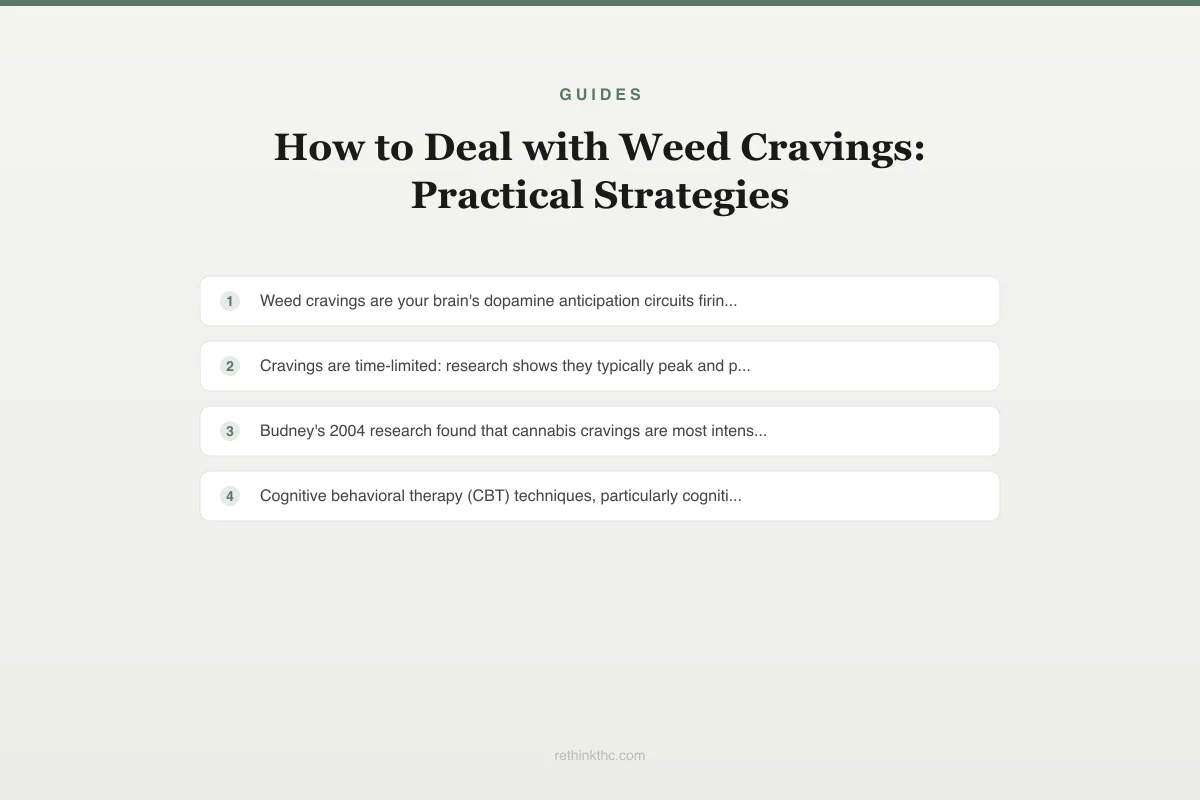
- Weed cravings are your brain's dopamine anticipation circuits firing in expectation of a reward — not a sign of genuine need or proof that you cannot quit
- Cravings are time-limited: research shows they typically peak and pass within 15 to 20 minutes, even if you do nothing at all
- Budney's 2004 research found that cannabis cravings hit hardest during the first week of abstinence and can linger at lower levels for several weeks after
- Cognitive behavioral therapy (CBT) techniques like cognitive reframing and trigger identification are proven tools for cannabis use disorder — and you can practice them without a therapist
- The "urge surfing" method from psychologist Alan Marlatt teaches you to watch a craving like a wave that rises, peaks, and falls instead of fighting it or giving in
- Cravings that feel like a constant pull instead of a passing wave often point to an unmet emotional need — anxiety, loneliness, boredom — that cannabis was covering, which means the root cause needs attention, not just the craving itself
Fact Check
What cravings are actually telling you
The claim
“The craving proves I need weed — my body is telling me something, and fighting it is just willpower that will eventually break”
The intensity of cravings during early abstinence, especially in the first week when they feel constant and overwhelming
What research shows
MisleadingCravings are learned dopamine anticipation responses, not signals of biological need. Budney's 2004 research documented that they peak in week one and decline — and each individual craving episode passes in 15-20 minutes regardless of whether you use or not.
The craving feels like need because your brain's reward circuitry fires the same way for anticipation as for actual necessity. But unlike hunger or thirst, not acting on a craving does not harm you. Every craving you ride out without using weakens the underlying association. You are not running out of willpower — you are rewiring a circuit.
Budney et al. (2004), Journal of Abnormal Psychology
What a Craving Actually Is
Your brain has a reward system built around dopamine, a neurotransmitter involved in motivation, anticipation, and the feeling that something is worth doing. Dopamine does not just fire when you receive a reward. It fires in anticipation of a reward you have learned to expect. This is why the craving hits before you use, not during.
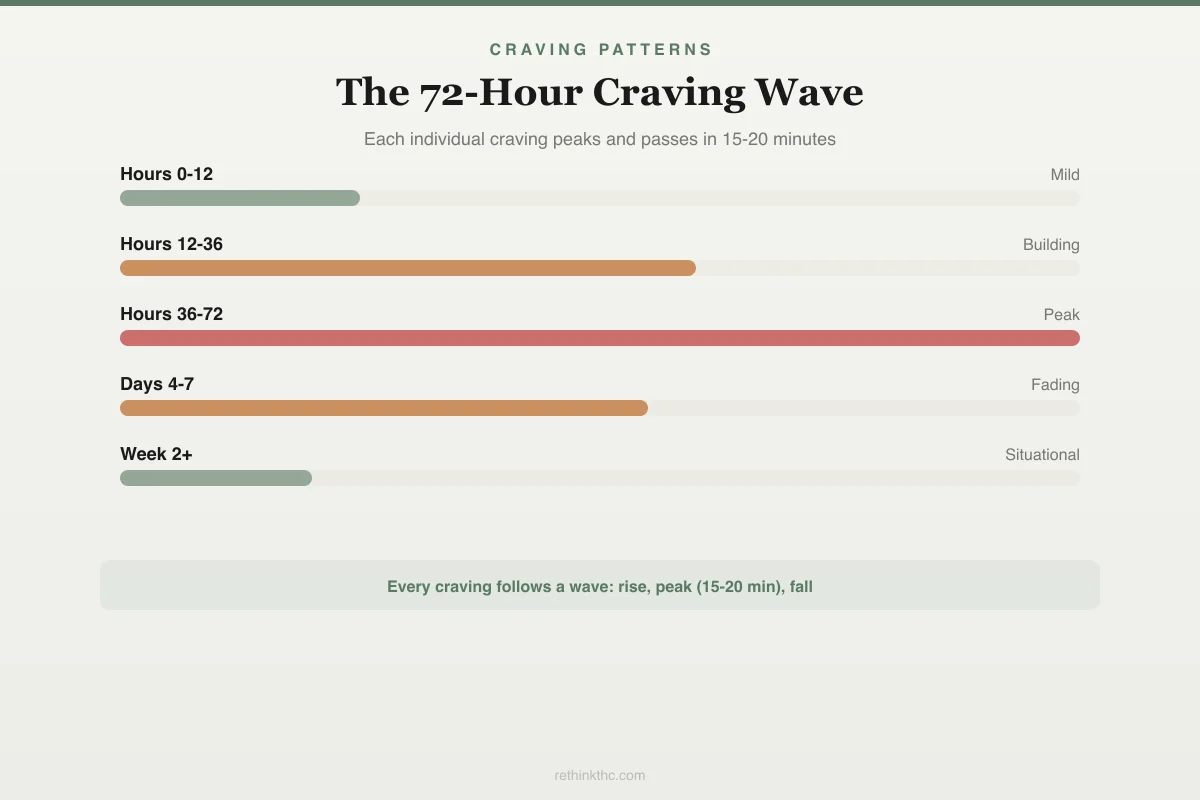
Craving Patterns
The 72-Hour Craving Wave
Each individual craving peaks and passes in 15-20 minutes — every single time.
Key insight: Cravings feel permanent but always follow a wave — rise, peak (15-20 min), fall. Ride the wave.
Based on Budney et al. (2003, 2006)
 View as image ↗
When you used cannabis regularly, your brain formed strong associations between specific cues (time of day, emotional states, social situations, even the sight of paraphernalia) and the dopamine surge that followed. These associations are stored in your dopamine anticipation circuits, and they do not disappear the moment you decide to quit. They persist for weeks or months, firing whenever the associated cue appears.
This is why cravings can feel so involuntary. They are not a conscious choice. They are a learned neurological response, as automatic as flinching when something flies toward your face. The good news is that learned responses can be unlearned. They weaken over time when they are not reinforced. Every craving you ride out without using weakens the association slightly.
The Craving Wave: It Peaks and Passes
The single most useful fact about cravings is that they are time-limited. A craving does not build indefinitely until you either give in or break. It rises, peaks, and falls, typically within 15 to 20 minutes.
Psychologist Alan Marlatt developed a technique called "urge surfing" based on this principle. The idea is straightforward: instead of fighting a craving (which intensifies it by keeping your attention locked on it) or giving in to it, you observe it. You notice where you feel it in your body. You watch it intensify. And then you watch it pass. Like a wave, it has a predictable shape. It builds, it crests, it subsides. Your job is not to stop the wave. Your job is to stay on the surfboard.
Budney et al. (2004) · Journal of Abnormal Psychology
- Population
- Regular cannabis users in controlled abstinence
- Intervention
- Monitored withdrawal symptoms including craving intensity over time
- Comparator
- Baseline craving levels during active use
- Finding
- Cravings peaked during the first week of abstinence and gradually declined over subsequent weeks, with individual episodes lasting 15-20 minutes
positive Confirms cravings are temporary and follow a predictable declining trajectory — they are not permanent
Budney et al. (2004), Journal of Abnormal Psychology
This sounds almost too simple, but it works because it aligns with what cravings actually are: time-limited neurological events. Budney's 2004 research, published in the Journal of Abnormal Psychology,[1] documented that cannabis cravings peak in intensity during the first week of abstinence and then gradually decline over the following weeks. The individual craving episodes also follow this wave pattern. If you can get through 15 to 20 minutes, the intensity drops substantially.
The practical implication is that you do not need to figure out how to never crave cannabis again. You need to figure out how to get through the next 20 minutes. That is a much more manageable problem.
CBT Techniques You Can Use Right Now
Cognitive behavioral therapy is one of the most well-studied interventions for cannabis use disorder, and its core techniques do not require a therapist to practice. CBT works on the principle that your thoughts, feelings, and behaviors are connected, and that changing the thought pattern can change the behavioral response.
Identify Your Triggers
Triggers fall into a few categories: emotional (stress, anxiety, boredom, sadness, loneliness), situational (being at a particular friend's house, the end of the work day, weekends), and sensory (the smell of cannabis, seeing someone light up). Most people have two or three primary triggers that account for the majority of their cravings.
Spend a few days simply noticing when cravings hit and writing down what was happening immediately before. You are looking for the pattern. Once you can see your triggers clearly, they lose some of their power because you can anticipate them rather than being ambushed by them. For a deeper look at how anxiety functions as a trigger, see managing anxiety without weed.
Cognitive Reframing
When a craving hits, your brain generates a thought that supports using. Common ones include: "One time will not matter," "I cannot handle this without it," "I have already proven I can quit, so I can use occasionally now," or "This feeling will never go away unless I use."
Cognitive reframing means catching these thoughts and evaluating them against evidence. "This feeling will never go away" becomes "This craving will peak and pass in 15 to 20 minutes, and I know this because I have experienced it before." "I cannot handle this" becomes "I am handling it right now, even though it is uncomfortable."
You are not arguing with yourself or trying to suppress the thought. You are testing whether the thought is accurate. Most craving-driven thoughts are not.
Thought Records
A thought record is a simple written exercise. When a craving hits, you write down: the situation (what triggered it), the automatic thought ("I need to smoke"), the emotion (anxious, bored, stressed), and then an alternative thought based on evidence ("Cravings pass in 15 to 20 minutes and I have gotten through them before"). The act of writing slows down the automatic response cycle and creates space between the trigger and the behavior.
You do not need a formal worksheet. A note on your phone works. The value is in the process of externalizing the thought so you can evaluate it rather than being swept along by it.
Evidence Review
Where the evidence stands
Cell & Lab Studies
Dopamine anticipation circuits and reward learning well-characterized in neuroscience
Animal Studies
Conditioned cue-response and extinction of reward associations demonstrated in rodent models
Case Reports
Extensive clinical documentation of craving patterns and urge surfing outcomes
Small Human Trials
Budney 2004: controlled abstinence study mapping craving timeline; CBT efficacy trials
Large Randomized Trial
Multiple RCTs confirm CBT effectiveness for cannabis use disorder
Meta-Analysis
Craving neuroscience is well-established, and CBT techniques for cannabis use disorder are backed by multiple randomized trials. The 15-20 minute wave pattern is consistently documented. A formal meta-analysis aggregating all craving intervention trials would strengthen the evidence further.
Budney et al. (2004); CBT for cannabis use disorder literature
Practical In-the-Moment Strategies
When a craving is active, you need something concrete to do. The three-step framework of Delay, Distract, Decide gives you a structure.
Practical Strategy
The 20-Minute Craving Framework: Delay → Distract → Decide
Delay
Commit to waiting 20 minutes before acting on the craving
Biology is on your side — the craving will be weaker in 20 minutes than it is right now
Set a timer on your phone. That is the finish line.
Distract
Do something that occupies your hands, body, or attention
The craving needs your full attention to maintain peak intensity — take that away
Walk, push-ups, cold shower, call someone, play a game that requires focus
Decide
Reassess from a calmer neurological state
After the wave passes, the urgency disappears — the decision becomes obvious
Most people find they no longer want to use. If you do, repeat from Step 1.
This works because of biology, not willpower. Cravings are time-limited neurological events. You are not resisting a permanent force — you are waiting out a 20-minute wave.
Source: Marlatt urge surfing method; Budney et al. (2004)
 View as image ↗
Delay means committing to wait before acting. Tell yourself you will wait 20 minutes. Set a timer if it helps. This is not about willpower. It is about using the biology of cravings in your favor. The craving will be weaker in 20 minutes than it is right now.
Distract means doing something that occupies your hands, your body, or your attention during those 20 minutes. Go for a walk. Do a set of push-ups. Call someone. Take a cold shower. Play a game that requires focus. The activity does not need to be enjoyable. It needs to occupy enough of your attention to prevent the craving from being the only thing in your awareness.
Decide means reassessing after the intensity has dropped. Once the peak has passed, you are making a decision from a calmer neurological state. Most people find that after the craving wave subsides, the urgency disappears with it. The decision to not use feels obvious rather than heroic.
If boredom is your primary trigger, the guide on boredom after quitting weed covers why everything feels flat and what actually helps.
Environmental Trigger Management
Your environment is loaded with cues that your brain has linked to cannabis. Managing these cues, especially in the first few weeks, significantly reduces the frequency and intensity of cravings.
Remove paraphernalia, residual cannabis, and anything else that serves as a visual or sensory trigger from your living space. Change your evening routine if the old one was built around using. If you always smoked on the couch at 9 PM, sit somewhere else or go somewhere else at 9 PM for the first few weeks. These changes feel small, but they disrupt the automatic cue-response chain that drives habitual use.
Social environments matter too. If your primary social circle uses cannabis, early abstinence is the highest-risk time to be in those settings. This does not mean permanently abandoning friendships. It means being honest about the fact that spending three hours in a room where people are smoking during your first two weeks of quitting is not a neutral decision. For guidance on navigating this, the how to quit weed guide covers practical planning.
When Cravings Signal Something Deeper
Some cravings are straightforward habit responses. The cue appears, the craving fires, it passes. But persistent, intense cravings that feel less like a wave and more like a constant pull often point to something underneath: an unmet emotional need that cannabis was addressing.
If you were using cannabis to manage anxiety, the craving is not really about cannabis. It is about the anxiety that cannabis was suppressing. If you were using to fill loneliness, boredom, or grief, the craving is pointing at the gap that cannabis used to fill. Riding out the craving addresses the surface event, but the underlying need remains.
This is where the question shifts from "how do I resist this craving" to "what am I actually trying to address." If stress is the driver, you need stress management tools. If anxiety is the driver, the anxiety toolkit for weed withdrawal offers concrete techniques. If the craving pattern points to a deeper emotional pattern, working with a therapist who understands substance use can help you build coping strategies that address the root rather than the symptom.
Understanding why relapse happens can also reframe the stakes. If you do slip, knowing what to do after a relapse prevents a single lapse from becoming a full return to daily use.
Cravings Are Evidence of Recovery, Not Failure
Cravings feel like evidence that you are failing, that your brain is rejecting the decision you made. They are actually evidence that your brain is in the process of rewiring. The dopamine anticipation circuits that fire during a craving were built by repeated cannabis use. Every time those circuits fire and you do not use, the association weakens slightly. The craving is the sound of an old circuit losing its grip.
The intensity drops over weeks. The frequency drops over weeks. The cravings that blindside you in week one become recognizable and manageable by week four. They do not disappear entirely for a while, but they stop running the show.
You are not waiting for cravings to stop so you can finally be free. You are building freedom every time a craving passes without you acting on it. That is not a metaphor. It is a description of how your brain unlearns a conditioned response. You are already doing the work.
The Bottom Line
Weed cravings are dopamine anticipation circuits firing in expectation of a learned reward, not a sign of genuine need. Individual craving episodes peak and pass within 15 to 20 minutes, following a predictable wave pattern. Budney's 2004 research found that cravings are most intense during the first week of abstinence and gradually decline over subsequent weeks. The "urge surfing" technique developed by psychologist Alan Marlatt aligns with craving neuroscience: observing the craving rather than fighting it allows the natural wave to complete. CBT techniques including trigger identification, cognitive reframing, and thought records can be practiced without a therapist and have strong evidence for cannabis use disorder. The Delay-Distract-Decide framework provides in-the-moment structure. Environmental trigger management, including removing paraphernalia and disrupting habitual cue-response chains, significantly reduces craving frequency. Persistent cravings that feel like a constant pull rather than passing waves often point to underlying emotional needs that cannabis was addressing.
How long do weed cravings last after quitting?
Individual craving episodes typically peak and pass within 15 to 20 minutes. In terms of the overall timeline, Budney's 2004 research[1] found that cravings are most intense during the first week of abstinence and then gradually decline. Most people experience a significant reduction in craving frequency and intensity by weeks three to four. Occasional cravings triggered by specific situations or emotions can occur for months after quitting, but they tend to be briefer and less intense over time.
Why are my weed cravings so intense in the first week?
The first week is when your brain's adjustment to the absence of THC is most acute. Your CB1 receptors are still downregulated from chronic cannabis use, and your dopamine system is recalibrating. The anticipation circuits that learned to expect THC at specific times and in specific situations are firing at full strength because they have not yet begun to weaken. Withdrawal symptoms like irritability, sleep disruption, and anxiety also lower your tolerance for discomfort, making cravings feel harder to resist.
Does urge surfing actually work for cannabis cravings?
Yes. Urge surfing is grounded in the neuroscience of how cravings function. Because cravings are time-limited neurological events that peak and pass within 15 to 20 minutes, the strategy of observing the craving rather than fighting it or acting on it allows the natural wave pattern to complete. Research on mindfulness-based relapse prevention, which incorporates urge surfing, has shown effectiveness in reducing substance use across multiple studies.
Can I stop weed cravings completely?
Cravings diminish significantly over time as the dopamine associations built by repeated cannabis use weaken. Most people find that cravings become infrequent and manageable within one to three months of abstinence. However, occasional cravings triggered by strong environmental or emotional cues can occur even after extended abstinence. The goal is not to eliminate cravings entirely but to reach a point where they are brief, recognizable, and easy to ride out.
What should I do if cravings make me relapse?
A relapse does not erase the neurological recovery that occurred during your period of abstinence. The most important thing is to prevent a single use from becoming a return to daily use. Identify what triggered the craving that led to the relapse, assess whether your quit strategy needs adjustment, and resume abstinence. If cravings are consistently overwhelming your ability to resist, that is a signal that additional support, whether through CBT-based therapy, a support group, or a healthcare provider, would be beneficial. The guide on what to do after a relapse covers concrete next steps.
Are weed cravings stronger for concentrate and vape users?
Yes. Higher-potency products produce larger dopamine surges per session, which builds stronger anticipation circuits over time. The stronger the learned association, the more intense the craving when the cue appears. Concentrate and vape users also tend to use more frequently throughout the day, creating more environmental and temporal triggers. This means both the intensity and frequency of cravings can be higher for concentrate and vape users compared to flower users. The same strategies still work — cravings still peak and pass within 15 to 20 minutes regardless of potency — but the peak may be sharper and the first week more challenging.
Sources & References
- 1RTHC-00159·Budney, Alan J. et al. (2004). “Yes, Cannabis Withdrawal Is Real. This 2004 Review Mapped What It Looks Like..” American Journal of Psychiatry.Study breakdown →PubMed →↩