Withdrawal & Recovery
2 Days
A single cannabis relapse does not erase your progress because CB1 receptor recovery restarts within 2 days, and what you do in the first 24 hours after slipping matters far more than the slip itself.
D'Souza et al., Biological Psychiatry: CNNI, 2016
2 days
One slip does not erase your progress — CB1 receptor
24 hours
What you do in the first 24 hours after relapsing matters
66 days
New habits take a median of 66 days to become automatic, so
D'Souza et al., Biological Psychiatry: CNNI, 2016
 View as image ↗
If you only read one thing
One slip does not erase your progress. Your brain was healing the whole time you were abstinent, and a single use doesn't reset that to zero. The real danger right now isn't the slip itself — it's the shame spiral that convinces you to keep going because you 'already failed.' That thought is wrong. What you do in the next 24 hours matters way more than what happened last night.
You smoked. Maybe it was last night, maybe it was an hour ago. You might be reading this while still high, or you might be reading it the morning after, sitting with that heavy mix of disappointment and frustration. Either way, you are here because you were trying to quit (or at least cut back), and it did not go as planned.
Here is what you need to hear first: this does not have to define what happens next. What you do in the next 24 to 48 hours matters significantly more than the fact that you used. This guide is organized by timeline, starting with what to do right now and moving through the next week, so you can take it one step at a time.
For background on why relapse happens in the first place (the neuroscience, the common triggers, the vulnerability timeline), the companion article on why weed relapse happens covers that in depth. This article is about what comes after.
Key Takeaways
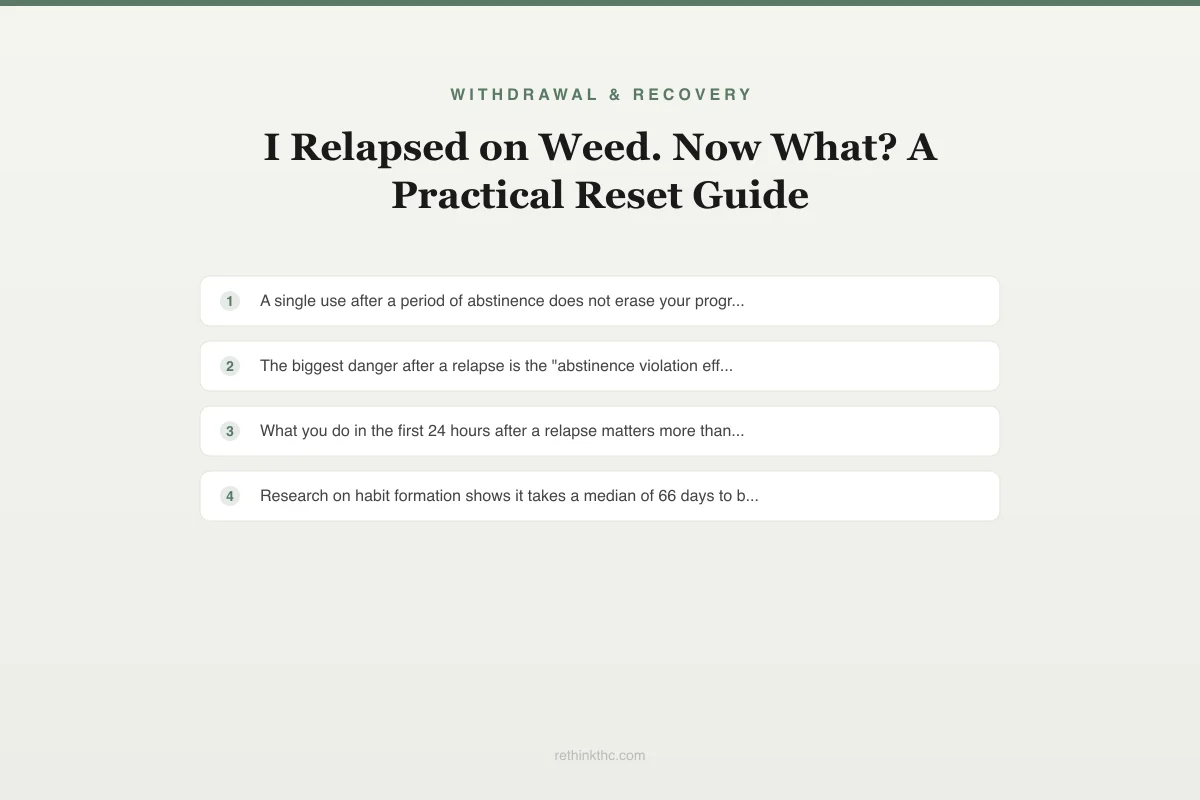
- One slip does not erase your progress — CB1 receptor recovery starts within 2 days, and a single session does not fully reverse weeks of healing
- The biggest danger after a relapse is the "abstinence violation effect," where shame and all-or-nothing thinking convince you to keep using because you feel you have already failed
- What you do in the first 24 hours after relapsing matters more than the relapse itself — do not binge, do not isolate, and do not throw away your quit tools
- New habits take a median of 66 days to become automatic, so a relapse at 3 or 4 weeks just means your new patterns were not cemented yet
- If you have relapsed multiple times, that is a signal to change your approach — add therapy, adjust your plan, address underlying triggers — not a signal to give up
- Treating relapse as data (which trigger, which time of day, what was missing) rather than as a verdict is what separates people who eventually quit from those who stop trying
Fact Check
What your brain tells you vs. what the science says
The claim
“I relapsed, so I'm back to square one — all that progress is gone”
The abstinence violation effect — a well-documented cognitive distortion in addiction psychology
What research shows
MisleadingPET imaging shows CB1 receptors begin recovering within 2 days of abstinence. After weeks of healing, a single use causes a temporary disruption — not a complete reset. The neural pathways you built during abstinence are still partially formed.
The difference between a lapse (one episode) and a full relapse (return to daily use) is entirely within your control. Research consistently shows that how you respond to a slip matters more than the slip itself.
D'Souza et al. (2016), Biological Psychiatry: CNNI
Right Now: Stop the Spiral
The most important thing you can do in the immediate aftermath of a relapse is prevent a single use from becoming a binge.
One Use Is Not the Same as Going Back
Your brain is going to try to convince you that you have already ruined everything, so you might as well keep going. This thought pattern has a name in psychology: the abstinence violation effect. It is the cognitive distortion where a single lapse gets interpreted as total failure, which then removes any motivation to get back on track.
The logic sounds like: "I already broke my streak, so what is the point? I might as well smoke tonight and start over Monday." This reasoning feels persuasive in the moment, but it is factually wrong. One session of use is categorically different from returning to daily use. The gap between a lapse (a single episode) and a full relapse (a return to your previous pattern) is entirely within your control right now.
Psychology
The Abstinence Violation Effect: How Shame Turns a Slip Into a Spiral
Single slip
You smoke once after a period of abstinence
Shame & self-blame
"I'm weak. I can't do this. I failed."
Break the cycle here
Recognize the pattern. One slip is not a return to daily use — unless you let this cycle convince you it is.
All-or-nothing thinking
"I already ruined it, so what's the point?"
Permission to binge
"Might as well smoke the rest and start over Monday"
Full return to daily use
A single lapse becomes a complete relapse
Source: Marlatt & Gordon (1985), Relapse Prevention model
 View as image ↗
Your Progress Is Not Erased
A 2016 study by D'Souza and colleagues, published in Biological Psychiatry: Cognitive Neuroscience and Neuroimaging,[1] showed that CB1 receptor recovery begins within just 2 days of abstinence. If you had been abstinent for two weeks, three weeks, a month, those receptors were actively healing during that time. One session does not reset them to zero.
Think of it this way: if you were recovering from a sprained ankle and you stumbled once, it would not re-break the ankle. It might cause a setback, some soreness, maybe a day or two of extra caution. But the weeks of healing that already occurred are still there. The same principle applies to your neurological recovery.
D'Souza et al. (2016) · Biol Psychiatry: CNNI
- Population
- 11 cannabis-dependent males vs. 19 matched healthy controls
- Intervention
- Monitored abstinence with PET brain scans at baseline, 2 days, and 28 days
- Comparator
- Healthy non-using controls
- Finding
- CB1 receptor availability was 15% lower in cannabis users at baseline. After just 2 days of abstinence, that difference was no longer detectable. By 28 days, receptors had fully normalized.
positive Strong neuroimaging evidence that receptor recovery begins almost immediately
D'Souza et al. (2016), Biological Psychiatry: CNNI, 1(1), 60-67
Recovery Science
What a Single Slip Does (and Doesn't) Erase
Still intact after one use
Begins recovering within 2 days — a single session does not reset weeks of progress
New routines you built are partially formed and still accessible
You know your triggers, vulnerable times, and what quitting feels like
Lung function, sleep patterns, appetite regulation — mostly preserved
Temporarily at risk
Shame can spiral into "what's the point" thinking if unchecked
May see 1–2 nights of disrupted sleep, not a full withdrawal cycle
Source: D'Souza et al. (2016), Biol Psychiatry: CNNI
 View as image ↗
Do Not Binge
If you have cannabis left over, this is the moment where having it accessible becomes dangerous. The abstinence violation effect will push you toward using whatever you have. You do not need to make a permanent decision about your stash right now, but putting distance between yourself and the remaining supply (give it to someone, lock it in a car, put it somewhere inconvenient) makes the next few hours safer.
Do not isolate. The impulse after a relapse is to withdraw, stew in shame, and avoid anyone who knew you were trying to quit. This is counterproductive. Isolation feeds the spiral. You do not need to make a public announcement, but being around another person, even without discussing what happened, breaks the feedback loop.
The Next 24 Hours: Reset
Once you have gotten through the immediate aftermath, the next day is about deliberate, concrete steps.
Identify the Trigger
Something led to this relapse. It was not random. Sit down and honestly trace back the chain of events. What happened in the hours before you used? Common patterns include:
Stress from work, a relationship, or finances. A social situation where others were using. A period of boredom or emptiness, especially in the evening. Poor sleep that had been accumulating over days. An emotional event (conflict, loneliness, grief, or even something positive like a celebration).
A 2012 study by Allsop and colleagues, published in PLOS ONE,[2] found that withdrawal severity and functional impairment are strong predictors of relapse. If you are still in the withdrawal window (first 2 to 4 weeks), the trigger may have been the withdrawal itself. Your body was in discomfort, and it found relief. Understanding this removes the moral framing and replaces it with practical information.
Write the trigger down. Literally write it on paper or in your phone. This is data you will use when you rebuild your plan.
Re-commit Out Loud
Tell someone. A friend, a partner, a family member, an online community, a therapist. The specific person matters less than the act of saying it out loud. "I smoked last night. I am getting back on track today."
This serves two purposes. First, it creates accountability that exists outside your own head, where it is easy to rationalize. Second, it transforms the relapse from a shameful secret into a stated fact, which reduces its psychological weight.
If you do not have someone you trust with this information, writing it down for yourself in a journal works as well. The key is externalizing it rather than letting it loop internally.
Do Not "Start Over Monday"
The impulse to pick a future restart date is a delay tactic disguised as planning. If you relapsed on a Wednesday and decide to "start fresh Monday," you have just given yourself permission to use for four more days. Those four days can easily become a full return to your previous pattern.
Your quit restarts now. Not tomorrow morning, not next week. The decision to not use today is the only one that matters.
After a Relapse: Your Reset Plan
The Next Week: Rebuild
With the immediate crisis managed, the next week is about addressing the structural gaps that led to the relapse.
Revisit Your Quit Plan
If you were using a specific approach to quitting, pull it out and evaluate it honestly. Where did it fail? A good quit plan should include strategies for your specific triggers, alternatives for the times of day you are most vulnerable, and a support structure you can activate when cravings hit.
If you did not have a plan (if you were trying to quit on willpower alone), that is likely a significant factor in why the relapse happened. The guide on how to quit weed covers how to build a structured approach rather than relying on pure determination.
Address the Specific Trigger
If stress caused the relapse, you need a stress management strategy that is not cannabis. If boredom caused it, you need to restructure your evenings. If a social situation caused it, you need a plan for those contexts (leaving early, bringing a sober friend, avoiding specific settings temporarily).
This is the step most people skip. They recommit to quitting without changing anything about the conditions that caused the relapse, and then they are surprised when the same trigger produces the same result.
Expect Withdrawal Again (But Shorter)
If you only used once or a few times, the withdrawal on re-quitting will be significantly milder than your original withdrawal. A 2003 study by Budney and colleagues, published in the Journal of Abnormal Psychology,[3] documented that withdrawal symptoms onset within 1 to 3 days and peak between days 2 and 6 for people stopping regular use. A brief lapse after weeks of abstinence is not the same as stopping daily use. Your symptoms may be minimal.
However, if the relapse extended over days or weeks before you caught it, you may go through a condensed version of the original withdrawal. The first week of quitting weed guide can help you navigate that stretch.
Understand the Habit Timeline
A 2010 study by Lally and colleagues, published in the European Journal of Social Psychology, found that new habits take a median of 66 days to become automatic, with a range of 18 to 254 days. If you relapsed at day 20 or day 35, your new non-cannabis routines simply had not had enough time to become ingrained. That is not a personal failing. It is the normal biology of habit formation.
This also means that the days of abstinence you accumulated before the relapse were not wasted. They were contributing to the habit-formation process. When you resume, you are not starting from scratch. The neural pathways you were building are still partially formed.
Evidence Review
Where the evidence stands
Cell & Lab Studies
CB1 receptor downregulation and recovery mechanisms well characterized
Animal Studies
THC tolerance and withdrawal confirmed across multiple animal models
Case Reports & Surveys
Relapse patterns, abstinence violation effect documented in clinical populations
Small Human Trials
D'Souza 2016 PET imaging (n=11), Lee 2014 inpatient monitoring (n=29)
Large Controlled Trials
Budney 2006 randomized trial of 90 adults — CBT + incentives most effective
Meta-Analysis
Cannabis relapse recovery has strong evidence from multiple angles: PET imaging confirms rapid receptor recovery, prospective studies document withdrawal-driven relapse, and a randomized trial shows structured treatment works. What's missing is a large meta-analysis comparing post-relapse strategies.
D'Souza et al. (2016); Allsop et al. (2012); Budney et al. (2006)
When Relapse Reveals a Pattern
A single relapse is common and does not necessarily mean anything needs to fundamentally change. But multiple relapses, especially with the same trigger, are a signal.
Consider Professional Support
A 2006 study by Budney and colleagues, published in the Journal of Consulting and Clinical Psychology,[4] studied 90 adults in a 14-week treatment program for cannabis dependence. The study found that combining cognitive behavioral therapy with motivational incentives produced the strongest outcomes. Importantly, the participants in this study were people who had difficulty quitting on their own. Professional support was not a last resort; it was the intervention that worked.
If you have tried to quit two or three times and keep returning to use, a therapist who specializes in substance use can help you identify the patterns you cannot see from inside them. For a look at what therapy options are available, see therapy for quitting weed and anxiety.
Ask Honest Questions
Multiple relapses are an opportunity to ask questions you might have been avoiding.
Are you using cannabis to manage an anxiety disorder, depression, or trauma symptoms? If so, quitting without addressing the underlying condition leaves you without a coping mechanism and without a replacement. The self-medication pattern will keep pulling you back until the root cause has its own treatment.
Is quitting the right goal for you right now, or would structured reduction be more realistic as a first step? There is no shame in adjusting the goal to match your reality. Our guide on whether to quit weed or cut back helps you think through this honestly.
Are you trying to quit alone when you need support? Willpower has limits. If your environment, social circle, or daily routine is saturated with cannabis cues, individual determination may not be sufficient without structural changes.
Reframing Relapse as Data
Here is the shift that separates people who eventually succeed from people who give up: treating relapse as information rather than as a verdict.
Every relapse tells you something specific. It tells you which trigger got through your defenses, which time of day or situation is most dangerous, which part of your plan was insufficient, and what support you were missing.
A person who relapses and says "I failed" learns nothing. A person who relapses and says "Stress at 9 PM on a weekday, when I was alone, after three nights of bad sleep" learns something they can act on.
You are not starting over. You are continuing with better information. The days you spent abstinent contributed to receptor recovery, habit formation, and self-knowledge. Those are still yours.
Safety
ModerateWhen self-guided recovery isn't enough
Concern
Multiple relapses following the same pattern — especially when connected to anxiety, depression, PTSD, or other mental health conditions — may indicate that cannabis use is serving as self-medication for an untreated condition.
What the research says
Quitting without addressing the underlying condition leaves you without a coping tool and without a replacement. Professional support breaks this cycle by treating both the substance pattern and the root cause simultaneously.
Particularly relevant for: Anyone who has relapsed two or more times with the same trigger, or who recognizes cannabis use is managing an underlying mental health condition
What to do
SAMHSA National Helpline: 1-800-662-4357 (free, confidential, 24/7). A therapist specializing in substance use can help you identify patterns you can't see from inside them.
Budney et al. (2006), J Consulting and Clinical Psychology
When to Seek Professional Help
If you are finding that you cannot stop using despite repeated genuine attempts, or if cannabis use is causing significant problems in your relationships, work, health, or daily functioning, professional help is the appropriate next step.
This is especially important if you recognize that your cannabis use is connected to anxiety, depression, PTSD, or other mental health conditions. Treating the underlying condition often makes it far easier to change the cannabis pattern.
The SAMHSA National Helpline at 1-800-662-4357 is free, confidential, and available 24/7. They can connect you with local counselors, treatment programs, and support groups. You do not need to be in crisis to call. You just need to want help.
For a full overview of cannabis withdrawal and what to expect, our complete guide covers the symptoms, timeline, and recovery process in detail.
The Bottom Line
A relapse does not erase neurological progress. CB1 receptors begin recovering within 2 days of abstinence, and a single use does not fully reverse weeks of healing. The biggest danger is the abstinence violation effect, where shame and all-or-nothing thinking turn a single lapse into a full return to daily use. The first 24 hours after a relapse are critical: prevent binging, identify the specific trigger, re-commit out loud to someone, and refuse to delay restarting. A 2012 PLOS ONE study found withdrawal severity predicts relapse, meaning the trigger may have been neurological rather than moral. Habit formation research shows new behaviors take a median of 66 days to become automatic, so a relapse at 3 to 4 weeks means new patterns simply were not cemented. Multiple relapses with the same trigger signal a need for professional support or strategy change, not proof that quitting is impossible.
I relapsed after 30 days. Did I lose all my progress?
No. The neurological recovery that occurred during those 30 days is not fully reversed by a single use. Research shows CB1 receptors begin recovering within 2 days of abstinence, and after 28 days they are largely normalized. One session causes a temporary disruption, not a complete reset. The habit-building progress you made during those 30 days also remains partially intact. What matters most is what you do next.
Why do I feel so much shame after relapsing on weed?
The shame response is driven by the abstinence violation effect, a well-documented psychological pattern where a single lapse gets interpreted as proof of total failure. Our culture also treats substance use as a moral issue rather than a behavioral and neurological one, which amplifies the shame. Recognizing that relapse is a statistically common part of quitting (not a character flaw) can help reduce its emotional weight.
Should I tell someone I relapsed?
Yes, if you have someone you trust. Telling another person serves two functions: it creates external accountability, and it prevents the relapse from becoming a shameful secret that grows in your mind. You do not need to tell everyone. One person is enough. If you do not have someone in your life you can tell, writing it down or posting in an anonymous online community achieves a similar effect.
How many times does it take to successfully quit weed?
There is no fixed number. Research on cannabis cessation shows that most people who eventually quit successfully have made multiple attempts. A 2006 study on 90 adults found that structured treatment combining therapy with motivational support produced the best results, especially for people who had difficulty quitting on their own. Each attempt provides information that improves your approach. The question is not how many times you have tried but whether you are adjusting your strategy between attempts.
Is a relapse a sign I should stop trying to quit?
No. A relapse is a sign that your current approach has a gap that needs addressing, whether that is an unmanaged trigger, insufficient support, an underlying mental health condition, or a quit plan that does not account for your specific vulnerabilities. If multiple relapses follow the same pattern, the answer is usually to add professional support or change the strategy, not to abandon the goal entirely.
Will withdrawal be as bad the second time if I only used once?
Usually not. If your relapse was a single session or a few days of use after weeks of abstinence, the withdrawal on re-quitting is typically much milder than your original withdrawal. Your CB1 receptors had already substantially recovered, and a brief lapse does not fully reverse that progress. You may experience a day or two of disrupted sleep or mild cravings, but it is unlikely to match the intensity of your first withdrawal. If the relapse extended over several weeks of daily use, expect a condensed version of the original withdrawal, though still shorter since your brain was not starting from baseline.
Sources & References
- 1RTHC-01134·D'Souza, Deepak Cyril et al. (2016). “Brain Cannabinoid Receptors Drop With Heavy Use, Then Rebound Within Days of Stopping.” Biological Psychiatry: Cognitive Neuroscience and Neuroimaging.Study breakdown →PubMed →↩
- 2RTHC-00538·Allsop, David J. et al. (2012). “Withdrawal That Disrupted Daily Life Was Tied to Relapse in a Small Study.” PLOS ONE.Study breakdown →PubMed →↩
- 3RTHC-00134·Budney, Alan J. et al. (2003). “When Heavy Users Quit Cannabis, Symptoms Show Up Fast and Ease Within Two Weeks.” Journal of Abnormal Psychology.Study breakdown →PubMed →↩
- 4RTHC-00218·Budney, Alan J. et al. (2006). “Paying for Clean Tests Worked During Treatment. Therapy Helped It Last..” Journal of Consulting and Clinical Psychology.Study breakdown →PubMed →↩