Relationships
Mismatch
Research shows solitary cannabis use is a stronger predictor of relationship problems and social withdrawal than how often you use with others, and couples with mismatched use patterns report significantly more conflict.
Cuttler et al., Drug and Alcohol Dependence, 2019
When One Partner Uses and the Other Does Not
covered in detail
Couples Who Use Together
covered in detail
Cannabis and Intimacy
covered in detail
Cuttler et al., Drug and Alcohol Dependence, 2019
 View as image ↗
If you only read one thing
The biggest thing that predicts whether weed will hurt your relationship isn't how much you use — it's whether you and your partner are on the same page about it. Couples where one smokes and the other doesn't fight more than couples who both use or both don't. And using alone is a bigger red flag than using with friends. If you quit, expect your relationship to get bumpier for about a month before it gets better — that's withdrawal messing with your patience, not a sign that quitting was wrong.
Cannabis does not just affect your brain. It affects every relationship you are in. The way you communicate with your partner, the depth of your friendships, how present you are with your family, and whether your social life is expanding or shrinking are all shaped by your relationship with weed. This is true whether you use daily, occasionally, or have recently quit.
The research on cannabis and relationships is less developed than the research on cannabis and, say, anxiety or sleep. But what does exist paints a consistent picture: cannabis changes how people connect, and the direction of that change depends heavily on patterns of use, whether partners are aligned, and whether the use is social or solitary.
This guide covers the major relationship dimensions that cannabis touches. For the broader picture of how cannabis shapes daily life, social norms, and identity, see our cannabis culture and lifestyle guide. If you are here because your use (or your partner's use, or your decision to quit) is straining something important, you are dealing with one of the most common and least discussed consequences of regular cannabis use.
Key Takeaways
- Couples where one partner uses cannabis and the other does not report significantly more conflict and lower satisfaction than couples who are aligned (Smith et al. 2014, Psychology of Addictive Behaviors)
- Cannabis dulls emotional reactions and flattens communication — which can erode intimacy over time even when both partners use together
- THC changes sexual experience through CB1 receptor activation in reward circuits, and quitting temporarily lowers desire and sensation before things normalize by weeks 3 to 4 (Hirvonen 2012, Molecular Psychiatry)
- Social isolation is one of the most underreported effects of heavy cannabis use — with users slowly narrowing their circles until they mostly hang out with other users
- When one person in a relationship quits, the relationship itself goes through a kind of withdrawal — requiring both partners to renegotiate routines, roles, and shared identity
- A 2019 study by Cuttler et al. in Drug and Alcohol Dependence found that using cannabis alone was a stronger predictor of relationship problems and social withdrawal than how often you use with other people
Fact Check
The assumption most couples get wrong
The claim
“If my partner just quit weed (or if I just quit), our relationship problems would go away”
Natural assumption that removing the substance removes the conflict
What research shows
Partly TrueQuitting makes relationships temporarily harder — irritability peaks in the first week, routines have to be renegotiated, and emotional processing comes back online all at once. Relationships almost always improve after the transition, but expecting instant improvement sets both partners up for disappointment.
Not every problem in a relationship where cannabis is present is a cannabis problem. If communication was poor before weed entered the picture, removing weed exposes the gap rather than fixing it. The research points to mismatch as the core issue — not cannabis itself.
Smith et al. (2014), Psychology of Addictive Behaviors
When One Partner Uses and the Other Does Not
This is the configuration that generates the most friction, and it is remarkably common. One person smokes. The other does not, or quit, or never started. The imbalance creates a set of tensions that are predictable, documented, and genuinely difficult to navigate.
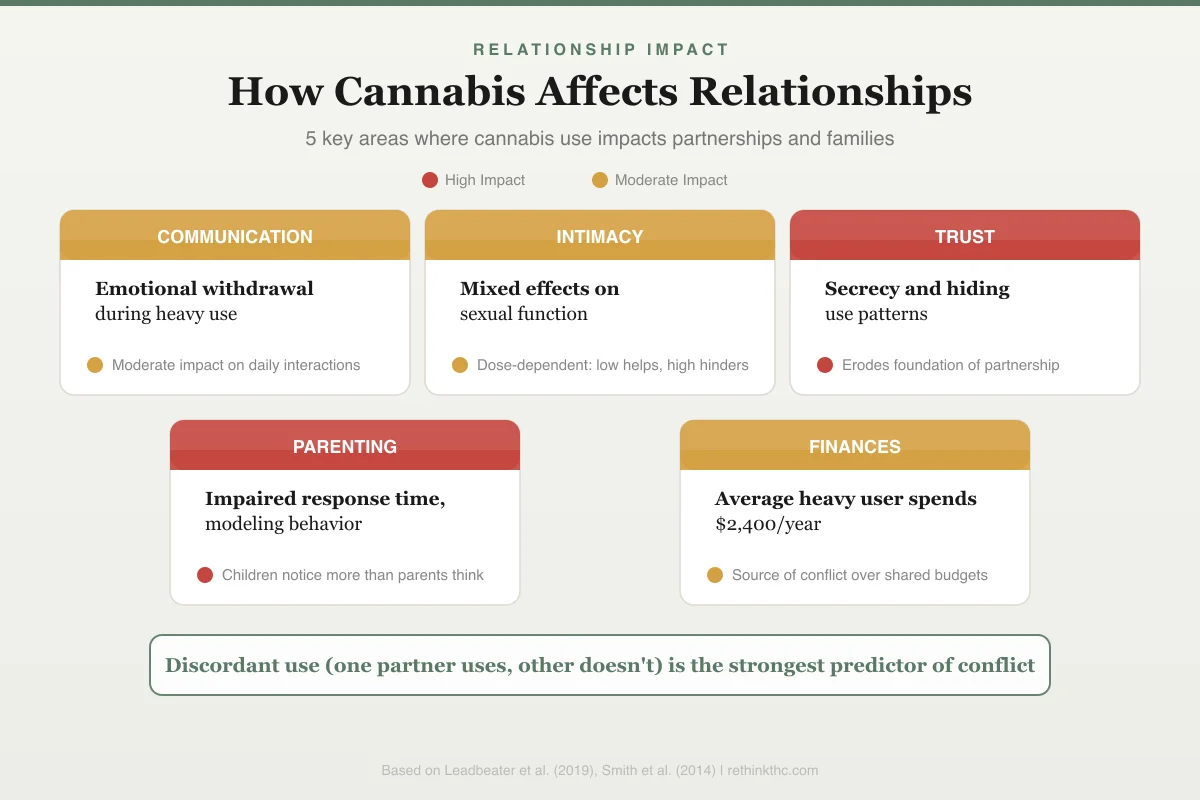
Relationship Impact
How Cannabis Affects Relationships
5 key areas where cannabis use impacts partnerships and families
Communication
Emotional withdrawal during heavy use
Intimacy
Mixed effects on sexual function
Trust
Secrecy and hiding use patterns
Parenting
Impaired response time, modeling behavior
Finances
Average heavy user spends $2,400/year
Discordant use (one partner uses, other doesn't) is the strongest predictor of conflict
Based on Leadbeater et al. (2019), Smith et al. (2014)
View as image ↗A 2014 study by Smith and colleagues, published in Psychology of Addictive Behaviors (a peer-reviewed journal that focuses on substance use and behavioral health), examined relationship outcomes in couples with discordant substance use patterns. Couples where one partner used cannabis and the other did not reported significantly higher levels of conflict and lower relationship satisfaction compared to couples who were aligned, whether both used or neither did. The key variable was not cannabis itself. It was the mismatch.
The reasons are layered. The non-using partner often feels like they are in a relationship with two versions of the same person: the sober version and the high version. They may feel shut out when their partner retreats into a session, or frustrated by the emotional flatness that comes with regular THC use. The using partner, meanwhile, may feel judged, controlled, or resentful of what they perceive as monitoring.
This dynamic intensifies when one partner quits and the other continues. The person who quit is dealing with withdrawal, cravings, and identity disruption simultaneously. The person still using becomes a walking trigger. The smell, the ritual, the sight of paraphernalia, all of it fires cue-induced craving circuits that make staying quit measurably harder. We cover the full complexity of this in your partner still smokes weed, and the daily tactical reality of managing it in quitting while your partner still smokes.
What the research consistently shows is that the mismatch itself is the problem, not which partner is "right." Relationships can survive and even improve through a cannabis transition, but only if both people acknowledge that the transition affects both of them.
Couples Who Use Together
Couples who use cannabis together often describe it as a bonding activity. Shared sessions, shared rituals, shared relaxation. On the surface, alignment eliminates the mismatch problem described above. But shared use introduces its own set of complications that tend to reveal themselves gradually.
The most significant is what researchers call emotional blunting. Regular THC use downregulates CB1 receptors in the prefrontal cortex and amygdala, brain regions that govern emotional processing and social cognition. A 2016 study by Gruber and colleagues, published in the Journal of Psychopharmacology, found that chronic cannabis users showed reduced emotional recognition, specifically in their ability to read facial expressions and respond to subtle emotional cues. Over time, this means that couples who use together may feel close in the moment but are actually processing less emotional information from each other.
The practical result is a pattern that couples therapists who work with substance use describe frequently: the relationship feels good while high and empty while sober. When cannabis becomes the medium through which a couple connects, the underlying communication muscles atrophy. Conflicts get deferred rather than resolved because both partners would rather smoke than argue. Emotional conversations feel too intense without chemical buffering. The relationship gradually becomes dependent on the substance the same way an individual can, not in a clinical sense, but in a functional one.
This does not mean every couple who uses together is in trouble. Occasional, low-dose use within an otherwise communicative relationship is a different picture than daily use that replaces difficult conversations. The distinction matters. But if you and your partner have realized that most of your quality time involves being high, and that sober time together feels flat or tense, that pattern is worth examining honestly.
Cannabis and Intimacy
Cannabis affects sex. Most regular users know this from experience, but the direction of the effect depends on whether you are currently using or recently stopped.
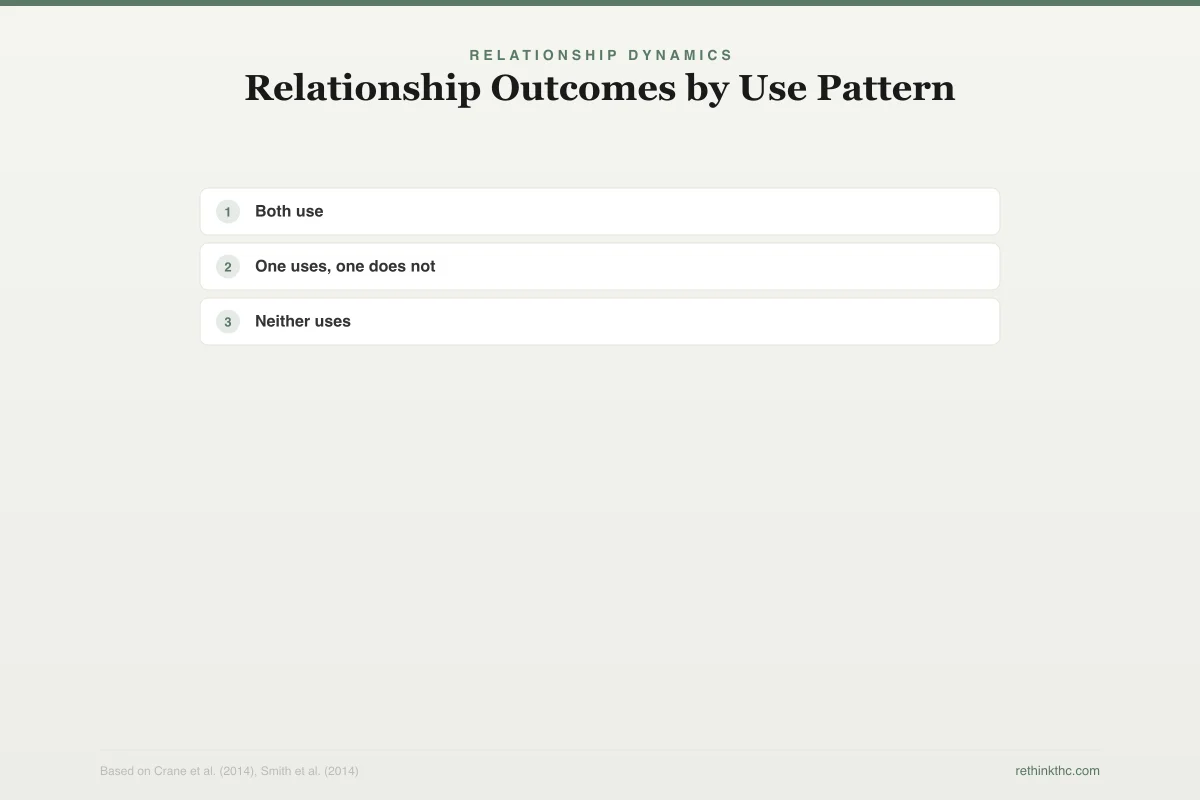
Relationship Dynamics
Relationship Outcomes by Use Pattern
Both use
Reported positives
+ Shared activity and ritual
+ Lower cannabis-specific conflict
+ Aligned lifestyle
Reported risks
– Risk of enabling
– Emotional blunting in both partners
– Conflict avoidance via substance
One uses, one does not
Reported positives
+ Non-user provides grounding perspective
Reported risks
– Highest conflict frequency
– Feeling disconnected or shut out
– Values clash and resentment
– Walking trigger if one quits
Neither uses
Reported positives
+ No cannabis-specific conflict
+ Full emotional availability
+ Aligned lifestyle choices
Reported risks
– Cannabis is not a factor
Key finding: The mismatch itself drives conflict, not which partner is right. Couples aligned in either direction report lower cannabis-related friction than discordant couples.
Based on Crane et al. (2014), Smith et al. (2014)
 View as image ↗
THC activates CB1 receptors throughout the brain's reward pathway, including regions responsible for pleasure, sensory processing, and emotional openness. During sex, this translates to heightened sensation, reduced inhibition, and amplified emotional connection. A 2017 study by Sun and Bhatt, published in the Journal of Sexual Medicine, found that cannabis users reported higher sexual frequency and that many described enhanced sexual satisfaction while using.
The complication is what happens with regular use. The same receptor downregulation that drives tolerance also affects sexual response. As CB1 receptors decrease, the enhanced sensations diminish. Some long-term users report that sex without cannabis feels flat, mechanical, or emotionally disconnected, not because it actually is, but because their receptor system has been recalibrated to expect THC-augmented input.
When someone quits, the sexual effects of withdrawal can be pronounced. Reduced desire, difficulty with arousal, and a general sense that physical intimacy has lost its dimension are common in the first two to three weeks. This maps directly to the broader anhedonia (inability to feel pleasure) that characterizes early cannabis withdrawal. CB1 receptors begin recovering within two days of abstinence and reach approximately normal density by day 28, according to brain imaging research by Hirvonen and colleagues published in Molecular Psychiatry in 2012.[1] The sexual dimension of recovery follows the same timeline. We cover this in full detail in sex after quitting weed.
For couples, the intimacy disruption during early quitting can feel like confirmation that quitting was a mistake. It is not. It is your reward system recalibrating, and most people report that sex eventually feels more present and connected without cannabis than it did with it.
Family Relationships
Cannabis use affects family dynamics in ways that are often invisible to the user and painfully obvious to everyone else.
For parents who use, the question is not usually whether cannabis impairs parenting in an acute, dramatic way. It is whether the subtle effects, emotional blunting, reduced engagement, shortened patience during withdrawal periods, and divided attention accumulate over time. Research on parental cannabis use is politically charged and methodologically complicated, but a 2020 review by Corsi and colleagues, published in the journal Addiction, examined the growing body of evidence on prenatal and postnatal cannabis exposure. While the most robust findings relate to prenatal exposure, the review also noted that parental substance use patterns (including cannabis) are consistently associated with household instability and inconsistent parenting behaviors.
The family dynamics around adult children and parents are different but equally complex. If you are the person using, your family may have expressed concern for years in ways that felt controlling or judgmental. If you are a family member watching someone you love prioritize cannabis over responsibilities, relationships, or their own stated goals, the frustration and helplessness are real. If you are a parent whose teenager uses, the conversation requires a specific kind of honesty that is covered in how to talk to your teenager about weed.
One pattern that comes up consistently in family therapy contexts: the user perceives their use as private and personal, while family members perceive it as something that changes the person they interact with. Both perceptions are accurate. The disconnect between them is what generates conflict.
Friendships and Social Circles
Cannabis friendships are real friendships. The idea that people you smoke with are not "real" friends is dismissive and usually wrong. But it is also true that when cannabis is the primary shared activity, the foundation of those friendships gets tested when someone quits.
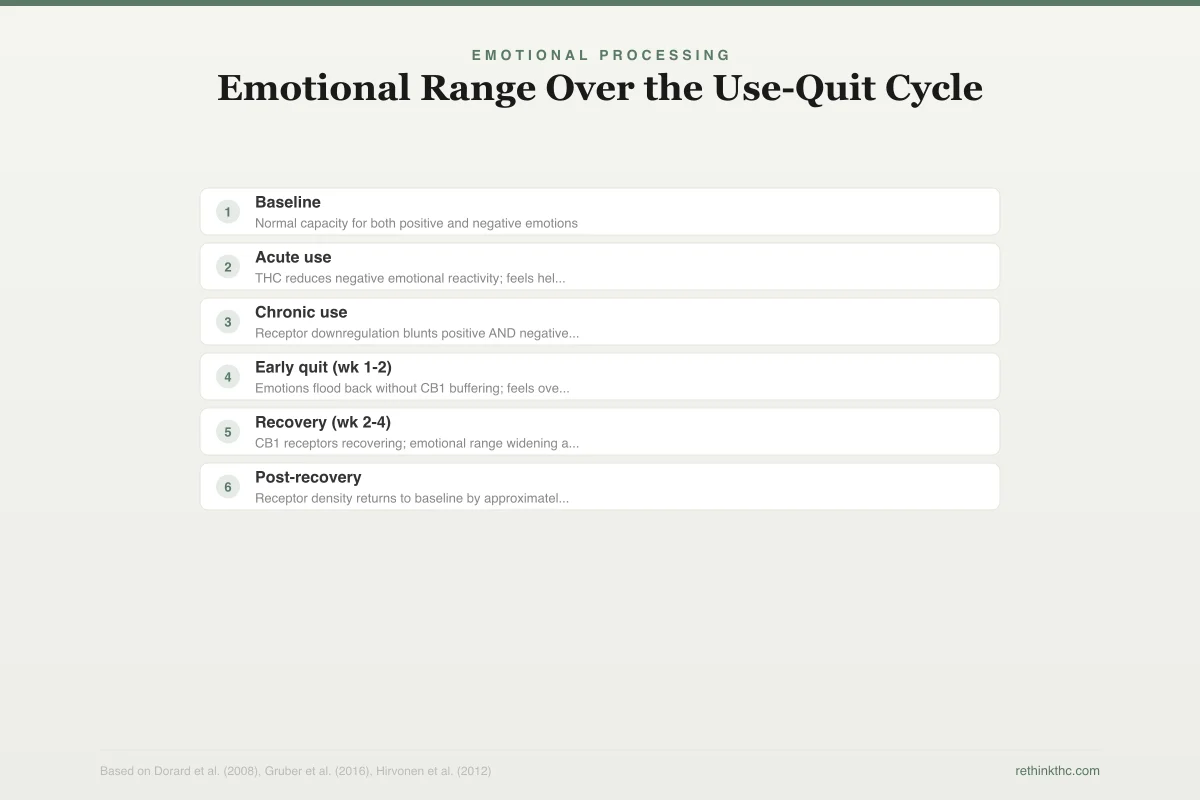
Emotional Processing
Emotional Range Over the Use-Quit Cycle
Baseline
Full emotional range
Normal capacity for both positive and negative emotions
Acute use
Negative emotions dampened
THC reduces negative emotional reactivity; feels helpful and calming
Chronic use
All emotions dampened
Receptor downregulation blunts positive AND negative emotions (alexithymia)
Early quit (wk 1-2)
Emotional flooding
Emotions flood back without CB1 buffering; feels overwhelming
Recovery (wk 2-4)
Normalizing
CB1 receptors recovering; emotional range widening and stabilizing
Post-recovery
Full range restored
Receptor density returns to baseline by approximately day 28
Based on Dorard et al. (2008), Gruber et al. (2016), Hirvonen et al. (2012)
 View as image ↗
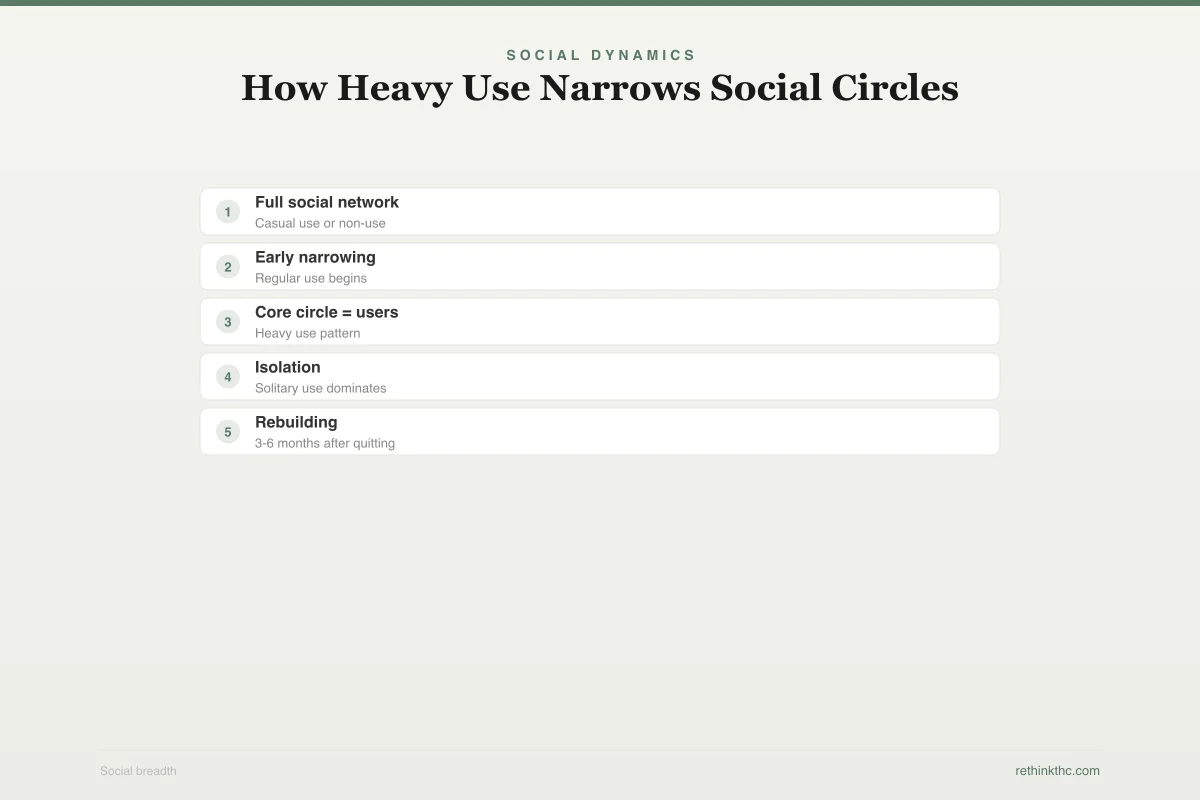
The social dimension of quitting is covered in leaving stoner culture behind and telling your friends you are quitting. What belongs in this overview is the broader pattern: regular cannabis use tends to narrow social circles over time. This is not unique to cannabis. Any regular substance use creates a filtering effect. You spend more time with people who share the behavior and less time with people who do not. You decline invitations that do not involve getting high, or you accept them but mentally count down to when you can go home and smoke. The circle tightens gradually enough that you do not notice it happening.
When someone quits, they sometimes discover that the breadth of their social life contracted significantly without them realizing it. The people they see most are all users. Non-using friends drifted away or were never cultivated. This leaves the person who quit in a social vacuum, which is one of the most potent relapse triggers. Isolation is uncomfortable, and cannabis was the primary tool for social connection. The pull to return to what worked is strong.
Rebuilding a social life after quitting is slower and more awkward than most people expect. It involves tolerating the discomfort of sober socializing while your brain's social anxiety circuits recalibrate, and it often means building new connections from scratch. This is not easy, but it is a normal part of the process.
Social Isolation vs. Social Use
Cannabis has a paradoxical relationship with socializing. Some people only use cannabis around others, treating it as a purely social behavior. It can be genuinely social, shared among friends, used in group settings, paired with conversation and laughter. It can also be profoundly isolating, used alone in a bedroom with the door closed, replacing social activity rather than enhancing it.
The distinction between social use and solitary use matters enormously for relationship outcomes. Social users tend to maintain broader social networks and report higher life satisfaction. Solitary users are more likely to meet criteria for cannabis use disorder, report higher rates of depression and anxiety, and describe their relationships as strained.
A 2019 study by Cuttler and colleagues, published in the journal Drug and Alcohol Dependence, examined cannabis use patterns and social behavior. They found that while cannabis was often used in social contexts, the frequency of solitary use was a stronger predictor of negative outcomes including relationship dissatisfaction and social withdrawal.
Cuttler et al. (2019) · Drug and Alcohol Dependence
- Population
- Cannabis users across varied use patterns and social contexts
- Intervention
- Analysis of solitary vs. social cannabis use frequency
- Comparator
- Social use patterns vs. solitary use patterns
- Finding
- How often someone used cannabis alone was a stronger predictor of relationship problems and social withdrawal than how often they used with other people
positive Key finding: the social context of use matters more than total frequency
Cuttler et al. (2019), Drug and Alcohol Dependence
If your use has shifted from social to solitary over time, that trajectory is worth paying attention to. The shift usually happens gradually. You used to smoke with friends on weekends. Then you started smoking alone on weeknights to decompress. Then the weeknight use became daily. Then you started canceling plans because you would rather be home getting high alone. Each step feels like a minor adjustment. The cumulative effect is significant.
How Quitting Changes Your Relationships
Quitting does not automatically fix relationship problems, and in the short term, it often makes them temporarily worse. This catches people off guard because they expect improvement and get turbulence instead.
Social Dynamics
How Heavy Use Narrows Social Circles
Full social network
Casual use or non-use
Early narrowing
Regular use begins
Core circle = users
Heavy use pattern
Isolation
Solitary use dominates
Rebuilding
3-6 months after quitting
Recovery timeline: Rebuilding social connections after quitting typically takes 3-6 months. The process involves tolerating the discomfort of sober socializing while social anxiety circuits recalibrate, and often means building new connections from scratch.
Based on Cuttler et al. (2019), clinical observations
 View as image ↗
During the acute withdrawal period, irritability is the most commonly reported symptom. People in withdrawal describe snapping at partners, losing patience with children, and starting arguments over nothing. This is neurologically driven, your brain's emotional regulation system is offline while CB1 receptors recover, and it typically peaks between days three and seven. But knowing the mechanism does not make it less damaging to the people around you. Relationships need to survive the withdrawal period, and that requires everyone involved to understand what is happening.
Beyond withdrawal, quitting forces a renegotiation of relationship dynamics. If cannabis was part of your evening routine with your partner, evenings now have a gap. If your friendships revolved around sessions, those friendships need a new activity or they will fade. If you used cannabis to manage the emotional demands of parenting, you now need to develop those coping skills without chemical assistance.
The people who navigate this best tend to be explicit about what is happening. They tell their partner, their close friends, and their family that they are quitting, that the first month will be rough, and that they need support rather than surveillance. The ones who try to quit silently and expect relationships to improve on their own tend to generate confusion and resentment instead.
The good news is consistent across both research and lived experience: relationships that survive the transition period almost always improve. Communication becomes more direct because it is no longer filtered through THC. Emotional availability increases because the blunting lifts. Conflict resolution improves because difficult conversations are no longer being deferred. The people around you get a version of you that is more present, more reactive (sometimes uncomfortably so at first), and ultimately more connected.
Evidence Review
Where the evidence stands
Cell & Lab Studies
CB1 receptor downregulation in emotional processing regions well-documented via neuroimaging
Animal Studies
THC effects on social behavior and bonding hormones established in rodent models
Clinical Observations
Couples therapists consistently report patterns of emotional blunting and conflict from mismatched use
Observational Studies
Smith 2014, Cuttler 2019, Gruber 2016 — use patterns predict relationship and social outcomes
Large Longitudinal Study
No large study tracking relationship outcomes over years of cannabis use and cessation
Meta-Analysis
No systematic review synthesizing cannabis and relationship research
Multiple observational studies consistently show that use mismatch, solitary use, and emotional blunting affect relationships. The findings are consistent but still largely observational — no one has run a long-term controlled study on cannabis and relationship outcomes.
Smith et al. (2014), Cuttler et al. (2019), Gruber et al. (2016)
Communication Strategies That Actually Work
Whether you are the person using, the person who quit, or the partner of someone navigating their relationship with cannabis, communication is the skill that determines whether the relationship absorbs the change or breaks under it.
Name the pattern, not the person. "When you smoke before we talk, I feel like I am not getting the real you" works differently than "You are always high when I need you." The first describes an experience. The second assigns blame. Both might be accurate, but only one opens a conversation.
Separate the substance from the relationship issue. Not every problem in a relationship where cannabis is present is a cannabis problem. If conflict predated the use, quitting will not resolve it. If communication was poor before cannabis entered the picture, removing cannabis exposes the deficit rather than fixing it. Being honest about what is actually a cannabis issue and what is a relationship issue prevents the trap of making weed the scapegoat for every problem.
Acknowledge that change is hard for both people. If you quit and your partner still uses, your partner is also going through an adjustment. Their routine changed. Their companion in the activity is gone. They may feel judged even if you are not judging them. Acknowledging this does not mean endorsing their use. It means recognizing that your decision to change affects them too, and that pretending it does not will breed resentment.
Set boundaries around behavior, not around other people's choices. "I need cannabis to not be visible in the living room during my first month" is a boundary. "You need to stop smoking" is an ultimatum disguised as a boundary. The first protects your recovery. The second attempts to control another person's behavior, which rarely works and almost always escalates conflict.
Get professional support when the stakes are high. If cannabis use or quitting is genuinely threatening the relationship, couples therapy with someone who understands substance use dynamics is significantly more effective than trying to navigate it alone. This is not a weakness. It is what the situation often requires. Individual therapy can also help if your relationship with cannabis is tangled up with deeper patterns of avoidance, anxiety, or unprocessed conflict.
Relationship impact by use pattern
Peer-reviewed research
The Bigger Picture
Cannabis does not destroy relationships on contact. Moderate, occasional use within an otherwise healthy relationship is probably fine for most people. The problems emerge with patterns: daily use that replaces communication, solitary use that replaces social engagement, escalating use that changes who you are when you are not high, and mismatched use that creates a divide between partners living in the same house.
If you are reading this because cannabis is affecting your relationships, you are already doing the most important thing, which is being honest about it. The research, the clinical experience, and the lived experience of millions of people who have navigated this all point in the same direction: awareness of the pattern is the prerequisite for changing it. What you do next depends on your situation, but you are not starting from zero. You are starting from seeing the problem clearly, and that is further along than most people get.
The Bottom Line
Pillar covering cannabis effects on romantic relationships, family, friendships, and social life. Partner mismatch: Smith 2014 (Psychology of Addictive Behaviors) — discordant couples (one uses, one doesn't) report significantly more conflict and lower satisfaction than aligned couples. Key variable is mismatch, not cannabis itself. Couples who use together: emotional blunting via CB1 downregulation in prefrontal cortex/amygdala → reduced emotional recognition (Gruber 2016, Journal of Psychopharmacology); relationship feels good while high, empty while sober; conflicts deferred. Intimacy: THC enhances sensation/pleasure via CB1 reward pathway activation; chronic use → tolerance to enhanced sensations; quitting → temporary reduced desire/arousal (anhedonia) for 2-3 weeks; CB1 recovery by day 28 (Hirvonen 2012, Molecular Psychiatry). Family: parental cannabis associated with household instability (Corsi 2020, Addiction); user perceives use as private, family perceives changed person — disconnect generates conflict. Friendships: social circle narrowing over time (filtering effect); quitting reveals contracted social life → social vacuum = potent relapse trigger. Social vs solitary use: Cuttler 2019 (Drug and Alcohol Dependence) — solitary use frequency stronger predictor of negative outcomes than social use. Quitting changes relationships: acute irritability (days 3-7), renegotiation of routines/roles/identity. Communication strategies: name pattern not person, separate substance from relationship issues, set boundaries around behavior not choices.
Does cannabis use cause relationship problems?
Cannabis use does not automatically cause relationship problems, but specific patterns are consistently associated with increased conflict. The strongest predictor is use mismatch — couples where one partner uses and the other does not report significantly more conflict than aligned couples. Daily use that replaces communication, solitary use that replaces social engagement, and escalating use that changes personality are all patterns that erode relationship quality over time. Occasional, moderate use within an otherwise communicative relationship is a different picture.
How does quitting weed affect your relationship?
Quitting often makes relationships temporarily worse before they improve. During the acute withdrawal period (days 3-10), irritability is the most commonly reported symptom, leading to snapping at partners and starting arguments over minor issues. Beyond withdrawal, quitting forces renegotiation of shared routines, roles, and identity. Relationships that survive the transition period almost always improve as communication becomes more direct, emotional availability increases, and conflicts are addressed rather than deferred.
Can couples who smoke together have a healthy relationship?
Yes, but it requires awareness of specific risks. Couples who use together avoid the mismatch problem but face emotional blunting from chronic CB1 receptor downregulation, which reduces the ability to read each other's emotional cues. The relationship can become functionally dependent on cannabis — feeling connected while high and empty while sober. Occasional, low-dose use within an otherwise communicative relationship is different from daily use that substitutes for emotional processing.
Is solitary cannabis use worse for relationships than social use?
Research suggests yes. A 2019 study in Drug and Alcohol Dependence found that solitary use frequency was a stronger predictor of relationship dissatisfaction and social withdrawal than social use. The shift from social to solitary use often happens gradually — weekend social sessions become weeknight solo sessions, then daily solo use — and each step feels minor while the cumulative effect on relationships and social life is significant.
How long does it take for intimacy to recover after quitting cannabis?
Most people experience reduced sexual desire and sensation during the first two to three weeks after quitting, driven by the same anhedonia (inability to feel pleasure) that characterizes early withdrawal. CB1 receptors begin recovering within two days and reach approximately normal density by day 28 of abstinence.[1] Sexual desire and sensation typically follow the same recovery timeline. Many people report that sex eventually feels more present and connected without cannabis than it did with it.
Should I tell my partner I am quitting weed?
Yes. Quitting silently while expecting the relationship to improve on its own tends to generate confusion and resentment. Being explicit about what is happening — that you are quitting, that the first month will be rough, and that you need support rather than surveillance — gives your partner context for the mood changes and irritability they will observe. It also prevents them from attributing withdrawal-driven behavior to relationship problems.
Sources & References
- 1RTHC-00573·Hirvonen, Jussi et al. (2012). “Daily Cannabis Use Was Linked to Fewer CB1 Receptors. A Month Without Brought Them Back..” Molecular Psychiatry.Study breakdown →PubMed →↩