Withdrawal & Recovery
Cue Exposure
Withdrawal severity directly predicts relapse likelihood, and living with a partner who still uses means constant exposure to sensory triggers that activate conditioned cravings your brain built over thousands of hours.
Allsop et al., PLOS ONE, 2012
Why This Is Harder Than People Acknowledge
covered in detail
What Not to Do
covered in detail
What Actually Helps
covered in detail
Allsop et al., PLOS ONE, 2012
 View as image ↗
If you only read one thing
This is one of the hardest parts of quitting and almost nobody talks about it. The smell alone triggers real cravings — that's brain wiring, not weakness. Don't give ultimatums (they backfire) and don't try to control their use. Instead, set boundaries around your own space: weed stays out of shared areas, they use in a different room, and you build your own support system outside the relationship. If they won't make any adjustments at all, that tells you something important.
You made the decision to quit. Your partner did not. That single sentence describes one of the hardest dynamics in cannabis withdrawal, and it gets almost no attention compared to the physical symptoms. You can find detailed guides on insomnia, appetite changes, and anxiety timelines. But navigating a household where one person is white-knuckling through cravings while the other is rolling a joint in the next room requires a different kind of guidance.
This is not a situation with simple answers. It is not as easy as "just talk about it" or "if they loved you, they would stop." The reality involves competing needs, different relationships with the same substance, and emotional dynamics that were probably present long before anyone decided to quit. Here is how to navigate it honestly.
Key Takeaways
- Living with a partner who still smokes weed while you are quitting is one of the most common — and least talked about — challenges in recovery
- The smell, the paraphernalia, and just being near someone using are all documented relapse triggers, and worse withdrawal symptoms make relapse even more likely
- Ultimatums and trying to control your partner's use almost always backfire, creating resentment instead of change
- Protecting your recovery means setting boundaries around your own environment and behavior — not around your partner's choices
- If your partner's use is actively threatening your ability to stay quit, that is a real problem that may need professional support or an honest look at the relationship
- Your partner may be self-medicating for anxiety, depression, or stress too, so approaching the conversation with that awareness works better than moral superiority
Why This Is Harder Than People Acknowledge
The difficulty is not just about willpower or temptation, though those are real. It is about several layers of friction that stack on top of each other.
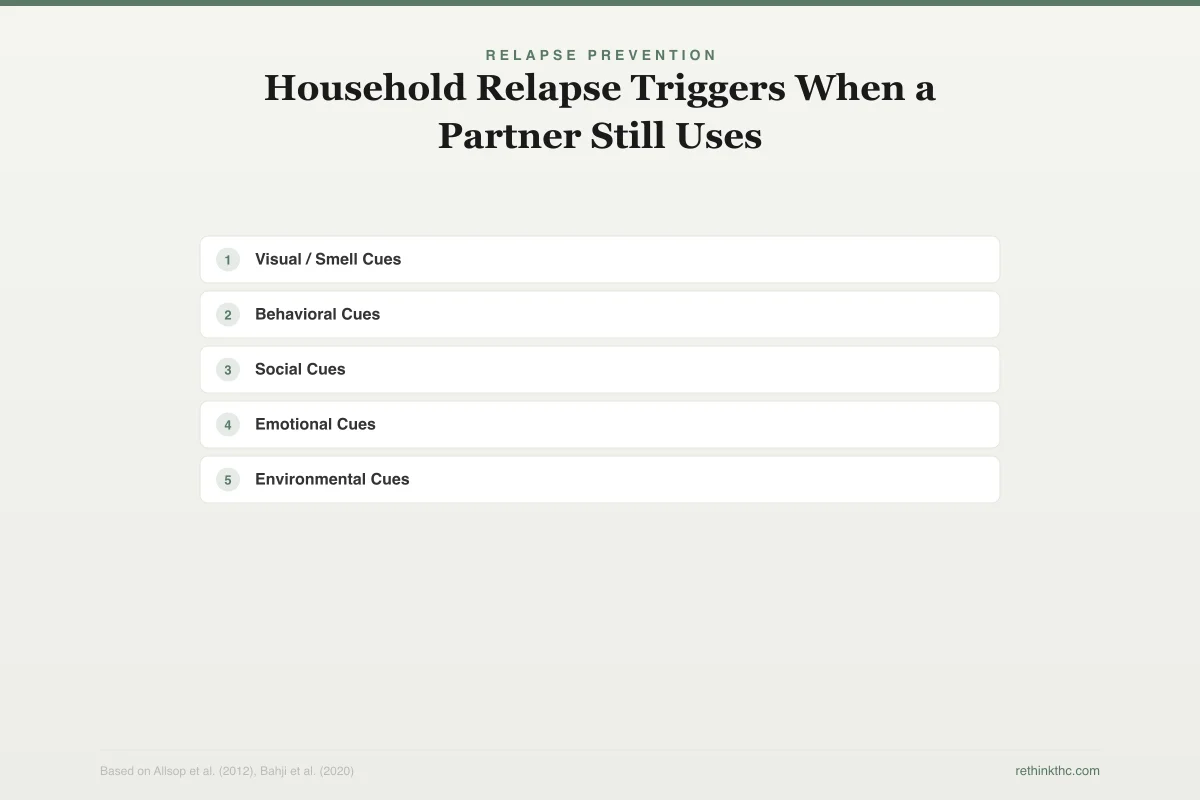
Relapse Prevention
Household Relapse Triggers When a Partner Still Uses
Conditioned cues that activate cravings and strategies to manage them
Visual / Smell Cues
High riskSeeing paraphernalia, smelling smoke, watching partner light up
Ask partner to keep paraphernalia out of shared spaces and use in a separate area
Behavioral Cues
High riskPartner's evening ritual, post-dinner routine, weekend wind-down
Build new evening rituals together that replace the old shared routine
Social Cues
Medium riskShared friends who use, gatherings where cannabis is present
Separate social settings where cannabis is central from your couple social life
Emotional Cues
High riskStress, conflict with partner, FOMO when they seem relaxed while high
Develop personal coping tools: therapist, support group, exercise, journaling
Environmental Cues
Medium riskFamiliar locations (couch, patio), specific music, time of day
Rearrange shared spaces and establish new patterns in trigger locations
Withdrawal severity predicts relapse risk. Reducing trigger exposure lowers the baseline difficulty of staying quit.
Based on Allsop et al. (2012), Bahji et al. (2020)
 View as image ↗
The Trigger Problem
Cannabis has a distinct smell. Seeing paraphernalia, watching your partner use, or even hearing the click of a lighter can activate cravings that feel almost physical. This is not weakness. It is conditioned response, the same mechanism that makes a former smoker crave a cigarette when they smell one. Your brain has thousands of hours of associating those sensory cues with the reward of getting high. Those neural pathways do not disappear because you decided to quit.
Allsop et al. (2012) · PLOS ONE
- Population
- Cannabis-dependent adults attempting to quit
- Intervention
- Assessment of withdrawal severity and functional impairment
- Comparator
- Participants with milder withdrawal symptoms
- Finding
- Withdrawal severity directly predicted likelihood of relapse — the harder the withdrawal, the more likely people were to start using again
positive Directly relevant: living with a using partner adds environmental stress on top of withdrawal, raising your baseline difficulty
Allsop et al. (2012), PLOS ONE
Allsop and colleagues' 2012 study in PLOS ONE[1] found that withdrawal severity directly predicted likelihood of relapse. Functional impairment during withdrawal (difficulty with daily tasks, disrupted relationships, impaired work performance) made it harder for people to maintain abstinence. Living in an environment where cannabis is present and being actively used adds a constant source of stress to an already difficult process. It raises the baseline difficulty of staying quit.
The Identity Shift
When you and your partner used together, cannabis was a shared experience. It was part of your evening routine, your weekend plans, your way of unwinding together. Our cannabis and relationships guide covers the full spectrum of how cannabis affects romantic partnerships, from couples who use together to the mismatch dynamic you are living now. Quitting removes you from that shared space. Your partner may feel like they are losing a companion in something they enjoy. You may feel left out, or like you are watching your former self from the outside. The shift is not just about the substance. It is about who you are together, and quitting forces that to change.
The Judgment Spiral
This goes both directions. You might start judging your partner for continuing to use, noticing things that did not bother you before (how much they use, how they act when high, how often they reach for it). Your partner might feel judged by your decision to quit, interpreting it as an implicit statement that their use is a problem. Neither of you may say it out loud, but the undercurrent of judgment can corrode the relationship from the inside.
Different Realities
You are going through withdrawal. Your partner is not. You are dealing with insomnia, irritability, anxiety, and cravings. They are having a normal Tuesday. This mismatch in experience can create a gap in empathy. Your partner may not understand why you are struggling, especially if they view cannabis as harmless. You may resent the ease with which they continue doing the thing you are fighting to stop.
Fact Check
The thing everyone suggests that doesn't work
The claim
“If your partner really loved you, they would quit too — give them an ultimatum”
Well-meaning friends and relationship advice forums
What research shows
MisleadingUltimatums put your partner in a defensive position. Forced abstinence breeds resentment, not lasting change. Research on substance use consistently shows that lasting behavior change comes from internal motivation, not external pressure.
Your partner may be self-medicating for their own anxiety, depression, or stress — the same way you might have been. 'Quit or I leave' treats their use as a character flaw rather than a complex behavior. Setting boundaries around your environment is effective. Demanding they change is usually not.
Khantzian (1985), self-medication hypothesis; clinical cessation literature
What Not to Do
Before covering what helps, here is what consistently makes this situation worse.
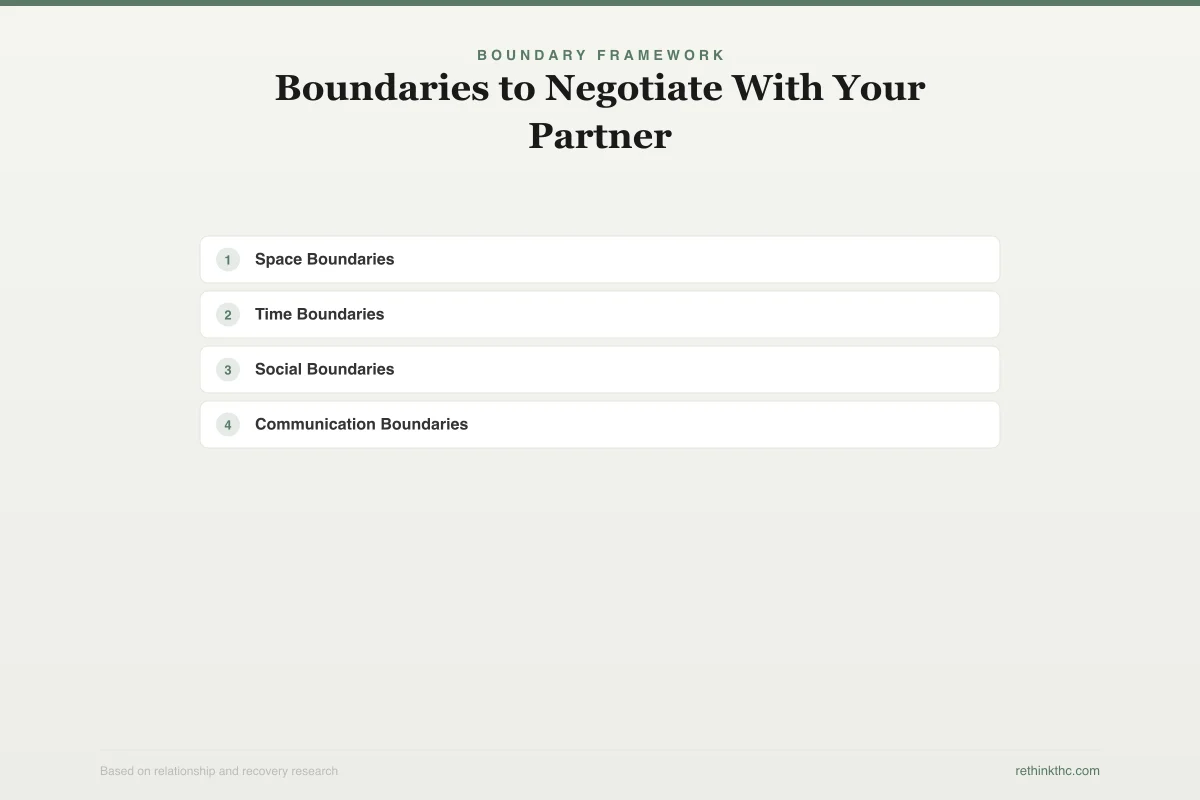
Boundary Framework
Boundaries to Negotiate With Your Partner
Boundaries protect your recovery without controlling their choices
Space Boundaries
- ✓Designated use area (separate room, patio, garage)
- ✓Paraphernalia stored out of shared spaces
- ✓No smoke or vapor in common living areas
Time Boundaries
- ✓Not around meals you share together
- ✓Not right before bed together
- ✓Not during quality time or conversations
Social Boundaries
- ✓Separate using friends from couple friends
- ✓Skip gatherings centered on cannabis if triggering
- ✓Partner does not invite you to use with others
Communication Boundaries
- ✓No pressure to join or "just try one hit"
- ✓No judgment for continuing to use
- ✓Regular check-ins on how the arrangement is working
A boundary is something you set for yourself. A rule is something you impose on someone else. Frame requests around your environment, not their behavior.
Based on relationship and recovery research
 View as image ↗
Do Not Issue Ultimatums
"It is me or the weed" sounds decisive, but it almost never produces the outcome you want. Ultimatums put your partner in a defensive position. They are more likely to resent the demand than to thoughtfully reconsider their use. Even if they comply, forced abstinence breeds resentment. If your partner is going to change their relationship with cannabis, it needs to come from their own reflection, not from a threat. The same principle applies to you: you quit because you decided to, and that internal motivation is what makes it sustainable. External pressure rarely produces lasting change.
Do Not Try to Control Their Use
Hiding their stash, throwing away their paraphernalia, making passive comments about how much they use, monitoring their intake. These behaviors come from a place of anxiety about your own recovery, but they feel controlling to your partner. And they are. You do not have the right to dictate what another adult puts in their body, even if you are married to them, even if their use makes your recovery harder. You have the right to set boundaries around your own environment. That is different from controlling theirs.
Do Not Weaponize Your Sobriety
It is tempting to position your decision to quit as the morally superior choice and to hold it over your partner. "I am working on myself, why are not you?" This framing poisons the relationship. Your decision to quit is about your needs. It is not a commentary on their character or choices. The moment sobriety becomes a weapon, the conversation stops being about health and starts being about power.
Do Not Suffer in Silence
The opposite extreme is also harmful. Saying nothing, absorbing the difficulty, pretending it is fine when it is not. Unexpressed resentment does not dissipate. It accumulates. If your partner's use is affecting your recovery, they need to know. Not as an accusation, but as information.
What Actually Helps
Have the Direct Conversation
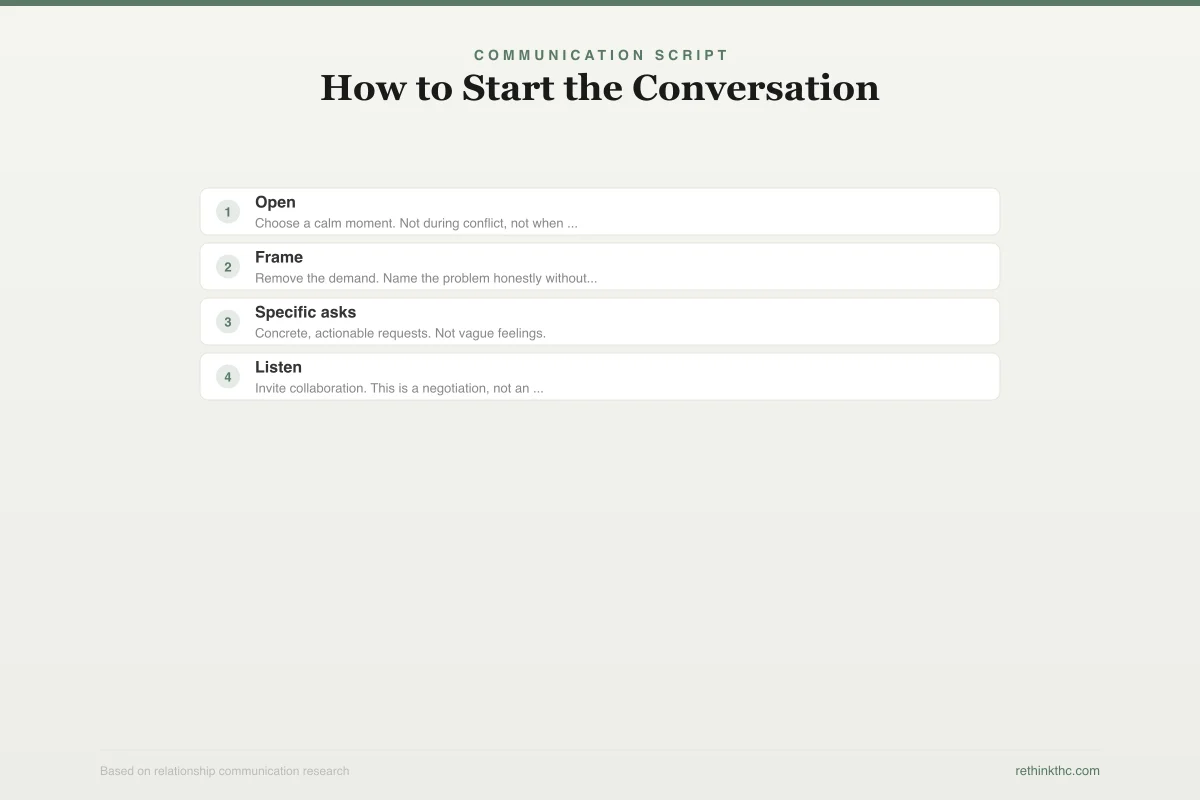
Communication Script
How to Start the Conversation
A 4-step framework that names the problem and invites collaboration
Open
"I need to talk about something that affects us both."
Choose a calm moment. Not during conflict, not when they are high.
Frame
"This is not about judging your use. It is about protecting my recovery."
Remove the demand. Name the problem honestly without blame.
Specific asks
"I need the weed kept out of our shared spaces. I need you to use in another room. I need some evenings that are not about either of us being high."
Concrete, actionable requests. Not vague feelings.
Listen
"What concerns do you have about this? What feels workable to you?"
Invite collaboration. This is a negotiation, not an announcement.
Goal: name the problem, remove the demand, invite collaboration instead of compliance.
Based on relationship communication research
 View as image ↗
Not a fight. Not a lecture. A conversation where you share what you are experiencing without blaming them for it. The framework looks something like this:
"I am going through withdrawal and it is genuinely hard. When I see or smell weed, it triggers cravings that make it harder for me to stay on track. I am not asking you to quit. I am asking if we can figure out some adjustments that make this easier for me without making it miserable for you."
That framing does three things: it names the problem honestly, it removes the demand, and it invites collaboration instead of compliance.
Set Boundaries Around Your Environment, Not Their Behavior
The distinction matters. A boundary is something you set for yourself. A rule is something you impose on someone else. Boundaries sound like: "I need the weed and paraphernalia kept out of our shared living spaces." "I need you to use in a different room or outside so I am not smelling it." "I need us to have some evening activities that do not revolve around you being high."
These are not unreasonable requests. They protect your recovery without dictating your partner's choices. Most partners who care about your well-being will accommodate reasonable environmental boundaries. If they refuse to make any adjustments at all, that is important information about the relationship.
Understand That Their Use May Be Self-Medication Too
Khantzian's self-medication hypothesis (1985, American Journal of Psychiatry) describes the pattern where people use substances to manage underlying emotional pain, anxiety, or trauma. If your partner is using cannabis daily, there is a reasonable chance they are not just using recreationally. They may be managing anxiety, depression, stress, or unresolved experiences, the same way you may have been before you quit.
This does not excuse behavior that harms your recovery. But it does reframe the situation: your partner is not choosing weed over you. They may be managing something they do not fully understand, using the same coping tool you just put down. If your partner is open to change, the guide on how to help someone quit weed covers what supportive engagement looks like without crossing into control. Approaching the conversation with that awareness produces better results than approaching it with moral superiority. Understanding this dynamic is similar to what is explored in the should I quit weed guide, where the decision to change has to come from internal readiness.
Build Separate Recovery Infrastructure
Your recovery cannot depend on your partner's cooperation. That is too fragile a foundation. You need your own support, whether that is a therapist, a support group, a friend who has been through it, or an online community. Reminding yourself of the concrete benefits of quitting weed, from better sleep to sharper thinking, can reinforce your motivation on the hardest days. People who successfully quit in households where cannabis is present almost always have recovery infrastructure outside the relationship. The how to quit weed guide covers building this broader support system.
Create New Shared Rituals
Part of what makes this transition hard is the loss of shared rituals. You used to smoke together before bed. You used to get high and watch movies on Saturday. Those rituals are gone for you now, and nothing has replaced them. Actively creating new shared experiences (cooking together, evening walks, a show you both follow, a project you work on as a couple) fills the gap that cannabis left in your shared life.
Accept the Asymmetry
You are going through something difficult. Your partner is not. That asymmetry is real, and it is not going to resolve by pretending it does not exist. Accepting it means allowing yourself to feel frustrated without demanding that your partner match your experience. It means communicating your needs without expecting them to fully understand something they are not going through. It means grieving the ease of your old shared routine without blaming anyone for its loss.
When the Relationship Itself Needs Attention
Sometimes the cannabis issue is the surface expression of deeper relationship problems. If cannabis has already caused significant damage, the guide on how weed ruins relationships may help you understand the patterns that led here. You might discover that you and your partner do not have much in common when sober. You might realize that cannabis was masking conflict that now has nowhere to hide. Your partner's use might reveal patterns (emotional unavailability, avoidance of difficult conversations, checked-out parenting) that were less visible when you were both high.
Relationship Outcomes
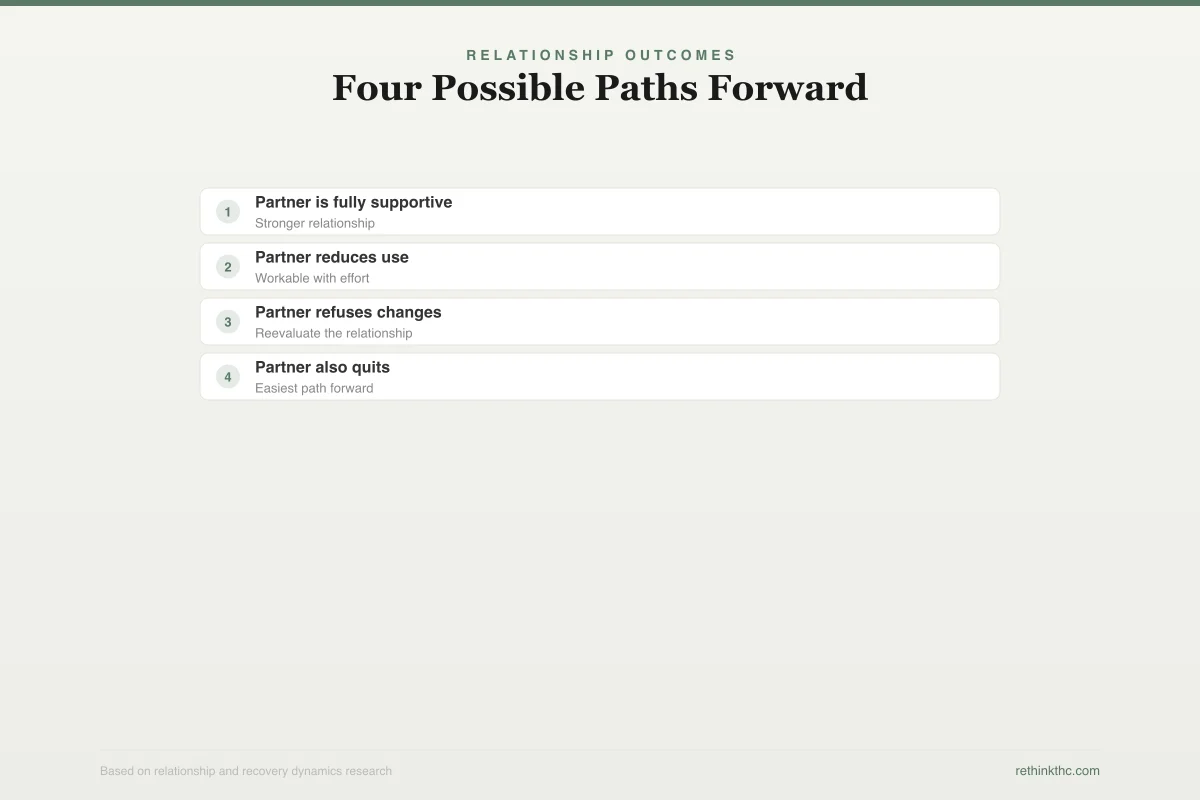
Four Possible Paths Forward
Your partner's response determines the trajectory
You quit. Your partner still uses.
Partner is fully supportive
- →Adjusts habits willingly
- →Respects boundaries
- →Engages in new shared rituals
Stronger relationship
Partner reduces use
- →Willing to compromise on environment
- →Makes some adjustments
- →Occasional friction but manageable
Workable with effort
Partner refuses changes
- →Dismisses withdrawal as not real
- →No environmental adjustments
- →Ongoing tension and relapse risk
Reevaluate the relationship
Partner also quits
- →Shared recovery journey
- →Mutual understanding of withdrawal
- →New shared identity together
Easiest path forward
Most relationships land on Path B. Willingness to collaborate matters more than the outcome itself.
Based on relationship and recovery dynamics research
 View as image ↗
Couples counseling is not a failure. It is a practical tool for navigating exactly this kind of transition. A therapist who understands substance use dynamics can help you both communicate more effectively, set sustainable boundaries, and determine whether the relationship can accommodate two different relationships with cannabis.
Research shows that nearly half (47%) of people who use cannabis regularly and then quit experience withdrawal symptoms.[2] That means this is an extremely common situation. Nearly half of regular users will go through this, and many of them have partners who continue using. The issue is widespread. The lack of honest guidance about it is the actual gap.
Evidence Review
Where the evidence stands
Neuroscience of Cue Conditioning
Well-established science showing how sensory cues (smell, sight) activate reward pathways and trigger cravings
Animal Cue-Exposure Studies
Rodent models confirm conditioned cue responses persist long after substance removal
Clinical Observations
Decades of documented relapse cases linked to environmental triggers and partner use
Human Clinical Studies
Allsop et al. (2012): withdrawal severity predicts relapse; functional impairment raises risk
Large Epidemiological Data
Bahji et al. (2020): 47% of regular users experience withdrawal — this situation is extremely common
Meta-Analysis
Multiple meta-analyses confirm environmental cue exposure as a primary relapse driver across substances
The science is clear: environmental cue exposure (living with a using partner) is a documented relapse trigger, and worse withdrawal predicts more relapse. This isn't about willpower — it's a well-studied neurological reality that nearly half of regular cannabis users face.
Allsop et al. (2012), PLOS ONE; Bahji et al. (2020)
When It Is a Dealbreaker
There is no universal answer for when a partner's continued use means the relationship cannot work. But there are clear warning signs:
Your partner refuses to make any environmental adjustments, even minor ones. They dismiss your withdrawal as not real or not serious. They actively offer you cannabis or pressure you to use. Their use escalates in response to your quitting (as if to prove a point). You have relapsed multiple times specifically because of proximity to their use.
Safety
ModerateWarning signs this is threatening your recovery
Concern
Some patterns indicate your partner's use has crossed from inconvenient to genuinely dangerous for your recovery: they refuse any environmental adjustments, dismiss your withdrawal as fake, actively offer you cannabis, or escalate their use in response to your quitting.
What the research says
If you've relapsed multiple times specifically because of proximity to their use, this is no longer a compromise situation — it's a health decision. Couples counseling can help, but your recovery has to come first.
Particularly relevant for: Anyone who has relapsed due to a partner's continued use
What to do
Talk to a therapist individually before making relationship decisions during withdrawal. Your judgment is clearest when you're not in the middle of acute symptoms. SAMHSA helpline: 1-800-662-4357.
Clinical relapse prevention literature
If your recovery is consistently threatened by your home environment and your partner is unwilling to collaborate on solutions, you are facing a decision that goes beyond cannabis. Your health and recovery have to come first. That is not an ultimatum. It is a fact. Understanding what relapse looks like and why it happens can help you assess this honestly, and the weed relapse guide covers the patterns to watch for.
When to Seek Professional Help
If the tension between your recovery and your partner's use is causing significant relationship distress, individual or couples counseling can help you navigate it. A therapist experienced in substance use dynamics will understand the competing needs at play.
If you are struggling with withdrawal, experiencing relapse, or feeling unable to maintain your recovery in your current environment, SAMHSA's National Helpline (1-800-662-4357) provides free, confidential referrals 24 hours a day, 7 days a week. They can connect you with local treatment programs and support groups.
The Bottom Line
Living with a partner who still uses cannabis while you are in recovery is one of the most common and least discussed challenges of quitting. Environmental exposure to cannabis (smell, paraphernalia, routine proximity) is a documented relapse trigger. Research shows withdrawal severity directly predicts relapse risk, and household cannabis presence raises the baseline difficulty of staying quit. Ultimatums and attempts to control a partner's use almost always create resentment. Effective strategies include having direct conversations that name the problem without blame, setting boundaries around your own environment rather than their behavior, building recovery infrastructure outside the relationship, and creating new shared rituals. If your partner refuses any accommodations or actively undermines your recovery, professional support or honest reassessment of the relationship may be necessary.
Should I ask my partner to quit weed for me?
You can share how their use affects your recovery, and you can ask for environmental accommodations (separate use spaces, keeping paraphernalia out of shared areas). But asking them to quit entirely is different from setting boundaries. Lasting change in substance use comes from internal motivation. If your partner decides to quit because of your conversation, that is a positive outcome. If they feel coerced into it, the change is unlikely to last and the resentment is likely to grow.
Is it possible to stay sober if my partner still smokes?
Yes, many people do. It is harder, and it requires deliberate strategies: strong personal recovery infrastructure, clear environmental boundaries, open communication, and separate coping tools. The people who navigate this successfully almost always have support outside the relationship (therapist, group, friend network) and a partner who is willing to make reasonable accommodations.
My partner says weed is not addictive, so they do not understand my withdrawal. What do I say?
Research shows that approximately 47% of regular cannabis users experience withdrawal upon stopping.[2] Cannabis withdrawal is recognized as a clinical diagnosis. You can share this data calmly, but ultimately, you do not need your partner to agree with the science in order to ask for support. Frame it in terms of your experience: "This is what I am going through, and I need these specific things from you."
We used to bond over smoking together. How do we replace that?
Actively create new shared rituals. The bonding was never really about the cannabis itself. It was about shared time, relaxation, and doing something together. Cook a meal together, take evening walks, start a show, play a game, work on a project. The replacement does not have to match the old ritual in form. It just needs to fill the same role: intentional, shared, low-pressure time together.
At what point should I consider leaving a relationship over this?
There is no fixed threshold, but certain patterns are concerning: your partner dismisses or ridicules your withdrawal, refuses any environmental accommodations, actively pressures you to use, or you have relapsed multiple times specifically due to their use. If your home environment consistently undermines your recovery and your partner is unwilling to collaborate on changes, prioritizing your health may require difficult decisions. A therapist can help you assess this clearly.
How do I handle cravings triggered by my partner's use?
Cravings triggered by environmental cues (smell, sight, routine) are conditioned responses, not willpower failures. When triggered, use the craving window technique: note the time and commit to waiting 15 to 20 minutes before making any decision. Most cravings peak and subside within that window. Remove yourself physically from the trigger if possible. Exercise, cold water on your wrists, or calling a supportive friend can interrupt the craving cycle. Having a plan for these moments before they happen is more effective than improvising during them.
Sources & References
- 1RTHC-00538·Allsop, David J. et al. (2012). “Withdrawal That Disrupted Daily Life Was Tied to Relapse in a Small Study.” PLOS ONE.Study breakdown →PubMed →↩
- 2RTHC-02407·Bahji, Anees et al. (2020). “About Half of Heavy Cannabis Users Experience Withdrawal. This Meta-Analysis Measured It..” JAMA Network Open.Study breakdown →PubMed →↩