Relationships
Don't Lecture
A 2015 meta-analysis found that motivational interviewing outperformed both confrontation and doing nothing for cannabis reduction, giving you an evidence-based framework for helping someone who is not yet ready to quit.
Meta-analysis, Addiction, 2015
Why Confrontation Almost Always Backfires
covered in detail
Setting Boundaries Without Issuing Threats
covered in detail
What to Do When They Refuse to See a Problem
covered in detail
Meta-analysis, Addiction, 2015
 View as image ↗
If you only read one thing
You can't make someone quit weed. But you can change how you talk to them about it — and the research says that matters a lot. Lectures and ultimatums actually make people smoke more, not less. What works is asking honest questions, listening without judging, and letting them reach their own conclusions. A 2015 meta-analysis proved this approach outperforms both confrontation and doing nothing. Your job isn't to fix them. It's to keep the door open.
You are watching someone you love smoke too much weed, and you do not know what to do. Maybe they are your partner, your adult child, or your closest friend. You can see the impact: the lost motivation, the missed commitments, the slow withdrawal from things they used to care about. You want to help someone quit weed, but every time you bring it up, they shut down or get defensive. You care too much to say nothing and you have learned that saying the wrong thing makes everything worse.
This article is for you. Not for the person using. For the person standing next to them trying to figure out how to help without pushing them further away.
Key Takeaways
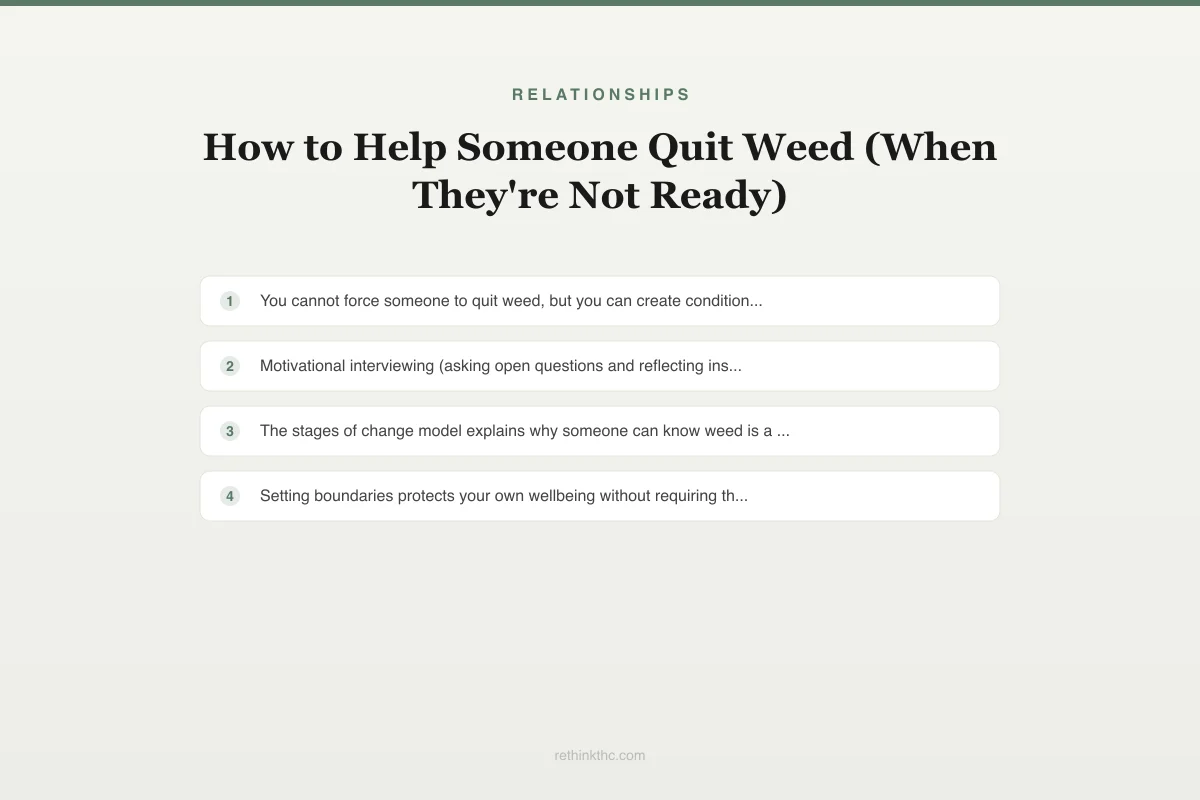
- You cannot force someone to quit weed, but you can create conditions that make them more likely to consider it on their own
- Motivational interviewing (asking open questions and reflecting instead of lecturing) is the most evidence-backed way to help someone quit weed when they are not ready to change
- The stages of change model explains why someone can know weed is a problem and still not be ready to quit — that gap is normal, not stubbornness
- Setting boundaries protects your own wellbeing without requiring the other person to change
- Taking care of yourself while waiting for someone else to be ready is not selfish — it is necessary
- A 2015 meta-analysis in Addiction found that motivational interviewing significantly increased the likelihood of reducing cannabis use compared to no intervention — without triggering the defensive backlash that confrontation produces
Fact Check
The 'tough love' approach vs. the evidence
The claim
“If you just lay out the facts hard enough — show them what they're losing, give them an ultimatum — they'll wake up and quit”
Intervention culture, TV shows, and the intuition that logic should override addiction
What research shows
MisleadingA 2004 study found confrontational approaches produced worse substance use outcomes than supportive ones. Pressure triggers psychological reactance — an automatic defensive response where the person doubles down on the targeted behavior. Ultimatums produce hidden use, not genuine change.
This doesn't mean you should say nothing. It means the way you say it matters as much as what you say. Motivational interviewing — asking questions and reflecting instead of arguing — outperforms both confrontation and doing nothing in clinical trials.
Miller & Rollnick (2013); Gates et al. (2015), Addiction
Why Confrontation Almost Always Backfires
Your instinct is probably to lay out the evidence. To explain, clearly and logically, why their cannabis use has become a problem. Maybe you have tried this already. Maybe you listed specific examples, sent articles, pointed out what they are missing. And maybe you noticed that it did not work.
There is a reason for that. Research on behavior change consistently shows that direct confrontation triggers what psychologists call reactance, a defensive response where the person doubles down on the exact behavior you are trying to change. A 2004 study in the Journal of Consulting and Clinical Psychology found that confrontational counseling approaches produced worse outcomes than supportive approaches across multiple substance use contexts. The more pressure applied, the more the person resisted.
This does not mean they are being difficult on purpose. Reactance is automatic. When someone feels their autonomy is threatened, the brain prioritizes defending that freedom over evaluating the argument. They are not hearing your logic. They are hearing a threat to their control over their own choices.
The same principle applies to ultimatums. "Quit or I am leaving" almost always produces compliance without genuine motivation, or it produces the opposite of what you wanted. The person may hide their use instead of stopping it. Real change requires internal motivation, and that cannot be installed from the outside through force.
The Stages of Change (And Why "Not Ready" Is a Real Stage)
Stages of Change: Where They Are & What You Can Do
Doesn't see a problem
Plant seeds. Don't push.
Sees downsides, not ready to act
Ask open questions. Reflect what they say.
Planning to change
Offer practical support. Share resources.
Actively quitting
Be patient with withdrawal symptoms. Show up.
Sustaining the change
Celebrate without pressure. Stay available.
Key insight: Most people cycle through these stages multiple times. Your job is to meet them where they are, not drag them to the next stage.
If you are frustrated that someone can acknowledge weed is affecting their life and still not do anything about it, the stages of change model explains why. Developed by psychologists Prochaska and DiClemente in the 1980s, this model maps the process people go through before changing any behavior.
The five stages are:
Precontemplation. The person does not see a problem. They are not thinking about quitting because they do not believe there is anything to quit. If this is where your person is, bringing up their use will almost certainly feel like an attack.
Contemplation. The person sees the downsides but is not ready to act. They might say things like "I know I should cut back" or "I do not like how much I am smoking" but take no steps to change. This stage can last months or years. It is not laziness. It is ambivalence, and ambivalence is a normal part of the process.
Preparation. The person is planning to change. They might be looking up information, setting a quit date, or telling people about their intention. This is where your support has the most direct impact.
Action. The person is actively quitting. This is the stage where practical support (understanding withdrawal symptoms, reducing triggers, offering patience during irritability) matters most. Sharing a structured resource like the step-by-step guide to quitting weed can give them a concrete starting point without making them feel lectured.
Maintenance. The person has quit and is working to sustain it.
The critical insight is that most people cycle through these stages multiple times before lasting change sticks. Your job is not to drag them from one stage to the next. It is to meet them where they actually are.
Motivational Interviewing: What Actually Works
If confrontation makes things worse, what makes things better? The most evidence-supported approach is called motivational interviewing (MI), a communication style developed by psychologists William Miller and Stephen Rollnick for conversations with people who are ambivalent about change.
A 2015 meta-analysis in the journal Addiction found that motivational interviewing significantly increased the likelihood of reducing cannabis use compared to no intervention. The effect was consistent and it did not produce the defensive backlash that confrontation did.
You do not need to be a therapist to use the core principles. Here is what they look like in practice.
Ask Open Questions Instead of Making Statements
Instead of "You are smoking too much," try "How do you feel about how much you have been smoking lately?" Instead of "Weed is making you lazy," try "Have you noticed any changes in your motivation recently?" Open questions invite the person to evaluate their own behavior. The conclusions they reach on their own carry infinitely more weight than the same conclusions delivered by you.
Reflect What They Say Without Adding Judgment
If they say "I know I am probably smoking too much, but it helps me relax," reflect both parts back: "It sounds like you are aware the amount has gone up, and at the same time it is serving a purpose for you." This does two things. It shows them you are listening, and it puts their own ambivalence in front of them without you having to argue either side.
Resist the Urge to Fix
When someone you care about shares a problem, your instinct is to offer a solution. Fight that instinct. The moment you jump to "So you should quit" or "Have you tried cutting back?", you have moved from supportive to directive. Let them sit with their own observations. Silence after a reflective statement is more powerful than any advice you could give.
Affirm Their Autonomy
Say it directly: "Whatever you decide to do about this, it is your call. I am not going to pressure you." This feels counterintuitive when your whole goal is to get them to change. But paradoxically, the more you affirm their right to choose, the more space you create for them to choose differently. Reactance drops when autonomy feels secure.
Communication
Confrontation vs. Motivational Interviewing: What to Actually Say
Instead of this
"You're smoking too much."
Try this
"How do you feel about how much you've been smoking lately?"
Why: Open questions invite self-evaluation instead of triggering defense
Instead of this
"Weed is making you lazy."
Try this
"Have you noticed any changes in your motivation recently?"
Why: Lets them name the problem themselves — their own words carry more weight
Instead of this
"You need to quit or I'm leaving."
Try this
"I'm not going to pressure you. Whatever you decide, it's your call."
Why: Affirming autonomy paradoxically makes them more open to change
Instead of this
"I found this article that proves cannabis is addictive."
Try this
"I've been reading about this. Can I share what I learned if you're interested?"
Why: Asking permission respects their agency and prevents reactance
Instead of this
"You always say you'll cut back and never do."
Try this
"It sounds like part of you wants to change and part of you isn't there yet."
Why: Reflecting ambivalence helps them see it without shame
Based on: Miller & Rollnick, Motivational Interviewing (2013); Gates et al. (2015), Addiction
 View as image ↗
Evidence Review
Where the evidence stands
Theory Development
Stages of change model (Prochaska & DiClemente, 1983); motivational interviewing developed (Miller & Rollnick, 1991)
Initial Clinical Testing
MI tested across alcohol, tobacco, and other substance use with positive results
Cannabis-Specific Studies
Multiple trials applying MI specifically to cannabis use reduction
Controlled Trials
Randomized trials comparing MI to confrontation and no-treatment controls
Large Multi-Site Trials
Gates et al. (2015): meta-analysis confirming MI effectiveness for cannabis reduction
Meta-Analysis
2015 Addiction meta-analysis: MI significantly outperforms doing nothing for cannabis reduction
Motivational interviewing for cannabis reduction has the strongest possible evidence level — confirmed by meta-analysis. The core principles (open questions, reflective listening, affirming autonomy) are well-validated and don't require clinical training to use. You don't need to be a therapist to talk to someone this way.
Gates et al. (2015), Addiction; Miller & Rollnick (2013)
The Difference Between Enabling and Supporting
This is the question that keeps people up at night. Am I helping, or am I making it easier for them to keep using?
Enabling means removing the natural consequences of someone's cannabis use. Covering for them when they miss obligations. Making excuses to family or friends. Giving them money you know will go toward weed. Enabling protects the person from the very discomfort that might push them toward contemplation.
Supporting means maintaining your relationship and care without shielding them from reality. It means saying "I love you and I am here when you are ready" while also letting them experience the consequences of missed deadlines and strained relationships. Supporting is not cold. It is honest.
If you are unsure whether your behavior counts as enabling, ask yourself: am I doing this because it genuinely helps them, or because it makes me less anxious about the situation?
Setting Boundaries Without Issuing Threats
Boundaries are about protecting yourself. They are not leverage to force someone else to change. The difference matters.
A threat sounds like: "If you do not quit, I am done." A boundary sounds like: "I am not able to be around heavy cannabis use every night. On the nights you are using, I am going to make other plans." The difference is that a threat puts their behavior at the center. A boundary puts your own needs at the center.
Some boundaries that commonly help people in this situation:
- "I am not going to cover for you when cannabis use causes you to miss something. If someone asks where you are, I will tell the truth."
- "I need our shared spaces to be free of cannabis smell and paraphernalia."
- "I am not going to have the same conversation about your use more than once a month. I have said my piece and I need to stop repeating it for my own mental health."
- "I am not going to lend money if I believe it is going toward weed."
The hardest part is following through. A boundary you state but do not enforce teaches the other person that your words do not match your actions. Start with boundaries you are genuinely prepared to maintain.
For more on navigating these dynamics in a romantic relationship specifically, the guide on what to do when your partner still smokes weed covers this in detail.
What to Do When They Refuse to See a Problem
If the person in your life is firmly in precontemplation, meaning they genuinely do not believe their cannabis use is an issue, your options are limited. Accepting that is important.
You can plant seeds. A single honest, non-confrontational conversation where you share what you have observed can stay in someone's mind for months before it produces visible change. Research on the signs of cannabis use disorder can help you articulate specific patterns rather than vague concerns.
You cannot make them see what they are not ready to see. Someone who is not in contemplation cannot be argued into it. They can only arrive there through their own experience, their own accumulation of evidence. Your job is to be there when that moment comes, not to manufacture it.
Taking Care of Yourself While You Wait
Loving someone who is not sure whether they should quit is genuinely exhausting. The worry, the frustration, the helplessness. These take a real toll on your mental health, your sleep, and your other relationships.
You are allowed to seek support for yourself even if the person you are worried about has not sought help yet. Therapy is not only for the person using. It is for the person watching. A therapist can help you process the emotional weight of this situation and identify when your own behavior has crossed into enabling.
Support groups for family members, including groups modeled on Al-Anon principles, exist specifically for this purpose. You do not have to be in crisis to use them. You just have to be tired.
And you are allowed to decide that a relationship with someone who will not address their cannabis use is not sustainable for you. That is not an ultimatum. That is a personal decision about what kind of life you are willing to live.
When to Seek Professional Help
If the person you are concerned about shows signs of cannabis use disorder, including inability to cut back despite wanting to, cannabis use interfering with work or relationships, or needing increasing amounts to get the same effect, professional support can make a significant difference.
A therapist trained in motivational interviewing can have conversations you cannot, because they come without the emotional history and personal stakes that complicate family dynamics. They can also assess whether the cannabis use is masking underlying issues like anxiety, depression, or trauma that need their own treatment.
If you are unsure where to start, SAMHSA's National Helpline is available at 1-800-662-4357. It is free, confidential, available 24 hours a day, and can connect both the person using and their family members with local resources.
You Are Already Doing Something
The fact that you searched for how to help someone quit weed means you are already past the point of doing nothing. You are educating yourself. You are looking for approaches that actually work instead of defaulting to the ones that feel instinctive but do not. That matters, even if it does not feel like enough right now.
You cannot control someone else's relationship with cannabis. You can control how you show up in the conversation, how you protect your own health, and how you respond when the moment of readiness finally arrives. Sometimes the most powerful thing you can do for someone is stay steady, stay honest, and stay present, without trying to be the one who fixes it.
Research Gaps
What would it take?
What would it take to know the best way to help a loved one quit cannabis?
Randomized trial of family-based MI specifically for cannabis (not mixed substances)
Some trials exist but with mixed substance populations
Comparison of different boundary-setting approaches and their outcomes
No controlled research on which specific boundaries help vs. hurt
Long-term follow-up on family member wellbeing after someone refuses to quit
Studies focus on the user, not the concerned person
Culturally adapted family intervention models for cannabis
Emerging research in some populations but not cannabis-specific
Assessment based on current MI research and clinical practice literature
The Bottom Line
Helping someone quit cannabis requires understanding that direct confrontation triggers psychological reactance — a defensive response where the person doubles down on the targeted behavior. A 2004 study in the Journal of Consulting and Clinical Psychology found confrontational approaches produced worse outcomes than supportive approaches across substance use contexts. The stages of change model (Prochaska and DiClemente) explains why someone can acknowledge a problem without acting: precontemplation, contemplation, preparation, action, and maintenance are sequential stages most people cycle through multiple times before lasting change. Motivational interviewing (MI), developed by Miller and Rollnick, is the most evidence-supported communication approach — a 2015 meta-analysis in Addiction confirmed MI significantly increased likelihood of reducing cannabis use. Core MI principles applicable without clinical training: ask open questions instead of making statements, reflect without judgment, resist the urge to fix, and affirm autonomy. The enabling vs. supporting distinction is critical: enabling removes natural consequences while supporting maintains care without shielding from reality. Boundaries protect the helper's wellbeing and differ from threats by centering the helper's needs rather than the user's behavior.
How do I bring up someone's weed use without starting a fight?
Choose a calm moment when neither of you is stressed or rushed. Use "I" statements that focus on what you have observed, not on what they are doing wrong. "I have noticed you seem less interested in things you used to enjoy, and it worries me" lands differently than "You are always high and it is ruining your life." Keep it short. If they get defensive, do not escalate. One honest conversation is worth more than ten arguments.
Is it wrong to research cannabis addiction on behalf of someone else?
Not at all. Educating yourself about whether cannabis is addictive and what the signs of problematic use look like helps you understand what you are seeing and respond more effectively. The key is how you use that information. Presenting research as evidence in an argument will trigger defensiveness. Using it to inform your own approach, set better boundaries, and ask better questions will not. Learn for yourself first. Share only when asked or when the moment is genuinely right.
What if I already tried confrontation and it made things worse?
That is recoverable. You can acknowledge it directly: "I realize the way I brought up your smoking last time was not helpful. I came at you with a lot of pressure and I understand why you shut down." This kind of honesty often reopens the door that confrontation closed. Then shift to the motivational interviewing approach: ask questions, listen, reflect, and resist the urge to push toward a specific outcome.
How long should I wait before bringing up their cannabis use again?
There is no universal timeline, but a good rule is to avoid repeating the same conversation more than once a month. If you have clearly expressed your concern and the person heard you, saying it again every few days does not add new information. It just adds pressure, which produces reactance rather than reflection. Between conversations, focus on your own boundaries and wellbeing. When you do revisit it, come with a question rather than a statement. "How are you feeling about things?" gives them room to bring it up themselves.
Can I help someone quit weed if I still use cannabis myself?
You can still express concern and set boundaries. However, asking someone to change a behavior you are actively engaged in creates a credibility gap. If your concern is about the amount or pattern of their use rather than cannabis itself, be specific: "I am not saying weed is bad. I am saying the amount you are using and how it is affecting your daily life concerns me." If you are questioning your own use, the guide on deciding whether to quit may be worth reading.
What do I do when they finally say they want to quit?
When the moment arrives, your role shifts from patient observer to active supporter. Practical help matters more than emotional reassurance at this stage. Offer to help them remove paraphernalia from the house. Stock easy foods for the appetite loss phase. Learn what withdrawal symptoms to expect so their irritability and insomnia do not catch you off guard. Share the how to quit weed guide as a starting resource. Most importantly, do not overreact with relief or excitement — treating their decision as a monumental event adds pressure that can backfire. A calm "I am glad to hear that. What do you need from me?" is the ideal response.
Sources & References
- 1RTHC-08512·Murri, Martino Belvederi et al. (2026). “Large meta-analysis finds regular cannabis use raises both pro-inflammatory and anti-inflammatory markers, not just one or the other.” Brain.Study breakdown →PubMed →↩
- 2RTHC-08534·P A Costa, Gabriel et al. (2026). “Cannabis Use Makes Quitting Tobacco Harder, But CBD Might Help.” medRxiv : the preprint server for health sciences.Study breakdown →PubMed →↩
- 3RTHC-06056·Berny, Lauren M et al. (2025). “Brief Interventions in Medical Settings Did Not Reduce Cannabis Use.” Prevention science : the official journal of the Society for Prevention Research.Study breakdown →PubMed →↩
- 4RTHC-06615·Halicka, Monika et al. (2025). “CBT with Motivational Enhancement Is the Best-Supported Psychotherapy for Cannabis Use Disorder.” Addiction (Abingdon.Study breakdown →PubMed →↩
- 5RTHC-06972·Lo, Jamie O et al. (2025). “Cannabis Use in Pregnancy Linked to Preterm Birth, Low Birth Weight, and Small Babies Even After Accounting for Tobacco.” JAMA pediatrics.Study breakdown →PubMed →↩
- 6RTHC-05376·Hill, Melanie L et al. (2024). “Cannabis Users with PTSD Still Benefit from Trauma-Focused Therapy — But Attend Fewer Sessions.” Journal of anxiety disorders.Study breakdown →PubMed →↩
- 7RTHC-05535·McClure, Erin A et al. (2024). “Reducing Cannabis Use by 50-75% Was Enough to See Real Improvements.” The American journal of psychiatry.Study breakdown →PubMed →↩
- 8RTHC-04980·Theerasuwipakorn, Nonthikorn (2023). “Cannabis and Heart Attack/Stroke Risk: A 183-Million-Patient Meta-Analysis Finds Stroke Risk but Not Heart Attack Risk.” Toxicology Reports.Study breakdown →PubMed →↩