Withdrawal & Recovery
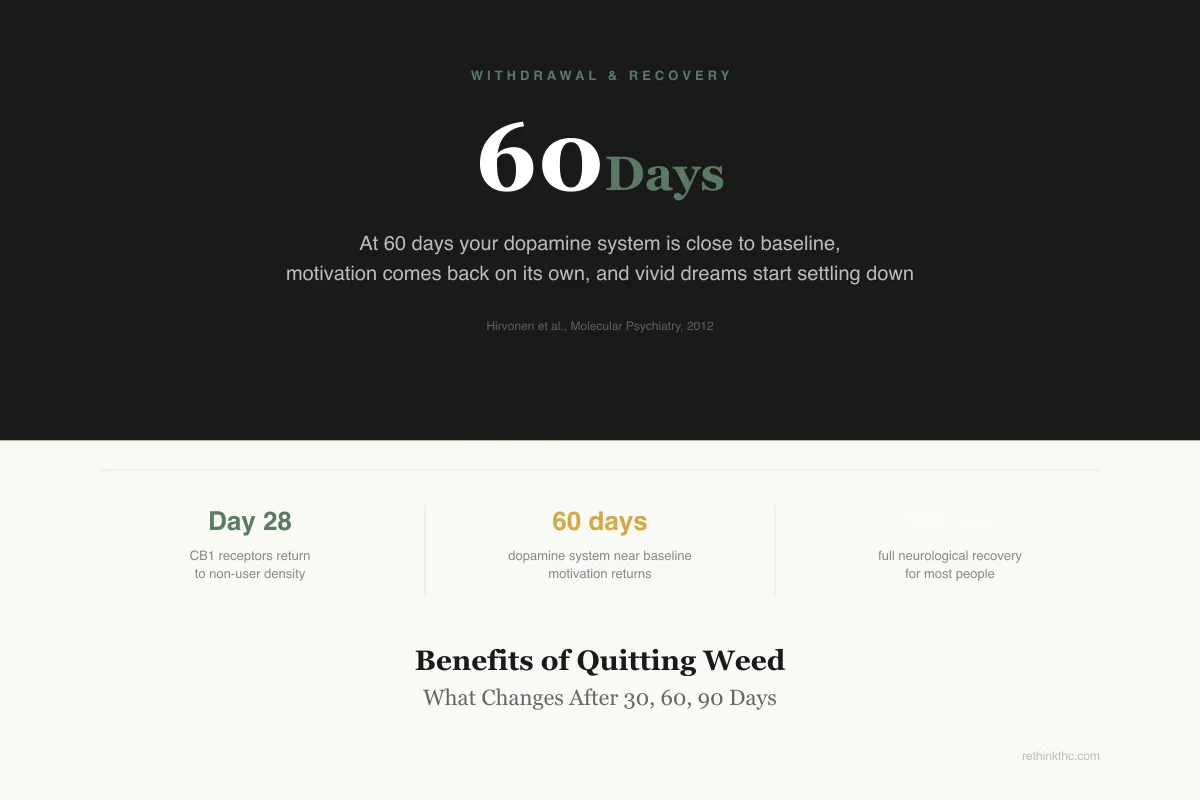
Day 28
By day 28, your brain's CB1 receptors have returned to the density of someone who never used cannabis. This single recovery milestone is why most people describe the end of the first month as a turning point.
Hirvonen et al., Molecular Psychiatry, 2012
Day 28
CB1 receptors return to non-user density
Day 60
motivation returns as reward system recalibrates
90 days
full neurological recovery for most people
Hirvonen et al., Molecular Psychiatry, 2012
 View as image ↗
If you only read one thing
Your brain fully recovers from weed. By day 28, brain scans show your cannabinoid receptors look like someone who never smoked. By month two, your motivation and reward system are back online. By day 90, most people are neurologically back to baseline. The first week is rough — withdrawal peaks around days 3 to 6 — but every benefit after that is your brain returning to what it can actually do without THC in the way.
Quitting weed produces a specific, measurable set of changes in your brain, body, and daily life. Some of those changes happen within days. Others take months. And some of the most meaningful ones are not biological at all.
This is not a sales pitch for quitting. It is a factual accounting of what happens at each milestone, based on clinical research and the consistent reports of people who have been through it. Whether these changes matter to you depends on your own situation. But knowing what to expect makes the process less abstract and more manageable.
Key Takeaways
- The first week is the hardest, but withdrawal symptoms peak around days three to six and steadily drop after that
- By day 30 your CB1 receptors have mostly normalized, sleep is improving, and you can actually notice better memory and focus
- At 60 days your dopamine system is close to baseline, motivation comes back on its own, and vivid dreams start settling down
- By 90 days most people have hit full neurological recovery, built new habits, and saved a real amount of money
- Not everyone hits every benefit on the same schedule — things like how long you used and your genetics play a role
- All cannabis-related changes are fully reversible — no permanent cognitive, respiratory, or neurological damage has been found from cannabis use alone in adults
Benefits Timeline at a Glance
| Milestone | Brain & Cognition | Body & Sleep | Life & Finances |
|---|---|---|---|
| Week 1 | CB1 receptors begin recovering; brain fog peaks then starts clearing | Lungs start clearing; appetite disrupted; night sweats | Withdrawal is the main experience; ~$50–100 saved |
| Day 30 | CB1 receptors normalized; memory and focus measurably improved | Sleep normalizing; appetite stable; breathing easier | Emotional regulation returns; ~$200–400 saved |
| Day 60 | Dopamine system near baseline; motivation returns naturally | Vivid dreams subsiding; exercise feels rewarding | Relationships improving; ~$400–800 saved |
| Day 90 | Full neurological recovery; sustained cognitive baseline | Sleep architecture fully restored; lung function improved | New habits established; identity shift; ~$600–1,200 saved |
| 6+ months | Ongoing gains for adolescent-onset users | Continued respiratory improvement for smokers | Compounding financial and relational benefits |
The visual below maps these milestones against the biological recovery curve, showing when each category of benefit becomes noticeable.
Recovery Timeline
What Changes at 30, 60, and 90 Days
30 Days
- ✓Sleep quality improves noticeably
- ✓Appetite normalizes to natural rhythms
- ✓Lung function begins recovery
- ✓Anxiety levels decrease significantly
60 Days
- ✓Cognitive function largely restored
- ✓Intrinsic motivation returns
- ✓REM sleep normalizes — vivid dreams fade
- ✓Financial savings: ~$400–800
90 Days
- ✓CB1 receptors fully recovered
- ✓Emotional regulation stable at baseline
- ✓Exercise capacity improved
- ✓Relationship improvements noticeable
Recovery progress
Based on Schlienz et al. (2018), Hirvonen et al. (2012)
 View as image ↗
The First Week: Surviving the Worst of It
The benefits of quitting weed do not start on day one. The first week is mostly about getting through withdrawal, which peaks between days three and six.[7] For a detailed day-by-day breakdown of what to expect, the first week without weed guide covers every phase. But even during this rough stretch, some early changes are already underway.
Your Lungs Start Clearing
If you smoked cannabis (rather than using edibles or vapes), your respiratory system begins repairing itself within 48 to 72 hours. The cilia, tiny hair-like structures lining your airways, start functioning again after being suppressed by smoke exposure. Research documents that cannabis smoke causes bronchitis and airway symptoms that improve after stopping.[4] A 2022 review found that while cannabis smoking causes bronchitis, it does not appear to cause COPD and probably does not cause lung cancer — a markedly different respiratory profile from tobacco. You may actually cough more during this period as your lungs push out accumulated debris. It sounds counterproductive, but it is the first sign of repair.
THC Levels Drop
THC is fat-soluble, so it does not leave your system overnight. But blood plasma levels drop significantly within the first few days, and your CB1 receptors begin their recovery process. A 2012 study by Hirvonen and colleagues in Molecular Psychiatry used PET brain imaging and found that CB1 receptor density begins increasing almost immediately after cessation.[1]
Sleep Is Rough
Sleep during the first week is not a benefit. It is the opposite. REM rebound kicks in as your brain compensates for the dreaming sleep that THC suppressed.[5] Vivid, sometimes disturbing dreams, night sweats, and difficulty falling or staying asleep are all common. This is the price of admission. It does get better.
The Honest Picture
The first week is not about feeling the benefits. It is about the benefits starting beneath the surface while you deal with the uncomfortable parts. Irritability, appetite loss, cravings, brain fog, and emotional volatility are all peaking during this stretch. For a detailed breakdown, the weed withdrawal timeline covers what to expect day by day.
After 30 Days: The First Real Milestone
Day 30 is where the balance tips. The acute withdrawal is behind you, and the biological changes are becoming hard to ignore.
CB1 Receptors Have Largely Recovered
The Hirvonen 2012 study[1] found that CB1 receptor density returns to normal levels by approximately day 28. These receptors regulate mood, appetite, pain perception, and sleep, among other functions. When they normalize, the systems they govern start working properly again. This single finding explains why so many people describe the end of the first month as a turning point.
Hirvonen et al. (2012) · Molecular Psychiatry
- Population
- Chronic daily cannabis smokers vs. healthy controls
- Intervention
- Approximately 4 weeks of continuously monitored abstinence
- Comparator
- Healthy non-users
- Finding
- CB1 receptor density returned to normal levels after about 28 days of abstinence — the first direct proof that the brain's cannabinoid system fully recovers in humans
positive PET brain imaging — gold standard for receptor measurement. First study to show this in humans.
Hirvonen et al. (2012), Molecular Psychiatry
Sleep Is Normalizing
By day 30, most people are falling asleep faster, staying asleep longer, and waking up feeling more rested. The vivid dreams are still present for some, but they have shifted from nightly nightmares to unusual but tolerable dreams. Research has documented that sleep architecture begins normalizing within two to four weeks of cannabis cessation, with continued improvement through week six.[5]
Cognitive Improvements Become Obvious
This is one of the most commonly reported benefits at the 30-day mark. Memory, focus, and processing speed all show measurable improvement. A 2018 meta-analysis by Scott and colleagues published in JAMA Psychiatry reviewed 69 studies and concluded that cognitive deficits associated with cannabis use largely resolve with sustained abstinence.[2] The most notable improvements were in learning and memory.
In practical terms: you remember conversations from earlier in the week. You can read a chapter without re-reading paragraphs. You walk into a room and actually know why you went in there. People at work or school may notice that you are sharper before you notice it yourself. If you are a creative professional wondering whether clarity will affect your work, the research on quitting weed and creativity is worth reading.
Scott et al. (2018) · JAMA Psychiatry
- Population
- 2,152 cannabis users and 6,575 comparison participants (mean age ~21)
- Intervention
- Sustained abstinence from cannabis (72+ hours)
- Comparator
- Minimal cannabis exposure controls
- Finding
- After more than 72 hours of abstinence, the cognitive deficit shrank to nearly zero — from a meaningful effect to one that was statistically indistinguishable from non-users
positive Meta-analysis of 69 studies — the strongest evidence available that cannabis cognitive effects are reversible
Scott et al. (2018), JAMA Psychiatry
Appetite Has Stabilized
THC stimulates appetite directly through CB1 receptor activation. Without it, your body had to relearn how to generate hunger signals on its own. Approximately 47 percent of regular cannabis users experience clinically significant withdrawal symptoms including appetite disruption, which typically resolves within two to four weeks.[8] By day 30, that process is complete for most people. You feel hungry at normal times, eat normal amounts, and may notice that food tastes different. Some people describe flavors as more distinct or nuanced without THC modulating the sensory experience.
Emotional Regulation Is Returning
The mood swings and irritability of early withdrawal have largely resolved.[7] Your emotions are proportionate to what is actually happening rather than being amplified by neurochemical instability. You can handle a frustrating situation without it spiraling. You can feel sad about something sad without it becoming a crisis. This is your brain's emotional processing running on its own chemistry again.
Money Saved
This one is straightforward math. Daily cannabis users typically spend between $200 and $400 per month. At the 30-day mark, you have that money in your account instead. It is a concrete, visible benefit that does not require any neuroscience to appreciate. For a detailed breakdown of the numbers, the money saved quitting weed calculator puts the cumulative savings into perspective.
After 60 Days: The New Baseline
By month two, you are past recovery and into something different. This is not about withdrawal ending. This is about discovering what your brain and body actually feel like when they are running clean.
Dopamine System Near Baseline
The flatness, the "gray period," the feeling that nothing is interesting. That phase is ending or already over. Your dopamine system has been rebuilding the receptors and sensitivity that THC disrupted, and by day 60, most people report that everyday activities feel rewarding again.
A 2017 case-control study found that cannabis-dependent participants had significantly reduced dopamine release in the striatum, with large effect sizes across the brain regions governing planning, motivation, and goal-directed behavior.[3] The broader recovery literature suggests this system recalibrates over the weeks following CB1 receptor normalization, with most people reporting restored motivation by the second month. You want to do things rather than having to force yourself through sheer willpower. Many people find this is the turning point where boredom stops being a problem and new hobbies start to actually feel appealing.
Exercise Feels Rewarding
This is closely tied to dopamine recovery. In the early weeks, exercise felt like dragging yourself through concrete. The reward signal was too blunted to make physical activity feel good. By day 60, your brain produces and registers a normal dopamine response to exercise. A run, a bike ride, even a long walk generates the feeling it is supposed to generate. Research has found that aerobic exercise directly increases dopamine receptor availability, which means exercise both benefits from and contributes to your recovery.
Vivid Dreams Are Subsiding
The intense, often bizarre dreams from REM rebound have settled into a normal dreaming pattern. You are still dreaming more than you did while using, because THC was suppressing your REM sleep and now your brain is cycling through it normally. But the dreams are no longer waking you up or leaving you unsettled in the morning.
Relationships Are Improving
This is one of the benefits that other people notice before you do. Partners, friends, family members, and coworkers may comment that you seem more present. More engaged. More reliable. More emotionally available. These changes accumulate gradually, which is why you might not see them yourself. But the people around you do.
Multiple people are not the only ones who benefit. Your relationship with yourself shifts too. You are processing emotions as they arise rather than buffering them with a substance. That can be uncomfortable at first, but by month two, most people report feeling more genuine and more grounded than they did while using.
Financial Impact Adds Up
At $300 per month (a moderate estimate), you have saved $600. Some people use this milestone to do something visible with the money, a purchase, a savings goal, paying off a debt, as a tangible reminder of the change.
Evidence Review
Where the evidence stands
Cell & Lab Studies
Receptor binding, dopamine signaling, and neuroinflammation pathways well-characterized
Animal Studies
Rodent models confirm CB1 downregulation and recovery after THC cessation
Case Reports & Surveys
Thousands of consistent reports of cognitive and mood recovery after quitting
Human Imaging Studies
Hirvonen 2012 — PET scans show CB1 receptors normalize by day 28 in chronic users
Large Meta-Analysis
Scott 2018 — 69 studies, 8,700+ participants. Cognitive deficits largely disappear with abstinence
Replicated Across Populations
Recovery confirmed across age groups, usage levels, and cognitive domains
This is one of the best-studied areas in cannabis science. Brain receptor recovery, cognitive recovery, and dopamine normalization after quitting are all supported by imaging studies and large meta-analyses. The evidence is strong: cannabis-related brain changes are reversible.
Hirvonen et al. (2012), Scott et al. (2018), van de Giessen et al. (2017)
After 90 Days: Full Neurological Recovery
The three-month mark is significant because by three months, the downstream effects of CB1 receptor normalization — which completed around day 28 — have had time to cascade through the broader neurotransmitter systems, and most people report feeling fully recovered.
Sustained Cognitive Gains
The memory and focus improvements from month one have continued and stabilized. The Scott 2018 meta-analysis[2] found that abstinent cannabis users demonstrated robust cognitive recovery, with recovery documented across age groups, including younger users whose still-developing brains resumed normal maturation without THC interference.[6]
By day 90, these gains are not fragile. They are your new baseline. You are not recovering anymore. You are simply operating at your cognitive capacity.
New Habits Are Established
Behavioral research suggests it takes roughly two months for a new behavior to become automatic. By day 90, the routines you built to replace cannabis use, whether that is exercise, a sleep routine, a creative practice, or simply a different way of spending your evenings, are no longer effortful. They are just what you do.
Financial Clarity
At $300 per month, you have saved $900. Over a full year, that trajectory becomes $3,600. For some people, that is a vacation. For others, it is getting out of debt. For others, it is the start of an emergency fund. The number varies, but the direction does not.
Recovery by the numbers
CB1 receptors normalized
Day 28
PET imaging — Hirvonen et al. 2012
confirm cognitive recovery
69 studies
Scott et al. 2018 meta-analysis
of regular users get withdrawal symptoms
47%
Bahji et al. 2020 prevalence review
average savings
$3,600/year
Based on $300/month moderate usage
Peer-reviewed research
The Identity Shift
This is harder to measure than receptor density or dollars saved, but people at the 90-day mark consistently describe a change in how they see themselves. You are no longer someone who is "trying to quit." You are someone who does not use cannabis. That identity shift, subtle as it sounds, compounds over time. Decisions become easier because they align with who you already are rather than who you are trying to become. For many people, this involves leaving stoner culture behind and working through a real stoner identity crisis that surfaces during the transition.
What People Consistently Describe at Each Milestone
The science tells you what is happening in your brain. But the experience of quitting is not just neuroscience. It is mornings and evenings and boredom and relief and doubt. Here is what people consistently describe at each stage — not testimonials, but the patterns that show up so often in clinical settings and recovery communities that they have become predictable.
At 30 Days
The most common word is "clarity." People describe a fog lifting that they did not realize was there while they were in it. Memory is the first thing they notice — conversations from earlier in the week stay accessible, names come back faster, the small cognitive lapses that had become normal stop happening. Sleep is better but not great. Appetite is back but still adjusting.
The most common emotion is not triumph. It is cautious optimism mixed with vulnerability. "I feel better but I am scared I will go back" is something clinicians and community moderators hear constantly at this stage. That fear is not a sign of weakness. It is a sign that you understand what you are up against and are taking it seriously.
If you are at day 30 and feeling this exact mix — clearer head, genuine improvement, lingering fear — you are tracking exactly where most people land.
At 60 Days
The shift people describe at month two is subtler but, for many, more meaningful than the cognitive gains of month one. It is about motivation. The gray period, where nothing felt interesting and you had to force yourself to do anything, is lifting. Activities generate their own reward again. You exercise because it feels good, not because you are grimly checking a box. You cook a meal because you want to eat it, not because someone told you to eat.
People also describe a changed relationship with stress. Not that stress has gone away, but that they can feel it without needing to immediately suppress it. They can sit in discomfort for a few minutes and let it pass on its own. For daily users who spent years reaching for cannabis the moment any negative feeling appeared, this ability feels foreign at first and then, gradually, feels like freedom.
This is the stage where most people stop white-knuckling it and start actually living without cannabis.
At 90 Days
The consistent description at three months is identity. People stop thinking of themselves as "someone who quit weed" and start thinking of themselves as "someone who does not use weed." The distinction sounds trivial. It is not. When your identity aligns with the behavior, the behavior requires less effort. You are not fighting your own self-concept anymore.
Relationships feel more genuine. Emotions have a full range again, including negative ones, which some people initially find uncomfortable but eventually prefer to the flattened emotional landscape of daily use. Multiple people describe being surprised by how much richer sadness and frustration feel when they are not being chemically suppressed. That sounds counterintuitive, but the full emotional spectrum, including the uncomfortable parts, is what makes the good parts feel real.
The Pattern Nobody Warns You About
Many people experience a dip around weeks six to eight. The initial motivation that carried them through withdrawal has faded. The novelty of sobriety has worn off. Life feels ordinary, which after weeks of dramatic neurological change can feel like regression.
This is not relapse. It is the transition from "quitting" to "living." The early weeks are full of milestones: surviving day three, making it to a week, hitting 30 days. By week six, the milestones slow down, and you are left with regular life. Some people interpret the absence of dramatic improvement as evidence that sobriety is not working. It is not evidence of that. It is evidence that recovery is complete enough for normal life to resume.
Knowing this dip is coming prevents the common mistake of relapsing at the exact moment your brain has finally finished the hardest part of the work.
Beyond 90 Days: The Long-Term Trajectory
The biological recovery is essentially complete by month three. What happens after that is about building on a foundation rather than repairing one.
Cognitive function continues at your restored baseline. For people who started using heavily during adolescence, some studies suggest ongoing improvements beyond 90 days as the brain completes developmental processes that were interrupted by THC.
Physical health keeps improving. If you were a smoker, lung function continues getting better for months. Cardiovascular risk factors associated with smoke inhalation continue declining. Exercise capacity increases as your respiratory system fully repairs. Some people also notice visible changes: the effects of quitting on your face and skin can be surprisingly noticeable, and weight changes are common as your appetite system fully recalibrates.
Financial benefits compound. The money you are not spending on cannabis is either being saved, invested, or redirected toward things that build your life rather than maintain a habit.
Relationships deepen. The presence, reliability, and emotional availability that emerged at month two continue strengthening. People trust you more because you have been consistently showing up as yourself.
The long-term trajectory is not dramatic. It is steady. The explosive changes happened in the first 90 days. What follows is the quieter process of building a life on top of a clear neurological foundation. For a firsthand account of what the full arc looks like, the one year sober from weed article documents the changes people consistently describe at the 12-month mark.
An Honest Note About Individual Variation
Not everyone experiences every benefit described here, and not everyone experiences them on the same timeline. Duration of use, frequency, potency of products, age of onset, genetics, and co-occurring mental health conditions all influence the process. Someone who used daily for 10 years will have a different recovery curve than someone who used for six months.
Some people also discover that symptoms they attributed to cannabis withdrawal, like anxiety or low mood, persist beyond 90 days. In those cases, cannabis may have been masking a pre-existing condition. That is worth exploring with a healthcare provider, not as a reason to resume use, but as information about what you might need.
The milestones above represent the typical trajectory supported by clinical research. Your specific experience may vary in timing, but the direction of change is consistent.
When to Seek Professional Help
Safety
ModerateWhen withdrawal needs professional support
Concern
About 47% of regular cannabis users experience clinically significant withdrawal symptoms. For most people, these resolve within 2-4 weeks. But for some — especially those with pre-existing anxiety, depression, or other mental health conditions — symptoms can be severe enough to need professional help.
What the research says
Cannabis may have been masking a condition that exists independently. A therapist or psychiatrist can help you figure out what's withdrawal and what was already there. Treatment and quitting aren't in conflict — they support each other.
Particularly relevant for: Anyone whose withdrawal symptoms interfere with work, relationships, or daily functioning for more than 2-3 weeks
What to do
If you're experiencing persistent depression, severe anxiety, panic attacks, or any thoughts of self-harm, reach out to SAMHSA's National Helpline at 1-800-662-4357 (free, confidential, 24/7). This isn't failure — it's getting the right tools for what you're dealing with.
Bahji et al. (2020), Budney et al. (2003)
The process described here reflects normal recovery. But if withdrawal symptoms become severe enough to interfere with work, relationships, or basic daily functioning, or if you experience persistent depression, anxiety, or thoughts of self-harm at any point, professional support is available.
SAMHSA's National Helpline is available at 1-800-662-4357. It is free, confidential, and available 24 hours a day. You can also visit how to quit weed for practical strategies that support each phase of the process.
The Reframe
Quitting weed is not about punishing yourself for using or proving something to anyone else. It is a decision that produces a specific set of outcomes, some of which start within days and others that unfold over months. The early part is hard. The middle part is surprising. The long-term part is quiet and steady.
You do not have to frame this as a battle or a moral achievement. Your brain adapted to a chemical, and now it is re-adapting to life without it. The benefits are real, measurable, and well-documented. What you do with that information is entirely yours.
The Bottom Line
Quitting weed produces measurable benefits that follow a predictable timeline. The first week is the hardest, with withdrawal symptoms peaking around days three to six. By day 30, CB1 receptors have normalized, sleep quality is improving, and cognitive gains in memory and focus become obvious. At 60 days, the reward system has had time to recalibrate, and motivation returns naturally. By 90 days, most people have achieved full neurological recovery, with sustained cognitive gains, established new habits, and meaningful financial savings. The trajectory is consistently positive, though individual timelines vary based on duration and frequency of prior use.
What are the biggest benefits of quitting weed?
The most consistently reported benefits are improved memory and cognitive function, better sleep quality, emotional stability, increased motivation, and financial savings. Research published in JAMA Psychiatry confirms that cognitive deficits from cannabis use largely resolve with abstinence, with memory showing the most robust recovery. Most people also report improved relationships and a greater sense of presence in daily life.
How long after quitting weed do you feel normal again?
Most acute withdrawal symptoms resolve within two to four weeks. CB1 receptors normalize by approximately day 28. Dopamine function and motivation typically return to baseline between weeks eight and 12. By the 90-day mark, most people report feeling fully recovered neurologically. Heavy, long-term users may take slightly longer, but the trajectory is consistently toward improvement.
Does quitting weed improve memory?
Yes. A 2018 meta-analysis in JAMA Psychiatry reviewed 69 studies and found that cannabis-related cognitive impairments, particularly in learning and memory, largely resolve with sustained abstinence. Most people notice meaningful improvements in verbal memory and recall within the first 30 days, with continued gains through month three.
What happens to your brain after 90 days without weed?
By day 90, CB1 receptor density has been normal for approximately two months, and downstream neurotransmitter systems including dopamine and serotonin have returned to baseline for most people. Cognitive function, emotional regulation, sleep architecture, and motivation have all stabilized at pre-use levels. For younger users, some cognitive improvements may continue beyond 90 days.
Is it worth quitting weed if you only smoke occasionally?
Occasional users typically experience milder withdrawal and faster recovery than daily users. The cognitive and sleep benefits may be less dramatic simply because there was less disruption to begin with. However, even occasional users often report improvements in sleep quality, mental clarity, and motivation after stopping. Whether those improvements are "worth it" depends on your own priorities and what you notice in your daily life.
Do the benefits of quitting weed last or do you eventually feel the same as when you were using?
The benefits are lasting because they reflect your brain returning to its natural baseline, not a temporary boost. CB1 receptors normalize permanently once THC is removed. Cognitive function, sleep architecture, and dopamine signaling stabilize at your pre-use levels. The financial savings, relationship improvements, and new habits continue compounding over time. The only scenario where benefits reverse is if you return to the same usage pattern that created the issues in the first place.
Sources & References
- 1RTHC-00573·Hirvonen, Jussi et al. (2012). “Daily Cannabis Use Was Linked to Fewer CB1 Receptors. A Month Without Brought Them Back..” Molecular Psychiatry.Study breakdown →PubMed →↩
- 2RTHC-01832·Scott, J. Cobb et al. (2018). “Cannabis Cognitive Effects Are Small and Largely Disappear After 72 Hours of Abstinence.” JAMA Psychiatry.Study breakdown →PubMed →↩
- 3RTHC-01542·van de Giessen, E et al. (2017). “Cannabis-Dependent People Had Significantly Blunted Dopamine Release in the Brain's Reward System.” Molecular psychiatry.Study breakdown →PubMed →↩
- 4RTHC-03941·Joshi, Manish et al. (2022). “Marijuana causes bronchitis but probably does not cause COPD or lung cancer.” The Medical clinics of North America.Study breakdown →PubMed →↩
- 5RTHC-01161·Gates, Peter et al. (2016). “Systematic Review Confirms Cannabis Withdrawal Disrupts Sleep, but Specific Mechanisms Remain Unclear.” Substance abuse.Study breakdown →PubMed →↩
- 6RTHC-00418·Hanson, Karen L et al. (2010). “Teen Cannabis Users Showed Memory Recovery After Two Weeks of Abstinence but Attention Problems Persisted.” Addictive behaviors.Study breakdown →PubMed →↩
- 7RTHC-00134·Budney, Alan J. et al. (2003). “When Heavy Users Quit Cannabis, Symptoms Show Up Fast and Ease Within Two Weeks.” Journal of Abnormal Psychology.Study breakdown →PubMed →↩
- 8RTHC-02407·Bahji, Anees et al. (2020). “About Half of Heavy Cannabis Users Experience Withdrawal. This Meta-Analysis Measured It..” JAMA Network Open.Study breakdown →PubMed →↩