Lifestyle & Identity
Emotional Depth
A 2018 study in Biological Psychiatry found that blunted emotional processing in chronic cannabis users fully reverses with abstinence, and at one year the restored emotional depth is consistently the most underestimated benefit of sobriety.
Biological Psychiatry, 2018
12 months
The most underestimated benefit at 12 months is emotional
What People Overestimate and Underestimate
covered in detail
Financial Impact at Twelve Months
covered in detail
Biological Psychiatry, 2018
 View as image ↗
One year sober from weed is a milestone that almost nobody talks about in specific terms. The internet is full of 30-day reports and 90-day reflections, but the one-year mark gets a different kind of attention in cannabis recovery communities. It is the point where people stop counting days and start taking stock of what actually changed, what did not, and what that means going forward.
If you are approaching this mark or recently passed it, you already know that the experience is more complicated than "everything got better." Some things are dramatically better. Some things are about the same. And a few things are harder to face now that you cannot attribute them to cannabis. This is an honest look at what the science and lived experience say about month 12.
Key Takeaways
- By one year without weed, all measurable brain recovery is complete — CB1 receptors, dopamine signaling, and prefrontal cortex function have fully normalized
- The most underestimated benefit at 12 months is emotional depth, while the most overestimated is motivation — which still takes effort and structure even with a clear head
- Cravings do not fully disappear at one year, but they shift from real urges to passing thoughts that carry almost no pull
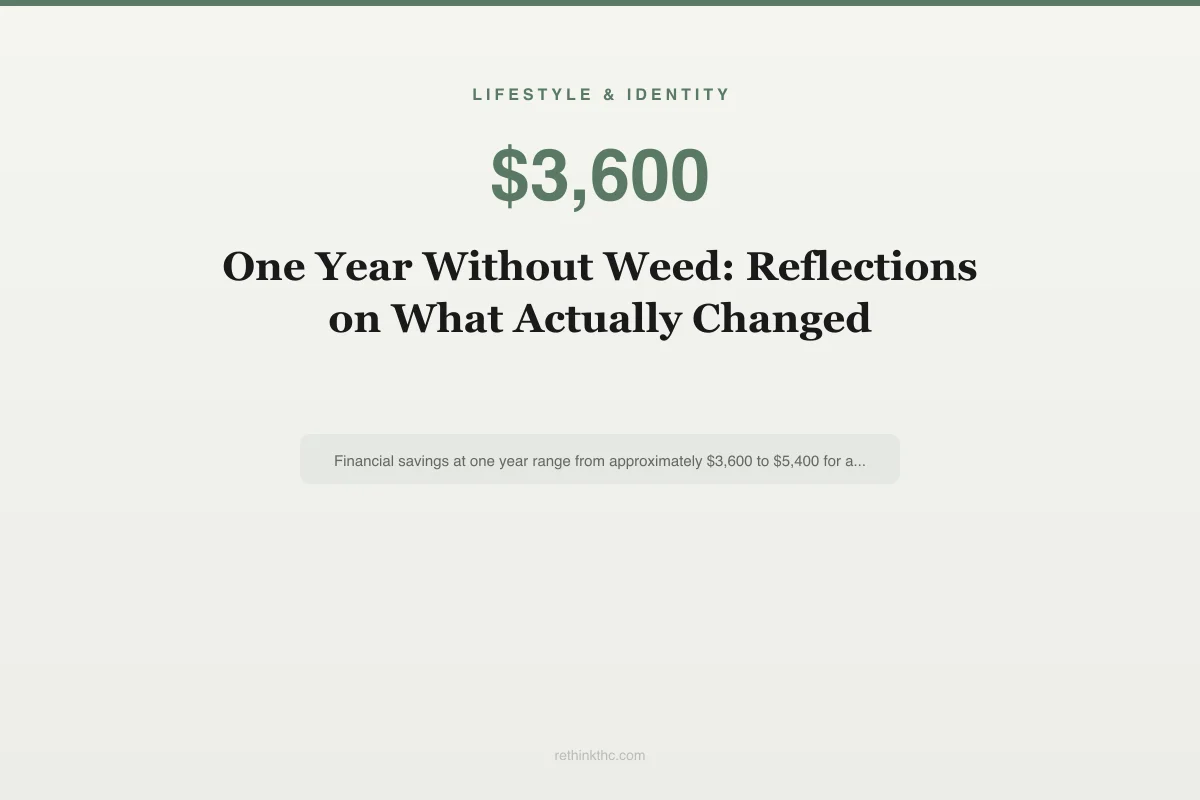
- Financial savings at one year range from roughly $3,600 to $5,400 for a former daily user who was spending $10 to $15 per day
- Some problems you blamed on cannabis are still there at 12 months — and that clarity about what is actually yours to fix is one of the most valuable things sobriety gives you
- A 2018 study in Biological Psychiatry found that chronic cannabis users show blunted emotional processing that reverses with abstinence, and at one year the restored emotional depth is consistently reported as the most underestimated benefit of long-term sobriety
Your Brain at One Year: What the Neuroscience Shows
By twelve months, the neurological recovery story is essentially complete. But understanding what "complete" means requires looking at the specific systems involved.
CB1 Receptors and Endocannabinoid Function
Your CB1 receptors, the sites where THC binds to produce its effects, returned to normal density months ago. A landmark 2012 PET imaging study by Hirvonen and colleagues in Molecular Psychiatry showed that this normalization occurs by approximately day 28 of abstinence.[1] At one year, your endocannabinoid system, the body's built-in cannabis-like signaling network that regulates mood, appetite, pain, and stress, has been running independently for over eleven months.
What this means practically is that every mood you feel, every appetite cue, every stress response is genuinely yours. Your endocannabinoid system is not compensating for the absence of THC anymore. It has fully reclaimed its role. For a deeper look at how this receptor recovery unfolds, the cannabinoid receptor recovery timeline covers the stages in detail.
Dopamine System Restoration
The dopamine recovery process is one of the most important neurological changes, and by 12 months it is long complete. Chronic THC use blunts dopamine signaling in the striatum, the brain region involved in motivation and reward. A 2016 study by Bloomfield and colleagues in Psychopharmacology found that regular cannabis users showed reduced dopamine synthesis capacity compared to non-users.
At one year, your dopamine system has had months of normal function. You are no longer in a recovery phase. Your baseline reward sensitivity is your baseline. This is important because it means the level of motivation and pleasure you feel now is not a temporary dip that will keep improving. It is your actual neurochemistry operating without interference.
Prefrontal Cortex and Cognitive Function
The prefrontal cortex, responsible for planning, impulse control, and complex decision-making, shows the most prolonged recovery timeline in heavy users. A 2018 meta-analysis in JAMA Psychiatry confirmed that cognitive deficits from cannabis use largely reverse with sustained abstinence, with most recovery occurring in the first three months but continued subtle improvements possible for up to a year.
At 12 months, you have the full benefit of whatever cognitive recovery your brain is going to make. Working memory, attention, processing speed, and executive function are at their restored ceiling. For most people, this represents a return to their pre-use baseline. For those who began heavy use during adolescence, some differences may persist, though even these individuals show significant recovery.
What People Overestimate and Underestimate
One Year Sober: What People Get Wrong
The defining shift: From "person who quit weed" → "person who doesn't use weed." Cannabis is simply not part of your life — the same way many things are not part of your life.
One of the most revealing patterns in one-year recovery accounts across Reddit and other cannabis recovery communities is the gap between what people expected and what actually happened.
The Overestimated Benefit: Automatic Motivation
Many people assume that removing cannabis will unlock sustained motivation. The logic makes sense on paper. THC blunts dopamine, dopamine drives motivation, so removing THC should make you naturally driven.
The reality at one year is more nuanced. Your dopamine system is working normally, but normal dopamine function does not mean you feel motivated all the time. It means you have the capacity for motivation when it is activated by meaningful goals, habits, and structure. People who built systems during their recovery, exercise routines, work habits, creative practices, report high motivation at one year. People who expected motivation to appear on its own often feel disappointed.
Cannabis was never the only reason you procrastinated or avoided hard things. It was one factor. Removing it gave you a clearer playing field. It did not hand you a playbook.
The Underestimated Benefit: Emotional Depth
Almost nobody anticipates how different their emotional life will feel at one year. At 90 days, people notice that emotions are more regulated. At six months, the range deepens further. But at one year, something qualitatively different has happened.
You have processed an entire year of life, including seasonal shifts, holidays, anniversaries, stressful periods, and joyful ones, without dampening any of it. People in recovery communities describe this as feeling "fully present" in a way that goes beyond simply being sober. It is the accumulated effect of twelve months of unfiltered emotional experience building on itself.
A 2018 study in Biological Psychiatry found that chronic cannabis users show blunted emotional processing that reverses with abstinence. At one year, that reversal is not new anymore. It is just how you experience life. The depth of connection in relationships, the intensity of creative engagement, and the richness of ordinary moments are benefits that almost nobody predicts but nearly everyone reports.
The Identity Shift: From "Person Who Quit" to "Person Who Doesn't Use"
This is the defining psychological change at the one-year mark, and it deserves its own section because it affects everything else.
In the first weeks and months, your identity is organized around the absence of cannabis. You are a person who is quitting weed. Your daily effort, social navigation, and internal narrative all center on what you are not doing. Even at six months, many people still think of themselves in relation to their former use.
At one year, that frame dissolves for most people. You are no longer defined by what you stopped. Cannabis is simply not part of your life, the way many things are not part of your life. This shift has real psychological consequences. Decisions become simpler because they are not filtered through "will this make me want to smoke." Social situations become easier because your non-use is no longer a statement. It is just a fact.
The identity shift after quitting weed is one of the least discussed but most transformative aspects of long-term recovery. At one year, you have had enough time and enough varied experience to know who you are without cannabis as a variable.
Cravings at One Year: Do They Ever Fully Stop?
The short answer is that most people at one year still experience occasional thoughts about cannabis, but the nature of those thoughts has changed completely.
In early recovery, cravings are physiological. Your body wants THC and sends urgent signals to get it. By 90 days, those physical cravings are gone and what remains are situational triggers. At one year, even situational triggers have largely weakened. What remains are fleeting associations, a smell, a song, a memory from a specific time in your life, that briefly connect to cannabis and then pass.
A 2019 review in Neuroscience and Biobehavioral Reviews found that cue-induced craving can persist well beyond physical withdrawal, but that the intensity and duration of craving episodes decrease significantly with sustained abstinence. At twelve months, most people describe these moments as nostalgic thoughts rather than urges. They carry almost no motivational pull. You notice them the way you might notice a memory of an old relationship. Interesting, sometimes bittersweet, but not compelling.
For a small percentage of people, strong situational cravings still surface at one year. This is more common in those who used cannabis as their primary coping mechanism for anxiety, trauma, or chronic pain. If the underlying condition has not been addressed, the pull toward cannabis can remain significant regardless of time elapsed.
The Uncomfortable Truth: What Cannabis Was Not Responsible For
This is the part of the one-year reflection that nobody puts on their motivational poster.
By twelve months, you have enough distance to see clearly which problems were caused by cannabis and which were merely obscured by it. Relationship patterns that you attributed to being high may still be present. Career stagnation you blamed on lack of motivation may have deeper roots. Anxiety you assumed was cannabis-induced may be an independent condition that cannabis was managing, however imperfectly.
This is not a reason to regret quitting. It is the opposite. Clarity about what your actual challenges are is infinitely more valuable than a hazy assumption that one substance was the source of everything wrong. You can now address these things directly, with professional help if needed, instead of hoping that sobriety alone would fix them.
Many people in recovery communities describe the one-year mark as the point where they stopped giving cannabis credit for their problems and started taking responsibility for the ones that remained. That shift, while uncomfortable, is a form of maturity that could not have happened while using.
Financial Impact at Twelve Months
The numbers at one year are hard to ignore. A daily user spending $10 to $15 per day has saved between $3,600 and $5,400. For heavier users or those in high-cost markets, the figure can exceed $7,000.
But the financial impact goes beyond what you did not spend. Many people at one year report improvements in their earning capacity. Better job performance, clearer thinking in negotiations, and the compound effect of eleven months of improved executive function translate into career advancement that would not have happened otherwise. The financial delta between your cannabis-using self and your current self is almost certainly larger than the savings number alone suggests.
When to Seek Professional Help
If you are at or near the one-year mark and still experiencing significant depression, anxiety, or emotional instability, those symptoms likely reflect something beyond cannabis recovery. A healthcare provider can help determine whether an underlying condition needs its own treatment plan.
SAMHSA's National Helpline is available at 1-800-662-4357. It is free, confidential, and operates 24 hours a day, 7 days a week. Seeking help at one year is not a setback. It is using the clarity you have gained to take the next right step.
What One Year Actually Means
One year without weed is not a victory lap. It is a vantage point. You can see clearly what changed, what did not, and what still needs work. The neurological recovery is real and complete. The benefits of quitting weed that accumulated over twelve months are yours to keep. But the most important thing you have at one year is not a recovered brain or a bigger bank account. It is an honest relationship with your own life, unmediated and unfiltered, with all the discomfort and all the richness that comes with it.
That honesty is worth more than any milestone.
The Bottom Line
At one year without cannabis, all measurable neurological recovery is complete. Hirvonen et al. (2012, Molecular Psychiatry) showed CB1 receptors normalize by day 28; by month 12, the endocannabinoid system has been running independently for 11+ months. Bloomfield et al. (2016, Psychopharmacology) documented reduced dopamine synthesis in regular users — by one year, dopamine function is fully restored but normal dopamine does not mean automatic motivation (requires goals, habits, structure). A 2018 JAMA Psychiatry meta-analysis confirmed cognitive deficits largely reverse with sustained abstinence, with most recovery by month 3 and continued subtle improvements possible up to one year. Most underestimated benefit: emotional depth — a 2018 Biological Psychiatry study found blunted emotional processing in chronic users reverses with abstinence; at 12 months, accumulated unfiltered emotional experience creates qualitatively different depth in relationships and engagement. Most overestimated benefit: automatic motivation — dopamine recovery provides capacity, not guarantee. Identity shift at one year: from "person who quit weed" to "person who does not use weed," reducing cognitive load around decisions and social situations. Cravings at 12 months: a 2019 Neuroscience and Biobehavioral Reviews review found cue-induced craving persists beyond physical withdrawal but intensity decreases significantly with sustained abstinence — at one year, most describe fleeting nostalgic thoughts, not urges. Critical insight: problems still present at 12 months were not caused by cannabis but were obscured by it — this clarity enables direct address of underlying conditions. Financial impact: $3,600-$5,400+ saved (at $10-15/day) plus improved earning capacity.
What happens to your brain after one year without weed?
By one year, all measurable neurological recovery from regular cannabis use is complete. CB1 receptor density normalized months earlier,[1] and downstream systems including dopamine signaling, serotonin balance, and prefrontal cortex function have fully stabilized. Cognitive abilities including memory, focus, and decision-making are at their restored baseline.
Do cravings for weed go away after a year?
For most people, strong cravings are gone well before the one-year mark. What remains at 12 months are occasional fleeting thoughts triggered by specific memories, smells, or situations. These typically feel more like nostalgia than urges and carry very little motivational pull. However, people who used cannabis primarily to manage anxiety, trauma, or chronic pain may still experience more significant cravings if the underlying condition has not been addressed.
How much money do you save after one year of not smoking weed?
A former daily user spending $10 to $15 per day saves approximately $3,600 to $5,400 in direct cannabis costs over one year. Heavier users or those in expensive markets may save $7,000 or more. The total financial impact is often larger when factoring in improved job performance and career advancement resulting from restored cognitive function.
Is it normal to still think about weed after a year sober?
Yes. Occasional thoughts about cannabis at one year are common and do not indicate a problem. The brain forms strong associative memories between cannabis use and specific environments, emotions, and experiences. These associations weaken over time but can surface briefly even years later. The key difference at one year is that these thoughts pass quickly and rarely carry any real desire to use.
Why do I still have problems after one year without weed?
Because not all problems are caused by cannabis use. One of the most valuable realizations at the one-year mark is the ability to distinguish between problems cannabis caused and problems cannabis was masking. Issues like anxiety, relationship patterns, or career dissatisfaction may have deeper roots that require their own attention. This clarity is a benefit of sobriety, not a failure of it.
Should I celebrate the one-year milestone or does that create pressure?
How you mark the milestone depends on what serves you. For some people, acknowledging one year reinforces the significance of the change and provides motivation. For others, treating it as a special event creates the implication that sobriety is an achievement that could be lost rather than simply how they live now. The healthier frame at one year is often the quieter one: noticing the date, reflecting briefly on what changed, and then continuing with your life. The shift from "person celebrating sobriety" to "person for whom cannabis is simply not relevant" is the real milestone, and that happens internally regardless of whether you mark the calendar.
Sources & References
- 1RTHC-00573·Hirvonen, Jussi et al. (2012). “Daily Cannabis Use Was Linked to Fewer CB1 Receptors. A Month Without Brought Them Back..” Molecular Psychiatry.Study breakdown →PubMed →↩