Withdrawal & Recovery
48 Hours
Cannabis withdrawal symptoms peak between days 2 and 6, but your CB1 receptors begin recovering within 48 hours of your last use.
Budney et al., Journal of Abnormal Psychology, 2003
48 hours
Your CB1 receptors — the brain's docking stations for THC —
Before Day 1: Preparation
covered in detail
Day 1: The Quiet Start
covered in detail
Budney et al., Journal of Abnormal Psychology, 2003
 View as image ↗
If you only read one thing
The first week off weed follows a predictable pattern: day 1 feels easier than you'd expect, days 3 through 5 are the roughest stretch (sleep goes sideways, appetite vanishes, and everything feels irritating), and by day 7 the worst has passed. The reason day 4 hits so hard is that your brain's reward chemistry is at its lowest point while you're running on almost no sleep. Having a concrete plan for each day — what you'll eat, when you'll walk, how you'll handle cravings — makes the difference between making it through and not.
The first week without weed is the hardest stretch you will face in this process. That is not speculation. A 2003 controlled-abstinence study by Budney and colleagues published in the Journal of Abnormal Psychology tracked 18 cannabis users through 50 days of abstinence and found that withdrawal symptoms begin within 1 to 3 days, peak between days 2 and 6, and then gradually decline.[1] A 2012 study by Allsop and colleagues published in PLOS ONE confirmed that the most functionally impairing symptoms (trouble sleeping, angry outbursts, cravings, and appetite loss) cluster in this same window.[2]
| Day | Physical | Mental | Key Strategy |
|---|---|---|---|
| Prep | Stock easy foods, set up sleep environment | Tell one person, clear high-stress obligations | Remove all paraphernalia from your space |
| Day 1 | Mild headache, subtle restlessness; residual THC still circulating | Mix of resolve and nervousness; mild evening cravings | Write down your specific reason for quitting |
| Day 2 | Lighter sleep, appetite dips, mild nausea; CB1 recovery begins | Irritability appears; situational cravings surface | 20 minutes of aerobic exercise to boost endocannabinoids |
| Day 3 | Sleep genuinely difficult; REM rebound dreams; appetite drops further; night sweats | Sharp irritability; concentration suffers; symptoms cross clinical threshold | Eat small amounts throughout the day even without hunger |
| Day 4 | Peak window; cumulative fatigue; headaches; temperature swings; stomach issues | Lowest dopamine point; strongest urge to relapse; emotional volatility peaks | Ride cravings in 15-minute blocks with a timer |
| Day 5 | Sleep marginally better; symptoms plateau; physical peak has passed | Dull agitation replaces sharp reactivity; brief windows of normalcy appear | Morning sunlight for 10–15 minutes to reset circadian rhythm |
| Day 6 | Most physical symptoms stopped worsening; night sweats easing | Mood swings less dramatic; cravings become situational rather than constant | Do one activity you used to pair with weed, sober |
| Day 7 | Past clinical peak; sleeping longer; appetite slowly returning | Emotional tone shifts to intermittent difficulty rather than constant | Write down what changed from day 1 — document your progress |
This article is designed to be your companion through those seven days. Bookmark it. Come back each morning. Each day includes what to expect physically, what to expect mentally, and one practical action to take. If you want the broader view of what happens across the full withdrawal arc, the weed withdrawal timeline covers weeks 1 through 6. This guide zooms in on the days that matter most.
Key Takeaways
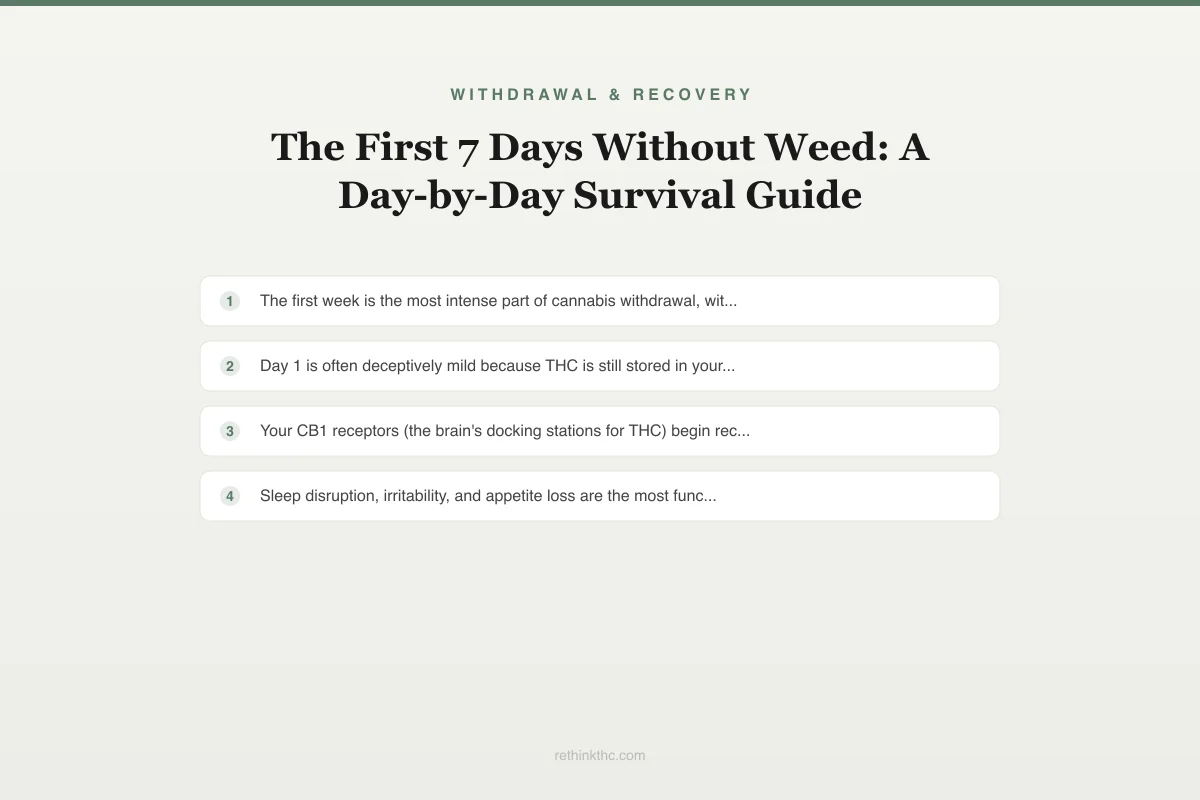
- The first week is the most intense part of cannabis withdrawal — clinical research shows symptoms peak between days 2 and 6
- Day 1 often feels deceptively mild because THC is still stored in your body fat and releasing slowly
- Your CB1 receptors — the brain's docking stations for THC — start recovering within 48 hours of your last use
- Sleep problems, irritability, and appetite loss are the symptoms that hit your daily life hardest during this window
- Having a concrete plan for each day dramatically raises your odds of making it through the week
- Exercise during the first week directly boosts endocannabinoid levels, supporting the exact system THC wore down and giving you natural mood relief when you need it most
Fact Check
'Weed has no real withdrawal' vs. the research
The claim
“Cannabis isn't physically addictive, so there's no actual withdrawal — quitting should feel fine”
Decades of cultural messaging that weed is harmless, reinforced by the fact that day 1 usually does feel mild
What research shows
UnsupportedCannabis withdrawal is a recognized clinical diagnosis in the DSM-5. Controlled studies (Budney 2003, Allsop 2012) show symptoms like trouble sleeping, irritability, appetite loss, and strong cravings peaking between days 2 and 6 — severe enough to impair work and relationships.
It's not dangerous the way alcohol or benzo withdrawal is. But 'not dangerous' isn't the same as 'not real.' Expecting it to feel fine is exactly why people relapse on day 4.
Budney et al. (2003) J. Abnormal Psychology; Allsop et al. (2012) PLOS ONE; APA DSM-5 (2013)
Before Day 1: Preparation
You would not run a marathon without preparing. The same logic applies here. A few hours of setup before your quit date makes the coming week significantly more manageable.
Day-by-Day Symptoms
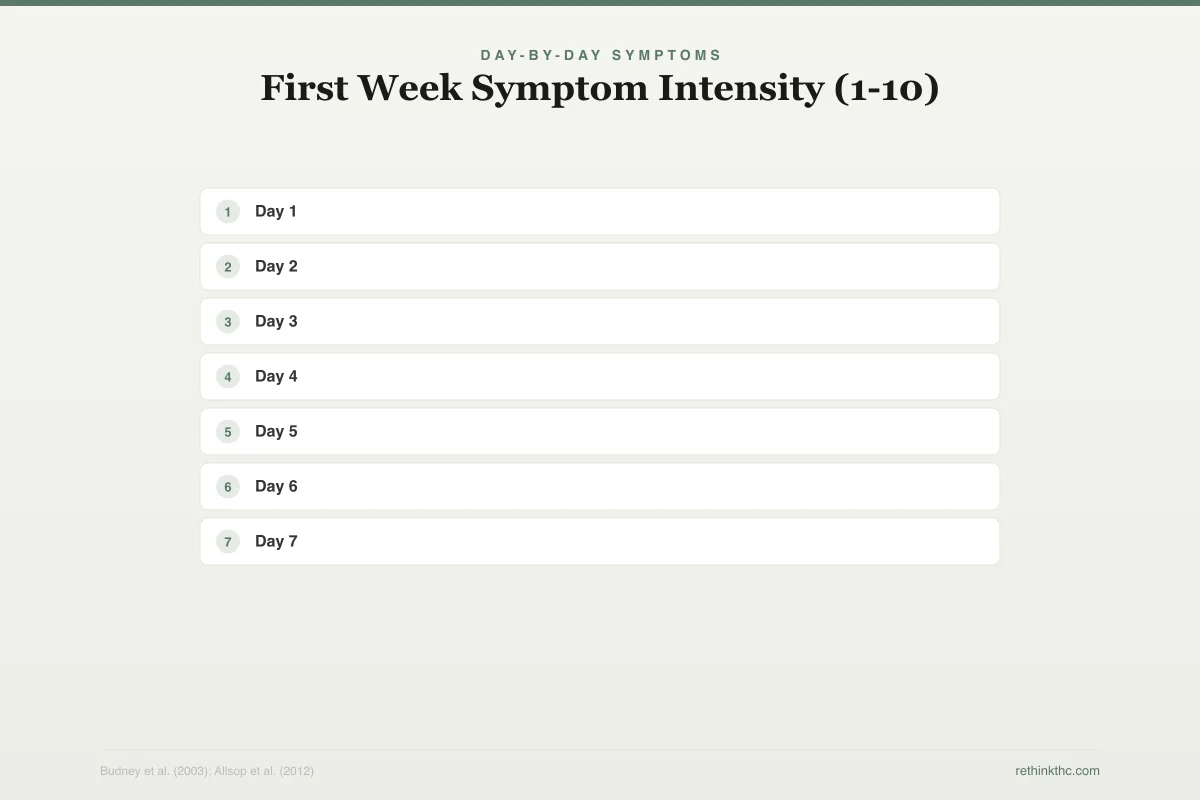
First Week Symptom Intensity (1-10)
Symptoms peak days 3-5, then begin stabilizing. Day 1 is deceptively mild.
Days 3-5 are the hardest window. If you can get through these three days, the trajectory shifts in your favor.
Budney et al. (2003); Allsop et al. (2012)
 View as image ↗
Stock your kitchen. Appetite loss is one of the most common withdrawal symptoms. You will not want to cook. Have easy, ready-to-eat foods on hand: bananas, crackers, yogurt, soup, granola bars. You do not need to eat large meals. You just need to keep some fuel going in.
Set up your sleep environment. Sleep is going to be difficult, possibly for the entire week. Give yourself every advantage. Cool the room down (65 to 68 degrees is ideal). Block light with curtains or a sleep mask. Remove screens from the bedroom, or at least set them to charge across the room so you are not reaching for your phone at 2 AM. For detailed sleep strategies, see how to sleep without weed.
Tell one person. Let someone know what you are doing. This is not about accountability in a punitive sense. It is about having someone who understands if you are irritable, distracted, or withdrawn this week. Even one person who knows makes a difference.
Clear your schedule where possible. If you can avoid high-stress obligations during days 3 through 5, do it. This is not the week to have a difficult conversation with your boss or host a dinner party.
Remove paraphernalia. If weed, pipes, papers, or vape cartridges are within arm's reach, the barrier to relapse during a craving is essentially zero. Move them out of your space entirely. Give them to someone, lock them in a car trunk, or throw them away.
Day 1: The Quiet Start
What to expect physically
Surprisingly little in most cases. You might feel a mild headache or slight restlessness. Some people notice a subtle tension they cannot quite name. Your body still has THC circulating from your last session. Because THC is fat-soluble (it dissolves into and is stored in body fat), it takes time for your system to clear it. On day one, you are still running on residual THC.
What to expect mentally
A mix of resolve and nervousness. You made a decision and the day feels important. You may feel motivated or you may already feel doubt. Both are normal. Some people feel a low-level craving in the evening, especially around the time they would normally use. Others feel nothing notable at all.
Practical tip: Write down your reason
Take two minutes and write down, on paper or in your phone, exactly why you are doing this. Be specific. "I want to think clearly at work." "I want to stop needing something every night." "I want to know who I am without it." You will need this on day 4 when your brain is telling you to give up. Having your own words to read back to yourself is more powerful than any advice from outside.
Day 2: The Shift Begins
What to expect physically
Daily Action Plan
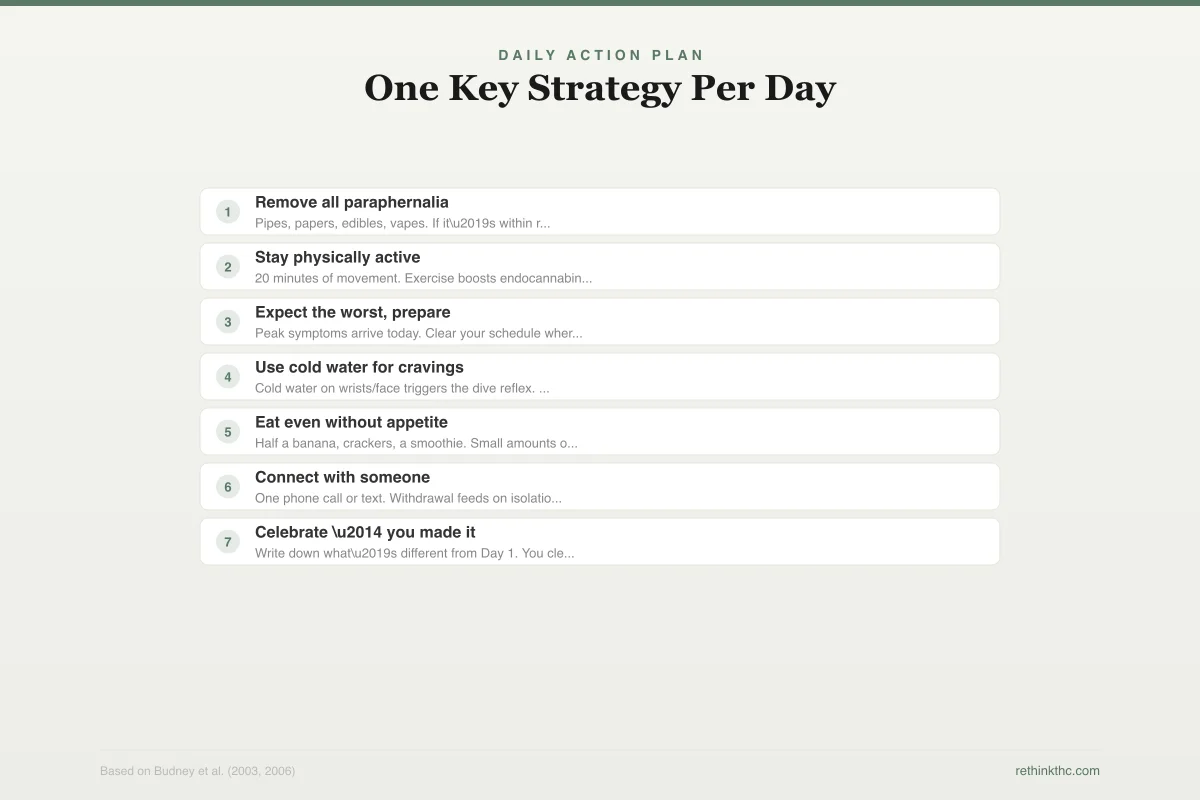
One Key Strategy Per Day
You do not have to do everything. One focused action per day is enough.
Remove all paraphernalia
Pipes, papers, edibles, vapes. If it’s within reach at 2 AM, you’ll use it.
Stay physically active
20 minutes of movement. Exercise boosts endocannabinoids — your brain’s natural THC.
Expect the worst, prepare
Peak symptoms arrive today. Clear your schedule where possible. Lower the bar.
Use cold water for cravings
Cold water on wrists/face triggers the dive reflex. Box breathing (4-4-4-4). Ride 15 min.
Eat even without appetite
Half a banana, crackers, a smoothie. Small amounts of fuel prevent irritability spirals.
Connect with someone
One phone call or text. Withdrawal feeds on isolation. Another voice breaks the loop.
Celebrate — you made it
Write down what’s different from Day 1. You cleared the clinical peak. It gets easier from here.
Based on Budney et al. (2003, 2006)
 View as image ↗
This is when the first real signals appear. Sleep the night before may have been lighter or more fragmented than usual. You might wake up feeling like you did not fully rest. Appetite begins to dip. Food may taste slightly flat or the idea of eating may feel unappealing. Some people get mild stomach discomfort or nausea.
Research by D'Souza and colleagues, published in 2016 in Biological Psychiatry: CNNI, found that CB1 receptor recovery begins within approximately 48 hours of last use.[3] Your brain is already starting to rebuild the receptor sites that THC depleted. That process is what drives the discomfort, but it is also the mechanism of healing.
Budney et al. (2003) · Journal of Abnormal Psychology
- Population
- 18 daily cannabis users tracked through monitored abstinence
- Intervention
- 50 days of observed abstinence with daily symptom tracking
- Comparator
- Each participant's own pre-quit baseline
- Finding
- Withdrawal symptoms (irritability, sleep trouble, appetite loss, cravings) begin days 1–3, peak between days 2 and 6, and fade by day 14
positive The clearest map of when symptoms hit — matches what people report in recovery communities
Budney et al. (2003), Journal of Abnormal Psychology
What to expect mentally
Irritability appears for many people on day 2. It is subtle at first. You might find yourself annoyed by things that normally would not bother you, a slow driver, a loud coworker, a minor inconvenience that suddenly feels intolerable. Cravings may surface, especially in situations or environments you associate with using.
Practical tip: Move your body for 20 minutes
Go for a walk, ride a bike, do bodyweight exercises, or clean your house with energy. Raichlen and colleagues published a 2012 study in the Journal of Experimental Biology[4] demonstrating that aerobic exercise directly increases endocannabinoid levels (the natural chemicals your brain makes that are similar to THC). You are essentially giving your endocannabinoid system a boost at the exact moment it needs one.
Day 3: Into the Peak
What to expect physically
Sleep is now genuinely difficult. Falling asleep takes longer, you wake in the middle of the night, and the sleep you get feels thin. Your first vivid dream may show up tonight or tomorrow night. This is called REM rebound, your brain flooding you with the dreaming sleep it was deprived of while THC suppressed it. Appetite continues to drop. Some people lose interest in food almost entirely. Night sweats may begin.
What to expect mentally
Irritability sharpens. It moves from "annoyed" to "reactive." You might snap at someone and immediately feel guilty about it. Cravings intensify. Budney's 2003 data showed that most marijuana withdrawal symptoms reach clinical significance between days 2 and 3[1], meaning they cross the threshold from mildly bothersome to genuinely disruptive.
Concentration begins to suffer. Reading feels harder. Conversations feel harder to track. This is your prefrontal cortex (the brain region responsible for focus and executive function) adjusting to the absence of THC.
Practical tip: Eat something, even if you do not want to
Your appetite signals are offline, but your body still needs fuel. Skipping meals entirely will make irritability, headaches, and concentration worse. Do not force a full plate. Eat half a banana. Have a few crackers with peanut butter. Sip a smoothie. Aim for small amounts of calories throughout the day rather than trying to sit down for a full meal.
Day 4: The Hardest Day for Many People
What to expect physically
Craving Science
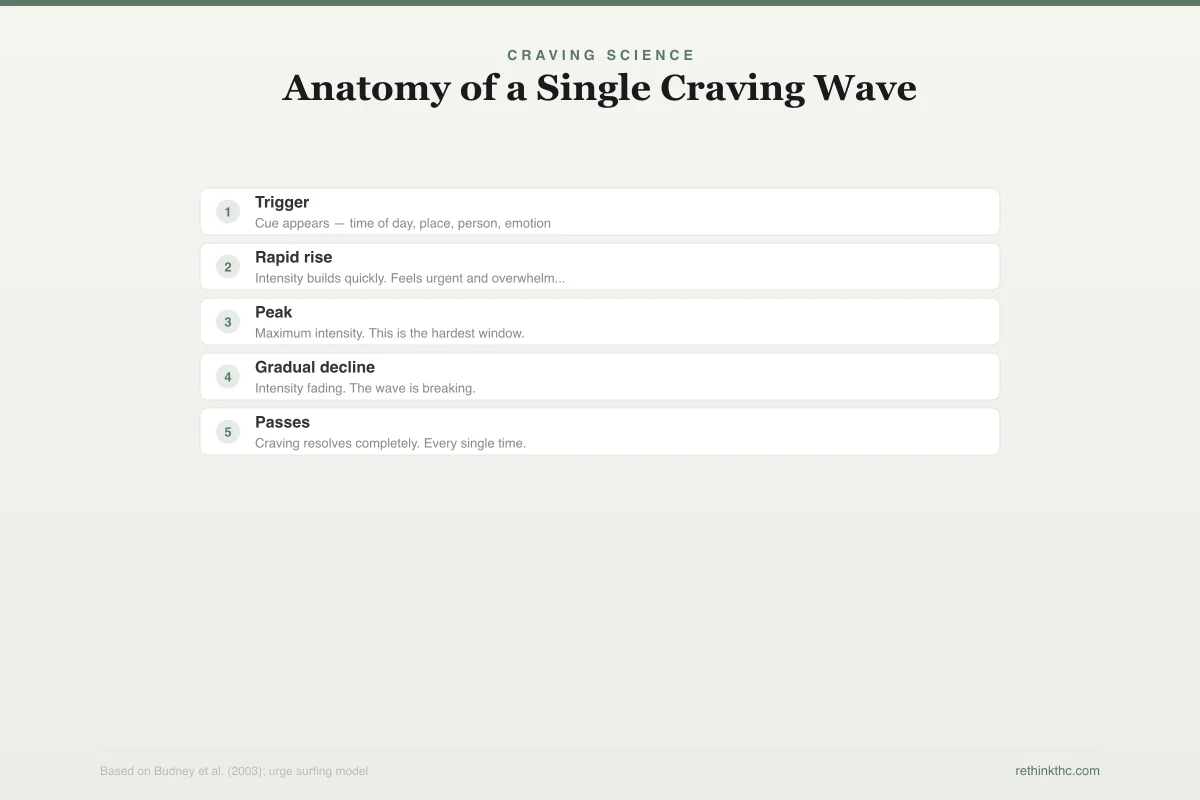
Anatomy of a Single Craving Wave
Every craving follows this pattern. They always pass. Always.
Cue appears — time of day, place, person, emotion
Intensity builds quickly. Feels urgent and overwhelming.
Maximum intensity. This is the hardest window.
Intensity fading. The wave is breaking.
Craving resolves completely. Every single time.
“Surf the urge.” You do not have to resist forever. You only have to get through 15 minutes. Set a timer. The wave will pass.
Based on Budney et al. (2003); urge surfing model
 View as image ↗
You are in the peak window. Sleep deprivation is compounding everything else. If you slept poorly on nights 2 and 3, day 4 arrives with a cumulative fatigue that colors everything. Headaches are common. Your body temperature regulation may feel off, with alternating chills and sweats. Stomach issues (cramping, loose stool, nausea) can intensify.
What to expect mentally
Day 4 is often when people describe wanting to give up the most. Your brain's dopamine levels are at their lowest point during this window. THC artificially elevated dopamine every time you used. Without it, your reward system is running below your natural baseline. Nothing feels interesting, nothing feels rewarding, and the one thing your brain knows will fix it immediately is the thing you are trying to quit.
This is also the day that emotional volatility peaks for many people. Sudden sadness, anxiety that comes out of nowhere, or a sense of flatness and emptiness are all within the normal range. These are not reflections of your actual emotional state. They are the output of a neurochemical system that is temporarily out of balance.
Practical tip: Ride cravings in 15-minute blocks
Cravings peak and fade in roughly 15 to 20 minutes. You do not have to resist forever. You just have to get through the next 15 minutes. Set a timer. Do something with your hands (dishes, a puzzle, a walk around the block). When the timer goes off, check in. The craving will have diminished. If it returns later, repeat the process. Each individual craving is temporary, even when cravings are frequent.
Day 5: Still Hard, But Something Subtle Shifts
What to expect physically
Sleep may be marginally better than nights 3 and 4, though it is still well below normal. Vivid dreams are likely in full effect now. Some people find them fascinating, others find them distressing. Appetite is still low but may begin showing the faintest signs of return, like a fleeting moment of hunger before it disappears again. Physical symptoms like headaches and nausea tend to plateau around this point rather than continuing to intensify.
What to expect mentally
Irritability is still elevated but for many people it has shifted from the sharp, reactive quality of days 3 and 4 to something more like a persistent, dull agitation. Cravings are still present but may feel slightly less urgent. You might notice a brief moment, maybe 30 minutes, maybe an hour, where you feel almost normal. These windows are meaningful. They are evidence that your brain is making progress.
Practical tip: Get outside in morning sunlight
Your circadian rhythm (your body's internal clock that governs sleep and wake cycles) is disrupted during withdrawal. Morning sunlight exposure is one of the most effective ways to reset it. Within 30 minutes of waking, spend 10 to 15 minutes outside in natural light. No sunglasses. This signals your brain to suppress melatonin production and start the sleep-wake timer that will help you feel appropriately tired at night. It is a small action with disproportionate impact on sleep quality over the coming days.
Day 6: The Plateau
What to expect physically
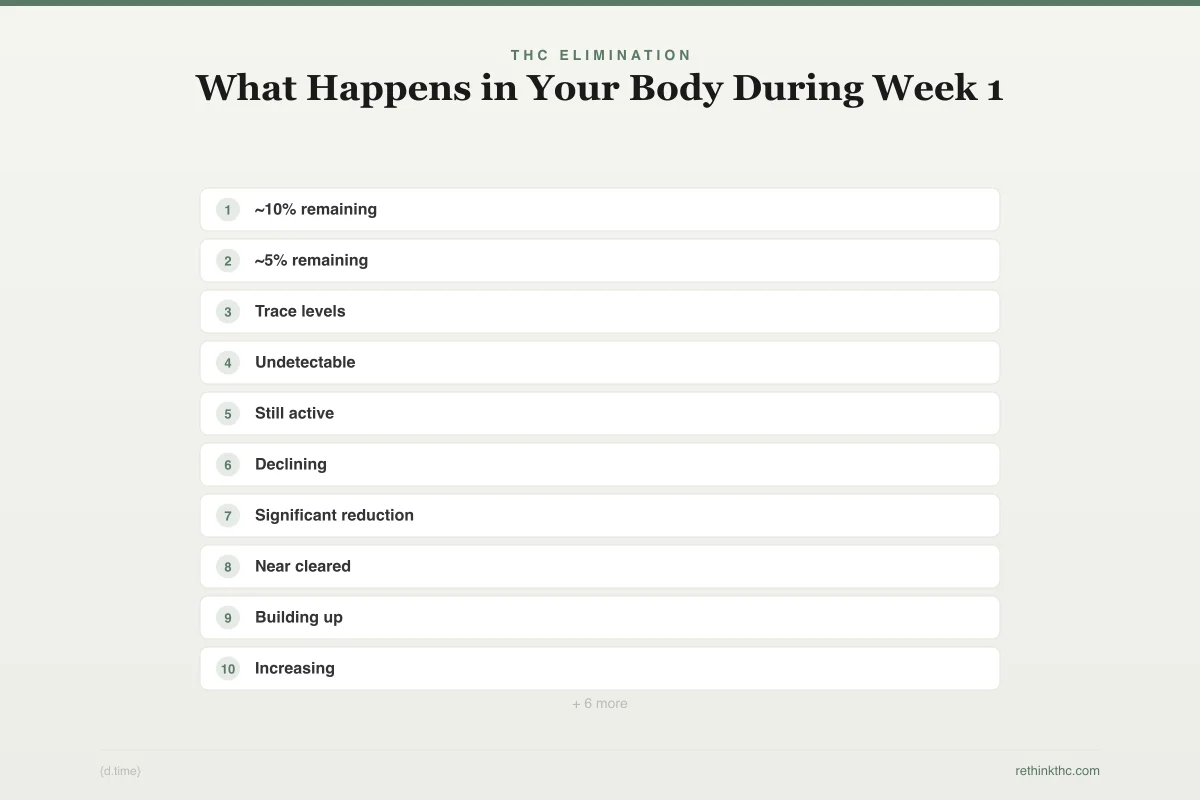
THC Elimination
What Happens in Your Body During Week 1
Four parallel processes happening simultaneously as THC leaves your system.
6 hrs
Day 1
Day 3
Day 7
Drops 90% within 6 hours of last use
6 hrs
Day 1
Day 3
Day 7
Fat-soluble — clears brain more slowly than blood
6 hrs
Day 1
Day 3-5
Day 7
Stored in fat, slowly released — peak metabolite excretion days 3-5
6 hrs
Day 2
Day 4
Day 7
Begin upregulation by day 2 — ~15% recovery by day 7
The discomfort you feel is your biology working. Every uncomfortable day is a day your receptors are rebuilding and your brain is recalibrating.
D'Souza et al. (2016); Hirvonen et al. (2012)
 View as image ↗
Most physical symptoms have stopped getting worse. That does not mean they are gone. Sleep is still disrupted. Appetite is still below normal. But the trajectory has changed. Days 2 through 5 felt like a continuous decline. Day 6 feels like a plateau, like the worst has happened and now you are holding steady before improvement begins.
Night sweats, if you experienced them, may begin easing. Stomach issues are typically less intense. You might notice you are slightly less tired today than yesterday, not rested exactly, but less depleted.
What to expect mentally
The emotional volatility of the peak days is beginning to settle. You may still have mood swings, but they are less dramatic and recover faster. A wave of irritability hits but passes in 20 minutes instead of coloring the entire afternoon. Concentration is still impaired but you may find it easier to complete a task that would have felt impossible on day 3.
Cravings may now be more situational than constant. They show up at specific times (evening, after a meal, when you see someone else using) rather than as a persistent background hum.
Practical tip: Do one thing that used to require weed
Think of an activity you typically paired with cannabis: watching a movie, playing a video game, listening to music, going for a hike. Do that activity sober. It may feel slightly flat. That is okay. You are retraining your brain's association between that activity and pleasure. Each time you do something you used to pair with weed and find even partial enjoyment without it, you are building a neural pathway that did not exist before.
Day 7: You Made It Through the Worst
What to expect physically
You have cleared the clinical peak window. Allsop's 2012 data confirmed that the most intense period of functional impairment falls between days 3 and 6.[2] Day 7 marks the beginning of a new phase. Sleep is still not great, but most people report sleeping longer and waking less often than during the peak. Appetite is slowly returning. You might experience genuine hunger for the first time all week, even if it is brief.
Your CB1 receptors have been actively recovering for about five days now. The biological gap between what your brain expects and what it is receiving has narrowed significantly since day 2.
What to expect mentally
There is a noticeable shift in emotional tone for most people around day 7. The constant, grinding discomfort of the peak days gives way to something more intermittent. You still have difficult stretches, but they are separated by longer periods of relative calm. The sense that you are capable of doing this, that the process is working, becomes tangible in a way it was not during the peak.
Cravings continue but their character has changed. They feel more like a thought ("I would normally smoke right now") and less like a physical need pulling you toward use.
Practical tip: Write down what you notice
Compare today to day 1. Write down what is different. What is better, even marginally. What surprised you. What was harder than expected. This record serves two purposes: it gives you evidence of progress that you can reference if week 2 has a hard day, and it helps you understand your own patterns. Knowing your personal withdrawal profile makes future decisions about cannabis clearer and more informed.
What Comes After Day 7
The acute peak is behind you. That does not mean everything is immediately easy, but the trajectory from here is improvement. Here is what the research shows for the weeks ahead.
Week 2: Irritability continues to fade. Cravings become less frequent. Sleep gradually improves. You start having "windows" of normalcy that last hours instead of minutes. Appetite approaches normal. Some people experience a pink cloud phase during this time, a wave of euphoria and confidence that feels great but can set unrealistic expectations. The full cannabis withdrawal process is well underway.
Week 3: Most psychological symptoms have eased significantly. Mood is more stable. Concentration is sharper. Sleep is better, though vivid dreams may persist. You may notice cognitive improvements that surprise you, like remembering details more easily or processing conversations faster.
Week 4: CB1 receptors reach approximately normal density around day 28 based on neuroimaging data. For many people, this marks the end of acute withdrawal. Sleep continues to improve, though it can take up to 45 days for sleep architecture to fully normalize.
The first week was the steepest climb. Everything from here gets gradually easier. If you want a detailed roadmap for what to expect during weeks 2 through 6, the weed withdrawal timeline covers each phase. And for a comprehensive plan for the entire quitting process, see the how to quit weed guide.
Evidence Review
Where the evidence stands
Cell & Lab Studies
CB1 receptor downregulation and recovery well characterized
Animal Studies
Rodent models of THC cessation show matching symptom arcs
Case Reports
Widely reported clinical observations in treatment settings
Small Human Trials
Budney 2003 and D'Souza 2016 directly tracked withdrawal in monitored abstinence
Large Randomized Trial
Allsop 2012 PLOS ONE studied 49 users with a validated withdrawal scale
Meta-Analysis
Systematic reviews confirm the day-2-to-6 peak across populations
Cannabis withdrawal is one of the best-characterized aspects of cannabis research. The day-by-day timeline in this guide isn't a guess — it's drawn from controlled abstinence studies, imaging research, and meta-analyses that all point to the same arc.
Budney et al. 2003; Allsop et al. 2012; D'Souza et al. 2016; aggregate cannabis withdrawal literature
When to Seek Professional Help
The symptoms described in this guide, while uncomfortable, are temporary and not medically dangerous for most people. However, there are situations where professional support is warranted.
Seek help if your symptoms are severe enough to prevent you from functioning at work, at home, or in basic self-care. Seek help if you are experiencing panic attacks that are worsening rather than improving by the end of week 1. Seek help if you have thoughts of self-harm or feel unable to keep yourself safe.
SAMHSA's National Helpline is available at 1-800-662-4357. It is free, confidential, and available 24 hours a day, 7 days a week. You can also text "HELLO" to 741741 to reach the Crisis Text Line.
Safety
ModerateWhen first-week symptoms cross into the 'get help' zone
Concern
Cannabis withdrawal is uncomfortable but rarely dangerous for most people. However, severe psychological symptoms — panic attacks that worsen through the week, sustained thoughts of self-harm, or an inability to keep food down for more than 48 hours — are signals that this shouldn't be white-knuckled alone.
What the research says
These outcomes are uncommon but possible, especially in heavy long-term users, people with a prior anxiety or mood disorder, or those quitting alongside other substances.
Particularly relevant for: Anyone whose symptoms are preventing basic functioning by day 5
What to do
Call SAMHSA at 1-800-662-4357 (free, 24/7) or text HELLO to 741741. If you have thoughts of self-harm, treat it as urgent — withdrawal thoughts feel convincing but are temporary neurochemistry, not conclusions.
SAMHSA National Helpline guidance; DSM-5 cannabis withdrawal criteria
There is no weakness in asking for support. The goal is to get through this, and using every available resource is a rational strategy. If you need motivation to keep going, real quitting weed success stories from people who survived this exact week can remind you that the other side exists.
The Bottom Line
The first week of quitting weed is the most intense phase of cannabis withdrawal, with symptoms peaking between days 2 and 6 before gradually declining. Day 1 is often deceptively mild because residual THC stored in body fat continues circulating. By day 2, CB1 receptors begin recovering, but dopamine drops below baseline, producing irritability, sleep disruption, appetite loss, and intense cravings that peak around days 3 to 4. Day 4 is frequently reported as the hardest single day, when cumulative sleep deprivation compounds the neurochemical low point. By days 5 to 6, symptoms plateau rather than worsening, and brief windows of normalcy appear. Day 7 marks the end of the clinical peak, with most symptoms beginning a sustained decline. Preparation before day 1, structured daily strategies, and understanding that each craving peaks and fades within 15 to 20 minutes are the most effective tools for surviving this window.
What is the hardest day when quitting weed?
Research by Budney et al. (2003) found that cannabis withdrawal symptoms peak between days 2 and 6. Many people report day 3 or day 4 as the single hardest day, when irritability, cravings, and sleep disruption converge with cumulative sleep deprivation. However, individual experiences vary based on usage history, potency, and personal biology. The key takeaway is that the hardest point falls within the first week, not after it.
How much sleep will I lose in the first week of quitting weed?
Sleep disruption varies, but clinical research consistently identifies it as one of the most impairing withdrawal symptoms. Some people lose 2 to 3 hours per night during the peak days (3 through 6). Others experience fragmented sleep where they wake multiple times rather than losing total hours. A 2017 review by Babson and colleagues in Current Psychiatry Reports confirmed that THC decreases the time it takes to fall asleep in the short term but impairs natural sleep architecture with long-term use, meaning withdrawal involves rebuilding normal sleep patterns from scratch.
Will I be able to work during the first week of quitting weed?
Most people can work during the first week, though performance and comfort are reduced. Concentration is impaired, irritability is elevated, and fatigue from poor sleep affects everything. If possible, avoid scheduling high-stakes presentations, difficult meetings, or tasks requiring sustained deep focus during days 3 through 5. Routine work is manageable for most people, even if it feels harder than usual.
Should I use sleep aids during the first week?
Over-the-counter options like melatonin (0.5 to 1 mg, 30 minutes before bed) may help mildly but are not a complete solution for withdrawal-related insomnia. Avoid prescription sleep medications or alcohol as substitutes. The sleep disruption is driven by neurological recalibration, not simply by difficulty relaxing. Good sleep hygiene (consistent schedule, cool dark room, no screens before bed) has the strongest evidence base. See our guide on how to sleep without weed for detailed strategies.
Is it normal to feel emotional during the first week without weed?
Yes. THC dampens your brain's emotional processing centers, particularly the amygdala. When you stop using, emotions run hotter than your actual baseline because those systems are overcorrecting before they stabilize. Sudden sadness, unexpected anxiety, irritability that feels disproportionate to the situation, and a general sense of emotional rawness are all within the expected range. These emotional symptoms typically improve significantly by the end of week 2.
Does exercising during the first week actually make a difference?
Yes, and it is one of the most impactful things you can do during the hardest days. Research by Raichlen et al. (2012) showed that aerobic exercise directly increases endocannabinoid levels, which supports the exact receptor system that THC depleted. Even a 20-minute brisk walk produces measurable changes. Exercise also raises dopamine, improves sleep quality, and reduces the inflammatory markers associated with low mood. The challenge is that your depleted reward system makes starting feel pointless, but the neurochemical benefits occur regardless of whether the exercise feels enjoyable in the moment.
Sources & References
- 1RTHC-00134·Budney, Alan J. et al. (2003). “When Heavy Users Quit Cannabis, Symptoms Show Up Fast and Ease Within Two Weeks.” Journal of Abnormal Psychology.Study breakdown →PubMed →↩
- 2RTHC-00538·Allsop, David J. et al. (2012). “Withdrawal That Disrupted Daily Life Was Tied to Relapse in a Small Study.” PLOS ONE.Study breakdown →PubMed →↩
- 3RTHC-01134·D'Souza, Deepak Cyril et al. (2016). “Brain Cannabinoid Receptors Drop With Heavy Use, Then Rebound Within Days of Stopping.” Biological Psychiatry: Cognitive Neuroscience and Neuroimaging.Study breakdown →PubMed →↩
- 4RTHC-00608·Raichlen, David A. et al. (2012). “Runner's High Has an Endocannabinoid Signature in Humans. Dogs Show It Too..” Journal of Experimental Biology.Study breakdown →PubMed →↩