Withdrawal & Recovery
Days 3-10
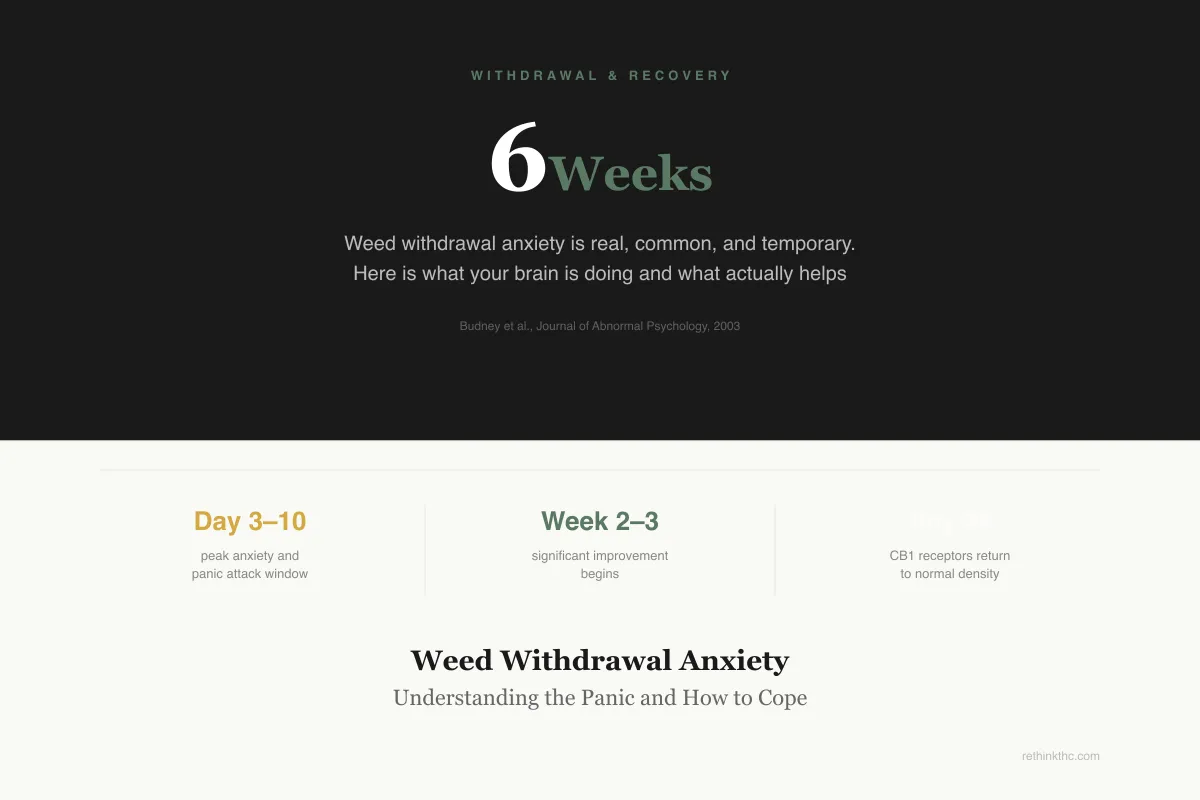
Weed withdrawal anxiety peaks between days 3 and 10, then steadily fades as CB1 receptors recover. Most people see real improvement by weeks 2 to 3.
Budney et al., Journal of Abnormal Psychology, 2003
Day 3–10
peak anxiety and panic attack window
Week 2–3
significant improvement begins
Day 28
CB1 receptors return to normal density
Budney et al., Journal of Abnormal Psychology, 2003
 View as image ↗
If you only read one thing
The anxiety you're feeling right now is your brain's alarm system running without its chemical mute button. THC was keeping your amygdala quiet and boosting your brain's calming chemicals (GABA). Without it, your threat detection is on high alert and your calming system is temporarily weakened. This peaks between days 3 and 10, then drops steadily. Most people feel significantly better by week 2 to 3. The racing heart, tight chest, and shortness of breath are not dangerous — they're your nervous system recalibrating. Slow breathing (long exhale) is the fastest way to tell your body to stand down. This passes.
If you are reading this at 3 AM with your heart pounding and your chest tight, wondering if something is seriously wrong with you, take a breath. What you are feeling is one of the most common symptoms of cannabis withdrawal. It is real, it has a clear biological cause, and it is temporary. You are not losing your mind. Your brain is recalibrating.
This article is going to explain exactly why this is happening, when it peaks, when it fades, and what you can do right now to get through it. For a broader look at the complicated relationship between cannabis and anxiety, including why weed can both cause and temporarily relieve it, see weed and anxiety: the paradox that traps people.
Key Takeaways
- Weed withdrawal anxiety is one of the most common symptoms — it hits the majority of frequent users who quit
- THC was keeping your anxiety quiet by dampening your amygdala and boosting GABA, so removing it creates a temporary rebound
- A racing heart, tight chest, and shortness of breath are your nervous system recalibrating — not a medical emergency
- Anxiety usually peaks between days 3 and 10, with real improvement by weeks 2 to 3
- Breathing techniques work because they directly activate the vagus nerve, which tells your nervous system to calm down
- If anxiety keeps going past 6 weeks with no improvement, it may point to a pre-existing condition that cannabis was masking
Why Weed Was Keeping Your Anxiety Quiet
To understand why you feel so anxious now, you need to understand what THC was doing to your anxiety system while you were using.
Your brain has a structure called the amygdala. It is your threat detection center, the part that decides whether something is dangerous and triggers the fear response. In people who use cannabis regularly, THC dampens amygdala activity. It turns down the volume on your internal alarm system. A 2009 review by Crippa and colleagues published in Human Psychopharmacology confirmed that cannabinoids modulate amygdala reactivity,[1] essentially lowering the brain's sensitivity to perceived threats. Human neuroimaging has since confirmed this directly: THC's anxiety-inducing effects are mediated through CB1 receptor density in the amygdala, meaning the more CB1 receptors are disrupted, the stronger the anxiety response.[3]
THC also boosts GABA, your brain's primary inhibitory neurotransmitter. GABA is the chemical that tells your neurons to slow down and calm down. It is the same system targeted by anti-anxiety medications like benzodiazepines. When THC increases GABA activity, you feel calmer, less reactive, less on edge. That is not a metaphor. It is a measurable chemical shift.
At the same time, THC suppresses glutamate, which is the brain's primary excitatory neurotransmitter. Glutamate is the accelerator. GABA is the brake. When you use cannabis regularly, you are pressing the brake harder and easing off the accelerator at the same time. The result is a brain that is consistently dampened, soothed, and less reactive to stress.
The problem is that your brain adapts. It notices the extra GABA and the suppressed glutamate and adjusts its own production to compensate. It reduces GABA sensitivity and upregulates glutamate receptors, essentially preparing for the extra THC that keeps showing up. This adaptation is called neuroadaptation, and it is the same process that drives cannabis withdrawal across all symptoms. Preclinical research has confirmed that medications targeting GABA and glutamate systems (pregabalin and topiramate) can reduce anxiety during cannabis withdrawal, validating that the GABA/glutamate imbalance is central to the mechanism.[4]
The Rebound: What Happens When You Remove the THC
The diagram below shows the cascade that fires when THC is suddenly absent — from GABA collapse to amygdala hyperactivation to the cortisol spike that makes everything feel urgent.
Neuroscience
The GABA–Glutamate Seesaw
Why removing THC flips the balance from calm to panic
During Regular Use — THC pressing the brake
Amygdala
Dampened
Threat signals muted
GABA (Brake)
Boosted
Calming system enhanced
Glutamate (Gas)
Suppressed
Excitation held down
= Artificial calm
During Withdrawal — brake removed, gas stuck on
Amygdala
Hyperactive
Everything feels threatening
GABA (Brake)
Depleted
Reduced receptor sensitivity
Glutamate (Gas)
Upregulated
Excitatory system unleashed
= Rebound anxiety / panic
Recovery Timeline
Days 1–3
Onset
Days 3–10
Peak anxiety
Days 10–21
Improving
Week 3+
Resolving
Colizzi & Bhattacharyya (2020), Budney et al. (2003)
View as image ↗When you stop using, the artificial brake is gone. But your brain has not readjusted yet. It is still producing less GABA responsiveness and more glutamate sensitivity than it would naturally. The result is a nervous system that is temporarily tilted toward excitation and away from calm.
This is why withdrawal anxiety does not feel like normal nervousness. It feels disproportionate. You might feel intense dread about nothing specific. You might feel like something terrible is about to happen even though you cannot identify what. Your body might respond as if you are in danger when you are sitting safely on your couch. That is the GABA/glutamate imbalance expressing itself.
On top of this, your cortisol levels are elevated. Cortisol is your primary stress hormone. Research using CB1 receptor antagonists (chemicals that block the same receptors THC activates) has confirmed that disrupting cannabinoid signaling directly elevates cortisol output in cannabis-dependent individuals.[5] Your body is running a stress response at a higher baseline than normal, which means it takes less to tip you into anxiety or panic.
And your amygdala, which THC had been keeping quiet, is now running at full sensitivity. Every noise, every uncertainty, every thought your brain would normally label as "not a threat" is being flagged for review. This is not your personality. This is your threat detection system overcorrecting after months or years of being chemically suppressed.
The Physical Symptoms That Make It Worse
Here is something that catches a lot of people off guard: weed withdrawal anxiety does not just live in your head. It produces physical symptoms that are intense enough to make you think something is medically wrong.
| Physical Symptom | What It Feels Like | Why It Happens |
|---|---|---|
| Racing heart | Palpitations, pounding chest, heart rate spikes | Sympathetic nervous system overactive without THC suppression |
| Tight chest / shortness of breath | Cannot get a full breath, pressure in ribcage | Anxiety-driven muscle tension + shallow rapid breathing feedback loop |
| Stomach churning / nausea | Nausea, cramping, stomach dropping sensation | Gut CB1 receptors recalibrating + vagus nerve anxiety response |
| Tingling / dizziness | Numbness in hands/face, lightheadedness | Hyperventilation blows off CO2, changing blood pH |
| Trembling / shakiness | Hands shaking, internal vibration feeling | Excess adrenaline from overactive fight-or-flight system |
| Hot flashes / sweating | Sudden warmth, sweaty palms, night sweats | Autonomic nervous system temperature dysregulation |
These symptoms are alarming, but they are not dangerous. They are the predictable output of a nervous system that has lost its chemical dampener and has not yet recalibrated. If you have any doubt, see a doctor to rule out other causes. But know that this symptom profile is textbook withdrawal anxiety.
Panic Attacks During Withdrawal
If you have had a full-blown panic attack during withdrawal, you are far from alone. Panic attacks are one of the most commonly reported experiences in the first two weeks of quitting, and they are among the most frightening.
A panic attack is what happens when your already-overactive anxiety system crosses a threshold and your brain interprets the anxiety itself as a threat. Your heart races, which makes you more anxious, which makes your heart race faster, which makes you more anxious. It is a feedback loop that escalates rapidly to a peak of terror.
Budney and colleagues documented anxiety escalation, including panic-level responses, as a core feature of cannabis withdrawal in their 2003 study published in the Journal of Abnormal Psychology.[2] A comprehensive review of cannabis withdrawal syndrome confirmed that anxiety is among the most clinically significant symptoms, with severity varying by gender and usage patterns.[6]
Panic attacks during withdrawal are not dangerous. They feel like you are dying, but you are not. They peak within about 10 minutes and resolve within 20 to 30 minutes. They cannot hurt you. Knowing this in advance is one of the most effective tools for getting through them, because the fear of the panic attack itself is often what sustains it.
The Timeline: When Does the Anxiety Peak and Fade
This is probably what you most want to know. Here is what the research and clinical experience consistently show.
| Phase | Timeframe | Anxiety Level | What to Expect |
|---|---|---|---|
| Onset | Days 1–3 | Mild to moderate | General unease, restlessness, feeling wired |
| Peak | Days 3–10 | Severe | Most intense anxiety, panic attacks most likely, strongest physical symptoms |
| Improvement | Days 10–21 | Moderate, decreasing | Shifts from constant to intermittent; stretches of normalcy appear |
| Resolution | Beyond week 3 | Mild to none | Acute withdrawal anxiety largely resolved; occasional situational anxiety |
Days 1 to 3: Anxiety often appears within the first 24 hours. It may be mild at first, more like a general unease or restlessness. Some people feel wired, like they have had too much caffeine.
Days 3 to 10: This is the peak window. Anxiety is at its most intense, panic attacks are most likely during this phase, and physical symptoms are strongest. If you are in this window right now, you are at the hardest part. It does not stay here.
Days 10 to 21: Significant improvement for most people. The anxiety shifts from constant to intermittent. You start having stretches of hours, then entire days, where you feel closer to normal. The physical symptoms (racing heart, chest tightness) diminish noticeably.
Beyond week 3: Acute withdrawal anxiety has largely resolved for most people. If some anxiety persists, it is milder and more manageable. The full withdrawal timeline covers how all symptoms progress.
This timeline aligns with the broader neurological recovery process. Your CB1 receptors, which THC depleted, begin recovering within 48 hours and reach normal levels by approximately day 28.[7] As they come back online, your GABA/glutamate balance normalizes, your cortisol regulation stabilizes, and your amygdala calms down to its actual baseline.
Timeline
When the Anxiety Peaks — and When It Actually Fades
Typical anxiety intensity curve during cannabis withdrawal
If you're in days 3–10 right now: You are at the hardest part. It does not stay here. The anxiety curve drops sharply after day 10 and most people feel significantly better by week 3.
Sources: Budney et al. (2003), J Abnorm Psych; Hirvonen et al. (2012), Molecular Psychiatry
 View as image ↗
Evidence Review
Where the evidence stands
Clinical Observations
Decades of clinical reports documenting anxiety as a primary withdrawal complaint
Controlled Studies
Budney 2003 mapped anxiety onset days 1-3, peak days 2-6 in monitored abstinence
Neuroimaging & Mechanism Studies
Crippa 2009 confirmed cannabinoid modulation of amygdala; Hirvonen 2012 showed CB1 recovery at ~28 days
Pharmacological Validation
GABA/glutamate-targeting medications reduce withdrawal anxiety, confirming the mechanism
Withdrawal anxiety has strong evidence at every level — from clinical observation through brain imaging to pharmacological proof of mechanism. This is not speculative. The GABA/glutamate imbalance, amygdala hyperactivation, and CB1 receptor recovery timeline are well-documented.
Crippa 2009, Budney 2003, Hirvonen 2012, Aracil-Fernandez 2013
Coping Strategies That Actually Work Right Now
These are not generic wellness tips. Each of these directly addresses the specific neurological mechanisms behind withdrawal anxiety.
Breathing Techniques: 4-7-8 and Box Breathing
Controlled breathing works for withdrawal anxiety because of the vagus nerve. The vagus nerve runs from your brainstem to your gut and controls your parasympathetic nervous system, the "rest and digest" branch that opposes the "fight or flight" response. Slow, controlled exhalation directly stimulates the vagus nerve, which tells your nervous system to stand down.
4-7-8 breathing: Inhale through your nose for 4 seconds. Hold for 7 seconds. Exhale slowly through your mouth for 8 seconds. Repeat four times. The extended exhale is the key. It is the exhale, not the inhale, that activates the vagus nerve.
Box breathing: Inhale for 4 seconds. Hold for 4 seconds. Exhale for 4 seconds. Hold for 4 seconds. Repeat. This method is used by military personnel and first responders to manage acute stress responses.
These are not placebos. Controlled breathing measurably reduces heart rate, lowers cortisol, and shifts your nervous system from sympathetic to parasympathetic dominance within minutes.
Physical Movement
Exercise is the most evidence-supported intervention for withdrawal symptoms across the board. For anxiety specifically, aerobic exercise burns off the excess adrenaline and cortisol that your body is producing during withdrawal. It also triggers endorphin release and increases dopamine receptor availability, which helps stabilize mood. Research has found that exercise may boost the body's own endocannabinoid production, partially compensating for the deficit left by THC removal.[8]
You do not need to run five miles. A 20-minute walk, a bike ride, or even vigorous housecleaning counts. The goal is to give your overactive fight-or-flight system a physical outlet so it stops expressing itself as anxiety. A randomized controlled trial found that daily cycling exercise improved sleep quality during inpatient cannabis withdrawal, which indirectly reduces next-day anxiety.[9]
The 5-4-3-2-1 Grounding Technique
When anxiety spirals into panic or derealization, grounding brings you back to your physical surroundings. Name 5 things you can see, 4 things you can touch, 3 things you can hear, 2 things you can smell, and 1 thing you can taste.
This works because anxiety pulls your attention inward, into catastrophic thoughts and physical sensations. Forcing your attention outward interrupts the feedback loop. It does not eliminate the anxiety, but it breaks the spiral.
Limit Caffeine
Your nervous system is already in an excitatory state from the GABA/glutamate imbalance. Caffeine adds to that excitation by blocking adenosine receptors (adenosine is a calming chemical your brain produces). If you are drinking coffee during withdrawal and wondering why your anxiety spikes every morning, this is likely why. Switch to half-caf or cut it entirely for the first two weeks. You can reintroduce it after the acute phase passes.
Write It Down
Journaling or thought recording is not about venting. It is about externalizing the anxious thoughts so you can see them on paper instead of experiencing them as reality. When you write "I feel like something terrible is going to happen," you can look at it and recognize it as a feeling, not a fact. When the thought stays in your head, the distinction between feeling and fact disappears.
People who track their anxiety through withdrawal also benefit from seeing their own improvement over time. Day 12 feels bad, but if you can see that day 12 is measurably better than day 5, it provides evidence that the process is working.
Talk to Someone
Isolation intensifies anxiety. Your anxious brain is already telling you that something is wrong. Sitting alone with that signal amplifies it. Telling someone what you are going through, even one person, provides perspective and regulation. Social connection activates the same parasympathetic pathways as controlled breathing. Your nervous system literally calms down in the presence of safe people.
The Self-Medication Question
Here is something important to sit with, not right now during the acute phase, but eventually. Some people develop anxiety after cannabis use. But some people started using cannabis because they already had anxiety.
If anxiety was present before you started using weed, it is likely that cannabis was functioning as self-medication. THC was managing a condition that existed independently of your cannabis use. In that case, quitting removes the medication but does not remove the condition. For more on this pattern, see the self-medication trap.
Safety
ModerateWhen anxiety doesn't fade on schedule
Concern
If anxiety persists at high intensity beyond 4 to 6 weeks with no improvement at all, it may indicate a pre-existing anxiety disorder that cannabis was masking — not just withdrawal.
What the research says
This is not a failure of your quit attempt. It's useful information: it means there's an underlying condition that can now be properly identified and treated without the masking effect of cannabis.
Particularly relevant for: Anyone whose anxiety remains severe past the expected withdrawal window
What to do
See a healthcare provider if anxiety shows zero improvement by week 6. They can distinguish between withdrawal anxiety and generalized anxiety disorder, panic disorder, or PTSD — all of which respond well to treatment.
Clinical distinction between withdrawal-driven and pre-existing anxiety
How to tell the difference: if your anxiety significantly improves by weeks 3 to 4 and continues improving, it was likely withdrawal-driven. If it persists at high intensity beyond 4 to 6 weeks with no improvement at all, there may be a pre-existing anxiety condition that cannabis was masking. This is not a failure. It is useful information, because it means a healthcare provider can help you address the actual underlying condition. Many of the other withdrawal symptoms follow similar patterns where the distinction between withdrawal and pre-existing conditions becomes clearer over time.
When to Seek Professional Help
Weed withdrawal anxiety is uncomfortable, sometimes severely so, but it is not medically dangerous on its own. That said, you deserve support if you need it.
See a healthcare provider if your anxiety is severe enough to prevent you from working, eating, or maintaining basic daily functions. See someone if you are having daily panic attacks that are not improving after two weeks. See someone if anxiety persists beyond 4 to 6 weeks with no reduction at all, which may indicate an underlying anxiety disorder.
If you experience thoughts of self-harm at any point, reach out immediately. SAMHSA's National Helpline is available at 1-800-662-4357. It is free, confidential, and available 24 hours a day. You can also text HOME to 741741 to reach the Crisis Text Line.
If insomnia is compounding your anxiety, which it often does, addressing sleep may indirectly reduce anxiety severity. Sleep deprivation and anxiety feed each other, so improving one often helps the other.
This Passes
The anxiety you are feeling right now is your brain recalibrating after running on an external chemical for months or years. Your GABA system is coming back online. Your glutamate levels are normalizing. Your amygdala is settling back to its actual baseline. Your cortisol regulation is repairing itself. Every one of these processes is moving in the right direction, even on the days when it does not feel like it.
You are not going crazy. You are not broken. You are in the hardest part of a temporary process with a documented endpoint. The anxiety fades. The panic attacks stop. Your nervous system finds its footing. And the version of you that comes out the other side has an anxiety regulation system that actually belongs to you, not one that was outsourced to a plant.
The Bottom Line
Weed withdrawal anxiety is caused by a temporary GABA/glutamate imbalance and amygdala hyperactivation after your brain loses the chemical dampening that THC was providing. It typically peaks between days 3 and 10, improves significantly by weeks 2 to 3, and resolves for most people within 4 weeks. Physical symptoms like racing heart, chest tightness, and shortness of breath are your autonomic nervous system recalibrating, not a medical emergency. Breathing techniques work because they directly activate the vagus nerve, which tells your nervous system to stand down.
How long does anxiety last after quitting weed?
Withdrawal anxiety typically peaks between days 3 and 10, with significant improvement by weeks 2 to 3. For most people, acute anxiety has largely resolved by the end of week 3 to 4. CB1 receptor recovery, which drives the timeline, reaches normal levels by approximately day 28. If anxiety persists at high intensity beyond 6 weeks with no improvement, it may indicate a pre-existing anxiety condition that was masked by cannabis use, and a healthcare provider can help.
Are panic attacks normal during weed withdrawal?
Yes. Panic attacks are one of the most commonly reported symptoms during cannabis withdrawal, particularly in the first two weeks. They occur because your amygdala is hyperactive and your GABA system is temporarily weakened, creating a nervous system primed for overreaction. Panic attacks during withdrawal are frightening but not dangerous — they peak within 10 minutes and resolve within 20 to 30 minutes.
Why is my anxiety worse after quitting weed than before I started?
THC dampens your amygdala (threat detection center) and boosts GABA (your brain's calming chemical). With regular use, your brain adapts by reducing its own calming capacity. When you quit, your natural anxiety regulation system is temporarily weakened, producing anxiety that can feel more intense than anything you experienced before using cannabis. This is rebound anxiety from a GABA/glutamate imbalance, and it resolves as your neurotransmitter balance normalizes over 2 to 4 weeks.
Can weed withdrawal cause chest tightness and shortness of breath?
Yes. These are common physical expressions of withdrawal anxiety. Your sympathetic nervous system (fight or flight) is overactive during withdrawal, which causes muscle tension in your chest and rapid, shallow breathing. The combination creates a sensation of tightness and difficulty breathing. These symptoms are not a cardiac emergency, but if you have any doubt, see a doctor to rule out other causes.
Should I see a doctor for weed withdrawal anxiety?
Withdrawal anxiety on its own does not require medical intervention and resolves for most people within 2 to 4 weeks. However, seek professional help if anxiety prevents you from functioning at work or in daily life, if you are having daily panic attacks beyond two weeks, or if symptoms persist beyond 6 weeks with no improvement. A provider can help distinguish between withdrawal anxiety and a pre-existing anxiety disorder that may benefit from its own treatment.
Does CBD help with weed withdrawal anxiety?
CBD works through different mechanisms than THC and does not produce the same rebound effects. Some preclinical research suggests CBD may reduce anxiety through serotonin receptor modulation and may have anti-panic properties. However, clinical evidence specifically for CBD during cannabis withdrawal is limited. If you are considering CBD, discuss it with a healthcare provider, as some people find that any cannabis-derived product triggers cravings during the early withdrawal phase.
Sources & References
- 1RTHC-00349·Crippa, Jose Alexandre S. et al. (2009). “Cannabis both calms and panics — the biphasic dose-response explains why the same drug produces opposite anxiety effects.” Human Psychopharmacology: Clinical and Experimental.Study breakdown →PubMed →↩
- 2RTHC-00134·Budney, Alan J. et al. (2003). “When Heavy Users Quit Cannabis, Symptoms Show Up Fast and Ease Within Two Weeks.” Journal of Abnormal Psychology.Study breakdown →PubMed →↩
- 3RTHC-01334·Bhattacharyya, Sagnik et al. (2017). “THC-induced anxiety in humans is linked to CB1 receptor density in the amygdala.” Scientific reports.Study breakdown →PubMed →↩
- 4RTHC-00644·Aracil-Fernández, Auxiliadora et al. (2013). “Pregabalin and Topiramate Reduced Anxiety and Motor Symptoms During Cannabis Withdrawal in Mice.” Addiction biology.Study breakdown →PubMed →↩
- 5RTHC-00563·Goodwin, Robert S et al. (2012). “CB1 blocker rimonabant raised cortisol levels in cannabis-dependent men, hinting at stress axis involvement.” The American journal of drug and alcohol abuse.Study breakdown →PubMed →↩
- 6RTHC-01338·Bonnet, Udo et al. (2017). “Comprehensive review of cannabis withdrawal: symptoms, brain mechanisms, gender differences, and treatment options.” Substance abuse and rehabilitation.Study breakdown →PubMed →↩
- 7RTHC-00573·Hirvonen, Jussi et al. (2012). “Daily Cannabis Use Was Linked to Fewer CB1 Receptors. A Month Without Brought Them Back..” Molecular Psychiatry.Study breakdown →PubMed →↩
- 8RTHC-00832·McPartland, John M et al. (2014). “Many Everyday Activities and Medications May Boost the Body's Own Cannabinoid System.” PloS one.Study breakdown →PubMed →↩
- 9RTHC-03333·McCartney, Danielle et al. (2021). “Daily cycling exercise improved sleep during inpatient cannabis withdrawal.” Journal of sleep research.Study breakdown →PubMed →↩