Withdrawal & Recovery
$7,800/yr
The average daily cannabis user spends roughly $7,800 per year, a figure most have never calculated and that compounds dramatically over five years of use.
U.S. dispensary market pricing data, 2024
How to Calculate Your Personal Number
covered in detail
What That Money Could Be Doing Instead
covered in detail
Redirecting the Money Intentionally
covered in detail
U.S. dispensary market pricing data, 2024
 View as image ↗
If you only read one thing
A regular daily user spends roughly $3,600 to $7,800 a year on weed. Heavy concentrate users can hit $16,000+. Most people have never done the math, and the number is almost always higher than they expect. Over five years, that's $18,000 to $39,000 in spending — or $25,000 to $55,000 if you'd invested it instead. The per-session cost feels small. The annual total usually doesn't.
Most people who use cannabis daily have a rough sense of what they spend per week, but almost no one has calculated the annual total, and almost no one has looked at what that money would be worth in five years if it had been saved or invested instead. Running those numbers takes about three minutes and tends to produce a figure that is more striking than people expect.
This article walks through spending estimates by usage level, a simple framework for calculating your personal number, the compounding effect of daily cannabis spending over time, and why the financial angle is useful data without being sufficient motivation on its own.
Key Takeaways
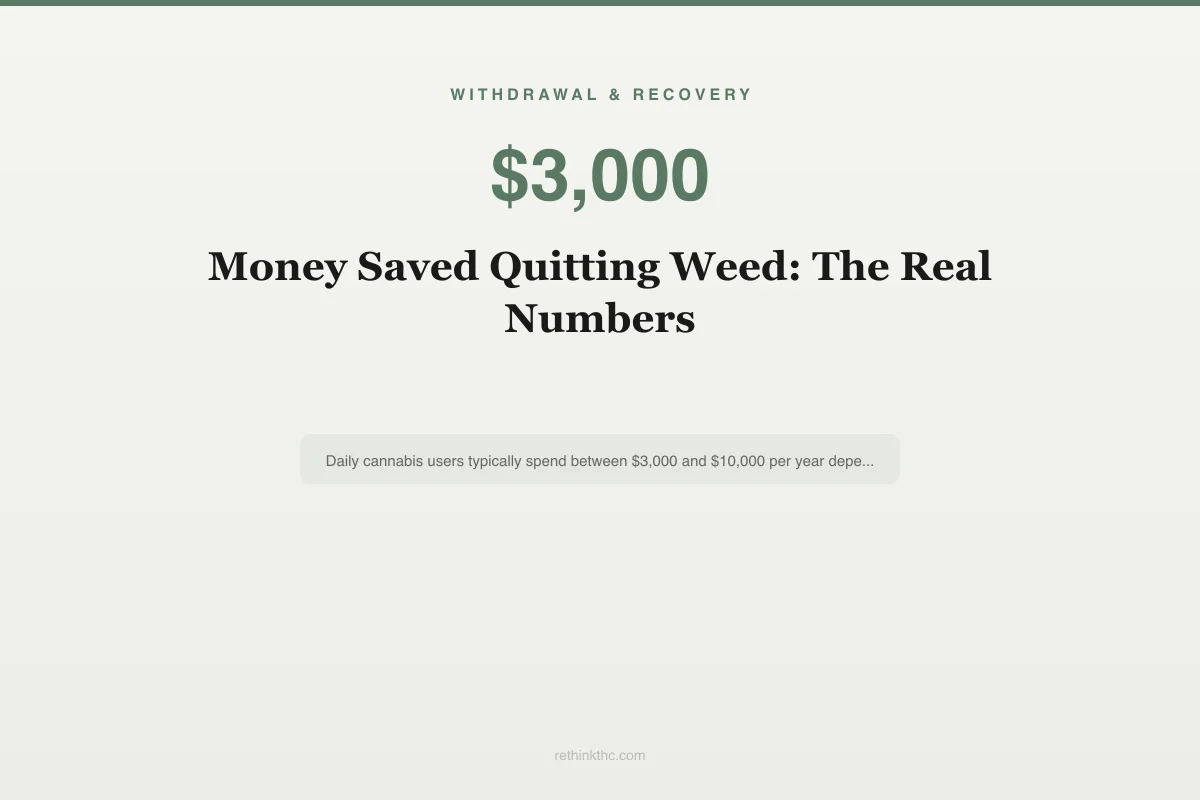
- Daily cannabis users typically spend $3,000 to $10,000 per year depending on tolerance, product type, and whether they use flower, vapes, or concentrates — and most people have never done the actual math
- Concentrate and vape pen users often spend significantly more than flower smokers because of unit cost, faster tolerance buildup, and how quickly cartridges run out
- The "latte effect" applies directly here: the cost per session feels small, but it compounds into a number that changes the conversation entirely over one to five years
- Money alone rarely keeps someone from using, but the real number is a concrete data point that sharpens decision-making when combined with other reasons to quit
- The most powerful calculation is not what you spend now but what that money would be worth in five years if invested — the opportunity cost tends to hit harder than the spending figure itself
- Tolerance escalation means your cannabis costs tend to climb over time, unlike a fixed bill, because you need more product to get the same effect
What the Average Cannabis User Actually Spends
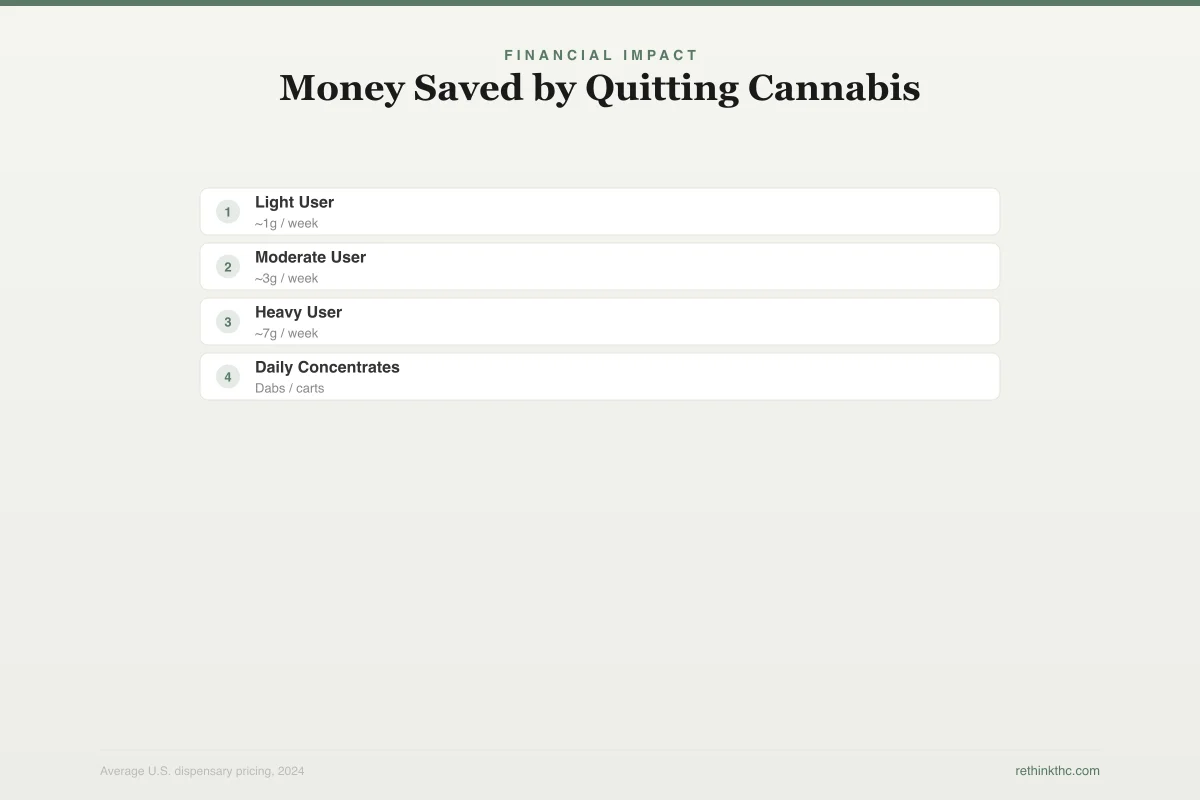
Spending varies widely based on usage frequency, product type, local pricing, and tolerance level. Here are realistic estimates across usage categories based on current legal market pricing in the US.
Financial Impact
Money Saved by Quitting Cannabis
Estimates based on average U.S. dispensary prices of $10–15/g for flower and $30–60/g for concentrates. Actual costs vary by state and product type.
Average U.S. dispensary pricing, 2024
 View as image ↗
Casual user (1 to 3 sessions per week, low tolerance)
A casual user typically spends $15 to $30 per session at dispensary prices. At two sessions per week, that is $30 to $60 weekly, or approximately $1,560 to $3,120 per year. This is the category where people most frequently underestimate their spending because the per-session cost feels modest.
Regular user (daily use, moderate tolerance)
A regular daily user consuming one to two grams of flower per day, or one to two sessions using a vape, typically spends between $50 and $100 per week on product. At $70 per week as a midpoint, the annual total is approximately $3,640. Many regular users also factor in accessories, rolling supplies, and storage, adding $200 to $500 per year on top of product costs.
Heavy user (multiple sessions daily, high tolerance)
Heavy daily users who have built significant tolerance often spend $100 to $200 per week on product to maintain their desired effect. At $150 per week, the annual total is approximately $7,800. Heavy users frequently report that their spending increased significantly over time as tolerance rose -- they needed more product to achieve the same effect they got when they started.
Concentrate and dab users
This is where spending can accelerate dramatically. High-quality concentrate (shatter, live resin, rosin) typically sells for $30 to $60 per gram at dispensaries, and heavy concentrate users may go through a gram every one to three days. At one gram every two days at $45 per gram, the annual cost is approximately $8,213. Heavy concentrate users consuming a gram per day spend approximately $16,425 per year on product alone.
For more on how concentrate use affects tolerance and the financial and physiological acceleration it produces, see dab and concentrate addiction and withdrawal.
Vape pen users
Vape cartridges typically range from $25 to $60 for a half-gram cartridge. Heavy vape users who go through a cartridge every three to four days spend approximately $3,000 to $7,300 per year depending on price point. Because vaping is discrete and easy to do frequently, it is one of the categories where users most consistently underestimate how much they are consuming and spending. For more on this pattern, see weed vape pen addiction.
How to Calculate Your Personal Number
Here is a simple framework that takes three minutes and produces your actual figure.
Step 1: Identify your average session cost. What does one session cost you -- either directly in product consumed or as a fraction of a purchase? If you buy an eighth (3.5 grams) for $45 and it lasts a week, your daily cost is approximately $6.43. If you buy a half-ounce (14 grams) for $120 and it lasts two weeks, your daily cost is approximately $8.57.
Step 2: Count your sessions per day (not per week). Be honest here. If you use multiple times per day, count all of them. People who count once per day often forget the morning session, the one on a lunch break, and the one before bed.
Step 3: Multiply your daily cost by 365. This gives you your annual product spend.
Step 4: Add ancillary costs. Grinders, pipes, papers, vaporizers, cartridges, and related items add real money. For many regular users this is an additional $300 to $800 per year.
Step 5: Do the five-year projection. Multiply your annual total by five. This number is usually the one that changes the conversation.
As a worked example: A daily vape user spending $12 per day ($3 per cartridge session, four sessions daily) spends $4,380 per year on product. Over five years, that is $21,900. At a modest 7% annual return in an index fund, $4,380 invested annually over five years becomes approximately $27,000 instead of $21,900 spent.
The "Latte Effect" of Daily Cannabis Spending
The "latte effect" is a concept from personal finance that describes how small recurring expenses compound into large annual figures. A $6 latte every workday is $1,560 per year. The principle is the same with daily cannabis use: the per-session cost feels trivial, but the annual and multi-year figures are not.
The effect is amplified with cannabis for two reasons that do not apply to coffee. First, tolerance escalation means that the cost per session tends to increase over time, not stay flat. What cost $8 per session two years ago may cost $15 to $20 per session now because tolerance has driven you toward higher-potency products or larger quantities. Second, the frequency tends to increase for regular users over time. Someone who used four times per week five years ago is often using daily today, which means the annual spending has roughly doubled independently of any price increases.
This tolerance-and-frequency escalation is why the five-year backward look is often more striking than the forward projection: many heavy users can identify a period in their lives when they spent $30 to $50 per week, compared to the $150 per week they spend now, and trace exactly how the escalation happened. The cannabis tolerance break guide covers the tolerance mechanics behind this pattern.
What That Money Could Be Doing Instead
The opportunity cost calculation is more motivating than the direct spending figure for most people, because it reframes the question from "what am I spending" to "what am I giving up."
At $5,000 per year (a reasonable midpoint for a regular daily user):
- One year saved: A $5,000 emergency fund, a significant debt payment, or a full contribution to an individual retirement account (IRA, a tax-advantaged account that grows investments over time)
- Five years saved: $25,000 in direct savings, or approximately $31,000 invested at 7% annual return -- enough for a down payment on a home in many markets, a significant portion of a vehicle, or a meaningful head start on retirement savings
- Ten years invested: Approximately $69,000 at 7% annual return from $5,000 annually -- from a single changed behavior
At $10,000 per year (common for heavy flower or concentrate users):
- Five years invested: Approximately $62,000 at 7% annual return
- Ten years invested: Approximately $138,000
These figures are not meant to suggest that quitting cannabis is a financial strategy, or that the money will automatically be redirected to investment. In practice, money freed from one spending habit tends to redistribute across other spending unless redirected intentionally. But the numbers are worth knowing as a concrete picture of what the behavior actually costs in real terms.
What the Financial Data Point Does and Does Not Do
Financial motivation is real, and for some people, running these numbers is a genuinely clarifying experience. Seeing the five-year figure written out, or calculating what their spending has been over the past three years, changes their relationship to the behavior in a way that abstract concern about their health or productivity did not.
But financial motivation alone rarely drives sustained behavior change, and it is worth being honest about why.
First, the financial benefit is deferred. You save money by not buying cannabis, but that money is not a tangible reward you receive immediately. The discomfort of withdrawal, the cravings, and the difficulty of early abstinence are immediate. Deferring gratification against an immediate cost is the neurological challenge that makes most behavior change hard, and financial reasoning does not solve this mismatch.
Second, cannabis use disorder involves changes to the reward system that financial logic does not address. If you are using cannabis primarily to manage anxiety, depression, boredom, or withdrawal discomfort, knowing that you would save $6,000 per year does not resolve those underlying functions. The money argument is a data point in a decision, not a substitute for addressing what the cannabis was doing for you. For a broader look at what drives use and how to address it, see should I quit weed and self-medicating with weed.
Third, the research on cannabis use disorder suggests that motivation for change is most effective when it is multidimensional. Anthony's 1994 study published in Experimental and Clinical Psychopharmacology found that approximately 9% of people who ever try cannabis develop dependence. That is a lower rate than tobacco (32%), heroin (23%), cocaine (17%), and alcohol (15%), but it is still a meaningful number -- and for those who do develop cannabis use disorder, financial reasoning alone typically is not sufficient to produce lasting change.
The most effective use of the financial data point is as part of a larger picture: this is one of the real costs of this behavior, alongside the effects on motivation, sleep, cognition, and relationships. For a complete view of what changes when you stop, see benefits of quitting weed. If you want a more detailed breakdown of the total cost of cannabis use including hidden expenses most people overlook, the cannabis cost calculator and the how much are you really spending calculator both approach the question from different angles.
Redirecting the Money Intentionally
If you do quit or significantly reduce your use, the money freed up does not automatically go anywhere useful unless you redirect it deliberately. Here are three approaches that work.
Redirect at the moment of a prevented purchase. When you would have bought product and did not, move that amount directly to a savings account or debt payment in the same day. The immediate redirect prevents the money from diffusing into general spending.
Name a specific target. Vague saving is less motivating than a concrete goal. "I am saving $250 per month until I have a $3,000 emergency fund" or "I am putting this toward paying off my credit card" converts an abstraction into a measurable progress metric.
Track visible progress. A simple running total of money saved since your quit date, even just a note on your phone updated weekly, makes the financial benefit tangible rather than theoretical. Many people find this reinforcing, particularly in the early weeks when other benefits of quitting (sleep, mood, cognitive clarity) are still emerging through withdrawal. The best apps for quitting weed includes tools that offer savings trackers alongside abstinence tracking.
Using the Financial Frame During Difficult Moments
The financial argument is most useful not as a primary motivation but as a specific tool during moments of wavering. When a craving is strong and the decision feels immediate and emotional, a stored, pre-calculated figure can introduce a rational counterweight.
"This session would cost me $15. Over this year, I have already saved $1,800. This craving will pass in 15 to 30 minutes."
The key is that the calculation has to be done in advance, not in the moment of craving. Do the math when you are calm and store the number somewhere accessible. The craving state is not the right time to run spreadsheets. The craving state is the time to recall a number you already know.
For strategies on navigating cravings and the early withdrawal period beyond the financial frame, the cannabis withdrawal complete guide covers the full landscape of what early abstinence looks like and how to move through it effectively.
When to Seek Professional Help
Safety
ModerateWhen spending becomes financial harm
Concern
If cannabis spending has created debt, inability to pay basic expenses, or borrowing to fund purchases, that pattern is one of the criteria clinicians use to assess cannabis use disorder. Financial harm from substance use is a clinical marker, not just a budgeting problem.
What the research says
This is treatable. A healthcare provider or counselor can help you address both the financial pattern and the underlying use disorder. You don't need to hit rock bottom to ask for help.
Particularly relevant for: Anyone experiencing financial consequences from cannabis spending — debt, missed bills, borrowing
What to do
SAMHSA National Helpline: 1-800-662-4357 (free, confidential, 24/7). You can also text 'HELLO' to 741741 for the Crisis Text Line.
DSM-5 Cannabis Use Disorder criteria
If cannabis spending has created financial consequences -- debt, inability to meet basic expenses, borrowing to fund purchases -- that is a signal that use has moved into a range where professional support is appropriate. Financial harm is one of the criteria used to assess whether cannabis use disorder is present.
SAMHSA's National Helpline is available at 1-800-662-4357. It is free, confidential, and available 24 hours a day, 7 days a week. You can also text "HELLO" to 741741 to reach the Crisis Text Line.
The Bottom Line
Daily cannabis users typically spend between $3,000 and $10,000 per year, with heavy concentrate users potentially reaching $16,000 or more. Most users have never calculated the actual annual figure. The "latte effect" applies directly: per-session costs feel trivial but compound into striking annual and multi-year totals. Tolerance escalation amplifies the effect because costs increase over time as users need more product. At $5,000 per year invested at 7% returns, quitting produces approximately $69,000 over ten years from a single changed behavior. Financial motivation alone rarely drives sustained change because withdrawal discomfort is immediate while savings are deferred, but the pre-calculated number serves as an effective rational counterweight during moments of craving. The most effective approach is to redirect saved money deliberately at the moment of a prevented purchase, toward a specific named goal, with visible progress tracking.
How much does the average daily weed smoker spend per year?
A regular daily flower user typically spends $3,000 to $5,000 per year on product. Heavy users and concentrate users often spend $7,000 to $16,000 per year. The range is wide because it depends on tolerance level, product type, and local pricing. The most accurate way to find your number is to calculate your daily product cost and multiply by 365, then add ancillary costs like accessories and supplies.
How do I calculate how much I spend on weed?
Start with your average session cost -- either the price of a purchase divided by the number of sessions it produces, or the per-cartridge or per-gram cost at your usage rate. Multiply by the number of sessions per day, then multiply by 365. Add annual accessories and supply costs. Then multiply the annual total by five for the five-year projection. Most people find the five-year number is the one that feels most significant.
Is saving money a good enough reason to quit weed?
It is a legitimate data point, but financial motivation alone rarely produces sustained behavior change. The discomfort of withdrawal and cravings is immediate, while the financial benefit is deferred. Financial reasoning works best as part of a larger set of motivations, not as the primary driver. It is also most useful as a stored reference point during cravings rather than as an ongoing primary motivation.
Why do concentrate and vape users spend more?
Concentrates cost more per gram than flower, and the THC concentration (potency level) accelerates tolerance faster, meaning users need progressively more product to achieve the same effect. Vape pen users tend to use more frequently because the format is discrete and accessible throughout the day. Both factors combine to produce higher annual spending than comparable flower use.
What should I do with the money I save after quitting weed?
Redirect it deliberately rather than letting it diffuse into general spending. The most effective approach is to move the money at the moment of a prevented purchase -- transfer the amount you would have spent directly to savings or debt repayment the same day. A specific, named savings goal is more motivating than general saving, and a visible running total of money saved since your quit date makes the financial benefit concrete and reinforcing during the early weeks.
Does tolerance really make weed more expensive over time?
Yes. Tolerance means you need more THC to achieve the same effect, which leads to either consuming more product per session, buying higher-potency products that cost more, or both. Someone who started with an eighth lasting a week may find themselves buying a quarter or half-ounce per week after a few years of daily use. This tolerance-driven cost escalation is one reason the five-year backward look is often more striking than a forward projection. The cannabis tolerance break guide explains the mechanics behind this pattern.
Sources & References
- 1RTHC-08534·P A Costa, Gabriel et al. (2026). “Cannabis Use Makes Quitting Tobacco Harder, But CBD Might Help.” medRxiv : the preprint server for health sciences.Study breakdown →PubMed →↩
- 2RTHC-06615·Halicka, Monika et al. (2025). “CBT with Motivational Enhancement Is the Best-Supported Psychotherapy for Cannabis Use Disorder.” Addiction (Abingdon.Study breakdown →PubMed →↩
- 3RTHC-05376·Hill, Melanie L et al. (2024). “Cannabis Users with PTSD Still Benefit from Trauma-Focused Therapy — But Attend Fewer Sessions.” Journal of anxiety disorders.Study breakdown →PubMed →↩
- 4RTHC-05535·McClure, Erin A et al. (2024). “Reducing Cannabis Use by 50-75% Was Enough to See Real Improvements.” The American journal of psychiatry.Study breakdown →PubMed →↩
- 5RTHC-02407·Bahji, Anees et al. (2020). “About Half of Heavy Cannabis Users Experience Withdrawal. This Meta-Analysis Measured It..” JAMA Network Open.Study breakdown →PubMed →↩
- 6RTHC-08677·Ullah, Safat et al. (2026). “Cognitive behavioral therapy did not significantly outperform other treatments for reducing cannabis use in a meta-analysis of 9 trials.” Cognitive behaviour therapy.Study breakdown →PubMed →↩
- 7RTHC-07459·Redonnet, Bertrand et al. (2025). “CBD Alone Does Not Effectively Treat Substance Use Disorders, But CBD-THC Combination Helps Cannabis Withdrawal.” Addiction (Abingdon.Study breakdown →PubMed →↩
- 8RTHC-01525·Sorensen, Cecilia J et al. (2017). “The Most Comprehensive Systematic Review of CHS: 183 Studies, 14 Diagnostic Features, and Treatment Options.” Journal of medical toxicology : official journal of the American College of Medical Toxicology.Study breakdown →PubMed →↩