Withdrawal & Recovery
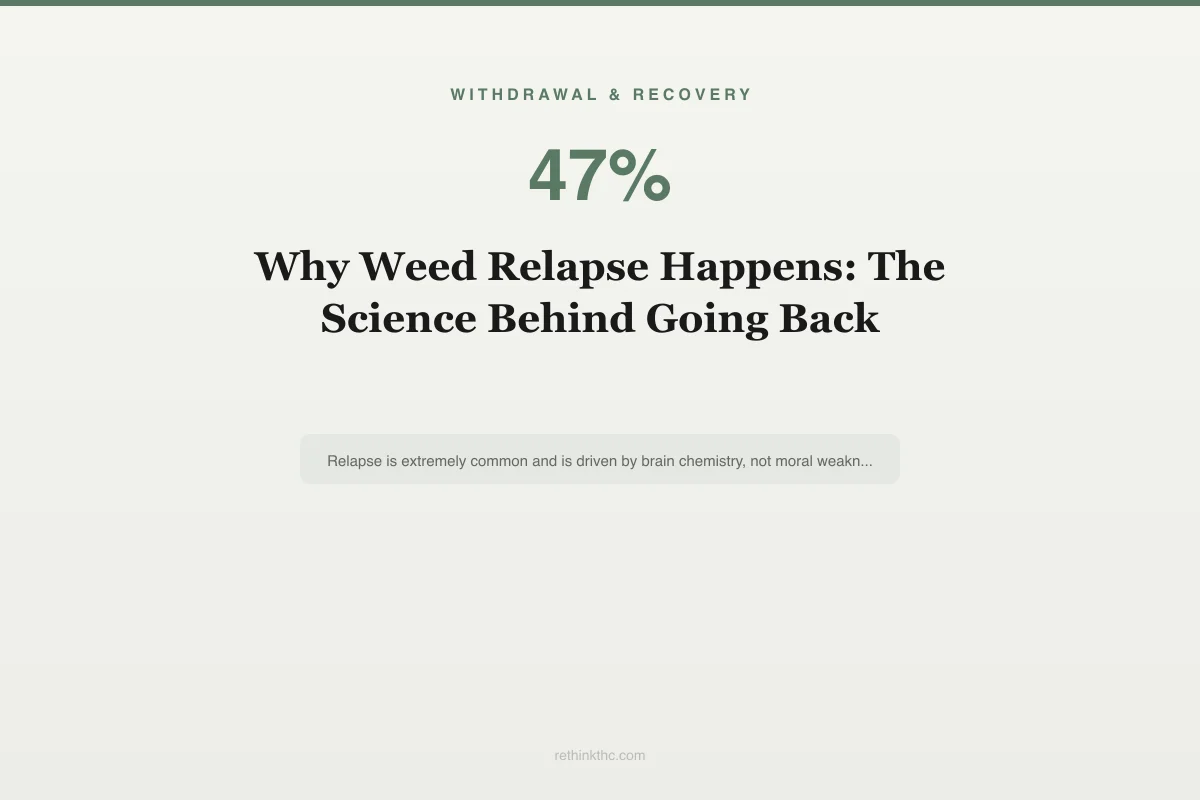
47%
Nearly half of people who quit cannabis relapse because withdrawal severity, not willpower, is the strongest predictor of return to use, with CB1 receptors needing roughly 28 days to normalize.
Bahji et al., JAMA Network Open, 2020
47%
Weed relapse is extremely common and driven by brain
28 days
Your brain's CB1 receptors take roughly 28 days to
66 days
Building new habits takes a median of 66 days according to
Bahji et al., JAMA Network Open, 2020
 View as image ↗
If you only read one thing
Relapse isn't a willpower problem — it's a brain chemistry problem. Your CB1 receptors take about 28 days to recover after you quit, and during that entire window your brain is pushing you to use again because it knows exactly how to fix the discomfort. Nearly half of people who quit experience withdrawal strong enough to pull them back. The worse your withdrawal, the higher your relapse risk. Knowing this turns relapse from a mystery into something you can plan around.
Relapse is the part of quitting weed that nobody wants to talk about honestly. People who have never experienced it tend to frame it as a lack of willpower. People who have experienced it tend to frame it as proof that they cannot change. Both interpretations miss what is actually happening in your brain and in your life when you go back to cannabis after trying to stop.
The science tells a different story. Relapse is not random, and it is not a character flaw. It is a predictable response driven by neurobiology, withdrawal symptoms, unresolved triggers, and the simple mathematics of habit formation. Understanding why it happens is the first step toward making it less likely to happen again.
For a complete overview of what withdrawal looks like, the cannabis withdrawal guide covers the full picture.
Key Takeaways
- Weed relapse is extremely common and driven by brain chemistry — not moral weakness — because nearly half (47%) of people who quit experience withdrawal symptoms that pull them back
- The worse your withdrawal symptoms, the higher your risk of relapsing, according to a 2012 PLOS ONE study that found withdrawal severity is one of the strongest predictors of return to use
- Your brain's CB1 receptors take roughly 28 days to normalize after quitting, so the entire first month is a window of real neurological vulnerability
- Building new habits takes a median of 66 days according to research, which means the timeline for a cannabis-free life is longer than most people plan for
- Knowing your personal triggers — stress, boredom, social situations, emotional pain — turns relapse from a mystery into something you can actually prepare for
- A single use does not erase your neurological recovery, but it hits harder because your receptors are more sensitive now — and for most daily users, occasional use quickly escalates back to the old pattern
The Neuroscience of Relapse
Your brain does not simply "go back to normal" the day you stop using cannabis. It goes through a recalibration process that takes weeks, and during that process, it is actively working against your decision to quit.
Your Receptors Are Still Adjusting
When you use cannabis regularly, your brain responds by reducing the number and sensitivity of CB1 receptors, the brain structures that THC binds to. A 2012 study by Hirvonen and colleagues, published in Molecular Psychiatry, used brain imaging to show[1] that these receptors take approximately 28 days of sustained abstinence to return to normal availability.
That 28-day window matters enormously for understanding relapse. During that period, your brain is literally operating with fewer functional receptors than a non-user's brain. Pleasure, motivation, appetite, sleep, and emotional regulation are all partially impaired. You are not imagining that everything feels flat or off. It is a measurable neurological state.
This is why the first month is the most dangerous period for relapse. Your brain has not finished recalibrating, and it has a built-in solution it already knows works: cannabis.
Dopamine and the Motivation Gap
The dopamine system, your brain's reward and motivation circuitry, is heavily affected by regular cannabis use. When you quit, dopamine signaling drops below baseline levels. This creates a state where normal activities that used to feel enjoyable (food, exercise, socializing, hobbies) feel muted or pointless.
This is not laziness. It is a temporary neurochemical deficit. Your brain was accustomed to the dopamine boost that THC provided, and without it, everything else feels insufficient by comparison. For a deeper look at how this recovers, see dopamine recovery after quitting weed.
The problem is that your brain remembers exactly how to fix this deficit quickly. One session, and the dopamine surge returns. That is what makes cravings so powerful during early abstinence. They are not just psychological. They are your brain's reward system pointing you toward the fastest known solution.
Relapse Science
Relapse Risk Over Time
Risk is not constant — different phases carry different triggers and vulnerability levels
Top relapse triggers
CB1 receptors: Take ~28 days to normalize. The entire first month is a window of real neurological vulnerability. "Just one" hits harder because receptors are now more sensitive.
Hirvonen et al. (2012) · Allsop et al. (2012) · Lally et al. (2010)
Cannabis Relapse Risk TimelineThe Timeline of Vulnerability
Relapse risk is not constant. It shifts in predictable ways over the first few months, with different triggers dominating at different points.
Weeks 1-2: Withdrawal-Driven Relapse
The highest-risk period for most people is the first two weeks. A 2003 study by Budney and colleagues, published in the Journal of Abnormal Psychology, documented[2] the cannabis withdrawal time course in detail. Symptoms typically begin within 1 to 3 days of stopping and peak between days 2 and 6. These include irritability, sleep disruption, appetite changes, anxiety, and physical discomfort.
A 2012 study by Allsop and colleagues, published in PLOS ONE, found[3] that withdrawal severity is one of the strongest predictors of relapse. The more intense your symptoms, the more likely you are to return to use. This is not surprising when you think about it. If quitting makes you feel terrible and you know exactly how to stop feeling terrible, the pull toward using again is enormous.
A separate meta-analysis by Bahji and colleagues, published in 2020 in JAMA Network Open, found[4] that roughly 47% of regular cannabis users experience clinically significant withdrawal symptoms when they stop. This is not a rare edge case. Nearly half of all regular users go through this.
For a detailed breakdown of what the first week looks like, see the first week of quitting weed.
Allsop et al. (2012) · PLOS ONE
- Population
- 49 cannabis-dependent adults (non-treatment-seeking) during 2 weeks of monitored abstinence
- Intervention
- Daily tracking of withdrawal symptoms and functional impairment during abstinence
- Comparator
- One-month follow-up comparing relapsers vs. abstainers
- Finding
- Withdrawal severity strongly predicted functional impairment. Those with greater functional impairment during the abstinence period used significantly more cannabis at the one-month follow-up. More severe dependence before quitting predicted worse withdrawal.
positive Small sample (n=49) but the finding — withdrawal severity drives relapse — has been replicated consistently
Allsop et al. (2012), PLOS ONE, 7(9), e44864
Weeks 3-6: Anhedonia and Boredom
After the acute withdrawal symptoms fade (usually by week 2 or 3), a different kind of risk emerges. Anhedonia, the inability to feel pleasure from normally enjoyable activities, can persist for several weeks. This is connected to the dopamine and receptor changes described above.
During this phase, the most common triggers are boredom and emotional flatness. The acute misery of withdrawal has passed, but nothing has replaced it. Your evenings feel empty. Your weekends feel long. Activities you used to enjoy with cannabis feel hollow without it. The thought process becomes: "I got through the hard part, I feel fine physically, so what am I doing this for?"
This is the phase where people convince themselves that they have "proven" they can quit and can now use occasionally. That reasoning feels logical in the moment, but it underestimates how much the neurological recovery is still in progress.
Months 2-3 and Beyond: Situational and Emotional Triggers
By month two, the biological withdrawal is largely over. CB1 receptors have normalized. The acute dopamine deficit has improved significantly. At this point, relapse is driven less by neurobiology and more by the situations, emotions, and routines that were wired to cannabis use.
This is where the self-medication hypothesis becomes relevant. Khantzian's 1985 framework, published in the American Journal of Psychiatry, argues that many people use substances not for the high itself but to manage painful emotions, unresolved stress, or mental health symptoms they do not have other tools for.
If you were using cannabis to manage anxiety, loneliness, grief, or boredom, quitting removes the coping mechanism without removing the underlying problem. When those emotions resurface (and they will), the pull toward cannabis is not about the drug. It is about the pain.
Common Triggers (and Why They Work)
Relapse triggers fall into a few predictable categories. Recognizing yours does not guarantee you will avoid them, but it makes them far less surprising when they show up.
Stress
Stress is the most commonly reported relapse trigger across all substance research, and cannabis is no exception. When cortisol (your body's stress hormone) spikes, your brain searches for the fastest available way to bring it back down. If cannabis has been your go-to stress response for months or years, the craving can feel automatic, almost physical.
Social Situations
Being around people who are using, or being in places where you used to use, activates powerful associative memories. Your brain has linked these contexts with cannabis through hundreds or thousands of repetitions. Walking into a friend's apartment where you always smoked can trigger a craving before you have time to think about it.
Boredom
Boredom is underestimated as a relapse trigger. Cannabis fills time. It makes passive activities feel engaging. Without it, you may find yourself with hours in the evening that feel uncomfortably empty. This is especially potent during weeks 3 through 6, when anhedonia is still present.
Sleep Problems
Insomnia and disrupted sleep are among the most persistent withdrawal symptoms, often lasting weeks after other symptoms have resolved. Sleep deprivation impairs judgment, lowers mood, and reduces your capacity to tolerate discomfort. Many people relapse specifically because they cannot face another night of poor sleep.
Emotional Pain
Grief, breakups, family conflict, job loss, loneliness. Any significant emotional pain can trigger relapse, especially if cannabis was your primary tool for managing difficult emotions. This is the self-medication dynamic at work.
Celebratory Moments
This one catches people off guard. A promotion, a birthday, a holiday, the end of a hard week. Celebratory contexts are strongly associated with cannabis use for many people. The thought is: "I deserve this. I have earned it." The trigger is positive rather than negative, which makes it harder to see coming.
Why "Just One" Rarely Works
One of the most common relapse patterns starts with a single use that is genuinely intended to be a one-time thing. You tell yourself you will have one session, prove you are in control, and go right back to abstinence.
The problem is neurological. Your CB1 receptors, which have been recovering over weeks of abstinence, are now more sensitive than they were during active daily use. That means a single use hits harder and produces a stronger reward signal. Your brain registers this as: "That worked even better than before." The motivation to repeat it increases.
Additionally, tolerance resets in a way that works against you. A small amount produces a large effect, which can make occasional use feel sustainable. But for most people with a history of daily use, the pattern escalates. One session becomes one per week, then two, then back to daily use. The timeline varies, but the trajectory is consistent.
The Role of Habit
Relapse is not just about brain chemistry. It is also about the simple mechanics of habit.
A 2010 study by Lally and colleagues, published in the European Journal of Social Psychology, found that it takes a median of 66 days to form a new automatic behavior, with a range of 18 to 254 days depending on the person and the behavior. That means if you quit cannabis and need to build new evening routines, new stress responses, and new social patterns, you are looking at roughly two months (at minimum) before those new behaviors start to feel natural.
During that 66-day window, every evening is a conscious effort. Every stressful moment requires deliberate decision-making about what to do instead. Every social situation where others are using requires active resistance. That is a lot of willpower to sustain, and willpower is a depletable resource.
This is why people relapse at 30, 45, or 60 days and feel blindsided. They assumed the hard part was the first week. In reality, the habit-formation research suggests the hard part extends much further than most people plan for.
Withdrawal Severity Predicts Relapse
This finding from Allsop 2012[3] deserves its own section because it is so practically important. The study, published in PLOS ONE, found that the severity of withdrawal symptoms and the degree of functional impairment (how much withdrawal disrupts your ability to work, sleep, and function normally) are significant predictors of who will relapse.
This has a specific implication: if your withdrawal is particularly severe, you are at higher statistical risk, and you need more support, not less. This is not the time for white-knuckling it alone. It is the time for structured quit strategies, professional support, or both.
People with severe withdrawal are not weaker. They are facing a harder version of the same challenge. Matching your support level to your symptom level is practical, not a sign of failure.
Evidence Review
Where the evidence stands
Cell & Lab Studies
CB1 receptor downregulation and dopamine signaling changes well-characterized in animal models
Animal Studies
Rodent models confirm THC-seeking behavior after abstinence, driven by receptor sensitivity changes
Case Reports
Relapse patterns well-documented in clinical addiction literature
Small Human Trials
Allsop 2012: withdrawal severity predicts relapse. Hirvonen 2012: 28-day receptor recovery window.
Large Randomized Trial
Meta-Analysis
Bahji 2020: 47% of regular users experience withdrawal (47 studies, 23,518 participants)
The neuroscience of cannabis relapse is well-established through multiple evidence levels including meta-analyses. Withdrawal severity as a relapse predictor, the 28-day receptor vulnerability window, and the 47% withdrawal prevalence rate are all supported by strong data.
Hirvonen (2012), Allsop (2012), Budney (2003), Bahji (2020)
Reframing Relapse
Relapse is data. It tells you what your triggers are, when you are most vulnerable, and what gaps exist in your quit strategy. It tells you whether the support you have is sufficient for the challenge you are facing.
It does not tell you that you are incapable of change. It does not tell you that quitting is pointless. It does not erase the days of abstinence you accumulated or the neurological recovery that occurred during that time.
If you have already relapsed and are looking for practical next steps, the guide on what to do after a weed relapse covers exactly how to move forward without spiraling. If you went back to weed and regret it, that regret is actually useful data about what you want. And if you are in the middle of a full relapse and trying to find your footing again, the recovery path is shorter than it feels.
When to Seek Professional Help
If you have relapsed multiple times and cannot seem to break the pattern on your own, that is a signal that professional support would be helpful. This is especially true if you are using cannabis to manage anxiety, depression, trauma, or chronic stress.
A therapist who specializes in substance use can help you identify the underlying patterns driving your relapse and build coping strategies that actually address the root cause. This is not about being "bad enough" to need help. It is about using the most effective tools available.
If you need immediate support, the SAMHSA National Helpline is available at 1-800-662-4357. It is free, confidential, and available 24 hours a day, 7 days a week. They can connect you with local treatment resources and support groups.
The Bottom Line
Relapse after quitting cannabis is driven by brain chemistry, not moral weakness. CB1 receptors take approximately 28 days to normalize, creating a window of genuine neurological vulnerability. A 2012 PLOS ONE study found withdrawal severity is one of the strongest relapse predictors, and a 2020 meta-analysis confirmed 47% of regular users experience clinically significant withdrawal. Risk is highest during weeks 1 to 2 (withdrawal-driven), shifts to anhedonia and boredom during weeks 3 to 6, and becomes situational and emotional from months 2 to 3 onward. Habit formation research shows it takes a median of 66 days to build new automatic behaviors, meaning the hard part extends well beyond the first week. Relapse is data about triggers and gaps in your quit strategy, not evidence that change is impossible.
Is relapsing on weed normal?
Yes. Relapse is one of the most common experiences in any quit attempt. Research shows that nearly 47% of regular users experience withdrawal symptoms, and withdrawal severity is a strong predictor of relapse. Most people who successfully quit long-term have at least one relapse in their history. It is a typical part of the process, not an anomaly.
Why do I keep relapsing on weed?
Repeated relapse usually points to one of three things: unaddressed triggers (stress, emotional pain, or a mental health condition you were self-medicating), insufficient support for the severity of your withdrawal, or incomplete habit replacement. A 2010 study found it takes a median of 66 days to form new habits, so if you are relapsing at 2 to 4 weeks, your new routines have not had time to become automatic yet.
How long does the highest relapse risk last?
The highest risk period is the first two weeks, when withdrawal symptoms peak (typically days 2 through 6). A secondary risk window extends from weeks 3 through 6, when anhedonia and boredom become the primary triggers. After about 2 to 3 months, the biological risk drops significantly, though situational and emotional triggers can persist longer.
Does one relapse erase all my progress?
No. The neurological recovery that occurred during your period of abstinence is not completely erased by a single use. CB1 receptors that have been recovering over weeks do not instantly revert to their pre-quit state after one session. However, resuming regular use will reverse the progress. The key is preventing a single use from becoming a pattern.
Should I try quitting again after a relapse?
Yes, if quitting is still your goal. Each quit attempt provides information about your triggers, your vulnerability windows, and what support you need. If you have relapsed multiple times, consider adjusting your approach rather than simply repeating the same strategy. A 2006 study found that structured treatment combining cognitive behavioral therapy with motivational incentives produced the best outcomes for people with cannabis use difficulties.
Why does one use after quitting so often lead back to daily use?
Two factors drive this pattern. First, your CB1 receptors have become more sensitive during abstinence, so a single use produces a stronger reward signal than it did during daily use. Your brain registers this as an especially effective solution. Second, the associative memories and habit pathways that were suppressed during abstinence get reactivated by a single use, making subsequent cravings stronger and more frequent. For most people with a history of daily use, the trajectory from one session to several per week to daily use is consistent, even when each step feels like a conscious choice.
Sources & References
- 1RTHC-00573·Hirvonen, Jussi et al. (2012). “Daily Cannabis Use Was Linked to Fewer CB1 Receptors. A Month Without Brought Them Back..” Molecular Psychiatry.Study breakdown →PubMed →↩
- 2RTHC-00134·Budney, Alan J. et al. (2003). “When Heavy Users Quit Cannabis, Symptoms Show Up Fast and Ease Within Two Weeks.” Journal of Abnormal Psychology.Study breakdown →PubMed →↩
- 3RTHC-00538·Allsop, David J. et al. (2012). “Withdrawal That Disrupted Daily Life Was Tied to Relapse in a Small Study.” PLOS ONE.Study breakdown →PubMed →↩
- 4RTHC-02407·Bahji, Anees et al. (2020). “About Half of Heavy Cannabis Users Experience Withdrawal. This Meta-Analysis Measured It..” JAMA Network Open.Study breakdown →PubMed →↩