Lifestyle / Identity
1 Friend
Social pressure to use is a stronger relapse predictor than withdrawal itself, so how you handle telling friends you are quitting directly shapes your chances of staying quit.
Addictive Behaviors, 2018
Why This Conversation Feels So Hard
covered in detail
Who Needs to Know (and Who Does Not)
covered in detail
What to Actually Say: Conversation Scripts
covered in detail
Addictive Behaviors, 2018
 View as image ↗
You have made the decision to quit. Maybe you followed a structured guide to quitting weed, maybe you woke up one morning and just knew. Either way, now comes the part nobody prepares you for: telling friends you are quitting weed. Not the withdrawal symptoms, not the cravings. The actual social moment of saying the words out loud to people who are used to smoking with you. You might be worried about judgment, pushback, or losing friendships entirely. Those worries are not irrational. How this conversation goes depends on who you are talking to, what you say, and when you say it.
This is different from the broader identity shift that happens when you leave stoner culture, and different from navigating a partner who still smokes. This is about the practical, person-by-person work of telling your friends.
Key Takeaways
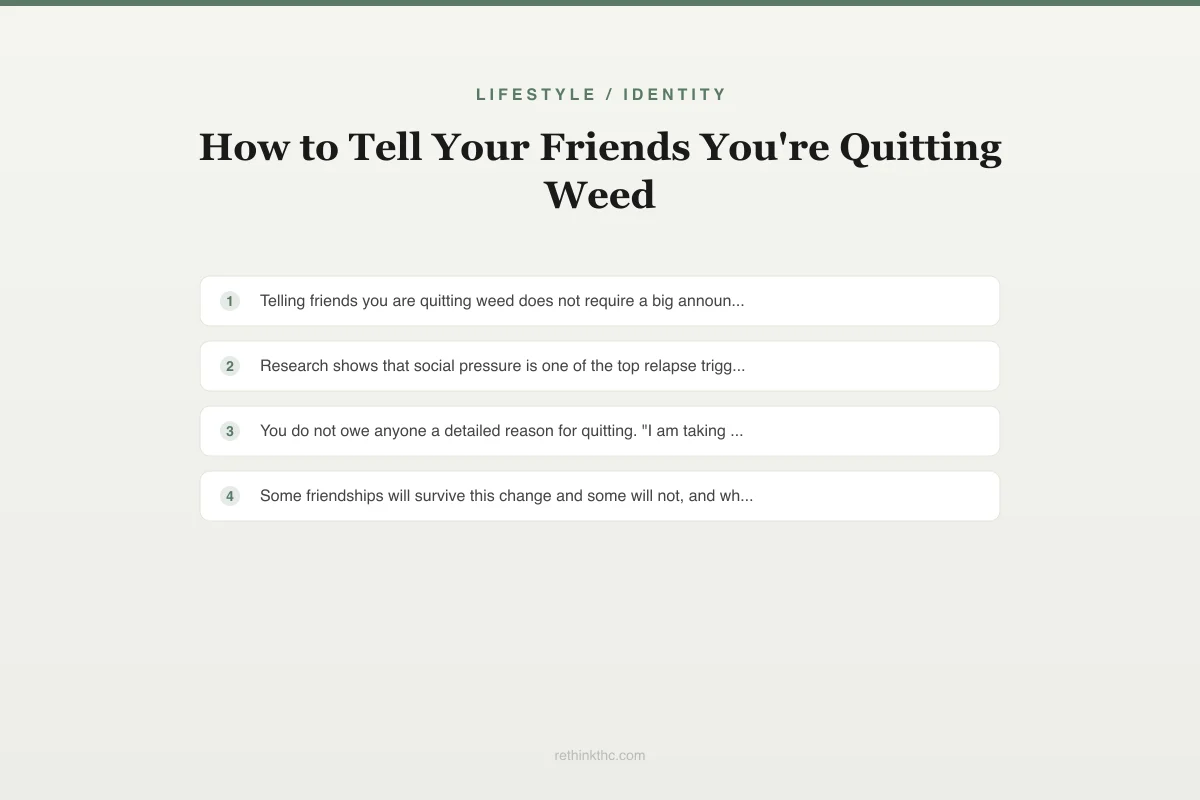
- Telling friends you are quitting weed does not need to be a big speech — short, direct, low-drama delivery works better than long explanations in most friendships
- Social pressure is one of the biggest relapse triggers — a 2018 study in Addictive Behaviors found that peer pressure to use predicted cannabis relapse more strongly than withdrawal severity alone
- You do not owe anyone a detailed reason for quitting, because "I am taking a break" is a complete sentence that works for acquaintances and casual friends
- Some friendships will survive this change and some will not — and which ones fall into which category often surprises people
- Having even one friend who supports your decision reduces relapse risk and makes the whole social adjustment significantly easier
- A 2020 review in Psychology of Addictive Behaviors found that people who undermine your health changes actually lower your chances of success — so setting boundaries with unsupportive friends is a real recovery skill, not just social etiquette
Why This Conversation Feels So Hard
Who to Tell, What to Say, and How to Handle Pushback
"I am quitting weed. It has been affecting my [sleep/focus/anxiety]. I am not asking you to change — just wanted to be straight with you."
When: Before the next session, one-on-one
"I am taking a break from smoking for a while."
When: When the situation arises naturally
"I am good, thanks." (No further explanation needed)
When: Only if directly offered
"I hear you. It just was not working for me the way I wanted."
"Not at all. This is about me, not about what anyone else does."
"I am good. I appreciate you being cool about it." (Then change topic)
Accept the support. This person is an asset to your recovery.
Key finding: Social pressure predicts relapse more strongly than withdrawal severity itself (Addictive Behaviors, 2018). Having even one supportive friend significantly reduces relapse risk.
Cannabis is deeply social. Weed is often the centerpiece of group rituals: the rotation, the session, the pre-game, the wind-down. Telling your friends you are quitting changes the social contract. You are stepping outside a shared ritual, and that can feel like a betrayal even when it is not.
A 2018 study in Addictive Behaviors found that perceived social pressure to use cannabis was a stronger predictor of relapse than withdrawal discomfort itself. The people around you matter more than the cravings in your body. That is why how you handle these conversations actually affects your chances of staying quit.
There is also the vulnerability factor. Telling someone you are quitting reveals that your relationship with cannabis was not entirely working for you. That honesty feels risky, especially in friend groups where weed is treated as harmless and consequence-free.
Who Needs to Know (and Who Does Not)
Not every friend requires the same conversation. Start by sorting your social circle into three groups.
Close friends who smoke with you regularly. These people will notice your absence from sessions. They deserve a direct, honest conversation. Not a speech, but a real one.
Friends you see in mixed settings. People you hang out with at parties, group dinners, or social events where cannabis happens to be present. These friends may not need a formal announcement. A casual mention when the situation arises is enough.
Acquaintances and outer-circle people. They do not need to know at all unless they directly offer you cannabis. A simple "I am good, thanks" handles it.
The mistake people make is treating this like a single announcement to the whole group. It is not. It is a series of individual conversations calibrated to the depth of the relationship.
What to Actually Say: Conversation Scripts
The biggest barrier is not knowing what words to use. Here are frameworks you can adapt to your own voice and friendships.
The Direct Approach (For Close Friends)
"Hey, I wanted to let you know I am quitting weed. It has been affecting my [sleep/motivation/anxiety/whatever is true for you] more than I want, so I am stepping away from it. I am not asking you to change anything about what you do. I just wanted to be straight with you about where I am at."
This works because it is honest, brief, and removes the pressure they might feel to change their own behavior.
The Low-Key Approach (For Casual Friends)
"I am actually taking a break from smoking for a while."
That is it. No explanation required. If they ask why, you can say "I just want to see how I feel without it" or "It has not been agreeing with me lately." These are true enough and short enough that most people will accept them without pressing further.
The Deflection Approach (For Acquaintances)
When someone passes you a joint or offers to match: "I am good, thanks." If they push: "Not my thing right now." Most people respect this and move on. The ones who do not are telling you something about their own relationship with cannabis, not about yours.
When Someone Pushes Back
Occasionally, someone will challenge your decision. They might say "come on, one hit will not kill you" or "since when do you not smoke." A 2020 review in Psychology of Addictive Behaviors found that social undermining of health behavior changes was associated with lower success rates across multiple substance categories.
You do not have to debate them. A firm response works: "I hear you, but I have made my decision and I am not looking for input on it." If someone continues pushing after that, they are not respecting a basic boundary.
When to Have These Conversations
Timing matters more than people realize.
Do not tell everyone at once. Start with one or two people you trust most. Their reaction will give you confidence for the next conversations, or useful information about what to expect.
Do not announce it mid-session. Telling a group of friends you are quitting while everyone is actively smoking creates maximum awkwardness. It puts them on the spot and makes the conversation about the group instead of about you.
Do it one-on-one when possible. Private conversations allow both of you to be honest. Your friend can ask questions or express support without performing for an audience.
Do it before the next social situation. If you are heading to a party or hangout where cannabis will be present, tell your close friends beforehand. This way you are not fielding questions in the moment and you already have allies in the room.
Friendships That Change After You Quit
Some friendships will shift, and being honest about that upfront saves you confusion later. There are generally two patterns.
Friendships with substance underneath. These are relationships where the connection exists outside of cannabis. You share humor, values, or history that does not depend on getting high together. These friendships go through an adjustment period, but they survive. The hangouts look different, but the bond holds.
Friendships built on the session. These are relationships where the primary connective tissue is the shared ritual of smoking. When you remove the ritual, there is not enough left to sustain regular contact. The friendship fades quietly. This can sting, but it is important information about what the relationship actually was.
You cannot always predict which category a friendship falls into until you quit. The friends you expected to be supportive sometimes are not. The ones you thought would disappear sometimes surprise you.
For a deeper look at how quitting reshapes your sense of self and social world, the guide on identity after quitting weed covers the longer arc of this process.
Building a Support System That Protects Your Decision
Having at least one person who actively supports your decision makes a measurable difference. Research on social support and behavior change consistently shows that even one supportive relationship during a major health change significantly improves your chances of sustaining it.
This person does not have to be a friend who also quit cannabis. It can be a family member, a therapist, or someone in an online recovery community. The key is having someone you can text after an awkward conversation instead of reaching for a joint.
If you are also building a broader plan around staying quit, the relapse prevention guide covers strategies for managing triggers, including social ones.
When to Seek Professional Help
If the social pressure to use is overwhelming enough that you are avoiding friends, isolating yourself, or repeatedly relapsing in social settings, consider talking to a therapist who understands substance use dynamics. Social anxiety and cannabis use are closely linked, and a professional can help you build the skills to navigate these situations without white-knuckling through every interaction.
SAMHSA's National Helpline is available at 1-800-662-4357, free, confidential, 24 hours a day, 7 days a week. You can also text "HELLO" to 741741 to reach the Crisis Text Line.
Your Friendships Are About to Get More Honest
Telling your friends you are quitting weed is uncomfortable. There is no script that makes it easy. But there is something on the other side of these conversations that most people do not expect: clarity. You learn quickly who values you and who valued the activity you shared. You discover which friendships have depth and which ones were held together by smoke.
The friendships that survive this are the ones that were never about the weed in the first place, and those are the ones worth having.
The Bottom Line
Social pressure is one of the strongest relapse triggers — 2018 Addictive Behaviors study found perceived peer pressure to use predicted cannabis relapse more strongly than withdrawal severity alone. Strategy: tier conversations by relationship depth. Close friends who smoke with you: direct, honest, one-on-one ("I am quitting weed, it has been affecting my [specific issue], I am not asking you to change"). Casual friends in mixed settings: brief mention when relevant ("I am taking a break"). Acquaintances: no announcement needed ("I am good, thanks" when offered). Timing: tell close friends early and individually before next social situation; avoid mid-session group announcements; private settings allow honest exchange. Pushback handling: 2020 Psychology of Addictive Behaviors review found social undermining of health behavior changes associated with lower success rates. Response: "I have made my decision and I am not looking for input." Friendship outcomes follow two patterns: relationships with substance underneath (shared values/humor independent of cannabis) survive with adjustment; relationships built on the session (primary connection is smoking ritual) typically fade. Cannot predict which category until you quit. Support system: even one actively supportive person measurably improves sustained change outcomes. Professional help warranted if social pressure causes isolation, repeated relapse in social settings, or social anxiety that prevents normal functioning.
How do I tell my best friend I am quitting weed?
Be direct and keep it short. Something like "I am quitting weed because it has been affecting my [sleep/motivation/mental health], and I wanted you to hear it from me" works well. Emphasize that you are not asking them to change their own use. One-on-one conversations in a private setting give both of you space to be honest without audience pressure.
What if my friends do not support me quitting weed?
A 2018 study in Addictive Behaviors found that social pressure to use is one of the strongest relapse triggers. If a friend actively discourages your decision, set a clear boundary: "I have made this choice and I am not looking for input." If they continue pushing, this reveals more about their relationship with cannabis than about your friendship. You may need to limit time with people who undermine your decision.
Do I have to stop hanging out with friends who still smoke?
Not necessarily. Many people successfully maintain friendships with cannabis users after quitting. The key is having clear boundaries, such as asking friends not to smoke directly around you during early recovery, and having at least some social spaces where cannabis is not present. Friendships built on genuine connection beyond weed typically adapt to the change.
Should I tell people why I am quitting or keep it private?
You do not owe anyone a detailed explanation. For close friends, sharing your actual reason builds trust and invites support. For casual friends and acquaintances, "I am taking a break" is sufficient. Match the depth of the explanation to the depth of the relationship. Oversharing with people who do not need to know can create unnecessary pressure.
When is the best time to tell friends I quit smoking weed?
Tell your closest friends early, ideally one-on-one and before the next social situation where cannabis will be present. This prevents awkward in-the-moment explanations and gives your friend time to process. Avoid making announcements during group smoke sessions, as this puts everyone on the spot and shifts focus away from your actual needs.
What if telling friends makes me want to relapse more than keeping it secret?
This is a common fear, but research consistently shows that social support improves recovery outcomes. Keeping your quit secret removes accountability and leaves you to handle every craving and social situation alone. Even telling one trusted person creates a safety net. If telling certain friends feels too risky because they might actively pressure you to use, that is useful information — it tells you which social situations to limit during early recovery, not that you should hide your decision entirely.
Sources & References
- 1RTHC-08512·Murri, Martino Belvederi et al. (2026). “Large meta-analysis finds regular cannabis use raises both pro-inflammatory and anti-inflammatory markers, not just one or the other.” Brain.Study breakdown →PubMed →↩
- 2RTHC-08534·P A Costa, Gabriel et al. (2026). “Cannabis Use Makes Quitting Tobacco Harder, But CBD Might Help.” medRxiv : the preprint server for health sciences.Study breakdown →PubMed →↩
- 3RTHC-06056·Berny, Lauren M et al. (2025). “Brief Interventions in Medical Settings Did Not Reduce Cannabis Use.” Prevention science : the official journal of the Society for Prevention Research.Study breakdown →PubMed →↩
- 4RTHC-06615·Halicka, Monika et al. (2025). “CBT with Motivational Enhancement Is the Best-Supported Psychotherapy for Cannabis Use Disorder.” Addiction (Abingdon.Study breakdown →PubMed →↩
- 5RTHC-06972·Lo, Jamie O et al. (2025). “Cannabis Use in Pregnancy Linked to Preterm Birth, Low Birth Weight, and Small Babies Even After Accounting for Tobacco.” JAMA pediatrics.Study breakdown →PubMed →↩
- 6RTHC-05376·Hill, Melanie L et al. (2024). “Cannabis Users with PTSD Still Benefit from Trauma-Focused Therapy — But Attend Fewer Sessions.” Journal of anxiety disorders.Study breakdown →PubMed →↩
- 7RTHC-05535·McClure, Erin A et al. (2024). “Reducing Cannabis Use by 50-75% Was Enough to See Real Improvements.” The American journal of psychiatry.Study breakdown →PubMed →↩
- 8RTHC-04980·Theerasuwipakorn, Nonthikorn (2023). “Cannabis and Heart Attack/Stroke Risk: A 183-Million-Patient Meta-Analysis Finds Stroke Risk but Not Heart Attack Risk.” Toxicology Reports.Study breakdown →PubMed →↩