Lifestyle & Identity
9% → 50%
Dependence rates climb from 9% among all who try cannabis to as high as 50% among daily users, and the shift from lifestyle choice to compulsive habit often happens without the user noticing.
Volkow et al., New England Journal of Medicine, 2014
50%
The range of users goes from occasional to daily, and
The Normalization of Cannabis Culture
covered in detail
The Spectrum from Casual to Daily User
covered in detail
Volkow et al., New England Journal of Medicine, 2014
 View as image ↗
If you only read one thing
Cannabis culture has gone mainstream — legal sales top $28 billion a year, and there's a full lifestyle built around use. That's not automatically a problem. The problem is that the culture doesn't have a built-in warning system for when use crosses from choice to compulsion. About 9% of everyone who tries cannabis develops dependence. For daily users, that number jumps to 25-50%. The single most honest test: can you comfortably choose not to use on any given day? If skipping feels like deprivation instead of a neutral decision, something has shifted.
Cannabis culture is no longer underground. It has dispensaries with the aesthetic of an Apple Store, branded merchandise that doubles as fashion, influencers with millions of followers, and a holiday that most Americans recognize even if they do not celebrate it. The normalization has been fast, broad, and largely one-directional. What was once fringe is now lifestyle.
This guide covers the practical, social, and psychological dimensions of cannabis culture as it actually exists today. It is not an argument for or against use. It is a clear-eyed look at what it means to live inside cannabis culture, what that costs in ways you might not have calculated, and how to tell whether your relationship with it is still a choice.
Key Takeaways
- Cannabis culture has gone from counterculture to mainstream lifestyle — with legal sales topping $28 billion a year in the U.S. and a full consumer ecosystem of products, media, and social norms built around use
- The range of users goes from occasional to daily, and frequency alone does not determine whether use is a problem — but daily users face significantly higher dependence rates at roughly 25 to 50%
- When cannabis shifts from something you do to something you are, that identity fusion makes it harder to notice when use has become compulsive rather than chosen
- The practical side of cannabis culture and lifestyle — cost, smell, discretion, social navigation — creates a hidden effort most users underestimate until they step back from it
- The line between lifestyle choice and dependence is not about how much you enjoy cannabis — it is about whether you can comfortably choose not to use it on any given day
- Research in the New England Journal of Medicine found that about 9% of everyone who tries cannabis develops dependence — rising to 17% for those who start as teenagers and 25 to 50% among daily users
The Normalization of Cannabis Culture
The speed of normalization is worth appreciating because it shapes how people think about their own use. In 2010, zero states had legalized recreational cannabis. By 2025, 24 states plus Washington D.C. had legal adult-use markets. Gallup polling from 2023 found that 70% of American adults believe marijuana should be legal, a number that has roughly doubled since the early 2000s.
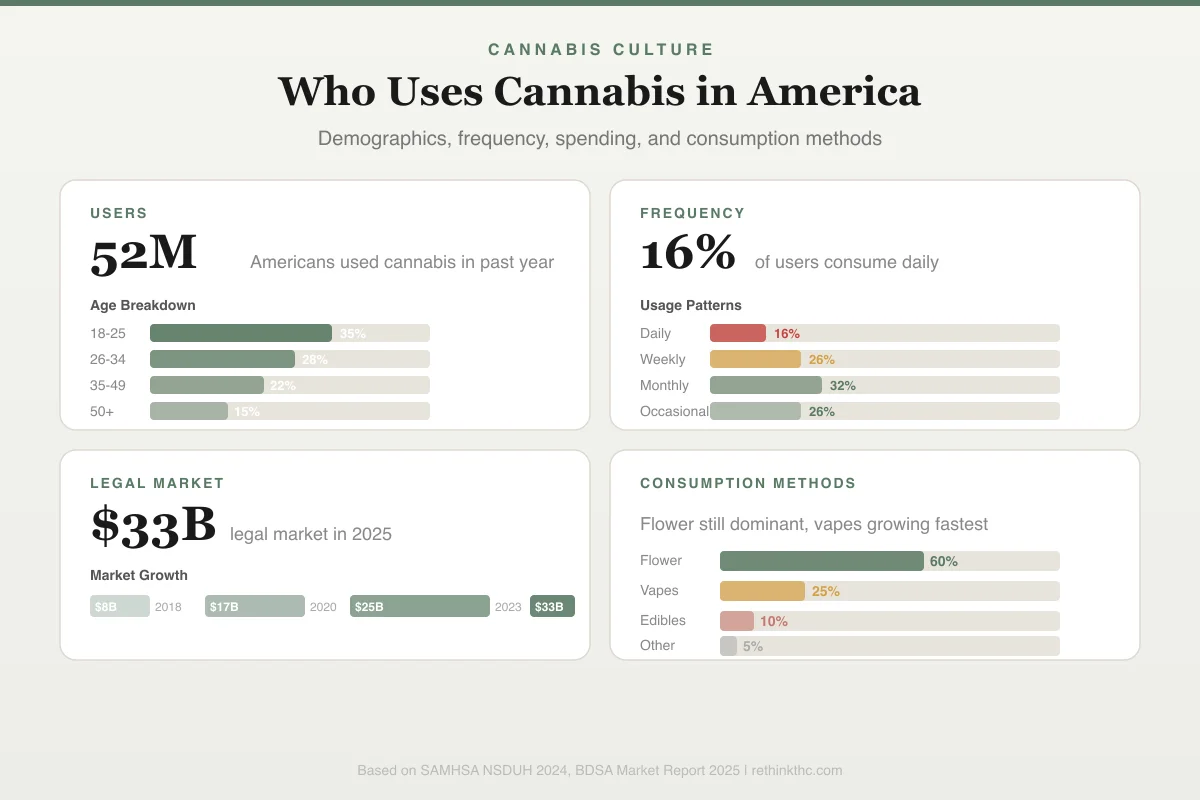
Cannabis Culture
Who Uses Cannabis in America
Demographics, frequency, spending, and consumption methods
Users
52M
Americans used cannabis in past year
Age Breakdown
Frequency
16%
of users consume daily
Usage Patterns
Legal Market
$33B
legal market in 2025
Market Growth
Consumption Methods
Flower still dominant, vapes growing fastest
Based on SAMHSA NSDUH 2024, BDSA Market Report 2025
View as image ↗This cultural shift has real psychological consequences. When something is illegal and stigmatized, using it carries a built-in friction. You have to seek it out, accept the risk, and process the social disapproval. When something is legal, marketed, and socially accepted, that friction disappears. The decision to use becomes as unremarkable as the decision to have a beer.
That is not inherently good or bad. But it does change the context in which people evaluate their own consumption. When cannabis use is normalized, the internal alarm that might have flagged escalating use gets quieter. If everyone around you uses, if there is a dispensary on your commute, if cannabis brands sponsor music festivals, then daily use can feel like a default setting rather than a decision that warrants examination.
The normalization has also created a consumer economy that actively encourages engagement. Dispensaries run loyalty programs. Subscription boxes deliver curated products monthly. Cannabis brands sponsor podcasts, athletic events, and wellness retreats. The infrastructure of cannabis culture is no longer just "people who smoke weed." It is a market that profits when you use more, use more often, and integrate use more deeply into your daily routine.
The Spectrum from Casual to Daily User
Not all cannabis users are the same, and the differences matter more than most people acknowledge. Research broadly categorizes users along a frequency spectrum, and the health implications shift significantly as you move along it.
At one end, you have occasional users. A few times a month, socially, or in specific contexts. For this group, the research on health risks is relatively reassuring. Occasional use in adults does not appear to produce lasting cognitive changes, and the risk of developing dependence is low.
At the other end, you have daily or near-daily users. This group makes up roughly 16 million Americans, according to survey data from the Substance Abuse and Mental Health Services Administration (SAMHSA). And it is this group where the research starts raising flags. A widely cited 2015 review in the journal JAMA Psychiatry (one of the top psychiatric research journals globally) found that approximately 30% of current cannabis users meet criteria for cannabis use disorder, with the risk increasing substantially among daily users.
The challenge is that the spectrum feels continuous from the inside. Nobody wakes up one day and says, "I have decided to become a daily user." It happens gradually. Weekend use becomes weeknight use. Evenings become afternoons. One session a day becomes two. The shift from casual to daily often spans months or years, and at each step, the new level feels normal because it only represents a small change from the previous one.
Cannabis culture, broadly, does not draw sharp lines along this spectrum. The culture celebrates use without much differentiation between someone who smokes once a week and someone who wakes and bakes every morning. This lack of internal differentiation is part of what makes escalation easy to miss.
Fact Check
The 'cannabis isn't addictive' claim
The claim
“Cannabis is natural and non-addictive — you can't get dependent on it”
Cannabis culture messaging, social media, comparison to 'hard drugs'
What research shows
MisleadingCannabis use disorder is recognized in both DSM-5 and ICD-11. About 9% of all users develop dependence. That number climbs to 17% for those who start as teenagers and 25-50% for daily users.
Cannabis dependence is real but looks different from opioid or alcohol dependence. There's no lethal overdose risk and withdrawal is uncomfortable but not medically dangerous. But 'less addictive than heroin' is a low bar, and the 25-50% dependence rate among daily users is not trivial.
Volkow et al. (2014), New England Journal of Medicine; Hasin et al. (2015), JAMA Psychiatry
Identity and Cannabis: When "Stoner" Becomes Who You Are
There is a meaningful psychological difference between using cannabis and identifying as a cannabis user. The first is a behavior. The second is an identity. And that distinction has real consequences for how people relate to their use.
Identity formation around cannabis follows the same psychological principles as any other identity. You adopt a label ("stoner," "cannabis enthusiast," "smoker"), you build social connections around it, you consume media that reinforces it, and you develop habits and rituals that express it. Over time, the label stops being a description of what you do and starts being a definition of who you are.
This matters because identity-level attachments are remarkably resistant to change. If cannabis is something you do, then changing your behavior requires effort but not existential upheaval. If cannabis is who you are, then changing your behavior means dismantling part of your self-concept. That is a much bigger ask.
We cover this in depth in our piece on leaving stoner culture and identity, but the short version is this: when use becomes identity, the psychological cost of reducing or quitting grows dramatically. You are not just giving up a substance. You are giving up a social group, a set of rituals, a sense of belonging, and a framework for understanding yourself. That is why identity fusion is one of the strongest predictors of difficulty cutting back.
Cannabis culture actively encourages this identity fusion. It offers clothing, art, music, humor, holidays, and online communities organized entirely around cannabis use. There is nothing inherently wrong with enjoying those things. But it is worth noticing that very few other consumable substances have this kind of identity infrastructure. Nobody builds their entire personality around drinking coffee, even though millions of people are genuinely dependent on caffeine. Cannabis culture is unique in how thoroughly it invites you to make consumption the organizing principle of your identity.
The Practical Side: Smell, Discretion, and Cost
The practical realities of regular cannabis use create a layer of daily management that is easy to underestimate from the outside. If you are living inside cannabis culture, you have likely developed systems for handling all of these. If you are evaluating your relationship with cannabis, it is worth tallying up how much energy these systems actually require.
$3,600–$5,400
Average annual cost for a 1g/day user
24 states
Legal recreational markets by 2025
70%
Americans supporting legalization (Gallup 2023)
30%
Current users meeting cannabis use disorder criteria (JAMA Psychiatry)
Peer-reviewed research
Smell Management
Cannabis smoke has one of the most recognizable and persistent odors of any commonly consumed substance. Regular users develop olfactory fatigue, meaning they become less able to detect the smell on themselves, their clothes, their cars, and their homes. But other people can. The gap between how much you think you smell and how much you actually smell is almost always larger than you estimate. We have detailed guides on getting the weed smell out of your car, removing it from clothes, eliminating it from your house, and creating a smell-proof room.
The smell management industry is itself a subcategory of cannabis culture: air purifiers, odor-eliminating sprays, scented candles, sploofs (devices you exhale through to filter smoke), specialized storage containers, and specific consumption methods chosen partly for discretion. If you are spending money and mental energy managing the smell of your use, that is a real cost. It does not make the use wrong, but it is worth counting.
Vaporizers and edibles partly solve the smell problem, which is one reason their market share has grown steadily. But switching to less detectable methods can also remove a natural check on consumption. The smell of smoke limits where and when you can use. Remove that limit, and frequency tends to increase.
Discretion and Social Navigation
Understanding cannabis etiquette and the unwritten rules of use is part of this navigation, as is knowing whether people can tell you are high. Even in legal states, cannabis use carries professional and social risks that alcohol does not. Most employers retain the right to test for and terminate employees over cannabis use, regardless of state legality. Landlords can prohibit use in rental agreements. Custody disputes can be affected by cannabis use. Federal employees, military personnel, and anyone with a security clearance cannot use legally.
This means that for many regular users, cannabis culture exists in a semi-hidden layer. You use openly with some people and conceal use from others. You have separate social groups that do not overlap. You monitor what you post online. You time your consumption around professional obligations.
This dual-life navigation is a form of cognitive overhead. It requires constant assessment of context, audience, and risk. Some people find it trivially easy. Others find it genuinely stressful. Either way, it is a real feature of living inside cannabis culture that the culture itself rarely acknowledges.
Cost
Regular cannabis use is expensive, and the math is usually worse than people think. If budget is a factor in how you consume, our guide on the cheapest ways to consume THC by cost per dose breaks down the economics across methods. The national average price for legal cannabis ranges between $10 and $15 per gram. A daily user consuming one gram per day spends roughly $300 to $450 per month, or $3,600 to $5,400 per year. Heavy users spending on concentrates, high-end flower, or multiple sessions per day can easily double those numbers.
That spending often goes unexamined because it is distributed across many small transactions. You are not writing a single $5,000 check. You are spending $30 or $50 at a time, multiple times per week. The pattern is similar to how subscription services accumulate: each one feels trivial, but the total is substantial.
We built a tool that lets you calculate exactly how much you are spending and what it costs you over time. Most people who run the numbers are surprised. Not because they did not know they were spending money, but because they never consolidated the total across months and years.
Social Dynamics of Cannabis Culture
Cannabis culture creates a specific social architecture. Smoking is often communal. Passing a joint or sharing a bowl is a bonding ritual with deep social roots. For many users, cannabis is not primarily about the high but about the social container the high creates: the circle of friends, the shared experience, the lowered inhibitions that make conversation feel easier and connection feel closer.
This social dimension is genuinely valuable. Human beings need communal rituals, shared experiences, and social lubrication. Cannabis provides all of these. The problem is not that cannabis serves these functions. The problem is when cannabis becomes the only thing serving these functions.
If your social life depends on cannabis, then cannabis is not just a recreational substance. It is your social infrastructure. And that creates a specific vulnerability: what happens when you want or need to stop? If every friendship, every gathering, and every shared activity involves cannabis, then reducing your use means reducing your social life. This is one of the most common reasons people give for returning to use after a break or an attempt to quit.
The social pressure within cannabis culture is also worth naming. It is rarely aggressive. Nobody forces you to smoke. But there is a gravitational pull. If everyone is smoking, not smoking is conspicuous. If the social norm is to get high together, staying sober requires explaining yourself. The pressure is ambient rather than direct, which makes it harder to identify and resist.
Cannabis and Productivity: The Creativity Question
One of the most persistent claims within cannabis culture is that cannabis enhances creativity. Many artists, musicians, writers, and other creative professionals credit cannabis with unlocking ideas, lowering inhibitions, and enabling a different mode of thinking.
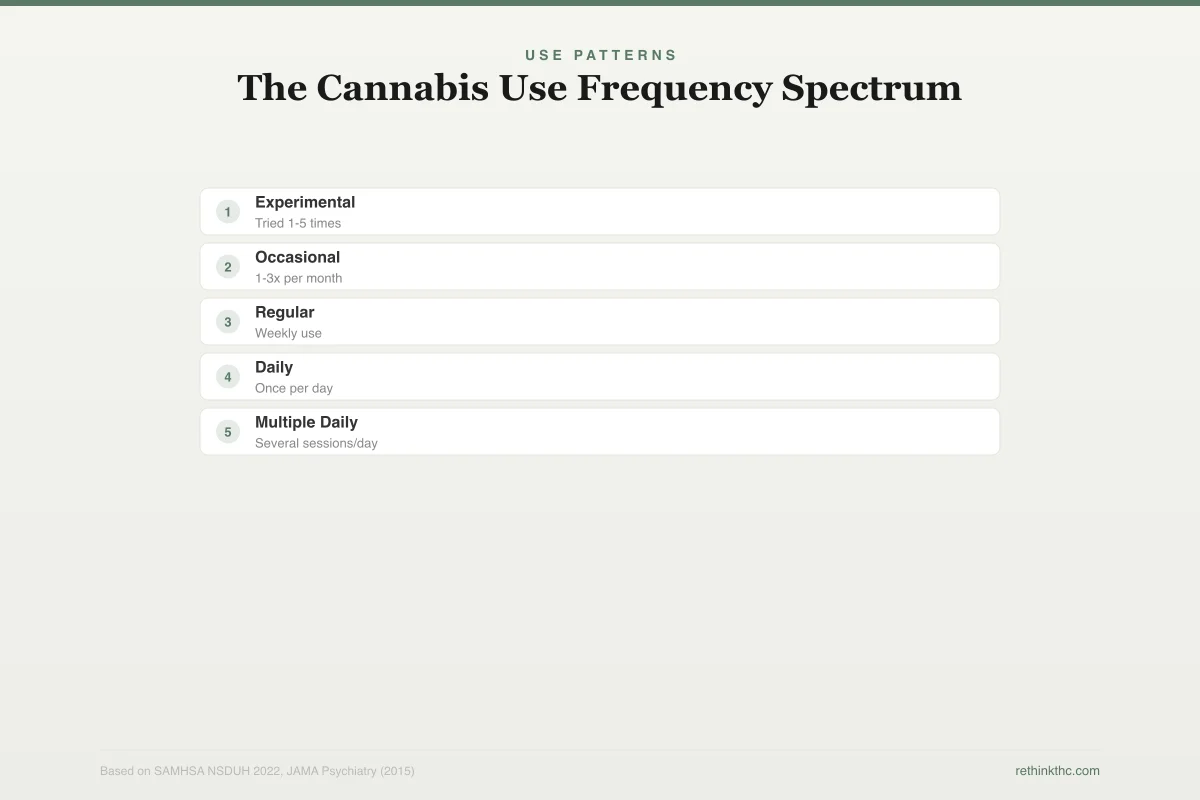
Use Patterns
The Cannabis Use Frequency Spectrum
From experimental to daily: how frequency maps to dependence risk
The funnel narrows sharply — most who try cannabis never become daily users, but those who do face 30-50% CUD rates
Based on SAMHSA NSDUH 2022, JAMA Psychiatry (2015)
 View as image ↗
The research on this is more nuanced than the culture suggests. A 2017 study published in Consciousness and Cognition found that while cannabis users often rate their ideas as more creative while high, independent evaluators do not consistently agree. The subjective experience of enhanced creativity appears to be stronger than the objective output. You feel more creative. Your work may or may not actually be more creative.
That said, creativity is notoriously difficult to measure, and individual variation is enormous. Some people genuinely do produce work while high that they value and that others value. The relevant question is not whether cannabis can ever aid creativity. It is whether you have come to believe you need cannabis to be creative. If you cannot sit down to write, paint, play music, or think creatively without first getting high, that is not a tool you are using. That is a dependency you have developed. The substance is no longer serving the creativity. The creativity is serving as justification for the substance.
The productivity question extends beyond creative work. Many daily users develop a working relationship with cannabis that involves microdosing or specific timing: a small amount before tasks, a session as a reward for completing work, a particular strain for focus. These systems can work, at least for a while. But they also create a fragile infrastructure where productivity depends on substance availability and precise dosing, a system with no built-in resilience. We explore this tension more deeply in THC and productivity: does it help or hurt? and the related question of THC and discipline. For creative professionals specifically, THC and creative work examines what the research actually shows about cannabis and artistic output. And for gamers wondering whether cannabis gives them an edge or dulls their reaction time, THC and competitive gaming covers the esports performance data.
The Lifestyle Trap: When Use Becomes the Organizing Principle
There is a pattern that develops gradually and is usually only visible in retrospect. It looks like this: you start using cannabis as an addition to your life. You smoke after work. You use on weekends. It is one part of a full day. Then, slowly, the rest of the day starts organizing itself around cannabis. You rush through obligations to get to the session. You decline invitations that would interfere with your smoking schedule. You choose activities based on whether you can use during them. You turn down opportunities that would require a drug test.
At some point, cannabis stops being something you add to your life and becomes the thing your life is built around. This is the lifestyle trap, and it is distinct from physical dependence. You may not experience withdrawal. You may not meet clinical criteria for cannabis use disorder. But your life has narrowed around a single activity, and the narrowing happened so gradually that you did not notice until a lot of options had quietly closed.
This pattern often coexists with the belief that cannabis is enhancing your life. And in some specific moments, it might be. A particular evening might genuinely be more enjoyable high. But zoom out, and the accumulated effect of organizing your days around use is a smaller life: fewer novel experiences, fewer spontaneous decisions, fewer connections with people who do not use.
The experience of not being able to enjoy anything without weed is the endpoint of this process. When your brain's reward system has been calibrated to expect THC with every pleasurable activity, the activities themselves lose their standalone appeal. The sunset is fine, but the sunset while high is what you actually want. Dinner is okay, but dinner after a session is the real experience. Over time, the unenhanced version of everything starts feeling flat.
Cannabis and Social Identity: Group Belonging
One underexplored dimension of cannabis culture is how it provides group belonging for people who might not find it elsewhere. Cannabis culture is generally welcoming, non-hierarchical, and low-barrier. You do not need to be athletic, wealthy, educated, or socially skilled to belong. You just need to smoke.
For people who struggle with social anxiety, who feel like outsiders in mainstream culture, or who have not found their group through conventional channels, cannabis culture offers a ready-made community with its own language, references, values, and rituals. This is not trivial. Belonging is a fundamental human need, and cannabis culture meets it effectively.
The risk is that this belonging becomes contingent on continued use. If you stop using, do you still belong? In practice, the answer is often complicated. Your friends may not explicitly exclude you, but the shared activity that brought you together is gone. The conversations shift. The inside jokes lose their context. The hangouts feel different when you are the only sober person in the room.
This is why evaluating your relationship with cannabis is not just about the substance. It is about everything the substance is connected to. If cannabis is your social glue, your creative catalyst, your stress management tool, your entertainment enhancer, and your identity marker, then it is carrying a load that no single substance should carry. And the heavier that load, the harder it becomes to set it down.
Knowing When Culture Becomes Dependence
Cannabis culture does not have a built-in mechanism for flagging problematic use. Alcohol culture, for all its flaws, at least has the concept of the "alcoholic" as a recognized warning. Cannabis culture largely resists the idea that cannabis use can become a problem. The prevailing narrative is that cannabis is natural, non-addictive, and harmless, and that anyone who develops a problematic relationship with it had pre-existing issues.
This narrative is contradicted by substantial evidence. Cannabis use disorder is a recognized condition in the DSM-5 and ICD-11 (the two major diagnostic systems used globally). Approximately 9% of all people who try cannabis develop dependence, a number that rises to roughly 17% among those who start in adolescence and to 25-50% among daily users, according to research published in the New England Journal of Medicine.
Evidence Review
Where the evidence stands
Neurobiological Mechanisms
CB1 receptor downregulation, reward circuit adaptation, and tolerance are well-documented
Animal Models of Dependence
Rodent studies confirm withdrawal syndrome and compulsive use patterns
Clinical Case Reports
Cannabis use disorder recognized in DSM-5 and ICD-11
Epidemiological Surveys
NEJM: 9% overall, 17% teen starters, 25-50% daily users develop dependence
Large Population Studies
JAMA Psychiatry: ~30% of current users meet CUD criteria; SAMHSA: ~16M daily users in U.S.
Meta-Analyses
Bahji 2020: 47% withdrawal prevalence among regular users (23 studies, 27K participants)
The evidence that cannabis can cause dependence is strong and consistent across every level of research. This is not debated in the scientific literature. What varies is the rate — occasional adult users face low risk, while daily users face rates comparable to alcohol.
Volkow et al. (2014), NEJM; Hasin et al. (2015), JAMA Psychiatry; Bahji et al. (2020), JAMA Network Open
So how do you know if your relationship with cannabis has crossed from lifestyle choice to dependence? The clinical criteria focus on a set of observable patterns: using more than you intend, unsuccessful attempts to cut back, spending significant time obtaining or using, cravings, failure to fulfill obligations, continued use despite social or interpersonal problems caused by use, giving up activities, using in hazardous situations, continued use despite physical or psychological problems, tolerance, and withdrawal.
But the simplest diagnostic question is also the most honest: can you comfortably not use on any given day? Not "can you go without if you have to" but "can you choose not to use and feel genuinely fine about it?" If the answer is no, if skipping a day feels like deprivation rather than a neutral choice, then your use has moved past the lifestyle category regardless of how it looks from the outside.
There are tools and apps designed to help you evaluate and track your use if you want a more structured self-assessment. But the honest internal check is usually sufficient. You already know the answer. The question is whether you are willing to sit with it.
Safety
LowThe escalation is gradual — that's what makes it hard to see
Concern
The shift from casual to daily use typically happens over months or years, with each step feeling like a small, normal change. Cannabis culture does not differentiate between someone who uses once a week and someone who uses every morning, which removes the social cues that might otherwise flag escalation.
What the research says
The shift is reversible. Most people who recognize the pattern and decide to change can reduce or stop, especially if use hasn't progressed to severe cannabis use disorder. The first step is an honest assessment of where you actually are on the spectrum.
Particularly relevant for: Regular cannabis users who have noticed their use gradually increasing over time
What to do
Try the one-day test: skip your next planned session and notice how it feels. If it feels like nothing, you're fine. If it feels like something is missing, that's useful information worth sitting with.
Volkow et al. (2014), New England Journal of Medicine
Moving Forward: A Framework for Honest Self-Assessment
Cannabis culture, like any culture, is a mix of genuine value and real risk. It offers community, ritual, relaxation, and a different way of experiencing the world. It also carries the potential for dependence, identity fusion, social narrowing, and financial drain. Both of these things are true at the same time.
The goal of this guide is not to tell you what to do. It is to give you a clearer picture of what you are actually doing. The practical costs, the social architecture, the identity dynamics, the productivity trade-offs, and the line between choice and compulsion. These are things that cannabis culture itself rarely examines honestly, because examining them honestly might lead to reduced use, and the culture (like any culture built around a consumable product) has a structural incentive against that.
Your framework for evaluation does not need to be complicated. Three questions cover most of the territory:
What is cannabis adding to my life? Be specific. Not "it helps me relax," but "on Tuesday I was stressed about a deadline and I smoked and felt less anxious for two hours." Specificity prevents the vague positive halo that makes all use feel justified.
What is cannabis costing me? Again, be specific. Money, time, motivation, sleep quality, relationships, career opportunities, physical health. Add it up. Compare the total cost to the total benefit. Most people have never done this calculation explicitly.
Can I freely choose not to use? Not in theory. In practice. Skip tonight. Skip this weekend. See how it feels. If it feels like nothing, your relationship with cannabis is probably a genuine choice. If it feels like something is missing, like the day is incomplete, like you are depriving yourself, that is worth paying attention to.
Cannabis culture is not going anywhere. It will continue to grow, normalize, and commercialize. Your job is not to reject it or embrace it wholesale. Your job is to be honest with yourself about where you stand within it, and whether where you stand is where you actually want to be.
Research Gaps
What would it take?
What would it take to understand the real impact of cannabis culture on use patterns?
Longitudinal study tracking how cultural normalization affects use frequency over time
Current data is cross-sectional — we see correlation, not causation
Research on how cannabis marketing and loyalty programs affect consumption rates
Alcohol and tobacco marketing studies exist; cannabis-specific data is just emerging
Study of identity fusion as a risk factor for cannabis use disorder
Identity-substance research exists for alcohol but barely for cannabis
Controlled comparison of dependence rates in legal vs. non-legal states over 5+ years
Early data emerging as more states legalize, but long follow-up is needed
Assessment based on current cannabis policy and epidemiological literature
The Bottom Line
Pillar covering practical, social, and psychological dimensions of cannabis culture. Normalization: 0 legal states in 2010 → 24 + D.C. by 2025; Gallup 2023: 70% support legalization; consumer economy (dispensaries, subscriptions, sponsorships) actively encourages increased engagement. User spectrum: occasional (low risk) to daily (~16M Americans per SAMHSA); JAMA Psychiatry 2015: ~30% of current users meet CUD criteria, higher among daily users. Escalation happens gradually — culture doesn't differentiate frequency levels. Identity fusion: when "stoner" moves from behavior to identity, changing use requires dismantling self-concept, not just stopping a habit. Cannabis culture uniquely invites identity fusion (clothing, holidays, media, communities organized around use). Practical costs: smell management (olfactory fatigue gap — you smell more than you think), discretion/social navigation (dual-life cognitive overhead), financial ($300-450/month for 1g/day, $3,600-5,400/year). Social dynamics: communal ritual value but vulnerability when cannabis = only social infrastructure; ambient rather than direct pressure. Creativity: 2017 Consciousness and Cognition — subjective creativity enhancement stronger than objective output. Lifestyle trap: life organizing around use rather than use fitting into life; endpoint = can't enjoy anything without weed. Dependence check: NEJM — 9% of all users, 17% adolescent starters, 25-50% daily users develop dependence. Key question: can you comfortably choose not to use on any given day?
Is cannabis culture encouraging people to use more?
Yes, structurally. The cannabis consumer economy, which includes dispensary loyalty programs, subscription boxes, branded merchandise, influencer marketing, and event sponsorships, is designed to increase engagement and purchase frequency. This is not unique to cannabis — it is how consumer markets work. But recognizing that the cultural environment is engineered to encourage consumption helps you evaluate your own use more honestly rather than treating it as purely a personal choice made in a vacuum.
How do I know if my cannabis use is a lifestyle choice or a dependence?
The simplest test is whether you can comfortably choose not to use on any given day. Not whether you can force yourself to abstain, but whether skipping a day feels like a neutral decision rather than a deprivation. If not using feels like something is missing or the day is incomplete, your relationship with cannabis has likely moved past the lifestyle category. Clinical criteria for cannabis use disorder include using more than intended, unsuccessful attempts to cut back, cravings, tolerance, and continued use despite negative consequences.
How much does regular cannabis use actually cost per year?
At national average dispensary prices of $10 to $15 per gram, a daily user consuming one gram per day spends roughly $3,600 to $5,400 per year. Heavy users or those who prefer concentrates and premium products can easily spend $7,000 to $10,000 annually. The spending is often underestimated because it is distributed across many small transactions rather than paid as a single sum.
Can cannabis culture exist without substance use?
The social, creative, and community dimensions of cannabis culture are real and valuable independent of the substance itself. Many people in recovery maintain connections to elements of cannabis culture, including music, art, and community, while abstaining from use. The question is whether your participation in the culture is contingent on active use. If it is, the culture is functioning as a dependency support system rather than a genuine lifestyle choice.
Does cannabis actually make you more creative?
The research is mixed. A 2017 study in Consciousness and Cognition found that while cannabis users rate their own ideas as more creative while high, independent evaluators do not consistently agree. The subjective experience of enhanced creativity is stronger than the objective output. Some individuals genuinely produce valued work while using, but if you cannot create without cannabis, the substance has become a dependency rather than a tool.
Why is it so hard to quit when cannabis is part of your identity?
When cannabis transitions from a behavior to an identity, quitting requires dismantling part of your self-concept, not just stopping a substance. You lose a social group, a set of rituals, a sense of belonging, and a framework for understanding yourself. This identity fusion is one of the strongest predictors of difficulty cutting back. Recognizing that your identity existed before cannabis and will exist after it is the first step, but rebuilding takes time and deliberate effort.
Sources & References
- 1RTHC-06041·Bellows, Zachary et al. (2025). “Bisexual Women in Canada Had the Highest Cannabis Use Disparities.” PloS one.Study breakdown →PubMed →↩
- 2RTHC-08095·Austin, Emily A C et al. (2026). “1 in 3 CBD Users Take It Instead of or Alongside Conventional Medications.” Frontiers in public health.Study breakdown →PubMed →↩
- 3RTHC-08286·González-Roz, Alba et al. (2026). “CBD Product Users Are Primed to Try Cannabis If Legalized.” Drug and alcohol review.Study breakdown →PubMed →↩
- 4RTHC-05992·Bacong, Adrian Matias et al. (2025). “Racial Discrimination Linked to Cannabis Coping Among Asian Americans During COVID.” BMC public health.Study breakdown →PubMed →↩
- 5RTHC-06040·Belloir, Joseph et al. (2025). “Cannabis Use Linked to Depression and Anxiety in Sexual Minority Young Men.” AIDS education and prevention : official publication of the International Society for AIDS Education.Study breakdown →PubMed →↩
- 6RTHC-06107·Boyle, Holly K et al. (2025). “College Students Drank More Heavily on Days They Also Used Cannabis.” Alcohol.Study breakdown →PubMed →↩
- 7RTHC-06170·Castillo-Toledo, Consuelo et al. (2025). “Twitter analysis finds most cannabis discussions are political, with majority favoring legalization worldwide.” JMIR infodemiology.Study breakdown →PubMed →↩
- 8RTHC-06183·Chang, Kyle et al. (2025). “Black men who have sex with men reported more cannabis use and lower ability to refuse cannabis than other Black men.” Substance use & misuse.Study breakdown →PubMed →↩