Lifestyle & Identity
HEPA + Carbon
Cannabis smoke leaves fat-soluble terpenes that soak into surfaces and HVAC systems, which is why air fresheners only mask the smell and effective removal requires HEPA filtration with activated carbon.
Cherian et al., Indoor Air, 2026
The Chemistry of Cannabis Odor
covered in detail
Why the Smell Lingers in Your House
covered in detail
What Does Not Work and Why
covered in detail
Cherian et al., Indoor Air, 2026
 View as image ↗
Cannabis smoke produces a distinctive, persistent odor that is immediately recognizable and notoriously difficult to eliminate. Understanding why this smell lingers requires knowing what compounds are involved and how they interact with household surfaces. Once you understand the chemistry, the effective removal methods make intuitive sense and the ineffective ones become obviously inadequate.
Key Takeaways
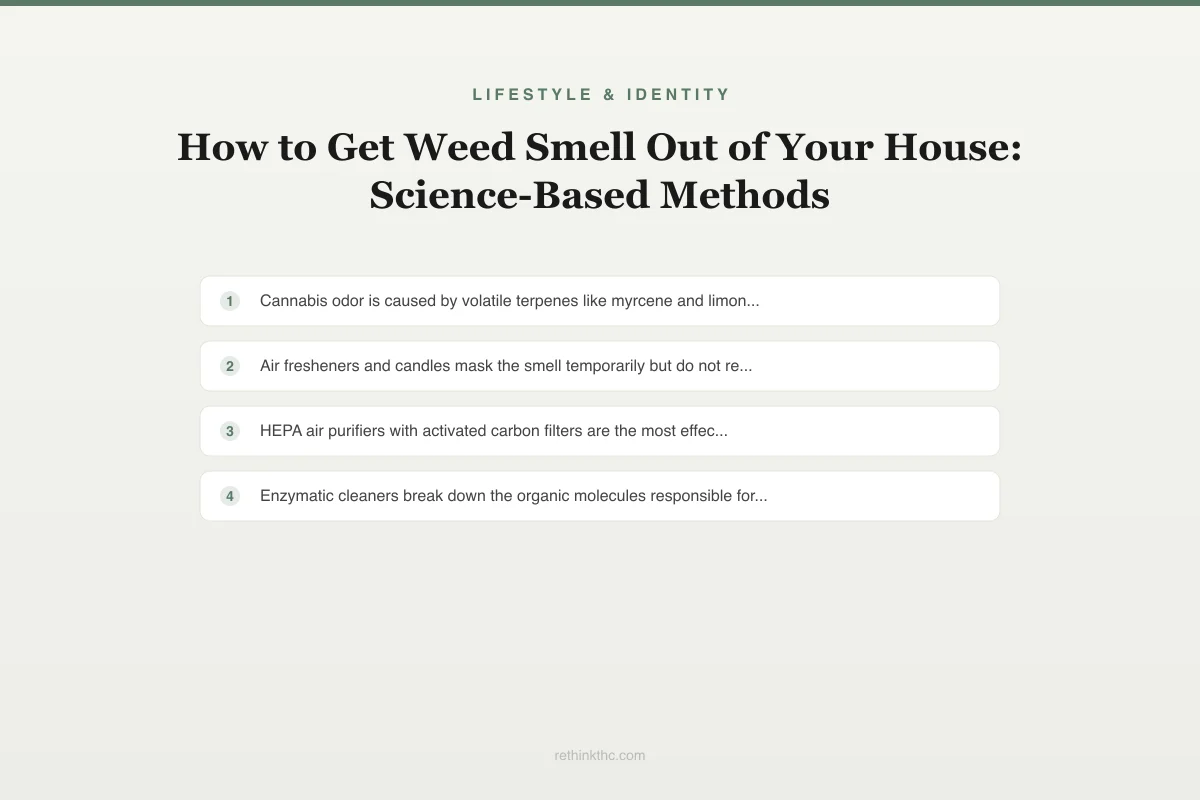
- Cannabis odor comes from volatile terpenes like myrcene and limonene mixed with combustion byproducts, and these compounds are fat-soluble — so they soak into soft surfaces instead of just floating in the air
- Air fresheners and candles only mask the smell temporarily and do not remove the compounds causing it, which is why the odor comes back once the fragrance fades
- HEPA air purifiers with activated carbon filters are the most effective ongoing solution because they catch both smoke particles and the volatile organic compounds that carry the smell
- Enzymatic cleaners break down the actual molecules causing the odor instead of covering them up, making them far more effective than standard household cleaners on fabrics and upholstery
- Prevention beats cleanup every time — using a dry herb vaporizer instead of combustion or setting up a dedicated ventilated space is far more effective than any after-the-fact cleaning method
- Your HVAC system is one of the most overlooked odor sources because smoke particles build up on filters, ductwork, and evaporator coils, then get redistributed through the entire house every time the system runs
The Chemistry of Cannabis Odor
Odor Science
Removal Methods Ranked by Effectiveness
Actual compound removal vs. temporary masking
earthy, musky
citrus
pine
combustion
clings to fibers
Prevention (vaporizer) eliminates 80%+ of odor at the source
Weed Smell Removal MethodsThe smell of cannabis comes from two primary sources: terpenes and combustion byproducts. Terpenes are aromatic compounds naturally present in the cannabis plant. The most abundant include myrcene (earthy, musky), limonene (citrus), pinene (pine), and linalool (floral). These compounds are volatile, meaning they evaporate readily at room temperature and disperse into the air. This is why even unsmoked cannabis has a noticeable aroma.
When cannabis is combusted, the terpene profile changes. Some terpenes are destroyed by heat while new compounds are created through pyrolysis, the chemical decomposition of organic material at high temperatures. Combustion produces particulate matter, carbon monoxide, polycyclic aromatic hydrocarbons, and a range of volatile organic compounds that collectively create that distinct "smoked weed" smell that differs from the scent of fresh flower.
The critical property that makes cannabis odor so persistent is lipophilicity. Terpenes and many combustion byproducts are fat-soluble rather than water-soluble. This means they preferentially bind to organic materials: fabric fibers, paint, wood, carpet padding, leather, and any surface with a lipid component. Water-based cleaning alone does not effectively dissolve or remove these compounds, which is why simply wiping down surfaces with a damp cloth has minimal effect.
Why the Smell Lingers in Your House
Several factors make residential spaces particularly prone to retaining cannabis odor.
Soft surfaces act as reservoirs. Couches, curtains, carpets, bedding, and clothing all absorb terpenes and smoke particles. These surfaces have enormous combined surface area and are composed of fibers that trap volatile compounds in their matrix. The smell does not just sit on top of these surfaces. It absorbs into them, and it continues to off-gas slowly over time, which is why a room can smell like cannabis days or weeks after the last session.
HVAC systems recirculate contaminated air. If you smoke indoors, the smoke particles are pulled into your heating and cooling system, depositing residue on filters, ductwork, and the evaporator coil. Every time the system runs, it redistributes trace amounts of these compounds throughout the house. This is one of the most overlooked sources of persistent odor.
Walls and ceilings accumulate residue. Just as cigarette smoke creates a yellowish film on walls over time, cannabis smoke deposits a thin layer of tar and terpene residue on painted surfaces. Flat and matte paint finishes absorb more than semi-gloss or gloss finishes because of their porous texture.
Enclosed spaces concentrate odor. Small rooms, closets, and bathrooms with poor ventilation allow smoke compounds to reach higher concentrations, increasing the amount that absorbs into surrounding surfaces during each session.
What Does Not Work and Why
Air fresheners and scented candles. These products add fragrance molecules to the air that temporarily mask the cannabis odor. They do not break down, neutralize, or remove the terpenes and combustion compounds. Once the masking fragrance dissipates, the cannabis smell returns. Aerosol sprays like Febreze contain cyclodextrin, which can trap some odor molecules, but this effect is temporary and insufficient for absorbed compounds.
Incense. Burning incense adds its own combustion byproducts to the air, creating a mixed odor profile that may be less distinctively cannabis-like but does not eliminate the underlying compounds. It can actually make the overall odor problem worse by adding additional residue to surfaces.
Opening windows briefly. A few minutes of ventilation helps with airborne smoke but does nothing for compounds already absorbed into surfaces. Meaningful ventilation requires sustained air exchange, not a brief window opening.
What Actually Works: Airborne Odor
HEPA air purifier with activated carbon filter. This is the single most effective tool for managing airborne cannabis odor. HEPA filters capture particulate matter down to 0.3 microns, removing smoke particles from the air. The activated carbon layer adsorbs volatile organic compounds including terpenes. For effective coverage, size the purifier to your room. Most manufacturers list recommended square footage. Run it continuously in the room where you consume, not just during sessions.
Sustained cross-ventilation. Opening windows on opposite sides of the space creates actual air exchange rather than just drafts. A box fan placed in one window blowing outward while another window is open creates negative pressure in the room, actively pulling fresh air through the space. This is significantly more effective than simply cracking a window.
Ozone generators. Ozone (O3) is a powerful oxidizer that breaks down organic compounds including terpenes and combustion byproducts at the molecular level. Commercial ozone generators used by fire restoration companies can eliminate cannabis odor from a room in 24 to 48 hours. However, ozone is harmful to breathe. The space must be completely unoccupied during treatment, including by pets and plants. Follow manufacturer guidelines precisely. This is an aggressive approach best reserved for situations where the odor has accumulated over months or years.
What Actually Works: Surface-Absorbed Odor
Enzymatic cleaners on fabrics. Enzymatic cleaners contain biological enzymes that break down organic molecules. Products designed for pet odor removal (which target urine's organic compounds) are effective on cannabis odor for the same reason: they disassemble the molecules causing the smell rather than masking them. Apply to upholstery, carpet, and curtains according to product directions.
Vinegar solution on hard surfaces. White vinegar (acetic acid) is mildly acidic and water-soluble, but it effectively cuts through the oily terpene residue on hard surfaces. A 1:1 vinegar-to-water solution wiped on walls, countertops, and hard floors removes surface-level residue. Follow with a clean water wipe to remove the vinegar smell.
TSP (trisodium phosphate) for walls. For heavy residue on painted walls, TSP dissolved in water is the standard approach used by professional painters preparing smoke-damaged walls for repainting. It removes the residue layer effectively. Wear gloves and ensure ventilation. In many cases, repainting with a stain-blocking primer like Kilz after TSP cleaning is necessary for heavily contaminated walls.
Steam cleaning carpets and upholstery. Professional steam cleaning reaches deep into carpet padding and upholstery foam where terpene compounds have absorbed. The combination of heat and moisture helps release trapped compounds, and the extraction process removes them. This is more effective than surface shampooing because it addresses the depth of absorption.
Washing machine for fabrics. For washable items like curtains, throw blankets, and pillow covers, wash on the hottest setting the fabric allows with an enzyme-based detergent. Adding half a cup of white vinegar to the rinse cycle helps dissolve remaining residue. Some items may require two wash cycles.
HVAC System Considerations
If you have been smoking indoors regularly, your HVAC system is part of the problem. Replace the air filter with a high-MERV rated filter (MERV 13 or higher). Consider having the ductwork professionally cleaned, which typically costs $300 to $500 and removes accumulated residue from the entire system. Clean or replace the filter on any window AC units. The evaporator coil in central systems can also accumulate residue and may need professional cleaning.
Going forward, running the system fan continuously (not just when heating or cooling) with a high-quality filter helps capture airborne particles before they settle on surfaces.
Prevention Strategies
The most effective odor management is prevention, not remediation.
Switch to a dry herb vaporizer. Vaporization heats cannabis below combustion temperature, releasing terpenes and cannabinoids without producing the tar, particulate matter, and many of the combustion byproducts that cause the heaviest odor. The smell from vaporization is noticeably less intense, dissipates faster, and absorbs less into surfaces. It is not odorless, but the difference is substantial.
Create a dedicated, ventilated consumption space. If you smoke rather than vaporize, designating one room with a window fan creating negative pressure, a carbon-filter air purifier running continuously, and minimal soft surfaces dramatically reduces odor spread to the rest of the house.
Use a smoke buddy or sploof. These are personal carbon filters you exhale through. Commercial versions like the Smoke Buddy contain activated carbon and capture a significant portion of exhaled smoke compounds. DIY versions using dryer sheets stuffed in a toilet paper roll are less effective but better than nothing.
Seal the consumption room. Draft stoppers under doors, closed HVAC vents in the room (to prevent contaminating the ductwork), and towels along door gaps all reduce odor migration to other parts of the house.
Consider edibles or tinctures. These consumption methods produce no smoke or vapor and therefore no airborne odor. The cannabis itself has a smell when handled, but it does not permeate a room the way combustion or even vaporization does.
A Practical Cleaning Protocol
For a thorough odor removal from a room that has been regularly used for smoking:
First, remove all washable fabrics and launder them with enzyme detergent and vinegar rinse. Second, vacuum all carpets and upholstery thoroughly. Third, apply enzymatic cleaner to carpets, upholstery, and any fabric that cannot be machine washed. Fourth, clean all hard surfaces including walls and ceiling with vinegar solution or TSP. Fifth, replace HVAC filters. Sixth, run a HEPA plus carbon air purifier continuously for several days. Seventh, if odor persists after these steps, consider professional ozone treatment or steam cleaning.
This protocol addresses both the airborne and absorbed components of cannabis odor. For most situations involving weeks to months of regular indoor smoking, the combination of enzymatic cleaning, surface washing, and continuous air purification resolves the odor within one to two weeks. For years of heavy indoor smoking, professional remediation including ozone treatment and repainting may be necessary.
The fundamental principle is straightforward: cannabis odor is caused by specific chemical compounds with known properties, and removing it requires methods that target those properties rather than methods that simply add competing fragrances to the air.
The Bottom Line
Science-based guide to removing cannabis odor from homes covering chemistry, why smell lingers, ineffective methods, effective airborne solutions, surface-absorbed solutions, HVAC considerations, and prevention. Chemistry: terpenes (myrcene, limonene, pinene, linalool) + combustion byproducts (PAHs, particulate, VOCs); lipophilic = bind to organic materials not water; absorb into fabric fibers, paint, wood, carpet. Why lingers: soft surfaces as reservoirs (off-gas slowly); HVAC recirculates contaminated air; walls/ceilings accumulate tar/terpene residue; enclosed spaces concentrate compounds. Ineffective: air fresheners/candles (mask only), incense (adds more combustion residue), brief window opening (no surface effect). Effective airborne: HEPA + activated carbon purifier (particles + VOCs); sustained cross-ventilation with box fan negative pressure; ozone generators (powerful oxidizer, space must be unoccupied). Effective surface: enzymatic cleaners on fabrics (break down organic molecules); vinegar solution on hard surfaces (cuts oily terpene residue); TSP for heavily contaminated walls; steam cleaning carpets/upholstery (reaches deep padding); hot wash + enzyme detergent + vinegar rinse for washables. HVAC: replace filter with MERV 13+; professional duct cleaning ($300-500); clean/replace window AC filters. Prevention: dry herb vaporizer (no combustion byproducts); dedicated ventilated room with carbon purifier; smoke buddy/sploof; sealed room (draft stoppers, closed vents); edibles/tinctures = no airborne odor.
What is the fastest way to get weed smell out of your house?
The fastest combination is opening windows on opposite sides with a box fan blowing outward to create negative pressure (clearing airborne compounds in minutes), while simultaneously running a HEPA air purifier with an activated carbon filter. This addresses the airborne component within hours. For surface-absorbed odor, spray enzymatic cleaner on upholstery and carpets and wipe hard surfaces with a 1:1 vinegar-water solution. Replace your HVAC filter immediately. Complete elimination from surfaces takes days to weeks depending on saturation level, but these steps produce noticeable improvement within the first day.
Why does my house still smell like weed after cleaning?
Cannabis terpenes are lipophilic (fat-soluble), meaning they absorb deep into fabric fibers, carpet padding, paint, and wood rather than sitting on surfaces. Standard water-based cleaning does not dissolve these compounds. Additionally, your HVAC system may be redistributing cannabis residue from contaminated filters and ductwork every time it runs. The most commonly missed sources are the HVAC filter, carpet padding (not just the carpet surface), and walls where flat or matte paint has absorbed terpene residue over time. Enzymatic cleaners, TSP for walls, and HVAC filter replacement address these deeper reservoirs.
Do air fresheners or candles actually remove weed smell?
No. Air fresheners, scented candles, and incense add fragrance molecules that temporarily mask the cannabis odor but do not break down, neutralize, or remove the terpenes and combustion compounds causing it. Once the masking fragrance dissipates, the cannabis smell returns unchanged. Incense actually worsens the problem by adding its own combustion byproducts to surfaces. Even Febreze, which contains cyclodextrin that can temporarily trap some odor molecules, provides only short-term relief and cannot reach compounds absorbed deep into fabrics and padding.
Does an ozone generator remove weed smell from a house?
Yes, ozone generators are the most thorough solution for heavily saturated spaces. Ozone (O3) is a powerful oxidizer that breaks down terpenes and combustion byproducts at the molecular level. Commercial units used by fire restoration companies can eliminate cannabis odor in 24 to 48 hours. However, the space must be completely unoccupied during treatment — ozone is harmful to breathe at effective concentrations, and pets and plants must also be removed. For best results, deep clean all surfaces first to physically remove as much contaminated material as possible, then use ozone to neutralize what remains.
How do you get weed smell out of carpet and upholstery?
Use enzymatic cleaners, not standard carpet shampoo. Enzymatic products contain biological enzymes that break down the organic terpene molecules causing the odor rather than masking them. Apply generously, work in with a soft brush, allow to dwell 15-30 minutes, then extract with a wet-dry vacuum. For deep saturation, professional steam cleaning is more effective because it reaches carpet padding where compounds have absorbed. Baking soda is a legitimate supplementary step — sprinkle on carpets and upholstery, leave several hours or overnight, then vacuum — but it is insufficient as a standalone solution for heavy odor.
How do you prevent weed smell from building up in your house?
The most effective prevention strategies in order of impact: switch from combustion to a dry herb vaporizer (dramatically less odor and residue), designate one room with a window fan creating negative pressure and a carbon-filter air purifier running continuously, use a personal carbon filter like a Smoke Buddy when exhaling, seal the consumption room with draft stoppers and closed HVAC vents to prevent odor migration and duct contamination, and keep soft surfaces minimal in that room. Edibles and tinctures eliminate airborne odor entirely. Prevention is far more effective than any after-the-fact cleaning method.
Sources & References
- 1RTHC-08165·Cherian, Sujith V et al. (2026). “Smoking Cannabis with Tobacco Changes Lung Disease Patterns in COPD Patients.” Heart & lung : the journal of critical care.Study breakdown →PubMed →↩
- 2RTHC-08205·Dawson, Danielle et al. (2026). “Cannabis Consumers Prefer Simple THC Dose Labels Over Percentages.” The International journal on drug policy.Study breakdown →PubMed →↩
- 3RTHC-07610·Seekins, Caleb A et al. (2025). “Cannabis Terpenes Relieved Surgical and Fibromyalgia Pain in Mice via Non-Cannabinoid Pathway.” Pharmacological reports : PR.Study breakdown →PubMed →↩