Withdrawal & Recovery
2 Days
Cannabis withdrawal anxiety peaks between days 2 and 6, and these nine timed techniques from 30 seconds to 30 minutes bridge the gap until your CB1 receptors begin recovering.
Budney et al., Journal of Abnormal Psychology, 2003
2 days
Your brain starts rebuilding CB1 receptors within 2 days of
30-Second Techniques
covered in detail
5-Minute Techniques
covered in detail
Budney et al., Journal of Abnormal Psychology, 2003
 View as image ↗
If you only read one thing
Withdrawal anxiety is your brain's alarm system going haywire because it lost the thing that was keeping it artificially calm. It peaks around days 2 to 6, then fades. You don't need to understand why it's happening to manage it — you need something to do right now. This page gives you nine techniques sorted by how much time you have: 30 seconds, 5 minutes, or 30 minutes. The physical ones (cold water, breathing, walking) work fastest because they talk directly to your nervous system.
Key Takeaways
- Cannabis withdrawal anxiety is a documented brain event, not a personal failing — and it peaks between days 2 and 6 after quitting
- Having specific techniques matched to how much time you have (30 seconds, 5 minutes, 30 minutes) turns anxiety spikes from overwhelming into manageable
- Physical tools like cold water, breathing patterns, and exercise work faster than mental strategies because they plug directly into your nervous system
- What you avoid during an anxiety spike matters as much as what you do — certain common behaviors reliably make withdrawal anxiety worse
- These techniques are not a replacement for professional help if your anxiety is severe, persistent, or comes with thoughts of self-harm
- Your brain starts rebuilding CB1 receptors within 2 days of quitting, and these techniques bridge the gap until your natural anxiety regulation comes back online around day 28
Anxiety during cannabis withdrawal is not a vague emotional experience. It is a measurable neurological event with a predictable timeline. A 2003 study by Budney and colleagues, published in the Journal of Abnormal Psychology, documented that withdrawal symptoms including anxiety begin within 1 to 3 days of last use and peak between days 2 and 6.[1] A 2009 review by Crippa and colleagues, published in Human Psychopharmacology, confirmed that cannabis directly modulates the brain's anxiety circuits[2], meaning that removing it after regular use creates a rebound effect in those same systems.
| Time Available | Technique | How It Works |
|---|---|---|
| 30 seconds | Box breathing (4-4-4-4) | Activates parasympathetic nervous system; slows heart rate |
| 30 seconds | 5-4-3-2-1 grounding | Anchors attention to sensory input; interrupts thought spirals |
| 30 seconds | Cold water on wrists/face | Triggers dive reflex; fastest physiological intervention available |
| 5 minutes | Progressive muscle relaxation | Tense-and-release resets nervous system tension baseline |
| 5 minutes | Guided imagery (specific safe place) | Activates prefrontal safety circuits; counters amygdala overdrive |
| 5 minutes | One-sentence journal prompt | Moves processing from amygdala to prefrontal cortex; names the emotion |
| 30 minutes | Walk outside | Increases endocannabinoid production; addresses the actual deficit |
| 30 minutes | Call or text someone | Interrupts isolation-driven anxiety spiral |
| 30 minutes | Contrast shower (warm/cool) | Temperature shifts engage autonomic nervous system; breaks feedback loop |
This article is designed as a reference card. Bookmark it. When you are in the middle of an anxiety spike during withdrawal, pull it up and pick the technique that matches how much time you have. Each one is kept short on purpose. You do not need a deep explanation when your heart is racing. You need something to do right now.
For a broader look at why withdrawal produces anxiety and how long it lasts, see the full guide on weed withdrawal and anxiety. For strategies that extend beyond the acute withdrawal window, see managing anxiety without weed.
Budney et al. (2003) · J Abnormal Psychology
- Population
- 18 heavy cannabis users tracked over 50 days (5-day use phase + 45-day abstinence)
- Intervention
- Complete cannabis cessation with daily symptom monitoring
- Comparator
- 12 former cannabis users (ex-user control group)
- Finding
- Withdrawal symptoms including anxiety, irritability, and sleep problems began days 1-3, peaked days 2-6, and most resolved within 4-14 days — comparable in severity to tobacco withdrawal
positive Small sample but foundational — established the withdrawal timeline that subsequent research has consistently replicated
Budney et al. (2003), Journal of Abnormal Psychology, 112(3), 393-402
30-Second Techniques
These are for the moments when anxiety hits hard and fast. You might be at work, in a store, or lying in bed at 2 AM. You need something immediate.
Withdrawal Anxiety
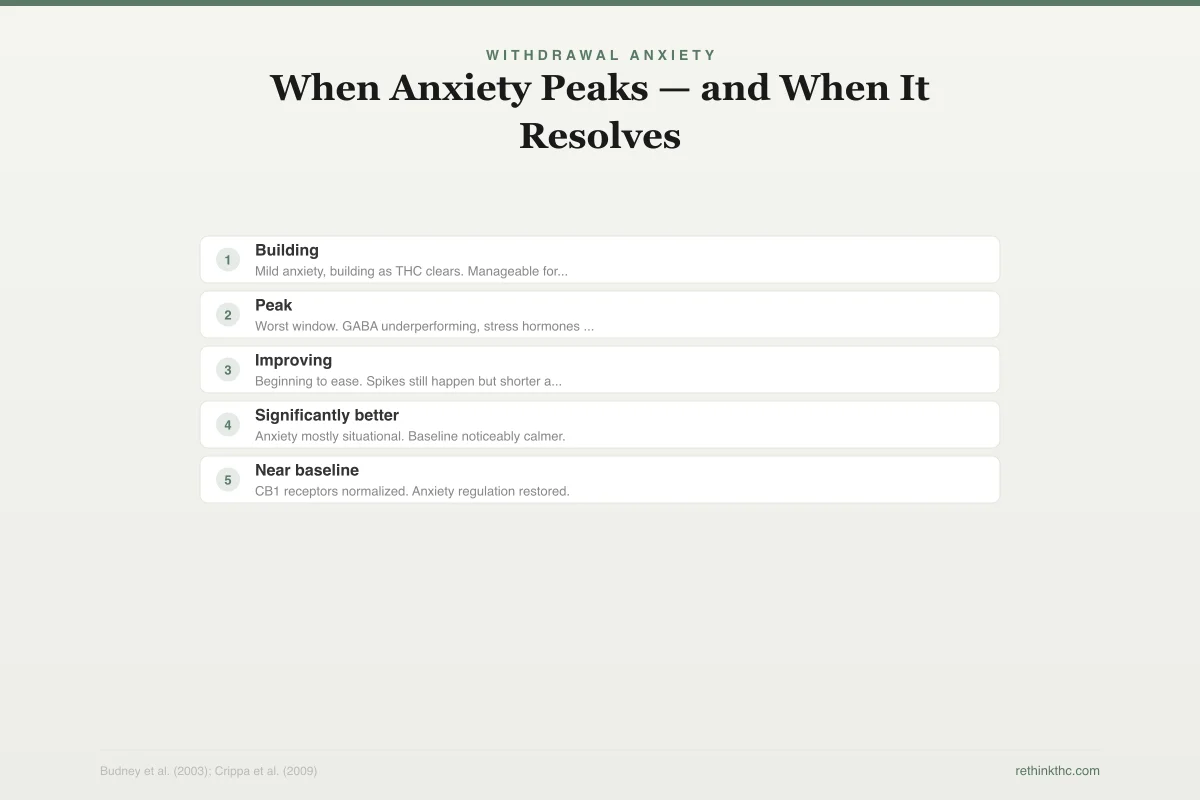
When Anxiety Peaks — and When It Resolves
Anxiety follows a predictable arc. The worst window is days 3-6.
Mild anxiety, building as THC clears. Manageable for most.
Worst window. GABA underperforming, stress hormones elevated.
Beginning to ease. Spikes still happen but shorter and less intense.
Anxiety mostly situational. Baseline noticeably calmer.
CB1 receptors normalized. Anxiety regulation restored.
Budney et al. (2003); Crippa et al. (2009)
 View as image ↗
Box Breathing (4-4-4-4)
Inhale through your nose for 4 seconds. Hold for 4 seconds. Exhale through your mouth for 4 seconds. Hold for 4 seconds. Repeat 3 to 4 times. This works because the extended exhale activates your parasympathetic nervous system (the branch of your nervous system responsible for calming you down). It is not a metaphor. It physically slows your heart rate and reduces cortisol output within seconds.
5-4-3-2-1 Grounding
Name 5 things you can see. 4 things you can touch. 3 things you can hear. 2 things you can smell. 1 thing you can taste. This technique pulls your attention out of the anxious thought loop and anchors it to sensory input. Your brain cannot simultaneously process a catastrophic thought and count the objects on your desk. Use it when your mind is spiraling.
Cold Water on Your Wrists and Face
Run cold water over the insides of your wrists for 15 to 20 seconds, or splash cold water on your face. This triggers the dive reflex, a mammalian response that slows your heart rate and redirects blood flow. It is one of the fastest physiological interventions available, and it requires nothing except a faucet.
5-Minute Techniques
These work when you have a few minutes and the anxiety is sustained rather than spiking. You might be at home, on a break, or trying to settle down before bed.
Anxiety Toolkit
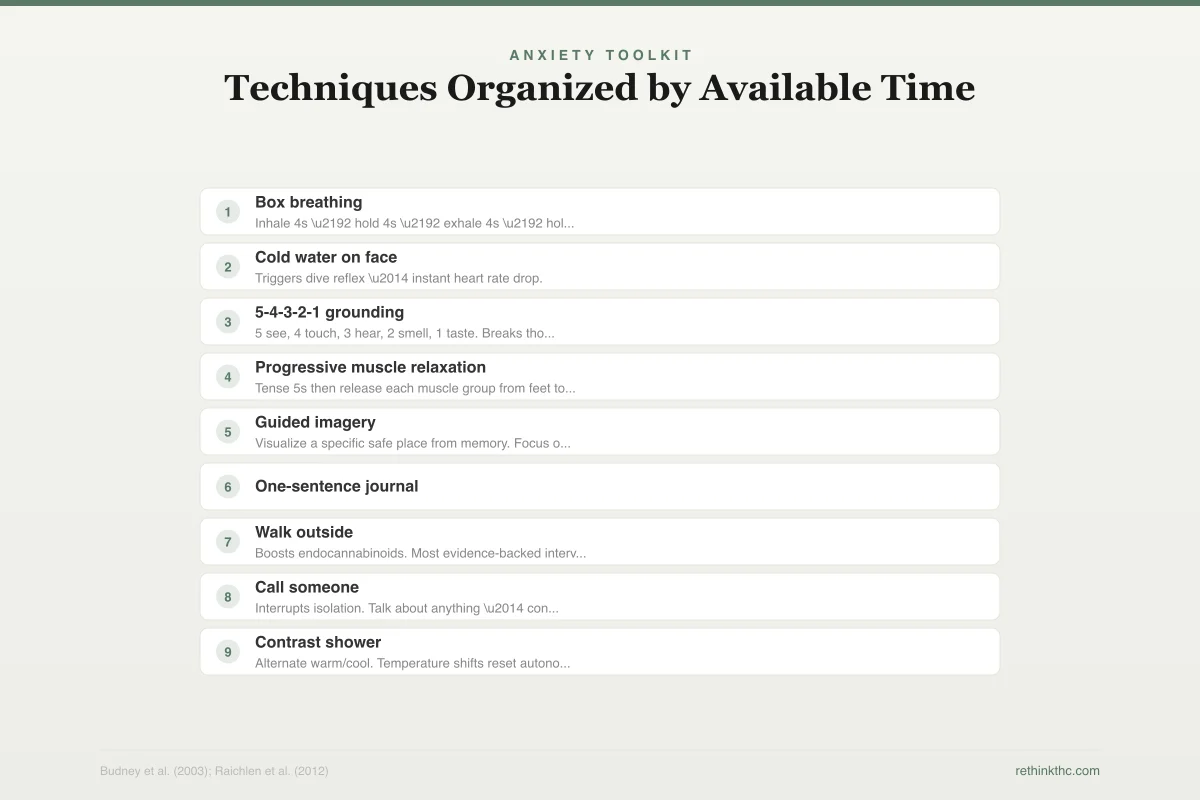
Techniques Organized by Available Time
Pick the one that matches your situation right now.
Box breathing
Inhale 4s → hold 4s → exhale 4s → hold 4s. Repeat 3-4x.
Cold water on face
Triggers dive reflex — instant heart rate drop.
5-4-3-2-1 grounding
5 see, 4 touch, 3 hear, 2 smell, 1 taste. Breaks thought loops.
Progressive muscle relaxation
Tense 5s then release each muscle group from feet to face.
Guided imagery
Visualize a specific safe place from memory. Focus on sensory details.
One-sentence journal
"I feel _____ because _____." Naming reduces intensity.
Walk outside
Boosts endocannabinoids. Most evidence-backed intervention.
Call someone
Interrupts isolation. Talk about anything — connection is what matters.
Contrast shower
Alternate warm/cool. Temperature shifts reset autonomic nervous system.
Budney et al. (2003); Raichlen et al. (2012)
 View as image ↗
Progressive Muscle Relaxation
Start at your feet. Tense the muscles as hard as you can for 5 seconds, then release completely. Move to your calves, then thighs, then stomach, then fists, then shoulders, then face. The deliberate tension followed by release teaches your nervous system the difference between a tense state and a relaxed state. During withdrawal, your baseline tension is elevated because your brain's calming systems are recalibrating. This technique manually resets the signal.
Guided Imagery
Close your eyes. Picture a specific place where you felt safe and calm. Not a generic beach, but an actual place from your memory. Focus on the details: the temperature, the light, the sounds, the textures. Spend 3 to 5 minutes in that scene. This is not wishful thinking. Visualizing a safe environment activates the same prefrontal circuits that real environmental safety activates, which helps counterbalance the overactive threat detection that withdrawal produces.
The One-Sentence Journal Prompt
Open your phone notes or grab paper. Write one sentence that completes this prompt: "Right now I feel _____ and that is because _____." That is it. You do not need to journal for 20 minutes. The act of naming an emotion and linking it to a cause (even if the cause is "withdrawal is doing this to my brain") moves activity from your amygdala to your prefrontal cortex. Naming what is happening to you reduces its intensity.
30-Minute Techniques
These are for when you have time and need a meaningful reset. They work best during the sustained, low-grade anxiety that characterizes much of the first week of quitting weed.
Nervous System Science
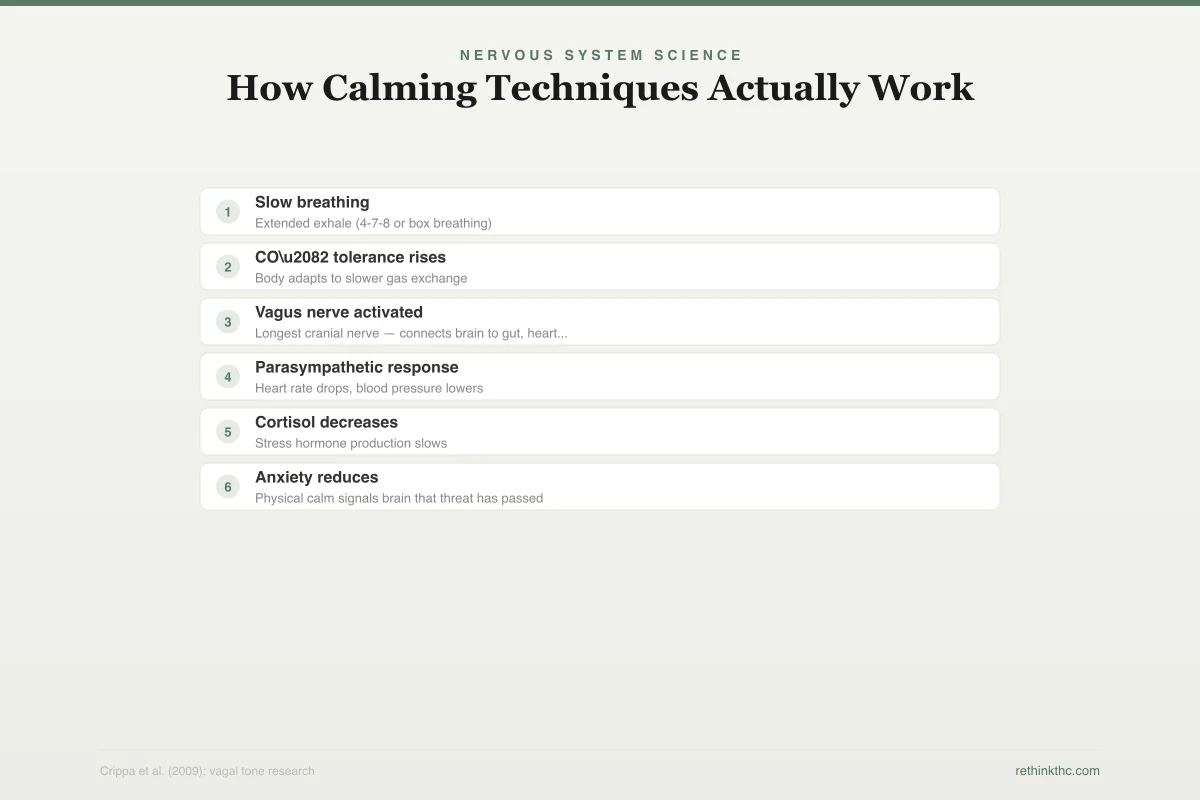
How Calming Techniques Actually Work
This is not a metaphor. These are measurable physiological changes.
Breathing pathway
Slow breathing
Extended exhale (4-7-8 or box breathing)
CO₂ tolerance rises
Body adapts to slower gas exchange
Vagus nerve activated
Longest cranial nerve — connects brain to gut, heart, lungs
Parasympathetic response
Heart rate drops, blood pressure lowers
Cortisol decreases
Stress hormone production slows
Anxiety reduces
Physical calm signals brain that threat has passed
Shortcut: Cold water on face
Triggers the mammalian dive reflex → instant vagal tone → heart rate drops in seconds. Skips steps 1-2 entirely.
Crippa et al. (2009); vagal tone research
 View as image ↗
Walk Outside for 20 to 30 Minutes
This is the single most evidence-backed intervention on this list. A 2012 study by Raichlen and colleagues, published in the Journal of Experimental Biology, found that aerobic exercise increases[3] your body's production of endocannabinoids, the natural chemicals your brain makes that are structurally similar to THC. During withdrawal, your endocannabinoid system is running at a deficit because it adapted to external THC and has not yet recalibrated. Walking, jogging, or any sustained movement helps fill that gap from the inside. You are not just distracting yourself. You are giving your brain chemistry what it is actually missing.
Call or Text Someone
Not to vent about how bad you feel (though that is fine too). Just to connect. Anxiety during withdrawal feeds on isolation. When you are alone with your thoughts at 10 PM and your nervous system is in overdrive, the absence of another human voice lets the anxiety narrative run unchecked. A 10-minute phone call interrupts that cycle. Tell them what you are going through or talk about something else entirely. Both work.
Take a Shower (Alternate Warm and Cool)
Start warm. After a few minutes, turn the water to cool for 30 seconds. Back to warm for a minute. Cool again for 30 seconds. The temperature contrast engages your autonomic nervous system in a way that interrupts the anxiety feedback loop. The warm water relaxes muscles. The cool water activates the dive reflex and redirects your attention to physical sensation. It is simple, private, and available at any hour.
What NOT to Do During an Anxiety Spike
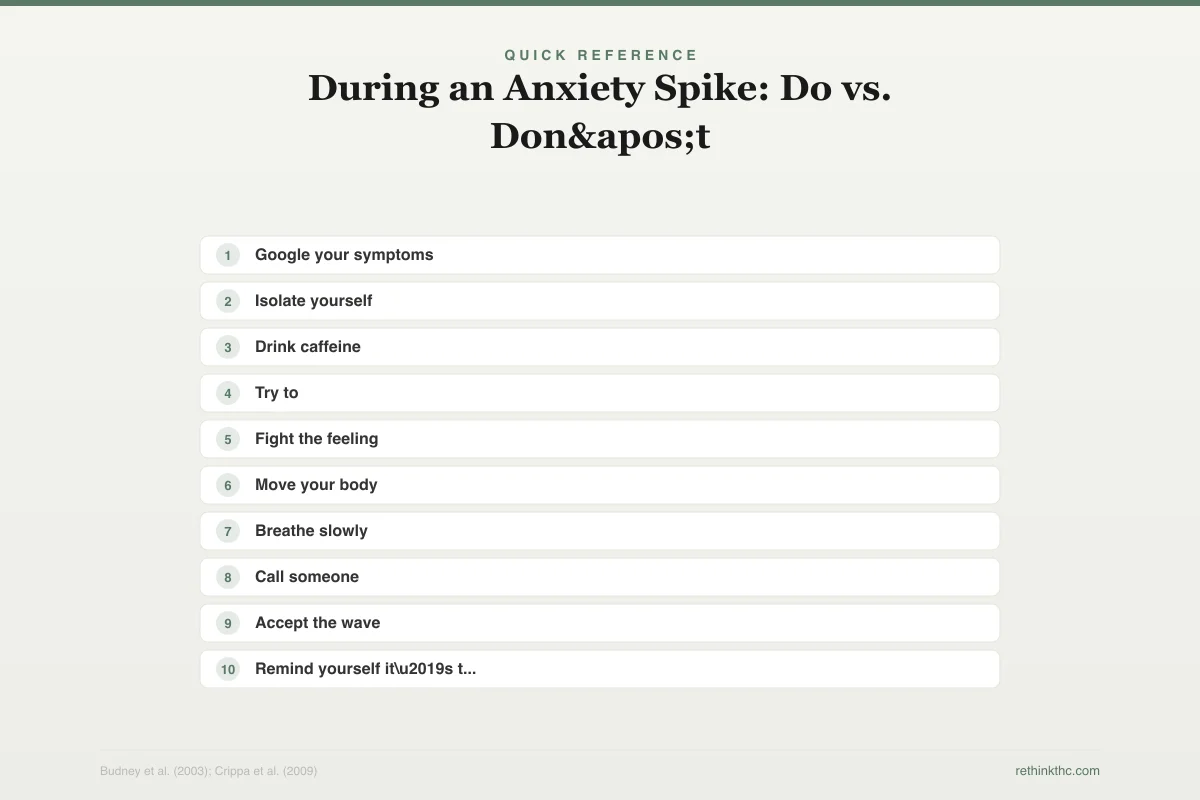
What you avoid during a spike matters as much as what you actively do. These are the most common behaviors that reliably make withdrawal anxiety worse.
Quick Reference
During an Anxiety Spike: Do vs. Don't
Don't
Google your symptoms
Rabbit holes of worst-case scenarios at 3 AM amplify panic
Isolate yourself
Anxiety feeds on being alone with your thoughts
Drink caffeine
Stimulant effect hits harder without THC’s counterbalance
Try to "think your way out"
This is a neurochemistry problem, not a thought problem
Fight the feeling
Resistance adds frustration on top of anxiety
Do
Move your body
Exercise boosts endocannabinoids — addresses the actual deficit
Breathe slowly
Extended exhale activates vagus nerve in seconds
Call someone
One human voice interrupts the anxiety narrative
Accept the wave
"This is withdrawal. It is temporary. It will pass."
Remind yourself it’s temporary
Peak anxiety resolves by days 7-10 for most people
Budney et al. (2003); Crippa et al. (2009)
 View as image ↗
Do Not Google Your Symptoms
Searching "cannabis withdrawal anxiety how long" or "is this a panic attack or am I dying" at 3 AM will not reassure you. It will send you down a rabbit hole of worst-case scenarios, rare conditions, and anonymous forum posts from people who are also panicking. If you need information, read a single trusted resource (like weed and anxiety) and then close the browser.
Do Not Scroll Catastrophic Reddit Threads
Some online communities are genuinely helpful. Others are echo chambers of suffering where the most extreme stories rise to the top. During an anxiety spike, your brain has a negativity bias that is already amplified by withdrawal. Reading about someone who had anxiety for 6 months after quitting will feel like a prophecy rather than one person's experience. Stay off the forums when you are spiraling.
Do Not Make Major Life Decisions
Withdrawal anxiety distorts your perception of everything. Your job feels unbearable. Your relationship feels doomed. Your future feels bleak. These feelings are real, but they are running through a brain that is neurochemically destabilized. Do not quit your job, end a relationship, or make any significant life change during peak withdrawal. Write it down if you need to. Revisit it in three weeks when your brain chemistry has stabilized.
Do Not Try to Reason Your Way Out of It
Anxiety during withdrawal is not a thought problem. It is a neurochemistry problem. Your CB1 receptors are recalibrating, your GABA system is underperforming, and your stress hormones are elevated. Trying to logic your way through it ("there is nothing to be anxious about, so why am I anxious") just adds frustration on top of the anxiety. Use the physical techniques above instead. They work with your nervous system rather than against it.
Evidence Review
Where the evidence stands
Cell & Lab Studies
CB1 receptor downregulation and GABA system disruption well-documented in vitro
Animal Studies
Rodent models confirm withdrawal-induced anxiety behaviors and endocannabinoid deficits
Case Reports
Thousands of clinical observations documenting withdrawal anxiety patterns
Small Human Trials
Budney (2003): 18 users tracked 50 days; multiple replications since
Large Controlled Trials
Cannabis withdrawal syndrome included in DSM-5 based on converging evidence
Systematic Reviews
Crippa (2009) and others confirm cannabis modulates anxiety circuits with rebound on cessation
Cannabis withdrawal anxiety is one of the best-established withdrawal symptoms in the literature. It is recognized in the DSM-5, replicated across multiple studies, and the neurobiological mechanism (CB1 receptor downregulation leading to GABA/glutamate imbalance) is well understood. These techniques target that mechanism directly.
Budney et al. (2003), Crippa et al. (2009), DSM-5 diagnostic criteria
When to Seek Professional Help
These techniques are designed for the acute anxiety spikes that are a normal part of cannabis withdrawal. They are not a substitute for professional care.
Reach out to a doctor or therapist if your anxiety is so severe that you cannot function at work or in daily life, if you are having panic attacks that do not respond to the techniques above, if your anxiety is not improving after 4 weeks of abstinence, or if you are having thoughts of self-harm. A clinician can help determine whether what you are experiencing is withdrawal anxiety, a pre-existing anxiety disorder that cannabis was masking, or both. For more on that distinction, see the guide on withdrawal anxiety versus pre-existing anxiety.
Safety
ModerateWhen anxiety goes beyond normal withdrawal
Concern
Withdrawal anxiety that persists beyond 4 weeks, involves daily panic attacks, or includes thoughts of self-harm may indicate a pre-existing anxiety disorder that cannabis was masking — not just withdrawal.
What the research says
A clinician can distinguish between withdrawal anxiety (temporary, peaks days 2-6, resolves by week 4) and underlying anxiety disorders (persist or worsen after withdrawal resolves). Both are treatable, but they require different approaches.
Particularly relevant for: People with severe or persistent anxiety after quitting cannabis
What to do
If anxiety is not improving by week 4, or if you cannot function in daily life, contact a healthcare provider. SAMHSA helpline: 1-800-662-4357 (free, 24/7, confidential).
Budney et al. (2003) — most withdrawal symptoms resolve within 4-14 days
If you need immediate support, the SAMHSA National Helpline is available 24/7 at 1-800-662-4357. It is free, confidential, and available in English and Spanish.
Quick Reference Summary
30 seconds: Box breathing (4-4-4-4), 5-4-3-2-1 grounding, cold water on wrists and face.
5 minutes: Progressive muscle relaxation, guided imagery of a safe place, one-sentence journal prompt.
30 minutes: Walk outside, call someone, contrast shower.
Do not: Google symptoms, scroll Reddit, make major decisions, try to out-think the anxiety.
Your brain is rebuilding its own anxiety regulation system. These techniques help you get through the days while that process completes. They are not permanent coping strategies. They are tools for a temporary, difficult, and ultimately finite phase. Bookmark this page. Use it when you need it. The anxiety will not last forever, even though it feels that way right now.
The Bottom Line
Cannabis withdrawal anxiety is a measurable neurological event that peaks between days 2 and 6 after quitting. This toolkit organizes evidence-based techniques by how much time you have: 30-second interventions (box breathing, 5-4-3-2-1 grounding, cold water) for acute spikes, 5-minute techniques (progressive muscle relaxation, guided imagery, one-sentence journaling) for sustained anxiety, and 30-minute resets (walking, calling someone, contrast showers) for deeper relief. Physical interventions work faster than mental strategies because they directly engage the parasympathetic nervous system. What you avoid during a spike matters equally: do not Google symptoms, scroll catastrophic threads, make major decisions, or try to reason your way through neurochemistry. These techniques bridge the gap while your CB1 receptors rebuild, a process that begins within 2 days and largely completes by day 28.
How long does anxiety last during cannabis withdrawal?
Research by Budney and colleagues (2003) found that anxiety typically peaks between days 2 and 6 and gradually declines over the following weeks. Most people see significant improvement by weeks 3 to 4, though some residual anxiety can persist for 6 to 8 weeks in heavy, long-term users. The complete withdrawal timeline covers the full arc.
Can breathing exercises really help with withdrawal anxiety?
Yes. Box breathing and other structured breathing patterns activate the parasympathetic nervous system, which directly counters the fight-or-flight response that withdrawal amplifies. This is a physiological mechanism, not a placebo effect. The key is doing it before trying to think your way through the anxiety. Physical interventions work faster than cognitive ones during acute spikes.
Should I take anxiety medication during cannabis withdrawal?
That is a decision to make with a doctor, not independently. Some people benefit from short-term medication during the acute withdrawal window, while others find that non-pharmacological techniques are sufficient. If your anxiety is severe enough that you cannot sleep, eat, or function, talking to a healthcare provider is a reasonable step. Do not self-medicate with alcohol, benzodiazepines, or other substances.
Why does exercise help with withdrawal anxiety specifically?
Research by Raichlen and colleagues (2012) showed that aerobic exercise increases your body's natural endocannabinoid production. During withdrawal, your endocannabinoid system is running at a deficit because it adapted to external THC. Exercise helps restore endocannabinoid tone from the inside, addressing the actual neurochemical cause of withdrawal anxiety rather than just distracting from it.
Is it normal to have anxiety even though I used weed to calm down?
Completely normal. Cannabis suppresses anxiety acutely by dampening amygdala reactivity and boosting GABA activity. When you remove it after regular use, those systems rebound in the opposite direction, producing more anxiety than you had before you started using. This rebound is temporary, but it is one of the main reasons people relapse during the first two weeks.
Why do physical techniques work better than trying to think through the anxiety?
Withdrawal anxiety is primarily a neurochemistry problem, not a thought problem. Your CB1 receptors are recalibrating, your GABA system is underperforming, and stress hormones are elevated. Trying to reason through it ("there is nothing to be anxious about") adds frustration because the anxiety is not caused by a thought. Physical techniques like breathing, cold water, and exercise directly engage the autonomic nervous system and produce measurable physiological changes within seconds. They work with your nervous system rather than against it.
Sources & References
- 1RTHC-00134·Budney, Alan J. et al. (2003). “When Heavy Users Quit Cannabis, Symptoms Show Up Fast and Ease Within Two Weeks.” Journal of Abnormal Psychology.Study breakdown →PubMed →↩
- 2RTHC-00349·Crippa, Jose Alexandre S. et al. (2009). “Cannabis both calms and panics — the biphasic dose-response explains why the same drug produces opposite anxiety effects.” Human Psychopharmacology: Clinical and Experimental.Study breakdown →PubMed →↩
- 3RTHC-00608·Raichlen, David A. et al. (2012). “Runner's High Has an Endocannabinoid Signature in Humans. Dogs Show It Too..” Journal of Experimental Biology.Study breakdown →PubMed →↩