Withdrawal & Recovery
91%
About 91% of cannabis users never develop clinical dependence, and CB1 receptors start recovering within 2 days of reduced use, so structured moderation with specific rules can meaningfully reset your brain without requiring you to quit entirely.
Anthony et al., Experimental and Clinical Psychopharmacology, 1994
9%
About 9% of people who try cannabis develop dependence, so
2 days
Your CB1 receptors start recovering within just 2 days of
Is Moderation Actually Realistic?
covered in detail
Anthony et al., Experimental and Clinical Psychopharmacology, 1994
 View as image ↗
If you only read one thing
Most people who use weed can successfully cut back without quitting — about 91% of cannabis users never develop dependence. Your brain starts recovering receptors within just 2 days of using less, so even small changes matter. The biggest single move: switch from concentrates to flower. The key honest check: if you keep setting rules and breaking them, that's not a willpower problem — it's information that moderation might not be enough.
Not everyone who wants to change their relationship with cannabis wants to stop using it completely. Maybe you are spending more money than you would like. Maybe the highs are not what they used to be. Maybe you are noticing that your use has crept from weekends into weekdays, from evenings into afternoons, from something you chose into something you default to. You are not necessarily looking for an exit. You are looking for a reset.
This guide is for that situation. It respects your autonomy, takes the science seriously, and gives you concrete strategies for pulling back without pulling out entirely. If you are looking for a concise set of principles to guide your use, the 10 lower-risk cannabis use guidelines provide a research-backed starting point.
Key Takeaways
- Moderation is a realistic option for many cannabis users, but it works best for people who have not developed Cannabis Use Disorder
- About 9% of people who try cannabis develop dependence, so the majority of users can successfully adjust their patterns without quitting entirely
- Practical strategies include scheduling specific use days, waiting until evening for your first use, switching to lower-potency products, and tracking what you consume
- Your CB1 receptors start recovering within just 2 days of reduced use, which means even small cutbacks produce measurable changes in your brain
- If cutting back keeps failing despite genuine effort, that pattern itself is important information worth paying attention to
- Switching from concentrates (70-90% THC) to flower (15-25% THC) is one of the most effective single changes you can make — it reduces CB1 receptor downregulation without changing how often you use
Is Moderation Actually Realistic?
The short answer: yes, for many people. But not for everyone, and honesty about which group you fall into matters more than optimism.
Self-Assessment
Can You Successfully Moderate?
Honest assessment of which approach fits your situation
Moderation Likely Viable
No prior failed moderation attempts
No co-occurring mental health issues driving use
Social or occasional user pattern
Using less than 1g per day
No morning use (no wake-and-bake)
Consider Quitting Instead
Multiple failed moderation attempts
Using cannabis to cope with anxiety or depression
Consuming more than 2g per day
Using immediately upon waking
Cannabis Use Disorder diagnosis
About 91% of cannabis users do not develop dependence — moderation is realistic for the majority
Anthony et al. (1994), Budney et al. (2006)
 View as image ↗
A foundational study by Anthony and colleagues, published in 1994 in Experimental and Clinical Psychopharmacology, found that approximately 9% of people who have ever used cannabis develop dependence. For comparison, that rate is about 32% for tobacco, 23% for heroin, 17% for cocaine, and 15% for alcohol. Cannabis carries real dependence risk, but it is lower than most other commonly used substances.
What that 9% figure means practically is that roughly 91 out of 100 people who use cannabis do not develop the compulsive, hard-to-control pattern that defines dependence. If you are in that majority, moderation is not just a nice idea. It is a realistic, evidence-supported option.
Anthony et al. (1994) · Experimental and Clinical Psychopharmacology
- Population
- National Comorbidity Survey — representative sample of the U.S. population
- Intervention
- Lifetime use of various substances including cannabis, tobacco, alcohol, cocaine, and heroin
- Comparator
- Dependence rates compared across all substance categories
- Finding
- About 9% of people who ever tried cannabis developed dependence. For comparison: tobacco 32%, heroin 23%, cocaine 17%, alcohol 15%. Cannabis has real dependence risk, but it's lower than most commonly used substances.
mixed The 91% who don't develop dependence have a realistic shot at moderation — but the 9% who do may need a different approach
Anthony et al. (1994), Experimental and Clinical Psychopharmacology, 2(3), 244-268
The people who tend to struggle with moderation are those who have crossed into Cannabis Use Disorder (CUD), a clinical diagnosis involving patterns like using more than intended, being unable to cut back despite wanting to, and continuing use despite negative consequences. If that sounds familiar, moderation may not be the right starting point, and that is worth exploring honestly. Our guide on signs of cannabis use disorder can help you figure out where you stand.
Why Cutting Back Feels Harder Than It Should
Understanding the neuroscience behind tolerance explains why "just use less" is simple advice that is not easy to follow.
When you use cannabis regularly, THC binds to CB1 receptors throughout your brain. Your brain responds to this constant stimulation by pulling CB1 receptors off the surface of your neurons (a process called downregulation) and reducing the sensitivity of the ones that remain. This is tolerance, and it is a physical change in your brain, not a failure of discipline.
A 2012 study by Hirvonen and colleagues, published in Molecular Psychiatry, used PET brain imaging to directly measure this process.[1] They found that daily cannabis users had significantly reduced CB1 receptor availability compared to non-users. The receptors are literally less available to do their job.
Here is why this matters for moderation: your brain has adapted to a certain level of THC. When you cut back, your brain is calibrated for the old amount. The reduced dose feels underwhelming, not because it is not "working," but because your receptor system is tuned for more. This creates a pull back toward your previous level of use. It is not weakness. It is neurobiology.
The encouraging news comes from a 2016 study by D'Souza and colleagues, published in Biological Psychiatry: Cognitive Neuroscience and Neuroimaging, which showed[2] that CB1 receptors begin recovering within just 2 days of abstinence. Your brain starts recalibrating quickly. Even modest reductions in use give your receptors a chance to come back online, which means the reduced amount starts feeling like enough again. This is the biological basis for why cutting back actually works if you can get through the initial adjustment.
The Potency Factor
One variable that makes modern moderation harder than it used to be is potency. A comprehensive analysis by ElSohly and colleagues, published in 2016 in Biological Psychiatry, documented[3] that the average THC concentration in cannabis tripled between 1995 and 2014, rising from about 4% to approximately 12%. Concentrates, which are increasingly popular, can reach 80% or higher.
Reduction Strategies
4 Common Reduction Patterns
Pick the pattern closest to your situation — concrete plans beat vague intentions
Daily to Weekends Only
5 sober days allow significant CB1 receptor recovery each week
All-Day to Evenings Only
Daytime clarity improves; each evening session carries more weight
Heavy to Measured
Use a one-hitter or scale to remove the open-ended quality
Concentrates to Flower
Massive potency reduction without changing frequency
D'Souza et al. (2016), ElSohly et al. (2016)
 View as image ↗
This matters because if you are using high-potency products, your CB1 receptors are being hit harder and downregulating faster. Switching to lower-potency flower is one of the most effective moderation strategies available, and we will get into that below.
Dose Comparison
THC: Research vs. commercial doses
What research used
~4% THC average
Smoked flower
Varies · Pre-2000s era cannabis
ElSohly 2016 potency analysis — what 'weed' meant when most research was done
What supplements sell
15-25% THC (flower) or 60-90% THC (concentrates)
Smoked, vaped, or dabbed
Daily to multiple times daily for many users
Modern dispensary flower, vape cartridges, dabs, wax
Today's cannabis is 3-6x stronger than what most tolerance research was based on. Concentrates deliver THC at 4-6 times the intensity of flower. Switching from concentrates to flower is effectively a 70-80% dose reduction without changing your routine.
- *Potency tripled between 1995 and 2014 per ElSohly's analysis, and concentrates push it further
- *Higher potency means faster CB1 downregulation and harder tolerance buildup
- *The 'same joint' your parents smoked was a fundamentally different product
ElSohly et al. (2016), Biological Psychiatry — THC potency trends in cannabis 1995-2014
What "Cutting Back" Actually Looks Like
Abstract goals fail. Concrete plans succeed. Here is what moderation looks like in practice, with specific examples you can adapt.
From daily to weekends only. This is one of the most common moderation targets. Five sober days per week gives your CB1 receptors significant time to recover between sessions, which means your weekend use actually feels stronger and more enjoyable. You get more effect from less product.
From multiple times per day to once at night. If you are currently using throughout the day, consolidating to a single evening session is a meaningful reduction. Your daytime clarity improves, your tolerance drops over the course of each day, and your evening session carries more weight.
From concentrates to flower. Switching from dabs or cartridges (often 70 to 90% THC) to flower (typically 15 to 25% THC) is a potency reduction that your receptors will notice immediately. You do not have to change your frequency. Just changing the intensity can shift your tolerance trajectory.
From large amounts to measured amounts. If you currently pack a full bowl or roll a joint and smoke until it is gone, try switching to a one-hitter or a small pipe with a defined amount. Measuring your intake removes the open-ended quality that lets consumption creep upward without you noticing.
| Moderation Strategy | How It Works | Best For |
|---|---|---|
| Weekends only | 5 sober days allow CB1 receptor recovery | Daily users wanting a significant reduction |
| Evening only | Consolidate to one session; daytime clarity improves | Multiple-times-per-day users |
| Concentrates → flower | 70-90% THC drops to 15-25% THC | Concentrate users; biggest single change |
| Measured amounts | One-hitter or small pipe with defined quantity | Open-ended session users |
| Delay first use | Push back start time by 2-4 hours progressively | Wake-and-bake users |
| Designated sober days | Specific cannabis-free days each week | Users building structure |
| Periodic 48-hour breaks | Minimum time for receptor recovery to begin | Maintaining lower tolerance long-term |
Practical Strategies That Work
These are not theoretical suggestions. They are strategies that people actually use to manage their consumption.
Moderation Framework
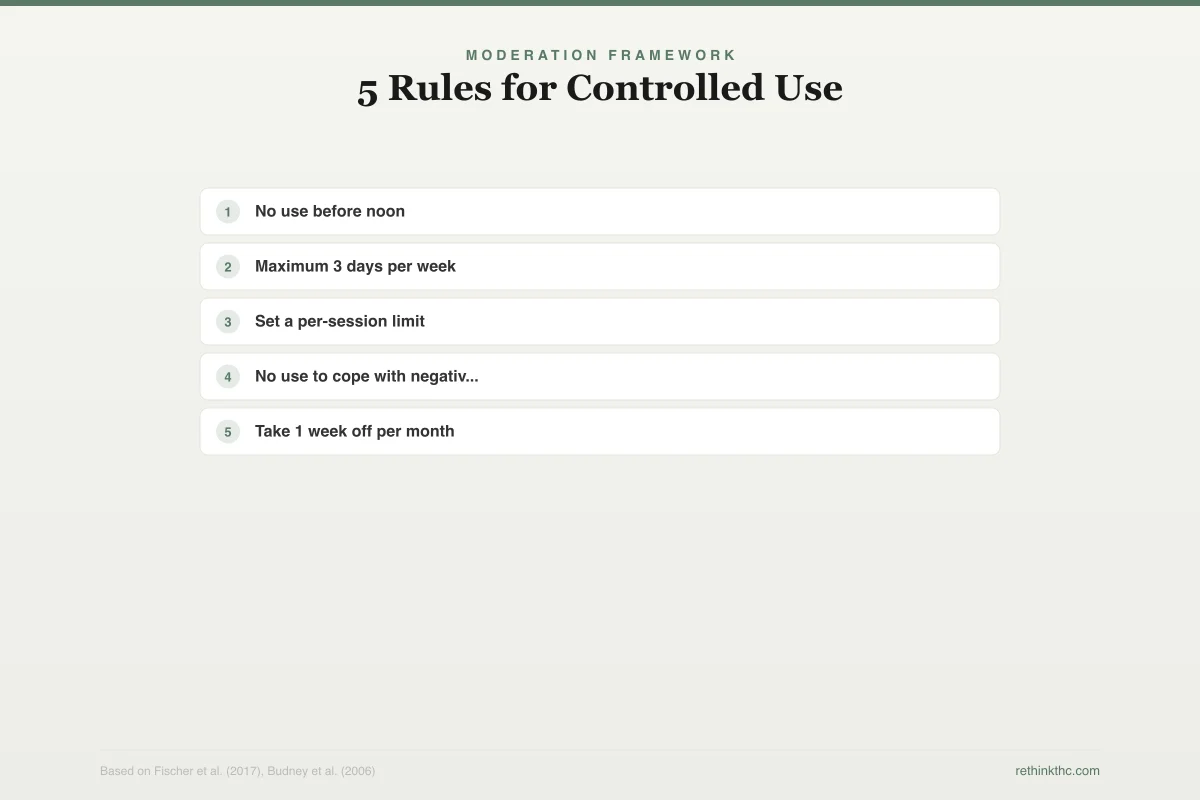
5 Rules for Controlled Use
Specific rules beat vague intentions — set limits before the impulse is active
No use before noon
Morning use sets the tone for all-day consumption. Delaying first use preserves daytime clarity and naturally limits total sessions.
Maximum 3 days per week
4 sober days per week gives CB1 receptors meaningful recovery time, keeping tolerance low and each session effective.
Set a per-session limit
One bowl, two puffs, or a defined edible dose. Measuring intake removes the open-ended quality that lets consumption creep upward.
No use to cope with negative emotions
Using cannabis to manage stress, anxiety, or sadness builds psychological dependence. Recreational use and coping use are different patterns.
Take 1 week off per month
A scheduled weekly break prevents tolerance buildup and proves to yourself that you can take a break. If you cannot, that is important information.
If you consistently break these rules despite wanting to follow them, that pattern is data — not failure. It may mean moderation is not the right approach for your situation.
Based on Fischer et al. (2017), Budney et al. (2006)
 View as image ↗
Set a Schedule
Decide in advance which days and times you will use. Write it down. "Friday and Saturday evenings after 8 PM" is a plan. "I will try to use less" is a wish. The specificity matters because decisions made in advance, when you are clear-headed, are better than decisions made in the moment, when the impulse is active.
Delay First Use of the Day
If you currently wake and bake, push your first session back by two hours. Then four. Then to the afternoon. Then to the evening. Each delay gives your brain more sober hours to work with, and the extended gap between sessions allows partial receptor recovery. Many people find that delaying first use is easier than eliminating sessions entirely, and it often naturally reduces overall consumption because there are fewer hours left in the day.
Track Your Use
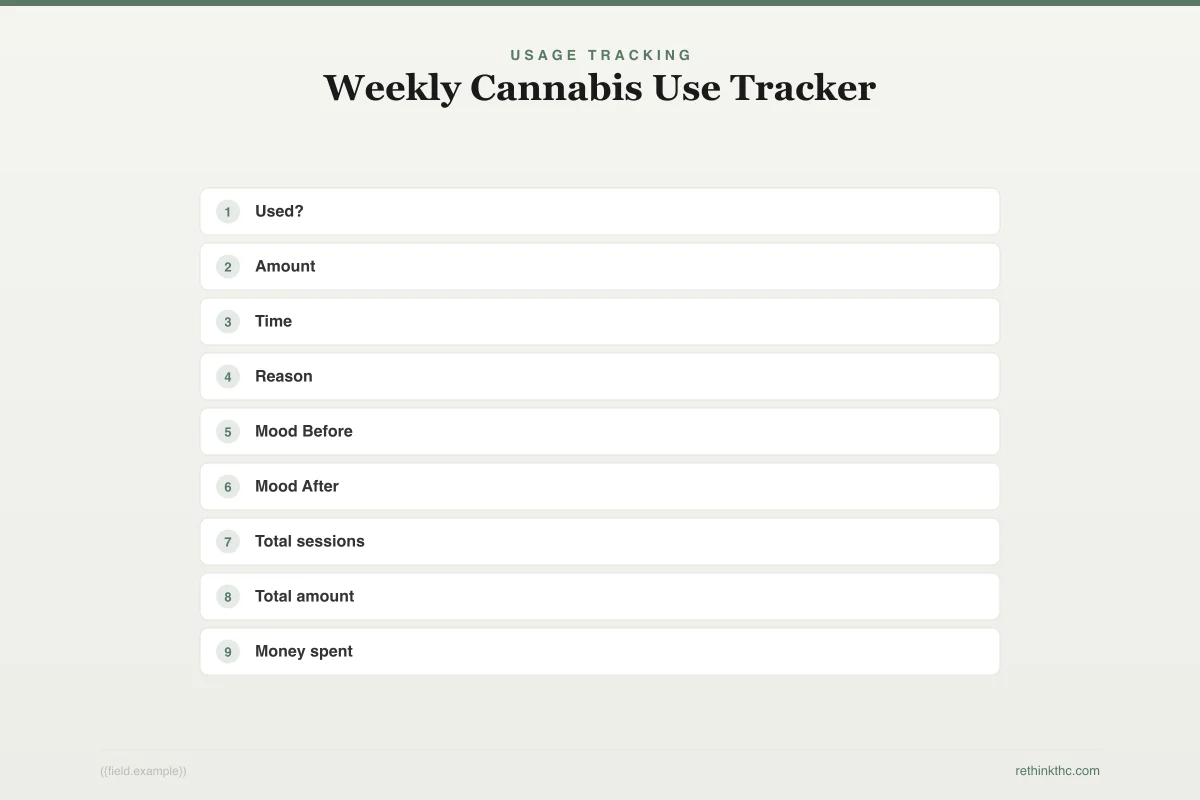
Most people underestimate how much they use. Start a simple log: date, time, amount, and how you felt afterward. You can use a notes app, a spreadsheet, or a dedicated cannabis tracking app. After two weeks of tracking, you will have an honest baseline. From there, set a specific reduction target (for example, 25% fewer sessions per week or half the amount per session) and track against it.
Designate Sober Days
Pick specific days of the week that are always cannabis-free. Tuesday and Thursday. Or Monday through Wednesday. The specific days matter less than the consistency. Sober days interrupt the daily pattern, give your receptors recovery time, and prove to yourself that you can do it.
Use a Timer
Set a timer when you start a session. When it goes off, you are done. This prevents the "one more hit" cycle that gradually inflates each session. Fifteen to twenty minutes is a reasonable window. The timer externalizes the stopping decision so you do not have to rely on in-the-moment willpower, which is unreliable when you are already high.
Change Your Environment
If certain settings trigger automatic use (the couch, the back porch, the car after work), interrupt those associations. Move your setup. Change your after-work routine. Go for a walk before you get home. Environmental cues drive habitual behavior more than most people realize, and small changes in context can break the autopilot.
Take Periodic Tolerance Breaks
Even if your goal is moderation rather than quitting, building in periodic tolerance breaks makes your moderation more sustainable. A 48-hour break, based on the D'Souza 2016 research, is enough to start receptor recovery. A full week or two delivers a more substantial reset. Our cannabis tolerance break guide covers how to plan and execute one.
When Cutting Back Is Not Working
Moderation strategies work for a lot of people. But they do not work for everyone, and recognizing when they are failing is just as important as trying them.
Here are signs that moderation may not be the right approach for you.
You set rules and break them repeatedly. Everyone slips occasionally. But if you set a plan (weekends only, one session per day, no concentrates) and find yourself consistently violating it within days, that pattern is telling you something. Occasional exceptions are human. Chronic rule-breaking suggests that the pull of the substance is stronger than your intentions, which is a hallmark of dependence.
You negotiate with yourself constantly. "I will just have a little." "Today does not count because it was stressful." "I will start the plan next week." If you find yourself in a running negotiation about whether this particular use counts as breaking your rule, the rule is not holding.
Cutting back produces significant withdrawal symptoms. Some discomfort when reducing is normal. But if cutting from daily use to weekends-only produces serious cannabis withdrawal symptoms like insomnia, intense irritability, loss of appetite, or anxiety that disrupts your daily functioning, your body is more dependent than casual moderation can address.
You are cutting back to justify continuing. This is subtle but important. Some people use the idea of moderation as a way to avoid confronting the possibility that they need to stop. If "cutting back" is functioning primarily as permission to keep using rather than as a genuine strategy for changing your relationship with cannabis, it may be worth asking harder questions. Our article on whether you should quit weed explores this honestly.
You feel unable to enjoy activities without it. If sober days feel empty, boring, or unbearable rather than merely different, that suggests a psychological dependence that moderation alone may not resolve.
None of these signs mean you are a bad person or that you are broken. They mean your relationship with cannabis may have moved past the point where simple reduction strategies are sufficient, and different approaches (a full break, professional support, or a deeper look at what cannabis is doing for you emotionally) might serve you better.
Safety
LowWhen moderation keeps failing
Concern
If you repeatedly set rules and break them, constantly negotiate exceptions with yourself, or find sober days unbearable rather than merely different, these patterns suggest your relationship with cannabis may have crossed into dependence territory where moderation alone isn't sufficient.
What the research says
This isn't a moral failing — it's useful information. About 9% of cannabis users develop dependence, and for those people, a full break (with professional support if needed) typically works better than repeated moderation attempts that don't hold.
Particularly relevant for: Anyone who has tried to cut back multiple times without success
What to do
If you've genuinely tried structured moderation for 2-4 weeks and consistently can't stick to your own rules, consider a full tolerance break or talk to a provider. SAMHSA helpline: 1-800-662-4357.
Anthony et al. (1994), Experimental and Clinical Psychopharmacology — cannabis dependence rates
The Role of Honest Self-Assessment
Moderation requires ongoing honesty. Not the performative honesty of telling friends you are "cutting back" while nothing actually changes. The internal honesty of checking in with yourself regularly and being willing to adjust your approach based on what is actually happening rather than what you want to be happening.
Usage Tracking
Weekly Cannabis Use Tracker
Most people underestimate how much they use — tracking creates an honest baseline
Total sessions
Goal: ___
Total amount
Goal: ___
Money spent
Budget: $___
Red Flags (moderation may not be working)
Using on a planned sober day
Exceeding per-session limit
Using to cope with negative emotions
Hiding use from others
Increasing amount week over week
Adapted from clinical moderation frameworks
 View as image ↗
Ask yourself at regular intervals: Am I actually using less? Am I happier with my use pattern? Are the things I wanted to improve (spending, motivation, health, relationships) actually improving? If the answers are yes, your moderation plan is working. If the answers are no, something needs to change.
Understanding whether your use has crossed into Cannabis Use Disorder territory can also help frame your approach. Not because the label defines you, but because it gives you information about what strategies are most likely to work for your specific situation.
A Note on Autonomy
This guide does not assume you should quit. It does not assume you should moderate. It assumes that you are an adult who gets to make your own decisions about what you put in your body, and that the best decisions are made with accurate information and honest self-assessment.
If moderation works for you, that is a perfectly valid outcome. If moderation reveals that your relationship with cannabis is harder to adjust than you expected, that information is also valuable. Either way, you are paying attention to something that most people on autopilot never examine at all, and that is worth something regardless of where you land.
Evidence Review
Where the evidence stands
Cell & Lab Studies
CB1 receptor downregulation and recovery mechanisms well-characterized at molecular level
Animal Studies
Dose-dependent tolerance and receptor recovery demonstrated across rodent models
Case Reports & Observational
Moderation outcomes documented in clinical settings; Cannabis Use Disorder criteria well-established
Small Human Trials
Hirvonen 2012 PET imaging (receptor downregulation), D'Souza 2016 (2-day recovery onset)
Large Epidemiological Studies
Anthony 1994 National Comorbidity Survey — 9% dependence rate across population
Meta-Analyses & Reviews
ElSohly 2016 potency trends; growing literature on moderation vs. abstinence outcomes
The science supporting moderation as a viable strategy is solid — we know who's most likely to succeed (no CUD), how fast the brain adapts (2 days), and what the biggest single lever is (potency reduction). The evidence is strong enough to say: moderation is realistic for most users, but not all.
Anthony 1994, Hirvonen 2012, D'Souza 2016, ElSohly 2016
When to Seek Professional Help
If you are struggling to cut back despite repeated genuine efforts, or if cannabis use is interfering with your work, relationships, health, or mental well-being, professional support is available and effective. Therapists who specialize in substance use can help you develop strategies tailored to your specific situation, whether your goal is moderation or cessation.
SAMHSA's National Helpline is available at 1-800-662-4357. It is free, confidential, and available 24 hours a day, 7 days a week. You can also text "HELLO" to 741741 to reach the Crisis Text Line.
The Bottom Line
Moderation is a realistic option for many cannabis users. About 9% of people who try cannabis develop dependence, meaning the majority can successfully adjust their patterns. Brain imaging shows CB1 receptors begin recovering within just 2 days of reduced use, so even small cutbacks produce measurable neurological changes. Practical strategies include scheduling specific use days, delaying first use until evening, switching to lower-potency products, tracking consumption, and taking periodic tolerance breaks. Moderation works best for people without Cannabis Use Disorder. If you consistently break your own rules, experience significant withdrawal from merely cutting back, or find sober days unbearable, these patterns suggest your relationship with cannabis may need a different approach than simple reduction.
Can you moderate weed use or do you have to quit completely?
Many people can successfully moderate cannabis use. Research shows that about 9% of people who try cannabis develop dependence, meaning the majority can adjust their patterns. Moderation tends to work best for people without Cannabis Use Disorder. If you consistently find yourself unable to stick to the limits you set, that may be a sign that moderation is not the right approach for your situation.
How long does it take for tolerance to drop when you cut back?
Brain imaging research shows that CB1 receptors begin recovering within 2 days of reduced THC exposure. A noticeable reduction in tolerance can occur within a week of cutting back, and significant receptor normalization happens within about 4 weeks. Even switching from daily use to weekends-only provides enough of a gap for meaningful receptor recovery between sessions.
What is the best way to start cutting back on weed?
Start by tracking your current use honestly for one to two weeks to establish a baseline. Then set specific, concrete rules rather than vague intentions. Common starting points include delaying first use until evening, designating certain days as cannabis-free, switching from concentrates to flower, and using measured amounts instead of open-ended sessions.
Will I get withdrawal symptoms from cutting back but not quitting?
Reducing use rather than stopping entirely typically produces milder symptoms than full cessation. You may notice some sleep disruption, irritability, or restlessness on your sober days, especially in the first week or two. These symptoms are generally manageable and tend to diminish as your brain adjusts to the new pattern. Significant withdrawal symptoms from merely cutting back may suggest a higher level of dependence.
How do I know if I should cut back or quit entirely?
If you can set limits and stick to them, if your use is not causing problems in your life, and if your sober days feel manageable rather than unbearable, moderation is likely a realistic option. If you repeatedly break your own rules, if you experience significant withdrawal symptoms, or if cannabis use is interfering with your responsibilities, relationships, or mental health, quitting (at least for a period) may be more appropriate. There is no universal answer, only what is honest for your situation.
Does switching from concentrates to flower actually make a difference?
Yes, significantly. Concentrates deliver 60 to 90% THC compared to flower at roughly 15 to 25%. This means concentrates produce more aggressive CB1 receptor downregulation per session. Switching to flower reduces the THC load on your receptors without requiring you to change your frequency of use. Many people find that this single change noticeably reduces tolerance buildup and makes moderation strategies more sustainable over time. It is one of the highest-impact changes available.
Sources & References
- 1RTHC-00573·Hirvonen, Jussi et al. (2012). “Daily Cannabis Use Was Linked to Fewer CB1 Receptors. A Month Without Brought Them Back..” Molecular Psychiatry.Study breakdown →PubMed →↩
- 2RTHC-01134·D'Souza, Deepak Cyril et al. (2016). “Brain Cannabinoid Receptors Drop With Heavy Use, Then Rebound Within Days of Stopping.” Biological Psychiatry: Cognitive Neuroscience and Neuroimaging.Study breakdown →PubMed →↩
- 3RTHC-01144·ElSohly, Mahmoud A. et al. (2016). “U.S. Cannabis Potency Tripled Over Two Decades While CBD Nearly Vanished.” Biological Psychiatry.Study breakdown →PubMed →↩