Lifestyle / Identity
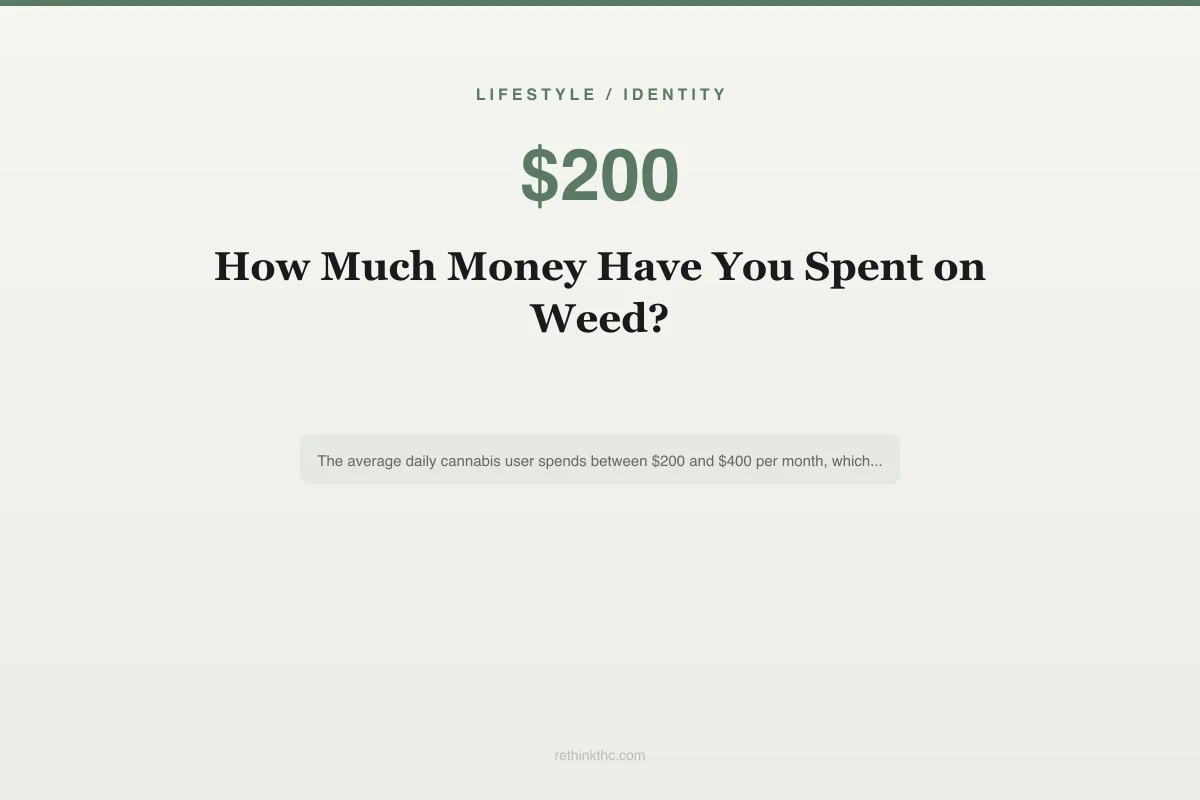
$200-400/Month
The average daily cannabis user spends $200 to $400 per month, which compounds to $12,000 to $48,000 over five to ten years, and small frequent purchases bypass your brain's financial alarm system so the total stays invisible.
U.S. dispensary market pricing data, 2024
Average Costs by Consumption Method
covered in detail
Regional Pricing Changes Everything
covered in detail
The Formula: Calculate Your Own Number
covered in detail
U.S. dispensary market pricing data, 2024
 View as image ↗
If you only read one thing
If you smoke daily, you're probably spending $200 to $400 a month — and most people who've done it for 5+ years have spent somewhere between $15,000 and $50,000 total without ever realizing it. The reason you've never calculated the number is that your brain doesn't flag small, frequent purchases as a financial event. The $40 cartridge doesn't feel like much. But 200 of them over 4 years is $8,000. Do the math below — the actual number is almost always bigger than people expect.
Key Takeaways
- The average daily cannabis user spends $200 to $400 per month — which adds up to $12,000 to $48,000 over five to ten years depending on tolerance and product type
- Most people have never calculated how much money they have spent on weed because it happens in small, frequent amounts that feel insignificant in the moment
- Costs vary a lot by method: flower is the cheapest per session, while concentrates, cartridges, and edibles can cost two to four times more per year
- Regional pricing creates massive differences — the same gram of flower that costs $5 in Oregon can cost $15 to $20 in Illinois or on the East Coast
- Knowing your number is not about guilt — it is a data point that puts your relationship with cannabis into concrete, measurable terms
- Behavioral economists call it "pain of paying" avoidance — small, frequent purchases bypass your brain's financial alarm system, so cumulative spending stays invisible until you calculate the total
Average Costs by Consumption Method
What you spend depends heavily on how you consume. Here is what each method typically costs per month for a daily user with moderate to high tolerance.
Cost Analysis
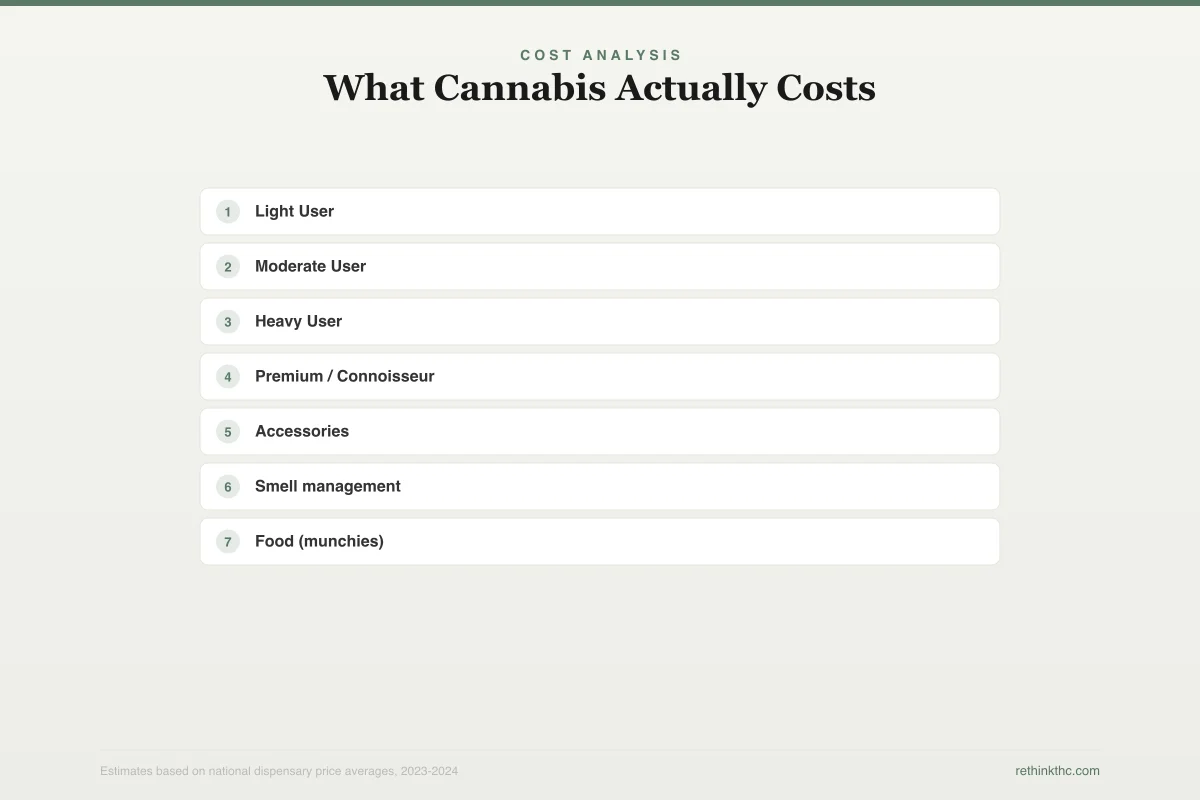
What Cannabis Actually Costs
Average monthly spending by user type, plus the hidden costs
Flower only
Flower + occasional concentrate
Daily use
Concentrates, top-shelf
Hidden Costs (Often Overlooked)
Accessories
$20-50/mo
Smell management
$15-30/mo
Food (munchies)
$50-100/mo
Hidden costs add $85-180/month that most users never count
A heavy user can spend $4,600-7,200/year when hidden costs are included — more than many car payments
Estimates based on national dispensary price averages, 2023-2024
 View as image ↗
Flower
Flower remains the most affordable option for most users. An eighth (3.5 grams) runs $25 to $60 depending on quality and market. A daily flower smoker going through roughly a gram per day spends approximately $150 to $300 per month. If you have been smoking daily for five years at the midpoint of that range, your flower spending alone is roughly $13,500.
Vape Cartridges
Cartridges typically cost $25 to $60 for a half gram. A heavy vape user going through one cartridge every three to four days spends $200 to $500 per month. Because vaping is easy to do anywhere, frequency tends to creep up without you noticing. Five years of daily vaping at $350 per month puts you at $21,000.
Concentrates and Dabs
This is where spending accelerates. A gram of quality concentrate (live resin, rosin, shatter) costs $30 to $80 depending on the product and market. Heavy dab users going through a gram every one to three days can spend $300 to $700 per month. Over five years at the midpoint, that is $30,000.
Edibles
Edibles are deceptively expensive per dose as tolerance builds. A pack of gummies costing $20 to $40 might provide two to four sessions for someone with low tolerance but barely one session for a daily user. Heavy edible users routinely spend $200 to $500 per month. At five years, that is $12,000 to $30,000.
Regional Pricing Changes Everything
Where you live dramatically affects your total. Cannabis pricing varies by state, legality status, and market maturity.
Mature legal markets (Oregon, Colorado, Washington): Prices are at their lowest. Flower can run as low as $3 to $7 per gram. Cartridges start around $15 to $25. These markets have had years of competition driving prices down.
Newer legal markets (Illinois, New York, New Jersey): Prices remain significantly higher due to limited licenses and high taxes. Flower runs $10 to $20 per gram. Cartridges regularly cost $50 to $70. Cannabis taxes in Illinois can push dispensary prices 30 to 40 percent above the sticker price.
Illegal markets: Street pricing varies wildly by region and connection. Some users pay less than dispensary prices, while others pay comparable amounts for unregulated product with no quality guarantee.
The tax factor: In legal states, cannabis taxes range from about 10 percent (Colorado) to over 35 percent (Washington). If your state charges 25 percent in combined taxes, every $100 you think you spent was actually $125. Over years, tax alone can add thousands to your total.
The Formula: Calculate Your Own Number
Lifestyle / Identity
Calculate Your Number in 4 Steps
Most daily users of 5+ years land between $15,000 and $50,000. Heavy concentrate users or people in expensive markets can exceed $60,000 over a decade. Don't forget to include tax (10-35% in legal states) and accessories.
Source: U.S. dispensary market pricing data, 2024
 View as image ↗
Here is the simple math. You can do this in under two minutes.
Step 1: Estimate your average weekly spending on cannabis products right now. Include everything: flower, carts, edibles, concentrates, papers, wraps, tips, accessories.
Step 2: Multiply that number by 52 to get your annual total.
Step 3: Think about how many years you have been spending at roughly that level. Be honest. Most people have a few phases: a lighter early period, a ramp-up, and their current steady state.
Step 4: For each phase, multiply the annual cost by the number of years in that phase. Then add the phases together.
Worked example: You smoked casually for two years at about $30 per week ($3,120 total for that phase). Then you became a daily smoker for three years at $60 per week ($9,360). Then your tolerance went up and you switched partly to concentrates for the last two years at $100 per week ($10,400). Your estimated lifetime total: $22,880.
Most daily users who have been at it for five or more years land somewhere between $15,000 and $50,000. Heavy concentrate users or people in expensive markets can easily exceed $60,000 over a decade.
Why You Have Never Done This Math Before
There is a reason most people have no idea what their total is. It is not laziness. It is how the human brain processes recurring small expenses.
Behavioral economists call this "pain of paying" avoidance. When a purchase is small and routine, your brain stops flagging it as a financial decision. It becomes automatic, like buying coffee or paying for streaming services. The $40 cartridge this week does not register as a meaningful financial event. But 200 cartridges over four years absolutely is.
Cannabis spending also lacks the paper trail that forces awareness. You do not get an annual statement from your dealer. Dispensary receipts get tossed. Unlike rent or a car payment, there is no single bill that shows the number. The spending is real, but it stays invisible unless you go looking for it.
This is not unique to weed. People underestimate their spending on alcohol, takeout food, and subscriptions for the same reason. But cannabis tends to be the one that surprises people the most because the per-unit cost feels so modest relative to what it delivers.
What That Money Could Have Been
This section is not meant to make you feel bad. It is meant to make the number real by translating it into things you understand.
$15,000 (five years of moderate daily flower use) could have been a used car, a semester of college tuition, or six months of rent in many US cities. Invested in an index fund averaging 7 percent annual returns, it would be worth roughly $17,500 to $20,000 depending on when it was invested.
$30,000 (five years of heavy use or ten years of moderate use) is a down payment on a home in many markets. It is a year of private university. It is a full emergency fund plus a vacation you actually remember.
$50,000 or more (a decade of heavy or concentrate-focused use) is life-changing money by almost any measure. A 20 percent down payment on a $250,000 home. A fully funded retirement account for someone in their twenties that could grow to over $500,000 by age 65.
Again, this is not about shame. You spent that money, and you cannot get it back. But knowing the real number changes how you think about spending going forward. If you are considering whether to quit, the financial picture is one concrete factor among many.
What to Do With This Number
Once you have your total, the question is what to do with it. Here are three honest options.
Use it as one data point in a bigger decision. If you have been thinking about quitting or cutting back, the financial total sits alongside the effects on your sleep, motivation, and mental clarity. No single factor has to carry the whole decision. But seeing $25,000 written down next to "and I am still not sure it is helping me" changes the weight of the conversation.
Set a future spending cap. If you are not ready to quit but the number bothers you, set a monthly budget and stick to it. Treating cannabis like any other line item in your budget takes it out of the invisible category and into the conscious one. Several of the best apps for quitting weed include spending trackers that calculate your savings in real time as you cut back or quit.
Let it motivate a redirect. If you do decide to stop after years of daily use, knowing what you have already spent makes the forward savings feel more tangible. You already know the cost of doing nothing because you have been paying it.
The Number Is Information, Not a Verdict
Running this calculation does not mean you have to quit. It does not mean you wasted your money. Plenty of people spend comparable amounts on alcohol, dining out, hobbies, and entertainment over similar timescales and consider it money well spent.
The point is awareness. Most people who use cannabis regularly have never converted their habit into a single cumulative number. Once you have that number, you get to decide what it means to you. Maybe the answer is "that's fine, I enjoy it, and it fits my budget." Maybe the answer is "I had no idea, and I want to change something." Both responses are valid.
What matters is that the decision is informed. Whatever you are spending, you deserve to know the real total. And now, if you did the math along the way, you do. For a forward-looking version of this exercise, including what your future savings could look like invested over time, check out the money saved quitting weed calculator. And if the number has you reconsidering your relationship with cannabis, the complete withdrawal guide is the most thorough place to start.
The Bottom Line
The average daily cannabis user spends $200-$400 per month, totaling $12,000-$48,000 over 5-10 years depending on tolerance, product type, and regional pricing. Costs vary significantly by method: flower ($150-$300/month for daily use), vape cartridges ($200-$500/month), concentrates ($300-$700/month), and edibles ($200-$500/month). Regional pricing creates massive differences — the same gram of flower costs $3-$7 in mature markets (Oregon, Colorado) versus $10-$20 in newer legal markets (Illinois, New York), with cannabis taxes adding 10-35% on top. Most people have never calculated their lifetime total because of what behavioral economists call "pain of paying" avoidance: small, routine purchases bypass the brain's financial alarm system, and cannabis spending lacks the paper trail that forces awareness. The calculation formula: estimate weekly spending for each phase of use, multiply by 52 for annual total, multiply by years in each phase, then sum all phases. Most daily users of 5+ years land between $15,000 and $50,000, with heavy concentrate users or expensive-market users exceeding $60,000 over a decade.
How much does the average person spend on weed per month?
The average daily cannabis user spends between $200 and $400 per month on product. Casual users (a few times per week) typically spend $60 to $150 per month. Heavy users or those using concentrates and cartridges can spend $400 to $700 or more per month. The exact figure depends on your consumption method, tolerance level, and local pricing.
How do I calculate how much I have spent on weed total?
Estimate your average weekly spending for each phase of your use. Multiply each phase's weekly amount by 52 (for the annual total), then multiply by the number of years in that phase. Add all phases together. For example, three years at $50 per week ($7,800 per year) plus two years at $80 per week ($8,320 per year) equals $40,240 total. Do not forget to include accessories, papers, and tax if you buy from dispensaries.
Why is weed so expensive in some states?
Cannabis pricing varies dramatically by state due to tax rates, licensing limits, and market maturity. States like Illinois and New York have limited dispensary licenses, creating less competition. Combined state and local cannabis taxes can add 25 to 40 percent on top of the shelf price. Mature markets like Oregon and Colorado have had years of competition that have driven prices significantly lower.
Is spending money on weed a waste?
That depends entirely on your situation and values. The same question applies to alcohol, dining out, or any recreational spending. The issue is not whether recreational spending is "wasteful" but whether you are aware of how much you are actually spending and whether that amount aligns with your priorities. Most people who run the lifetime calculation are surprised by the total, and that awareness alone is valuable regardless of what you decide to do with it.
How much do accessories and extras add to the total cost of weed?
Accessories are the hidden line item most people forget. Rolling papers, wraps, and tips add $5 to $15 per month for joint smokers. Lighters are a small but constant expense. Pipes, bongs, and rigs range from $20 to $300+ and often need replacing due to breakage. Vape batteries cost $15 to $50 and need periodic replacement. Cleaning supplies, grinders, storage containers, and odor eliminators add another $10 to $30 per month for many users. Over five years, accessories alone can add $1,000 to $5,000 to your total, depending on how often you replace or upgrade equipment.
Does tolerance increase how much you spend on weed over time?
Yes, and this is one of the most significant cost escalators. When you first start using, a small amount produces a strong effect. As tolerance builds over months of regular use, you need more product to achieve the same result. Many users also escalate from lower-cost methods (flower) to higher-cost, higher-potency products (concentrates, cartridges) as tolerance makes flower feel insufficient. A person who started spending $30 per week on flower may find themselves spending $100 or more per week on concentrates within a few years — not because they chose to spend more, but because tolerance required it.
Sources & References
- 1RTHC-07874·Vikingsson, Svante et al. (2025). “Legal CBD Products With Trace THC Can Cause Positive Drug Tests in Oral Fluid.” Journal of analytical toxicology.Study breakdown →PubMed →↩
- 2RTHC-07892·Wade, Natasha E et al. (2025). “Hair Testing Reveals 7% of 15–16-Year-Olds in the U.S. Use Cannabis Heavily.” medRxiv : the preprint server for health sciences.Study breakdown →PubMed →↩
- 3RTHC-07964·Wolinsky, David et al. (2025). “How CBD and Low-Dose THC From Hemp Products Affect Drug Tests and the Body.” Journal of analytical toxicology.Study breakdown →PubMed →↩
- 4RTHC-08235·Dos Santos, Mariana Candeias et al. (2026). “CBD and THC Can Interfere With How Your Body Processes Other Medications.” European journal of drug metabolism and pharmacokinetics.Study breakdown →PubMed →↩
- 5RTHC-07602·Schumacher, Joseph E et al. (2025). “Cannabis Was the Most Common Drug Found in First-Time Jail Arrestees.” Addiction science & clinical practice.Study breakdown →PubMed →↩
- 6RTHC-07633·Sharip, Akbar et al. (2025). “Pre-Employment THC Positive Tests Jumped 683% After California Legalization.” Journal of occupational medicine and toxicology (London.Study breakdown →PubMed →↩
- 7RTHC-05003·Vikingsson, Svante et al. (2023). “Delta-8 THC Is Already Showing Up in 1 in 4 Positive Workplace Drug Tests.” Journal of analytical toxicology.Study breakdown →PubMed →↩
- 8RTHC-03836·Feltmann, Kristin et al. (2022). “Swedish Workplace Drug Tests Over 25 Years: Positive Results Quadrupled, With Cannabis Driving the Recent Surge.” European journal of public health.Study breakdown →PubMed →↩