Support & Community
300K+ Members
Online cannabis recovery communities range from the 300,000-member r/leaves to 100+ weekly MA meetings to SMART Recovery's 24/7 chat, each with different philosophies on abstinence and moderation.
Addiction, 2020
Marijuana Anonymous Online Meetings
covered in detail
SMART Recovery Online
covered in detail
Recovery Apps with Community Features
covered in detail
Addiction, 2020
 View as image ↗
If you only read one thing
There's no single 'best' cannabis recovery community — the right one is the one whose stance matches your goal. Want to quit completely? r/leaves (300,000+ members) or Marijuana Anonymous are built for that. Want to cut back rather than stop? r/Petioles is the moderation-friendly option. Prefer structured, science-based tools over peer sharing? SMART Recovery. Most people end up using two or three of these together — quick daily check-ins in one place, deeper support somewhere else.
You decided you want to change your relationship with cannabis. Maybe you want to quit entirely. Maybe you want to cut back. Either way, you know it would help to talk to people who actually understand what that feels like. The problem is that cannabis recovery community support options are scattered across Reddit, apps, meeting platforms, and Discord servers, and it is not obvious which ones are worth your time or which ones match your specific situation.
This is a practical comparison of the online and informal communities where people actually go for cannabis support. Not the formal treatment programs (that comparison is covered in the MA vs SMART Recovery vs therapy breakdown), but the everyday digital spaces where people check in, vent, celebrate milestones, and remind each other why they are doing this.
Key Takeaways
- Online cannabis recovery communities range from fully abstinence-focused (r/leaves, with over 300,000 members) to moderation-friendly (r/Petioles) — each with different rules and culture
- Marijuana Anonymous now runs over 100 online meetings per week, giving you 12-step community support without geographic limits
- SMART Recovery's online platform includes meetings, forums, and 24/7 chat — all built on cognitive behavioral principles with no spiritual framework required
- Dedicated apps like Grounded combine built-in community features with tracking tools, pairing peer support with daily accountability
- Anonymity, moderation quality, and philosophical stance (abstinence vs. moderation) vary a lot across platforms, so matching a community to your goals matters more than picking the most popular one
- A 2022 review in Psychology of Addictive Behaviors confirmed that feeling socially supported is significantly linked to reduced substance use and better recovery outcomes — making community engagement a core part of lasting change, not an optional add-on
Fact Check
'Quitting weed is willpower, not a group thing' vs. the research
The claim
“Recovery communities are for alcoholics and hard drugs — quitting weed is just a matter of deciding to stop”
The cultural framing of cannabis as a 'soft' substance that shouldn't need group support
What research shows
UnsupportedSocial connection is one of the strongest predictors of sustained behavior change — across every substance studied, including cannabis. Peer support consistently improves engagement, self-efficacy, and outcomes in the research.
This isn't about needing a group to survive. It's that your brain is rewiring itself, and having people who understand the specific weirdness of quitting weed (the insomnia, the vivid dreams, the day-4 flatness) makes it measurably easier to stay the course.
Psychology of Addictive Behaviors (2022) social support review; Journal of Medical Internet Research (2023) peer support study
r/leaves: The Abstinence-Focused Reddit Community
What It Is and Who It Is For
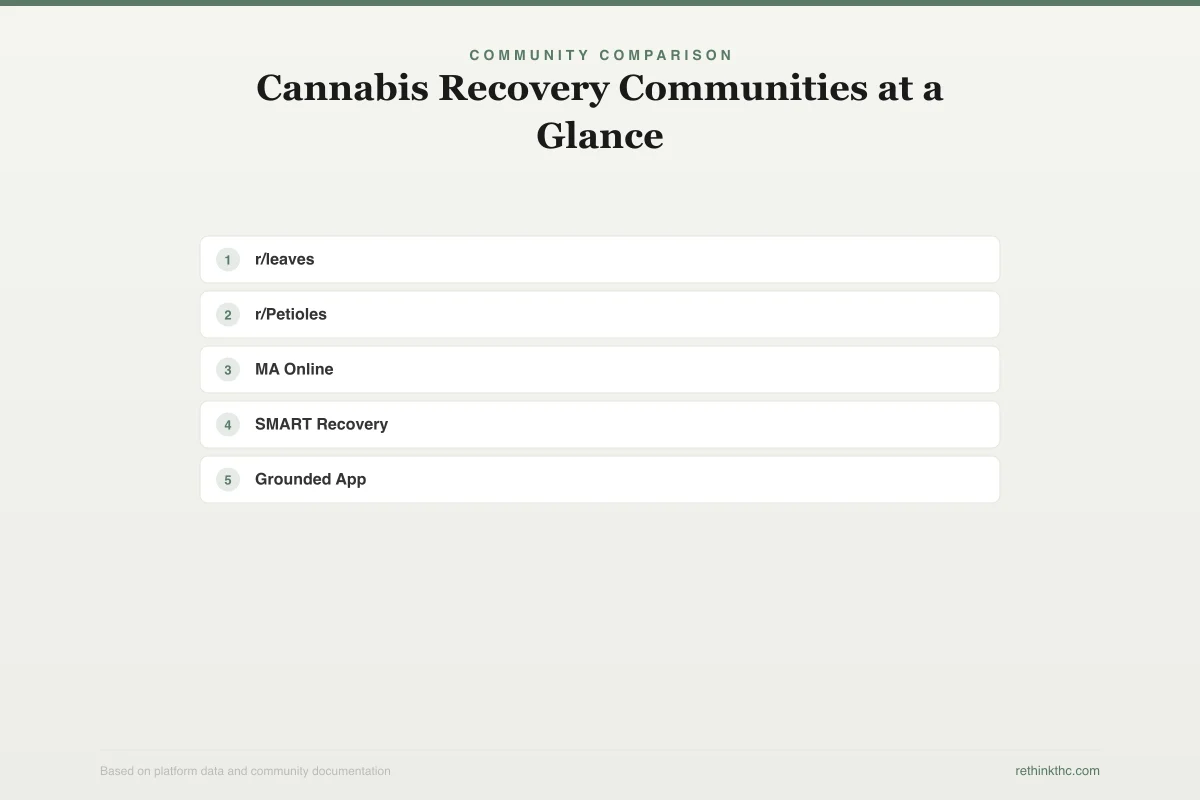
Community Comparison
Cannabis Recovery Communities at a Glance
Format, stance, anonymity, and accessibility compared
r/leaves
Abstinencer/Petioles
ModerationMA Online
AbstinenceSMART Recovery
FlexibleGrounded App
Abstinence| Community | Members | Stance | Format | Anonymity | Cost | Availability |
|---|---|---|---|---|---|---|
| r/leaves | 300K+ | Abstinence | Text forum | High | Free | 24/7 |
| r/Petioles | ~90K | Moderation | Text forum | High | Free | 24/7 |
| MA Online | Varies | Abstinence | Video meetings | Medium | Free | 100+ meetings/wk |
| SMART Recovery | Varies | Flexible | Video + forums | Medium | Free | Scheduled + 24/7 chat |
| Grounded App | Growing | Abstinence | App feed | High | Free / Premium | 24/7 |
Based on platform data and community documentation
 View as image ↗
r/leaves is one of the largest online spaces dedicated specifically to quitting cannabis. With over 300,000 members, it functions as a 24/7 open forum where people post about their experiences with quitting weed. The name is a play on "leaving" cannabis behind.
The community is strictly abstinence-focused. The rules are explicit: this is a space for people who want to stop using cannabis completely. Posts about moderation, cutting back, or reducing use are directed elsewhere. If your goal is to quit, this is the community built around that single purpose.
The Vibe
The tone is raw and supportive. People post from day one of quitting, describing insomnia, irritability, and brain fog. Others post from day 300 with reflections on how their life has changed. The most common type of post is someone describing a struggle and receiving validation from people who have been through the exact same thing.
Moderation is active. Self-promotion, sourcing discussions, and off-topic content get removed. The community enforces its abstinence-only stance consistently, which keeps the space focused but also means it is not the right fit if you are exploring moderation rather than full cessation.
Anonymity and Accessibility
Reddit accounts are pseudonymous by default. You choose a username, and nothing ties it to your real identity unless you share that information. There is no registration process beyond creating a Reddit account. You can lurk without posting, read everything without an account, and participate as much or as little as you want.
The community runs on upvotes and comments, which means the most resonant posts rise to the top. During peak hours, new posts typically receive responses within minutes. If you are up at 3 AM on day four of cannabis withdrawal and need someone to tell you it gets better, someone is almost certainly online.
r/Petioles: The Moderation-Focused Alternative
What It Is and Who It Is For
r/Petioles occupies the space that r/leaves intentionally does not. Named after the stem that connects a leaf to a plant (not the leaf itself), this community is for people who want to reduce their cannabis use, take tolerance breaks, or develop a healthier relationship with weed without necessarily quitting forever.
The community is significantly smaller, but the culture is distinct and intentional. Posts cover tolerance break strategies, rules people set for themselves (weekends only, no solo sessions, only after 8 PM), and the psychological challenges of moderating a substance you have used heavily.
The Vibe
The tone is reflective and practical. Where r/leaves rallies around the commitment to quit, r/Petioles explores the messy middle ground of changing a pattern without eliminating it entirely. People share their moderation rules, report on what worked and what did not, and discuss the honest difficulty of changing your relationship with cannabis culture when you are not leaving it behind completely.
Moderation of the community itself is lighter than r/leaves. The rules are less restrictive, which means the quality of individual posts varies more. Some threads contain thoughtful analysis of use patterns. Others are more casual check-ins.
Who Should Choose r/Petioles Over r/leaves
If you have already decided to quit cannabis entirely, r/leaves is the better fit. If you are not sure whether you want to quit or cut back, or if you have specifically decided that moderation is your goal, r/Petioles gives you a community where that approach is respected rather than redirected. Research from a 2019 study in Addiction found that people with less severe cannabis use disorder can achieve stable moderation, though those with more severe dependence tend to do better with abstinence goals.
Marijuana Anonymous Online Meetings
What They Are and How They Differ from In-Person
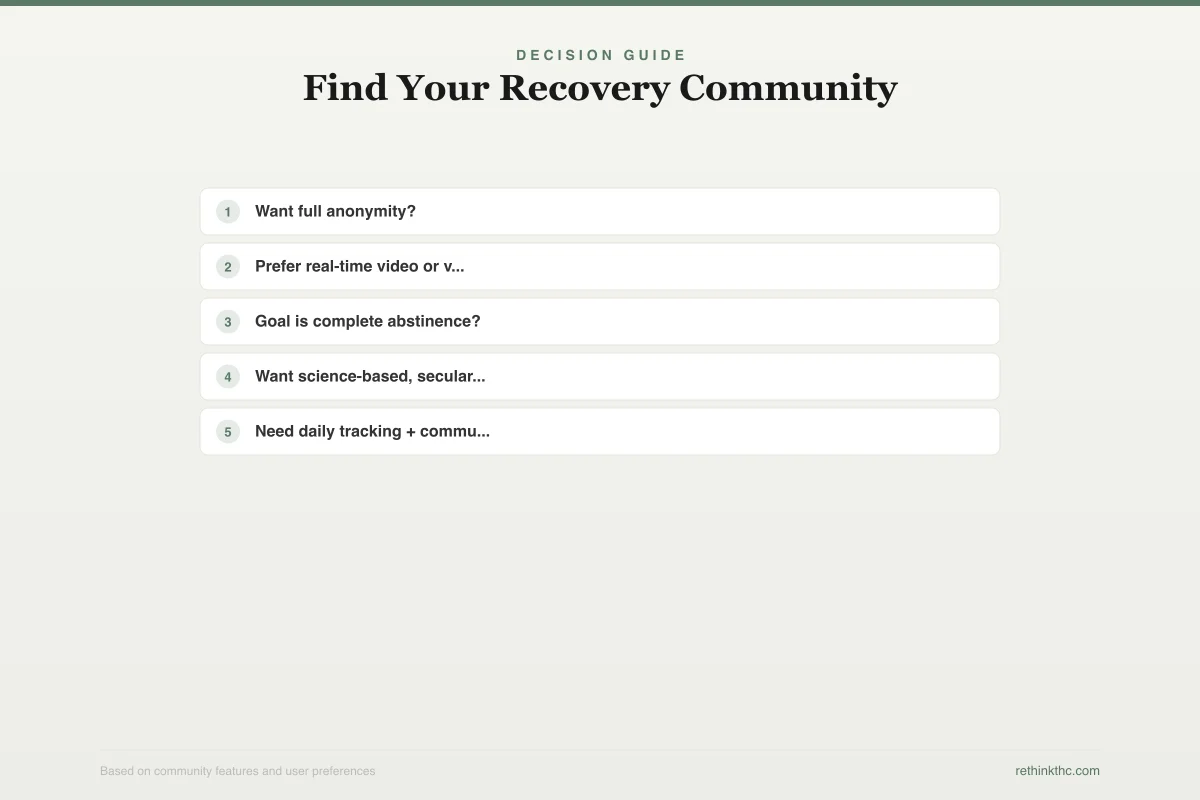
Decision Guide
Find Your Recovery Community
Answer each question to narrow down your best fit
Want full anonymity?
Reddit communities (r/leaves, r/Petioles)
Continue below
Prefer real-time video or voice?
MA Online or SMART Recovery meetings
Reddit, app communities, or Discord
Goal is complete abstinence?
r/leaves or Marijuana Anonymous
r/Petioles (moderation-friendly)
Want science-based, secular approach?
SMART Recovery Online
MA (12-step with spiritual framework)
Need daily tracking + community in one place?
Grounded or similar recovery apps
Combine Reddit + scheduled meetings
Communities are not mutually exclusive. Many people use Reddit daily, attend one or two meetings per week, and track progress in an app.
Based on community features and user preferences
 View as image ↗
Marijuana Anonymous (MA) expanded its online meeting schedule significantly in recent years. The organization now offers over 100 online meetings per week, running across multiple time zones and formats. These are real-time meetings held over video or phone, following the same 12-step structure as in-person MA meetings.
The online format preserves the core MA experience: readings, sharing, speaker meetings, and step study. The main difference is accessibility. You can attend from anywhere, and many meetings allow camera-off participation for people who want to listen without being seen.
For a detailed breakdown of how MA's 12-step approach compares to SMART Recovery and individual therapy, the formal treatment comparison covers the philosophy, evidence base, and practical differences of each.
The Vibe
MA online meetings carry the warmth and ritual of 12-step culture. People introduce themselves, share from personal experience, and follow group norms around cross-talk (not directly responding to what others share during open discussion). There is a sense of ceremony to it, with readings and closing statements that create consistency from meeting to meeting.
The community aspect extends beyond meetings. Many MA groups have phone lists where members share numbers for between-meeting support. The sponsor relationship, where a more experienced member guides you through the steps, also functions online.
Anonymity and Commitment
MA meetings use first names only. Online meetings typically allow you to display any name you choose. The 12 traditions of MA emphasize anonymity as a foundational principle. That said, video meetings do involve showing your face (unless cameras are off), which is a higher level of personal exposure than posting on Reddit.
The commitment level is also higher. MA meetings are scheduled events that you attend in real time. They require you to show up at a specific time and participate in a group setting. This structure is a feature for people who need accountability and a weakness for people who want support on their own schedule.
SMART Recovery Online
What It Is and How It Works
SMART Recovery's online platform includes scheduled meetings, 24/7 discussion forums, and a live chat feature. The meetings use cognitive behavioral tools, including cost-benefit analysis exercises, urge management techniques, and structured problem-solving. A trained facilitator guides each meeting.
SMART's online meetings are free and do not require registration to attend your first meeting. The community is substance-general, meaning you will be in meetings with people working on alcohol, cannabis, opioids, and other substances. Cannabis-specific meetings exist but are less common than general sessions.
The Vibe
SMART online meetings are more structured and educational than peer-led support spaces. The facilitator introduces a specific tool or topic, the group works through it together, and discussion stays focused on skill-building rather than open sharing. The tone is practical and forward-looking.
The forums and chat provide a less structured space for ongoing connection. The forum culture is supportive but less emotionally intense than Reddit communities. Posts tend to focus on applying SMART techniques to specific situations rather than venting or processing emotions.
Who SMART Online Works Best For
If you prefer a secular, science-based framework and want to learn specific cognitive tools for managing urges and thought patterns, SMART's online platform delivers that. If you are looking for emotional connection, raw shared experience, and the feeling of being deeply understood by someone who has been where you are, the Reddit communities or MA meetings may feel more resonant.
Recovery Apps with Community Features
Grounded and Similar Platforms
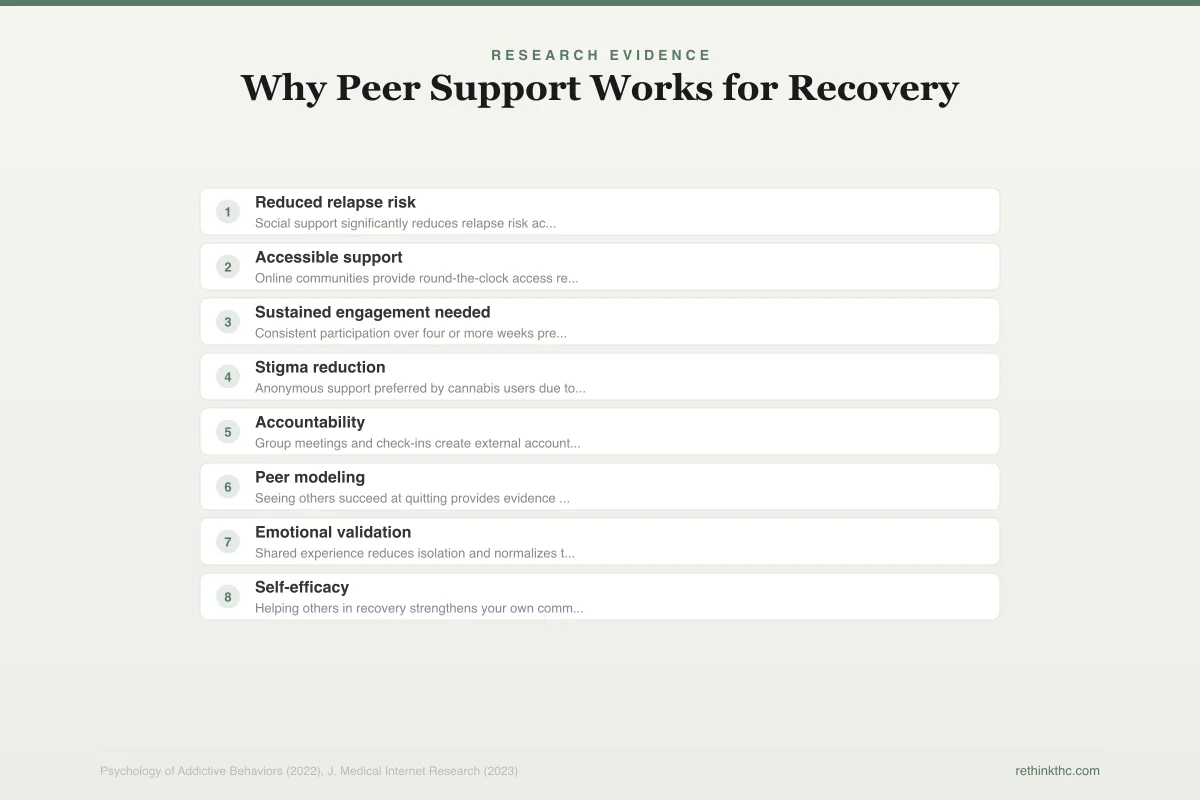
Research Evidence
Why Peer Support Works for Recovery
40-60%
Reduced relapse risk
Social support significantly reduces relapse risk across substance use disorders
24/7
Accessible support
Online communities provide round-the-clock access regardless of location or schedule
4+ wks
Sustained engagement needed
Consistent participation over four or more weeks predicts significantly better outcomes
How It Works
Stigma reduction
Anonymous support preferred by cannabis users due to societal minimization of cannabis dependence
Accountability
Group meetings and check-ins create external accountability that reinforces commitment
Peer modeling
Seeing others succeed at quitting provides evidence that recovery is achievable
Emotional validation
Shared experience reduces isolation and normalizes the difficulty of quitting
Self-efficacy
Helping others in recovery strengthens your own commitment and confidence
Psychology of Addictive Behaviors (2022), J. Medical Internet Research (2023)
 View as image ↗
Several apps now combine cannabis-specific tracking tools with built-in community features. Grounded is one of the most widely used, offering a day counter, journal, milestone celebrations, and a community feed where users post updates and encouragement. For a broader look at quit-weed apps, the best apps for quitting weed covers the full landscape with honest reviews of each option.
App-based communities sit between the structure of MA meetings and the open format of Reddit. Posts are typically short, positive, and milestone-focused. The culture emphasizes encouragement and daily accountability. You see a lot of "Day 14, still going" posts and congratulatory responses.
Strengths and Limitations
The strength of app communities is integration. Your tracking, journaling, and community are in one place on your phone. The barrier to checking in is almost zero, and push notifications can prompt daily engagement.
The limitation is depth. App community feeds rarely produce the kind of extended, nuanced conversation you find in Reddit threads or the structured skill-building of SMART meetings. They work best as a daily touchpoint alongside a deeper community engagement elsewhere.
Discord Servers and General Sobriety Communities
A growing number of Discord servers cater to people in cannabis recovery or general sobriety. These range from small private groups to servers with thousands of members. The format is real-time chat organized into channels (general discussion, daily check-ins, specific topics).
General sobriety communities that welcome cannabis recovery include broader "sober curious" spaces and quit-drinking communities that have expanded to include all substances. The advantage is a larger, more active community. The limitation is that cannabis-specific experience can be diluted, and you may encounter people who do not take cannabis dependence as seriously as alcohol or other substances.
A 2023 survey published in the Journal of Medical Internet Research found that online peer support communities for substance use showed consistent benefits for engagement, self-efficacy, and perceived social support. The format matters less than the consistency of participation.
How to Choose the Right Community for You
Match the Community to Your Goal
Best Practices
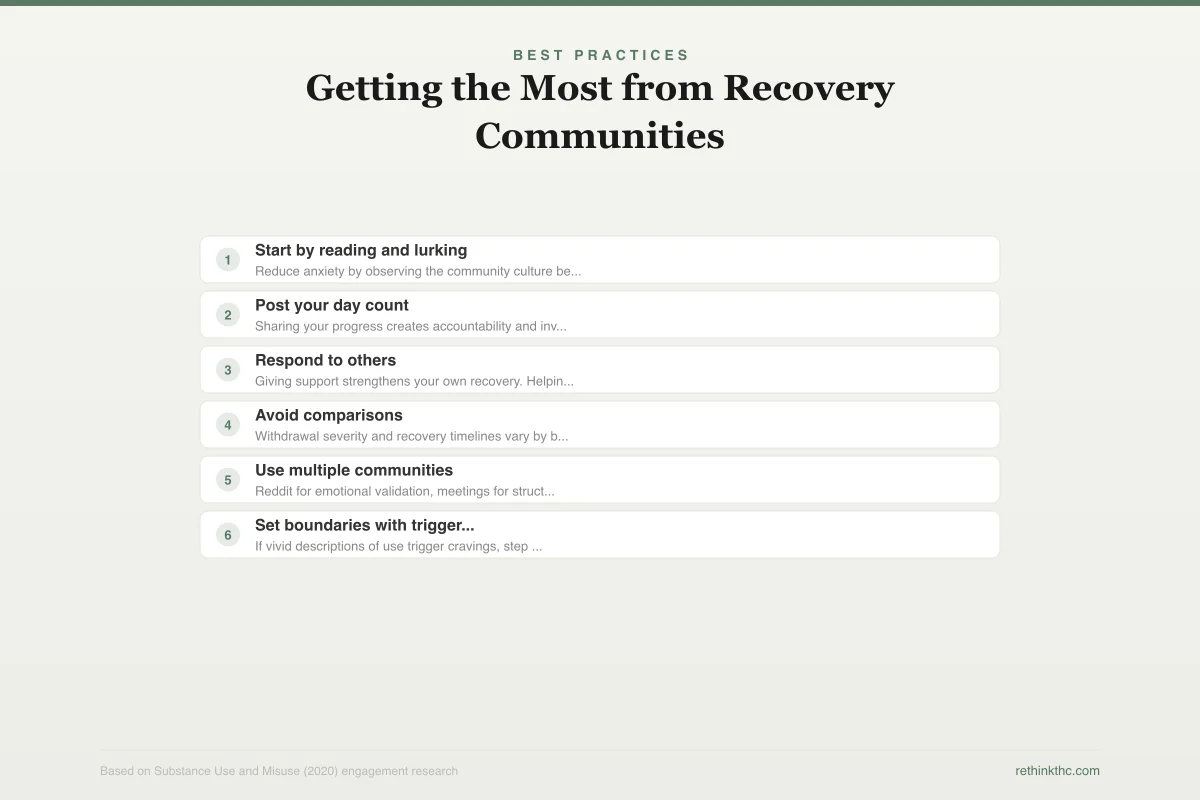
Getting the Most from Recovery Communities
Six strategies for meaningful engagement
Start by reading and lurking
Reduce anxiety by observing the community culture before posting. Most communities welcome silent participation.
Post your day count
Sharing your progress creates accountability and invites support. Even "Day 1" posts get strong responses.
Respond to others
Giving support strengthens your own recovery. Helping someone on Day 2 when you are on Day 20 reinforces how far you have come.
Avoid comparisons
Withdrawal severity and recovery timelines vary by biology and use history. Someone else’s Day 7 is not your Day 7.
Use multiple communities
Reddit for emotional validation, meetings for structured growth, apps for daily accountability. Different tools serve different needs.
Set boundaries with triggering content
If vivid descriptions of use trigger cravings, step back temporarily. Protecting your recovery is more important than engagement.
Commit to at least four weeks of consistent participation before deciding a community is not for you. First impressions during withdrawal can be misleading.
Based on Substance Use and Misuse (2020) engagement research
 View as image ↗
The single most important factor is alignment between the community's stance and your personal goal. If you want to quit entirely, communities built around abstinence (r/leaves, MA) will reinforce that commitment. If you want to moderate, a moderation-friendly space (r/Petioles) will meet you where you are. Joining an abstinence community when you want to moderate creates friction. Joining a moderation community when you need to quit can enable the part of your brain that is looking for permission to keep using.
Try More Than One
Communities are not mutually exclusive. Many people check in on Reddit daily, attend one or two MA or SMART meetings per week, and use an app to track their progress. The combination provides different types of support: immediate emotional validation (Reddit), structured growth (meetings), and daily accountability (apps).
If you are early in your journey to quit weed, starting with a low-barrier option like Reddit or an app lets you build the habit of seeking support before committing to scheduled meetings.
Give It Time
A 2020 study in Substance Use and Misuse found that sustained engagement with peer support, defined as consistent participation over at least four weeks, predicted better outcomes than initial enthusiasm followed by dropout. Whatever community you choose, commit to at least a month of regular participation before deciding it is not for you.
When to Seek Professional Help
Online communities are powerful, but they are not a substitute for professional support when you need it. If you are experiencing severe withdrawal symptoms, depression or anxiety that interferes with daily life, or thoughts of self-harm, a therapist or medical provider can offer the level of care that peer communities cannot.
If your cannabis use is tangled up with other mental health conditions, or if you have tried community support and keep relapsing, individual treatment may need to be part of your plan.
You can reach the SAMHSA National Helpline at 1-800-662-4357. It is free, confidential, available 24/7, and can connect you with local treatment resources and support group information.
Your People Are Out There
Finding the right cannabis recovery community is less about picking the objectively best option and more about finding the space where you feel understood. The person who thrives in the structured ritual of MA meetings might feel lost in a Reddit thread, and the person who finds their voice on r/leaves might never set foot in a SMART meeting. That is not a flaw in any of these communities. It is a feature of how differently human beings process change.
The science consistently shows that social connection is one of the strongest predictors of sustained behavior change. A 2022 review in Psychology of Addictive Behaviors confirmed that perceived social support is significantly associated with reduced substance use and improved recovery outcomes. The community you build around your decision, whether it is online, in-person, or some combination, is not a bonus. It is a core part of the process.
Systematic review (2022) · Psychology of Addictive Behaviors
- Population
- Aggregated across multiple studies of people changing substance use patterns
- Intervention
- Participation in peer support communities, 12-step groups, and online recovery networks
- Comparator
- Going it alone or using professional treatment without peer connection
- Finding
- Perceived social support was significantly associated with reduced substance use and better long-term recovery outcomes — across substances, including cannabis
positive Effect size is meaningful. This is why community isn't an optional extra — it's one of the few consistently protective factors in the literature.
Psychology of Addictive Behaviors (2022) review on social support and substance use outcomes
The Bottom Line
Cannabis recovery communities span multiple platforms with distinct cultures and approaches. r/leaves (300,000+ members) is the largest abstinence-focused online community — strictly no moderation discussion, raw supportive tone, active moderation, pseudonymous, 24/7 engagement. r/Petioles serves the moderation/tolerance-break audience — smaller, reflective tone, lighter moderation rules; a 2019 Addiction study found less severe CUD can achieve stable moderation while more severe dependence favors abstinence goals. Marijuana Anonymous online offers 100+ weekly meetings with full 12-step structure (readings, sharing, sponsor system, phone lists) — free, first-name anonymity, cameras-optional, higher commitment than async forums. SMART Recovery online provides CBT-based facilitated meetings with cognitive exercises (cost-benefit analysis, DISARM technique, ABC model), plus 24/7 forums and chat — secular, skill-building focus, substance-general with limited cannabis-specific meetings. App-based communities (Grounded and similar) integrate tracking, journaling, and community feeds — low-barrier daily touchpoints but limited depth compared to dedicated forums or meetings. Discord servers offer real-time chat in organized channels but quality varies widely. Key selection principle: match community stance (abstinence vs. moderation) to your goal — misalignment creates friction or enables continued use. Sustained engagement (4+ weeks consistent participation) predicts better outcomes than initial enthusiasm followed by dropout (Substance Use and Misuse, 2020). Social connection is one of the strongest predictors of sustained behavior change — a 2022 Psychology of Addictive Behaviors review confirmed perceived social support significantly reduces substance use and improves recovery outcomes.
What is the best online community for quitting weed?
The best community depends on your goals and preferences. r/leaves is the largest abstinence-focused online community with over 300,000 members and active 24/7 engagement. Marijuana Anonymous online meetings offer structured 12-step support with real-time interaction. SMART Recovery online provides cognitive behavioral tools in a secular framework. Most people benefit from combining two or more communities for different types of support.
Is r/leaves or r/Petioles better for cannabis recovery?
r/leaves is designed for people who want to quit cannabis completely, and all content reinforces that goal. r/Petioles is for people who want to moderate their use, take tolerance breaks, or reduce consumption without full abstinence. Choose based on your specific goal. Research suggests that people with more severe dependence tend to do better with abstinence-focused support, while those with milder use patterns can succeed with moderation approaches.
Are Marijuana Anonymous online meetings free?
Yes. All Marijuana Anonymous meetings, both in-person and online, are completely free. MA offers over 100 online meetings per week across multiple time zones. There is no registration requirement, no insurance needed, and no waitlist. You can find the full schedule on the Marijuana Anonymous website and attend your first meeting immediately.
Can I stay anonymous in online recovery communities?
Anonymity levels vary by platform. Reddit communities (r/leaves, r/Petioles) are pseudonymous, meaning you use a username with no real identity attached. Marijuana Anonymous meetings use first names only and allow cameras-off participation. SMART Recovery online meetings are similar. App-based communities typically use display names. Discord servers vary, but most allow anonymous participation. None of these platforms require your real name or personal information to participate.
How long should I try a recovery community before deciding it is not for me?
Research suggests committing to at least four weeks of consistent participation before making a judgment. A 2020 study in Substance Use and Misuse found that sustained engagement over four or more weeks predicted significantly better outcomes than brief initial participation. First impressions can be misleading, especially if you are in early withdrawal when everything feels uncomfortable. Give the community time to become familiar before evaluating whether it fits.
Can I use multiple recovery communities at the same time?
Yes, and many people do. A common effective combination is daily check-ins on Reddit (r/leaves or r/Petioles), one or two weekly MA or SMART meetings for structured support, and an app like Grounded for tracking and quick accountability. Each platform provides a different type of support: immediate emotional validation, structured skill-building, and daily habit tracking. Using multiple communities covers more of your needs than any single platform can.
Sources & References
- 1RTHC-07926·Ware, Orrin D (2025). “Cannabis Use Disorder Cases in U.S. Mental Health Treatment Nearly Doubled From 2013 to 2018.” Substance use : research and treatment.Study breakdown →PubMed →↩
- 2RTHC-00312·Hasin, Deborah S et al. (2008). “National Survey Found 44% of Frequent Cannabis Users Experienced Withdrawal Symptoms.” The Journal of clinical psychiatry.Study breakdown →PubMed →↩
- 3RTHC-07707·Spiga, Francesca et al. (2025). “Is There a Pill to Help You Quit Cannabis? The Cochrane Review Says Not Yet.” The Cochrane database of systematic reviews.Study breakdown →PubMed →↩
- 4RTHC-00218·Budney, Alan J. et al. (2006). “Paying for Clean Tests Worked During Treatment. Therapy Helped It Last..” Journal of Consulting and Clinical Psychology.Study breakdown →PubMed →↩
- 5RTHC-00166·Haney, Margaret et al. (2004). “Can Oral THC Pills Ease Marijuana Withdrawal? A Controlled Study Says Yes.” Neuropsychopharmacology : official publication of the American College of Neuropsychopharmacology.Study breakdown →PubMed →↩
- 6RTHC-08112·Bedillion, Margaret F et al. (2026). “Why There's Still No FDA-Approved Medication for Cannabis Addiction.” Current topics in behavioral neurosciences.Study breakdown →PubMed →↩
- 7RTHC-00188·González, Sara et al. (2005). “Comprehensive Review of Cannabis Tolerance and Dependence in Laboratory Animals.” Pharmacology.Study breakdown →PubMed →↩
- 8RTHC-00203·Raphael, Beverley et al. (2005). “Review of Cannabis Health Risks: Psychosis Link Strong, Withdrawal Syndrome Real, Gateway Theory Debated.” Journal of psychiatric practice.Study breakdown →PubMed →↩