Support & Community
3 Paths
A 2020 Cochrane review found 12-step programs like Marijuana Anonymous were as effective as other treatments for sustained abstinence, and a separate RCT showed SMART Recovery produced equivalent outcomes.
Kelly et al., Cochrane Review, 2020
Marijuana Anonymous: The 12-Step Approach
covered in detail
Side-by-Side Comparison
covered in detail
Who Each Approach Works Best For
covered in detail
Kelly et al., Cochrane Review, 2020
 View as image ↗
When you start looking for support with cannabis, the options can feel overwhelming. Marijuana Anonymous, SMART Recovery, therapy, online groups, apps. You know you want help, but you are not sure which kind. And the differences between these approaches are not just logistical. They reflect fundamentally different ideas about why people use substances, what recovery looks like, and what role community plays in the process.
This is a practical comparison of the three most common structured approaches to marijuana anonymous SMART recovery: Marijuana Anonymous (MA), SMART Recovery, and individual therapy. Each one works. Each one has limitations. And understanding what makes them different is the fastest way to figure out which one fits your situation, your values, and your brain. If you want a broader roadmap first, the complete guide to quitting weed covers the full process and where support programs fit into it.
Key Takeaways
- Marijuana Anonymous follows the 12-step model with a spiritual framework, sponsor system, and peer accountability — it is completely free with both in-person and online meetings available worldwide
- SMART Recovery uses cognitive behavioral and motivational techniques in a secular, self-empowerment framework with no sponsors or step work — also free with widespread online access
- Individual therapy — especially CBT and motivational interviewing — offers personalized treatment for cannabis use disorder but costs money and requires finding the right clinician
- Research supports all three approaches, but individual CBT has the strongest evidence base, while peer support programs show consistent benefits for long-term engagement and accountability
- These approaches are not mutually exclusive, and many people combine two or all three for the best results
- A 2020 Cochrane review by Kelly et al. found 12-step programs were as effective as other established treatments for sustained abstinence, and a 2020 RCT comparing SMART to 12-step facilitation found both produced meaningful improvements with no significant difference in outcomes
Marijuana Anonymous: The 12-Step Approach
Philosophy and Framework
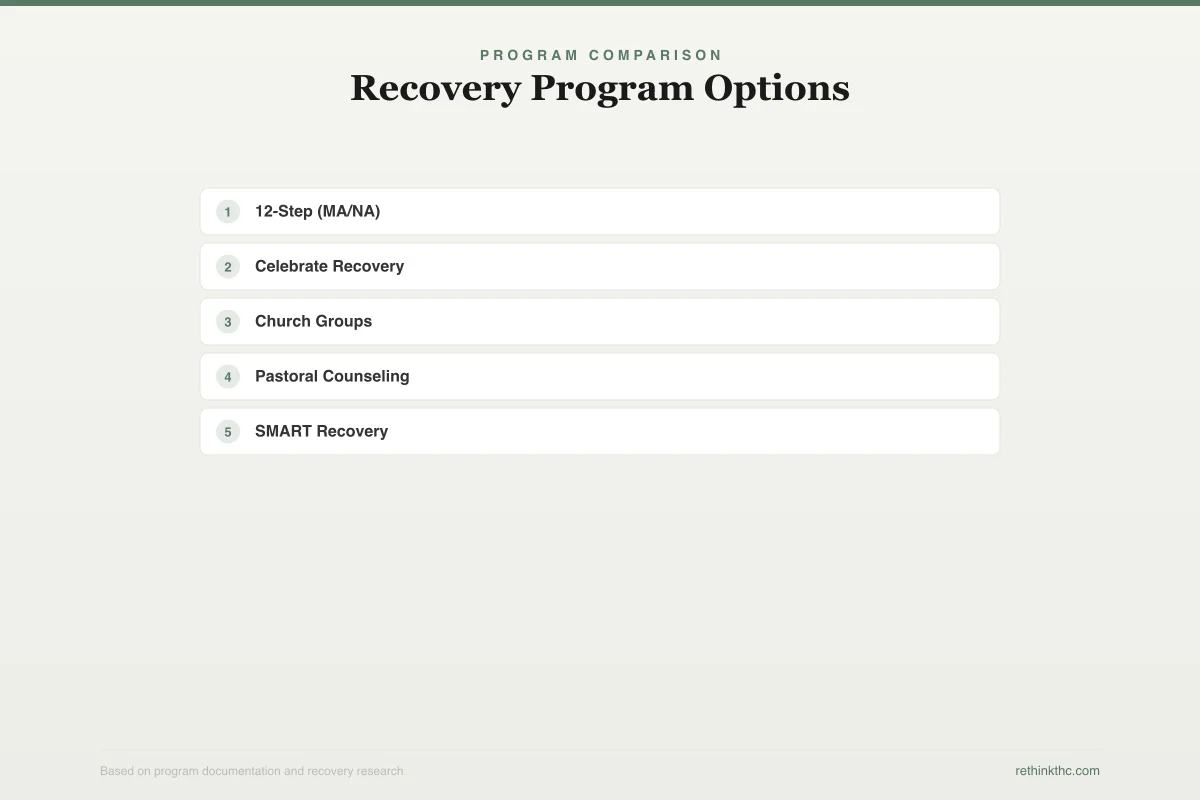
Program Comparison
Recovery Program Options
Comparing faith-based and secular recovery approaches
12-Step (MA/NA)
Celebrate Recovery
Church Groups
Pastoral Counseling
SMART Recovery
| Program | Spiritual | Evidence | Cannabis | Size | Access | Cost |
|---|---|---|---|---|---|---|
| 12-Step (MA/NA) | Med | Strong | MA only | Large | High | Free |
| Celebrate Recovery | High | Moderate | No | Medium | High | Free |
| Church Groups | High | Limited | No | Small | Variable | Free |
| Pastoral Counseling | High | Limited | No | 1-on-1 | Variable | Free/Low |
| SMART Recovery | Low | Strong | No | Medium | Moderate | Free |
Based on program documentation and recovery research
 View as image ↗
Marijuana Anonymous is built on the same 12-step model that Alcoholics Anonymous introduced in 1935. The core framework treats addiction as a chronic condition that requires ongoing management through spiritual principles, peer accountability, and surrender to a "higher power." That higher power does not have to be religious. MA materials describe it as any power greater than yourself, which members define in their own way, from God to the group itself to the natural world.
The 12 steps move through a progression: admitting powerlessness over marijuana, taking a moral inventory, making amends, and committing to ongoing spiritual practice and service. This is not a quick process. Working through all 12 steps with a sponsor typically takes months to a year or longer.
MA's philosophy is that cannabis addiction is something you manage for life, not something you cure. This framing helps some people and frustrates others.
What a Meeting Looks Like
MA meetings typically last 60 to 90 minutes. Most follow a structured format: a reading of the 12 steps and traditions, a speaker sharing their story, and an open discussion period. Some meetings are "speaker meetings" where one person shares at length. Others are "step study" meetings focused on working through a specific step.
The atmosphere is informal. There is no therapist in the room. Everyone is there because they have a problem with marijuana, and the primary mechanism of change is identification. Hearing someone describe the exact thought pattern you had last Tuesday, the same rationalization, the same cycle, creates a powerful sense of being understood.
MA also has a sponsor system. A sponsor is a more experienced member who guides you through the steps, answers your calls when you are struggling, and holds you accountable. This relationship is voluntary and unpaid, and for many people it becomes the most valuable part of the program.
Evidence and Accessibility
The research base for 12-step programs is strongest for Alcoholics Anonymous, where a 2020 Cochrane review by Kelly and colleagues found that AA was as effective as other established treatments for alcohol use disorder and better at producing sustained abstinence. Cannabis-specific 12-step research is more limited, but the mechanisms (social support, identity change, accountability) are consistent across substances.
MA meetings are free. There is no registration, no insurance, no waitlist. You show up and sit down. MA offers in-person meetings in most major cities and a growing number of online meetings through their website. The barrier to entry is essentially zero.
SMART Recovery: The Cognitive-Behavioral Approach
Philosophy and Framework
SMART Recovery (Self-Management and Recovery Training) was founded in 1994 as a science-based alternative to the 12-step model. It draws on cognitive behavioral therapy (CBT), rational emotive behavior therapy (REBT), and motivational interviewing. If you want to understand the CBT foundation in detail, the article on CBT for cannabis recovery covers those techniques thoroughly.
The philosophical differences from MA are significant. SMART does not use the language of powerlessness. Instead, it emphasizes self-empowerment and the idea that you have the ability to change your own thoughts and behaviors. There is no higher power, no sponsor, no step work, and no expectation that you will attend for life. SMART treats problematic substance use as a learned behavior that can be unlearned, not a lifelong disease.
SMART is organized around four core principles: building and maintaining motivation, coping with urges, managing thoughts and feelings and behaviors, and living a balanced life. These map closely to CBT and motivational enhancement techniques used in clinical settings.
What a Meeting Looks Like
SMART meetings are facilitated, meaning a trained volunteer guides the discussion. This is different from MA, where meetings are peer-led without a designated facilitator role. The facilitator introduces tools and exercises, keeps the discussion focused, and may teach specific techniques during the meeting.
A typical SMART meeting might involve working through a cost-benefit analysis of cannabis use, practicing the DISARM technique (Destructive Images and Self-talk Awareness and Refusal Method) for managing urges, or discussing how to apply the ABC model (Activating event, Beliefs, Consequences) to a real situation from the past week. These are structured cognitive exercises, not open-ended sharing.
The tone is more educational than confessional. You will not hear people introduce themselves as addicts. There is less emphasis on storytelling and more on skill-building. Some people find this refreshing. Others find it lacks the emotional depth and connection of 12-step meetings.
SMART does not have sponsors. Peer support happens within the meeting, but there is no formal one-on-one mentorship structure outside of it.
Evidence and Accessibility
A 2018 study by Beck and colleagues, published in the Journal of Clinical Psychology, found that SMART Recovery participants showed significant reductions in substance use and improvements in quality of life. A 2020 randomized controlled trial by Kelly and colleagues, published in the Journal of Substance Abuse Treatment, compared SMART to 12-step facilitation and found both produced meaningful improvements, with no significant difference in outcomes between the two approaches.
SMART meetings are free. They offer both in-person and online options, though in-person availability is more limited than MA in some areas. Their online meeting schedule is extensive, with multiple meetings running daily across time zones. SMART also has a robust online forum and 24/7 chat support.
Individual Therapy: The Personalized Approach
Philosophy and Framework
Individual therapy for cannabis use disorder is not a single approach. It encompasses multiple modalities, with cognitive behavioral therapy and motivational interviewing having the strongest evidence base. The key difference from group programs is personalization. A therapist tailors the approach to your specific triggers, your history, your co-occurring conditions, and your goals.
This matters because the reasons people struggle with cannabis vary enormously. One person uses cannabis primarily to manage anxiety, another uses it out of boredom, another uses it because their entire social life is organized around it. Group programs address these patterns at a general level. A skilled therapist addresses them at the level of your specific life.
Individual therapy also handles something that peer support groups cannot: clinical assessment and treatment of co-occurring mental health conditions. If your cannabis use is tangled up with depression, anxiety, PTSD, or ADHD, a therapist can treat both simultaneously. This dual focus is critical, because untreated mental health conditions are one of the strongest predictors of relapse.
What a Session Looks Like
A typical therapy session for cannabis use disorder runs 45 to 60 minutes and is structured around your current situation. In CBT-focused treatment, early sessions involve mapping your triggers, identifying automatic thoughts that drive use, and building a relapse prevention plan. Later sessions focus on practicing new coping skills, processing setbacks, and addressing deeper cognitive patterns.
Motivational interviewing sessions look different. The therapist uses open-ended questions and reflective listening to help you explore your own ambivalence about change. There is no homework, no structured exercises, just a skilled conversational approach that helps you clarify what you actually want and why.
Some therapists combine modalities, using MI in early sessions when motivation is still forming and shifting to CBT techniques once you are committed to change. This combined approach has strong research support.
Evidence and Accessibility
Individual CBT for cannabis use disorder has the most robust evidence base of any intervention. The landmark Marijuana Treatment Project, a multi-site clinical trial published in the Journal of Consulting and Clinical Psychology, found that CBT combined with motivational enhancement therapy produced significant reductions in cannabis use. A 2021 meta-analysis in Addiction confirmed that CBT-based interventions outperform control conditions for cannabis use.
The limitation is access. Therapy costs money. Even with insurance, copays of $20 to $50 per session are common, and out-of-pocket rates range from $100 to $250 per session depending on location and provider. Online therapy platforms have expanded access and often cost less than traditional in-person therapy, but they still represent a financial commitment that MA and SMART do not require.
Finding a therapist who specifically understands cannabis use disorder also takes effort. Many general therapists have limited training in substance use, and some still hold outdated views about cannabis. Look for clinicians with specific experience in substance use disorders, ideally with CBT or MI training.
Side-by-Side Comparison
| Marijuana Anonymous | SMART Recovery | Individual Therapy | |
|---|---|---|---|
| Model | 12-step, spiritual framework | CBT-based, secular | Varies (CBT, MI, other) |
| Cost | Free | Free | $20-$250/session |
| Format | Peer-led group meetings | Facilitated group meetings | One-on-one sessions |
| Sponsor/mentor | Yes | No | Therapist fills this role |
| Personalization | Low (shared framework) | Moderate (tools-based) | High (tailored to you) |
| Addresses co-occurring conditions | No | Limited | Yes |
| Online availability | Good | Excellent | Good (growing) |
| Time commitment | Ongoing, often lifelong | Self-determined | Typically 8-16 weeks |
| Philosophy | Powerlessness, surrender | Self-empowerment | Evidence-based, varies |
Who Each Approach Works Best For
MA tends to work best for people who value community and long-term belonging, respond to spiritual or meaning-making frameworks, want a structured program with clear milestones, benefit from having a personal mentor (sponsor), and find motivation in hearing other people's stories.
SMART tends to work best for people who prefer science-based, secular approaches, want specific cognitive tools they can use independently, are uncomfortable with the disease model or the concept of powerlessness, want flexibility in how long they participate, and respond well to structured exercises and skill-building.
Therapy tends to work best for people who have co-occurring mental health conditions alongside cannabis use, need personalized assessment and a tailored plan, have tried group approaches without success, prefer private one-on-one support, or have complex situations (trauma history, multiple substances, relationship dynamics) that require clinical expertise.
Combining Approaches
These options are not mutually exclusive, and in practice, many people combine two or all three. A common and effective combination is individual therapy for the first 8 to 12 weeks of cannabis cessation (when withdrawal and early adjustment are most intense) alongside weekly SMART or MA meetings for ongoing peer support. The therapy provides personalized skill-building while the group provides community and accountability.
Another pattern is starting with MA or SMART and adding therapy if progress stalls or if an underlying issue surfaces that peer support cannot address. There is no wrong order. The point is to build a support structure that covers your specific vulnerabilities.
If you are dealing with cannabis withdrawal symptoms, the early weeks may benefit most from professional support alongside peer community, since withdrawal creates both clinical symptoms and a strong need for people who understand what you are going through.
When to Seek Professional Help
If you are unsure where to start, individual therapy provides the most thorough starting point because a clinician can assess your full situation and recommend additional resources. But if cost is a barrier, starting with MA or SMART costs nothing and can provide immediate support.
Seek professional help specifically if you experience severe anxiety or depression when you stop using, if you have a history of trauma, if you have tried to quit multiple times without success, or if you are using other substances alongside cannabis.
You can reach the SAMHSA National Helpline at 1-800-662-4357. It is free, confidential, available 24/7, and can connect you with local treatment resources including therapy referrals and support group information. You do not need to be in crisis to call.
Finding What Works for You
The best approach to cannabis recovery is the one you will actually use. That sounds simple, but it matters more than the evidence base or the theoretical framework. A person who attends MA meetings three times a week and connects deeply with their sponsor will likely do better than someone who goes to one therapy session and drops out, even though therapy has the stronger research base on paper.
Start with what feels accessible and aligned with how you think. If you value community and structure, try MA. If you want cognitive tools and a secular framework, try SMART. If you need personalized support or have co-occurring conditions, find a therapist. And if the first thing you try does not click, that is not failure. It is information about what you need.
You are not choosing a lifelong commitment with your first step. You are running an experiment to find what helps you build the life you want without cannabis. Give any approach at least a month of consistent engagement before deciding it is not for you. And stay open to combining approaches as you learn more about what your recovery actually requires.
The Bottom Line
Three primary structured approaches to cannabis recovery — Marijuana Anonymous (MA), SMART Recovery, and individual therapy — each work through different mechanisms and suit different people. MA follows the 12-step model (spiritual framework, sponsor system, peer-led meetings, lifelong engagement, free); 2020 Cochrane review by Kelly et al. found 12-step programs as effective as other established treatments for sustained abstinence. SMART Recovery uses CBT/REBT/motivational interviewing (secular, self-empowerment framework, facilitated meetings with cognitive exercises, no sponsors, self-determined duration, free); Beck et al. (2018, Journal of Clinical Psychology) showed significant substance use reductions; Kelly et al. (2020, Journal of Substance Abuse Treatment) RCT found SMART comparable to 12-step facilitation. Individual therapy offers highest personalization (CBT/MI modalities, addresses co-occurring conditions, tailored trigger mapping and relapse prevention); Marijuana Treatment Project (Journal of Consulting and Clinical Psychology) found CBT+MET produced significant cannabis use reductions; 2021 Addiction meta-analysis confirmed CBT outperforms control conditions. Cost comparison: MA/SMART free, therapy $20-250/session. Key differentiators: MA provides community/sponsorship/spiritual meaning-making; SMART provides cognitive tools/secular skill-building; therapy provides personalized assessment, co-occurring condition treatment, clinical expertise. Approaches are complementary — common effective combination is therapy for first 8-12 weeks plus ongoing MA or SMART for peer accountability. The most important factor is consistent engagement with whichever approach resonates, not which has the strongest evidence base.
Can I attend both MA and SMART Recovery at the same time?
Yes. Many people attend both, particularly in early recovery when they want maximum support. The approaches are different enough that they complement rather than conflict with each other. MA provides community, sponsorship, and a spiritual framework. SMART provides cognitive tools and skill-building exercises. Some people find that one resonates more over time and naturally shift their attendance, while others continue with both indefinitely.
Is Marijuana Anonymous religious?
MA is spiritual but not religious. The program references a "higher power," but members define that concept individually. Some members interpret it as God, others as the group, nature, or simply a force greater than their own willpower. MA meetings do not promote any specific religion. That said, the language of the 12 steps (particularly "God as we understood Him" in some step readings) does feel religious to some people, which is one reason SMART Recovery appeals to those who prefer a fully secular approach.
How much does therapy for cannabis use disorder cost?
Costs vary widely. With insurance, copays typically range from $20 to $50 per session. Without insurance, rates range from $100 to $250 per session depending on the provider and location. Online therapy platforms often cost $60 to $100 per session. Community mental health centers and university training clinics offer sliding-scale fees based on income, sometimes as low as $5 to $20 per session. The SAMHSA helpline (1-800-662-4357) can help you find affordable options in your area.
Which approach has the best success rate?
This question is harder to answer than it appears, because "success" is defined differently across approaches and studies use different outcome measures. Individual CBT has the most controlled clinical trial evidence. The 2020 Cochrane review found 12-step programs (like MA) comparable to clinical treatments for sustained abstinence. SMART Recovery shows significant improvements in clinical studies. The most honest answer is that all three work, none works for everyone, and the approach you engage with consistently will outperform the one with better research that you attend once and stop.
What if none of these approaches work for me?
If you have genuinely engaged with multiple approaches (attending consistently for at least a month each, not just trying once) and are still struggling, it is worth exploring whether an underlying condition is driving your use. A psychiatrist can evaluate whether medication for anxiety, depression, ADHD, or another condition might address the root issue that cannabis was managing. Intensive outpatient programs that combine group therapy, individual therapy, and structured support are another option for people who need more than a weekly meeting or session provides.
How quickly should I expect to see results from any of these approaches?
Set realistic expectations based on the approach. MA and SMART meetings provide immediate community support, but behavioral change typically takes consistent attendance over 4 to 8 weeks before patterns shift noticeably. Individual therapy often shows measurable progress within 6 to 8 sessions when using CBT or motivational interviewing. The most important early metric is not whether you have achieved your goal but whether you are consistently engaging with the process. Any approach you attend once or twice and abandon was never given a fair test. Commit to at least one month of consistent participation before evaluating whether it is working.
Sources & References
- 1RTHC-08512·Murri, Martino Belvederi et al. (2026). “Large meta-analysis finds regular cannabis use raises both pro-inflammatory and anti-inflammatory markers, not just one or the other.” Brain.Study breakdown →PubMed →↩
- 2RTHC-08534·P A Costa, Gabriel et al. (2026). “Cannabis Use Makes Quitting Tobacco Harder, But CBD Might Help.” medRxiv : the preprint server for health sciences.Study breakdown →PubMed →↩
- 3RTHC-06056·Berny, Lauren M et al. (2025). “Brief Interventions in Medical Settings Did Not Reduce Cannabis Use.” Prevention science : the official journal of the Society for Prevention Research.Study breakdown →PubMed →↩
- 4RTHC-06615·Halicka, Monika et al. (2025). “CBT with Motivational Enhancement Is the Best-Supported Psychotherapy for Cannabis Use Disorder.” Addiction (Abingdon.Study breakdown →PubMed →↩
- 5RTHC-06972·Lo, Jamie O et al. (2025). “Cannabis Use in Pregnancy Linked to Preterm Birth, Low Birth Weight, and Small Babies Even After Accounting for Tobacco.” JAMA pediatrics.Study breakdown →PubMed →↩
- 6RTHC-05376·Hill, Melanie L et al. (2024). “Cannabis Users with PTSD Still Benefit from Trauma-Focused Therapy — But Attend Fewer Sessions.” Journal of anxiety disorders.Study breakdown →PubMed →↩
- 7RTHC-05535·McClure, Erin A et al. (2024). “Reducing Cannabis Use by 50-75% Was Enough to See Real Improvements.” The American journal of psychiatry.Study breakdown →PubMed →↩
- 8RTHC-04980·Theerasuwipakorn, Nonthikorn (2023). “Cannabis and Heart Attack/Stroke Risk: A 183-Million-Patient Meta-Analysis Finds Stroke Risk but Not Heart Attack Risk.” Toxicology Reports.Study breakdown →PubMed →↩