Support & Community
7 Books
No single book works for everyone, so the strongest approach pairs a cannabis-specific title covering withdrawal and cravings with a general habit-change book for the behavioral side.
Budney et al., Journal of Consulting and Clinical Psychology, 2006
CBT-based
the approach with strongest evidence for cannabis cessation
Self-efficacy
reading builds the confidence that predicts quit success
Pair 2 books
one for why you use, one for how to stop
Budney et al., Journal of Consulting and Clinical Psychology, 2006
 View as image ↗
If you only read one thing
There's no single 'best book' for quitting weed — pairing two works better than hunting for the perfect one. For a cannabis-specific plan, 'Quitting Weed' by Matthew Clarke is the most directly useful. For the behavioral and habit side, pair it with 'Atomic Habits' by James Clear. If you keep relapsing, 'This Naked Mind' or 'Dopamine Nation' tackle the beliefs and brain chemistry that keep pulling you back. Reading before your quit date works better than trying to concentrate during week-one withdrawal.
When you search for the best books for quitting weed and cannabis recovery, you get a wall of affiliate lists that rate every book five stars and tell you nothing useful. That is not what this is. These are honest reviews of seven books relevant to quitting cannabis, covering what each one does well, where it falls short, and who it is best for.
Some are cannabis-specific. Others are general addiction or habit-change books that apply to quitting weed even though they were not written for that purpose. Reading alone does not replace professional support, but the right book at the right time can shift how you think about your relationship with cannabis. If you are looking for a step-by-step quit guide right now, start with the practical guide to quitting weed and come back here when you want to go deeper.
Key Takeaways
- No single book works for everyone — the best books for quitting weed depend on whether you want science-based strategies, personal stories, or practical habit-change tools
- Cannabis-specific titles like "Quitting Weed" by Matthew Clarke tackle marijuana withdrawal and cravings directly, while general addiction books require you to translate the concepts on your own
- Habit-change books like "Atomic Habits" are strongest when paired with a cannabis-specific resource that covers withdrawal and the emotional side of quitting
- Memoirs and personal narratives can reduce shame and isolation but rarely give you a step-by-step quit plan
- The most effective approach is combining two books: one that addresses the psychology of why you use and one that gives you concrete tools for stopping
- Research shows that self-efficacy — confidence in your ability to avoid cannabis — is a significant predictor of cessation outcomes[2], which is why reading that builds understanding and confidence can complement structured treatment
Fact Check
'Reading about quitting is procrastinating from quitting' vs. the research
The claim
“If you really wanted to stop, you'd just stop — buying more books is just another way to delay”
Self-help fatigue, and a cultural bias that 'real change' has to feel dramatic
What research shows
Partly TrueSelf-efficacy — your belief that you can actually do this — is one of the strongest predictors of whether you stay quit. Understanding what withdrawal will feel like, why your brain pulls you back, and how to think about a lapse is exactly what builds that belief. Reading first is not avoidance. It's preparation.
Reading becomes procrastination when you use it to stay on the sidelines forever. The fix is a deadline: pick one or two books, read them by a specific quit date, and then act.
Stephens et al. (1995) self-efficacy and marijuana cessation; Stephens et al. (1994) abstinence violation effect
Cannabis-Specific Books
"Quitting Weed: The Complete Guide" by Matthew Clarke
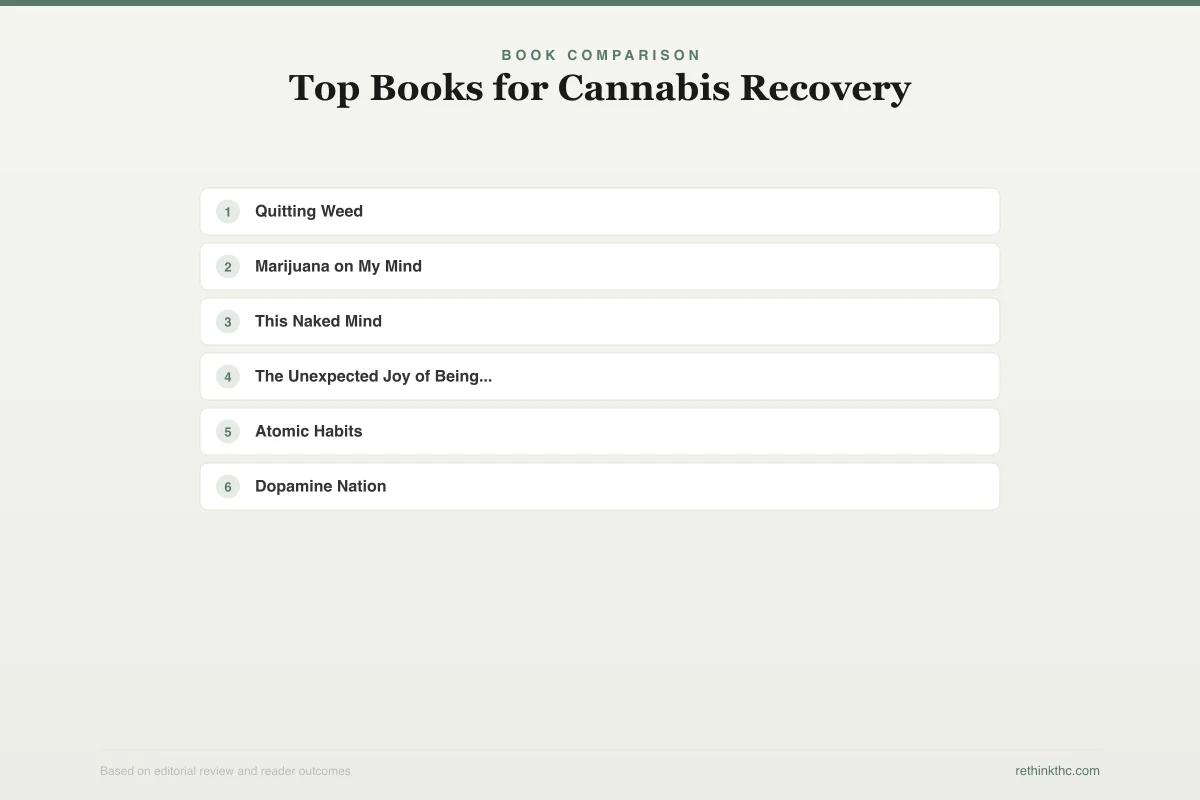
The comparison below rates all seven books across approach, cannabis specificity, and who each one works best for.
Book Comparison
Top Books for Cannabis Recovery
Approach, difficulty, and who each book is best for
Quitting Weed
Matthew Clarke
Marijuana on My Mind
Timmen Cermak, MD
This Naked Mind
Annie Grace
The Unexpected Joy of Being Sober
Catherine Gray
Atomic Habits
James Clear
Dopamine Nation
Dr. Anna Lembke
| Book | Approach | Difficulty | Best For | Cannabis |
|---|---|---|---|---|
Quitting Weed Matthew Clarke | Self-help / CBT | Easy | New quitters | |
Marijuana on My Mind Timmen Cermak, MD | Science-based | Moderate | Deep dive | |
This Naked Mind Annie Grace | Cognitive reframing | Easy | Belief change | |
The Unexpected Joy of Being Sober Catherine Gray | Memoir / research | Easy | Motivation | |
Atomic Habits James Clear | Behavioral science | Easy | Habit replacement | |
Dopamine Nation Dr. Anna Lembke | Neuroscience | Moderate | Understanding compulsion |
Based on editorial review and reader outcomes
 View as image ↗
If you want a book that is actually about quitting weed — not alcohol, not opioids, not "substances" in general — this is the one. Clarke structures the book around understanding why you use, preparing to quit, managing withdrawal, and preventing relapse, with cognitive behavioral exercises drawn from the same framework that clinical research supports for cannabis cessation.[1]
Clarke covers withdrawal honestly, including the sleep disruption and irritability that catch people off guard. The exercises are concrete and the tone is non-judgmental. Where it falls short is scientific depth — citations are light and the CBT framework is simplified in places. If you already understand CBT-based approaches to cannabis recovery, parts will feel like review.
Short chapters, clear language, readable during the first week of quitting. Start here if you have never read anything about cannabis cessation specifically.
"Marijuana on My Mind: The Science and Mystique of Cannabis" by Timmen Cermak, MD
This is not a quit guide. It is the book you read when you need to understand what is happening in your brain before you commit to action. Cermak is an addiction psychiatrist, and this reads more like an accessible textbook than a self-help book.
The science is accurate and thorough. Cermak explains how THC interacts with the endocannabinoid system, why tolerance develops, and what happens in the brain during withdrawal. He addresses the cultural divide between cannabis advocates and prohibitionists without picking a side. This is not a weekend read — Cermak writes at a level that assumes you want the full picture, not the summary.
Excellent as a companion book. Pair it with a practical guide for the actual quitting process.
General Addiction and Sobriety Books (Applied to Cannabis)
"This Naked Mind" by Annie Grace
The guide below matches your situation to the book most likely to help.
Reading Guide
Which Book Matches Your Goal?
Start with your situation, get a targeted recommendation
Want to quit and need a plan
"Quitting Weed" by Matthew Clarke
"Atomic Habits" by James Clear
Cannabis-specific guidance paired with behavioral framework for habit change
Want to understand the science
"Marijuana on My Mind" by Timmen Cermak
"Dopamine Nation" by Anna Lembke
Neuroscience of cannabis dependency and the dopamine balance that drives compulsive use
Keep trying to quit but it does not stick
"This Naked Mind" by Annie Grace
"Dopamine Nation" by Anna Lembke
Reframes subconscious beliefs about cannabis and explains why moderation feels impossible
Feel alone and need motivation
"The Unexpected Joy of Being Sober" by Catherine Gray
"Recovery" by Russell Brand
Personal narratives that reduce shame and show life without substances can be better
Want a structured workbook approach
"Quitting Weed" by Matthew Clarke
Concrete exercises with CBT underpinnings — the most step-by-step cannabis-specific option
Based on book content analysis and recovery goals
 View as image ↗
If you keep trying to quit and it does not stick, this book addresses the belief system that pulls you back. Grace wrote it about alcohol, but the core method — systematically dismantling the subconscious beliefs that make you think you need the substance — transfers to cannabis.
The central insight is powerful. You do not quit by fighting cravings harder. You quit by changing what you believe cannabis does for you. When you genuinely stop believing that weed relaxes you or that you need it to sleep, the desire diminishes on its own. Research on cannabis cessation supports this: how someone interprets a lapse after quitting — whether they see it as proof they cannot quit or as a recoverable setback — is one of the strongest predictors of whether they return to regular use.[3] Grace walks through this cognitive reframing process skillfully.
You will need to substitute "cannabis" for "alcohol" throughout, and some sections (social drinking culture, liver damage) do not translate. The tone can feel repetitive. But if you apply it to cannabis intentionally, the core method works.
"The Unexpected Joy of Being Sober" by Catherine Gray
If you need someone to make sobriety sound like something other than deprivation, start here. Gray chronicles her journey from heavy drinking to sobriety, weaving in interviews with addiction researchers, and she writes with humor and honesty that cuts through shame.
Gray is blunt about how much she loved drinking and how terrified she was to stop, which resonates with cannabis users who genuinely enjoy being high. The "unexpected joy" framing shifts your mental model from "I am losing something" to "I am gaining something." That reframe alone is worth the price of the book.
This is an alcohol memoir. You will not find discussion of THC withdrawal, cannabis-specific cravings, or the challenges of quitting a substance that much of society considers harmless. If you are struggling with the unique aspects of cannabis withdrawal, this book will not address them. Read it when you need permission to believe that life without substances can be better, not just tolerable.
Habit-Change Books (The Behavioral Angle)
"Atomic Habits" by James Clear
If you see cannabis use as a deeply embedded habit and want a systematic framework for replacing it, Clear gives you one. His model centers on four laws: make the desired behavior obvious, attractive, easy, and satisfying (and invert them for habits you want to break).
Clear's concept of "environment design" — removing cues that trigger the habit — aligns with clinical research on cannabis relapse prevention. His emphasis on identity-based change ("I am someone who does not smoke" versus "I am trying to quit") parallels the cognitive reframing that effective relapse prevention plans use. The book is practical, well-organized, and actionable.
But cannabis use is not just a habit. It involves neurochemical dependency, emotional regulation patterns, and withdrawal symptoms that a general habit framework does not address. "Stack a new habit onto an existing cue" is not sufficient when you are awake at 3 AM drenched in sweat. Clear does not discuss addiction or withdrawal. Pair this with something that addresses the neurological and emotional dimensions of cannabis dependency — together they cover what neither can alone.
"Dopamine Nation" by Dr. Anna Lembke
If you have ever wondered why you keep smoking weed when you do not even enjoy it anymore, this book explains the mechanism. Lembke is the chief of Stanford's Dual Diagnosis Clinic and frames substance use through the lens of dopamine balance.
The core concept — that pleasure and pain operate on a shared balance in the brain, and that chronic use tips that balance toward a pain-dominant state — explains why long-term cannabis users often feel flat and unable to enjoy things without THC. The clinical stories make abstract neuroscience feel personal. Lembke is a compelling writer who makes you understand your own behavior without judging it.
Cannabis is mentioned but not the focus. The suggestion that a 30-day abstinence period resolves the issue oversimplifies what many cannabis users experience, as full neurological recovery can take longer. Read this before quitting or after the acute phase — it is not ideal during the fog of early withdrawal. Pair with a practical quit guide for the step-by-step plan it does not provide.
"Recovery" by Russell Brand
If Brand's voice resonates with you, this book will reach you in a way that clinical self-help titles cannot. He rewrites the traditional 12 steps in his own language, drawing from his experience with heroin, alcohol, and other substances. His transparency about his own dysfunction reduces the shame barrier. If you have been considering peer support programs like Marijuana Anonymous or SMART Recovery, this serves as an accessible introduction to structured recovery.
Brand's style is polarizing — you will either love or hate it. The book focuses on severe addiction to hard drugs, and cannabis users may feel they do not "qualify" for the level of recovery Brand describes. Cannabis is barely mentioned. This is not a practical cannabis cessation resource on its own, but if the 12-step framework interests you and you want to explore it through a raw, irreverent lens before committing, it serves that purpose.
How to Choose the Right Book for Where You Are
Your situation determines which book will be most useful:
If you are about to quit and need a plan: Start with "Quitting Weed" by Matthew Clarke for cannabis-specific guidance, and supplement with "Atomic Habits" for the behavioral framework. These two together cover the practical and structural sides.
If you keep trying to quit and it does not stick: "This Naked Mind" (applied to cannabis) addresses the belief system that pulls you back. "Dopamine Nation" explains the neuroscience of why moderation feels impossible after chronic use.
If you feel alone in this: "The Unexpected Joy of Being Sober" or "Recovery" provides the "someone else has been here" feeling that reduces isolation. Pair with an actual support community for lasting effect.
If you want to understand the science first: "Marijuana on My Mind" is the most thorough and accurate resource for understanding what cannabis does in the brain and body.
No book replaces professional support for severe dependency. These are tools, and like all tools, they work best when combined with other strategies. Research on self-efficacy and cannabis cessation consistently shows that confidence in your ability to avoid use — the kind of confidence that understanding and preparation build — is one of the strongest predictors of outcomes.[2] Reading builds that confidence. But it works best alongside a quit plan, not as a substitute for one. If you prefer digital tools alongside your reading, the best apps for quitting weed covers tracking, community, and accountability options you can use from your phone.
When to Seek Professional Help
Books are a starting point, not a ceiling. If you have tried to quit multiple times and cannot stay stopped, if your cannabis use is connected to anxiety, depression, or trauma, or if withdrawal symptoms feel unmanageable, professional support changes the equation. A therapist trained in substance use can provide the personalized strategies that no book can.
If you are not sure where to start, SAMHSA's National Helpline at 1-800-662-4357 is free, confidential, and available 24/7. They can connect you with local treatment and support options.
The Right Book at the Right Time
Reading about quitting is not quitting. But it is often the thing that makes quitting feel possible. The right book can name something you have been feeling but could not articulate, or give you a framework that makes the process feel less chaotic.
Choose one book from this list that matches where you are right now. Read it with a pen in hand. Mark the parts that feel true. Skip the parts that do not. And when you are ready to move from reading to doing, the practical guide to quitting weed is here.
The Bottom Line
If you are about to quit and want one book, start with "Quitting Weed" by Matthew Clarke — it is the most cannabis-specific and practical option. If you want to understand why you keep going back, read "Dopamine Nation" by Anna Lembke. If you need someone to make sobriety sound like something other than deprivation, read "The Unexpected Joy of Being Sober" by Catherine Gray. No single book covers everything. The strongest approach pairs a cannabis-specific title with a general habit-change or addiction book. And reading about quitting is not quitting — but it is often the thing that makes quitting feel possible.
What is the best book for quitting weed specifically?
"Quitting Weed" by Matthew Clarke is the most cannabis-specific option that combines practical exercises with an evidence-informed approach. If you want to understand the neuroscience behind cannabis dependency, "Marijuana on My Mind" by Timmen Cermak is the most thorough science-based option. Most people benefit from pairing a cannabis-specific book with a general habit-change or addiction book.
Can books about quitting alcohol help with quitting cannabis?
Yes, but with caveats. Books like "This Naked Mind" and "The Unexpected Joy of Being Sober" address psychological patterns, belief systems, and identity shifts that are relevant across substances. However, they will not cover cannabis-specific withdrawal symptoms, THC's unique interaction with the endocannabinoid system, or the particular cultural challenges of quitting a substance that many people consider harmless. Use them as supplements, not primary resources.
Is reading about quitting weed enough to actually quit?
Reading alone rarely leads to sustained change, but it often plays a critical role in the process. Research on behavior change shows that self-efficacy — confidence in your ability to avoid cannabis — is a significant predictor of cessation outcomes. The key is translating what you read into action. Pair any book with a concrete quit plan and consider structured support like recovery programs.
When is the best time to read a recovery book, before or after quitting?
Before. Understanding what to expect from withdrawal, building a cognitive framework for why you are quitting, and having strategies ready before cravings hit all improve outcomes. During acute withdrawal (the first one to two weeks), your concentration may be impaired, so front-loading the reading is practical. Lighter reads like memoirs can work during withdrawal. Denser science-based books are better read before your quit date or after the acute phase passes.
Are there any books written specifically about cannabis withdrawal?
Cannabis-specific withdrawal books are rare compared to alcohol or opioid resources. "Quitting Weed" by Matthew Clarke is the most directly applicable, covering withdrawal symptoms, cravings, and relapse prevention with a cannabis-specific lens. "Marijuana on My Mind" by Timmen Cermak provides the most thorough scientific explanation of what happens during withdrawal at the neurochemical level. For the most detailed withdrawal information, pairing either of these with the cannabis withdrawal complete guide gives you clinical-level detail that most books do not reach.
Should I read recovery books during withdrawal or wait until after?
Front-load your reading before your quit date whenever possible. During the first one to two weeks of withdrawal, concentration and focus are often impaired, making dense science-based books difficult. If you are already in withdrawal and want to read, choose lighter titles like memoirs (Gray, Brand) or short-chapter practical guides (Clarke, Clear). Save denser books (Cermak, Lembke) for after the acute phase passes, typically around week three. The key insight you need during withdrawal itself is usually simple — that what you are feeling is temporary and normal — and a single chapter can deliver that without requiring sustained focus.
Sources & References
- 1RTHC-00218·Budney, Alan J. et al. (2006). “Paying for Clean Tests Worked During Treatment. Therapy Helped It Last..” Journal of Consulting and Clinical Psychology.Study breakdown →PubMed →↩
- 2RTHC-00055·Stephens, R S et al. (1995). “Confidence in Avoiding Marijuana Predicted How Often People Used After Treatment, Not Whether They Quit.” Journal of consulting and clinical psychology.Study breakdown →PubMed →↩
- 3RTHC-00051·Stephens, R S et al. (1994). “How People Explained Their First Marijuana Lapse Predicted Whether They Returned to Regular Use.” Addictive behaviors.Study breakdown →PubMed →↩