Withdrawal & Recovery
2 Days Either Way
CB1 receptors begin recovering within 2 days regardless of whether you quit cold turkey or taper, so the best method depends on your personality and situation, not the neuroscience.
D'Souza et al., Biological Psychiatry: CNNI, 2016
47%
About 47% of regular cannabis users get withdrawal symptoms
2 days
Your CB1 receptors — the brain's main THC targets — start
What Happens in Your Brain When You Quit
covered in detail
D'Souza et al., Biological Psychiatry: CNNI, 2016
 View as image ↗
If you only read one thing
Your brain recovers the same way whether you quit cold turkey or taper — CB1 receptors start rebuilding in 2 days and normalize by day 28 either way. The difference is in how the ride feels. Cold turkey is rougher for the first week but simpler — one rule, no decisions. Tapering is gentler but requires real discipline to not cheat on your schedule. The right method depends on you: if you struggle with moderation, go cold turkey. If quitting all at once would wreck your work or life, taper over 3-4 weeks. A clinical trial of 90 people found that cold turkey combined with therapy produced the best outcomes.
Key Takeaways
- About 47% of regular cannabis users get withdrawal symptoms when they stop, which is why the method you choose actually matters
- Cold turkey means stopping all at once — it brings more intense but shorter withdrawal, and it works well for people who struggle with moderation rules
- Tapering means gradually cutting your intake over days or weeks — it produces milder symptoms but requires real discipline and a structured plan
- Your CB1 receptors — the brain's main THC targets — start recovering within 2 days and largely normalize by about 28 days, regardless of which method you pick
- Neither approach is objectively better — the right one depends on your usage level, how you handle rules, your life circumstances, and whether you have tried one method before and struggled
- A 14-week clinical trial of 90 adults with cannabis dependence found that abstinence combined with cognitive behavioral therapy produced the best outcomes
What Happens in Your Brain When You Quit
Before comparing methods, it helps to understand what is happening at the neurological level. When you use cannabis regularly, THC binds to CB1 receptors (cannabinoid type 1 receptors, one of the main receptor types in your brain's endocannabinoid system). Over time, your brain responds by pulling some of those receptors offline, a process called downregulation. You need more THC to feel the same effect, which is the basis of tolerance.
Withdrawal Comparison
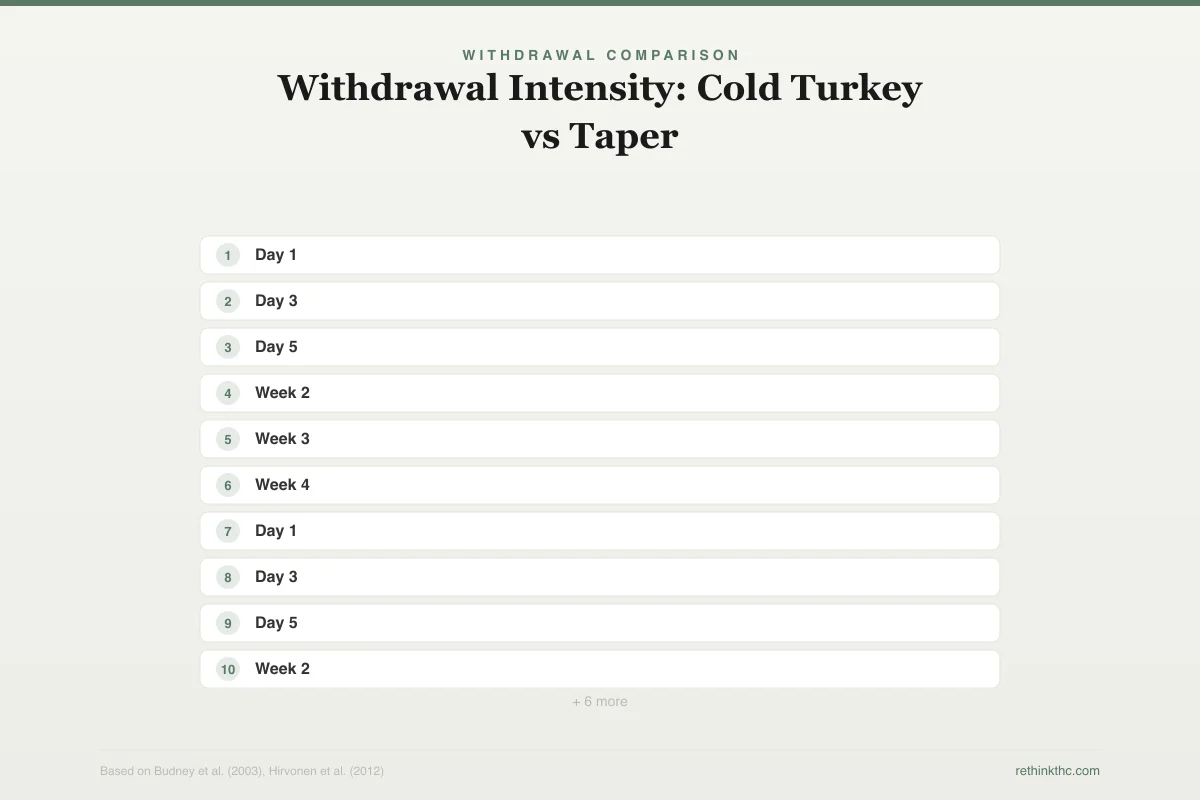
Withdrawal Intensity: Cold Turkey vs Taper
Different paths, same destination — CB1 receptors normalize by ~28 days post-cessation
Cold Turkey: High peak, faster resolution
Taper: Lower peak, longer tail
Both methods converge at the same endpoint. CB1 receptor density returns to normal ~28 days after last use, regardless of method.
Based on Budney et al. (2003), Hirvonen et al. (2012)
 View as image ↗
When you stop providing THC, or significantly reduce it, your brain has to rebuild those receptors and recalibrate the entire system. D'Souza's 2016 study in Biological Psychiatry[1] showed that CB1 receptor recovery begins within just 2 days of abstinence. Hirvonen's 2012 brain imaging study in Molecular Psychiatry[2] found that CB1 receptor density returns to roughly normal levels by about 28 days.
This 28-day receptor reset happens whether you quit cold turkey or taper. The difference is in how intensely you experience the transition. For a deeper look at the receptor recovery timeline, see the cannabinoid receptors recovery guide.
The Cold Turkey Approach
Cold turkey means you pick a date, use cannabis for the last time, and do not use again. No reduction period, no weaning schedule. You go from your current level of use to zero overnight.
Taper Protocol
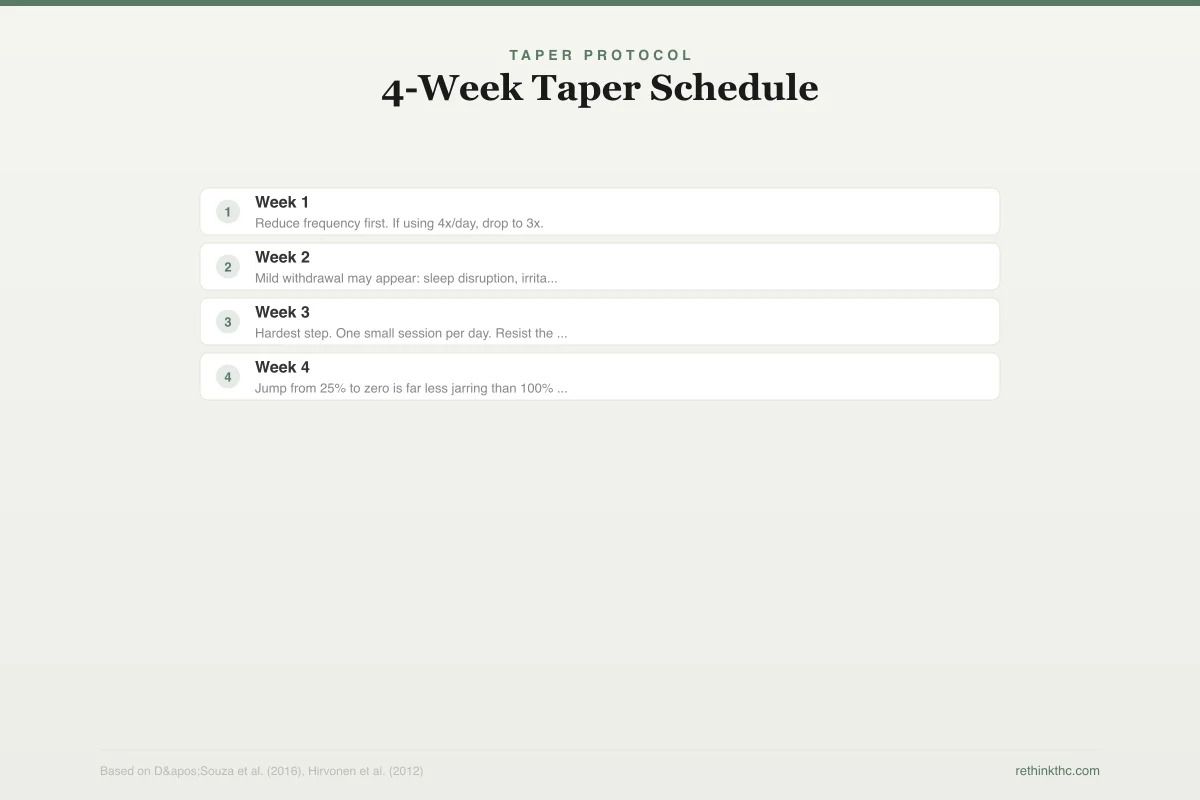
4-Week Taper Schedule
Reduce 25% per week. Track precisely. Have a firm quit date.
Week 1
75% of current use
Reduce frequency first. If using 4x/day, drop to 3x.
Week 2
50% of current use
Mild withdrawal may appear: sleep disruption, irritability. This is your brain adjusting.
Week 3
25% of current use
Hardest step. One small session per day. Resist the pull to use more.
Week 4
Stop completely
Jump from 25% to zero is far less jarring than 100% to zero. Recovery already underway.
Taper rules that prevent backsliding
- ✓Track every session — write down time, amount, and method
- ✓Set specific use windows (e.g., 8 PM only)
- ✓Only keep what your schedule allows for the next few days
- ✓No potency increases — do not switch from flower to concentrates
- ✓Do not compensate by using more per remaining session
Based on D'Souza et al. (2016), Hirvonen et al. (2012)
 View as image ↗
How It Feels
Budney's 2003 study in the Journal of Abnormal Psychology[3] documented the withdrawal timeline for people who stopped cannabis abruptly. Symptoms typically begin within 1 to 3 days, peak around days 2 to 6, and most effects resolve within 4 to 14 days. The most common symptoms include irritability, anxiety, sleep disruption, decreased appetite, and cravings.
The intensity of cold turkey withdrawal depends heavily on your usage level. Someone who smoked a few times a week may experience mild irritability and a couple of rough nights. Someone who used high-potency products multiple times daily may face significant insomnia, anxiety, and appetite loss for one to two weeks.
The peak is typically days 3 through 7. If you can get through the first week, the worst is behind you. For a day-by-day look at what to expect, see the first week quitting weed guide.
Who Cold Turkey Works Best For
People who struggle with moderation. If you have tried cutting back before and always ended up back at your original level, cold turkey removes the decision-making. There is no "just one hit" to negotiate. The rule is simple: zero.
People who want it over with. Cold turkey withdrawal is more intense, but it is shorter. If you prefer to rip the bandage off rather than deal with weeks of gradual discomfort, this approach matches your temperament. The complete cold turkey quit guide walks through the experience in detail, including what to expect hour by hour.
People with a clean break point. Starting a new job, moving to a new city, returning from a vacation. Any natural disruption in your routine makes cold turkey easier because you are already outside your normal patterns and triggers.
People whose use is moderate. If you use a few times a week rather than multiple times daily, your withdrawal symptoms will be milder and cold turkey is unlikely to significantly disrupt your daily functioning.
Cold Turkey Challenges
The biggest challenge is the intensity of the first week. Sleep disruption is often the hardest part. When your brain loses its nightly dose of THC, the rebound in REM sleep can produce vivid dreams and difficulty falling asleep. Irritability can strain relationships. Appetite suppression can feel physically uncomfortable.
The second challenge is the psychological simplicity that cuts both ways. "Never again" is a clear rule, but it can also feel overwhelming. Some people do better with a less absolute framing, like "I am not using today" rather than "I am never using again."
Budney et al. (2006) · Journal of Consulting and Clinical Psychology
- Population
- 90 adults with cannabis dependence in a 14-week treatment program
- Intervention
- Abstinence-based approach combined with cognitive behavioral therapy (CBT)
- Comparator
- Motivational enhancement therapy alone and CBT alone
- Finding
- Abstinence combined with CBT produced the best outcomes for sustained cessation — skills-based support made the biggest difference
positive The largest controlled trial of cannabis cessation methods — supports cold turkey + therapy as the strongest evidence-based combination
Budney et al. (2006), Journal of Consulting and Clinical Psychology
Budney's 2006 study[4] of 90 adults in a 14-week treatment program found that abstinence-based approaches (combined with cognitive behavioral therapy) produced the best outcomes for sustained cessation. This suggests that for people who are committed to quitting entirely, cold turkey combined with skills-based support is a well-studied path.
The Tapering Approach
Tapering means systematically reducing your cannabis intake over a set period, typically 1 to 4 weeks, until you reach zero. You create a schedule, track your use, and step down at defined intervals.
Method Selection
Which Approach Is Right for You?
The best method is the one you will actually follow through on
Cold Turkey
Intense but shorter
Best for:
- ✓Moderate users (a few times per week)
- ✓People who struggle with moderation rules
- ✓Those who want discomfort over with quickly
- ✓Those with strong support systems
- ✓People who have failed tapering before
- ✓Those at a natural break point (new job, move)
Peak: Days 2–6
Duration: 3–4 weeks to resolution
Taper
Milder but longer
Best for:
- ✓Heavy daily users (>2g/day or multiple sessions)
- ✓People with severe anxiety history
- ✓Those still working, parenting, or in school
- ✓Medical users transitioning off cannabis
- ✓Those who are disciplined with schedules
- ✓People with demanding life circumstances
Peak: Spread across step-downs
Duration: 5–8 weeks total
Tried one and it did not work? That is not failure — it is information. Try the other approach.
Based on Budney et al. (2006), Bahji et al. (2020)
 View as image ↗
How It Feels
Tapering produces a gentler version of the same withdrawal symptoms. Because you are reducing THC exposure gradually rather than eliminating it all at once, your brain gets time to begin recalibrating before you hit zero. Many people who taper report milder sleep disruption, less intense irritability, and more manageable cravings compared to their previous cold turkey attempts.
That said, tapering does not eliminate withdrawal entirely. When you finally reach zero (and you do have to reach zero), you will still experience some adjustment period. The difference is that the drop from your final reduced level to nothing is much smaller than the drop from full daily use to nothing.
A Practical Taper Schedule
There is no single correct way to taper, but here is a structured framework that works for many people.
Week 1: Cut your use by 25%. If you normally use four times a day, drop to three. If you use one gram a day, drop to 0.75 grams. Track your intake precisely. Do not eyeball it.
Week 2: Cut by another 25% from your original baseline (now at 50%). You are now at half your starting level. This is often where you start noticing mild withdrawal symptoms, usually some sleep disruption and increased irritability. These are signs that your brain is adjusting, not signs that you need to go back up.
Week 3: Cut to 25% of your original use. One session a day, or a very small amount. Some people find this the hardest step because it requires the most discipline. You still have cannabis available, you are still using, and the temptation to "just have a little more" is real.
Week 4: Stop completely. You have been gradually reducing for three weeks, and your brain has already begun significant receptor recovery. The jump from 25% to zero is far less jarring than the jump from 100% to zero.
Some people prefer a faster taper (2 weeks total) or a slower one (6 weeks). The right pace depends on your starting level and how your body responds to each reduction.
Taper Rules That Prevent Backsliding
The taper only works if you treat the schedule as non-negotiable. Here are the rules that keep it on track.
Track every session. Write down every time you use, how much, and when. You cannot manage what you do not measure. A simple notes app or spreadsheet is enough.
Set specific use windows. Rather than allowing yourself to use "whenever, just less," define specific times. For example: one session at 8 PM only. This prevents the slow creep of "just one more."
Remove excess supply. Only keep on hand what your taper schedule allows for the next few days. Having a full stash while trying to cut back is fighting yourself on hard mode.
No potency increases. Switching from flower to concentrates, or from moderate-THC strains to high-THC strains, defeats the purpose. Your per-session THC intake should decrease, not just the number of sessions.
Have a quit date. A taper without a defined end date is just cutting back, which is a different goal entirely. Pick the date you will reach zero and work backward from there.
Who Tapering Works Best For
Heavy daily users. If you have been using multiple times a day for months or years, the jump to zero can be severe enough to disrupt work, relationships, and daily functioning. Tapering lets you maintain your responsibilities while making the transition.
People with demanding schedules. If you cannot afford a rough week (maybe you are in the middle of a high-pressure project, caring for kids, or in school), tapering lets you spread the discomfort across a longer period at lower intensity.
People with anxiety about quitting. If the thought of going cold turkey triggers intense anxiety, tapering gives you a sense of control. You are making incremental changes rather than one dramatic leap.
People who are disciplined with rules. Tapering requires following a schedule, tracking use, and resisting the pull to use more than the plan allows. If you are someone who can set a rule and stick to it, tapering can be very effective. If you have historically struggled with moderation rules, cold turkey may be the better match.
Head-to-Head Comparison
| Factor | Cold Turkey | Tapering |
|---|---|---|
| Withdrawal intensity | Higher | Lower |
| Withdrawal duration | Shorter (peak days 2-6) | Spread out over weeks |
| Simplicity | Very simple. One rule: stop. | Requires planning and tracking |
| Discipline required | Endurance through peak | Daily moderation decisions |
| Best for | Moderate users, people who struggle with limits | Heavy users, busy schedules |
| Risk of backsliding | Lower (no partial use to rationalize) | Higher (using "a little" can become a lot) |
| Time to full receptor recovery | ~28 days from quit date | ~28 days from final quit date |
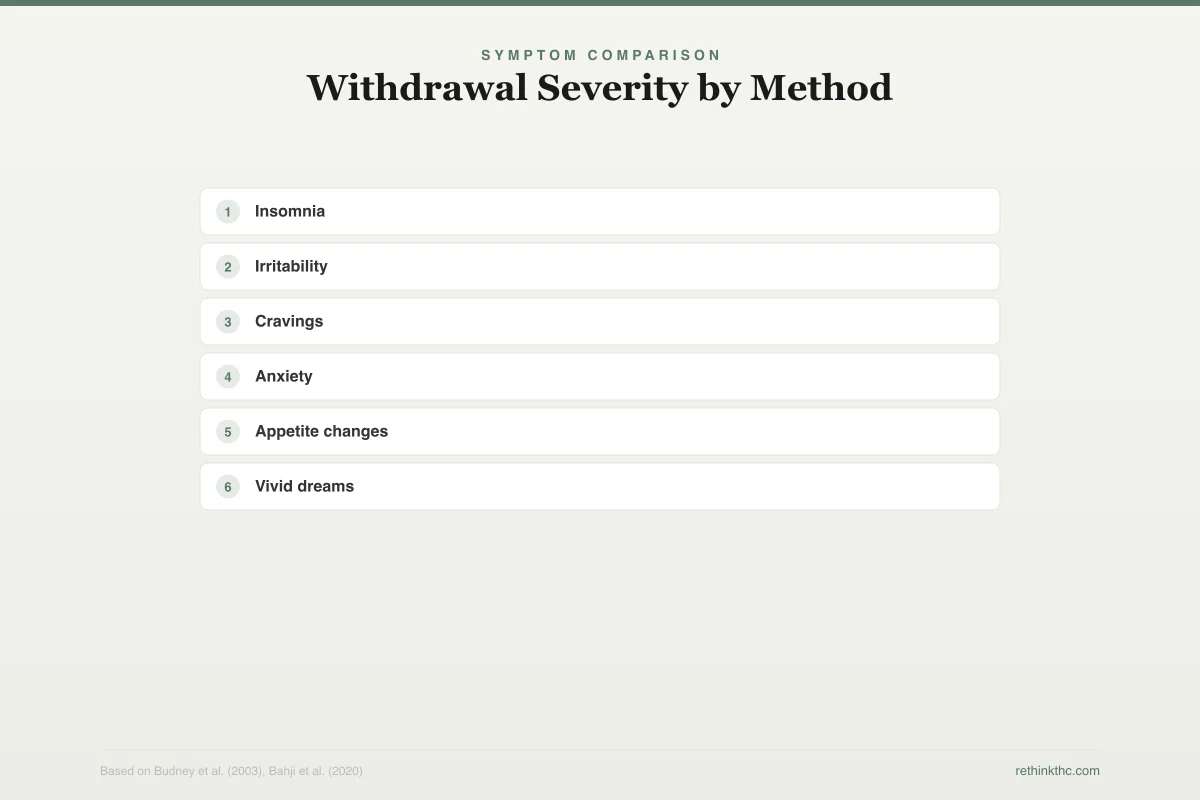
Symptom Comparison
Withdrawal Severity by Method
Same symptoms, different intensity profiles
Insomnia
REM rebound more intense with abrupt stop
Irritability
Peaks days 3–7 with cold turkey
Cravings
Cold turkey cravings peak faster; taper cravings linger
Anxiety
Gradual reduction gives the brain time to adjust
Appetite changes
Present with both methods, usually resolves first
Vivid dreams
Similar with both — REM sleep rebounds regardless
Based on Budney et al. (2003), Bahji et al. (2020)
 View as image ↗
Evidence Review
Where the evidence stands
Cell & Lab Studies
CB1 receptor downregulation and recovery mechanisms well-characterized
Animal Studies
THC dose-reduction and abrupt cessation both studied in rodent models
Case Reports
Extensive clinical observations of both cold turkey and taper outcomes
Controlled Human Studies
Budney 2003 (withdrawal timeline); Hirvonen 2012 (receptor recovery); D'Souza 2016 (early recovery); Budney 2006 (90-person treatment trial)
Meta-Analysis
Bahji 2020: 47% withdrawal rate; withdrawal occurs regardless of cessation method
Head-to-Head RCT
Both cessation methods are supported by strong evidence. The 90-person Budney 2006 trial is the largest controlled study of cannabis cessation. What's missing is a head-to-head randomized trial directly comparing cold turkey vs. tapering — current evidence comes from separate studies and clinical experience rather than direct comparison.
Budney et al. (2003, 2006); Hirvonen et al. (2012); D'Souza et al. (2016); Bahji et al. (2020)
The Neuroscience Is the Same Either Way
Regardless of which method you choose, the underlying recovery process is identical. Your CB1 receptors begin rebuilding within 2 days of reduced THC exposure.[1] By 28 days of complete abstinence, receptor density has largely returned to the levels seen in people who have never used cannabis.[2]
This means that if you taper over 3 weeks and then stop, your brain has already made significant progress before your quit date arrives. By the time you reach zero, some of the hardest receptor recalibration is already done. That is one of the neurological advantages of tapering.
But the 28-day clock for full normalization starts from your last day of use, not from when you started reducing. So a cold turkey quitter who stops on day 1 will likely reach full receptor recovery before a tapering quitter who reaches zero on day 21, even though the tapering quitter had a gentler overall experience.
For a complete look at what the brain recovery timeline looks like, the cannabis withdrawal complete guide covers all stages in detail.
What If One Method Does Not Work
Many people try one approach and switch to the other. That is not failure. It is information.
If you tried cold turkey and the withdrawal was so intense that you relapsed within days, tapering might give you a more sustainable path. If you tried tapering and kept breaking your own rules, cold turkey might give you the clear boundary you need.
The data supports trying again. Bahji's 2020 meta-analysis in JAMA Network Open[5] found that about 47% of regular cannabis users experience withdrawal symptoms, but the severity varies significantly between individuals and attempts. What felt unmanageable on your first try may feel different with better preparation, more support, or a different approach.
If you have relapsed after a previous attempt, the relapse guide covers why it happens and how to use that experience constructively.
When to Seek Professional Help
If you have tried both methods multiple times without success, or if withdrawal symptoms are severe enough to interfere with work, relationships, or your mental health, professional support can make a significant difference. Cognitive behavioral therapy (CBT) combined with abstinence-based approaches produced the best outcomes in Budney's 2006 clinical trial[4] of 90 adults over 14 weeks.
A therapist who specializes in substance use can help you identify triggers, build coping strategies, and create a plan tailored to your specific situation. This is especially important if you are using cannabis to manage an underlying condition like anxiety, depression, or PTSD.
SAMHSA's National Helpline is available at 1-800-662-4357. It is free, confidential, and available 24 hours a day, 7 days a week. You can also text "HELLO" to 741741 to reach the Crisis Text Line.
The Bottom Line
Cold turkey and tapering both lead to the same neurological recovery: CB1 receptors begin rebuilding within 2 days and normalize by about 28 days of abstinence. Cold turkey produces more intense but shorter withdrawal (peaking days 2 to 6, resolving in 1 to 2 weeks) and works best for moderate users and people who struggle with moderation rules. Tapering produces milder but more prolonged adjustment and works best for heavy daily users, those with demanding schedules, and people disciplined about following rules. About 47% of regular cannabis users experience withdrawal regardless of method. A 14-week clinical trial found abstinence combined with cognitive behavioral therapy produced the best outcomes. Neither method is objectively superior; the right choice depends on usage level, personality, and previous quit attempts.
Is it better to quit weed cold turkey or taper off gradually?
Neither method is universally better. Cold turkey works well for people who struggle with moderation, prefer to get discomfort over with quickly, or use moderately. Tapering works well for heavy daily users, people with demanding schedules, and those who are disciplined about following rules. The best method is the one you will actually follow through on. If one approach has not worked in the past, try the other.
How long does withdrawal last if you quit weed cold turkey?
Budney's 2003 research[3] found that withdrawal symptoms typically begin within 1 to 3 days, peak around days 2 to 6, and most effects resolve within 4 to 14 days. Sleep disruption and cravings may linger beyond two weeks for heavy users. The underlying brain recovery (CB1 receptor normalization) takes approximately 28 days from your last use.[2]
Can you taper off weed if you smoke every day?
Yes, and daily users are often the best candidates for tapering because the jump from heavy daily use to zero can produce intense withdrawal. A typical taper schedule involves reducing your intake by about 25% per week over 3 to 4 weeks. The key is to track your use precisely, set specific use windows, and have a firm quit date. Without structure, "tapering" can become an excuse to keep using at a slightly reduced level indefinitely.
Will I still get withdrawal symptoms if I taper?
Yes, but they are typically milder and more spread out. You may notice mild sleep disruption, irritability, or cravings at each step-down, and you will still experience some withdrawal when you make the final jump from your lowest level to zero. The advantage is that each individual step produces less intense symptoms than stopping all at once from a high level of use. About 47% of regular cannabis users experience withdrawal regardless of method.[5]
How fast do your brain receptors recover after quitting weed?
CB1 receptor recovery begins within 2 days of abstinence.[1] Brain imaging research by Hirvonen in 2012[2] showed that CB1 receptor density returns to approximately normal levels by 28 days of complete abstinence. This timeline applies whether you quit cold turkey or taper, though the 28-day clock starts from your last day of any use.
What if my taper keeps failing and I end up using more than planned?
This is one of the most common problems with tapering, and it is useful information rather than a failure. If you consistently break your taper schedule, it suggests that moderation-based approaches may not match your behavioral patterns with cannabis. Consider switching to cold turkey, which eliminates the daily decision-making that tapering requires. You might also add structured support: a therapist, an accountability partner, or a tracking system that someone else reviews. Budney's 2006 research found that combining abstinence with cognitive behavioral therapy produced the strongest outcomes, specifically because the therapy helps you build skills for managing cravings and triggers that willpower alone cannot handle.
Sources & References
- 1RTHC-01134·D'Souza, Deepak Cyril et al. (2016). “Brain Cannabinoid Receptors Drop With Heavy Use, Then Rebound Within Days of Stopping.” Biological Psychiatry: Cognitive Neuroscience and Neuroimaging.Study breakdown →PubMed →↩
- 2RTHC-00573·Hirvonen, Jussi et al. (2012). “Daily Cannabis Use Was Linked to Fewer CB1 Receptors. A Month Without Brought Them Back..” Molecular Psychiatry.Study breakdown →PubMed →↩
- 3RTHC-00134·Budney, Alan J. et al. (2003). “When Heavy Users Quit Cannabis, Symptoms Show Up Fast and Ease Within Two Weeks.” Journal of Abnormal Psychology.Study breakdown →PubMed →↩
- 4RTHC-00218·Budney, Alan J. et al. (2006). “Paying for Clean Tests Worked During Treatment. Therapy Helped It Last..” Journal of Consulting and Clinical Psychology.Study breakdown →PubMed →↩
- 5RTHC-02407·Bahji, Anees et al. (2020). “About Half of Heavy Cannabis Users Experience Withdrawal. This Meta-Analysis Measured It..” JAMA Network Open.Study breakdown →PubMed →↩