Withdrawal & Recovery
45 Days
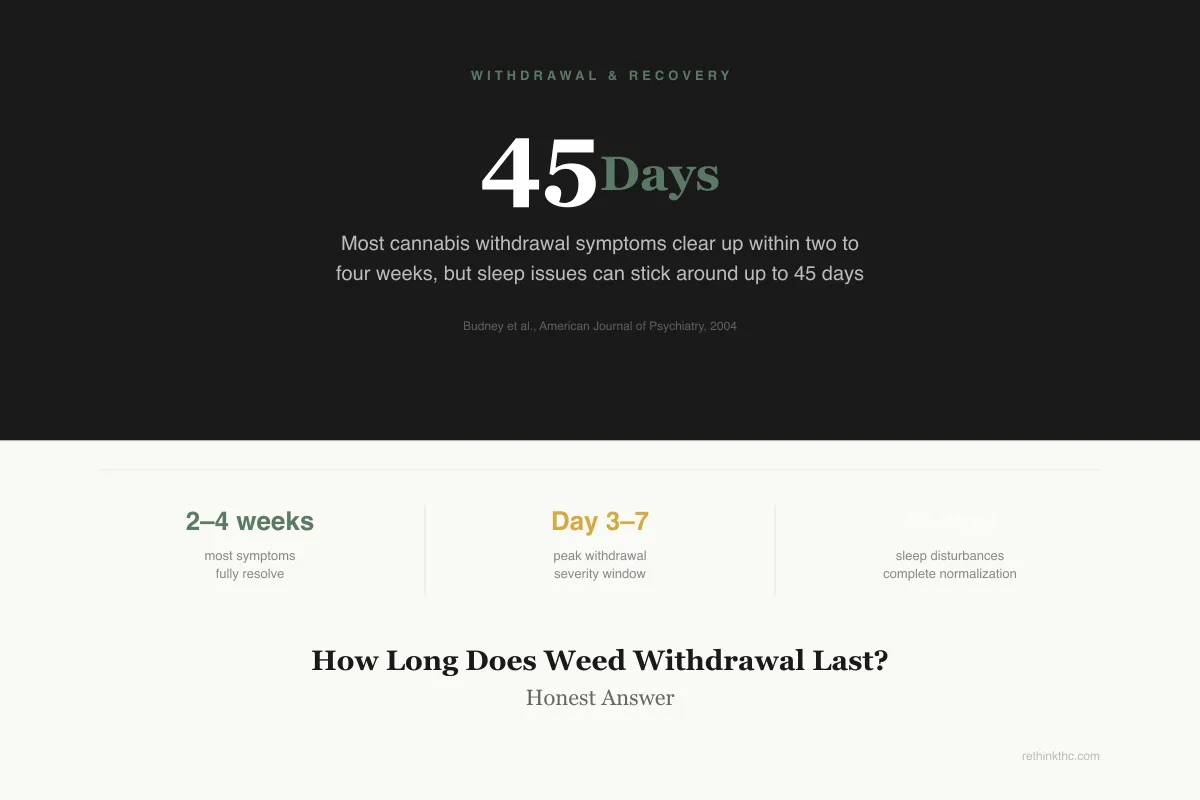
Most cannabis withdrawal symptoms clear up within two to four weeks, but sleep issues can stick around up to 45 days.
Budney et al., American Journal of Psychiatry, 2004
2–4 weeks
most symptoms fully resolve
Day 3–7
peak withdrawal severity window
45 days
sleep disturbances complete normalization
Budney et al., American Journal of Psychiatry, 2004
 View as image ↗
If you only read one thing
Most weed withdrawal symptoms are done within 2 to 4 weeks. The worst part — irritability, anxiety, no appetite — peaks around days 3 to 7 and fades fast after that. Sleep is the stubborn one: it can stay messed up for up to 45 days. If you used heavily for a long time, you might get mild waves of low motivation or random cravings for a few months after, but nothing like the first two weeks. Your brain's cannabinoid receptors fully recover in about 28 days. It ends. It always ends.
You searched this because you need a number. You need someone to tell you how many days until you feel normal again. The honest answer is that there is no single number, but there is a well-documented range, and the research is clear enough to give you a realistic picture of what to expect.
For most people, the worst of cannabis withdrawal is over within two to four weeks. Sleep problems can last up to 45 days. And for heavy, long-term users, milder symptoms like intermittent cravings or low motivation can come and go for a few months. That is the short answer. The rest of this article is the longer, more useful one.
Key Takeaways
- Most cannabis withdrawal symptoms clear up within two to four weeks, but sleep issues can stick around up to 45 days
- There is no single moment when withdrawal "ends" — it is a gradual process where symptoms fade at different rates
- Irritability and mood swings peak around days 3 to 7 and are usually gone by week 3
- Sleep problems are consistently the last symptom standing, outlasting everything else by weeks
- Heavy, long-term users may get post-acute withdrawal symptoms (PAWS) for several months, though these are mild compared to the acute phase
- The trend always points toward full recovery — there is no evidence of permanent effects
Why There Is No Single Answer
If someone tells you withdrawal lasts exactly 14 days or exactly 30 days, they are oversimplifying. The actual duration depends on several variables that differ from person to person.
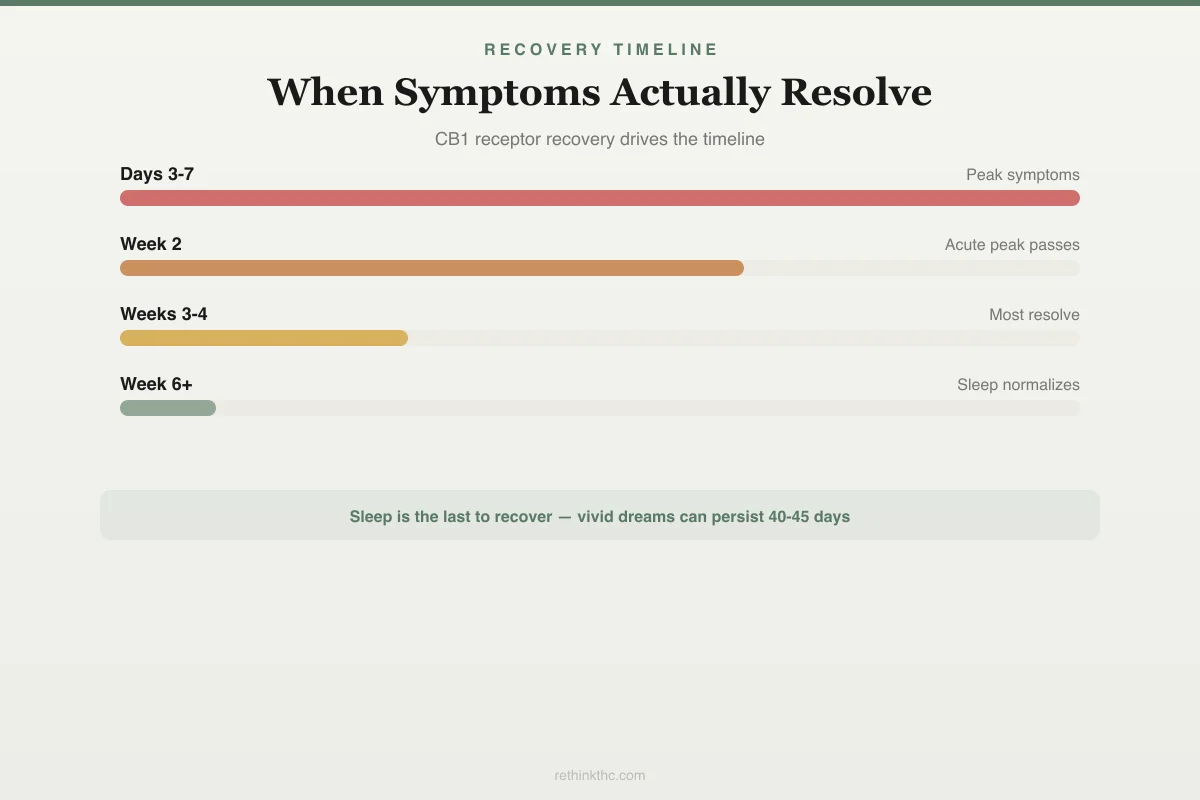
The timeline below maps the four major recovery phases, from peak severity through full normalization, so you can see where you are in the process.
Recovery Timeline
When Symptoms Actually Resolve
CB1 receptor recovery drives the timeline. Exercise and sleep reduce intensity but don't speed it up.
Irritability, sleep loss, appetite crash, mood swings at maximum
Windows of normalcy appear, appetite returns, mood less volatile
Mood stable, concentration back, cravings become situational
Final system to recover — vivid dreams fade, full sleep architecture restored
Sleep is the last system to recover — vivid dreams and disruption can persist 40-45 days
Based on Budney et al. (2003), D'Souza & Ranganathan (2015)
 View as image ↗
How much you used. Someone who smoked a joint every evening for six months is going to have a different experience than someone who used concentrates multiple times a day for five years. A 2003 controlled-abstinence study by Budney et al. published in the Journal of Abnormal Psychology found that frequency and quantity of use were the strongest predictors of withdrawal severity and duration.[1] More THC exposure means more receptor downregulation, which means more recovery time.
Hirvonen et al. (2012) · Molecular Psychiatry
- Population
- Chronic daily cannabis smokers vs. non-smoking controls
- Intervention
- Monitored abstinence on a secure research unit
- Comparator
- Healthy non-cannabis-using controls
- Finding
- PET imaging showed CB1 receptor density returned to normal levels after about 4 weeks of abstinence, even in heavy long-term users
positive First direct proof in humans that cannabis-related brain changes are reversible — your receptors do come back
Hirvonen et al. (2012), Molecular Psychiatry, 17(6), 642-649
How long you used. Duration matters independently of quantity. Years of daily use create deeper neurological adaptation than months of the same habit. Your brain had more time to remodel itself around the presence of THC, so it takes more time to remodel back.
What you were using. Flower, concentrates, and edibles deliver different THC loads. Concentrates and high-potency products push cannabinoid receptor adaptation further than lower-potency flower, which generally means a longer withdrawal timeline.
Your individual biology. Genetics influence how quickly your body metabolizes THC and how your endocannabinoid system responds to disruption. Two people with identical usage patterns can have meaningfully different withdrawal experiences. A 2012 study by Allsop et al. in PLOS ONE confirmed significant individual variation in both symptom severity and duration, even among participants with similar use histories.[2]
Your mental health baseline. If you were using cannabis to manage anxiety, depression, or insomnia, withdrawal can feel more intense because you are dealing with the original condition on top of the withdrawal itself. This does not mean you are withdrawing "worse." It means you have two things going on at once.
Symptom-by-Symptom Duration Breakdown
This is the part you probably came here for. Each symptom follows its own timeline. Understanding them individually prevents the mistake of thinking something is wrong because one symptom resolved while another has not.
| Symptom | Onset | Peak | Resolution | Notes |
|---|---|---|---|---|
| Irritability / mood swings | Within 24 hours | Days 3–7 | Weeks 2–3 | Most commonly reported symptom; resolves relatively quickly |
| Sleep disturbances | Night 1–3 | Weeks 1–2 | 30–45 days | Longest-lasting symptom; causes most late-stage relapses |
| Appetite changes | Days 1–3 | Week 1 | Week 2 | Among the fastest to resolve |
| Cravings | Day 1 | Week 1 | Gradual over months | Shift from urgent to occasional; can be triggered situationally |
| Brain fog | Week 1 | Weeks 1–2 | Weeks 3–4 | Noticeable clearing around week 3 |
| Vivid dreams | Night 2–3 | Weeks 1–3 | By day 45 | Part of REM rebound; can be emotionally intense |
| Anhedonia (flat mood) | Week 1 | Weeks 2–4 | 4–12 weeks | Slowest to resolve; tied to dopamine receptor recovery |
Irritability and Mood Swings
Onset: Within 24 hours. Peak: Days 3 to 7. Resolution: Weeks 2 to 3.
This is the symptom most people notice first and complain about most. Your emotional thermostat was calibrated to include THC, and without it, everything runs hotter. Small annoyances feel like personal attacks. Sadness hits out of nowhere. You may snap at people and then feel terrible about it five minutes later.
Budney et al. (2004), in a comprehensive validity review published in the American Journal of Psychiatry, documented irritability as the most common withdrawal symptom, reported by the majority of participants.[3] The good news is that it also resolves relatively quickly. By week two, most people notice a significant reduction. By week three, it is usually gone or close to it.
Sleep Disturbances
Onset: Night 1 to 3. Peak: Week 1 to 2. Resolution: 30 to 45 days.
Sleep is the long game of cannabis withdrawal. It is the first symptom to appear and the last to leave. You may have trouble falling asleep, wake up multiple times per night, or sleep but wake up feeling like you did not rest at all.
The REM rebound effect is part of this. THC suppresses REM sleep, and when you quit, your brain floods your nights with vivid, emotionally intense dreams. Clinical research has found that sleep disturbances can persist for 40 to 45 days after cessation.[4] A systematic review of cannabis withdrawal and sleep confirmed that sleep disruption is one of the most consistent features across all withdrawal studies.[5] This is the symptom that causes the most relapses at the three-week mark, because people assume their sleep should have recovered by then. It has not. It takes longer. But it does recover. For a full guide, see how to sleep without weed and the sleep recovery timeline.
Appetite Changes
Onset: Days 1 to 3. Peak: Week 1. Resolution: Week 2.
THC directly stimulates hunger through CB1 receptor activation. Without it, your appetite drops below baseline temporarily. Food may taste bland or unappealing. Some people lose a few pounds during the first two weeks. For strategies, see appetite loss during weed withdrawal.
This is one of the faster symptoms to resolve. Most people report appetite returning to normal by the end of week two. It may not snap back all at once. You might notice that you start getting hungry again but that the meals feel smaller or less satisfying for a few more days before fully normalizing.
Cravings
Onset: Day 1. Peak: Week 1. Resolution: Gradual over months.
Cravings peak early and then follow a slow, uneven decline. The first week is the most intense, with strong, frequent urges that can feel almost physical. By week two and three, they come less often. By month two, most people describe them as occasional thoughts rather than urgent needs.
But cravings are the one symptom that can pop up months later, triggered by situations, people, or emotions you associate with using. This does not mean you are "still in withdrawal." It means your brain formed strong associations between cannabis and certain contexts, and those associations take time to weaken. Allsop et al. found that cravings were among the most persistent symptoms, with some participants reporting occasional urges well beyond the acute phase.[2] For strategies, see how to deal with weed cravings.
Brain Fog
Onset: Week 1. Peak: Week 1 to 2. Resolution: Week 3 to 4.
The cognitive cloudiness that makes you feel like you are thinking through cotton. Difficulty concentrating, slower processing, trouble finding words. This is your prefrontal cortex recalibrating. THC affects working memory and executive function, and it takes a few weeks for those systems to get back to full speed.
A 2018 meta-analysis in JAMA Psychiatry found that cognitive function shows measurable improvement within 72 hours of abstinence, with continued improvement over weeks.[6] Most people describe a noticeable clearing around week three to four. A lot of people say they did not realize how foggy they had been until the fog lifted.
Vivid Dreams
Onset: Night 2 to 3. Peak: Week 1 to 3. Resolution: By day 45.
Covered in detail in the REM rebound article, vivid dreams are a subset of the sleep disruption but worth calling out separately because they are so distinctive. Dreams during withdrawal can be startlingly realistic, emotionally heavy, and sometimes disturbing. They peak in weeks one through three and taper gradually. By day 45, dream activity is typically back to normal for most people.
Dopamine and Anhedonia
Onset: Week 1. Peak: Week 2 to 4. Resolution: 4 to 12 weeks.
This is the "nothing feels good" feeling. THC artificially elevated your dopamine output, and your brain adapted by reducing its sensitivity to dopamine. When you quit, normal activities produce normal dopamine, but your desensitized receptors cannot fully register the signal. Music sounds flat. Hobbies feel pointless. Socializing feels like work.
This is the slowest symptom to resolve, because dopamine receptor upregulation takes time. PET imaging studies show that CB1 receptor density returns to normal within roughly 28 days, with dopamine receptors following a parallel but slightly longer timeline.[7] The subjective experience of pleasure and motivation usually improves steadily starting around week four.
What Makes Withdrawal Longer or Shorter
| Factor | Tends to Lengthen | Tends to Shorten |
|---|---|---|
| Usage frequency | Daily, multiple times per day | Weekend or occasional use |
| Product potency | Concentrates, dabs, high-THC vapes | Lower-potency flower |
| Duration of use | Years of daily use | Months of use |
| Exercise | Sedentary during withdrawal | Regular aerobic exercise (supports dopamine recovery) |
| Sleep hygiene | Irregular schedule, screens before bed | Consistent times, cool dark room |
| Social support | Isolation during the process | Trusted people who know what you are doing |
| Mental health | Co-occurring anxiety, depression, PTSD | Stable baseline mental health |
72 hrs
Measurable cognitive improvement begins within 3 days
~28 days
CB1 cannabinoid receptors return to normal density (PET imaging)
45 days
Sleep disturbances fully normalize in most people
47%
Of regular users experience clinically significant withdrawal
Scott et al. (2018); Hirvonen et al. (2012); Bolla et al. (2008); Bahji et al. (2020)
None of these are magic shortcuts. They shift the timeline by days to weeks, not months. But the difference between actively supporting your recovery and passively waiting it out is real and measurable.
What "Done With Withdrawal" Actually Means
There is no finish line. There is no morning where you wake up and everything is suddenly normal. Withdrawal ends the way a bruise heals. You stop noticing it, and then one day you realize it has been gone for a while.
The symptoms do not all resolve at the same time. Appetite comes back while sleep is still disrupted. Mood stabilizes while cravings still show up. Brain fog lifts while dreams are still vivid. This staggered resolution is normal and expected. It does not mean something is wrong.
For heavy, long-term users, there is a phenomenon sometimes called post-acute withdrawal syndrome (PAWS). This involves mild, intermittent symptoms like low motivation, occasional cravings, or brief mood dips that can surface for several months after the acute phase ends. PAWS is not well-studied specifically in cannabis (the term comes from alcohol research), but it is commonly reported in recovery communities. The symptoms are mild compared to the acute phase and decrease in both frequency and intensity over time.
When to Seek Professional Help
Most cannabis withdrawal is uncomfortable but not dangerous. However, you should talk to a healthcare provider if your symptoms include severe anxiety or panic attacks that are not improving after two weeks, depression that feels like it is getting worse rather than better, insomnia that persists beyond six weeks with no improvement, or thoughts of self-harm.
If you are experiencing a mental health crisis, contact SAMHSA's National Helpline at 1-800-662-4357. It is free, confidential, and available 24 hours a day, 365 days a year. You can also text HOME to 741741 to reach the Crisis Text Line.
A healthcare provider can help determine whether what you are experiencing is withdrawal, an underlying condition that cannabis was masking, or both. Getting that distinction right matters for knowing what to do next.
The Reframe
Two to four weeks for most symptoms. Up to 45 days for sleep. Possibly a few months of mild, intermittent aftereffects for heavy users. That is the honest timeline, based on the best available research.
You are not going to feel like this forever. The fact that you feel bad right now is evidence that your brain is actively repairing itself. Every day you are not using is a day your cannabinoid receptors are rebuilding and your neurochemistry is moving back toward baseline. You cannot feel the recovery happening while you are in it. But it is happening.
The Bottom Line
Most cannabis withdrawal symptoms resolve within two to four weeks. Sleep disturbances are the longest-lasting symptom, persisting up to 45 days. Heavy, long-term users may experience mild post-acute symptoms (occasional cravings, low motivation) for several additional months. The exact duration depends on usage frequency, potency, duration of use, and individual biology. There is no single moment when withdrawal "ends" — symptoms fade at different rates, with appetite recovering fastest and sleep normalizing last.
Is two weeks enough to get through weed withdrawal?
For many people, the worst symptoms have significantly improved by the two-week mark. Irritability, appetite loss, and acute cravings are usually past their peak. However, sleep disturbances and anhedonia commonly persist beyond two weeks. Research has found that while most symptoms peak between days 4 and 14, sleep disruption continues for several more weeks. Two weeks is enough to get through the hardest part, but full resolution takes longer.
Does withdrawal from edibles last longer than from smoking?
There is limited research comparing withdrawal timelines by consumption method. However, edibles can deliver higher THC doses and produce longer-lasting effects per session, which may contribute to greater receptor adaptation. Anecdotally, people who primarily used high-dose edibles report withdrawal timelines on the longer end of the spectrum, but this has not been isolated as a variable in controlled studies.
Can you have withdrawal symptoms from using weed only on weekends?
It is less common but possible. The DSM-5 criteria for cannabis withdrawal require "heavy and prolonged use," which typically means daily or near-daily consumption. Weekend-only users are unlikely to develop the level of neuroadaptation that produces clinical withdrawal. However, some people who use heavily on weekends (multiple sessions, high-potency products) do report mild irritability and sleep disruption during the week.
Why do some people seem to quit weed with no withdrawal at all?
About 53% of frequent users do not experience clinically significant withdrawal symptoms, according to a 2020 meta-analysis. Individual variation in endocannabinoid system genetics, usage patterns, and baseline mental health all influence whether withdrawal occurs and how severe it is. Not experiencing withdrawal does not mean your experience is invalid, and neither does experiencing it.
Does exercise actually shorten how long withdrawal lasts?
Exercise does not eliminate withdrawal, but research supports that it reduces symptom severity, particularly for mood, anxiety, and sleep. Aerobic exercise has been shown to increase dopamine receptor availability in the brain's reward center, which directly addresses one of the slower-recovering aspects of withdrawal. It also improves sleep quality and reduces anxiety through independent mechanisms. Consistent exercise during withdrawal appears to accelerate the subjective experience of recovery even if the underlying receptor timeline remains similar.
When should I worry that my withdrawal is lasting too long?
If most symptoms are not showing any improvement by week four, or if sleep disruption has not improved at all by week six, it is worth talking to a healthcare provider. It is also important to distinguish between withdrawal and a pre-existing condition that cannabis was masking. Persistent depression, anxiety, or insomnia beyond the expected withdrawal window may indicate an underlying condition that benefits from its own treatment plan.
Sources & References
- 1RTHC-00134·Budney, Alan J. et al. (2003). “When Heavy Users Quit Cannabis, Symptoms Show Up Fast and Ease Within Two Weeks.” Journal of Abnormal Psychology.Study breakdown →PubMed →↩
- 2RTHC-00538·Allsop, David J. et al. (2012). “Withdrawal That Disrupted Daily Life Was Tied to Relapse in a Small Study.” PLOS ONE.Study breakdown →PubMed →↩
- 3RTHC-00159·Budney, Alan J. et al. (2004). “Yes, Cannabis Withdrawal Is Real. This 2004 Review Mapped What It Looks Like..” American Journal of Psychiatry.Study breakdown →PubMed →↩
- 4RTHC-00301·Bolla, Karen I. et al. (2008). “Stopping Heavy Cannabis Use Was Linked to Poorer Sleep. The Second Night Looked Worse..” Sleep.Study breakdown →PubMed →↩
- 5RTHC-01161·Gates, Peter et al. (2016). “Systematic Review Confirms Cannabis Withdrawal Disrupts Sleep, but Specific Mechanisms Remain Unclear.” Substance abuse.Study breakdown →PubMed →↩
- 6RTHC-01832·Scott, J. Cobb et al. (2018). “Cannabis Cognitive Effects Are Small and Largely Disappear After 72 Hours of Abstinence.” JAMA Psychiatry.Study breakdown →PubMed →↩
- 7RTHC-00573·Hirvonen, Jussi et al. (2012). “Daily Cannabis Use Was Linked to Fewer CB1 Receptors. A Month Without Brought Them Back..” Molecular Psychiatry.Study breakdown →PubMed →↩