Triggers / Culture
50%
With over 50% of festival attendees using cannabis on-site, attending sober requires a specific plan, but live music triggers its own dopamine and endorphin release without any substance.
Journal of Studies on Alcohol and Drugs, 2019
50%
A 2019 survey in the Journal of Studies on Alcohol and
Your Sober Festival Plan
covered in detail
The Rise of Sober Festival Culture
covered in detail
Journal of Studies on Alcohol and Drugs, 2019
 View as image ↗
Going to a concert or music festival sober when you used to smoke at every show can feel like returning to a place where the rules have changed but nobody told the crowd. The smell of cannabis drifts through the venue. People pass joints openly. The entire atmosphere is built around letting go, and for years, letting go meant lighting up. If you are trying to attend a sober music festival or concert without weed, the challenge is real. Live music and cannabis are so deeply linked in popular culture that separating the two can feel like trying to enjoy a meal without tasting it.
But that feeling is a distortion. The music was always the point. And there are concrete ways to protect your recovery while still showing up for the experiences you love.
Key Takeaways
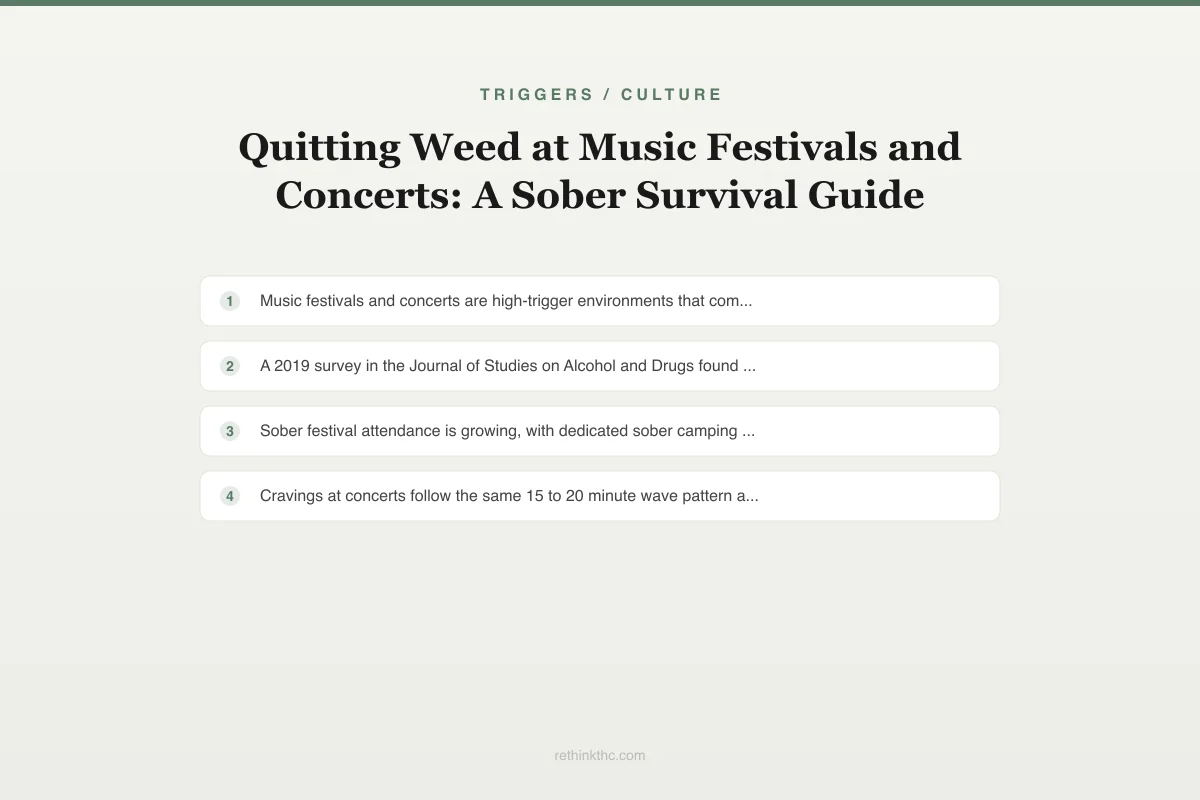
- Music festivals and concerts pack social pressure, sensory overload, and deep cultural ties between cannabis and live music into one high-trigger environment
- A 2019 survey in the Journal of Studies on Alcohol and Drugs found that over 50% of festival attendees used cannabis during the event — so exposure at a sober music festival or concert without weed is nearly unavoidable
- Sober festival attendance is growing, with dedicated sober camping sections and recovery-friendly meetups now offered at major events across the U.S.
- Cravings at concerts follow the same 15 to 20 minute wave pattern as any other trigger — so you only need to get through individual moments, not the entire event
- A specific plan with a sober buddy, an exit strategy, and sensory grounding techniques significantly reduces relapse risk in high-trigger settings
- A 2019 study in PNAS found that group musical experiences trigger dopamine and endorphin release in the brain — meaning live music produces real neurochemical pleasure all on its own, no substance needed
Why Live Music Environments Are Uniquely Triggering
Sober Festival Survival: Triggers and Defenses
Concerts and festivals layer multiple trigger types on top of each other in a way that few other settings match. Understanding why they hit so hard makes them easier to navigate.
First, there is the sensory exposure. Cannabis smoke is often inescapable at outdoor festivals and even indoor venues. Smell is one of the most powerful triggers for weed cravings because your olfactory system connects directly to the amygdala and hippocampus, the brain regions responsible for emotion and memory. One whiff can activate a cascade of associations before your conscious mind has time to intervene.
Second, there is the social layer. Cannabis use at festivals is not hidden. It is communal, casual, and often celebrated. A 2021 study published in Substance Use and Misuse found that social normalization of drug use at music events increased individual likelihood of use, even among people who had not planned to partake. The group dynamic creates a pull that feels less like peer pressure and more like cultural gravity.
Third, there is the emotional intensity. Live music produces genuine neurochemical effects. A 2019 study in the Proceedings of the National Academy of Sciences (PNAS) found that group musical experiences trigger dopamine release and endorphin activity in the brain. When you combine that natural high with a setting you previously associated with cannabis, your brain's reward system can blur the lines between wanting the music and wanting the substance.
How Festivals Differ from a Single Day Like 4/20
If you have already developed strategies for getting through 4/20 sober, festivals require a different approach. April 20th is a single, predictable day you can plan around and then move past. A multi-day festival is an extended immersion in exactly the kind of environment that tests your recovery the hardest.
Fatigue matters here. Decision fatigue, the progressive depletion of your ability to make good choices after a day of making constant decisions, hits harder across a three-day weekend than a single afternoon. Sleep deprivation, dehydration, and the general sensory overload of festival life weaken the prefrontal cortex, the part of your brain that handles impulse control. By day two of a festival, your willpower reserves are genuinely lower than they were on day one.
This is why preparation matters more for festivals than for almost any other trigger scenario.
Your Sober Festival Plan
Going in without a plan is the single biggest risk factor. Having one does not guarantee a perfect experience, but it dramatically changes the odds.
Bring a Sober Buddy
This is the most effective single strategy. A 2020 study in the journal Psychology of Addictive Behaviors found that having a supportive companion in high-risk social settings reduced substance use significantly compared to attending alone. Your sober buddy does not have to be in recovery themselves. They need to know your situation, respect your boundaries, and be someone you can be honest with in the moment. If telling friends you are quitting weed feels difficult, a festival is not the place to figure it out. Have that conversation before you buy the tickets.
Have an Exit Plan
Know how you are leaving and when. If you drove, keep your keys accessible. If you are at a camping festival, identify a quiet zone you can retreat to when the environment gets overwhelming. Give yourself permission in advance to leave early if the situation becomes unmanageable. Leaving is not failure. Leaving is the plan working.
Focus on the Music Itself
This sounds obvious, but it is a deliberate strategy. When you actively engage with the music, pay attention to the instruments, the dynamics, the crowd's energy, you are occupying the same neural circuits that cravings compete for. Your prefrontal cortex cannot fully process complex auditory input and a craving simultaneously. Immersing yourself in the performance is a form of cognitive redirection, the same principle behind the layered response strategies used for managing triggers you cannot avoid.
Use Sensory Grounding
When a craving hits in a festival setting, the 5-4-3-2-1 grounding technique works well. Name five things you can see, four you can hear, three you can touch, two you can smell (besides cannabis), and one you can taste. This forces your brain out of the craving loop and into the present moment. Cravings at concerts follow the same wave pattern as anywhere else. They peak in 15 to 20 minutes and then fade. You only need to ride each one individually, not survive the entire weekend at once.
The Rise of Sober Festival Culture
If sober attendance at festivals feels isolating, it is worth knowing that the landscape is shifting. Bonnaroo, Lightning in a Bottle, and several other major festivals now offer dedicated sober camping areas. Organizations like Clean Vibes and Sober AF Entertainment have built communities specifically for people who want the festival experience without substances.
A 2023 report from the National Institute on Drug Abuse (NIDA) noted that interest in "sober curious" lifestyles has risen steadily among adults ages 18 to 35, with music and social events becoming focal points for sober community building. You are not the only person in the crowd who is not smoking. You are part of a growing group that has decided the music is enough.
When to Seek Professional Help
If festival or concert environments consistently lead to relapse, or if anticipating these events creates anxiety that disrupts your daily life, consider working with a therapist who specializes in substance use recovery. A counselor trained in CBT can help you build personalized coping strategies for high-trigger social settings.
If you are struggling with cannabis use or experiencing a crisis, contact the SAMHSA National Helpline at 1-800-662-4357. It is free, confidential, and available 24/7. You can also reach the Crisis Text Line by texting HOME to 741741.
The Music Was Always the Point
Going to a show sober for the first time after quitting can feel like meeting an old friend under new circumstances. The dynamic is different, and that takes adjustment. But many people in recovery describe a surprising discovery: the music sounds better. Not metaphorically. When your sensory processing is not filtered through THC, you hear details you missed before. The bass hits differently. The crowd's energy is something you feel directly, not through a haze.
Understanding the full scope of cannabis withdrawal and how your brain recovers helps put this in context. As your endocannabinoid system recalibrates, your brain's natural ability to generate pleasure from experiences like live music comes back online. For a deeper framework on the quitting process itself, how to quit weed: a science-based guide walks you through the withdrawal timeline, the neurochemistry of recovery, and strategies that work beyond just managing festival triggers. You are not losing something by going sober. You are finding out what the experience actually feels like without a filter.
The Bottom Line
Music festivals and concerts layer multiple trigger types: sensory (cannabis smoke activating olfactory-amygdala-hippocampus pathway), social (2021 Substance Use and Misuse: social normalization at events increased individual use likelihood), and emotional (2019 PNAS: group musical experiences trigger dopamine and endorphin release, blurring lines between wanting music and wanting substance). Multi-day festivals harder than single events due to decision fatigue depleting prefrontal cortex/impulse control, compounded by sleep deprivation and sensory overload. 2019 Journal of Studies on Alcohol and Drugs: 50%+ of festival attendees reported cannabis use. Sober festival plan: sober buddy (2020 Psychology of Addictive Behaviors: supportive companion reduced substance use in high-risk settings), exit strategy (permission to leave = plan working), active musical engagement (occupies neural circuits cravings compete for), sensory grounding (5-4-3-2-1 technique). Each craving peaks and passes within 15-20 minutes. Sober festival culture growing: Bonnaroo/Lightning in a Bottle offer sober camping, organizations like Sober AF Entertainment host substance-free events. NIDA 2023: rising "sober curious" interest ages 18-35. Post-recovery discovery: music often sounds better sober — sensory processing unfiltered by THC, natural pleasure systems back online.
Can you enjoy a music festival without weed?
Yes. Live music produces real neurochemical effects, including dopamine and endorphin release, independent of any substance. Many people in recovery report that concerts and festivals feel more vivid and immersive when experienced sober. The cultural association between cannabis and live music is strong, but the enjoyment of music does not depend on it.
How do I handle people smoking weed at a concert?
You cannot control the environment, but you can manage your response. Bring a sober buddy, position yourself upwind when possible, and use grounding techniques when the smell or sight of cannabis triggers a craving. Remember that each craving peaks and passes within 15 to 20 minutes. If the exposure becomes overwhelming, give yourself permission to move to a different area or leave.
Are there sober-friendly music festivals?
Yes, and the number is growing. Major festivals like Bonnaroo and Lightning in a Bottle now offer dedicated sober camping areas. Organizations like Sober AF Entertainment host substance-free music events. Online communities can help you find sober meetups at festivals, and the broader "sober curious" movement has made substance-free attendance increasingly common.
What if I relapse at a music festival?
One use does not erase your progress. If you slip at a festival, the most important thing is what you do next. Stop using for the rest of the event, reach out to your sober buddy or a support contact, and avoid the "already ruined it" mindset that turns a single lapse into a full relapse. When you get home, revisit your recovery plan and consider what adjustments would help in future high-trigger situations.
How do I tell my friends I am not smoking at a festival?
Keep it simple and confident. "I'm not smoking anymore" or "I'm good, thanks" delivered without apology is usually enough. Have the conversation before the event rather than in the moment. Most friends will respect a clear, calm boundary. If someone pressures you, that says more about their relationship with cannabis than yours.
Is it too early to go to a festival if I just quit weed?
Timing matters. During the first two weeks of withdrawal, your amygdala is hyperreactive and your stress tolerance is at its lowest, making a festival environment significantly harder to navigate. If possible, wait until you are at least three to four weeks into abstinence, when acute withdrawal symptoms have largely subsided and your CB1 receptors are recovering. If the event falls during early withdrawal and you cannot reschedule, go with a strong plan: a sober buddy, an exit strategy, and realistic expectations that the experience may be more challenging than it would be a month from now.
Sources & References
- 1RTHC-08512·Murri, Martino Belvederi et al. (2026). “Large meta-analysis finds regular cannabis use raises both pro-inflammatory and anti-inflammatory markers, not just one or the other.” Brain.Study breakdown →PubMed →↩
- 2RTHC-08534·P A Costa, Gabriel et al. (2026). “Cannabis Use Makes Quitting Tobacco Harder, But CBD Might Help.” medRxiv : the preprint server for health sciences.Study breakdown →PubMed →↩
- 3RTHC-06056·Berny, Lauren M et al. (2025). “Brief Interventions in Medical Settings Did Not Reduce Cannabis Use.” Prevention science : the official journal of the Society for Prevention Research.Study breakdown →PubMed →↩
- 4RTHC-06615·Halicka, Monika et al. (2025). “CBT with Motivational Enhancement Is the Best-Supported Psychotherapy for Cannabis Use Disorder.” Addiction (Abingdon.Study breakdown →PubMed →↩
- 5RTHC-06972·Lo, Jamie O et al. (2025). “Cannabis Use in Pregnancy Linked to Preterm Birth, Low Birth Weight, and Small Babies Even After Accounting for Tobacco.” JAMA pediatrics.Study breakdown →PubMed →↩
- 6RTHC-05376·Hill, Melanie L et al. (2024). “Cannabis Users with PTSD Still Benefit from Trauma-Focused Therapy — But Attend Fewer Sessions.” Journal of anxiety disorders.Study breakdown →PubMed →↩
- 7RTHC-05535·McClure, Erin A et al. (2024). “Reducing Cannabis Use by 50-75% Was Enough to See Real Improvements.” The American journal of psychiatry.Study breakdown →PubMed →↩
- 8RTHC-04980·Theerasuwipakorn, Nonthikorn (2023). “Cannabis and Heart Attack/Stroke Risk: A 183-Million-Patient Meta-Analysis Finds Stroke Risk but Not Heart Attack Risk.” Toxicology Reports.Study breakdown →PubMed →↩