Lifestyle & Identity
24 Hours
The day is 24 hours long and cravings peak and pass in 15 to 20 minutes, so the math is on your side if you focus on getting through one craving at a time.
Budney et al., Journal of Abnormal Psychology, 2004
24 hours
The day is 24 hours long and cravings peak and pass in 15
Why 4/20 Hits Different
covered in detail
Your Pre-Game Plan
covered in detail
Budney et al., Journal of Abnormal Psychology, 2004
 View as image ↗
April 20th is the one day of the year when cannabis is not just normalized but celebrated. If you are navigating sobriety from weed, this 420 sober survival guide is built for exactly this moment. Your social media fills with smoke clouds and countdown posts. Friends send invites. Dispensaries run promotions. The entire cultural atmosphere shifts to make cannabis feel not just acceptable but expected. For someone who has decided to quit or cut back, 4/20 can feel like the world is running a targeted ad campaign against your recovery.
The good news is that it is one day. It is predictable. And because it is predictable, you can plan for it in a way that random Tuesday night cravings do not allow. If you are still building your overall quit strategy, the step-by-step guide to quitting weed gives you a foundation that makes days like this easier to navigate.
Key Takeaways
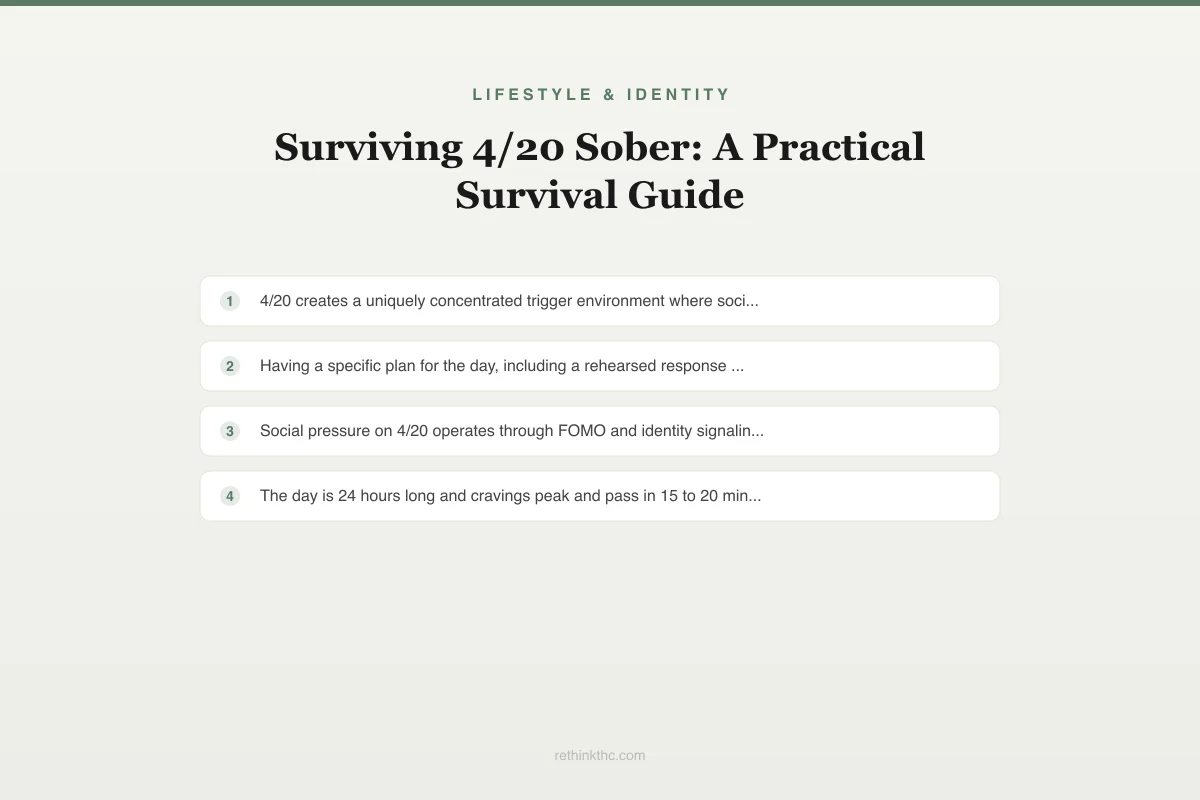
- 4/20 creates a uniquely concentrated trigger environment where social media, friend groups, and cultural celebration of cannabis all land on one day
- Having a specific plan for the day — including a rehearsed response to offers — cuts the mental load of making decisions when your willpower is already under pressure
- Social pressure on 4/20 works through FOMO and identity signaling, not just direct offers to smoke, which means passive scrolling can be just as triggering as being at a party
- The day is 24 hours long and cravings peak and pass in 15 to 20 minutes, so the math is on your side if you focus on getting through individual moments rather than "surviving the whole day"
- Reframing 4/20 as a personal milestone marker rather than a threat turns an annual trigger into evidence of your progress
- Research on cue-induced craving shows that anticipatory dopamine firing in response to environmental cues is often stronger than the reward itself — which is why the days leading up to 4/20 can feel harder than the day itself
Why 4/20 Hits Different
4/20 Sober Survival Checklist
Reframe: 4/20 is a built-in annual checkpoint. The first sober one is hard. The second is data. The third is barely a thing. You wake up on April 21st with your clarity, progress, and momentum intact.
Most triggers catch you off guard. A craving surfaces because of a smell, a stressful phone call, a particular time of day. You deal with it in the moment. But 4/20 is a scheduled trigger, and that changes the psychology in a few specific ways.
First, the buildup starts days or even weeks before. Memes appear. Group chats start buzzing. You see it coming, which means your brain has time to build anticipation, and anticipation is where cravings actually live. Your dopamine system does not wait for the reward itself. It fires in response to cues that predict the reward. A two-week countdown to 4/20 is a two-week cue.
Second, 4/20 carries social identity weight. Cannabis culture treats the day as a marker of belonging. If you were part of that culture, skipping it can feel like publicly leaving a group. That sense of losing your tribe is one of the hardest parts of stepping away from stoner culture, and 4/20 compresses that entire identity tension into a single day.
Third, the sheer volume of exposure is unusual. On a normal day, you might encounter one or two cannabis cues. On 4/20, they are everywhere. Social media, texts, news coverage, even jokes at work. That saturation makes it harder to use the avoidance strategies that work the rest of the year.
Your Pre-Game Plan
The single most effective thing you can do is make your decisions before the day arrives. Willpower is a limited resource, and 4/20 will drain it faster than a normal day. Every decision you make in advance is one you do not have to make under pressure.
Decide your schedule now. Fill the day with specific activities. Not vague plans like "stay busy" but concrete, time-blocked commitments. A morning workout. An afternoon with a friend who does not use. An evening movie or dinner reservation. Dead time is when cravings find space to expand.
Write your response to offers. If someone offers you cannabis or invites you to a 4/20 gathering, know what you will say before the moment arrives. Keep it simple and rehearsed. "I'm good, thanks" works. "Not today" works. You do not owe anyone an explanation, and lengthy justifications often invite debate. Having a relapse prevention plan that includes scripted responses removes the mental scramble of figuring out what to say in real time.
Set your phone boundaries. Mute group chats that will be 4/20-heavy. Unfollow or mute accounts that post cannabis content. This is not avoidance as weakness. This is strategic trigger management. You would not stand downwind of a barbecue if you were fasting, and you do not need to marinate in 4/20 content to prove your sobriety is real.
Handling the Day Itself
Even with a plan, the day will have moments that test you. Here is how to handle them in real time.
The Craving Window
When a craving hits, remember that it follows a wave pattern. It rises, peaks, and drops within 15 to 20 minutes. You do not need to figure out how to get through the entire day. You need to get through the next 20 minutes. Distraction works during this window. Call someone, go for a walk, do pushups, take a cold shower. The goal is not to pretend the craving does not exist. The goal is to let it pass without acting on it.
The Invitation
If you get invited to a 4/20 event, you have three options. You can decline, which is the safest choice if you are in early recovery or if the event is centered entirely around smoking. You can attend briefly with a clear exit plan and a sober ally, which works if the event has meaning beyond cannabis (close friends, a birthday that happens to fall on 4/20). Or you can suggest an alternative activity with the same people in a different setting.
There is no right answer here. The question to ask yourself is honest and simple: can I be around active use right now without it pulling me back? If the answer is "probably" or "I think so," treat it as a no. Confidence about your ability to handle high-risk situations is one of the factors that the relapse cycle exploits most effectively.
The FOMO Spiral
The hardest part of 4/20 for many people is not a direct offer. It is watching everyone else participate. Scrolling through stories of people laughing, smoking, having what looks like effortless fun. FOMO is not a craving in the traditional sense, but it creates the emotional conditions (loneliness, feeling left out, questioning your choices) that feed cravings.
The counter to FOMO is not logic. It is replacement. You need to be doing something that feels genuinely good, not just "sober alternatives" that feel like punishment. Plan something you actually enjoy. This is the ritual replacement principle applied to a specific day: the goal is not to white-knuckle through emptiness but to fill the space with something real.
The Social Pressure Playbook
Social pressure around cannabis on 4/20 usually does not come as aggressive pushiness. It comes as casual assumption. "You are coming, right?" "Wait, you are not smoking anymore?" The assumption that of course you will participate can be harder to push back against than a direct offer because it makes your sobriety feel like the unusual choice, the thing that requires explanation.
A few principles help here. Keep your responses short and confident. Tone matters more than words. A casual "nah, I'm taking a break" delivered without apology communicates more than a five-minute explanation. Do not debate. Some people will question your choice, and that is about their relationship with cannabis, not yours. You do not need to convince anyone.
If you are in a friend group where cannabis is central to the social bond, 4/20 may force a larger question about whether those relationships can survive your sobriety. That is a real and painful question, and it does not need to be answered on April 20th. Give yourself permission to get through the day first and evaluate the bigger picture later.
When to Seek Professional Help
If you find that 4/20 triggers intense distress, persistent cravings that last beyond the day, or a return to regular use, that is a signal to get support. One difficult day is normal. A difficult day that becomes a difficult week suggests you need more tools than a survival guide can offer.
If you or someone you know is struggling with substance use, contact the SAMHSA National Helpline at 1-800-662-4357. It is free, confidential, and available 24/7.
Reframing the Day
Here is the shift that changes 4/20 from a threat into something useful: it is a built-in annual checkpoint. Every year, on the same day, you get to measure the distance between where you are and where you were. The first sober 4/20 is hard. The second one is data. The third one is barely a thing.
You are not "missing out" on 4/20. You are choosing a version of April 20th where you wake up on April 21st with your clarity, your progress, and your momentum intact. That is not deprivation. That is the whole point.
The Bottom Line
April 20th creates a uniquely concentrated trigger environment combining social media saturation, friend group pressure, cultural normalization, and identity-level FOMO into a single 24-hour period. The psychology differs from random cravings because 4/20 is a scheduled trigger — the buildup starts days or weeks before, generating anticipatory dopamine firing that is often stronger than the reward itself. Social identity weight compounds the pressure: cannabis culture treats 4/20 as a marker of belonging, making abstinence feel like publicly leaving a group. Pre-game planning is the most effective strategy: make decisions before the day (specific time-blocked schedule, rehearsed responses to offers, social media boundaries with muted accounts and group chats). Craving management relies on the wave principle — individual cravings peak and pass within 15-20 minutes, so surviving moments rather than "the whole day" is the correct frame. FOMO, not direct offers, is the hardest challenge for most people; the counter is replacement with genuinely enjoyable activities rather than white-knuckling through emptiness. Social pressure on 4/20 operates through casual assumption ("you're coming, right?") rather than aggressive pushiness — short, confident, unapologetic responses work better than lengthy justifications. Reframing: 4/20 becomes an annual checkpoint measuring distance from where you were; the first sober 4/20 is hard, the second is data, the third is barely a thing.
How do I get through 4/20 without smoking?
Make your plan before the day arrives. Schedule specific activities, prepare a short response for offers, limit social media exposure, and remember that individual cravings pass in 15 to 20 minutes. Fill the day with things you genuinely enjoy rather than trying to endure emptiness.
Should I go to a 4/20 party if I am sober?
It depends on where you are in your recovery and what the event looks like. If you are in early sobriety or the event revolves entirely around smoking, declining is the safest choice. If you go, bring a sober ally, have a clear exit plan, and leave if the environment becomes triggering.
Why does 4/20 feel so much harder than a normal day?
4/20 combines multiple trigger types at once: social media saturation, friend group pressure, cultural normalization, and identity-level FOMO. On a normal day you might encounter one or two cannabis cues, but 4/20 concentrates them all into a single 24-hour period. The anticipation buildup in the days before adds to the intensity.
What do I say when someone asks why I am not smoking on 4/20?
Keep it short and confident. "I'm good, thanks," "not my thing anymore," or "I'm taking a break" all work. You do not owe anyone a detailed explanation, and lengthy justifications tend to invite debate. Deliver your response casually and without apology.
Should I delete social media on 4/20?
You do not need to delete your accounts, but temporarily muting or logging out is a legitimate strategy. Social media on 4/20 is a concentrated stream of cannabis cues, and passive scrolling can trigger cravings as effectively as being offered a hit. Mute cannabis-related accounts and group chats a few days before, and consider logging out of platforms entirely for the day. This is not avoidance as weakness. It is the same principle as not keeping weed in your house: you are managing your environment to support your decision.
Does the first sober 4/20 get easier in future years?
Yes. The first sober 4/20 is typically the hardest because the contrast with previous years is sharpest and your recovery identity is newest. By the second year, most people report that the day carries significantly less emotional charge. The cues are the same, but your neural response to them weakens with each exposure that is not reinforced by use. By the third year, many people describe 4/20 as a non-event or even a source of quiet pride. The anticipation in the days before tends to decrease faster than the day-of experience, because your brain learns that the buildup never leads to the reward.
Sources & References
- 1RTHC-08512·Murri, Martino Belvederi et al. (2026). “Large meta-analysis finds regular cannabis use raises both pro-inflammatory and anti-inflammatory markers, not just one or the other.” Brain.Study breakdown →PubMed →↩
- 2RTHC-08534·P A Costa, Gabriel et al. (2026). “Cannabis Use Makes Quitting Tobacco Harder, But CBD Might Help.” medRxiv : the preprint server for health sciences.Study breakdown →PubMed →↩
- 3RTHC-06056·Berny, Lauren M et al. (2025). “Brief Interventions in Medical Settings Did Not Reduce Cannabis Use.” Prevention science : the official journal of the Society for Prevention Research.Study breakdown →PubMed →↩
- 4RTHC-06615·Halicka, Monika et al. (2025). “CBT with Motivational Enhancement Is the Best-Supported Psychotherapy for Cannabis Use Disorder.” Addiction (Abingdon.Study breakdown →PubMed →↩
- 5RTHC-06972·Lo, Jamie O et al. (2025). “Cannabis Use in Pregnancy Linked to Preterm Birth, Low Birth Weight, and Small Babies Even After Accounting for Tobacco.” JAMA pediatrics.Study breakdown →PubMed →↩
- 6RTHC-05376·Hill, Melanie L et al. (2024). “Cannabis Users with PTSD Still Benefit from Trauma-Focused Therapy — But Attend Fewer Sessions.” Journal of anxiety disorders.Study breakdown →PubMed →↩
- 7RTHC-05535·McClure, Erin A et al. (2024). “Reducing Cannabis Use by 50-75% Was Enough to See Real Improvements.” The American journal of psychiatry.Study breakdown →PubMed →↩
- 8RTHC-04980·Theerasuwipakorn, Nonthikorn (2023). “Cannabis and Heart Attack/Stroke Risk: A 183-Million-Patient Meta-Analysis Finds Stroke Risk but Not Heart Attack Risk.” Toxicology Reports.Study breakdown →PubMed →↩