Withdrawal & Recovery
91%
About 91% of cannabis users never develop dependence, so most people can adjust their use without quitting entirely, but a 30-day test with strict rules is the most honest way to find out which approach your situation requires.
Molecular Psychiatry, 2012
2 days
Your CB1 receptors start recovering within 2 days of
91%
About 91% of cannabis users never develop dependence, so
30 days
The most honest test is 30 days with strict rules — if you
Molecular Psychiatry, 2012
 View as image ↗
If you only read one thing
Both quitting and cutting back can work — but for different people. If you can set strict rules for 30 days and actually follow them, moderation is realistic for you. If you keep breaking your own rules, that's your answer: you need to quit, at least for a while. About 91% of cannabis users never become dependent, so most people can realistically cut back. But if your use has crossed into dependence territory, a full 28-day break lets your brain reset completely — and that clean reset makes everything after it easier.
The internet is full of people who have already made up their minds. Quit-weed communities say abstinence is the only way. Cannabis enthusiast forums say moderation works for everyone. Neither side has much interest in what you are actually trying to figure out, which is whether quitting or cutting back is more likely to work for your specific situation.
This article takes the question seriously. The research supports both approaches, depending on who is using them. What matters is matching the strategy to your reality rather than to your hopes.
| Factor | Quitting | Cutting Back |
|---|---|---|
| Receptor reset | Full reset by ~28 days | Partial reset; depends on reduction level |
| Withdrawal intensity | Higher peak (days 2-6) but resolves faster | Lower intensity but more prolonged adjustment |
| Decision fatigue | None (rule is absolute) | Ongoing negotiation about use days/amounts |
| Best for | Moderate-severe CUD, failed moderation attempts | Mild/no CUD, recreational users, stepping stone |
| Biggest risk | Relapse without coping strategies | "Moderation management trap" (rules bent repeatedly) |
| Timeline | 4-6 weeks to feel significantly better | Months for gradual improvement |
Key Takeaways
- Quitting and cutting back are both valid strategies, but they work for different people in different situations
- A study of 90 adults in a 14-week program found that structured abstinence combined with behavioral therapy gave the best results for people with Cannabis Use Disorder
- Your CB1 receptors start recovering within 2 days of reduced use and largely normalize around 28 days, which is why both full breaks and structured cutbacks can work
- About 91% of cannabis users never develop dependence, so most people can realistically adjust their use without quitting entirely
- The most honest test is 30 days with strict rules — if you cannot follow them, that tells you which approach you actually need
- Using the idea of moderation as a shield against facing the need to quit is a common trap that delays real change
The Case for Quitting
There are real, evidence-supported reasons why some people do better with a complete stop.
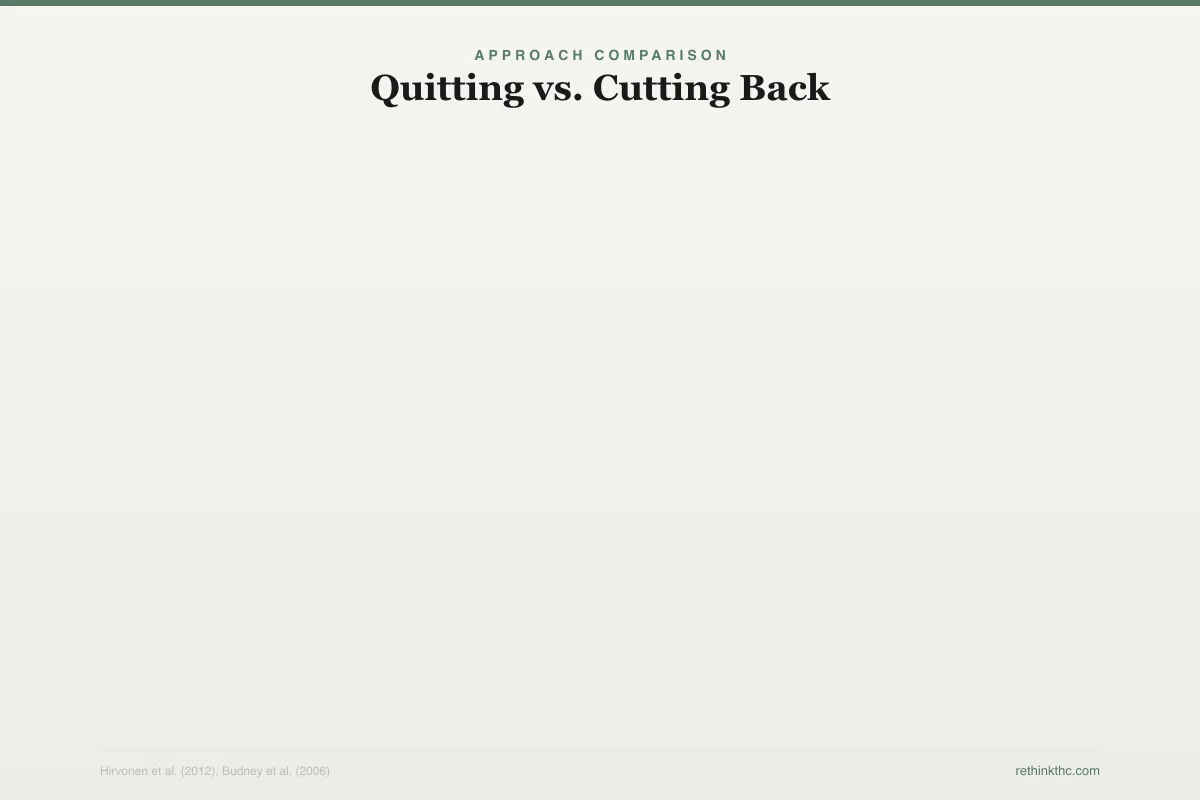
Approach Comparison
Quitting vs. Cutting Back
Both are valid strategies — the right choice depends on your situation
Quitting Completely
Complete neurological reset
CB1 receptors normalize by day 28
No ongoing willpower drain
Simple rule: you do not use
Necessary for moderate-severe CUD
Moderation often fails at this level
Faster, more concentrated recovery
Worst is over within 2 weeks
Loss of any genuine benefits
Pain relief, sleep, social ease — gone
Cutting Back
Less disruptive to daily life
Gradual adjustment, life stays stable
Preserves medical/social benefits
If benefits are genuine, not dependency
Can be a stepping stone to quitting
Build confidence with partial reduction
Harder to maintain long-term
Constant decision-making required
Slower, partial receptor recovery
Never reaches full reset while using
Hirvonen et al. (2012), Budney et al. (2006)
 View as image ↗
A Cleaner Neurological Reset
When you stop using cannabis entirely, your brain gets to complete a full recalibration without interruption. A 2012 study by Hirvonen and colleagues, published in Molecular Psychiatry, used PET imaging to show[1] that CB1 receptors, the brain structures THC binds to, return to approximately normal availability after about 28 days of abstinence. This is the most thorough reset available, and it means that after a month, your brain is operating at (or very close to) its natural baseline.
A complementary study by D'Souza and colleagues, published in 2016 in Biological Psychiatry: Cognitive Neuroscience and Neuroimaging, showed[2] that this recovery process begins within just 2 days of abstinence. Even the early days of quitting are producing measurable neurological change. But the full 28-day timeline requires sustained abstinence. Intermittent use during that window slows the process down.
No Willpower Drain
Moderation requires ongoing decision-making. Every day, sometimes multiple times a day, you have to decide: Is this a use day or a sober day? Have I hit my limit? Does this situation count as an exception? That constant negotiation uses cognitive resources, and for many people it is exhausting.
Quitting eliminates the negotiation entirely. The rule is simple: you do not use. There is no gray area, no exception-making, no bargaining with yourself about whether tonight counts. For people who find moderation draining, the clarity of abstinence can be a relief rather than a restriction.
It Is Necessary for Some People
If you meet criteria for moderate to severe Cannabis Use Disorder (CUD), the research is fairly clear that moderation is less likely to succeed as a primary strategy. A 2006 study by Budney and colleagues, published in the Journal of Consulting and Clinical Psychology, studied[3] 90 adults in a 14-week treatment program. The study compared different treatment approaches and found that structured abstinence combined with cognitive behavioral therapy and motivational incentives produced the strongest outcomes.
This does not mean every person with CUD must quit forever. It means that if your use has reached the level of a clinical disorder, cutting back without first establishing a period of abstinence tends to produce weaker results. If you are unsure whether your use meets CUD criteria, our guide on signs of cannabis use disorder walks through the assessment in plain language.
Faster Recovery Timeline
Quitting produces a faster, more concentrated recovery experience. Withdrawal symptoms typically peak between days 2 and 6, with the worst of it behind you within two weeks. By day 28, the receptor reset is largely complete. By comparison, moderation produces a slower, more gradual recovery that can stretch over months.
For some people, getting the hard part over with quickly is preferable to a prolonged low-grade adjustment. It is the difference between pulling a bandage off fast versus peeling it slowly.
The Case for Cutting Back
Quitting gets more attention in the literature, partly because clinical research tends to focus on problem populations. But for a large number of cannabis users, moderation is both realistic and effective.
It Is Less Disruptive
Quitting requires reorganizing your social life, your evenings, your sleep routine, and your stress management strategies all at once. For people with demanding jobs, family responsibilities, or limited support systems, that level of disruption is a barrier to attempting any change at all. Cutting back allows you to adjust gradually while keeping the rest of your life stable.
It Preserves Genuine Benefits
Some people derive real, measurable value from cannabis. Pain management. Sleep initiation. Creative enhancement. Social ease. If these benefits are genuine (not dependency in disguise), moderation lets you maintain them while reducing the costs. Complete abstinence eliminates the costs and the benefits simultaneously, which may not be the right trade-off for everyone.
It Can Be a Stepping Stone
For some people, cutting back is the first step toward quitting. Reducing from daily use to weekends only, then from weekends to once a month, then to nothing is a progression that feels achievable where quitting cold turkey does not. Each reduction builds confidence and provides data about what life looks like with less cannabis in it.
The Biology Supports Partial Reduction
The D'Souza 2016 research[2] showing that CB1 receptor recovery begins within 2 days has practical implications for moderation. If you go from daily use to three days a week, you are giving your receptors four days of recovery time each week. That is meaningful. You may not achieve the full reset that 28 continuous days of abstinence provides, but you will experience partial recovery that reduces tolerance and improves the quality of each session.
Our cannabis tolerance break guide covers how to structure these breaks for maximum benefit.
Most Cannabis Users Are Not Dependent
The Anthony 1994 study in Experimental and Clinical Psychopharmacology established that approximately 9% of people who have ever used cannabis develop dependence. That means roughly 91 out of 100 users are not clinically dependent. For the majority of cannabis users, the neurobiological machinery of compulsive use is not in play, and moderation is a realistic strategy rather than wishful thinking.
The Potency Complication
One factor that makes this decision harder than it used to be is the changing potency of cannabis products. A 2016 analysis by ElSohly and colleagues, published in Biological Psychiatry, documented[4] that the average THC concentration in cannabis products tripled between 1995 and 2014, from about 4% to 12%. Concentrates, which are now widely available, can exceed 80% THC.
Withdrawal Comparison
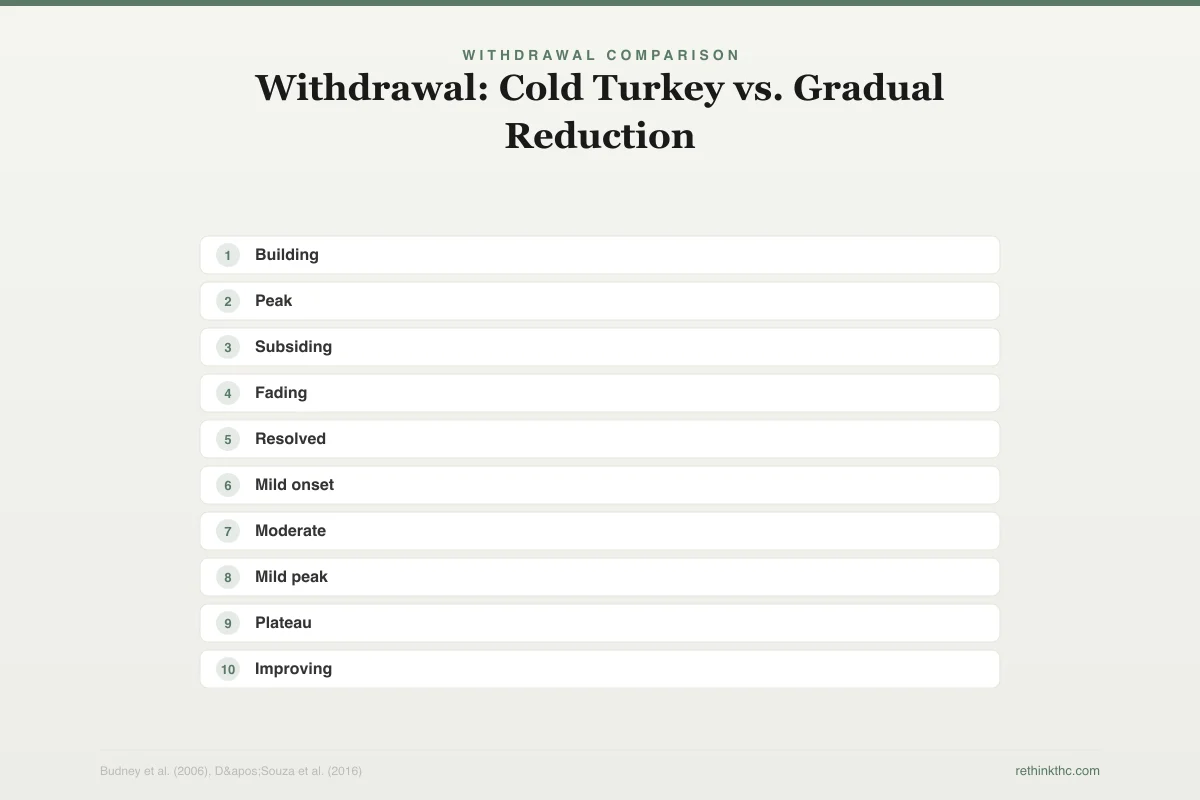
Withdrawal: Cold Turkey vs. Gradual Reduction
Cold turkey peaks higher but resolves faster; gradual is more manageable but lasts longer
Cold Turkey
+ Faster overall resolution
+ No decision fatigue
+ Complete receptor reset by day 28
- Intense peak days 2-5
- Higher dropout risk
- More disruptive to daily life
Gradual
+ Lower peak intensity
+ More manageable day-to-day
+ Easier to maintain work/life
- Longer tail of symptoms
- Requires sustained discipline
- Slower receptor recovery
Budney et al. (2006), D'Souza et al. (2016)
 View as image ↗
This matters for the quit-versus-cut-back question because higher potency accelerates receptor downregulation, builds tolerance faster, and makes dependence more likely to develop. If your primary products are high-potency concentrates, your brain has adapted to a level of stimulation that makes moderate use of the same products particularly difficult. Switching to lower-potency flower as part of a moderation strategy is one way to address this, but it requires honesty about whether you are willing to accept a less intense experience.
Evidence Review
Where the evidence stands
Neurobiology of Reset
CB1 receptor downregulation and recovery well-mapped; begins within 2 days, full reset ~28 days
Animal Models
Rodent studies confirm tolerance reversal with abstinence and partial reversal with reduced exposure
Brain Imaging in Humans
Hirvonen 2012 and D'Souza 2016: PET imaging confirmed receptor recovery timeline in daily smokers
Treatment Trials
Budney 2006: 90-person RCT showed abstinence + CBT produced best outcomes for CUD
Large Trial Comparing Quit vs. Moderation
No large RCT has directly compared quitting to structured moderation head-to-head
Meta-Analysis
The biology of both approaches is well-supported. What's missing is a large head-to-head trial directly comparing quitting to structured moderation. Current evidence strongly supports quitting for people with CUD, and supports moderation for those without it — but the comparison hasn't been formally tested.
Hirvonen et al. (2012); D'Souza et al. (2016); Budney et al. (2006)
Who Tends to Succeed with Each Approach
Research and clinical observation point to patterns in who does well with quitting versus moderation.
Quitting tends to work better for people who: meet criteria for moderate to severe Cannabis Use Disorder. Have tried moderation seriously and failed multiple times. Use cannabis primarily as a coping mechanism for anxiety, depression, or stress (rather than recreationally). Experience significant cannabis withdrawal symptoms, suggesting physical dependence. Have an "all or nothing" personality where maintaining a partial habit is harder than maintaining abstinence.
Moderation tends to work better for people who: do not meet criteria for CUD, or meet criteria for mild CUD only. Have not previously attempted and failed at moderation. Use cannabis primarily recreationally rather than as a coping tool. Can set rules and follow them consistently. Do not experience significant withdrawal symptoms during breaks.
Quitting works better if you...
- Meet criteria for moderate-severe CUD
- Have tried moderation and repeatedly broken your rules
- Use primarily to cope with anxiety, depression, or stress
- Experience withdrawal symptoms during breaks
- Find 'all or nothing' easier than 'sometimes'
Cutting back works better if you...
- Don't meet CUD criteria (or mild only)
- Haven't tried and failed at moderation before
- Use recreationally rather than as a coping tool
- Can set rules and actually follow them
- Don't experience significant withdrawal
These are patterns, not rules. Individual variation matters. But if you read one list and thought "that's me," that is worth noting.
The Moderation Management Trap
There is a specific pattern worth naming, because it is common and it delays genuine change.
Personalized Approach
Which Approach Fits Your Profile?
Match the strategy to your reality, not your hopes
Light Social User
Few times a month, no dependency signs, no negative consequences
Cutting back likely fine
No clinical concern. Adjust if you want, but no urgency.
Daily User, Some Dependency
Daily or near-daily use, tolerance building, some withdrawal on breaks
Try cutting back first, quit if it fails
Set strict moderation rules for 30 days. If you break them repeatedly, that tells you something.
Heavy Daily User, CUD
Multiple times daily, significant tolerance, failed moderation attempts, using to cope
Abstinence recommended
Research shows structured abstinence + therapy produces the strongest outcomes at this level.
Medical User
Using for pain, sleep, anxiety, or other medical conditions under guidance
Work with your doctor
Not a simple quit/cut decision. Medical benefits must be weighed against dependency risk.
Budney et al. (2006), Anthony et al. (1994)
 View as image ↗
It goes like this: you recognize that your cannabis use has become problematic. Rather than quitting, you decide to "just cut back." You set rules. You break the rules. You set new rules. You break those too. You tell yourself that moderation is working because you are "using less than before," even though "less" is still more than your rules allow. Months pass. Your use pattern has not meaningfully changed, but you have successfully avoided confronting the possibility that you need to quit.
This is not moderation. It is using the idea of moderation as a shield against a harder truth. Real moderation involves rules that you actually follow. If you set a plan and consistently cannot execute it, the plan is not the problem. The degree of control you have over your use is the problem.
This does not mean you have failed. It means you have collected important data about what approach you need. And that data, uncomfortable as it is, is more valuable than another round of rules you will not keep.
The 30-Day Test: Your Decision Tool
If you are still unsure which approach is right, here is a concrete experiment you can run.
Pick your approach
Follow the plan for exactly 30 days
Track what happens
Evaluate honestly at day 30
Peer-reviewed research
Choose either quitting or cutting back with strict rules. If you choose moderation, define the rules in advance. Be specific: which days, what times, what products, what amounts. Write them down.
Follow the plan for exactly 30 days. Not approximately 30 days. Not 30 days with exceptions. Thirty consecutive days of executing the plan you defined.
Track what happens. How do you feel physically? Emotionally? How is your sleep, motivation, clarity, and mood? What cravings arise, and when? Are you following the rules, or bending them?
Evaluate honestly at day 30. If you chose quitting and completed 30 days, you now have real data about what sobriety feels like for you. If you chose moderation and followed every rule for 30 days, you have evidence that moderation is realistic for you. If you chose moderation and broke your own rules within the first two weeks, that is the most important data of all.
The 30-day window is not arbitrary. It aligns with the Hirvonen 2012 research[1] showing CB1 receptor normalization at approximately 28 days. By the end of the test, whether you chose abstinence or moderation, your brain has had meaningful time to recalibrate.
If you decide that quitting is the right path, our guide on how to quit weed provides a detailed, realistic approach. If moderation is the better fit, our guide to cutting back covers practical strategies that actually work.
What If You Have Already Tried Both?
Some people reading this have already attempted moderation and failed, or quit and relapsed, or cycled between the two without finding anything that sticks. If that is you, the answer is not more willpower. It is likely a different kind of support.
Recovery Comparison
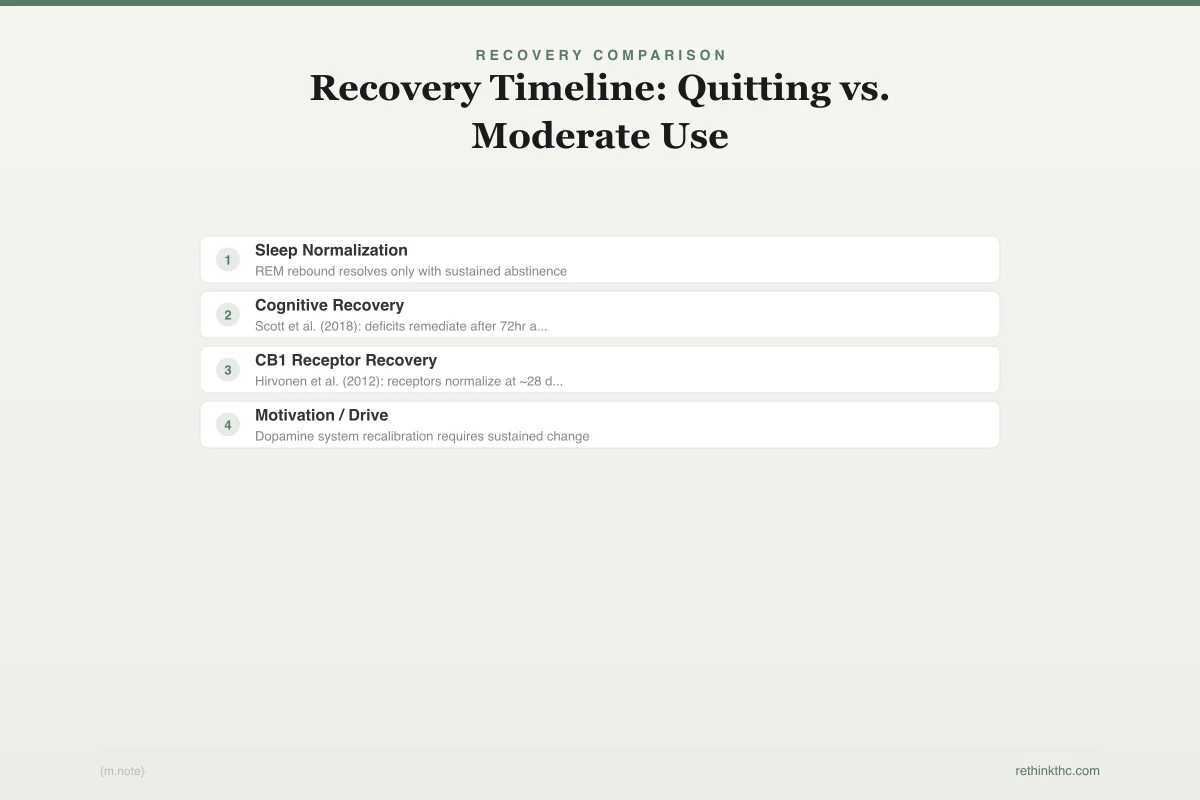
Recovery Timeline: Quitting vs. Moderate Use
Full abstinence produces faster, more complete recovery across every metric
Sleep Normalization
REM rebound resolves only with sustained abstinence
Cognitive Recovery
Scott et al. (2018): deficits remediate after 72hr abstinence
CB1 Receptor Recovery
Hirvonen et al. (2012): receptors normalize at ~28 days abstinence
Motivation / Drive
Dopamine system recalibration requires sustained change
Hirvonen et al. (2012), Scott et al. (2018)
 View as image ↗
The Budney 2006 study[3] found that the most effective treatment combined abstinence with cognitive behavioral therapy and motivational incentives. That means structured professional help, not just trying harder at the same approach that has not worked. A therapist who specializes in substance use can help you identify the psychological patterns driving your use, develop coping strategies that do not involve cannabis, and build accountability into the process.
Cycling between failed moderation and failed quitting is not a character defect. It is a sign that the complexity of your situation exceeds what self-directed strategies alone can address. If you are wondering whether you should quit weed, our companion article covers the broader decision framework.
Making the Choice
Here is the most honest summary available.
If you can set rules and follow them, cutting back is a valid option that the biology supports. If you cannot set rules and follow them, that inability is the answer, and quitting (at least for a sustained period) is the approach more likely to produce the change you are looking for.
Neither choice is a moral statement. Quitting does not mean you were broken. Cutting back does not mean you are in denial. Both are strategies, and the right strategy is the one that matches your actual situation rather than the situation you wish you were in.
The only wrong choice is refusing to choose, because inaction defaults to continuation of the current pattern. And if the current pattern were working, you would not be reading this article.
Safety
LowCycling between failed attempts is a signal, not a failure
Concern
Repeatedly trying moderation and quitting without success is not a character defect. It's a sign that the complexity of your situation — possibly including underlying anxiety, depression, or trauma — exceeds what self-directed strategies alone can address.
What the research says
The Budney 2006 trial found that combining structured abstinence with professional CBT and motivational incentives produced the best outcomes. Professional help isn't a last resort — it's often the most effective first move for people with moderate to severe cannabis use disorder.
Particularly relevant for: Anyone who has tried quitting or moderating multiple times without lasting change
What to do
If self-directed approaches haven't worked after 2-3 serious attempts, consider a therapist who specializes in substance use. SAMHSA helpline: 1-800-662-4357 (free, 24/7).
Budney et al. (2006), Journal of Consulting and Clinical Psychology
When to Seek Professional Help
If you have tried both quitting and cutting back without success, or if your cannabis use is tangled up with anxiety, depression, trauma, or other mental health concerns, professional support is both appropriate and effective. Substance use therapists can offer structured approaches that are difficult to replicate on your own.
If you are experiencing a crisis, or if substance use is affecting your ability to function safely in daily life, do not wait for the perfect moment to seek help.
SAMHSA's National Helpline is available at 1-800-662-4357. It is free, confidential, and available 24 hours a day, 7 days a week. You can also text "HELLO" to 741741 to reach the Crisis Text Line.
Research Gaps
What would it take?
What would it take to definitively answer 'quit or cut back'?
Large RCT directly comparing structured quitting vs. structured moderation in the same population
No trial has randomized people to quit vs. moderate and tracked outcomes head-to-head
Biomarker-based tool to predict who will succeed at moderation vs. who needs abstinence
CUD severity is a rough predictor, but individual-level prediction tools don't exist
Long-term (1+ year) follow-up comparing sustained outcomes of each approach
Studies accounting for product potency — does moderation work differently with high-THC concentrates vs. flower?
Potency tripled since the 1990s but quit/moderate studies haven't caught up
Assessment based on current treatment and neuroimaging literature
The Bottom Line
Quitting and cutting back are both valid strategies, but they work for different people. Research on 90 adults found that structured abstinence combined with cognitive behavioral therapy produced the best outcomes for people with Cannabis Use Disorder. CB1 receptors begin recovering within 2 days and normalize around 28 days, supporting both full breaks and structured reduction. About 91% of cannabis users are not clinically dependent and can realistically moderate. Quitting works better for people with moderate to severe CUD, those who have failed at moderation repeatedly, and those using cannabis primarily as a coping mechanism. Moderation works better for occasional users without CUD who can set and follow rules consistently. The most reliable decision tool is a 30-day test with strict rules: if you follow them, moderation is viable; if you break them, quitting is the more honest path forward.
Is it better to quit weed or cut back?
It depends on your situation. Research suggests that people with moderate to severe Cannabis Use Disorder tend to do better with quitting, at least initially. People without CUD, or with mild CUD, can often succeed with moderation. The most reliable test is to set strict rules for 30 days. If you can follow them, moderation may work. If you consistently break your own rules, that pattern suggests quitting is the more realistic option.
Can you successfully moderate cannabis use after being a heavy user?
Some people can, but it requires a period of abstinence first to allow CB1 receptors to reset, which takes about 28 days. After the reset, using less frequently (such as weekends only) becomes biologically more feasible because your tolerance has dropped. The people who struggle most with moderation are those who attempt it without a tolerance break, going straight from heavy daily use to "I will just use less" without allowing their brain to recalibrate.
How do I know if I need to quit weed completely?
Strong indicators that quitting is the better option include: repeatedly setting moderation rules and breaking them, experiencing significant withdrawal symptoms during breaks, using cannabis primarily to cope with negative emotions rather than for enjoyment, meeting criteria for moderate to severe Cannabis Use Disorder, and finding that your use is affecting your work, relationships, or health despite attempts to cut back.
What does the research say about quitting versus cutting back on weed?
A key study by Budney and colleagues (2006) found that structured abstinence combined with cognitive behavioral therapy and motivational incentives produced the best outcomes for adults with Cannabis Use Disorder. Separately, brain imaging research shows that CB1 receptors begin recovering within 2 days of reduced use and normalize around 28 days of full abstinence. Both abstinence and reduction produce neurological benefits, but full abstinence produces a more complete and faster reset.
What if cutting back on weed is not working for me?
If you have genuinely tried moderation with specific rules and consistently failed to follow them, that pattern is important information. It does not mean you lack discipline. It likely means your relationship with cannabis has moved past the point where simple reduction is effective. Consider a period of full abstinence to reset your receptors and your habits, and if self-directed quitting has also not worked, professional support from a therapist specializing in substance use can provide the structured accountability and strategies that self-directed approaches sometimes lack.
Does switching from concentrates to flower count as cutting back?
Yes, and it is one of the most impactful single changes you can make. Concentrates deliver 60 to 90% THC compared to flower at 15 to 25%, meaning the switch significantly reduces the THC load on your CB1 receptors even without changing frequency. This reduction in potency slows tolerance development and gives your receptors more room to recover between sessions. For concentrate users who are not ready to quit, switching to flower is often the most practical first step.
Sources & References
- 1RTHC-00573·Hirvonen, Jussi et al. (2012). “Daily Cannabis Use Was Linked to Fewer CB1 Receptors. A Month Without Brought Them Back..” Molecular Psychiatry.Study breakdown →PubMed →↩
- 2RTHC-01134·D'Souza, Deepak Cyril et al. (2016). “Brain Cannabinoid Receptors Drop With Heavy Use, Then Rebound Within Days of Stopping.” Biological Psychiatry: Cognitive Neuroscience and Neuroimaging.Study breakdown →PubMed →↩
- 3RTHC-00218·Budney, Alan J. et al. (2006). “Paying for Clean Tests Worked During Treatment. Therapy Helped It Last..” Journal of Consulting and Clinical Psychology.Study breakdown →PubMed →↩
- 4RTHC-01144·ElSohly, Mahmoud A. et al. (2016). “U.S. Cannabis Potency Tripled Over Two Decades While CBD Nearly Vanished.” Biological Psychiatry.Study breakdown →PubMed →↩