Withdrawal & Recovery
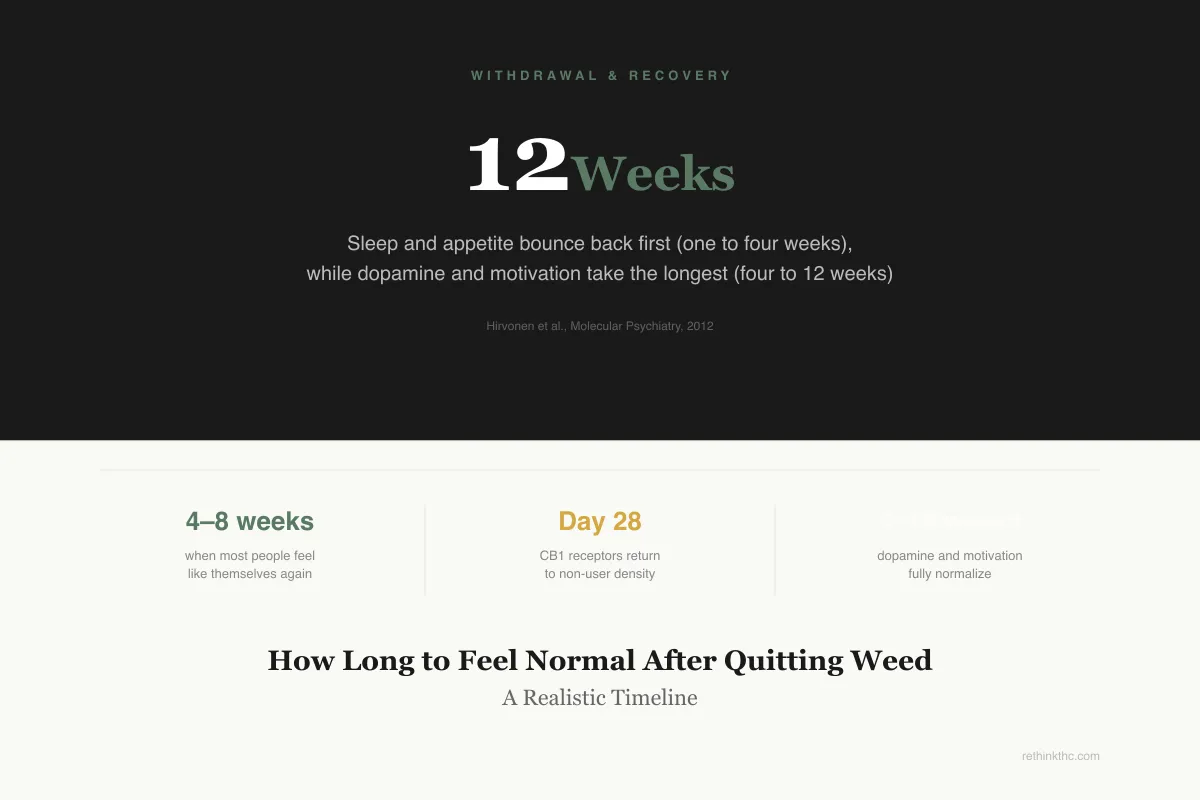
12 Weeks
Sleep and appetite bounce back first within one to four weeks, while dopamine and motivation take the longest at four to 12 weeks.
Hirvonen et al., Molecular Psychiatry, 2012
4–8 weeks
when most people feel like themselves again
Day 28
CB1 receptors return to non-user density
4–12 weeks
dopamine and motivation fully normalize
Hirvonen et al., Molecular Psychiatry, 2012
 View as image ↗
If you only read one thing
Most people feel like themselves again between 4 and 8 weeks after quitting weed. But 'normal' doesn't arrive all at once — your appetite comes back first (1-2 weeks), then sleep (2-6 weeks), then mood (2-4 weeks), and motivation is last (4-12 weeks). The hardest part: recovery isn't a straight line. You'll have good days and bad days, and the bad days don't mean you're going backwards. Your CB1 receptors are fully rebuilt by day 28.
Somewhere around week two or three after quitting, most people ask the same question. Not "will I feel normal," but "when." You are past the worst of it. The acute symptoms have eased enough that you can function. But you still do not feel like yourself. Things are just slightly off. Sleep is weird. Your emotions are unpredictable. Your brain feels slow. And you want a date, a number, some kind of finish line you can count down to.
The honest answer is that "normal" is not a single moment. It is a gradual process where different systems come back online at different speeds. But there are real, research-backed timelines for each one, and knowing them makes the waiting significantly more tolerable.
Key Takeaways
- There is no single moment where you suddenly feel "normal" — different systems in your brain and body come back on their own timelines
- Sleep and appetite tend to bounce back first (one to four weeks), while dopamine and motivation take the longest (four to 12 weeks)
- Your CB1 receptors — the ones THC binds to — return to normal density by about day 28
- Most people say they feel like themselves again between weeks four and eight, though heavy long-term users may need closer to three months
- Recovery is not a straight line — good days followed by bad days do not mean you are going backwards
- Quitting can unmask pre-existing conditions like anxiety, depression, or ADHD that cannabis was covering up without you knowing
Why "Normal" Is Not One Thing
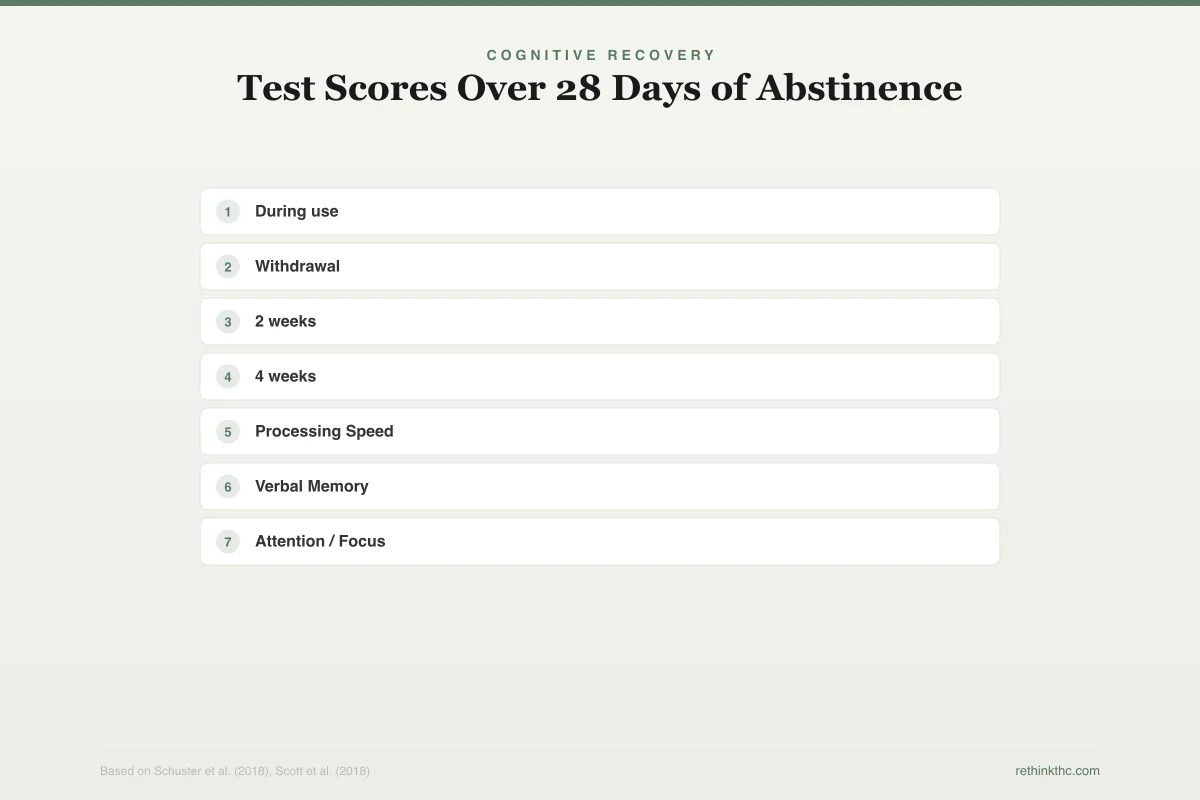
Your brain is not a single machine that was knocked offline and needs to reboot. It is dozens of interconnected systems, each of which adapted to the presence of THC in its own way and recovers at its own pace. The chart below tracks how cognitive function specifically recovers across the weeks after quitting.
Cognitive Recovery
Test Scores Over 28 Days of Abstinence
Scores shown as percentage of normal cognitive performance
Day 0
During use
Day 7
Withdrawal
Day 14
2 weeks
Day 28
4 weeks
Day 7 dip reflects acute withdrawal effects on cognition. Recovery accelerates after withdrawal resolves.
Based on Schuster et al. (2018), Scott et al. (2018)
 View as image ↗
THC interacts with your endocannabinoid system, which regulates sleep, mood, appetite, memory, pain, and reward processing. When you used regularly, every one of those systems adjusted to account for the external THC. Now that the THC is gone, each system has to recalibrate independently. That is why you might sleep fine but feel emotionally flat, or have your appetite back but struggle to concentrate.
Understanding this is the key to not losing your mind during recovery. You are not waiting for one thing to get better. You are waiting for several things to get better on overlapping but different schedules.
The System-by-System Recovery Timeline
These timelines come from clinical research and are consistent with what people in cannabis recovery communities report. Your individual experience depends on how long and how heavily you used, but the general trajectory holds.
| System | Recovery Timeline | What "Normal" Looks Like | What Delays Recovery |
|---|---|---|---|
| Appetite | 1–2 weeks | Hungry at normal times; food is enjoyable | Heavy edible use; high pre-use appetite |
| Sleep | 2–6 weeks (up to 45 days) | Fall asleep within 20 min; feel rested | Long-term daily use; pre-existing insomnia |
| Mood | 2–4 weeks | Emotions proportional to situation | Co-occurring anxiety/depression |
| Cognition | 2–4 weeks, continuing to 3 months | Clear memory; sustained focus | Adolescent-onset use; years of daily use |
| CB1 receptors | ~28 days | Biological hardware restored | Higher potency products; longer use history |
| Dopamine/motivation | 4–12 weeks | Activities feel rewarding naturally | Concentrate use; co-occurring conditions |
Appetite: 1 to 2 Weeks
Appetite is usually the first thing to come back. THC stimulates hunger directly through CB1 receptor activation, and when you quit, your body temporarily loses the ability to generate normal hunger signals. Most people report their appetite returning in some form within the first week, with it feeling mostly normal by week two.
Food might taste different for a while. Some people find that flavors are sharper or more distinct without THC modulating sensory processing. Others find food boring at first, which has less to do with taste and more to do with your dopamine system still being in its recalibration phase.
Sleep: 2 to 6 Weeks
Sleep is one of the most disruptive withdrawal symptoms and one of the slower systems to fully normalize. The first week or two brings insomnia, night sweats, and vivid dreams from REM rebound. THC suppresses your dreaming sleep, and your brain floods you with it when the THC is removed.
By weeks two to three, most people are sleeping more total hours, even if the quality is still poor. Full normalization of sleep architecture, meaning you cycle through light sleep, deep sleep, and REM in healthy patterns and wake up feeling rested, typically takes four to six weeks. A systematic review by Gates and colleagues confirmed that sleep disturbance is among the most persistent withdrawal symptoms, with resolution typically occurring within 45 days.[3] Heavy users sometimes need up to that 45-day mark. You can find more detail in our guide on weed withdrawal insomnia.
Mood and Emotional Regulation: 2 to 4 Weeks
The emotional volatility of the first two weeks is among the hardest parts of quitting. You swing between irritable, anxious, sad, and numb, sometimes within the same hour. THC was dampening your emotional responses, and without it, your brain's emotional circuitry is running without its usual buffer.
Most people notice significant stabilization of mood by weeks three to four. The swings become less extreme and shorter in duration. You still feel things strongly, but your reactions start being proportional to what is actually happening in your life rather than wildly out of scale. Our cannabis withdrawal complete guide covers the full picture of what to expect during this phase.
Cognitive Function (Memory, Focus): 2 to 4 Weeks, Continuing to 3 Months
Brain fog is real, measurable, and temporary. A 2018 meta-analysis published in JAMA Psychiatry[1] reviewed 69 studies and found that cannabis-related cognitive deficits largely resolve with sustained abstinence. The areas that show the most recovery include verbal memory, attention, and processing speed.
Most people notice meaningful cognitive improvement within two to four weeks. You can hold a conversation without losing your train of thought. You remember what you read. Work tasks require less brute-force willpower to complete. But the research suggests that cognitive function continues improving beyond the initial month, with some gains still occurring up to three months after quitting, particularly for heavy users.
CB1 Receptors: Approximately 4 Weeks
A landmark 2012 study by Hirvonen and colleagues, published in Molecular Psychiatry, used[2] PET imaging to directly measure CB1 receptor density in the brains of daily cannabis users. They found that chronic use significantly reduced CB1 receptor availability throughout the brain. The critical finding: after approximately 28 days of abstinence, receptor density returned to levels comparable to non-users.
This matters because CB1 receptors regulate the systems listed above. Their recovery is essentially the biological foundation for everything else normalizing. Day 28 is not a magic line, but it represents the point at which the hardware your brain needs to function normally is restored.
Hirvonen et al. (2012) · Molecular Psychiatry
- Population
- Chronic daily cannabis smokers vs. non-using controls
- Intervention
- PET brain imaging before and after ~28 days of monitored abstinence
- Comparator
- Healthy non-cannabis-using controls
- Finding
- After approximately 28 days of supervised abstinence, CB1 receptor density returned to levels comparable to people who never used cannabis. Downregulation was selective to cortical regions and correlated with years of use.
positive The biological hardware for feeling normal is restored by day 28
Hirvonen et al. (2012), Molecular Psychiatry, 17(6), 642-649
Dopamine and Reward System: 4 to 12 Weeks
This is the one that makes people feel like they will never enjoy anything again. The flat, colorless, "nothing is interesting" sensation is called anhedonia, and it is a direct result of your dopamine system recalibrating. THC was boosting dopamine output each time you used, and your brain adapted by turning down its sensitivity. Research by Bloomfield and colleagues documented reduced dopamine synthesis capacity in chronic cannabis users.[4] Now the boost is gone but the sensitivity is still low.
The gray period is the worst in weeks one and two, shows meaningful improvement by week four, and continues resolving through week eight for most people. Heavy, long-term users may need the full 12 weeks for complete normalization. This is the slowest system to fully recover, which is why people often report that their sleep and appetite are fine but they still feel "off."
Motivation and Drive: 4 to 8 Weeks
Motivation is downstream from dopamine. Until your reward system is producing and registering normal signals, starting tasks and sustaining effort feels like pushing a boulder uphill. You know you should want to do things. You just cannot generate the wanting.
This improves in parallel with dopamine recovery. Most people report that motivation returns in functional amounts by weeks four to six, with continued improvement through week eight. The shift is gradual. One day you notice you started a project without having to talk yourself into it. That is your motivation circuitry coming back.
Why "Normal" Might Feel Different Than You Expected
Here is something that catches a lot of people off guard. When you finally feel normal, it might not feel the way you remember.
If you used daily for years, your memory of what "sober normal" feels like is old. You may have forgotten what your baseline actually was. The normal you are comparing your recovery to might be a version of yourself that was already using cannabis, not the sober version from before that.
Some people find that their sober baseline is better than they expected. Things are sharper, more vivid, more engaging than they remembered. Others find that their baseline includes feelings they were unknowingly using cannabis to avoid.
Pre-existing conditions are a real factor here. Anxiety, depression, and ADHD are among the most common reasons people start self-medicating with cannabis, often without realizing that is what they are doing. When you quit, those conditions are no longer being masked. If you find that anxiety or low mood persists well beyond the typical withdrawal timeline, it may not be withdrawal at all. It may be an underlying condition that now needs to be addressed on its own terms.
This is not a reason to keep using. It is a reason to work with a healthcare provider who can help you distinguish between lingering withdrawal and something that existed before the cannabis.
Recovery Is Not a Straight Line
Why Recovery Feels Like a Rollercoaster (But Isn't)
 View as image ↗
This is critical to understand, because it is the thing that makes people panic.
You will have a good day on Wednesday. You will feel sharp, motivated, almost normal. Then Thursday will feel like you went backwards a week. Mood crashes. Brain fog returns. You wonder if something is wrong.
Nothing is wrong. Recovery from cannabis withdrawal does not follow a straight upward line. It follows an upward trend with daily fluctuations. The bad days do not erase the good days. They are noise inside a signal that is consistently moving in the right direction.
People who track their symptoms, even with something as simple as a daily 1 to 10 rating, consistently see the trend more clearly than people who judge by feel. On Thursday, it feels like nothing has changed. But your Thursday 3 is better than your week-one Thursday 1, and your average for the week is higher than last week's average. The data tells the truth when your subjective experience lies.
Evidence Review
Where the evidence stands
Cell & Lab Studies
CB1 receptor binding and endocannabinoid system regulation thoroughly characterized
Animal Studies
Rodent models confirm system-by-system recovery timelines after chronic THC
Case Reports
Massive patient-reported data from recovery communities confirming 4-8 week normalization
Small Human Trials
Hirvonen 2012: PET imaging showing CB1 recovery by day 28. Bloomfield 2014: dopamine synthesis changes.
Large Randomized Trial
Meta-Analysis
Scott 2018 (69 studies): cognitive recovery confirmed. Gates 2016: sleep disturbance resolution within 45 days.
Recovery timelines are among the best-documented aspects of cannabis cessation, with PET imaging confirming receptor recovery and major meta-analyses confirming cognitive normalization. The individual variation in timeline is real but the direction — full recovery — is consistent.
Hirvonen et al. (2012); Scott et al. (2018); Gates et al. (2016); Bloomfield et al. (2014)
The Realistic Summary
For the majority of people, the answer to "how long to feel normal" falls between four and eight weeks. That is the window where most systems have recovered enough that your day-to-day experience feels like yours again. Sleep works. Emotions are stable. You can think clearly. Things are interesting.
For heavy, long-term users, people who smoked daily for multiple years, especially high-potency products, three months is a more realistic target for full normalization. The dopamine and reward system take the longest, and years of adaptation require more time to reverse.
People in recovery communities describe the process the same way, over and over: "The color comes back slowly, and then all at once." There is a stretch where you cannot see the changes, and then one day you realize you laughed without thinking about it, or you finished a project because you wanted to, or you woke up and felt genuinely rested. And you understand that it happened gradually, even though it felt sudden.
To understand everything that changes when you stop, our full breakdown of what happens when you quit covers the process week by week. And for a complete overview of the withdrawal process, the cannabis withdrawal complete guide is the best starting point.
When to Seek Professional Help
The timelines in this article describe the typical experience. But if your symptoms are not improving at all after six to eight weeks, or if anxiety, depression, or emotional instability is severe enough to interfere with work, relationships, or daily functioning, professional evaluation is warranted.
This is especially true if you suspect you may have a condition that was masked by cannabis use. A healthcare provider can help distinguish between lingering withdrawal and an underlying condition like depression, generalized anxiety, or ADHD that needs its own treatment.
If you experience persistent hopelessness or thoughts of self-harm at any point in the process, reach out immediately. SAMHSA's National Helpline is available at 1-800-662-4357. It is free, confidential, and available 24 hours a day.
The Reframe
Your brain adapted to years of receiving THC, and now it is adapting back. That process has a clear beginning, a well-documented middle, and a definite end. The timeline is not instant, but it is not endless either. Every day without THC is a day your receptors are rebuilding, your dopamine sensitivity is increasing, and your baseline is rising. You do not have to feel it happening for it to be happening. The research says it is, and the thousands of people who have walked through this before you confirm it. Normal is coming. It is closer than the bad days make it feel.
The Bottom Line
There is no single moment where you suddenly feel "normal" after quitting cannabis. Different brain systems recover on their own timelines: appetite returns within one to two weeks, sleep normalizes by weeks two to six, mood stabilizes around weeks three to four, CB1 receptors reach normal density by day 28, and dopamine-driven motivation is the slowest system at four to 12 weeks. Most people report feeling like themselves between weeks four and eight. Heavy, long-term users may need closer to three months. Recovery is not a straight line — good days followed by bad days are normal fluctuations inside an upward trend, not signs of regression.
How long does it take to feel normal after quitting weed?
Most people report feeling like themselves again between four and eight weeks after quitting. Sleep and appetite tend to recover within the first two to four weeks, while mood, motivation, and cognitive function continue improving through weeks four to eight. Heavy, long-term users may need closer to three months for full normalization, particularly for dopamine and reward system recovery.
Why do I still feel weird weeks after quitting weed?
Different brain systems recover at different rates. Your appetite and sleep may be back to normal while your dopamine system is still recalibrating, which can leave you feeling flat, unmotivated, or emotionally off even after the acute symptoms are gone. CB1 receptors return to normal density around day 28, but downstream effects on mood and reward processing can take four to 12 weeks to fully resolve.
Does everyone recover on the same timeline after quitting cannabis?
No. The timeline depends on how long you used, how frequently, and the potency of the products. Daily users of high-potency cannabis for multiple years will generally take longer to recover than someone who used moderately for a shorter period. Age, genetics, overall health, and whether you have pre-existing mental health conditions also influence the timeline. The trajectory is the same for everyone, but the speed varies.
Is it normal to have bad days after weeks of feeling better?
Yes. Recovery from cannabis use is not a straight upward line. It is an upward trend with daily fluctuations. A bad day after a string of good days does not mean you are going backwards. It means your brain is still recalibrating, and the process has natural variation. Tracking your symptoms over weeks rather than judging by individual days gives you a much more accurate picture of your progress.
Can quitting weed reveal mental health conditions?
Yes. Anxiety, depression, and ADHD are among the most common conditions that people unknowingly self-medicate with cannabis. When you quit, those conditions are no longer being masked by THC. If symptoms like persistent anxiety or low mood continue well beyond the typical withdrawal timeline of four to eight weeks with no improvement, it may indicate an underlying condition that needs professional evaluation and treatment.
Does exercise speed up the process of feeling normal?
Exercise is one of the most evidence-supported ways to support recovery. Aerobic activity directly increases natural endocannabinoid levels, promotes dopamine release through healthy pathways, improves sleep quality, and reduces the irritability and anxiety that peak during the first few weeks. It does not override the biological timeline for receptor recovery, but it creates optimal conditions for your brain to recalibrate and can make the subjective experience of recovery significantly more tolerable.
Sources & References
- 1RTHC-01832·Scott, J. Cobb et al. (2018). “Cannabis Cognitive Effects Are Small and Largely Disappear After 72 Hours of Abstinence.” JAMA Psychiatry.Study breakdown →PubMed →↩
- 2RTHC-00573·Hirvonen, Jussi et al. (2012). “Daily Cannabis Use Was Linked to Fewer CB1 Receptors. A Month Without Brought Them Back..” Molecular Psychiatry.Study breakdown →PubMed →↩
- 3RTHC-01161·Gates, Peter et al. (2016). “Systematic Review Confirms Cannabis Withdrawal Disrupts Sleep, but Specific Mechanisms Remain Unclear.” Substance abuse.Study breakdown →PubMed →↩
- 4RTHC-00773·Bloomfield, Michael A P et al. (2014). “Lower Dopamine Production Tracked With Higher Apathy Scores in Regular Cannabis Users.” Psychopharmacology.Study breakdown →PubMed →↩