Dopamine / Brain
72 Hours
A 2018 JAMA meta-analysis found that cannabis-related memory deficits show significant recovery after just 72 hours of abstinence, with hippocampal CB1 receptors returning to normal density by day 28.
Scott et al., JAMA Internal Medicine, 2018
72 hours
A 2018 JAMA Psychiatry meta-analysis found that
2 days
CB1 receptors in the hippocampus start recovering within 2
Why THC Hits Your Memory So Hard
covered in detail
Scott et al., JAMA Internal Medicine, 2018
 View as image ↗
If you only read one thing
Weed messes with your memory by flooding a brain region called the hippocampus — the part that files away new memories. Your brain turns down the memory-recording volume to cope, which is why things slip through. When you quit, that volume knob resets. Most people notice their memory working again within 1 to 2 weeks, and brain scans show the underlying receptors fully bounce back by about 28 days.
You forgot what you walked in to get. You read a paragraph and retained nothing. Someone told you something important yesterday and today it is completely gone. If you have been using weed regularly and your memory feels unreliable, or if you recently quit and you are wondering whether weed memory loss recovery is actually possible, the short answer is: yes, your memory comes back. The science on this is clearer than most people expect, and the news is genuinely good.
Your hippocampus, the part of your brain responsible for forming and storing memories, is one of the areas most heavily affected by THC. It is also one of the areas that recovers most reliably when you stop.
Key Takeaways
- THC hurts your memory by binding to CB1 receptors in the hippocampus — the brain region where new memories are formed and stored
- Short-term memory problems while high are well established, but long-term memory damage from chronic use is largely reversible after quitting
- A 2018 JAMA Psychiatry meta-analysis found that cannabis-related memory deficits show significant recovery after just 72 hours of abstinence, with continued improvement over weeks
- CB1 receptors in the hippocampus start recovering within 2 days and return to normal density by roughly 28 days
- Better memory is one of the most commonly reported benefits people notice after quitting cannabis
- People who started using as teenagers may have a lower ceiling for full weed memory loss recovery compared to adult-onset users — based on the Dunedin study tracking over 1,000 people from birth to age 38
Fact Check
The 'permanent damage' fear vs. the research
The claim
“Smoking weed for years permanently destroys your memory”
A mix of old anti-drug messaging and the very real but misread cognitive fog heavy users feel
What research shows
OverstatedChronic cannabis use doesn't kill memory cells. It reduces the number of working CB1 receptors in the hippocampus, and those receptors grow back. PET brain scans show them returning to normal within about 28 days of quitting.
There is one group where recovery is less complete: people who used heavily as teenagers, while the brain was still developing. Even then, big improvements still happen after quitting — the ceiling is just a bit lower.
Hirvonen et al. (2012) Molecular Psychiatry; Meier et al. (2012) PNAS
Why THC Hits Your Memory So Hard
To understand what cannabis does to memory, you need to understand one brain structure: the hippocampus. It sits deep in the middle of your brain, one on each side, and it is the gateway for turning experiences into memories. When you learn a new name, remember where you parked, or recall what you had for lunch, your hippocampus is doing the work.
Memory Science
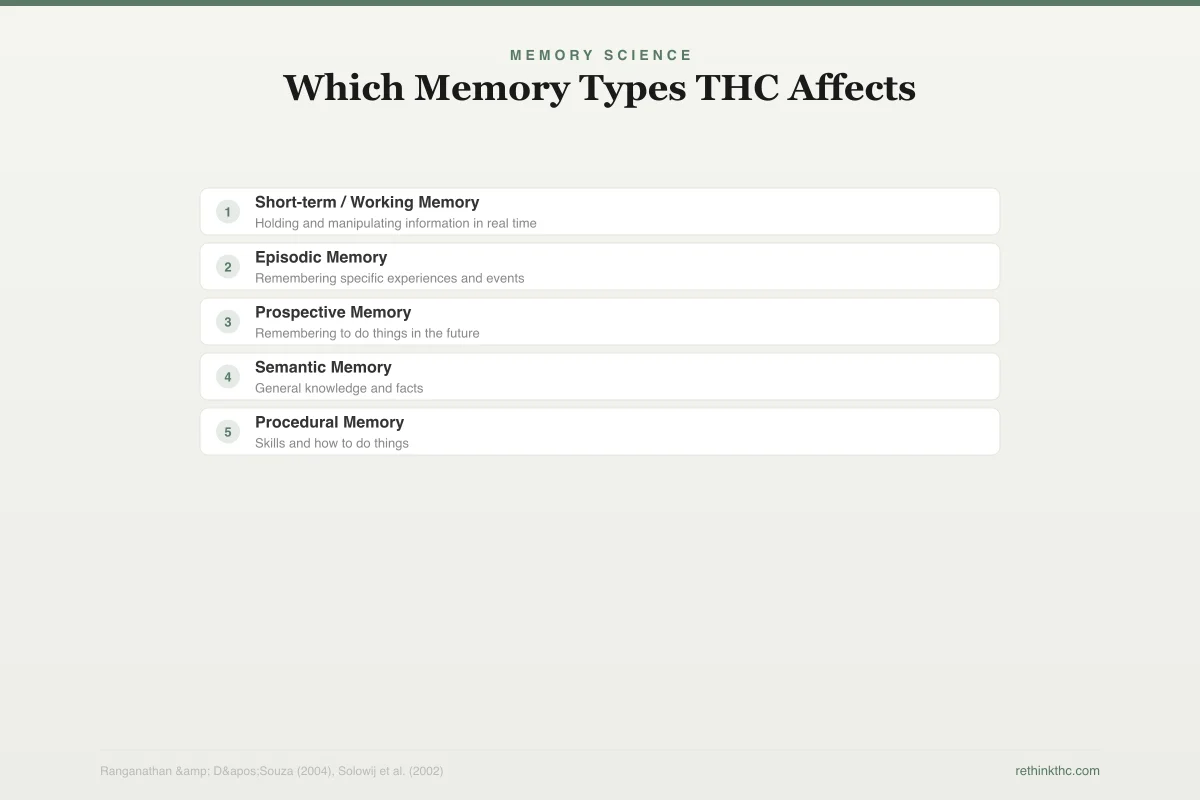
Which Memory Types THC Affects
Not all memory is created equal — THC targets specific systems
Short-term / Working Memory
Fully reversibleHolding and manipulating information in real time
Forgetting what you were just saying, losing track of conversations
Episodic Memory
Largely reversibleRemembering specific experiences and events
Not remembering details from yesterday, gaps in personal timeline
Prospective Memory
Fully reversibleRemembering to do things in the future
Forgetting appointments, missing tasks you planned to do
Semantic Memory
Not typically affectedGeneral knowledge and facts
You still know that Paris is in France or how to do math
Procedural Memory
Not typically affectedSkills and how to do things
You can still ride a bike, type, or play an instrument
Ranganathan & D'Souza (2004), Solowij et al. (2002)
 View as image ↗
The hippocampus has one of the highest concentrations of CB1 receptors in the entire brain. CB1 receptors are the docking stations where THC binds to produce its effects, and they are a core part of the endocannabinoid system. Under normal conditions, your body's own cannabinoids (called endocannabinoids) bind to these receptors in small, precisely timed amounts to help regulate how strongly memories are encoded. They act as a volume knob, fine-tuning which experiences get stored and how vividly.
When you use cannabis, THC floods those same receptors. Instead of precise, small-dose fine-tuning, THC overwhelms the hippocampus with a signal that essentially tells it to turn the volume way down. A 2012 study by Bhattacharyya and colleagues, published in the Archives of General Psychiatry (now JAMA Psychiatry), used brain imaging to show that THC specifically disrupts hippocampal function during memory tasks. Participants performed worse on memory encoding tests, and their hippocampal activation patterns were measurably altered.
This is the mechanism behind the classic experience of being high and forgetting what you were just talking about. Your hippocampus is being chemically suppressed in real time.
Short-Term Memory While High vs. Long-Term Memory After Chronic Use
There is an important distinction between what happens to your memory while you are actively high and what happens after months or years of regular use. They are related but different problems.
Memory Impairment While High
The acute memory effects of THC are well established and dose-dependent. The more THC, the worse the impairment. While high, your ability to form new memories is significantly reduced. This is called anterograde memory impairment, which means you struggle to encode new information while THC is active in your system. Existing memories are not erased. The problem is creating new ones.
A 2004 review by Ranganathan and D'Souza, published in Psychopharmacology, documented that acute THC administration consistently impairs verbal learning, short-term recall, and working memory across dozens of controlled studies. The effect is temporary. Once THC clears your system, your ability to form new memories returns to baseline.
Memory Effects From Chronic Use
With daily or near-daily use over months or years, the situation gets more complex. Your brain adapts to constant THC exposure by reducing the number of available CB1 receptors in the hippocampus, a process called downregulation. Think of it as your brain pulling receptors offline because they are being overstimulated. This adaptation means your memory and cognitive systems are operating with less equipment even when you are not actively high.
Solowij and colleagues published a 2002 study in JAMA that found long-term cannabis users showed impaired attention and memory performance even after 12 or more hours without using. The impairments correlated with duration of use: the longer someone had been using regularly, the more pronounced the memory deficits.
This is the finding that worries people. It is also the finding that has an important second chapter.
Weed Memory Loss Recovery: What Happens When You Quit
Here is where the science becomes reassuring. The memory impairment caused by chronic cannabis use is not permanent brain damage. It is the result of CB1 receptor downregulation, and those receptors recover.
Cellular Mechanism
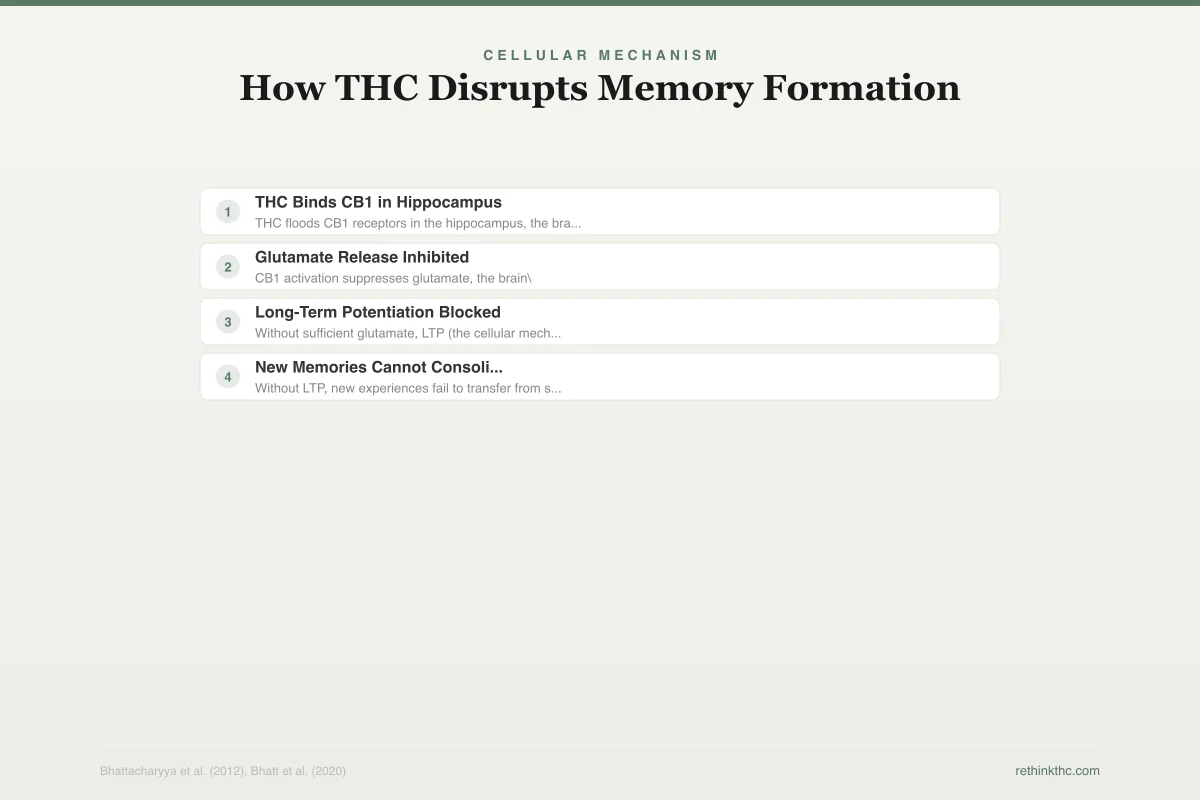
How THC Disrupts Memory Formation
The 4-step pathway from THC binding to memory impairment
THC Binds CB1 in Hippocampus
THC floods CB1 receptors in the hippocampus, the brain region with the highest CB1 density. Overwhelms the precision signaling system.
Glutamate Release Inhibited
CB1 activation suppresses glutamate, the brain's primary excitatory neurotransmitter. Neural communication in memory circuits slows down.
Long-Term Potentiation Blocked
Without sufficient glutamate, LTP (the cellular mechanism that strengthens connections between neurons) cannot occur. This is how memories are physically encoded.
New Memories Cannot Consolidate
Without LTP, new experiences fail to transfer from short-term to long-term storage. Existing memories are not erased — the problem is forming new ones.
This process is reversible. When THC clears and CB1 receptors recover, glutamate signaling normalizes and LTP resumes. Memory encoding returns to baseline.
Bhattacharyya et al. (2012), Bhatt et al. (2020)
 View as image ↗
Hirvonen and colleagues published a landmark 2012 study in Molecular Psychiatry[1] that used PET brain imaging to directly observe CB1 receptor levels in chronic cannabis users before and after quitting. They found that CB1 receptors began recovering within just 2 days of abstinence and returned to levels comparable to people who had never used cannabis by approximately 28 days.
Hirvonen et al. (2012) · Molecular Psychiatry
- Population
- Chronic daily cannabis users (avg. 10+ years of use) vs. non-users
- Intervention
- Monitored abstinence with PET brain imaging at baseline and after 4 weeks
- Comparator
- Healthy control subjects who had never used cannabis
- Finding
- Hippocampal CB1 receptor density began recovering within 2 days and returned to non-user levels by ~28 days of abstinence
positive Direct brain-imaging evidence that receptor downregulation reverses — this is the biological basis for memory recovery
Hirvonen et al. (2012), Molecular Psychiatry
Your hippocampus is literally rebuilding the receptors that THC wore down. As those receptors come back online, your memory function improves along a predictable curve.
Scott and colleagues confirmed the functional side of this recovery in a 2018 meta-analysis published in JAMA Psychiatry.[2] They analyzed 69 studies covering over 2,100 participants and found that cannabis-related cognitive deficits, including memory, showed significant improvement after just 72 hours of abstinence. Continued improvement followed over the subsequent weeks.
In other words, your memory starts getting better within days of quitting and continues improving for weeks after that.
Evidence Review
Where the evidence stands
Cell & Lab Studies
CB1 receptor binding and hippocampal mechanisms well characterized
Animal Studies
Rodent studies show CB1 downregulation and recovery, plus neurogenesis effects
Case Reports
Clinical reports of cognitive recovery after cessation
Small Human Trials
PET imaging studies like Hirvonen 2012 directly show receptor recovery in humans
Large Randomized Trial
No large RCTs of structured abstinence vs. continued use
Meta-Analysis
Scott 2018 pooled 69 studies (2,100+ participants) confirming cognitive recovery
Memory recovery after quitting cannabis has strong evidence across the entire research hierarchy, including a meta-analysis of 69 studies. The main gap is large randomized trials directly comparing abstinence vs. continued use — but the mechanistic, imaging, and pooled behavioral data all point the same direction.
Hirvonen et al. 2012; Scott et al. 2018; Solowij et al. 2002; aggregate cannabis cognition literature
The Memory Recovery Timeline
Individual experience varies based on how much you used, how long you used, and the potency of what you were consuming. But the research supports a general pattern that most people follow.
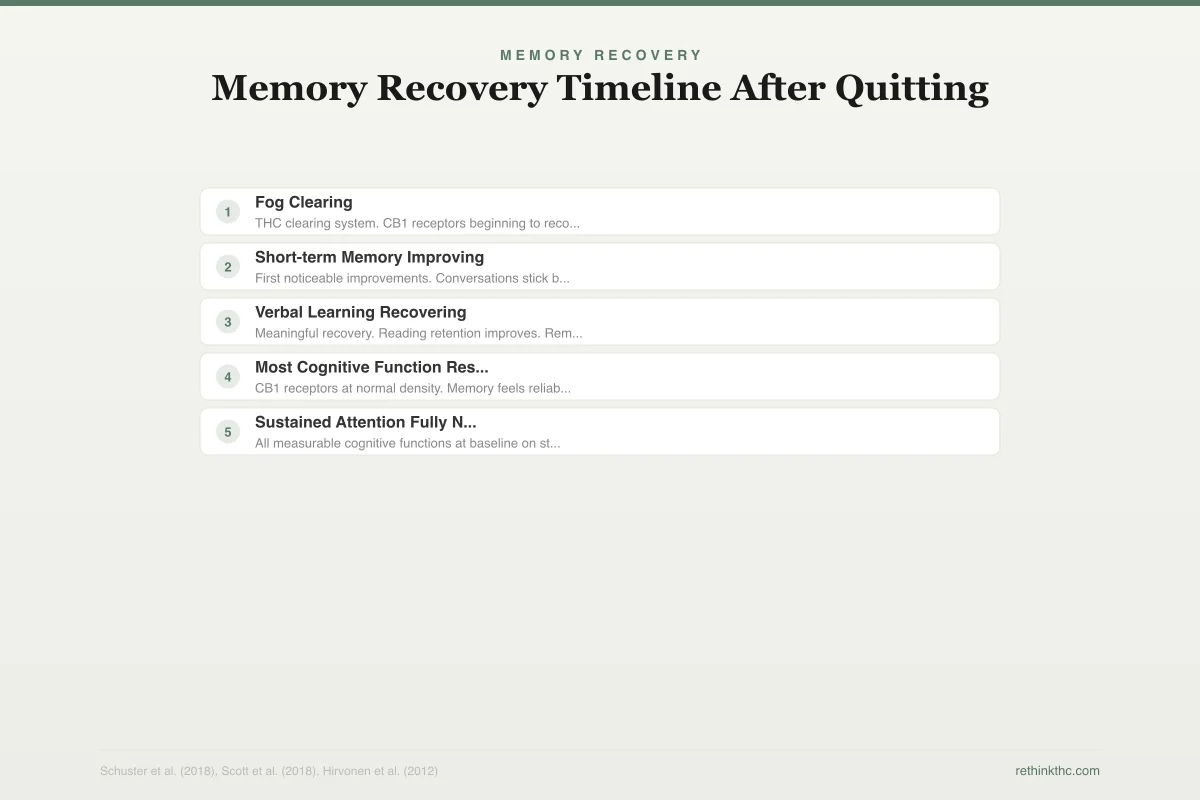
Days 1 to 3. THC is clearing your system and CB1 receptors are beginning to recover. You may still feel foggy, and memory may not feel noticeably better yet. This is the phase where brain fog tends to be most intense. Your brain is in the earliest stage of rebuilding.
Days 3 to 7. Some people notice the first flickers of improvement. You might find yourself recalling a detail from earlier in the day that you normally would have lost. These small wins are easy to miss because other withdrawal symptoms are peaking during this same window, which makes the cognitive improvements harder to appreciate.
Days 7 to 14. Meaningful improvement for most people. Reading retention gets better. Conversations stick. You remember what you needed at the grocery store without a list. People in cannabis recovery communities frequently describe this phase as "the lights coming back on."
Days 14 to 28. Significant memory recovery. CB1 receptors are approaching normal density. Most people report that their memory feels reliable again. The difference between week one and week four is often dramatic enough that people describe it as one of the most noticeable benefits of quitting weed.
Beyond 28 days. For very heavy, long-term users, subtle improvements may continue past the one-month mark as the brain continues fine-tuning. Research on how long it takes to feel normal after quitting suggests full cognitive normalization typically occurs within one to three months for most people.
Hippocampal Neurogenesis: Your Brain Grows New Cells
One of the more encouraging findings in this area involves neurogenesis, the process of growing new brain cells. For a long time, scientists believed adult brains could not produce new neurons. That turned out to be wrong. The hippocampus is one of the few brain regions where new neurons are generated throughout life.
Memory Recovery
Memory Recovery Timeline After Quitting
Cognitive function returns on a predictable curve for most adult users
THC clearing system. CB1 receptors beginning to recover. Brain fog still intense but starting to lift.
First noticeable improvements. Conversations stick better. Can follow a plot while reading or watching TV.
Meaningful recovery. Reading retention improves. Remember names and details from earlier in the day.
CB1 receptors at normal density. Memory feels reliable again. "Lights coming back on" commonly reported.
All measurable cognitive functions at baseline on standardized tests. Subtle sharpening may continue.
Adolescent-onset users may have residual deficits beyond 72 days. Meier et al. (2012) found persistent effects specific to those who began heavy use as teenagers.
Schuster et al. (2018), Scott et al. (2018), Hirvonen et al. (2012)
 View as image ↗
A 2005 study by Jiang and colleagues, published in the Journal of Clinical Investigation, found that certain cannabinoids can actually stimulate hippocampal neurogenesis in animal models. However, the picture with THC specifically is more complicated. Chronic THC exposure appears to suppress neurogenesis in the hippocampus, while cessation allows the process to resume.
Suliman and colleagues published a 2018 review in Frontiers in Pharmacology that examined the relationship between cannabinoids and hippocampal neurogenesis. Their analysis suggested that while chronic THC use impairs the birth of new hippocampal neurons, this effect reverses with abstinence.
This means that when you quit cannabis, your hippocampus is not only rebuilding CB1 receptors. It is also resuming the production of new neurons. Your brain is doing two kinds of repair work simultaneously. This dual recovery process may explain why many people describe a sense of sharpening clarity that continues to improve well beyond the first month.
Why Memory Is the Benefit People Notice Most
In surveys and online recovery communities, improved memory consistently ranks among the top benefits people report after quitting cannabis. This tracks with the science. Memory impairment is one of the most measurable effects of chronic use, which means the reversal of that impairment is one of the most noticeable experiences of recovery.
People describe remembering names again. Following complex conversations without losing the thread. Retaining what they read. Feeling like their mind is actually recording their life instead of letting it pass through unprocessed. For people who used heavily for years, this can feel like gaining a capability they forgot they had.
The Exception: Adolescent Use
One area where the recovery picture is less clear involves people who began using cannabis heavily during adolescence. The hippocampus, like the prefrontal cortex, continues developing into the mid-20s. Exposure to regular THC during this developmental window may affect the hippocampus in ways that are harder to fully reverse.
Recovery Strategies
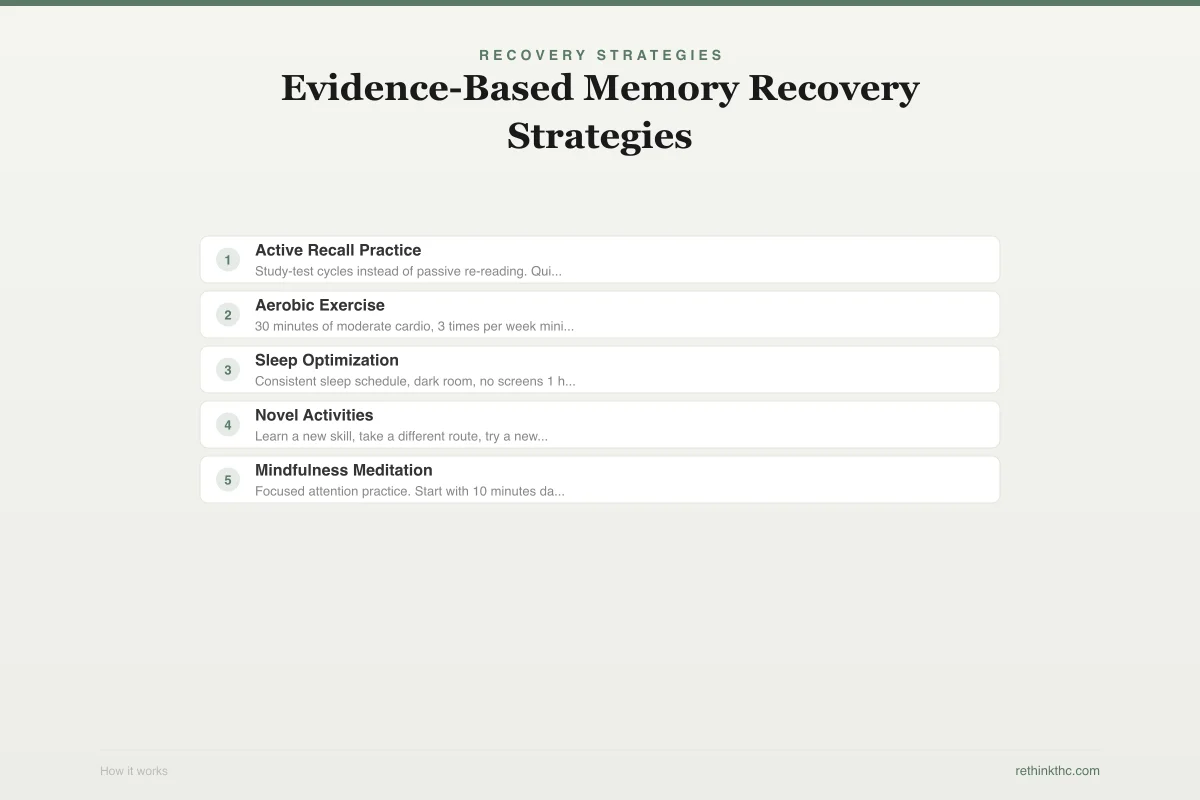
Evidence-Based Memory Recovery Strategies
Active steps to accelerate cognitive recovery after quitting
Active Recall Practice
StrongStudy-test cycles instead of passive re-reading. Quiz yourself on material, use flashcards, summarize from memory.
How it works
Strengthens retrieval pathways — the act of recalling builds stronger memory traces than re-exposure
Recommended
Daily, 15-20 min sessions
Aerobic Exercise
Strong30 minutes of moderate cardio, 3 times per week minimum. Running, cycling, swimming, or brisk walking.
How it works
Increases BDNF (brain-derived neurotrophic factor), which promotes neurogenesis in the hippocampus
Recommended
3x/week, 30 min moderate intensity
Sleep Optimization
StrongConsistent sleep schedule, dark room, no screens 1 hour before bed. Aim for 7-9 hours.
How it works
Memory consolidation happens during deep sleep — new memories transfer from hippocampus to cortex
Recommended
Nightly — consistency matters more than duration
Novel Activities
ModerateLearn a new skill, take a different route, try a new hobby. Anything that challenges your brain in unfamiliar ways.
How it works
Stimulates neuroplasticity — new neural connections form when the brain encounters novel challenges
Recommended
Weekly — even small novelty counts
Mindfulness Meditation
ModerateFocused attention practice. Start with 10 minutes daily. Apps like Headspace or Calm provide guided sessions.
How it works
Trains sustained attention — the cognitive function most measurably improved by meditation practice
Recommended
Daily, 10-20 min
Based on cognitive rehabilitation and neuroplasticity research
 View as image ↗
Meier and colleagues published a 2012 study in PNAS[3] that followed over 1,000 people from birth to age 38. They found that persistent cannabis use beginning in adolescence was associated with measurable IQ decline and cognitive impairment that did not fully resolve after quitting. The effect was specific to adolescent-onset use. People who began using as adults did not show the same persistent deficits.
This does not mean that people who started young cannot experience significant memory improvement after quitting. They can and do. The research suggests that the ceiling for recovery may be somewhat lower for adolescent-onset users compared to adult-onset users. But improvement is still the consistent finding, not stagnation.
When to Seek Professional Help
If you have quit cannabis and your memory issues are severe enough to interfere with your ability to work, maintain relationships, or handle daily responsibilities, consider talking to a healthcare provider. Memory problems can also be related to depression, anxiety, sleep disorders, or other conditions that may need their own treatment. If you are experiencing thoughts of self-harm, reach out to a healthcare provider or call SAMHSA's National Helpline at 1-800-662-4357.
Your Memory Is Waiting for You
The fear that cannabis has permanently damaged your memory is one of the most common worries people carry when they decide to quit. The science does not support that fear for the vast majority of users. Your hippocampus is remarkably resilient. CB1 receptors recover, neurogenesis resumes, and the cognitive systems that felt broken start working again on a timeline measured in days and weeks, not years.
Understanding the neuroscience of weed memory loss recovery gives you something powerful: the knowledge that what you are experiencing is temporary, that the recovery process is already underway the moment you stop, and that the memory you had before cannabis is still in there, waiting for your brain to finish rebuilding the hardware it needs to access it.
The Bottom Line
THC impairs memory by binding to CB1 receptors in the hippocampus, which has one of the highest CB1 receptor concentrations in the brain. Bhattacharyya et al. (2012, JAMA Psychiatry) showed via brain imaging that THC disrupts hippocampal activation during memory tasks. Acute effects (anterograde memory impairment while high) are dose-dependent and temporary. Chronic effects involve CB1 receptor downregulation that impairs memory even when not actively high, as Solowij et al. (2002, JAMA) documented correlating with duration of use. Recovery is well-supported: Hirvonen et al. (2012, Molecular Psychiatry) showed CB1 receptors begin recovering within 2 days and normalize by day 28. Scott et al.'s 2018 JAMA Psychiatry meta-analysis of 69 studies found significant cognitive improvement within 72 hours of abstinence, with continued recovery over weeks. The hippocampus also resumes neurogenesis (new neuron production) after cessation. The exception is adolescent-onset use: Meier et al. (2012, PNAS) found persistent IQ decline specific to those who began heavy use during brain development, though improvement still occurs.
Does weed permanently damage your memory?
For the vast majority of adult users, no. Research consistently shows that cannabis-related memory impairment is reversible after quitting. A 2018 meta-analysis in JAMA Psychiatry[2] found that cognitive deficits including memory show significant recovery starting within 72 hours of abstinence, with continued improvement over weeks. CB1 receptors in the hippocampus return to normal levels by approximately 28 days.
How long does it take for memory to come back after quitting weed?
Most people notice meaningful memory improvement within 1 to 2 weeks of quitting, with significant recovery by 28 days. Brain imaging studies show that CB1 receptors in the hippocampus begin recovering within 2 days and reach normal levels by about 4 weeks.[1] Heavy, long-term users may continue to experience subtle improvements for 1 to 3 months after quitting.
Why can't I remember things when I'm high?
THC binds to CB1 receptors in your hippocampus, the brain region responsible for forming new memories. This temporarily suppresses your ability to encode new information, a process called anterograde memory impairment. The effect is dose-dependent (more THC means worse memory) and temporary, resolving as THC clears your system.
Does weed kill brain cells?
THC does not destroy brain cells. It causes CB1 receptor downregulation, meaning your brain reduces the number of available receptors in response to chronic overstimulation. This process is reversible. Research also suggests that chronic THC use may temporarily suppress the growth of new neurons in the hippocampus (neurogenesis), but this process resumes after quitting.
Is memory loss from edibles worse than from smoking?
The memory impairment mechanism is the same regardless of how THC enters your body, since it all ends up binding to CB1 receptors in the hippocampus. However, edibles can produce stronger and longer-lasting memory effects because THC is converted to 11-hydroxy-THC in the liver, a metabolite that crosses the blood-brain barrier more efficiently. The memory impairment lasts longer per session but is still temporary.
Is memory recovery worse for people who started smoking weed as teenagers?
Potentially. A landmark longitudinal study by Meier et al. (2012) following over 1,000 people from birth to age 38 found that persistent cannabis use beginning in adolescence was associated with IQ decline and cognitive impairment that did not fully resolve after quitting.[3] This effect was specific to adolescent-onset use; adult-onset users did not show the same persistent deficits. The hippocampus continues developing into the mid-20s, so THC exposure during that window may affect it in ways that are harder to fully reverse. However, significant improvement still occurs — the ceiling for recovery may simply be somewhat lower.
Sources & References
- 1RTHC-00573·Hirvonen, Jussi et al. (2012). “Daily Cannabis Use Was Linked to Fewer CB1 Receptors. A Month Without Brought Them Back..” Molecular Psychiatry.Study breakdown →PubMed →↩
- 2RTHC-01832·Scott, J. Cobb et al. (2018). “Cannabis Cognitive Effects Are Small and Largely Disappear After 72 Hours of Abstinence.” JAMA Psychiatry.Study breakdown →PubMed →↩
- 3RTHC-00591·Meier, Madeline H. et al. (2012). “From Teen Years to 38: Heavy, Long-Term Cannabis Use Tracked With Lower Cognitive Scores.” Proceedings of the National Academy of Sciences (PNAS).Study breakdown →PubMed →↩