Balanced Cannabis Science
8-Point IQ Drop
A landmark study tracking 1,037 people from birth to age 38 found that persistent cannabis use starting in adolescence was linked to an 8-point IQ drop that did not fully reverse after quitting.
Meier et al., PNAS, 2012
3 to 4 weeks
Teen cannabis users showed problems with memory, attention,
17%
The teen dependence rate (about 17%) is nearly double the
Why the Adolescent Brain Is Different
covered in detail
Meier et al., PNAS, 2012
 View as image ↗
If you only read one thing
A teenage brain responds to cannabis differently than an adult brain — and not in a small way. Your brain is still wiring itself until around age 25, and regular THC exposure during that window can leave marks that don't fully erase when you quit. The Dunedin study, which followed over 1,000 people for 38 years, found an 8-point IQ drop in persistent teen users that didn't bounce back. Occasional use is a different story. But daily high-potency use during the teen years is where the real risk lives.
The conversation around teenagers and cannabis tends to land in one of two places. Either it is dismissed entirely ("it's just weed, relax") or it is wrapped in the kind of fear-based messaging that teenagers see through immediately and then ignore. Neither approach is helpful. What is helpful is looking at what the research actually shows about cannabis and the developing brain, because the evidence here is genuinely different from what we see in adults. Not because of moral panic, but because of neurobiology.
Key Takeaways
- Your brain keeps developing until about age 25, and the prefrontal cortex — responsible for judgment, planning, and impulse control — finishes last
- A landmark study tracking 1,037 people from birth to age 38 found that persistent cannabis use starting in adolescence was linked to an 8-point IQ drop that did not fully reverse after quitting
- Teen cannabis users showed problems with memory, attention, and planning that stuck around even after 3 to 4 weeks of abstinence
- Daily use of high-potency cannabis carries a fivefold higher risk of psychosis, with younger users at particular risk
- Today's cannabis is roughly three times stronger than what was available in the mid-1990s, so older research may underestimate the risks of current products
- The teen dependence rate (about 17%) is nearly double the general population rate (9%) — because the developing brain is both more sensitive to THC and less likely to fully recover from persistent exposure
Fact Check
'I smoked weed as a kid and I'm fine' vs. the research
The claim
“Adults who used cannabis as teens are living proof that teen weed use is harmless”
Common adult reassurance, especially from people who feel successful in life
What research shows
MisleadingThe Dunedin study controlled for individual outcomes and still found a population-level 8-point IQ decline in persistent adolescent-onset users. And the weed most adults smoked as teenagers averaged 3–4% THC — a fraction of today's 20–30% flower and 60–90% concentrates.
Plenty of people who used occasionally as teens are fine. The research isn't about them — it's about persistent, regular use during the years the brain is still wiring itself. Comparing casual 1990s use to daily modern vape use is comparing two very different exposures.
Meier et al. (2012) PNAS; ElSohly et al. (2016) Biological Psychiatry
Why the Adolescent Brain Is Different
Your brain is not finished developing at 18. It is not finished at 21 either. The current scientific consensus, supported by longitudinal neuroimaging studies, is that the human brain continues developing until approximately age 25. The last region to fully mature is the prefrontal cortex, which handles executive functions like planning, impulse control, risk assessment, and the ability to weigh long-term consequences against short-term rewards.
Neurodevelopment
Brain Development vs. THC Vulnerability by Age
The same substance carries different risks at different developmental stages — this is neuroscience, not a double standard
Major synaptic pruning + PFC construction
Myelination accelerating in frontal lobes
PFC still maturing; judgment improving
Final PFC connections being insulated
Development complete; deficits largely reversible
Teen vs. adult outcomes
Meier (2012) · Volkow (2014) · Di Forti (2019)
Brain Development and THC VulnerabilityThis matters for cannabis because the developing brain is fundamentally more plastic than the adult brain. Neuroplasticity (the brain's ability to reorganize and form new connections) is at its peak during adolescence. This is why teenagers learn languages faster, pick up instruments more easily, and adapt to new environments more quickly than adults. But the same plasticity that makes the adolescent brain a rapid learner also makes it more vulnerable to disruption.
THC works by binding to CB1 receptors in the endocannabinoid system. These receptors are densely concentrated in exactly the brain regions that are still actively developing during adolescence: the prefrontal cortex, the hippocampus (critical for memory formation), and the amygdala (involved in emotional processing). When a substance repeatedly activates receptors in brain regions that are still being wired, it has the potential to alter the trajectory of that wiring in ways that do not apply to a brain that has already finished the job.
A 2014 review by Volkow and colleagues published in the New England Journal of Medicine identified adolescent-onset use as a distinct risk category. The review noted that approximately 17% of people who begin using cannabis as teenagers develop dependence, compared to about 9% of the general population of people who ever try it. The developing brain is not just more sensitive to cannabis. It is more likely to develop a problematic relationship with it.
| Risk Factor | Adolescent Users | Adult Users |
|---|---|---|
| Dependence rate | ~17% of those who start as teens | ~9% of general population |
| IQ impact | Up to 8-point decline (not fully reversible) | No significant IQ decline documented |
| Cognitive recovery | Deficits persist after 3-4 weeks abstinence | Most deficits resolve within 72 hours |
| Psychosis risk | Higher vulnerability, especially with genetic predisposition | Lower but still elevated with daily high-potency use |
| Brain region vulnerability | Prefrontal cortex, hippocampus still developing | These regions fully developed |
| THC potency context | Today's products 3x stronger than research era | Same potency concern applies |
The Dunedin Study: Following 1,037 People for 38 Years
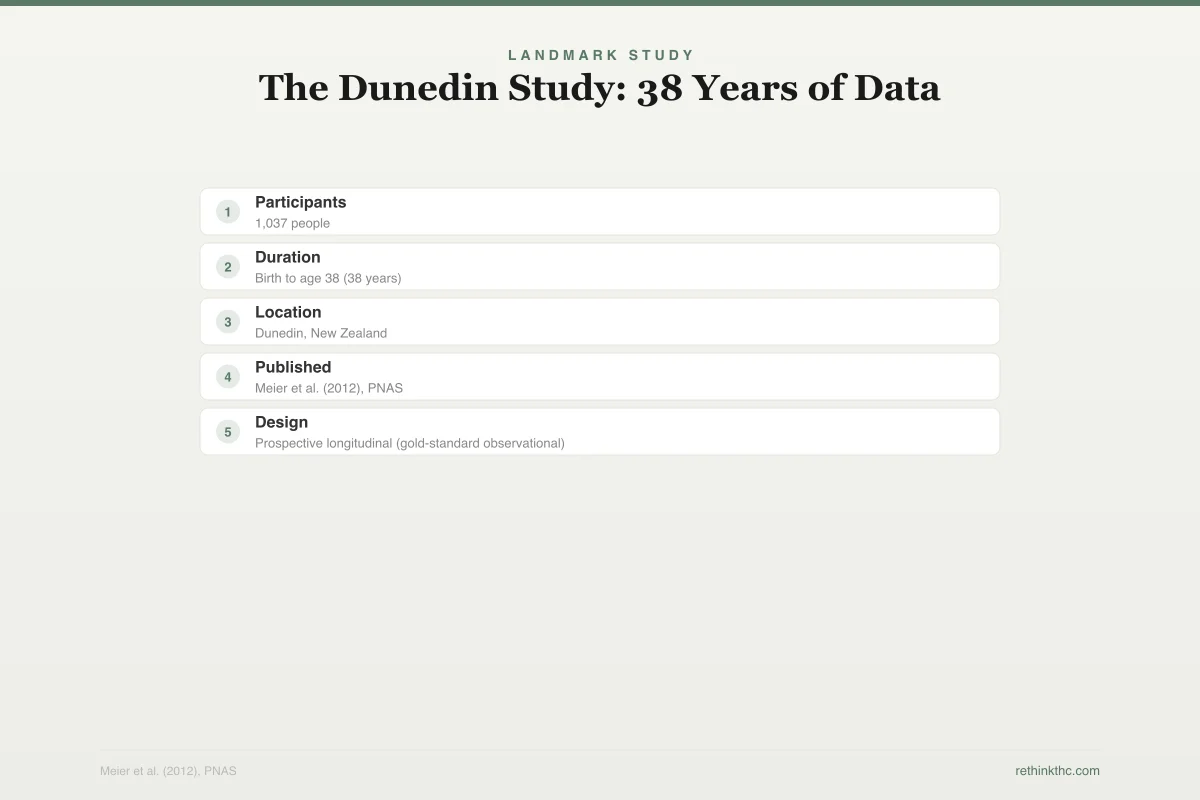
The single most cited study on cannabis and adolescent brain development is the Meier 2012 study published in the Proceedings of the National Academy of Sciences.[1] It followed 1,037 individuals born in Dunedin, New Zealand, from birth to age 38, testing their cognitive abilities at multiple points throughout their lives.
The findings were striking. Participants who began using cannabis regularly during adolescence and continued persistent use into adulthood showed an average 8-point decline in IQ from childhood to midlife. To put that in perspective, 8 IQ points is roughly the difference between being in the 50th percentile and the 29th percentile. It is a meaningful shift in cognitive capacity.
Several details from this study are important. First, the IQ decline was specific to adolescent-onset users. People who began using cannabis as adults did not show the same pattern. Second, the decline was dose-dependent. More persistent use was associated with greater decline. Third, and this is the finding that gets the most attention, the IQ loss was not fully restored even after participants reduced or stopped their use for at least one year. Other cognitive impairments in adults tend to resolve with abstinence. This one, for adolescent-onset persistent users, showed lasting effects.
The study controlled for education, childhood socioeconomic status, and other substance use. The researchers also addressed the possibility that pre-existing cognitive differences could explain the results, and found that the decline occurred after cannabis use began, not before. This is not proof of causation in the absolute sense, but it is as close as longitudinal observational research gets.
Meier et al. (2012) · Proceedings of the National Academy of Sciences (PNAS)
- Population
- 1,037 people born in Dunedin, New Zealand, tracked from birth to age 38
- Intervention
- Cognitive testing at multiple life stages alongside tracked cannabis use patterns
- Comparator
- Non-users, adult-onset users, and occasional users within the same birth cohort
- Finding
- Persistent adolescent-onset cannabis users showed an average 8-point IQ decline that did not fully recover after a year of reduced use — adult-onset users did not
positive Observational study (not a randomized trial), but controls for socioeconomic status, education, and other substances make this the strongest available evidence
Meier et al. (2012), PNAS
Cognitive Deficits That Persist in Adolescent Users
A 2009 study by Jacobus and colleagues, published in Pharmacology, Biochemistry and Behavior, examined adolescent cannabis users after 3 to 4 weeks of monitored abstinence. This is important because it removes the "they were just tested while high" objection. These were teens who had not used cannabis for nearly a month.
Landmark Study
The Dunedin Study: 38 Years of Data
Adolescent-onset cannabis use was associated with lasting IQ decline
1,037 people
Participants
Birth to age 38 (38 years)
Duration
Dunedin, New Zealand
Location
Meier et al. (2012), PNAS
Published
Prospective longitudinal (gold-standard observational)
Design
Adolescent-Onset Persistent Users
-8 IQStarted before 18, used persistently into adulthood
Not fully reversed even after 1+ year reduced use
Adult-Onset Users
0 IQStarted using after age 18
No significant IQ decline observed
8 IQ points is the difference between the 50th and 29th percentile — a meaningful shift in cognitive capacity that was dose-dependent and specific to adolescent-onset use
Meier et al. (2012), PNAS
 View as image ↗
Even after that period of abstinence, the adolescent cannabis users showed deficits in memory, attention, and planning compared to non-using peers. In adults, a major meta-analysis by Scott and colleagues published in 2018 in JAMA Psychiatry (covering 69 studies) found[4] that most cognitive deficits from cannabis use resolve within 72 hours of stopping. The adolescent data tells a different story. Recovery appears to be slower, less complete, or both.
This does not mean every teenager who smokes weed will have permanent cognitive damage. The Jacobus study looked at regular users, not someone who tried it once at a party. But it does suggest that the "just stop and you will be fine" reassurance that applies reasonably well to adults may not fully apply to adolescents whose brains were still developing during the period of use.
The Psychosis Question
The relationship between cannabis and psychosis is one of the most debated topics in cannabis research. A 2019 study by Di Forti and colleagues, published in The Lancet Psychiatry, provided[2] some of the clearest data to date.
The study found that daily cannabis use was associated with approximately a threefold increased risk of a first episode of psychosis compared to people who had never used cannabis. For daily use of high-potency cannabis (defined as THC content above 10%), the risk jumped to approximately fivefold. Importantly, the study found no significant association between psychosis and less-than-weekly cannabis use.
Several points about this data matter for the adolescent conversation. First, the developing brain appears to be more vulnerable to psychotic experiences from cannabis than the mature brain. Second, the potency matters enormously (more on this below). Third, this is a risk increase, not a guarantee. The baseline risk of psychosis in the general population is relatively low (around 1-3%), so even a fivefold increase still means the majority of daily high-potency users will not develop a psychotic disorder. But for the minority who do, the consequences are severe and potentially life-altering.
If there is a family history of schizophrenia, bipolar disorder, or other psychotic disorders, the risk calculation changes significantly. Genetic vulnerability combined with adolescent cannabis use is a particularly concerning combination that the research consistently flags.
Safety
CriticalFamily history of psychosis + teen high-potency use = highest-risk combo
Concern
Daily use of high-potency cannabis (THC >10%) in adolescence is associated with a roughly 5x increase in first-episode psychosis risk. When there's also a family history of schizophrenia or bipolar disorder, that risk compounds significantly.
What the research says
This is the one scenario where the evidence crosses from 'be thoughtful' to 'seriously rethink this.' Psychosis triggered this way can be life-altering and doesn't always resolve when cannabis stops.
Particularly relevant for: Teens and young adults with any family history of schizophrenia, bipolar disorder, or psychotic depression
What to do
If this is you or someone you love, the safest call is to avoid high-potency cannabis entirely during the teens and early 20s. Talk to a mental health provider about family risk before starting or continuing use.
Di Forti et al. (2019), The Lancet Psychiatry
The Potency Problem
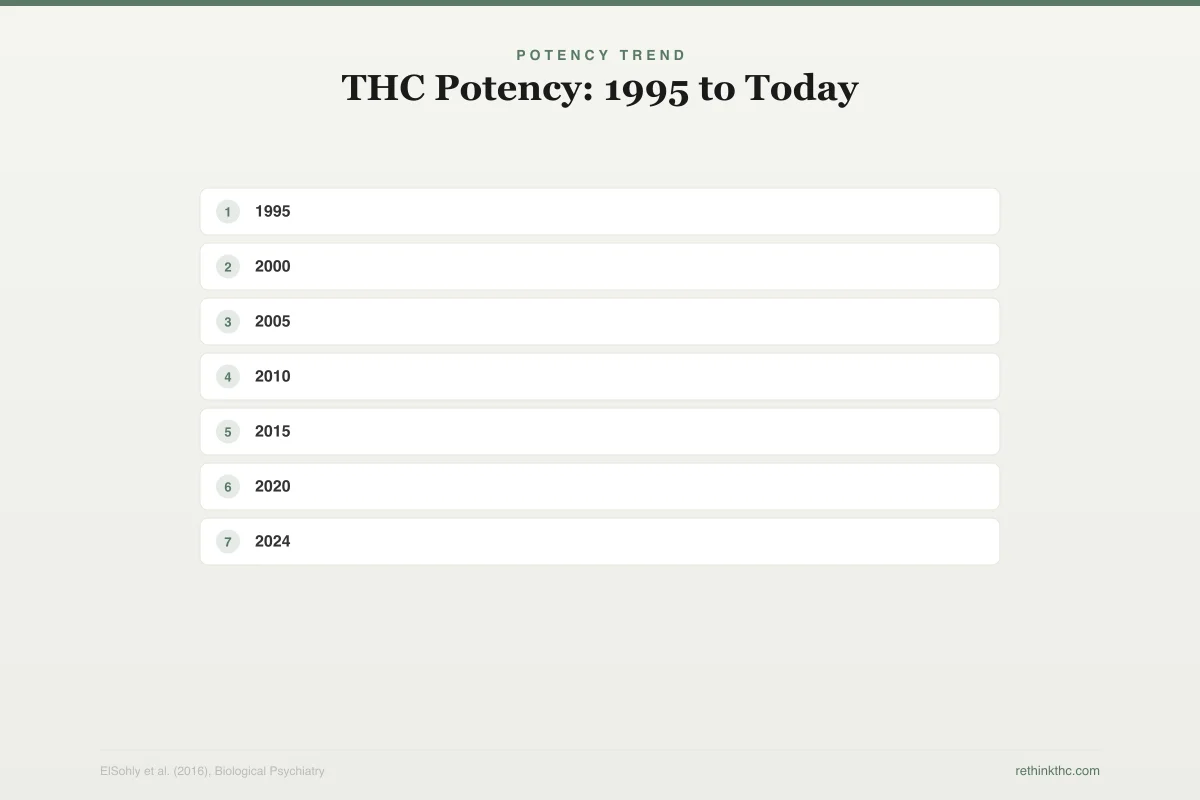
Much of the foundational research on cannabis and the developing brain was conducted with cannabis that looked very different from what is available today. A 2016 analysis by ElSohly and colleagues, published in Biological Psychiatry, documented[3] that average THC content in confiscated cannabis samples roughly tripled between 1995 and 2014, rising from approximately 4% to approximately 12%. Concentrates, which were not widely available during most of the research period, can contain 60 to 90% THC.
Age-Based Risk
Same Cannabis, Different Brains: Teen vs. Adult Risk
The developing brain responds differently to THC than the mature brain
Cognitive Decline
-8 IQ points (persistent use)
No significant decline
Psychosis Risk
3–5x increased risk
~1.4x increased risk
Addiction Rate
~17% develop dependence
~9% develop dependence
White Matter Changes
Measurable structural changes
Minimal structural impact
Recovery After Quitting
Partial — deficits persist 3-4+ weeks
Full — resolves within ~72 hours
The same cannabis use carries fundamentally different risks depending on whether the brain has finished developing — and there is no way to know in advance how an individual will be affected
Meier et al. (2012), Di Forti et al. (2019), Scott et al. (2018)
 View as image ↗
At the same time, CBD content (which may have neuroprotective properties and partially counteracts some of THC's effects) decreased. The ratio of THC to CBD shifted dramatically, meaning today's cannabis delivers a more potent, less balanced neurochemical hit than the cannabis studied in most of the research.
This is relevant because studies like the Dunedin study (Meier 2012) and the Jacobus 2009 study were conducted with cannabis that averaged well under 10% THC. If adolescent brains showed vulnerability at those potency levels, the implications for today's 20-30% THC flower and concentrate products are concerning. The research has not had time to catch up with the current potency landscape, which means existing findings may actually underestimate the risks of modern cannabis products on developing brains.
What About Cognitive Recovery?
The picture here is mixed, and honesty about that matters.
The Scott 2018 meta-analysis in JAMA Psychiatry is the most comprehensive review of cannabis and cognition to date, synthesizing 69 studies. Its headline finding was encouraging: in the general population of cannabis users, most cognitive deficits remediate after approximately 72 hours of abstinence. This suggests that for many users, the cognitive fog associated with regular use is a temporary state, not a permanent change.
However, the adolescent data complicates this optimistic picture. The Jacobus 2009 study found persistent deficits after 3 to 4 weeks of abstinence in teen users. The Dunedin study found incomplete IQ recovery after a year or more of reduced use in adolescent-onset persistent users. The pattern that emerges is that adult brains have a stronger capacity for cognitive recovery than adolescent brains that were exposed during development.
This makes biological sense. If cannabis disrupts the wiring process during a critical developmental window, some of that disruption may be structural rather than functional. An adult brain that has already been wired can recover from temporary chemical interference. An adolescent brain that was being wired under the influence of regular THC exposure may end up with a different blueprint.
To be clear, this is not a certainty. The research shows statistical trends, not individual destinies. Some adolescent users will recover fully. Others will not. The problem is that there is no way to know in advance which category you fall into, and by the time the answer is clear, the developmental window has closed.
Evidence Review
Where the evidence stands
Cell & Lab Studies
CB1 receptor density mapped in adolescent brain regions still under development
Animal Studies
Adolescent rodent THC exposure produces lasting behavioral and structural effects not seen in adult-exposed rodents
Case Reports
Extensive clinical documentation of adolescent-onset cannabis-related cognitive and psychiatric outcomes
Small Human Trials
Jacobus 2009 and similar studies of teen users during extended monitored abstinence
Large Randomized Trial
Randomizing teens to cannabis exposure is ethically impossible — can't be done
Meta-Analysis
Scott 2018 (69 studies) plus Dunedin's 38-year longitudinal data cover thousands of individuals
The evidence for adolescent-specific cannabis risk is strong across cell, animal, and large longitudinal human studies. The one tier that will never exist is a randomized trial — you can't ethically assign teenagers to smoke weed. What we have instead is the next best thing: a cohort study that followed real kids for 38 years.
Meier et al. 2012; Jacobus et al. 2009; Scott et al. 2018; aggregate adolescent cannabis literature
The "It's Just Weed" Problem
Perhaps the most significant risk factor for adolescent cannabis use is not the THC itself but the cultural minimization of its potential impact. When adults say "I smoked weed as a kid and I'm fine," they are committing two errors. First, they are using their individual experience to dismiss population-level data. Second, the weed they smoked as a kid was likely one-third to one-quarter the potency of what is available today.
Potency Trend
THC Potency: 1995 to Today
Average THC content has roughly tripled — concentrates reach 60–90%
1995
2000
2005
2010
2015
2020
2024
Vape cartridges, dabs, and wax — 10–20x stronger than 1995 cannabis
Most adolescent brain research was done on 4–8% THC cannabis. Current products are 3–10x stronger — existing findings may underestimate risks of modern cannabis.
ElSohly et al. (2016), Biological Psychiatry
 View as image ↗
The normalization of cannabis use, accelerated by legalization in many states, has created an environment where teenagers are less likely to perceive risk. This is not an argument against legalization, which has its own legitimate policy rationale. It is an observation that reduced risk perception in a population whose brains are genuinely more vulnerable creates a specific public health concern that deserves honest conversation rather than either panic or dismissal.
Understanding whether cannabis is addictive and what the science shows about dependence is particularly important for younger users, because the rate of dependence among adolescent-onset users (approximately 17%) is nearly double the general population rate.
What This Means in Practice
If you are a teenager currently using cannabis, this article is not telling you that you are doomed. It is telling you that your brain is in a unique developmental stage that makes it more sensitive to THC's effects, and that the research on adolescent use is more concerning than the research on adult use. The decisions you make now carry different weight than the same decisions made at 30.
If you are a parent, the most effective approach is not scare tactics (which teenagers are calibrated to reject) but honest conversation about the specific reasons adolescent use carries different risks. The data in this article is not exaggerated. It does not need to be. A potential 8-point IQ decline from persistent adolescent use, cognitive deficits that persist after abstinence, and increased psychosis risk with high-potency daily use are concerning enough on their own terms.
For anyone who has already been using cannabis during their teenage years and is thinking about stopping, the sooner the better. The brain retains significant plasticity into the mid-twenties, and there is evidence that dopamine and reward pathways can recover with sustained abstinence. The benefits of quitting apply to everyone, but they may be especially meaningful for younger users whose brains still have developmental runway ahead of them.
When to Seek Professional Help
If you or a teenager you know is using cannabis daily, struggling to stop despite wanting to, or experiencing cognitive changes, mood instability, paranoia, or detachment from reality, professional support can make a real difference. These are not signs of weakness. They are signals that the brain is responding to a chemical exposure in ways that benefit from guided intervention.
A healthcare provider experienced with adolescent substance use can help assess the situation without judgment and provide strategies tailored to the developing brain. Family involvement, when it is supportive rather than punitive, consistently improves outcomes in the research.
SAMHSA's National Helpline is available at 1-800-662-4357. It is free, confidential, and available 24 hours a day, 7 days a week.
The Bottom Line
The human brain continues developing until approximately age 25, with the prefrontal cortex finishing last. This extended developmental window makes the adolescent brain more vulnerable to cannabis in specific, measurable ways. The Dunedin study (Meier 2012), tracking 1,037 individuals from birth to age 38, found that persistent adolescent-onset cannabis use was associated with an 8-point IQ decline that did not fully reverse after quitting. Adolescent users showed cognitive deficits in memory, attention, and planning that persisted after 3 to 4 weeks of abstinence. Daily high-potency cannabis use carries a fivefold increased psychosis risk, with younger users at particular vulnerability. THC potency has roughly tripled since the mid-1990s, meaning existing research may underestimate risks for current products. The adolescent dependence rate (17%) is nearly double the general population rate.
At what age is it safer to use cannabis?
The research consistently points to age 25 as the approximate completion point for brain development, particularly in the prefrontal cortex. Use before this age carries greater risk for cognitive and structural impacts than use after. The dependence rate for adolescent-onset users is approximately 17%, compared to 9% for the general population. While there is no age at which cannabis use is risk-free, the data clearly shows that younger use is associated with greater vulnerability.
Can the brain recover from teenage cannabis use?
It depends on the extent and duration of use. A 2018 meta-analysis of 69 studies found that most cannabis-related cognitive deficits resolve within 72 hours of abstinence in the general population. However, a study tracking adolescent users found persistent deficits after 3 to 4 weeks of abstinence. The Dunedin study found that IQ decline from persistent adolescent-onset use was not fully restored after a year or more of reduced use. Earlier cessation and less total exposure are associated with better recovery prospects.
Does cannabis cause permanent brain damage in teenagers?
The research does not support the term "brain damage" in the way most people use it, but it does show lasting effects. Persistent adolescent-onset cannabis use has been associated with measurable IQ decline, persistent cognitive deficits in memory and attention, and structural changes in brain imaging studies. "Permanent" is difficult to establish definitively, but "not easily reversed" is supported by the current evidence, particularly for heavy, early-onset, long-duration use.
Is today's cannabis more dangerous for teenagers than older cannabis?
Average THC content roughly tripled between 1995 and 2014, from about 4% to about 12%, and many current products are considerably stronger. Most of the research on adolescent cannabis effects was conducted with lower-potency cannabis. Higher THC content means more aggressive CB1 receptor downregulation and greater neurochemical impact during the developmental window. While direct comparisons are limited, the potency increase is a legitimate reason for increased concern.
How can I talk to my teenager about cannabis without pushing them away?
Lead with curiosity rather than lectures. Acknowledge that cannabis is normalized in their social environment and that dismissing it entirely will cost you credibility. Share specific research findings (like the Dunedin IQ data or the potency increases) rather than vague warnings. Focus on the unique vulnerability of the developing brain rather than moral arguments. Ask what they have heard and what their friends think. Keep the conversation ongoing rather than a single "big talk." Teenagers respond better to being treated as capable of understanding evidence than to being told what to do.
Does occasional cannabis use during the teen years carry the same risks as daily use?
No. The research consistently shows dose-dependent effects. The Dunedin study's 8-point IQ decline was associated with persistent, regular use, not occasional experimentation. The Di Forti 2019 psychosis study found no significant association between psychosis and less-than-weekly use. While occasional use is not risk-free during brain development, the data clearly shows that frequency and duration of use are the primary drivers of adolescent-specific risks. Daily use of high-potency products represents the highest risk category by a substantial margin.
Sources & References
- 1RTHC-00591·Meier, Madeline H. et al. (2012). “From Teen Years to 38: Heavy, Long-Term Cannabis Use Tracked With Lower Cognitive Scores.” Proceedings of the National Academy of Sciences (PNAS).Study breakdown →PubMed →↩
- 2RTHC-02010·Di Forti, Marta et al. (2019). “Daily High-Potency Cannabis Use and Psychosis Risk: The Largest European Study Drew a Direct Line.” The Lancet Psychiatry.Study breakdown →PubMed →↩
- 3RTHC-01144·ElSohly, Mahmoud A. et al. (2016). “U.S. Cannabis Potency Tripled Over Two Decades While CBD Nearly Vanished.” Biological Psychiatry.Study breakdown →PubMed →↩
- 4RTHC-01832·Scott, J. Cobb et al. (2018). “Cannabis Cognitive Effects Are Small and Largely Disappear After 72 Hours of Abstinence.” JAMA Psychiatry.Study breakdown →PubMed →↩