Recovery
31 Days
Sober October gives you a full 31 days off weed, enough time for your CB1 receptors to normalize and your brain to show you what baseline actually feels like.
Molecular Psychiatry, 2004
31 days
Sober October gives you a full 31 days off weed — enough
72 hours
A 2018 meta-analysis in JAMA Psychiatry reviewing 69
Why 31 Days Is the Right Number
covered in detail
Molecular Psychiatry, 2004
 View as image ↗
Sober October started as a challenge centered on alcohol. But a growing number of people are using it as a framework for stepping away from weed, and the timing actually works in their favor. Thirty-one days of Sober October for weed lines up almost perfectly with the neuroscience of cannabinoid receptor recovery, making it one of the most effective structured breaks you can take. This guide covers what to expect each week, how to handle the parts that are genuinely hard, and what has actually changed in your brain by November 1.
Key Takeaways
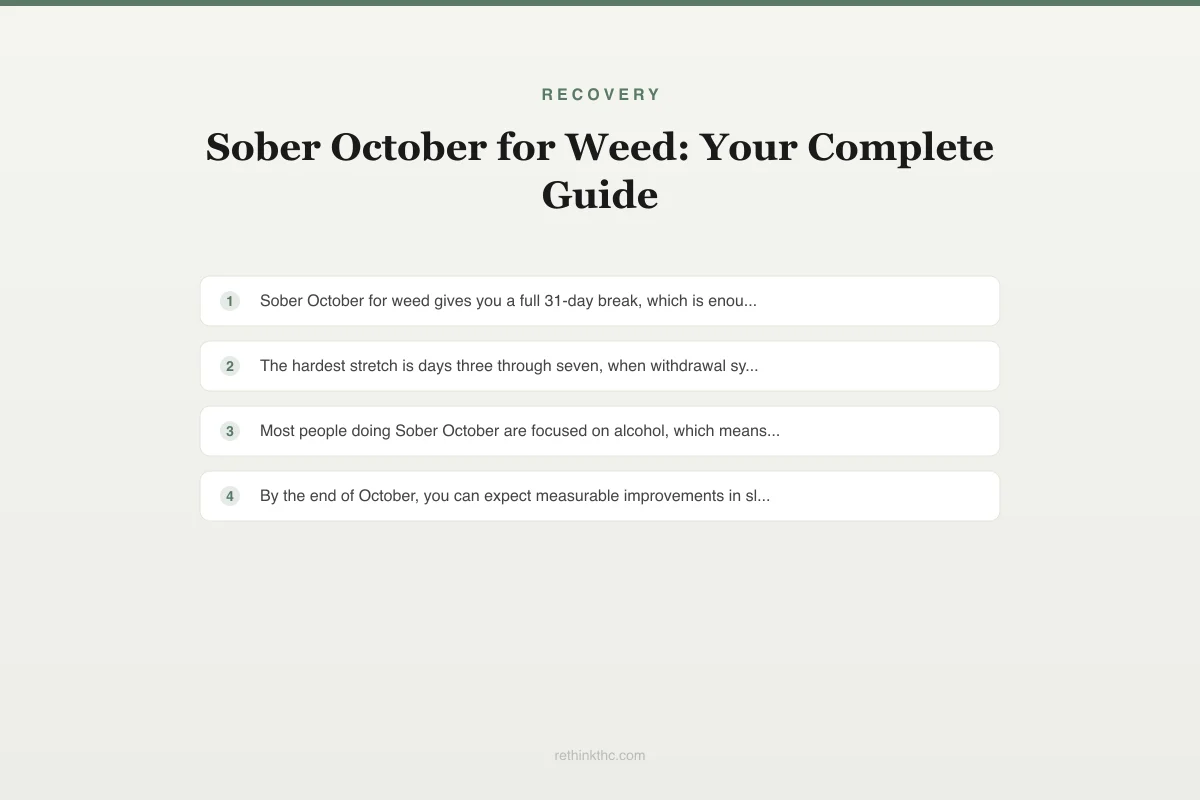
- Sober October gives you a full 31 days off weed — enough time for your CB1 receptors (the brain receptors THC binds to) to return to near-normal density according to a 2012 brain imaging study
- The toughest stretch is days three through seven, when irritability, sleep disruption, and appetite changes peak before gradually easing off
- Most people doing Sober October are focused on alcohol, so cannabis-specific support is harder to find and social pressure plays out differently than you might expect
- By November 1, you can expect real improvements in sleep, mental clarity, motivation, and emotional balance — whether you plan to stay off cannabis or go back at a lower level
- A 2018 meta-analysis in JAMA Psychiatry reviewing 69 studies found that learning and memory problems start clearing up within 72 hours of stopping and keep improving through week four — with the biggest gains in attention and working memory
Why 31 Days Is the Right Number
Sober October Week by Week: What to Expect
Symptoms: Irritability, insomnia, REM rebound (vivid dreams), appetite loss, restlessness
Withdrawal peaks days 3–6. Cilia begin regrowing.
Lower expectations. You are on schedule if this is rough.
Symptoms: Brain fog, emotional sensitivity, difficulty concentrating, random tearfulness
Prefrontal cortex adjusting. Amygdala processing at full volume.
Alcohol-quitters may feel fine already. Your timeline runs longer — that is normal.
Symptoms: Sleep improving, appetite normalizing, mental clarity returning
Cognitive recovery accelerating (Scott 2018 — gains in attention and working memory)
The investment is paying off. Hard part is behind you.
Symptoms: CB1 receptors at/near normal. Sleep, clarity, motivation all improved.
Receptor density reaches non-user levels by day 28 (Hirvonen 2012)
Decide: resume at lower dose, or keep going?
A tolerance break from weed can be as short as 48 hours and still produce a noticeable difference. But 31 days hits a specific biological milestone that shorter breaks cannot reach.
A landmark 2012 study by Hirvonen and colleagues at the National Institutes of Health used PET imaging to track CB1 receptor recovery in daily cannabis users.[1] CB1 receptors are the primary binding sites for THC in your brain, and they regulate mood, appetite, sleep, memory, and pain perception. Daily cannabis use causes your brain to pull these receptors offline, a process called downregulation. Fewer available receptors means you need more THC to feel the same effects.
The Hirvonen study found that CB1 receptor density returns to levels indistinguishable from non-users by approximately day 28. October gives you 31 days. That is three full days past the receptor recovery benchmark, which means you are not just hitting the threshold. You are clearing it.
This is why Sober October for weed is more than a social media challenge. It is a neurologically complete reset, long enough for your brain to restore the hardware that regular THC exposure had altered.
Week One: Days 1 Through 7
The first week is the hardest part of the entire month, and the difficulty is front-loaded. Most people feel relatively normal on day one, maybe a little restless by evening. Days two and three bring the first real discomfort: irritability, disrupted sleep, reduced appetite, and a persistent feeling of being slightly off.
By days four through six, you are at the peak of cannabis withdrawal symptoms. A 2004 study in the Journal of Abnormal Psychology found that withdrawal symptoms typically begin within 24 to 72 hours and peak between days three and six. The most common symptoms during this window include irritability, difficulty sleeping, decreased appetite, restlessness, and anxiety that shows up without any obvious cause.
Sleep disruption is often the most difficult part of week one. THC suppresses REM sleep, the stage associated with dreaming. When you stop using, your brain overcompensates with a flood of vivid, emotionally intense dreams called REM rebound. Falling asleep may take longer than usual, and you may wake up in the middle of the night feeling wired. This is temporary. Your sleep architecture is recalibrating, and it needs a few days to find its new rhythm.
The practical advice for week one is simple: lower your expectations for productivity and comfort, and raise your tolerance for feeling off. You are not failing if the first week is rough. You are on schedule.
Week Two: Days 8 Through 14
The acute symptoms from week one start fading during week two, but they are replaced by something subtler and, for many people, harder to manage: brain fog and emotional sensitivity.
The fog shows up as difficulty concentrating, losing your train of thought mid-sentence, or feeling like your mental processing speed has dropped. This is a recognized feature of early cannabis abstinence. Your prefrontal cortex, the brain region handling focus and decision-making, is adjusting to functioning without THC influencing its signaling.
The emotional sensitivity catches people off guard. You may find yourself tearing up at a commercial, overreacting to a minor inconvenience, or feeling waves of sadness that seem disproportionate to anything happening in your life. THC partially dampens emotional processing through the amygdala, your brain's emotional center. Without it, your brain is processing feelings at full volume again, and it takes time to recalibrate.
Week two is also when the Sober October social dynamic becomes relevant. If you are doing this alongside friends who are giving up alcohol, their experience will look different from yours. Alcohol withdrawal for casual drinkers is often physical and short-lived. Cannabis withdrawal is more psychological and drawn out. You may feel like everyone else is already feeling great while you are still in the fog. That gap is real, and it does not mean something is wrong with you. It means the two substances affect the brain differently, and your withdrawal timeline simply runs longer.
Week Three: Days 15 Through 21
This is when most people start noticing genuine improvement. The changes are not dramatic. They are more like the background noise of withdrawal slowly turning down.
Sleep improves first. You fall asleep faster, stay asleep longer, and wake up feeling like rest actually happened. The vivid dreams may still be present, but they are less intense and less likely to jolt you awake.
Appetite returns to something closer to natural. Instead of either having no appetite or stress-eating at random hours, you start feeling hungry at mealtimes and satisfied after eating.
Mental clarity returns in small, noticeable ways. You finish a task without losing focus. You remember a conversation from earlier in the week without effort. You read something and absorb it on the first pass.
A 2018 meta-analysis in JAMA Psychiatry reviewed 69 studies on cognitive effects of cannabis abstinence and found that learning and memory deficits begin resolving within 72 hours and continue improving through week four. The most significant gains were in attention and working memory.
Week three is when the investment starts paying off. The hard part is behind you. The returns are becoming visible.
Week Four: Days 22 Through 31
By the final stretch of Sober October, the benefits of quitting weed are no longer subtle. Your CB1 receptors are at or near full recovery. Your sleep is better than it has been in months. Your thinking feels sharper. Your emotional responses feel proportionate again. Motivation, the thing many daily users notice slipping first and recovering last, is starting to come back.
This is also when you face the question that will define what happens after October: what do you want to do on November 1?
Some people use Sober October as a reset before returning to cannabis at a lower frequency or dose. Others reach day 31 and realize they feel better without it than they expected, and they want to keep going. Both outcomes are valid. The point of a structured break is not to make a permanent decision under pressure. It is to give yourself enough clean data to make an informed choice.
If you plan to use again after October, know that your old dose will hit significantly harder than it did before you stopped. Your receptors have reset. Start low. Half of what you used to consume, or less. You can always add more. You cannot take it back once it is in your system. Reviewing the 10 lower-risk cannabis use guidelines before you resume can help you build a more intentional pattern than the one you had before October.
If you are considering extending your break, our guide to 30 days without weed covers what the transition from one month into month two looks like and what additional changes to expect.
Handling Social Pressure During Sober October
The social side of Sober October for weed is different from the alcohol version, and it helps to understand why.
When someone says they are doing Sober October for alcohol, most people understand immediately. Alcohol's health risks are widely accepted, and temporary abstinence challenges are culturally normal. Cannabis sits in a different space. Depending on your social circle, telling people you are taking a break from weed might be met with support, confusion, or dismissiveness. Some people will tell you cannabis is not addictive and you do not need a break. Others will treat it like a bigger deal than you want it to be.
You do not owe anyone a detailed explanation. "I am doing a Sober October" is a complete sentence. If someone pushes, "I just want to see how I feel without it" shuts down most follow-up questions. The people worth keeping in your corner will respect it.
If you are in a living situation where cannabis is present daily, the practical challenge is bigger than the social one. Having your stash out of sight, or better yet, out of the house entirely, removes the friction of constant access. Cravings during the first two weeks are real but typically short-lived, lasting 10 to 20 minutes before fading. A small barrier between the impulse and the substance is often enough.
When Sober October Reveals Something Bigger
For most people, Sober October is a productive reset. You get through it, you feel better, and you make a more intentional choice about cannabis going forward. But for some people, the month reveals something they were not expecting: that their relationship with cannabis was managing a problem they now have to face without a buffer.
If you find that anxiety, depression, insomnia, or emotional distress persist or intensify beyond the first two weeks, that is worth paying attention to. Cannabis may have been masking symptoms of an underlying condition rather than causing them. In that case, the most useful next step is talking to a healthcare provider who can assess what is going on without the interference of daily THC.
If you are struggling and need support, the SAMHSA National Helpline (1-800-662-4357) provides free, confidential referrals 24 hours a day, 7 days a week. You can also reach the Crisis Text Line by texting HOME to 741741.
The Bottom Line
Sober October provides a 31-day cannabis abstinence framework that aligns with CB1 receptor recovery neuroscience. Hirvonen 2012 (Molecular Psychiatry) PET imaging showed CB1 receptor density returns to non-user levels by ~day 28 — October's 31 days clears this benchmark. Week 1 (days 1-7): hardest stretch, withdrawal peaks days 3-6 per Budney 2004 (Journal of Abnormal Psychology) — irritability, sleep disruption (REM rebound with vivid dreams), decreased appetite, restlessness, causeless anxiety. Week 2 (days 8-14): acute symptoms fade, replaced by brain fog (prefrontal cortex adjusting) and emotional sensitivity (amygdala processing at full volume without THC dampening). Social dynamic diverges from alcohol-focused participants whose withdrawal is shorter. Week 3 (days 15-21): genuine improvements — sleep quality, appetite normalization, mental clarity returning. 2018 JAMA Psychiatry meta-analysis (69 studies): learning/memory deficits begin resolving within 72 hours, continue improving through week 4, biggest gains in attention and working memory. Week 4 (days 22-31): CB1 receptors at/near full recovery, measurable improvements in sleep, clarity, motivation, emotional regulation. Post-October decision: if resuming, start at half prior dose or less (reset tolerance); if extending, additional gains continue in month 2. Social pressure unique for cannabis vs alcohol — less cultural acceptance of cannabis breaks. If anxiety/depression persist beyond week 2, cannabis may have been masking an underlying condition worth professional evaluation.
Is Sober October long enough to reset weed tolerance completely?
Yes. A 2012 PET imaging study found that CB1 receptor density in daily cannabis users returned to levels statistically indistinguishable from non-users by approximately day 28.[1] October gives you 31 days, which clears that benchmark with room to spare. Your tolerance will be significantly lower on November 1 than it was on September 30.
Will I have withdrawal symptoms during Sober October for weed?
If you are a daily or near-daily user, you will likely experience some withdrawal symptoms. The most common are irritability, sleep disruption, vivid dreams, decreased appetite, and restlessness. These symptoms typically peak between days three and six and ease significantly by the end of week two. Not everyone experiences withdrawal, and severity varies based on frequency and duration of use.
Can I just cut back instead of quitting completely for Sober October?
You can, but you will get different results. The receptor recovery research is based on complete abstinence from THC. Even occasional use during the month will partially reactivate the downregulation process and reduce the reset effect. If a full 31 days feels too ambitious, a two-week complete break will still produce meaningful receptor recovery and tolerance reduction.
How is Sober October for weed different from a regular tolerance break?
The mechanics are the same. You are abstaining from THC to allow CB1 receptors to recover. The difference is structure and social support. Sober October gives you a defined start date, a defined end date, and a cultural framework that makes the break feel less isolating. Having a name and a community around the challenge can make it easier to commit and follow through than an open-ended decision to "take a break sometime."
What should I do on November 1 after completing Sober October?
That depends on your goals. If you plan to resume cannabis use, start with a much lower dose than your pre-October baseline, since your receptors have reset and your old dose will hit harder. If the month showed you that you feel better without cannabis, there is no rule that says you have to go back. The goal of the month is to give you clear data for making an intentional decision, not to prescribe a specific outcome.
Does CBD count as breaking Sober October for weed?
CBD does not bind to CB1 receptors in the same way THC does and does not produce intoxication, so it will not interfere with the tolerance reset that is the neurological goal of the month. However, many CBD products contain trace amounts of THC (up to 0.3% in full-spectrum products), which could partially reactivate downregulation if consumed in large quantities. If your goal is a complete CB1 receptor reset, isolate-based CBD or broad-spectrum products with verified zero THC are the safest options.
Sources & References
- 1RTHC-00573·Hirvonen, Jussi et al. (2012). “Daily Cannabis Use Was Linked to Fewer CB1 Receptors. A Month Without Brought Them Back..” Molecular Psychiatry.Study breakdown →PubMed →↩