Balanced Cannabis Science
THC-COOH
Drug tests detect THC-COOH stored in fat tissue, not active THC, which is why daily users can test positive for 30 days or longer and the only guaranteed method is abstinence plus time.
Biological Psychiatry, 2016
3 to 5 days
A single use may clear your system in 3 to 5 days, but
4%
Cannabis is far more potent than it used to be — THC
What Drug Tests Are Actually Detecting
covered in detail
Biological Psychiatry, 2016
 View as image ↗
If you only read one thing
The only guaranteed way to pass a drug test for weed is to stop using and wait. A one-time user can clear in 3 to 5 days. A daily user may need 30 days or more. Drug tests detect a fat-stored metabolite called THC-COOH, not THC itself, which is why it sticks around so long. Detox drinks, niacin, cranberry juice — none of them have been proven to work. Home test kits from the pharmacy use the same technology as workplace tests, so grab one and test yourself before the real thing.
Whether it is a pre-employment screen, a random workplace test, or a court-ordered panel, drug testing for cannabis remains one of the most stressful parts of being someone who uses weed. The rules around testing are confusing, the timelines are unpredictable, and the internet is full of advice that ranges from genuinely useful to dangerously wrong. This guide covers what drug tests are actually detecting, why some people fail for weeks after their last use, and which strategies have real science behind them.
Key Takeaways
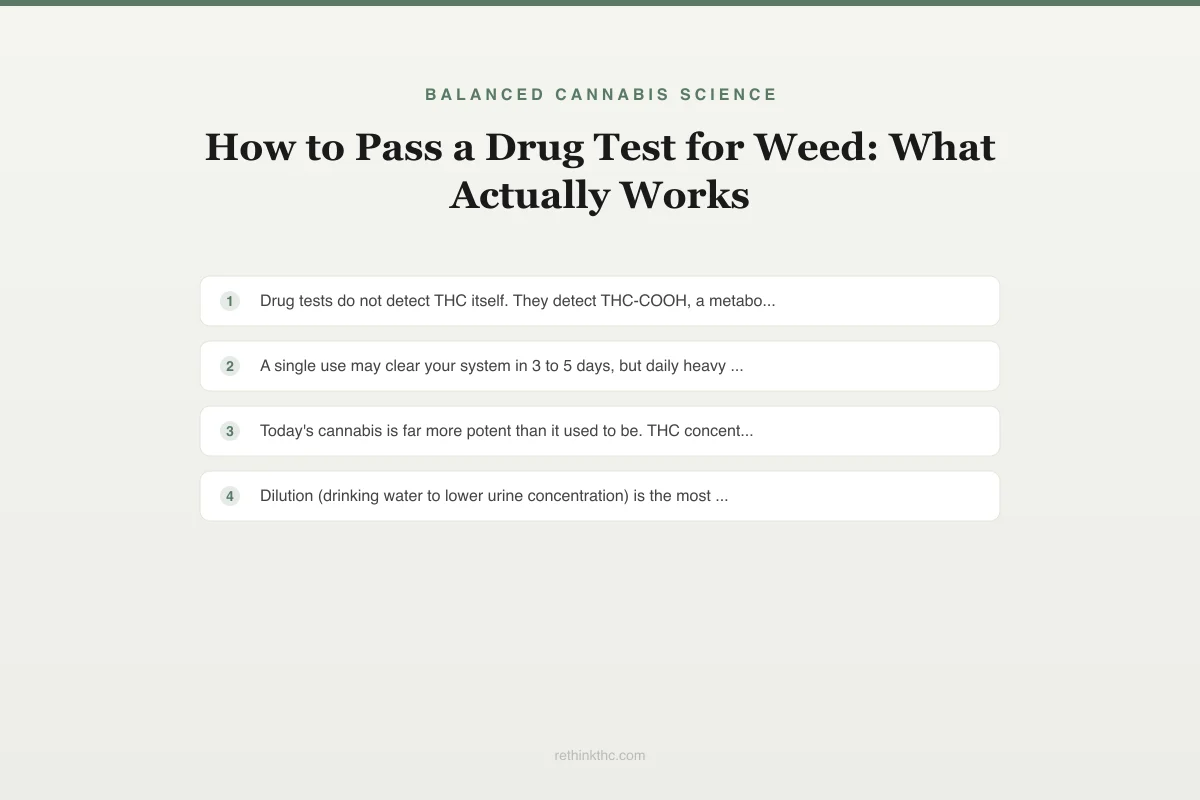
- Drug tests do not look for THC itself — they detect THC-COOH, a metabolite your body makes as it breaks down THC and stores it in fat tissue
- A single use may clear your system in 3 to 5 days, but daily heavy users can test positive for 30 days or longer because THC-COOH builds up in body fat over time
- Cannabis is far more potent than it used to be — THC concentrations tripled from about 4% to 12% between 1995 and 2014 — so each session loads more metabolites into your body
- Dilution (drinking water to lower urine concentration) is the most common trick people try, but labs flag overly dilute samples and you may have to retest
- The only guaranteed way to pass a drug test is to stop using and give your body enough time to clear THC-COOH naturally
- Home test kits use the same technology and 50 ng/mL cutoff as most workplace screens, so they are a reliable way to track your clearance before the real test
Fact Check
The detox drink promise vs. the science
The claim
“Detox drinks flush THC from your system in 24 hours”
Supplement marketing and online testimonials
What research shows
MisleadingDetox drinks are dilution products — they temporarily lower the concentration of THC-COOH in your urine by flooding your system with water, B-vitamins, and creatine. They do not 'flush' or accelerate the elimination of THC metabolites from fat cells. No detox drink has been validated in peer-reviewed research.
Some people do pass after using them, but this is the dilution effect, not detoxification. Labs specifically check for dilute samples, and a flagged sample may count as a fail or require a retest under observation.
Pharmacokinetic literature; no peer-reviewed evidence supports accelerated THC-COOH clearance from any commercial product
What Drug Tests Are Actually Detecting
Most people assume drug tests look for THC, the compound that gets you high. They do not. Standard cannabis drug tests detect THC-COOH (11-nor-9-carboxy-THC), a metabolite your liver produces as it breaks down THC. THC-COOH is not psychoactive. It does not impair you. It is simply a byproduct that your body stores in fat cells and eliminates slowly through urine and stool.
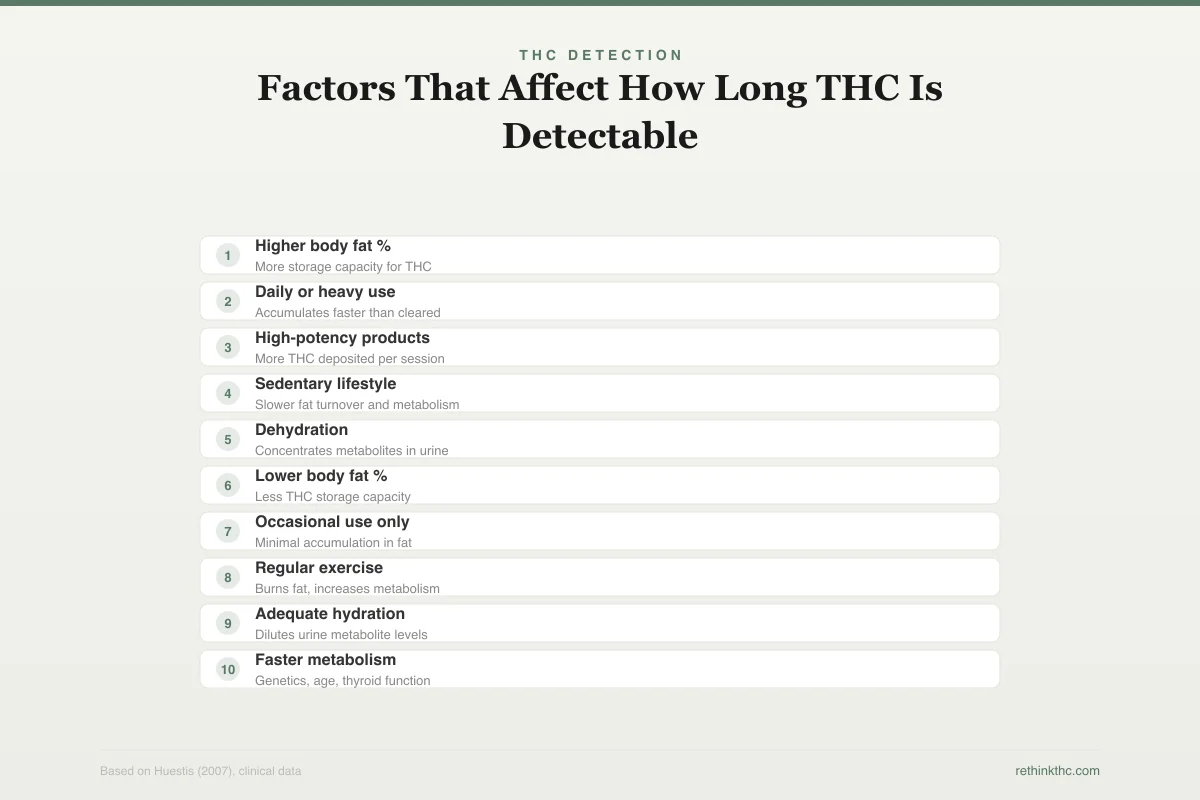
THC Detection
Factors That Affect How Long THC Is Detectable
Increases Detection Time
Higher body fat %
More storage capacity for THC
Daily or heavy use
Accumulates faster than cleared
High-potency products
More THC deposited per session
Sedentary lifestyle
Slower fat turnover and metabolism
Dehydration
Concentrates metabolites in urine
Decreases Detection Time
Lower body fat %
Less THC storage capacity
Occasional use only
Minimal accumulation in fat
Regular exercise
Burns fat, increases metabolism
Adequate hydration
Dilutes urine metabolite levels
Faster metabolism
Genetics, age, thyroid function
Usage frequency and amount matter most — body composition and lifestyle factors adjust the window, but cannot override heavy use
Based on Huestis (2007), clinical data
 View as image ↗
This distinction matters because THC-COOH lingers in your body far longer than THC does. THC itself clears your bloodstream within hours. THC-COOH can remain detectable for days, weeks, or even months depending on how much you used, how often, and your body composition. The full pharmacokinetic breakdown, including detection windows by test type, is covered in how long THC stays in your system.
As Volkow's 2014 review in the New England Journal of Medicine noted, the pharmacokinetics of cannabis are fundamentally different from most other substances because of this fat-soluble storage mechanism. Your body does not flush THC metabolites the way it flushes water-soluble compounds. It releases them slowly from fat tissue over time.
The Two-Stage Testing Process
Most drug testing programs use a two-step process.
Stage 1: Immunoassay screening. This is the initial test. It is fast, cheap, and designed to cast a wide net. The standard cutoff for a positive result on a urine immunoassay is 50 ng/mL (nanograms per milliliter) of THC-COOH. If your sample falls below that threshold, you pass. If it falls above it, your sample moves to confirmation testing.
Immunoassays are good at detecting the presence of metabolites, but they can produce false positives. That is why a positive screening result is never treated as a final answer.
Stage 2: GC-MS or LC-MS/MS confirmation. If you fail the initial screen, your sample goes to a lab for gas chromatography-mass spectrometry (GC-MS) or liquid chromatography-tandem mass spectrometry (LC-MS/MS). These are highly accurate tests that can identify the exact concentration of THC-COOH in your sample. The confirmation cutoff is typically 15 ng/mL. This step eliminates false positives and provides a definitive result.
Types of Drug Tests and Detection Windows
Different tests have different detection windows because they measure THC metabolites in different biological materials.
Urine Tests
Urine testing is by far the most common method, accounting for the vast majority of workplace drug screens. Detection windows vary widely based on usage patterns.
- Single or occasional use (once or twice): 3 to 5 days
- Moderate use (a few times per week): 7 to 14 days
- Daily use: 15 to 30 days
- Heavy daily use (multiple sessions, high potency): 30 to 60 days, sometimes longer
These ranges are estimates. Individual variation is significant, which is covered in the next section.
Hair Tests
Hair follicle tests detect THC-COOH that has been incorporated into the hair shaft via the bloodstream. The standard detection window is 90 days (based on 1.5 inches of hair growth from the scalp). Hair tests are less common for employment screening but are used in some legal and federal contexts. They are better at detecting consistent heavy use than occasional use.
Saliva Tests
Oral fluid tests detect THC itself (not THC-COOH) and have a short detection window of 24 to 72 hours. They are increasingly used for roadside testing and same-day workplace screening. If you have not used in the past few days, saliva tests are generally the easiest to pass.
Blood Tests
Blood tests detect active THC and are primarily used in medical settings or DUI investigations. THC clears the blood within hours for occasional users, though metabolites can be detected for up to a week in heavy users.
Why Heavy Users Fail for So Long
Two factors explain why daily or heavy users test positive for weeks after their last use.
Fat storage and slow release. THC-COOH is lipophilic, meaning it binds to fat. Every time you use cannabis, a portion of the metabolites gets stored in your fat cells. With repeated use, these deposits accumulate. When you stop using, your body gradually releases stored THC-COOH from fat tissue back into your bloodstream, where it gets filtered through your kidneys and into your urine. The more fat-stored metabolites you have, the longer this clearance takes.
Higher potency means more metabolites. ElSohly's 2016 analysis in Biological Psychiatry[1] documented that THC concentrations in cannabis tripled from approximately 4% to 12% between 1995 and 2014. Today's products, especially concentrates and dabs, can exceed 80% THC. Higher potency means your body produces more THC-COOH per session, which means more gets stored and more needs to be cleared. If you have been using modern high-potency products daily, your clearance timeline is longer than someone who smoked occasionally 20 years ago.
Body composition matters. People with higher body fat percentages tend to store more THC-COOH and release it more slowly. Exercise, metabolism, hydration, and genetics all influence individual clearance rates, which is why two people with identical usage histories can have very different detection windows.
Common Methods: What Works and What Does Not
Evidence Check
Every Drug Test Method, Rated by Evidence
The only method with a 100% success rate. Wait for your body to clear THC-COOH naturally.
Same 50 ng/mL immunoassay cutoff as most workplace screens. Accurate for monitoring clearance.
Can lower THC-COOH concentration below cutoff, but labs check for dilution.
Expensive dilution products. No peer-reviewed validation. Inconsistent results.
Burns fat and releases stored THC-COOH. Helps weeks before, but spikes levels 48–72 hrs before test.
Labs improving detection. Many programs require observed collection. Illegal in some states.
No scientific evidence for any home remedy. High-dose niacin can cause liver damage.
Labs test for pH, oxidants, and known adulterants. More likely to flag your sample.
Source: Pharmacokinetic literature; ElSohly et al. (2016); Volkow et al. (2014)
 View as image ↗
The internet is full of supposed hacks for passing a drug test. Here is an honest look at what the evidence supports.
Abstinence and Time
Does it work: Yes. This is the only method that is guaranteed. If you stop using and wait long enough for your body to clear stored THC-COOH below the testing threshold, you will pass. The challenge is that "long enough" varies from a few days to over a month depending on your usage history. If you have time before your test, this is the most reliable approach. For guidance on what to expect during that period, the tolerance break guide covers the process.
Dilution (Drinking Excess Water)
Does it work: Sometimes, with risks. The logic is straightforward. Drinking large amounts of water before your test dilutes the concentration of THC-COOH in your urine, potentially bringing it below the 50 ng/mL cutoff. Some people also take B-vitamins (to restore the yellow color of dilute urine) and creatine supplements (because labs check creatinine levels to detect dilution).
The risk is that labs are specifically looking for dilute samples. If your creatinine is too low or your specific gravity is outside the normal range, your result will come back as "dilute" rather than negative. Depending on the testing program, a dilute result may be treated as a fail, or you may be required to retest under observation.
Detox Drinks
Does it work: Unreliable. Commercial detox drinks are essentially expensive dilution products. Most contain water, B-vitamins, creatine, and herbal ingredients. They work on the same principle as dilution: temporarily lowering the concentration of metabolites in your urine. Some people report success, but the results are inconsistent, and none of these products have been validated in peer-reviewed research. The same dilution detection risks apply.
Exercise
Does it work: It depends on timing. Exercise burns fat, which releases stored THC-COOH into your bloodstream and eventually your urine. In the long run, regular exercise helps clear metabolites faster. But in the short term (the days immediately before a test), intense exercise can actually spike your THC-COOH levels by mobilizing stored metabolites all at once. The general advice is to exercise regularly in the weeks leading up to a test but stop 48 to 72 hours before the actual test date.
Synthetic Urine
Does it work: High risk. Synthetic urine products are designed to mimic the chemical composition of real urine. Some are sophisticated enough to match pH, specific gravity, creatinine levels, and temperature. In unsupervised testing situations, some people do use them successfully. However, labs are continually improving their ability to detect synthetic samples, many testing programs now require observed collection, and using synthetic urine is illegal in some states. The consequences of getting caught, which can include automatic failure, job loss, or legal penalties, are significant.
Adulterants (Adding Substances to Your Sample)
Does it work: No. Adding bleach, vinegar, eye drops, or other chemicals to a urine sample to mask metabolites is one of the oldest tricks in the book, and labs have been testing for adulterants for decades. Modern validity testing checks pH, oxidant levels, and the presence of known adulterants. This method is more likely to result in a flagged sample than a passing one.
Niacin, Cranberry Juice, and Other Home Remedies
Does it work: No. There is no scientific evidence that niacin, cranberry juice, apple cider vinegar, or any other home remedy accelerates THC-COOH clearance. High-dose niacin can actually cause liver damage and skin flushing. These remedies persist through anecdote, not evidence.
A Realistic Timeline for Clearing Your System
If you know your test date and have time to prepare, here is a realistic framework.
Light user (once or twice a month): You are likely clear within 5 to 7 days of your last use. A home test kit from a pharmacy can confirm this.
Regular user (several times a week): Plan for 2 to 3 weeks of abstinence. Use a home test kit at the 14-day mark to check your status.
Daily heavy user: Plan for 30 days minimum, and consider 45 to 60 days if you use high-potency products. Home test kits are especially useful here to track your progress over time.
Home test kits are inexpensive immunoassay strips that use the same 50 ng/mL cutoff as most workplace screens. They are available at pharmacies and online. Testing yourself before your actual test gives you a realistic picture of where you stand.
The Bigger Picture: What You Are Really Dealing With
If you are searching for ways to pass a drug test, it is worth taking a step back and thinking about what is driving that search. For some people, it is a simple timing issue. A single use at a party, followed by an unexpected test. That is a straightforward problem with a straightforward solution: wait it out.
But if you are a daily user who is worried about passing a test, and you are finding it difficult to stop even temporarily, that pattern is worth paying attention to. Roughly 9% of people who ever use cannabis develop a dependence pattern (Anthony 1994, Experimental and Clinical Psychopharmacology). If stopping for a drug test feels harder than you expected, you might want to explore whether your relationship with cannabis has shifted. The article on signs of cannabis use disorder can help you assess that honestly.
For those considering a longer break, knowing how long THC stays in your system can help set realistic expectations. The THC clearance calculator can give you a personalized estimate based on your usage history and body composition. And if you decide to cut back rather than quit entirely, the moderation guide lays out practical strategies.
When to Seek Professional Help
If you are unable to stop using cannabis long enough to pass a drug test despite real consequences (job loss, legal trouble, custody issues), that is a sign your use may have moved beyond recreational. Difficulty stopping when you want to is one of the defining features of a problematic use pattern.
A healthcare provider or therapist who specializes in substance use can help you figure out what is going on and what your options are. There is no judgment involved. These professionals work with people across the full spectrum of cannabis use, from occasional users who want strategies to daily users who want support making a change.
SAMHSA's National Helpline is available at 1-800-662-4357. It is free, confidential, and available 24 hours a day, 7 days a week. You can also text "HELLO" to 741741 to reach the Crisis Text Line.
The Bottom Line
Drug tests detect THC-COOH, a fat-soluble metabolite, not THC itself. Detection windows range from 3 to 5 days for single use to 30 to 60+ days for daily heavy use. THC potency tripled from 4% to 12% between 1995 and 2014, meaning modern products deposit more metabolites per session. Most workplace screening uses immunoassay at a 50 ng/mL cutoff, with confirmation by GC-MS at 15 ng/mL. Dilution (excess water) can temporarily lower urine concentration but labs flag overly dilute samples. Detox drinks, niacin, cranberry juice, and adulterants are unreliable or ineffective. Exercise helps long-term clearance but can spike levels 48 to 72 hours before a test. The only guaranteed method is abstinence and time, with home test kits providing reliable progress tracking.
How long does weed stay in your system for a urine test?
It depends on how often you use. A single use may clear in 3 to 5 days. Regular use (several times a week) typically takes 2 to 3 weeks. Daily heavy use can take 30 to 60 days or longer. Body fat percentage, metabolism, and the potency of the products you use all affect the timeline. The test is detecting THC-COOH, a metabolite stored in fat, not THC itself.
Does drinking water help you pass a drug test?
Drinking large amounts of water before a test can dilute the concentration of THC-COOH in your urine, sometimes enough to fall below the 50 ng/mL cutoff. However, labs test for dilution by checking creatinine levels and specific gravity. An overly dilute sample may be flagged, and you could be required to retest. It is not a reliable strategy on its own.
Do detox drinks work for drug tests?
Detox drinks are essentially commercial dilution products. They contain water, B-vitamins, creatine, and herbal ingredients designed to temporarily lower metabolite concentration in your urine. Results are inconsistent, and no detox drink has been validated by peer-reviewed research. The same risks that apply to water dilution apply to detox drinks.
Can exercise help you pass a drug test faster?
Regular exercise in the weeks before a test can help by burning fat and releasing stored THC-COOH for elimination. However, exercising in the 48 to 72 hours immediately before a test can temporarily spike metabolite levels in your urine by mobilizing stored THC-COOH all at once. The general recommendation is to exercise consistently during your abstinence period but stop a few days before the test.
Are home drug test kits accurate?
Home test kits use the same immunoassay technology and the same 50 ng/mL cutoff as most standard workplace urine screens. They are reasonably accurate for predicting whether you would pass or fail a standard screening test. They do not replicate the GC-MS confirmation step, but if you are consistently testing negative on home kits, you are very likely to pass a standard workplace screen.
What is the difference between a screening test and a confirmation test?
The initial screening is an immunoassay that is fast and inexpensive but can produce false positives. It uses a 50 ng/mL cutoff. If you test positive on the screening, your sample goes to confirmation testing using GC-MS or LC-MS/MS, which are highly accurate laboratory methods that identify the exact concentration of THC-COOH. The confirmation cutoff is typically 15 ng/mL. A positive screening result is never treated as a final answer. You only officially fail once the confirmation test verifies the result. This two-step process protects against false positives from cross-reactive substances.
Sources & References
- 1RTHC-01144·ElSohly, Mahmoud A. et al. (2016). “U.S. Cannabis Potency Tripled Over Two Decades While CBD Nearly Vanished.” Biological Psychiatry.Study breakdown →PubMed →↩