Balanced Cannabis Science
30+ Days
THC is fat-soluble and accumulates in body tissue, which is why a one-time user may test clean in 3 to 4 days on urine while a daily heavy user can test positive for 30 days or longer.
Huestis, Chemistry and Biodiversity, 2007
24 to 72 hours
Detection windows vary wildly by test type: saliva (24 to
3 to 4 days
How often you use is the single biggest factor — a one-time
4%
THC potency roughly tripled from about 4% to 12% between
Huestis, Chemistry and Biodiversity, 2007
 View as image ↗
If you only read one thing
It depends on how often you use and which test you're taking. If you used once, you'll likely test clean on urine in 3 to 4 days. If you use daily, expect 3 to 4 weeks — sometimes longer. Saliva tests only catch the last 1 to 3 days. Hair tests go back 90 days. The reason THC sticks around so long is that it dissolves into your body fat and slowly leaks out over time. Nothing you drink, sweat out, or take as a supplement meaningfully speeds this up.
| Test Type | What It Detects | Occasional User Window | Daily User Window |
|---|---|---|---|
| Urine | THC-COOH (metabolite) | 3 to 7 days | 21 to 30+ days |
| Blood | Active THC (delta-9) | 3 to 4 hours | Up to 7 to 30 days |
| Saliva | THC (parent compound) | 24 to 48 hours | Up to 72 hours |
| Hair | THC metabolites in shaft | Up to 90 days | Up to 90 days |
THC does not leave your body the way alcohol does. Alcohol is water-soluble, processed by your liver at a predictable rate, and typically undetectable within hours. THC plays by different rules. It dissolves into fat, gets stored throughout your body, and releases back into your bloodstream gradually over days or weeks. This is why cannabis has the longest detection window of virtually any recreational substance, and why the answer to "how long does THC stay in your system" depends on a surprisingly long list of factors.
Whether you are facing a drug test, taking a tolerance break, starting a job search, or just curious about what is happening inside your body, this guide covers the science of how THC is metabolized, how long each type of drug test can detect it, and what actually influences your personal detection window.
Key Takeaways
- THC is fat-soluble (lipophilic), so it parks in your body's fat cells and trickles out slowly — which is why cannabis stays detectable far longer than almost any other substance
- Detection windows vary wildly by test type: saliva (24 to 72 hours), blood (3 to 4 hours for occasional users, up to 30 days for heavy users), urine (3 to 30+ days), and hair (up to 90 days)
- How often you use is the single biggest factor — a one-time user may test clean on urine within 3 to 4 days, while a daily heavy user can test positive for 30 days or longer
- THC potency roughly tripled from about 4% to 12% between 1995 and 2014, so today's cannabis loads more THC into your system per session than older products did
- Body fat percentage, metabolism, hydration, and exercise all affect clearance speed, but frequency and amount of use matter most
- Hair follicle tests have the longest window at up to 90 days, but they are bad at catching single or very infrequent use and show documented racial disparities in detection rates
Fact Check
The detox drink promise vs. what your liver actually does
The claim
“Detox drinks, cranberry juice, niacin, and special cleanses can flush THC from your system in 24 to 48 hours”
Supplement marketing, cannabis forums, detox product companies
What research shows
UnsupportedNo drink, supplement, or sweat session speeds up THC metabolism. Your liver processes THC at a fixed rate, and nothing commercially available changes that. Detox drinks may temporarily dilute your urine, but labs test for dilution and flag it.
Some products might help you squeak past a test by diluting your sample just enough — but diluted samples get flagged for retesting. The only reliable method is time and abstinence.
Huestis (2007), Chemistry and Biodiversity — THC pharmacokinetics review
How Your Body Processes THC
When you inhale cannabis (smoking or vaping), THC enters your bloodstream through your lungs within seconds. Blood levels peak within about 3 to 10 minutes. When you eat an edible, THC is absorbed through your digestive tract and processed by your liver first (called first-pass metabolism), which converts a significant portion of delta-9 THC into 11-hydroxy-THC, a metabolite (a chemical your body produces when it breaks down a substance) that is actually more potent and longer-lasting than the original THC.
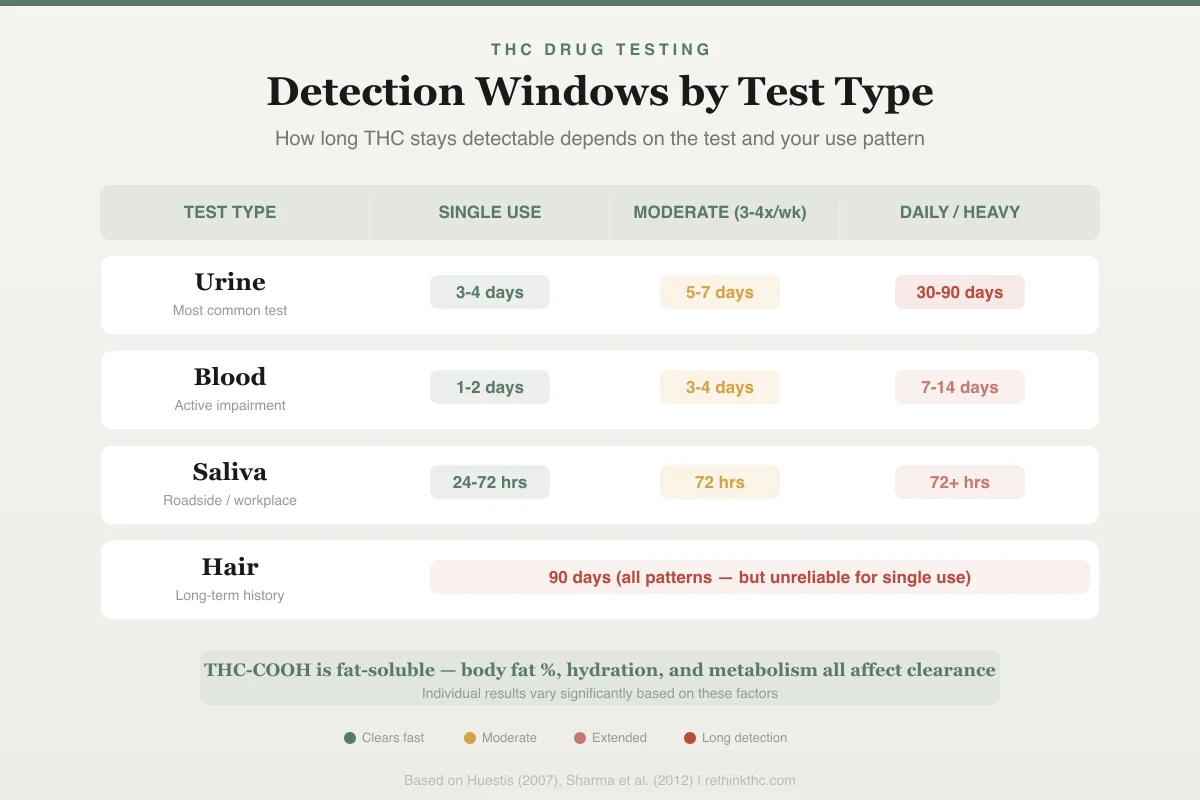
THC Drug Testing
Detection Windows by Test Type
How long THC stays detectable depends on the test and your use pattern
THC-COOH is fat-soluble — body fat %, hydration, and metabolism all affect clearance
Based on Huestis (2007), Sharma et al. (2012)
View as image ↗Regardless of how it enters your system, THC's journey follows the same general path.
Step 1: Rapid distribution. THC in your blood quickly distributes to organs with high blood flow, particularly your brain (which is why you feel effects quickly) and other tissues.
Step 2: Fat storage. Because THC is lipophilic (meaning it dissolves in fat rather than water), it migrates from your blood into your body's fat cells. This happens rapidly. Within minutes of THC peaking in your blood, levels start dropping as the compound moves into fat tissue. Your body fat acts like a sponge, absorbing THC and its metabolites.
Step 3: Slow release. Over the following hours and days, THC slowly leaks back out of your fat cells into your bloodstream. Your liver then converts it into metabolites, primarily THC-COOH (carboxy-THC), which is the specific compound that most drug tests are looking for. THC-COOH is eventually excreted through urine and feces.
Step 4: Ongoing cycling. Here is what makes THC unique. Because it is stored in fat, it does not clear in one pass. THC and its metabolites cycle in and out of fat tissue over an extended period. Each time fat cells release stored THC into the blood, your liver processes another small batch into THC-COOH. This is why a daily user can test positive weeks after their last use. The fat stores are slowly emptying, and each release creates another detectable pulse of metabolites.
This fat-storage mechanism is the reason THC behaves so differently from other substances on drug tests. It is also why factors like body fat percentage and metabolism have a meaningful influence on detection windows.
Detection Windows by Test Type
Drug tests do not all measure the same thing, and they do not all have the same detection windows. Here is what each type looks for and how long it can find it.
Urine Tests
Urine testing is by far the most common drug screening method, used by most employers, probation programs, and treatment facilities. Urine tests detect THC-COOH, the metabolite your liver produces as it breaks down THC. The standard cutoff is 50 nanograms per milliliter (ng/mL), though some tests use a lower 20 ng/mL threshold for confirmation.
Detection windows by use frequency:
- Single use (one time): 3 to 4 days
- Occasional use (a few times per month): 5 to 7 days
- Moderate use (a few times per week): 7 to 21 days
- Daily heavy use: 21 to 30+ days
- Chronic heavy use (multiple times daily for months/years): Up to 45 to 90 days in some documented cases
The enormous range between a one-time user (3 days) and a chronic heavy user (potentially months) comes down to fat storage accumulation. A single use deposits a small amount of THC into your fat. Your body clears it relatively quickly. Daily use for months means your fat cells have been accumulating THC continuously, building up a reservoir that takes a long time to fully empty.
Blood Tests
Blood tests measure active THC (delta-9-THC) in your bloodstream, not the metabolite. This makes them better at detecting recent use but much worse at detecting past use.
Detection windows:
- After smoking/vaping: THC is detectable in blood within seconds and peaks within 3 to 10 minutes. For occasional users, blood levels drop below detectable thresholds within 3 to 4 hours. For regular users, low levels of THC can remain detectable in blood for up to 7 days due to slow release from fat stores.
- After edibles: THC appears in blood more slowly (30 to 90 minutes) and at lower peak concentrations, but the detection window is similar.
- Chronic heavy users: Some studies have found detectable blood THC levels up to 30 days after last use in very heavy, long-term users, though levels are extremely low.
Blood tests are less common than urine tests for employment screening. They are most often used in situations where recent impairment matters, such as roadside testing for driving under the influence.
Saliva Tests
Saliva (oral fluid) tests detect THC itself, not metabolites. They are designed to identify very recent use and have the shortest detection window of any test type.
Detection windows:
- Occasional users: 24 to 48 hours
- Frequent users: Up to 72 hours
- Some studies suggest: Up to 72 hours in chronic heavy users, though this is at the extreme end
Saliva tests are increasingly used for roadside impairment testing and some workplace screening because their short window more closely aligns with the period of actual impairment. THC enters saliva primarily through direct oral exposure during smoking or eating, so the detection window reflects recent consumption more than accumulated body stores.
Hair Tests
Hair follicle tests have the longest detection window and work on a completely different principle than other tests.
How it works: When THC metabolites circulate in your blood, small amounts get incorporated into the cells of growing hair follicles. As the hair grows, those metabolites are locked into the hair shaft. Standard hair tests analyze the 1.5 inches of hair closest to the scalp. Since head hair grows at approximately 0.5 inches per month, this provides a roughly 90-day detection window.
Detection windows:
- Standard test: Up to 90 days
- Longer hair samples: Can theoretically detect use from further back, though this is less reliable and not standard practice
Important limitations of hair tests: Hair tests are poor at detecting single or very infrequent use. They are best at identifying patterns of regular use over time. They can also be affected by environmental contamination (secondhand smoke, handling cannabis) and by hair treatments like bleaching and dyeing, though labs attempt to account for these factors. Hair tests also show racial disparities in detection rates due to differences in hair structure and melanin content, which has raised ethical concerns about their use in employment screening.
Factors That Influence Your Detection Window
The ranges above are wide because individual variation is enormous. The same amount of cannabis can be detectable for 5 days in one person and 25 days in another. Here are the factors that explain the difference.
THC Metabolism
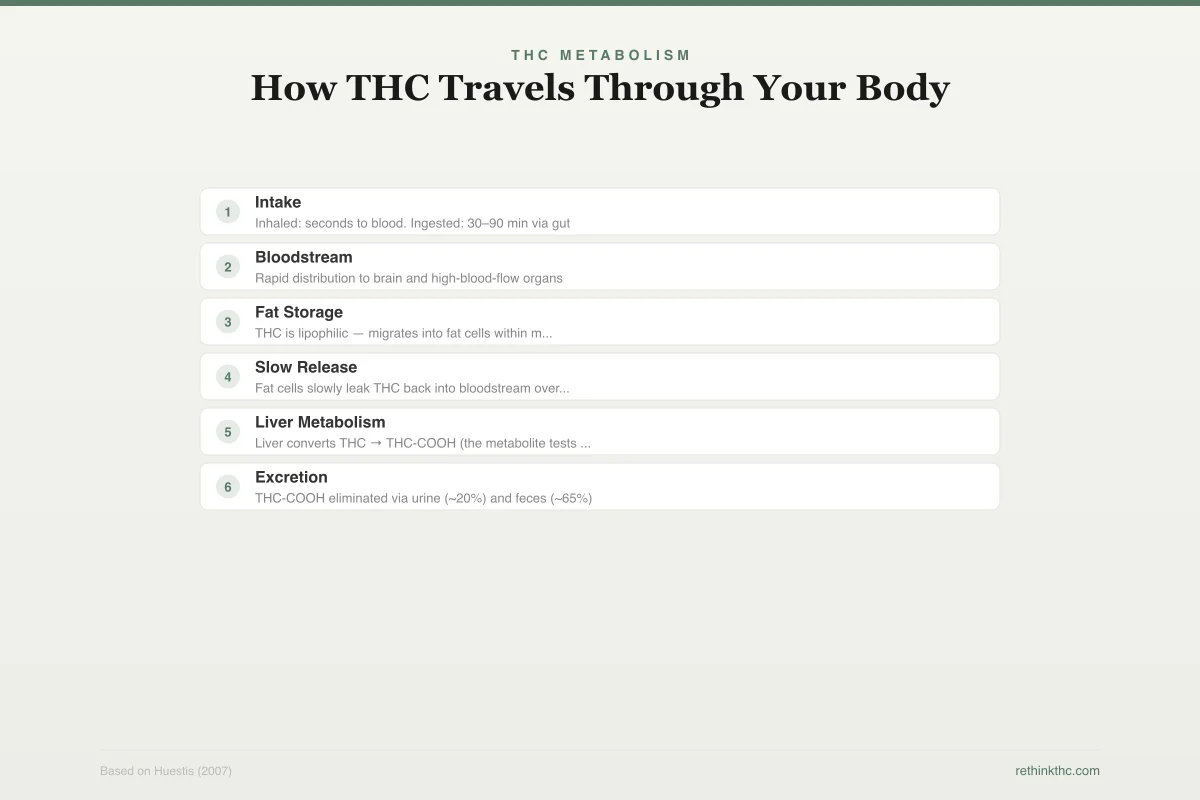
How THC Travels Through Your Body
Intake
Seconds – 90 minInhaled: seconds to blood. Ingested: 30–90 min via gut
Bloodstream
3–10 min peakRapid distribution to brain and high-blood-flow organs
Fat Storage
Minutes–hoursTHC is lipophilic — migrates into fat cells within minutes
Slow Release
Days–weeksFat cells slowly leak THC back into bloodstream over days
Liver Metabolism
OngoingLiver converts THC → THC-COOH (the metabolite tests detect)
Excretion
Days–monthsTHC-COOH eliminated via urine (~20%) and feces (~65%)
Fat storage creates a reservoir — daily users accumulate THC faster than it can be released, extending detection by weeks
Based on Huestis (2007)
 View as image ↗
Frequency and Amount of Use
This is the single most important variable. A person who used once will clear THC dramatically faster than someone who used daily for a year. This is pure math: more sessions mean more THC deposited into fat, which means a larger reservoir that takes longer to empty. There is no shortcut around this one.
Body Fat Percentage
Because THC is stored in fat, people with higher body fat percentages tend to retain THC longer. More fat means more storage capacity, which means more total THC locked away and a longer clearance time. This is one reason why two people who use the same amount can have very different detection windows.
Metabolism
Individual metabolic rate affects how quickly your liver processes THC into metabolites and how quickly your body turns over fat stores. People with faster metabolisms generally clear THC more quickly, all else being equal. Metabolic rate is influenced by genetics, age, muscle mass, activity level, and thyroid function.
THC Potency
ElSohly et al. (2016) · Biological Psychiatry
- Population
- 38,681 cannabis samples seized by the DEA from 1995 to 2014
- Intervention
- Analysis of THC and CBD content over time
- Comparator
- 1995 baseline levels
- Finding
- Average THC jumped from about 4% to 12% while CBD dropped from 0.28% to under 0.15% — the THC-to-CBD ratio went from 14:1 to 80:1
positive Robust dataset confirming a dramatic shift in cannabis potency and composition
ElSohly et al. (2016), Biological Psychiatry, 79(7), 613-619
This factor has become increasingly relevant. ElSohly's 2016 analysis in Biological Psychiatry documented[1] that average THC content in cannabis roughly tripled from about 4% to approximately 12% between 1995 and 2014. Concentrates, dabs, and many modern vape products can contain 60% to 90% THC. Higher potency means more THC per session, more deposits into fat per session, and a longer clearance time. If you primarily use high-potency products, your detection window will generally be longer than someone who uses lower-potency flower at the same frequency.
Method of Consumption
Smoking and vaping produce rapid, high peak blood levels of THC. Edibles produce lower peak levels but sustain them for longer, and the first-pass metabolism through the liver creates additional metabolites. The net effect on detection windows is roughly similar for equivalent total THC doses, but the pattern of metabolite production differs.
Hydration
Hydration does not speed up the actual clearance of THC from your body. What it does affect is the concentration of THC-COOH in your urine. Well-hydrated urine is more dilute, which can push metabolite concentration below the test cutoff on a given day even though THC is still present in your system. This is why some people "pass" one day and "fail" the next, depending on how much water they have been drinking. Note that labs test for urine dilution (creatinine levels), and an overly dilute sample may be flagged as invalid.
Exercise
Exercise is a double-edged factor. In the long run, regular physical activity helps clear THC faster by increasing metabolism and burning fat (which releases stored THC for processing). However, in the short term, intense exercise immediately before a test can temporarily spike blood levels of THC as fat cells release their stores during the workout. If you are days away from a test, exercising could temporarily increase your metabolite levels.
BMI and Body Composition
Related to body fat percentage but worth noting separately: body mass index and overall body composition interact with THC clearance. Two people at the same weight can have very different body fat levels depending on muscle mass, which means different THC storage capacities and different clearance rates.
Why Heavy Users Test Positive So Much Longer
The difference between a one-time user clearing in 3 days and a daily user testing positive for 30+ days is not just about having more THC on board. It is about saturation.
With daily use, your fat cells are receiving new THC deposits faster than they can release old ones. Over weeks and months, THC accumulates to high levels throughout your fat tissue. When you stop using, the release process begins from a much higher starting point. Your liver can only process THC at a certain rate, so even though metabolites are being produced continuously, it takes weeks to work through the entire backlog.
This is compounded by the fact that Volkow's 2014 review in the New England Journal of Medicine noted that about 9% of people who ever try cannabis develop dependence, with the rate rising to 17% for those who start as adolescents. People who develop heavy use patterns are exactly the population most likely to face long detection windows, and they are also the population most likely to need to pass drug tests for legal, employment, or treatment-related reasons.
Safety
ModerateLosing weight can make you test positive again
Concern
When you burn fat during abstinence (common during withdrawal due to appetite changes), your fat cells release stored THC back into your bloodstream. This can cause a surprise spike in urine metabolite levels weeks after your last use.
What the research says
This doesn't mean your body is producing new THC — it's releasing what was stored. The spike is temporary, but it can look like recent use on a test.
Particularly relevant for: Heavy users who are dieting, exercising hard, or experiencing withdrawal appetite loss while trying to pass a test
What to do
If you're working toward a test deadline, avoid crash diets or intense exercise in the final 2 to 3 days before testing. Steady, moderate activity in the weeks before is fine — just ease off right before the test.
Huestis (2007), Chemistry and Biodiversity — THC pharmacokinetics
Additionally, weight fluctuation can cause unexpected results. If you lose weight during your abstinence period (which is common, since appetite changes are part of withdrawal), the fat cells you are burning release their stored THC back into circulation. This can produce a temporary spike in urinary THC-COOH, sometimes making it look like you have used recently when you have not.
Common Myths About Clearing THC Faster
There is an entire industry built on products and methods that claim to help you clear THC from your system faster or beat a drug test. Most of these claims do not hold up.
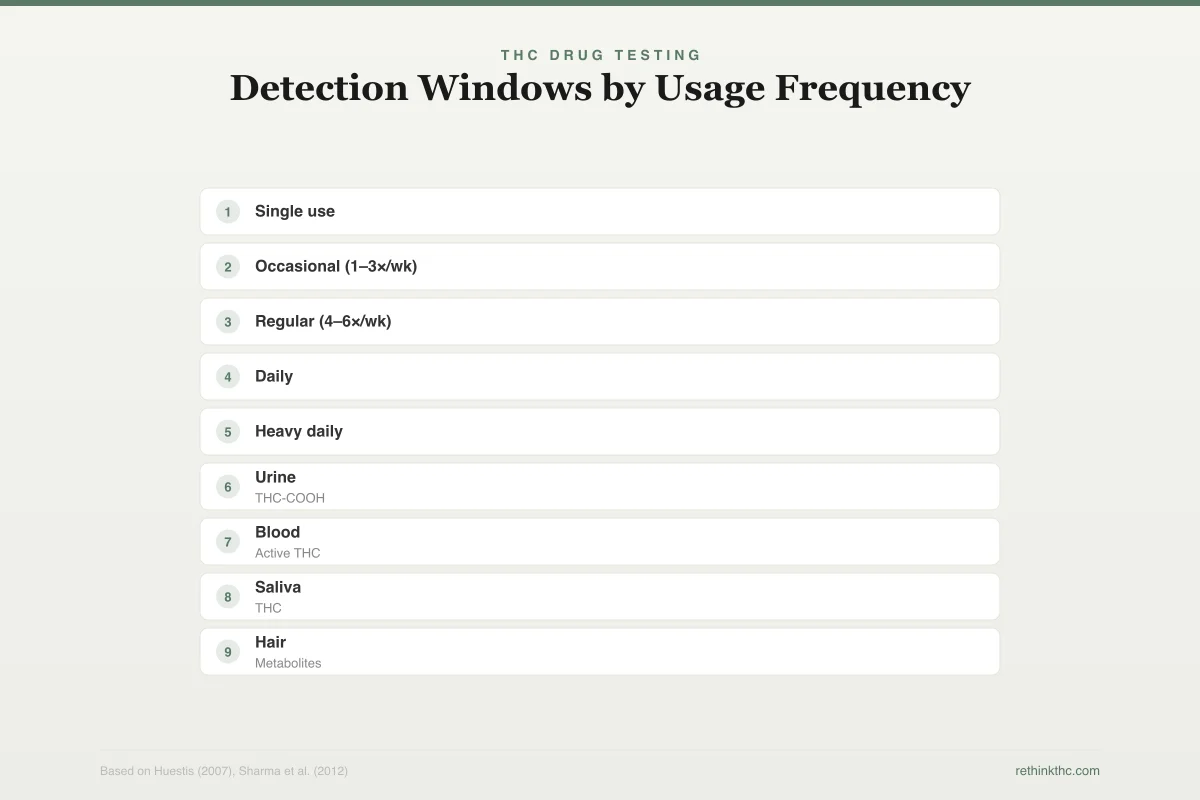
THC Drug Testing
Detection Windows by Usage Frequency
How long each test type detects THC based on how often you use
| Frequency | UrineTHC-COOH | BloodActive THC | SalivaTHC | HairMetabolites |
|---|---|---|---|---|
| Single use | 3–5 days | 3–4 hrs | 24–48 hrs | Unlikely |
| Occasional (1–3×/wk) | 5–7 days | 1–2 days | 24–72 hrs | ~90 days |
| Regular (4–6×/wk) | 7–21 days | 3–7 days | 72 hrs | ~90 days |
| Daily | 21–30 days | 7–14 days | 72+ hrs | ~90 days |
| Heavy daily | 45–90 days | Up to 30 days | 72+ hrs | ~90 days |
Single use
Urine
3–5 days
Blood
3–4 hrs
Saliva
24–48 hrs
Hair
Unlikely
Occasional (1–3×/wk)
Urine
5–7 days
Blood
1–2 days
Saliva
24–72 hrs
Hair
~90 days
Regular (4–6×/wk)
Urine
7–21 days
Blood
3–7 days
Saliva
72 hrs
Hair
~90 days
Daily
Urine
21–30 days
Blood
7–14 days
Saliva
72+ hrs
Hair
~90 days
Heavy daily
Urine
45–90 days
Blood
Up to 30 days
Saliva
72+ hrs
Hair
~90 days
Based on Huestis (2007), Sharma et al. (2012)
 View as image ↗
Cranberry juice, niacin, and detox drinks do not accelerate THC metabolism. At best, they increase urine production, which may temporarily dilute your sample. Labs are aware of this and test for dilution.
Excessive water intake right before a test can dilute urine below the metabolite threshold, but as mentioned above, overly dilute samples are flagged and typically require retesting.
Zinc supplements have been studied for their potential to interfere with urine immunoassay tests, with some laboratory evidence of false negatives. However, labs have developed methods to detect zinc adulteration, and this is not a reliable strategy.
Saunas and excessive sweating release minimal amounts of THC through sweat compared to what your liver processes. The contribution is negligible.
The most reliable approach to testing negative is time and abstinence. Nothing meaningfully speeds up the rate at which your liver processes THC. Understanding your likely detection window based on your use history and planning accordingly is the most effective strategy. The THC detox calculator can help you estimate your personal clearance timeline based on usage patterns and body composition. For a practical walkthrough of what actually works and what does not, see how to pass a drug test for weed.
THC Detection and Tolerance Breaks
If you need to quit specifically because of an upcoming test, the quitting weed for a drug test guide covers how to plan your timeline and manage withdrawal while working against a deadline.
If you are taking a tolerance break rather than quitting entirely, understanding detection windows helps you plan. The endocannabinoid system begins recalibrating as soon as you stop using, but the presence of THC metabolites in your body does not necessarily mean your tolerance has not decreased. Detection and tolerance operate on different timelines. You can test positive on a urine test while your CB1 receptors have already started recovering and your tolerance has already dropped.
For heavy daily users, most sources suggest a tolerance break of at least 2 to 4 weeks for meaningful receptor recovery. A drug test detecting metabolites at week 3 does not mean the break is not working. It means your fat stores have not fully emptied, while your brain has already made significant adjustments.
Special Considerations
Secondhand Smoke Exposure
Under normal ventilation conditions, secondhand cannabis smoke is very unlikely to produce a positive drug test. Studies on passive exposure have found that it takes extreme conditions (unventilated rooms, extended exposure, very heavy smoking) to produce urine metabolite levels above the standard 50 ng/mL cutoff. Casual or brief secondhand exposure in well-ventilated spaces will not cause a positive test.
CBD Products
Full-spectrum CBD products contain trace amounts of THC (up to 0.3% by law in the United States). For most people using standard doses, this is insufficient to trigger a positive drug test. However, some people using high doses of full-spectrum CBD products daily have reported positive tests. If you are subject to testing, broad-spectrum or CBD isolate products (which should contain zero THC) are safer options, though quality control varies by manufacturer.
Delta-8 THC
Delta-8 THC is metabolized similarly to delta-9 THC and produces metabolites that most standard drug tests cannot distinguish from delta-9 metabolites. Using delta-8 products will likely cause you to test positive on a standard cannabis drug test.
Military, DOT, and Security Clearance Testing
Some testing contexts have stricter protocols and higher consequences than standard employment screening. If you are in the military, hold a commercial driver's license, or require a security clearance, the rules, cutoff levels, and consequences are different from civilian workplace testing. The military, DOT, and security clearance testing guide covers these specific contexts in detail.
Employer Drug Testing in 2026
Workplace cannabis testing policies are evolving rapidly as legalization expands. The employer drug test THC 2026 guide covers current state-by-state protections, which industries still test, and what your rights are if you test positive in a legal state.
When to Seek Professional Help
If you are trying to stop using cannabis and finding it difficult, or if you are experiencing withdrawal symptoms that interfere with your daily life, consider talking to a healthcare provider. About 47% of regular users experience withdrawal when they stop,[2] and professional support can make the process significantly more manageable, especially if you are working against a testing deadline.
SAMHSA's National Helpline is available at 1-800-662-4357. It is free, confidential, and available 24 hours a day, 7 days a week. You can also text "HELLO" to 741741 to reach the Crisis Text Line.
The Bottom Line
THC is lipophilic (fat-soluble), storing in fat cells and releasing slowly over days to weeks, which gives cannabis the longest detection window of virtually any recreational substance. Detection windows vary by test type: saliva (24 to 72 hours), blood (3 to 4 hours for occasional users, up to 30 days for heavy users), urine (3 to 30+ days), and hair (up to 90 days). The single biggest factor is use frequency: a one-time user may clear urine in 3 to 4 days while a daily heavy user can test positive for 30 days or longer. THC potency has tripled since 1995, meaning modern products deposit more THC per session. Body fat percentage, metabolism, and hydration influence clearance rates, but no product or method reliably accelerates THC elimination. The most effective strategy is time and abstinence.
How long does THC stay in urine for a daily smoker?
For daily users, THC metabolites are typically detectable in urine for 21 to 30 days after last use. Chronic heavy users (multiple sessions per day for months or years) can test positive for 45 days or longer in some cases, though this is the extreme end. The primary factors are how much THC accumulated in your fat stores, your body fat percentage, and your metabolic rate. The standard urine test cutoff of 50 ng/mL means you can still have some metabolites present and test negative once levels drop below that threshold.
Can you fail a drug test from secondhand weed smoke?
Under realistic conditions, no. Studies have shown that secondhand cannabis smoke exposure in normal environments (ventilated rooms, casual contact) does not produce urine metabolite levels above the standard 50 ng/mL cutoff. Only extreme, prolonged exposure in completely unventilated spaces has been shown to push levels above the threshold, and even then, the positive result is typically short-lived. Normal social exposure is very unlikely to cause a positive test.
Does drinking water help you pass a drug test for weed?
Drinking extra water does not speed up THC clearance from your body. What it can do is temporarily dilute your urine, lowering the concentration of THC-COOH (the metabolite being tested) below the detection threshold for that specific sample. However, drug testing labs measure creatinine levels and specific gravity to detect diluted samples. An overly dilute sample is typically flagged as invalid and may require retesting under observed conditions. Hydration alone is not a reliable strategy.
How long does THC stay in your blood?
For occasional users, THC is detectable in blood for approximately 3 to 4 hours after smoking or vaping. For regular users, low levels can persist for up to 7 days due to slow release from fat stores. In chronic heavy users, some studies have found detectable blood THC up to 30 days after last use, though at very low concentrations. Blood tests are most useful for detecting recent use or active impairment, which is why they are used in roadside testing situations rather than routine employment screening.
Will a tolerance break show up on a drug test?
If you are a regular user taking a tolerance break, you will likely still test positive on a urine test for days to weeks depending on your usage history, even though your tolerance is already decreasing. THC detection and tolerance operate on different timelines. Your brain's cannabinoid receptors can begin recovering within 2 days of abstinence, but your fat cells may still be releasing stored THC metabolites into your urine for much longer. A tolerance break is still effective for its intended purpose even if your drug test has not cleared yet.
Can losing weight cause a positive drug test after quitting?
Yes, this is a documented phenomenon. THC is stored in fat cells, and when you lose weight (which is common during withdrawal due to appetite changes), burning fat releases stored THC back into your bloodstream. Your liver then converts it into THC-COOH, the metabolite detected in urine tests. This can produce a temporary spike in urinary metabolite levels, sometimes making it appear that you have used recently when you have not. If you are working toward a testing deadline, dramatic weight loss through crash dieting or intense exercise in the days immediately before a test could temporarily increase your metabolite levels rather than decrease them.
Sources & References
- 1RTHC-01144·ElSohly, Mahmoud A. et al. (2016). “U.S. Cannabis Potency Tripled Over Two Decades While CBD Nearly Vanished.” Biological Psychiatry.Study breakdown →PubMed →↩
- 2RTHC-02407·Bahji, Anees et al. (2020). “About Half of Heavy Cannabis Users Experience Withdrawal. This Meta-Analysis Measured It..” JAMA Network Open.Study breakdown →PubMed →↩