Withdrawal & Recovery
85%
Average THC potency tripled between 1995 and 2014, pushing most modern cannabis past the dose threshold where anxiety relief flips to anxiety production.
ElSohly et al., Biological Psychiatry, 2016
The Biphasic Effect: Dose Changes Everything
covered in detail
The Potency Problem
covered in detail
Acute Relief vs. Chronic Outcomes
covered in detail
ElSohly et al., Biological Psychiatry, 2016
 View as image ↗
If you only read one thing
A little bit of weed can calm anxiety. A lot of weed makes it worse. That's called the biphasic effect, and it's the key to the whole question. The problem is that today's weed is about 3 times stronger than what was around in the '90s, so a 'normal' hit now delivers a dose that's more likely to trigger anxiety than relieve it. Short-term, occasional, low-dose use can genuinely help. Daily use over months almost always makes anxiety worse because your brain stops managing anxiety on its own.
This is one of the most common questions people type into a search bar at 2 AM. You are anxious. Cannabis seems to help. But you have also had sessions where it made everything worse. Maybe you have read that weed is good for anxiety, and then read the opposite the next day. The conflicting information is not because the research is bad. It is because the answer is genuinely complicated.
The short version: cannabis can reduce anxiety at low doses, increase it at higher doses, and make it significantly worse over time with chronic daily use. But the details matter enormously. This article breaks down what the research actually shows, without the pro-cannabis spin or the anti-drug scare tactics.
Key Takeaways
- Low doses of THC may temporarily calm anxiety, but higher doses consistently make it worse — a pattern researchers call the biphasic effect
- Today's cannabis is roughly three times stronger than what was available in the mid-1990s, which pushes the average experience toward the anxiety-producing end
- CBD appears to have real anti-anxiety properties without the high that THC causes, but most commercial cannabis products are THC-dominant
- Short-term anxiety relief from cannabis does not translate to long-term improvement, and chronic daily use is consistently tied to worse anxiety outcomes
- Your individual biology, tolerance level, and whether you have a pre-existing anxiety condition all shape how cannabis affects your anxiety
- A structured 4-week break with daily anxiety tracking is the most reliable way to find out whether cannabis is helping or hurting your specific situation
The Biphasic Effect: Dose Changes Everything
The single most important concept for understanding cannabis and anxiety is the biphasic effect. This means that THC produces opposite effects at different doses. At low doses, THC tends to reduce anxiety. At higher doses, it tends to increase it, sometimes dramatically.
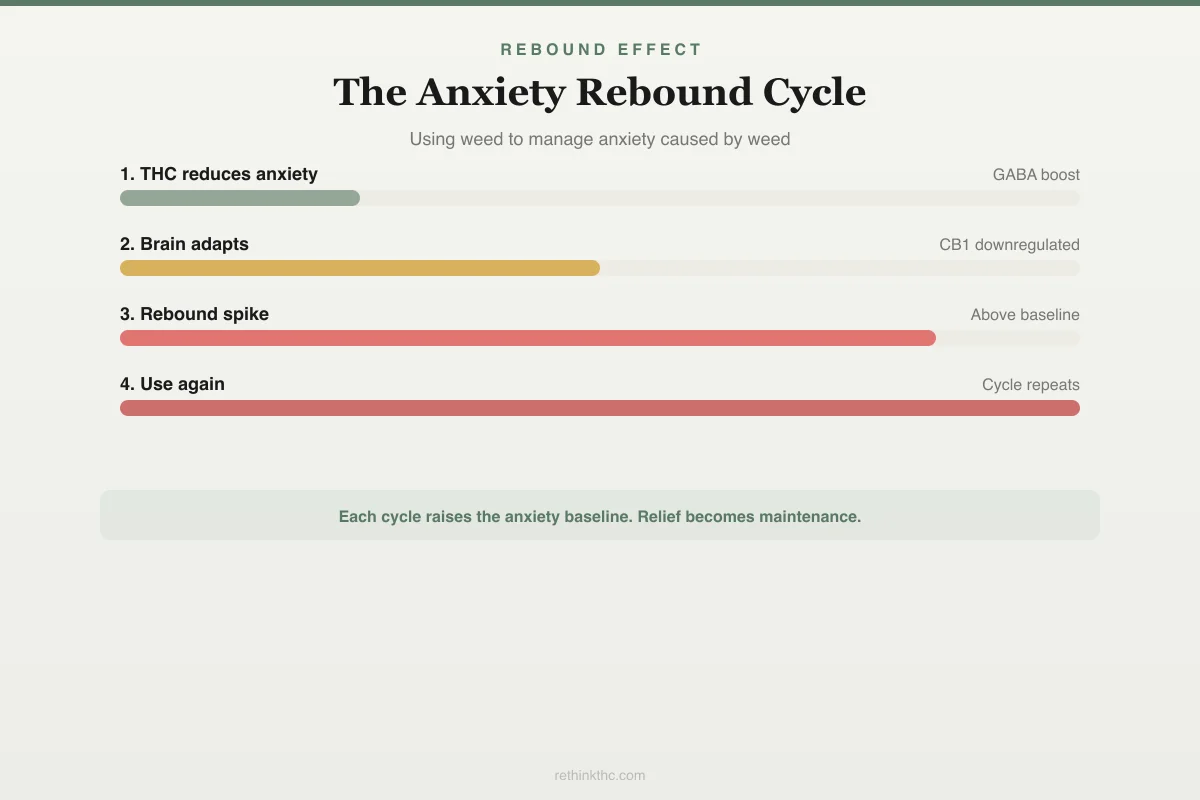
Rebound Effect
The Anxiety Rebound Cycle
Using weed to manage anxiety caused by weed. The cycle tightens with each repetition.
Cannabis reduces anxiety
THC boosts GABA, dampens amygdala, suppresses glutamate
Brain adapts
GABA dampened, glutamate upregulated, CB1 downregulated
Between-session anxiety spikes
Rebound above original baseline when not using
Use again to manage rebound
The very problem that cannabis "solves" is now caused by it
Each cycle raises the anxiety baseline. What started as relief becomes maintenance — you're using to feel "normal," not better.
Based on Crippa et al. (2009), Volkow et al. (2014)
 View as image ↗
A 2009 review by Crippa and colleagues, published in Human Psychopharmacology, found that anxiety reactions and panic attacks were among the most frequent acute adverse effects of cannabis use.[1] The review documented a clear dose-dependent relationship: lower THC concentrations were associated with anxiolytic (anxiety-reducing) effects, while higher concentrations were associated with anxiogenic (anxiety-producing) effects.
Crippa et al. (2009) · Human Psychopharmacology
- Population
- Systematic review of studies across Medline, PsycLIT, and EMBASE
- Intervention
- Review of cannabis effects on anxiety across multiple study types
- Comparator
- Cannabis users vs. non-users; low-dose vs. high-dose effects
- Finding
- Anxiety reactions and panic attacks are the most frequent acute adverse effects of cannabis. Frequent users have high rates of anxiety disorders, and anxiety disorder patients have high rates of cannabis use — but the causal direction remains unclear
mixed Consistent pattern across studies, but precise causal relationship not established
Crippa et al. (2009), Human Psychopharmacology, 24(7), 515-523
This is not a subtle distinction. At the anxiety-producing end, the effects include racing thoughts, paranoia, a sense of impending doom, and full-blown panic attacks. Many people who say "weed helps my anxiety" are describing the low-dose experience. Many people who say "weed gives me anxiety" are describing the high-dose experience. They are both right.
The problem is that the line between "low enough to calm you down" and "high enough to make it worse" is not consistent. It varies by person, by product, by your current stress level, and by your tolerance. There is no universal safe dose for anxiety relief.
The Potency Problem
Here is where modern cannabis use gets especially complicated. The weed available today is not the same plant that people were using twenty or thirty years ago.
A landmark study by ElSohly and colleagues, published in 2016 in Biological Psychiatry, documented that the average THC content in cannabis tripled between 1995 and 2014.[2] Samples that once tested at around 4% THC were routinely testing above 12%, and concentrates available today can exceed 80%.
This matters enormously for anxiety. If the biphasic effect means that low THC reduces anxiety and high THC increases it, then today's products have shifted the default experience toward the anxiety-producing side. Someone buying cannabis in 2026 and taking a "normal" hit is consuming dramatically more THC per use than someone doing the same thing in 2000. The margin for staying in the anxiety-reducing zone has gotten extremely narrow.
Concentrates, vape cartridges, and high-potency flower make this even more pronounced. If you are using an 85% THC concentrate for anxiety, you are delivering a dose that is almost certainly on the wrong side of the biphasic curve for most people.
THC vs. CBD: Different Molecules, Different Effects
Part of the confusion around cannabis and anxiety comes from lumping THC and CBD together as if they do the same thing. They do not.
THC (tetrahydrocannabinol) is the psychoactive compound responsible for the high. It is also the compound with the biphasic anxiety effect. Low doses can calm you. Higher doses can trigger panic. And chronic use leads to tolerance, dependence, and withdrawal symptoms that include significant anxiety.
CBD (cannabidiol) is a different molecule with a different pharmacological profile. A 2015 review by Blessing and colleagues, published in Neurotherapeutics, examined the preclinical and clinical evidence for CBD as a treatment for anxiety disorders.[3] The review found substantial evidence that CBD has potential therapeutic value for generalized anxiety disorder, panic disorder, social anxiety disorder, obsessive-compulsive disorder, and post-traumatic stress disorder.
This is significant because CBD does not produce a high, does not impair cognition, and does not appear to carry the same tolerance and dependence risks as THC. The research suggests that the anxiety-reducing properties many people attribute to "cannabis" may actually be driven by CBD, while the THC component is either neutral or counterproductive at typical doses.
However, there is an important caveat. Most cannabis products available commercially, whether flower, edibles, or vapes, are THC-dominant. The shift toward higher and higher THC potency has often come at the expense of CBD content. Many strains that were once balanced between THC and CBD are now heavily THC-weighted. If you are reaching for cannabis to manage anxiety, the product you are actually using likely contains far more of the compound that can worsen anxiety than the one that might help it.
Fact Check
The dispensary claim vs. the research
The claim
“Cannabis is a natural anxiety treatment — safer than pharmaceuticals”
Dispensary marketing, social media wellness culture, and real short-term relief experiences
What research shows
Context DependentLow-dose THC can temporarily reduce anxiety, but chronic daily use is consistently associated with worse anxiety outcomes. CBD shows genuine anti-anxiety potential, but most commercial products are THC-dominant. The 'natural' framing obscures that today's concentrated THC products are heavily engineered.
The short-term relief is real — nobody is imagining it. But the same mechanism that provides relief (dampening GABA, suppressing the amygdala) causes your brain to compensate over time, producing worse anxiety between sessions. Acute relief and chronic outcome are two different questions with two different answers.
Crippa et al. (2009), Blessing et al. (2015)
| Factor | Anxiety-Reducing | Anxiety-Producing |
|---|---|---|
| Dose | Low (1–2 mg THC) | High (10+ mg THC) |
| Frequency | Occasional use | Daily or near-daily use |
| Product | Balanced THC:CBD | THC-dominant, concentrates |
| Potency | Low-potency flower (< 10% THC) | High-potency flower, vapes, dabs (> 20% THC) |
| Baseline state | Calm, comfortable environment | Already stressed, anxious, or unfamiliar setting |
| Duration of use | Short-term (weeks) | Long-term (months to years) |
Acute Relief vs. Chronic Outcomes
This is the distinction that changes the entire conversation. There is a meaningful difference between what cannabis does to anxiety in a single session versus what it does over months or years of regular use.
Acute effects (single session, occasional use): THC at low doses can reduce subjective anxiety within minutes. This is real, measurable, and well-documented. For someone having a rough evening, a small amount of cannabis can produce genuine temporary relief. Nobody is arguing that this does not happen.
Chronic effects (daily or near-daily use over weeks, months, or years): The research tells a very different story. The Crippa 2009 review found a high prevalence of anxiety disorders among frequent cannabis users[1], as well as high rates of cannabis use among people with diagnosed anxiety disorders. While the directionality is complex (anxious people may be more likely to use cannabis, and cannabis may worsen anxiety), the association between chronic use and worse anxiety outcomes is consistent across studies.
The mechanism is straightforward. Regular THC exposure causes your brain to downregulate its own anxiety-management systems. Your GABA sensitivity decreases. Your amygdala recalibrates around the presence of THC. Your endocannabinoid system, which plays a key role in stress regulation, adapts to the external cannabinoids and reduces its own production. Over time, you become more anxious when you are not using, which drives more frequent use, which deepens the cycle.
Babson and colleagues documented a related pattern in their 2017 review published in Current Psychiatry Reports.[4] While the review focused primarily on cannabis and sleep, it highlighted a recurring theme across multiple symptom domains: THC provides acute symptom relief that degrades with chronic use, while tolerance and withdrawal create symptoms that mirror or worsen the original condition.
Individual Variation: Why Your Friend Is Fine and You Are Not
One of the most frustrating aspects of the cannabis and anxiety question is the enormous individual variation. Two people can use the exact same product in the exact same amount and have completely opposite experiences. One feels relaxed. The other feels like their heart is going to explode.
This variation is driven by several factors.
Genetics. Variations in the genes that encode cannabinoid receptors, GABA receptors, and the enzymes that metabolize THC all influence how you respond. Some people are genetically predisposed to anxiety reactions from cannabis. This is not something you can test for at a dispensary.
Baseline anxiety. If you already have elevated anxiety, whether from a diagnosed disorder, chronic stress, or current life circumstances, your threshold for THC-induced anxiety is lower. The same dose that relaxes a calm person can tip an anxious person into panic.
Tolerance. Regular users develop tolerance to THC's effects, including its anxiety-reducing properties. This means you need more to get the same relief, but "more" pushes you further up the dose curve toward anxiety-producing territory.
Setting and mindset. Cannabis amplifies existing mental states. Using in a comfortable, safe environment when you are feeling reasonably stable is a different experience than using when you are already stressed, in an unfamiliar place, or around people who make you uncomfortable.
The Self-Medication Cycle
Many people who use cannabis for anxiety are self-medicating an existing condition. This creates a specific pattern that deserves its own attention.
The cycle works like this: you have anxiety. Cannabis provides relief. You use more frequently. Tolerance builds. You increase the dose or frequency. Your brain's natural anxiety regulation weakens. You feel more anxious when not using. You interpret this as evidence that you "need" cannabis. The dependency deepens.
Eventually, you may reach a point where cannabis no longer reduces your anxiety to baseline. It just brings it from "unbearable without weed" to "somewhat manageable with weed." The relief becomes less about feeling good and more about feeling less bad. This is a sign that the self-medication pattern has become part of the problem.
Understanding the connection between weed and anxiety at a broader level can help you recognize where you are in this cycle.
What the Research Cannot Tell You
Science is good at identifying patterns across populations. It is less good at predicting your specific experience. The research clearly shows that high doses increase anxiety, that chronic use is associated with worse anxiety outcomes, and that today's products are stronger than what was studied in most older research. But it cannot tell you whether your current pattern of use is helping or hurting you specifically.
Here is one approach that can clarify things. If you have been using cannabis daily for anxiety, try a structured break of at least 4 weeks. Track your anxiety levels daily. Withdrawal anxiety will peak in the first 7 to 10 days and should improve significantly by weeks 2 to 3. If your anxiety is measurably better at week 4 than it was while you were using, that tells you something important. If it is worse or unchanged, that tells you something too.
The point is not to suffer. It is to get an honest signal that chronic use may be obscuring. Understanding whether your anxiety is from withdrawal or is a standalone condition requires this kind of clarity.
Evidence Review
Where the evidence stands
Cell & Lab Studies
THC and CBD mechanisms on GABA, glutamate, and amygdala well-characterized
Animal Studies
Biphasic anxiety response confirmed across multiple rodent models
Clinical Observations
Anxiety and panic attacks are the most common acute adverse effects of cannabis
Human Studies
CBD: strong preclinical evidence for anxiety disorders (Blessing 2015). THC: biphasic effect documented (Crippa 2009)
Large Controlled Trials
No large RCT of cannabis vs. standard anxiety treatments
Treatment Guidelines
No clinical guidelines recommend cannabis for anxiety disorders
The biphasic effect of THC on anxiety is well-established. CBD shows genuine promise but hasn't been tested in large clinical trials. No major medical organization recommends cannabis as an anxiety treatment. The gap between what people experience acutely and what happens with chronic use is the key unresolved tension.
Crippa et al. (2009), Blessing et al. (2015), ElSohly et al. (2016)
A More Honest Answer to the Question
Does weed help anxiety? Sometimes, temporarily, at low doses, in some people. Does weed hurt anxiety? Often, at the doses most people actually use, with the potency levels of modern products, and especially with chronic daily use.
The most honest answer is that cannabis is a poor long-term anxiety management tool for most people, even if it provides real short-term relief. The tolerance cycle, the potency problem, the withdrawal anxiety, and the way it prevents you from developing other coping strategies all work against you over time.
This does not mean that every person who uses cannabis for anxiety is making a mistake. It means that the question itself, "does weed help anxiety," is too simple for the complexity of the actual answer. Dose, frequency, potency, product composition, individual biology, and the presence or absence of a pre-existing anxiety condition all change the equation. If you are going to use cannabis in the context of anxiety, understanding all of these variables is the minimum requirement for making an informed decision.
When to Seek Professional Help
If anxiety is significantly affecting your daily life, whether you are currently using cannabis or not, professional help is available and effective. Cognitive behavioral therapy, in particular, has strong evidence for anxiety disorders and can provide tools that do not carry tolerance or withdrawal risks.
If you are experiencing severe anxiety, panic attacks, or anxiety that has worsened despite cannabis use, talk to a healthcare provider. If you experience thoughts of self-harm at any point, reach out immediately. SAMHSA's National Helpline is available at 1-800-662-4357. It is free, confidential, and available 24 hours a day. You can also text "HELLO" to 741741 to reach the Crisis Text Line.
The Bottom Line
Whether weed helps or hurts anxiety depends on dose, frequency, potency, and individual biology. Low doses of THC temporarily reduce anxiety by dampening amygdala reactivity and boosting GABA, but higher doses consistently increase it — a pattern called the biphasic effect. THC potency has roughly tripled since the mid-1990s, pushing typical use into anxiety-producing territory. CBD appears to have genuine anti-anxiety properties without the psychoactive effects, but most commercial products are THC-dominant. The critical distinction is between acute and chronic effects: a single low-dose session can reduce anxiety within minutes, but daily use over months causes the brain to downregulate its own anxiety-management systems, producing worse anxiety between sessions and driving a self-medication cycle. A structured 4-week break with daily anxiety tracking provides the most honest signal about whether cannabis is helping or hurting.
Does weed help or hurt anxiety?
Both, depending on the circumstances. Low doses of THC can temporarily reduce anxiety, while higher doses consistently increase it. This is called the biphasic effect. Chronic daily use is associated with worse anxiety outcomes over time because tolerance weakens your brain's natural anxiety regulation. The potency of modern cannabis products means most people are consuming doses more likely to increase anxiety than reduce it.
Why does weed sometimes give me anxiety and sometimes calm me down?
The variation comes from dose, your current stress level, tolerance, the specific product, and your individual biology. A small amount when you are relatively calm may reduce anxiety. A larger amount, a higher-potency product, or using when you are already stressed can push you past the threshold where THC becomes anxiety-producing. There is no fixed dose that reliably produces one effect over the other.
Is CBD better than THC for anxiety?
Preclinical and early clinical evidence suggests that CBD has genuine anti-anxiety properties without the psychoactive effects, tolerance risks, or biphasic anxiety response associated with THC. A 2015 review in Neurotherapeutics found substantial evidence supporting CBD for generalized anxiety disorder, panic disorder, social anxiety disorder, OCD, and PTSD. However, most commercially available cannabis products are THC-dominant, not CBD-dominant.
Can daily weed use make anxiety worse over time?
Yes. Regular THC use causes your brain to downregulate its own anxiety-management systems (reducing GABA sensitivity, increasing glutamate sensitivity, adapting the endocannabinoid system). Over months or years, this means you become more anxious when not using cannabis, which drives more frequent use. Research consistently shows that chronic cannabis use is associated with higher rates of anxiety disorders.
How can I tell if weed is helping or hurting my anxiety?
The most reliable method is a structured break of at least 4 weeks while tracking your anxiety levels daily. Withdrawal anxiety peaks in the first 7 to 10 days and should improve significantly by weeks 2 to 3. If your anxiety is better at week 4 than it was during daily use, cannabis was likely contributing to the problem. If it persists unchanged beyond 6 weeks, you may have a pre-existing anxiety condition that needs separate treatment.
Why has cannabis become more likely to cause anxiety than it used to?
THC potency has roughly tripled since the mid-1990s, from around 4% to over 12% on average, with concentrates exceeding 80%. Since THC has a biphasic effect on anxiety (low doses reduce it, high doses increase it), the dramatic increase in potency means a typical session now delivers doses far more likely to cross the anxiety-producing threshold. At the same time, the CBD content in many strains has decreased. CBD appears to buffer some of THC's anxiety-producing effects, so losing that counterbalance has compounded the problem.
Sources & References
- 1RTHC-00349·Crippa, Jose Alexandre S. et al. (2009). “Cannabis both calms and panics — the biphasic dose-response explains why the same drug produces opposite anxiety effects.” Human Psychopharmacology: Clinical and Experimental.Study breakdown →PubMed →↩
- 2RTHC-01144·ElSohly, Mahmoud A. et al. (2016). “U.S. Cannabis Potency Tripled Over Two Decades While CBD Nearly Vanished.” Biological Psychiatry.Study breakdown →PubMed →↩
- 3RTHC-00924·Blessing, Esther M. et al. (2015). “CBD and Anxiety in 2015: Promising Signals, Mostly From Single Doses.” Neurotherapeutics.Study breakdown →PubMed →↩
- 4RTHC-01329·Babson, Kimberly A et al. (2017). “Why Quitting Cannabis Wrecks Your Sleep — and Why It Gets Better.” Current psychiatry reports.Study breakdown →PubMed →↩