Faith
35,000+ Churches
Brain imaging shows prayer activates self-regulation circuits and quiets the amygdala, giving faith-based recovery a measurable neurological mechanism for resisting cannabis cravings.
Moos & Moos, Addiction, 2006
Evidence-based
peer-reviewed research
Evidence-based
peer-reviewed research
Evidence-based
peer-reviewed research
Moos & Moos, Addiction, 2006
 View as image ↗
If you only read one thing
Faith-based marijuana recovery works because it tackles the stuff most quit-smoking programs miss — your sense of purpose, who you are, and the people around you. Brain scans actually show that prayer lights up the same part of your brain that helps you resist cravings and calms the part that fires up anxiety. Programs like Celebrate Recovery run in over 35,000 churches worldwide. The best results come from combining your faith with an understanding of what withdrawal actually does to your brain, not picking one or the other.
For many people trying to quit cannabis, faith based marijuana recovery is the approach that finally works after other methods have not. This is not because faith is magical or because willpower alone was the missing ingredient. It is because faith-based frameworks address dimensions of the quitting process that purely clinical or secular programs sometimes overlook: purpose, identity, community belonging, and the deep question of why the change matters in the first place. Understanding how these spiritual dimensions interact with the actual neuroscience of cannabis dependence puts you in the strongest possible position.
Key Takeaways
- Faith based marijuana recovery is a real, research-supported approach — spiritual practice activates measurable brain and psychological mechanisms tied to addiction and behavior change
- Traditional 12-step programs like Marijuana Anonymous help many people but not everyone, and when they do not fit, that is a structural mismatch — not a personal failing
- Programs like Celebrate Recovery, church-based support groups, and pastoral counseling blend spiritual conviction with accountability and community
- The strongest results happen when faith-based approaches are paired with an understanding of the science behind cannabis withdrawal — not used as a replacement for it
- Building your own faith-informed recovery plan means figuring out what cannabis was doing for you and developing spiritual and practical alternatives for each of those needs
- Brain imaging research shows that prayer and contemplative meditation activate the prefrontal cortex (self-regulation) and quiet the amygdala (threat detection) — giving you a measurable brain mechanism for resisting cravings
Fact Check
The false choice people keep making
The claim
“You have to pick a side — either trust God to heal you, or follow the science. Faith and clinical recovery don't mix.”
Cultural framing that treats spirituality and medicine as opposing forces
What research shows
MisleadingBrain imaging shows prayer activates the exact prefrontal regions that help you resist cravings. Community belonging — a core feature of faith life — is one of the strongest predictors of staying clean. Faith and neuroscience point the same direction.
The divide is cultural, not scientific. Research on prayer, community, and identity transformation all support what faith communities have practiced for centuries. The most successful recoveries use both.
Newberg (2010), Moos & Moos (2006, Addiction), Kaskutas (2009)
Why 12-Step Programs Do Not Work for Everyone
Marijuana Anonymous (MA) and other 12-step programs have helped many people quit cannabis successfully. They deserve respect for that. The structure of regular meetings, accountability partners, and a step-by-step framework gives people a concrete path when they feel lost.
Faith-Based Recovery
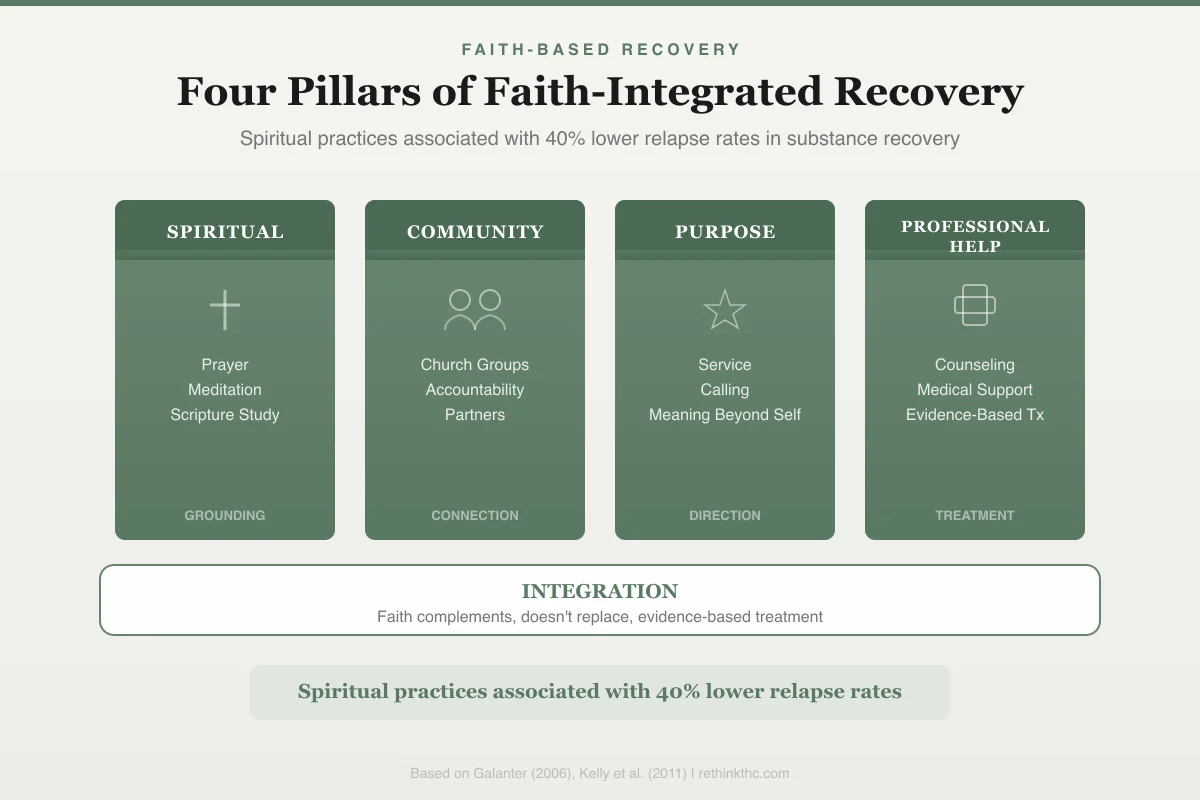
Four Pillars of Faith-Integrated Recovery
Spiritual practices associated with 40% lower relapse rates
Spiritual Grounding
- Prayer
- Meditation
- Scripture study
Community
- Church groups
- Accountability partners
Purpose
- Service
- Calling
- Meaning beyond self
Professional Help
- Counseling
- Medical support
- Evidence-based Tx
Integration
Faith complements, doesn't replace, evidence-based treatment
Based on Galanter (2006), Kelly et al. (2011)
View as image ↗But the 12-step model was designed in the 1930s for alcohol dependence, and its assumptions do not fit every person or every substance equally. There are several specific reasons it falls short for some cannabis users.
The "powerlessness" framing conflicts with some faith traditions. Step One asks you to admit you are powerless over your addiction. For people whose faith emphasizes God-given agency, personal responsibility, and the capacity for transformation through divine partnership, this framing can feel contradictory rather than liberating. You may believe deeply that God equips you to overcome challenges rather than that you must first declare yourself unable to.
The meeting culture can feel misaligned. MA meetings often include people using a wide range of substances. For someone whose cannabis use was daily but functional, sitting alongside people describing heroin or methamphetamine experiences can create a sense of disconnection rather than belonging. This is not a judgment of those experiences. It is a recognition that connection and identification are what make group support work, and when identification is absent, the group loses its power.
The spiritual language is intentionally generic. The 12-step concept of a "Higher Power" is deliberately non-specific to include people of all beliefs and no belief. For someone with a defined, personal faith, this vagueness can actually reduce the potency of the spiritual component. If your relationship with God is specific and central to your life, a framework that asks you to abstract that relationship into a generic "higher power" may dilute the very resource you most need to draw on.
None of this means 12-step programs are wrong. It means they are one tool, and if that tool does not fit your hand, the problem is the fit, not your hand.
Faith-Based Alternatives That Exist Right Now
Celebrate Recovery
Celebrate Recovery is the largest explicitly Christian recovery program in the world, operating in over 35,000 churches across more than 29 countries. For a detailed comparison of how Celebrate Recovery stacks up against Marijuana Anonymous and other recovery options, see Celebrate Recovery vs Marijuana Anonymous. It was founded at Saddleback Church in 1991 and uses a framework built directly on the Beatitudes rather than the generic higher power language of traditional 12-step programs.
The program addresses what it calls "hurts, hang-ups, and habits," which means it does not isolate substance use from the broader patterns of coping and pain that drove it. For cannabis users, this is particularly relevant because marijuana dependence is often intertwined with anxiety, stress management, and emotional avoidance patterns that a substance-only program may not reach. Celebrate Recovery's broader lens matches the reality of how most people actually use cannabis.
The structure includes large group worship, small gender-specific accountability groups, and a step study that parallels the 12 steps but grounds each one in specific Scripture. Meetings are free and widely available. You can find locations at celebraterecovery.com.
Church-Based Support Groups
Many churches run their own support groups for people navigating habit change, and these do not always carry the formal "recovery program" label. A men's group, a women's Bible study, or a small group focused on personal growth can serve a recovery function when the group provides honest conversation, regular accountability, and a shared commitment to change.
The advantage of church-based groups is that they are embedded in a community you may already belong to. You are not walking into a room of strangers in a church basement. You are deepening relationships with people who share your faith and who will see you throughout the week, not just at a weekly meeting. This continuity matters. Research on social support and behavior change consistently shows that accountability embedded in existing relationships is more durable than accountability from strangers.
Pastoral Counseling
A pastor, priest, or faith leader who understands both spiritual care and the basics of substance dependence can serve as a guide through the quitting process. If you are in church leadership yourself and want to better support someone in your congregation, the church leader's guide to supporting cannabis struggles covers practical frameworks for pastoral care in this area. Pastoral counseling is not therapy and should not replace it when therapy is needed. But it offers something therapy often does not: someone who can speak into the spiritual dimensions of your struggle with authority and shared conviction.
The most effective pastoral counseling for cannabis cessation combines spiritual guidance with practical awareness of what withdrawal actually involves. If your pastor understands that the irritability, sleep disruption, and anxiety you experience in the first two weeks are neurological symptoms with a defined timeline, they can help you frame that suffering within your faith rather than interpreting it as spiritual failure.
Celebrate Recovery
- Christ-centered 12 steps based on the Beatitudes
- 35,000+ churches in 29 countries
- Gender-specific small groups
- Addresses all hurts, hang-ups, and habits — not just substances
- Free and widely available
Church Support Groups
- Built into a community you already belong to
- Accountability from people who see you all week
- Men's groups, Bible studies, small groups
- Less formal 'recovery' label — lower barrier to entry
- Relationship-based accountability
Pastoral Counseling
- One-on-one spiritual guidance
- Someone who speaks your faith language with authority
- Can address spiritual dimensions therapy may not
- Best when pastor understands withdrawal basics
- Not a replacement for therapy when therapy is needed
The Science That Makes Faith-Based Recovery Work
Faith-based recovery is not a rejection of science. The most effective version of it is a partnership between spiritual practice and neurological understanding. Several mechanisms explain why faith-based approaches produce real outcomes.
Prayer and meditation change brain activity in measurable ways. Newberg's research using neuroimaging at Thomas Jefferson University found that sustained prayer and contemplative meditation produce changes in prefrontal cortex activation and reduce activity in the amygdala (the brain's threat-detection center). These are the same brain regions involved in craving, anxiety, and impulsive decision-making during cannabis withdrawal. When you pray through a craving, you are not just "being strong." You are activating neural circuits that directly counteract the craving response.
Moos & Moos (2006) · Addiction
- Population
- Adults seeking help for alcohol and substance use disorders
- Intervention
- Community involvement including faith-based social support and regular group participation
- Comparator
- Individuals without structured community support
- Finding
- Social support and community involvement were among the strongest predictors of sustained abstinence across substances
positive Large longitudinal study — results consistent across different substances and demographics
Moos & Moos (2006), Addiction
Community belonging reduces relapse risk. Moos and Moos's 2006 study published in Addiction found that social support and community involvement were among the strongest predictors of sustained abstinence across substances. Faith communities provide a built-in social network with regular contact, shared values, and a reason to show up that extends beyond the recovery itself. This is precisely the kind of support structure that protects against relapse.
Purpose and meaning buffer against the emotional drivers of use. Many people use cannabis to manage a low-level sense of emptiness, purposelessness, or existential discomfort. If you have been wrestling with the question of whether your cannabis use itself conflicts with your beliefs, the is smoking weed a sin article explores that question with nuance rather than easy answers. Regardless of where you land on that question, faith provides a direct answer to those states. When you have a clear sense of calling, belonging, and ultimate meaning, the emotional void that cannabis was filling has something substantial in its place. This is not abstract. It is functional. The void gets filled by something real rather than something you have to keep consuming.
Identity transformation supports behavior change. Kaskutas's 2009 research on recovery identity found that people who developed a new identity as a person in recovery had significantly better long-term outcomes than those who simply stopped a behavior. Faith traditions are built on identity transformation. The concept of becoming a new creation, of being defined by your relationship with God rather than your past behavior, provides exactly the kind of identity shift that research identifies as protective.
Evidence Review
Where the evidence stands
Cell & Lab Studies
Neuroimaging confirms prayer and meditation change prefrontal cortex and amygdala activity
Animal Studies
Not directly applicable — faith-based recovery is studied in humans
Case Reports & Surveys
Thousands of individual recovery stories across Celebrate Recovery and similar programs
Observational Studies
Moos & Moos (2006), Kaskutas (2009) — community and identity predict sustained abstinence
Large Randomized Trial
No RCTs comparing faith-based vs. secular recovery for cannabis specifically
Meta-Analysis
No systematic review of faith-based cannabis recovery programs
Faith-based recovery has strong observational evidence and neuroimaging support. Community involvement and identity transformation are well-documented predictors of sustained sobriety. What's missing is a head-to-head randomized trial specifically for cannabis — but the mechanisms are well-established across substances.
Newberg (2010), Moos & Moos (2006), Kaskutas (2009)
Building Your Own Faith-Informed Recovery Plan
You do not need to join a formal program to build a faith-based approach to quitting cannabis. What matters is that your plan addresses the specific functions cannabis was serving and replaces them with both spiritual and practical alternatives.
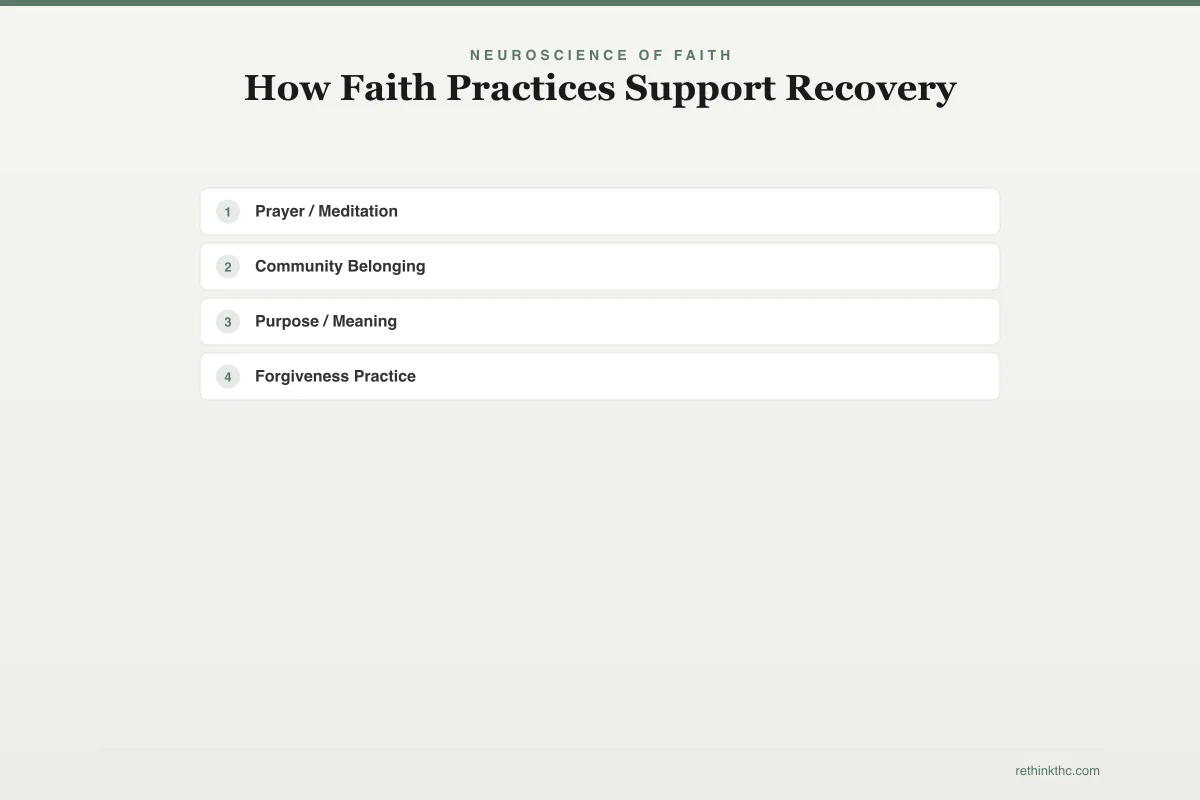
Neuroscience of Faith
How Faith Practices Support Recovery
Spiritual practice activates measurable neurological mechanisms
Brain effect
Prefrontal cortex activation, reduced cortisol
Recovery benefit
Counteracts cravings, reduces anxiety response
Brain effect
Oxytocin release, social bonding pathways
Recovery benefit
Built-in accountability, reduces isolation
Brain effect
Dopamine pathway engagement (reward)
Recovery benefit
Replaces cannabis reward with sustainable source
Brain effect
Reduced rumination, amygdala calming
Recovery benefit
Lowers shame cycle that triggers relapse
Based on Newberg (2010), Moos & Moos (2006), Kaskutas (2009)
 View as image ↗
Identify your use patterns honestly. When were you using? What emotional states triggered it? Stress after work, anxiety before social interaction, boredom in the evening, difficulty sleeping? Each of these needs its own replacement. For a comprehensive approach to quitting that covers the practical side, see how to quit weed.
Build a prayer and meditation practice for high-risk moments. If your highest-risk time is evening, build a prayer practice specifically for that window. This is not generic advice to "pray more." It is a targeted intervention: when the craving hits at 8 PM, you have a specific spiritual practice ready. Contemplative prayer, Scripture meditation, worship music, or journaling through a prompt like "What am I actually feeling right now, and what would I ask God to do with it?" all serve this function. The prayer and sobriety guide walks through how to build a sustainable prayer practice specifically designed for the hardest moments of quitting.
Establish accountability with specificity. Tell someone in your faith community what you are doing and give them permission to ask you about it regularly. Vague accountability ("pray for me, I am working on some stuff") is ineffective. Specific accountability ("I am quitting cannabis. I want you to ask me every Sunday how my week went, and I will be honest") is effective. The difference is enormous.
Expect withdrawal and frame it correctly. Cannabis withdrawal is real and neurological. You will likely experience anxiety, sleep disruption, irritability, and reduced appetite in the first one to three weeks. These symptoms are your brain recalibrating after the removal of external THC, not a sign that you are failing or that God is not helping. Understanding the timeline gives you the ability to endure it with accurate expectations rather than interpreting normal withdrawal as evidence that quitting is not working. For practical strategies to manage the anxiety component, see managing anxiety without weed.
Use Scripture as a reframing tool, not a guilt tool. The goal is not to pile shame on yourself for past use. It is to anchor your motivation in something larger than willpower. Passages about renewal, freedom, self-control as a fruit of the Spirit, and God's faithfulness in difficult seasons serve as cognitive reframing tools that redirect your attention from the discomfort of the present moment to the purpose behind the change. For a curated collection of passages that speak directly to addiction and recovery, see Bible verses for strength in addiction recovery. If you want a structured daily practice that combines Scripture with the quitting process, the 30-day cannabis recovery devotional provides a day-by-day framework pairing specific passages with the stages of withdrawal and early recovery.
Do not isolate. Cannabis use often becomes a solitary activity over time, and quitting can initially increase isolation if you pull away from friends who still use without replacing that social time. Faith communities provide an immediate social alternative. Attend services, join a group, volunteer, accept invitations. The combination of social contact and shared purpose is one of the strongest protective factors against returning to use.
When Faith-Based Recovery Is Not Enough on Its Own
Safety
ModerateWhen you need professional help too
Concern
Faith-based recovery is powerful for purpose, identity, and community — but it is not a substitute for clinical care when severe mental health symptoms are present. Panic attacks, deep depression, or suicidal thoughts during cannabis withdrawal need professional intervention.
What the research says
The most effective approach for many people is integration: faith for daily support and meaning, plus a therapist or psychiatrist for clinical symptoms. These work together, not against each other.
Particularly relevant for: Anyone experiencing severe anxiety, depression, or panic attacks during withdrawal
What to do
If withdrawal symptoms are disrupting your ability to function — not just uncomfortable but truly overwhelming — see a doctor or therapist alongside your faith practice. A faith tradition that honors the whole person should support treating the whole person.
Clinical consensus on cannabis withdrawal management
Faith is powerful. It is also not a replacement for professional help when professional help is needed. If you are experiencing severe anxiety, depression, or panic attacks during cannabis withdrawal, a therapist or psychiatrist can provide tools and interventions that complement your faith practice rather than competing with it.
The most effective approach for many people is integration: faith-based community and spiritual practice for purpose, identity, and daily support, combined with professional guidance for the clinical dimensions of withdrawal and any underlying mental health conditions. These are not opposing forces. They are complementary ones. A faith tradition that teaches you are a whole person, body, mind, and spirit, should logically support addressing all three dimensions. If you have been through this process and feel like you keep stumbling, the grace and cannabis article addresses the theology of falling short and trying again without letting shame derail your progress.
If you are exploring whether Christian faith and quitting marijuana can work together, they can. The key is building a plan that is specific, honest, grounded in both spiritual conviction and scientific understanding, and supported by real people who will walk through it with you.
You Are Not Choosing Between Faith and Science
The framing that forces a choice between spiritual and evidence-based approaches is false. Your brain is doing specific, measurable things during cannabis withdrawal. Your faith speaks to why the change matters, who you are becoming, and where your strength comes from. Both are true at the same time. The people who build recovery plans that honor both dimensions tend to be the ones who sustain change over the long term.
You do not need to fit into a program designed for someone else. You need a plan that fits your faith, your life, and your specific relationship with cannabis. Build that plan with honesty, community, and the understanding that what you are doing is both spiritually meaningful and neurologically real.
Research Gaps
What would it take?
What would it take to prove faith-based recovery works specifically for marijuana?
A randomized controlled trial comparing faith-based vs. secular cannabis cessation programs
No registered trials as of 2026
Standardized measurement of 'faith-based' intervention components
Celebrate Recovery has structure, but most church programs are informal and unstandardized
Cannabis-specific outcome data from Celebrate Recovery and similar programs
Current data groups all substances together
Neuroimaging studies of prayer during active cannabis cravings
Existing brain imaging is general, not cannabis-specific
Long-term follow-up tracking relapse rates by program type
Moos & Moos tracked long-term outcomes but not by faith-based program specifically
Assessment based on current published literature and ClinicalTrials.gov
The Bottom Line
Faith-based marijuana recovery addresses dimensions that purely clinical programs sometimes miss: purpose, identity, community belonging, and the deep question of why change matters. Traditional 12-step programs like Marijuana Anonymous fall short for some believers because the "powerlessness" framing conflicts with faith traditions emphasizing God-given agency, the meeting culture can feel misaligned, and the generic "Higher Power" language dilutes the specificity of a personal relationship with God. Alternatives include Celebrate Recovery (operating in 35,000+ churches across 29 countries), church-based support groups, and pastoral counseling. Neuroimaging research by Newberg at Thomas Jefferson University shows prayer and contemplative meditation activate prefrontal cortex regions and reduce amygdala activity, directly counteracting craving and anxiety circuits. Moos and Moos's 2006 Addiction study found community involvement among the strongest predictors of sustained abstinence. Kaskutas's 2009 research showed that developing a new recovery identity significantly improved long-term outcomes, and faith traditions are built on exactly this kind of identity transformation.
Is faith-based recovery from marijuana as effective as traditional programs?
Research on faith-based recovery across substances shows comparable or better outcomes when the program includes structured accountability, community support, and regular participation. Moos and Moos's 2006 research found that social support and community involvement were among the strongest predictors of sustained abstinence, and faith communities provide these in abundance. The key factor is not the specific framework but whether it provides genuine accountability, consistent support, and tools that address the actual functions cannabis was serving.
Can I combine Marijuana Anonymous with faith-based approaches?
Yes. Many people attend MA meetings while also participating in Celebrate Recovery or a church-based group. The approaches are not mutually exclusive. If MA's structure helps you but the spiritual language feels too generic, supplementing it with faith-specific community and practice gives you the benefits of both. The goal is building the strongest possible support structure, not choosing a single path out of loyalty.
What if my church does not understand marijuana dependence?
This is a real challenge. Cannabis dependence is less understood in many faith communities than alcohol or opioid dependence. If your pastor or church community minimizes what you are going through, consider seeking a Celebrate Recovery group (which operates inside churches but with trained leaders), a Christian counselor who understands substance dependence, or an online faith-based recovery community. You deserve support from people who take your experience seriously.
Does praying through cravings actually help, or is it just distraction?
It is more than distraction. Neuroimaging research shows that prayer and contemplative meditation activate prefrontal cortex regions involved in self-regulation and reduce amygdala activity associated with stress and craving. When you pray through a craving, you are engaging neural circuits that directly counteract the brain's craving response. The spiritual meaning of the practice and the neurological effect of the practice reinforce each other.
How long does it take for faith-based recovery to feel like it is working?
Cannabis withdrawal symptoms typically peak in the first week and resolve substantially within two to four weeks. During that window, any recovery approach will feel difficult because the neurological symptoms are at their most intense. Most people in faith-based recovery report that the combination of community, prayer, and purpose begins to feel genuinely sustaining around the three to six week mark, once acute withdrawal has passed and the new rhythms are becoming habitual.
What if my church treats marijuana use as a moral failure rather than a health issue?
Not every church environment is equipped to handle substance dependence with nuance. If your community responds to vulnerability with judgment rather than support, that is a limitation of the community, not a failure of your faith. Options include seeking a Celebrate Recovery group (which operates within churches but with trained leaders who understand dependence), finding a Christian counselor who specializes in substance use, or connecting with online faith-based recovery communities. You deserve support from people who take both your faith and your neurological experience seriously.
Sources & References
- 1RTHC-08399·Kozlov, Gregory et al. (2026). “Religious Israeli Nursing Students Hold More Negative Views on Medical Cannabis.” Journal of religion and health.Study breakdown →PubMed →↩