Faith
20-30%
Survey data shows 20 to 30 percent of Christians under 45 in legal states have used cannabis in the past year, making an informed pastoral response more urgent than most church leaders realize.
Gallup / Barna Group, 2024
The Scope of the Issue
covered in detail
Why Shame Does Not Work
covered in detail
What You Need to Understand About Cannabis
covered in detail
Gallup / Barna Group, 2024
 View as image ↗
If you lead a church of any size, people in your congregation use cannabis. This is a statistical certainty in 2026 America. Some use it medicinally with a physician's guidance. Some use it recreationally in states where it is legal. Some use it in ways that have become compulsive and are causing problems in their lives. And almost none of them will tell you about it, because the evangelical church has overwhelmingly communicated that cannabis use is incompatible with serious faith.
This guide is designed to help you change that dynamic, not by endorsing cannabis use, but by creating the conditions under which people feel safe enough to be honest, and by equipping you to respond with the wisdom and compassion that the situation actually requires.
Key Takeaways
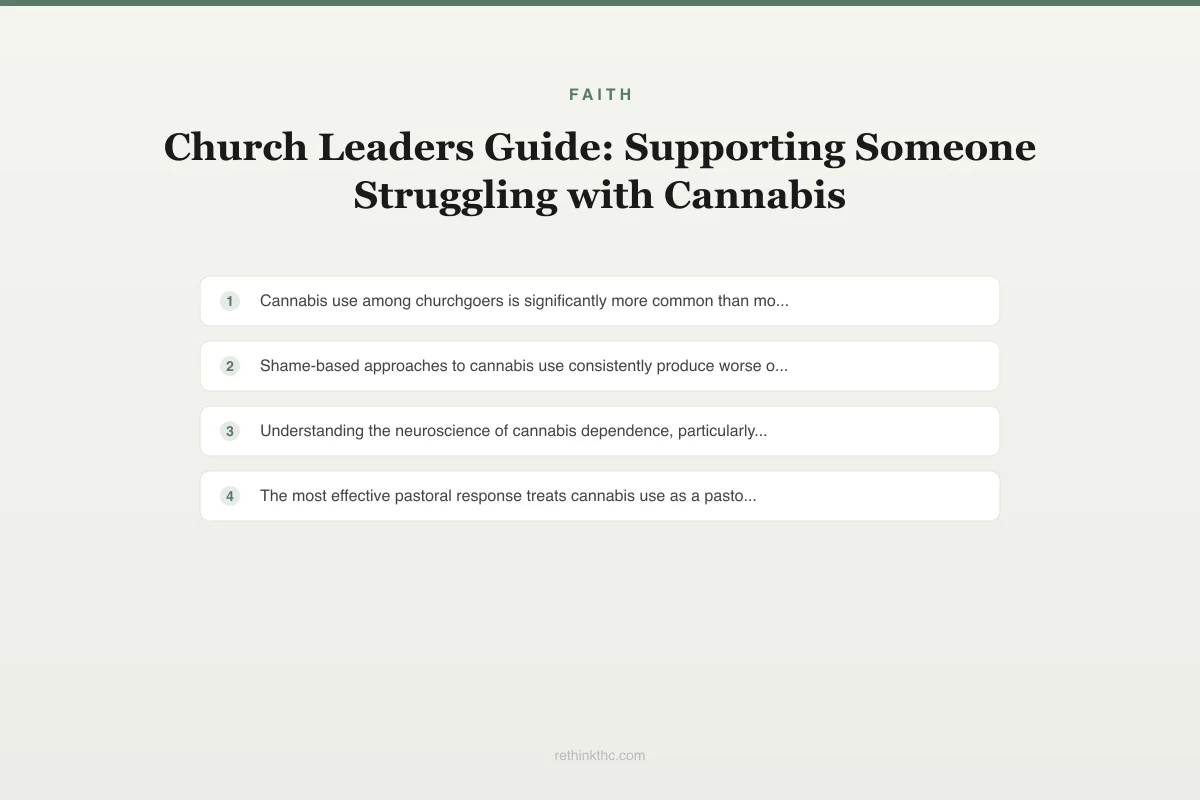
- Cannabis use among churchgoers is far more common than most church leaders realize — survey data suggests 20 to 30 percent of Christians under 45 in legal states have used cannabis in the past year
- Shame-based approaches consistently backfire, pushing people away from the community support that is most protective against problematic cannabis use patterns
- Cannabis withdrawal symptoms are real and willpower alone is often not enough — understanding the neuroscience of dependence helps church leaders offer support that is compassionate instead of naive
- Treating cannabis use as a pastoral care issue rather than a disciplinary issue creates space for honest conversation, which is far more effective than forcing confession under threat of consequences
- Church leaders do not need to become substance abuse counselors, but they should know when and how to refer to professionals — including Christian counselors trained in addiction — while keeping the pastoral relationship intact
- Cannabis often masks underlying anxiety, depression, trauma, or chronic pain, so addressing the use without treating the root cause is like taking away a crutch without fixing the broken leg
The Scope of the Issue
Church Leadership
Pastoral Response Effectiveness
How different pastoral approaches impact recovery outcomes
Cannabis often masks underlying anxiety, depression, or trauma. Addressing use without treating the root cause is like taking away a crutch without fixing the broken leg.
20-30% of Christians under 45 in legal states used cannabis past year
Pastoral Cannabis Response FrameworkGallup polling data shows that approximately 50 percent of American adults have tried cannabis, and roughly 17 percent report current use. Among adults under 45, the numbers are higher. These are population-level statistics that do not stop at the church door.
Barna Group research on faith and substance use reveals that Christians under 40 use cannabis at rates only modestly lower than the general population. In states with legal recreational markets, the gap narrows further. The idea that cannabis use is an "out there" problem rather than an "in here" reality does not match the data.
What does differ between churchgoing cannabis users and the general population is disclosure. Cannabis users in faith communities are significantly less likely to discuss their use with anyone in their church, including pastors, small group leaders, and close friends within the congregation. The perceived cost of honesty, judgment, social exclusion, loss of ministry roles, is too high.
This silence is the actual problem. It is not the cannabis use itself that does the most damage in a church context. It is the isolation, shame, and disconnection from community support that secrecy produces.
Why Shame Does Not Work
The instinctive response in many church contexts is moral correction: cannabis use is sin, sin requires repentance, and the leader's job is to call the person to repentance. While there are theological frameworks that support this approach, the practical outcomes are consistently poor.
Research on shame-based interventions for substance use, across all substances, not just cannabis, consistently shows that shame increases secrecy, reduces help-seeking, and is associated with worse outcomes. Shame does not produce lasting behavior change; it produces hiding.
From a neuroscience perspective, shame activates the same threat-detection circuitry, the amygdala and related structures, that problematic substance use often developed to manage in the first place. Telling someone who uses cannabis to cope with anxiety that they should feel ashamed of their coping mechanism does not give them a better coping mechanism. It adds another source of distress to the pile that cannabis was already inadequately addressing.
The alternative is not moral permissiveness. It is creating an environment where honest conversation is possible, where the person's value in the community is not contingent on their current behavior, and where the path toward change is walked together rather than prescribed from a position of authority.
What You Need to Understand About Cannabis
You do not need to become an expert on cannabis pharmacology to support someone well. But a basic understanding of a few key concepts will make your support more informed and credible.
Cannabis dependence is real. Approximately 9 percent of people who use cannabis develop cannabis use disorder, characterized by inability to control use despite negative consequences. For daily users, the rate is roughly 25 to 50 percent. This is a recognized clinical condition, not a moral failing.
Withdrawal symptoms are real. When a dependent person stops using cannabis, they experience irritability, insomnia, appetite loss, anxiety, and sometimes physical symptoms like sweating and headaches. These symptoms peak at days two through four and last one to three weeks. Telling someone to just stop does not account for the biological reality of withdrawal.
Not all use is problematic. Many adults use cannabis occasionally without developing dependence or experiencing negative consequences. The question of whether any cannabis use is sinful is a theological one that you can hold according to your convictions, but the pastoral approach to someone who uses cannabis occasionally without problems should differ from the approach to someone whose daily use is disrupting their life.
Cannabis often masks underlying issues. Heavy cannabis use frequently develops as self-medication for anxiety, depression, trauma, PTSD, chronic pain, or insomnia. Addressing the cannabis use without addressing the underlying condition it was managing is like removing a crutch without treating the broken leg.
The First Conversation
When someone in your church discloses cannabis use, whether in confidence, through a small group discussion, or because it has become visible through life consequences, how you handle the first conversation sets the trajectory for everything that follows.
Lead with gratitude for their honesty. Before you say anything else, acknowledge the courage it took to disclose. Something like: "Thank you for trusting me with this. I know that was not easy, and I want you to know this does not change how I see you or your place in this community."
Listen before speaking. Ask open-ended questions about their experience. How long have they been using? What role does it play in their life? Have they tried to change their pattern? What happened when they did? What prompted them to bring it up now? Your goal is to understand their situation before responding to it.
Assess the spectrum. Is this occasional recreational use that the person feels some guilt about? Is it medicinal use for a legitimate health condition? Is it daily use that has become compulsive? Is it causing relational, vocational, or health problems? The appropriate pastoral response varies significantly across this spectrum.
Separate the person from the behavior. Whatever your theological position on cannabis use, the person in front of you is a beloved image-bearer of God whose identity is not defined by their substance use. Making this clear in the first conversation establishes the foundation for everything that follows.
Ongoing Support
If the person is seeking to change their cannabis use pattern, ongoing support from the church community can be one of the most powerful factors in their success.
Regular check-ins. Weekly or biweekly conversations that are genuinely curious rather than inspectorial. The question is not "have you stayed clean?" but "how are you doing?" The relationship should feel supportive, not supervisory.
Accountability without surveillance. Accountability in the church context works best when it is bidirectional and trust-based. The person shares honestly because they feel safe, not because they fear consequences. An accountability partner who responds to a relapse with compassion and practical support is more effective than one who responds with disappointment and correction.
Practical support during withdrawal. If someone in your congregation is going through cannabis withdrawal, practical help makes an enormous difference. Meals during the first week when appetite is suppressed. Evening companionship during the insomnia phase. Daytime activities to combat restlessness. These tangible acts of service embody the church's call to bear one another's burdens.
Connection to the broader community. Social isolation is one of the strongest predictors of continued problematic substance use. Helping the person deepen their connections within the church, through small groups, service teams, social activities, and genuine friendship, provides the relational infrastructure that supports lasting change.
When to Refer
There are situations where pastoral care alone is insufficient, and recognizing these situations is an important leadership skill.
Co-occurring mental health conditions. If the person is using cannabis to manage diagnosed or apparent anxiety, depression, PTSD, or another mental health condition, they need professional mental health support. A licensed Christian counselor who understands both the clinical and spiritual dimensions is ideal.
Severe dependence. If the person has tried multiple times to stop without success, if their use is causing serious life consequences, or if they are consuming very high quantities daily, professional addiction treatment may be warranted. This is not a failure of faith; it is wisdom in pursuing the most effective path to freedom.
Medical cannabis users. If the person uses cannabis under medical supervision for chronic pain, seizures, or another qualifying condition, the conversation is different. The pastoral questions shift from "should you use this substance?" to "how is this affecting your spiritual life, and is this the best available option for your health?"
Crisis situations. If cannabis use is co-occurring with suicidal ideation, domestic conflict, legal problems, or other crisis situations, ensure the person is connected with appropriate crisis resources immediately.
What the Church Can Do Differently
Beyond individual pastoral interactions, church culture can be shaped to better address substance use in general and cannabis specifically.
Normalize honest conversation. When pastors or other leaders are willing to discuss cannabis and other substance use from the pulpit or in teaching contexts without leading with condemnation, it signals that these topics are safe to bring up. This does not mean endorsing use. It means acknowledging reality and creating space for honest engagement.
Educate small group leaders. The people most likely to hear first about a congregant's cannabis use are small group leaders, not the senior pastor. Equipping these leaders with basic knowledge about cannabis, compassionate response skills, and clear protocols for when to escalate provides a net of support throughout the congregation.
Develop referral relationships. Build connections with Christian counselors, addiction specialists, and recovery groups in your area before you need them. Having names and numbers ready when a referral is needed eliminates the friction that can delay someone getting appropriate help.
Examine your theology of grace. How your church handles cannabis use reveals what it actually believes about grace, not just what it professes. A theology of grace that extends to every struggle except the ones currently stigmatized is not really grace. Ensure that your response to cannabis use is consistent with how you would respond to other struggles, not harsher because of cultural taboo.
The Goal
The goal of pastoral engagement with cannabis use is not to produce outward behavioral compliance. It is to create the conditions under which genuine, lasting change can occur: honest community, informed support, professional help when needed, and the persistent assurance that the person's standing in the community and before God is secured by grace rather than earned by sobriety.
Some people in your congregation will hear this message and choose to change their cannabis use. Others will not, at least not yet. Your faithfulness as a leader is measured not by their outcome but by whether you created the conditions where transformation was possible.
The Bottom Line
Pastoral guide for church leaders on cannabis use covering scope, why shame fails, essential cannabis knowledge, first conversation framework, ongoing support, referral criteria, and church culture changes. Scope: ~50% of US adults have tried cannabis (Gallup); Barna data = Christians under 40 use at rates only modestly lower; 20-30% under 45 in legal states used past year; churchgoing users significantly less likely to disclose (perceived cost too high); silence/isolation = the actual problem, not the use itself. Why shame fails: research shows shame increases secrecy, reduces help-seeking, produces worse outcomes; shame activates same threat circuits that cannabis was managing; alternative = honest environment, unconditional community value, walking together not prescribing. Essential knowledge: cannabis dependence real (~9% of users, 25-50% of daily users); withdrawal real (insomnia, irritability, appetite loss, peaks days 2-4, lasts 1-3 weeks); not all use problematic; often masks anxiety/depression/trauma/pain — removing cannabis without addressing underlying cause = removing crutch without treating broken leg. First conversation: lead with gratitude for honesty, listen before speaking, assess spectrum (occasional/medicinal/compulsive/problematic), separate person from behavior. Ongoing support: genuine check-ins not inspection, bidirectional accountability, practical withdrawal support (meals, companionship, activities), community connection. Referral: co-occurring mental health, severe dependence, medical cannabis, crisis situations. Culture changes: normalize honest conversation from pulpit, educate small group leaders, develop referral relationships, examine theology of grace (inconsistent grace = not really grace).
How common is cannabis use among church members?
More common than most leaders realize. Gallup data shows approximately 50% of American adults have tried cannabis and roughly 17% report current use. Barna Group research reveals Christians under 40 use at rates only modestly lower than the general population, and in legal states, the gap narrows further. An estimated 20-30% of Christians under 45 in legal states have used cannabis in the past year. What differs is disclosure — churchgoing cannabis users are significantly less likely to discuss use with anyone in their church because the perceived cost (judgment, social exclusion, loss of ministry roles) is too high.
Why doesn't a shame-based approach work for cannabis use?
Research on shame-based interventions for substance use consistently shows that shame increases secrecy, reduces help-seeking, and produces worse outcomes across all substances. From a neuroscience perspective, shame activates the same threat-detection circuitry (amygdala) that problematic substance use often developed to manage. Telling someone who uses cannabis to cope with anxiety that they should feel ashamed adds another source of distress to the pile cannabis was already inadequately addressing. The alternative is not moral permissiveness — it is creating space for honest conversation where the person's community value is not contingent on their current behavior.
What should a pastor say when someone discloses cannabis use?
Lead with gratitude for their honesty: "Thank you for trusting me with this. This does not change how I see you or your place in this community." Then listen before speaking — ask open-ended questions about their experience, the role cannabis plays, whether they have tried to change, and what prompted the disclosure. Assess the spectrum: occasional recreational, medicinal, compulsive, or causing problems. Separate the person from the behavior — whatever your theological position, the person is a beloved image-bearer whose identity is not defined by substance use. How you handle this first conversation sets the trajectory for everything that follows.
When should a church leader refer someone to a professional for cannabis issues?
Refer when: the person is using cannabis to manage diagnosed or apparent anxiety, depression, PTSD, or another mental health condition (they need clinical support, not just pastoral care); they have tried multiple times to stop without success or their use causes serious life consequences (professional addiction treatment may be warranted); they use cannabis under medical supervision for a qualifying condition (the conversation shifts to spiritual impact and treatment optimization); or cannabis use co-occurs with suicidal ideation, domestic conflict, or other crisis situations. Build referral relationships with Christian counselors and addiction specialists before you need them.
How can churches create a culture where people are honest about cannabis use?
Four practical steps: normalize honest conversation from the pulpit by discussing cannabis and substance use in teaching contexts without leading with condemnation (acknowledge reality, create space); educate small group leaders with basic cannabis knowledge, compassionate response skills, and escalation protocols (they hear about it before the pastor); develop referral relationships with Christian counselors and recovery groups before you need them; and examine your theology of grace — if your grace extends to every struggle except currently stigmatized ones, it is not really grace. Ensure your cannabis response is consistent with how you handle other struggles.
Is cannabis dependence a real medical condition or a moral failing?
Cannabis use disorder is a recognized clinical condition in the DSM-5, not a moral failing. Approximately 9% of people who use cannabis develop it, and among daily users, the rate is 25-50%. It is characterized by inability to control use despite negative consequences. Withdrawal symptoms are real and biologically mediated: irritability, insomnia, appetite loss, anxiety, peaking days 2-4 and lasting 1-3 weeks. Understanding this neuroscience helps leaders provide support that is compassionate rather than naive — telling someone to "just stop" does not account for the biological reality of dependence and withdrawal.
Sources & References
- 1RTHC-08294·Graham, Francis Julian L et al. (2026). “Cannabis Use Disorder Creates the Biggest Barriers to Quitting Smoking.” Addictive behaviors.Study breakdown →PubMed →↩
- 2RTHC-07885·Vogel, Erin A et al. (2025). “People With Disabilities Were More Likely to Use Medical Cannabis, Regardless of Social Support.” Cannabis (Albuquerque.Study breakdown →PubMed →↩
- 3RTHC-07908·Walsh, Hannah et al. (2025). “Quitting Tobacco and Cannabis Go Hand in Hand — But Few UK Young Adults Seek Help for Either.” Substance use & misuse.Study breakdown →PubMed →↩
- 4RTHC-07932·Wegener, Milena et al. (2025). “A Cannabis Cessation App Revealed Distinct User Profiles With Different Motivations and Readiness to Quit.” JMIR formative research.Study breakdown →PubMed →↩
- 5RTHC-08399·Kozlov, Gregory et al. (2026). “Religious Israeli Nursing Students Hold More Negative Views on Medical Cannabis.” Journal of religion and health.Study breakdown →PubMed →↩