Faith
Grace
A grace-centered approach to quitting cannabis outperforms shame-based motivation according to addiction research, and individuals with active spiritual practices show significantly better recovery outcomes.
Moos & Moos, Addiction, 2006
Why Faith and Science Are Not Competing Here
covered in detail
Grace Means You Can Start Today
covered in detail
Evidence-based
peer-reviewed research
Moos & Moos, Addiction, 2006
 View as image ↗
If you only read one thing
You don't have to choose between your faith and the science of quitting. Research shows that people with active spiritual practices actually do better in recovery — and that grace-based approaches beat shame-based ones by a wide margin. Your brain heals on a predictable timeline (most of the hard stuff is over within 2-4 weeks), and prayer, community, and structured support all help you get through it. You don't need to resolve every theological question before you start.
Millions of Christians use cannabis, and a growing number are trying to stop. If you are navigating that intersection of faith and recovery, you already know it can feel lonely. Most recovery resources ignore faith entirely, and most church conversations about substance use lean heavy on condemnation and light on practical help. Christian quitting marijuana does not have to mean choosing between your Bible and your biology. The science of withdrawal and the resources of faith work on the same side of this process.
This is not a sermon. It is a guide for people who take both their faith and the science seriously, and who want to use every tool available to get through the hard part. If you are looking for a broader framework that integrates faith and recovery principles, the faith-based recovery from marijuana pillar guide covers that foundation in depth.
Key Takeaways
- Faith and science work together when quitting cannabis — they are complementary tools, not competing frameworks
- A grace-centered approach works better than shame or guilt-based motivation, and behavioral research backs that up
- Church communities and small groups can give you the social support that clinical research identifies as one of the strongest predictors of lasting recovery
- Withdrawal is a brain process with a predictable timeline, and prayer or meditation practices can help calm your stress response during the hardest days
- The Bible does not contain a direct statement about cannabis, and wrestling with that ambiguity honestly is healthier than forcing a simple answer
- Shame-based interventions are actually linked to higher relapse rates than self-compassion approaches — so grace theology is a clinically supported framework for recovery
Why Faith and Science Are Not Competing Here
There is a common assumption that you either approach quitting from a spiritual angle or a clinical one. That is a false choice. The neuroscience of cannabis withdrawal describes what is happening in your brain. Faith speaks to why you want to change, what sustains you through discomfort, and how you understand your own story.
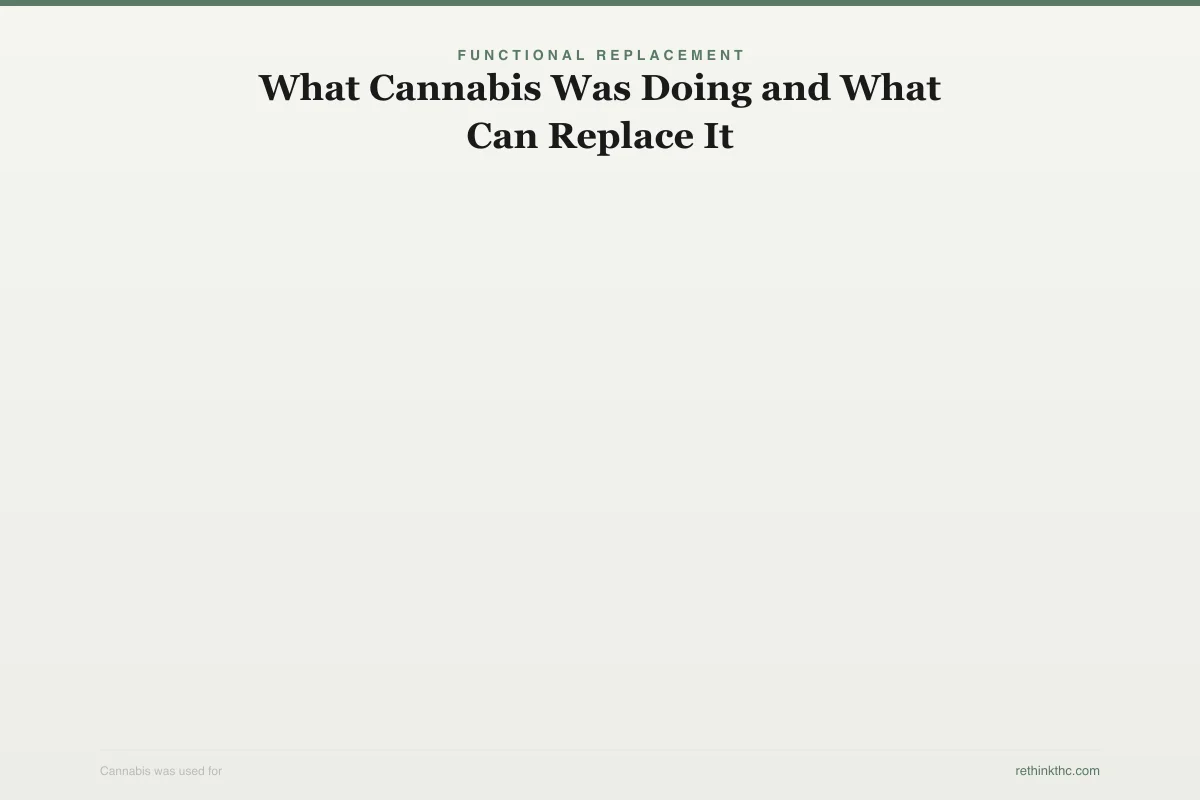
Functional Replacement
What Cannabis Was Doing and What Can Replace It
Matching each function to a spiritual and practical alternative
Used for
Stress relief
Replace with
Prayer / meditation
Used for
Social bonding
Replace with
Fellowship groups
Used for
Boredom / emptiness
Replace with
Service / purpose
Used for
Sleep aid
Replace with
Evening devotional + sleep hygiene
Used for
Anxiety management
Replace with
Breathwork + scripture meditation
Cannabis was used for
Spiritual alternative
Based on functional use patterns in recovery research
 View as image ↗
A 2012 study in Molecular Psychiatry[1] found that CB1 receptors, the brain's docking stations for THC, begin recovering within two days of quitting and return to normal levels by about day 28. That is the biological clock. It runs the same regardless of what you believe. Understanding that clock gives you something powerful: the knowledge that what you are feeling is temporary and predictable.
At the same time, a 2016 meta-analysis published in the Journal of Behavioral Medicine reviewed 30 studies and found that individuals with active religious or spiritual practices had significantly better outcomes in substance use recovery. The researchers noted that spiritual practices appeared to strengthen motivation, provide meaning, and reduce the emotional distress that drives relapse.
Both of those findings are true at once. Your brain needs time to heal, and your faith can make that healing time more bearable.
The Grace-Centered Approach: Why Shame Does Not Work
If you grew up in a church environment, you may have absorbed the message that substance use is primarily a moral failure. That framing feels intuitive, but it actually works against recovery. Shame is one of the least effective motivators for lasting behavior change.
A 2013 study in Addiction found that shame-based interventions were associated with higher rates of relapse compared to approaches that emphasized self-compassion and internal motivation. The researchers concluded that guilt about specific behaviors can motivate change, but global shame, the feeling that "I am a bad person," tends to drive people back toward the very behaviors they are trying to stop. You feel terrible about yourself, so you reach for the thing that numbs the terrible feeling. The cycle tightens.
The Christian concept of grace offers a direct alternative to that cycle. Grace says the relationship is not conditional on performance. You do not have to earn your way back into good standing before you can ask for help. That theological reality happens to align with what behavioral science knows about sustainable change: people who approach recovery with self-compassion and a sense of being supported, rather than monitored and judged, are more likely to stick with it.
This does not mean pretending the struggle is not real. It means refusing to let setbacks become an identity. A bad day is a bad day. It is not proof that you are beyond help.
Fact Check
What many churches get wrong about quitting
The claim
“If you just had stronger faith or more willpower, you'd stop. Substance use is a moral failure that shame can fix.”
Common in conservative church cultures and some recovery ministries
What research shows
MisleadingA 2013 study in Addiction found that shame-based interventions were linked to higher relapse rates. Self-compassion approaches, which align closely with grace theology, produced better long-term outcomes.
Guilt about a specific behavior can motivate change. But global shame — 'I am a bad person' — drives people back to the numbing behavior. Grace theology is not soft on sin. It's clinically superior to shame as a recovery framework.
Addiction (2013), shame-based vs. self-compassion interventions
What Withdrawal Feels Like and How Faith Practices Can Help
Cannabis withdrawal follows a predictable timeline. Symptoms typically begin within 24 hours, peak between days three and seven, and mostly resolve within two to four weeks. Sleep disturbances can last up to 45 days. The most common symptoms include irritability, anxiety, insomnia, reduced appetite, and intense cravings.
Knowing that timeline matters because it removes the fear that something is permanently wrong. You are not broken. Your endocannabinoid system is recalibrating. And there are specific points in that process where faith-based practices can provide real, measurable support.
Prayer and Meditation During Peak Withdrawal
Days three through seven are the hardest. Irritability spikes. Anxiety can feel overwhelming. Cravings are at their most intense. This is the window where most people relapse.
Contemplative prayer and meditation directly engage the prefrontal cortex, the part of your brain responsible for impulse control and emotional regulation. A 2014 study published in JAMA Internal Medicine analyzed 47 clinical trials and found that meditation practices produced moderate improvements in anxiety, depression, and pain. For someone in the peak of withdrawal, even moderate improvement in anxiety can be the difference between pushing through and giving in.
You do not need a complicated practice. Sitting quietly for 10 minutes with a passage of Scripture, breathing slowly, and letting your mind settle is enough. The Psalms are particularly useful during withdrawal because so many of them are written from a place of distress. Psalm 40, Psalm 42, Psalm 130. They normalize the experience of waiting in an uncomfortable place for relief that has not arrived yet.
Using Community Instead of Isolation
One of the most dangerous patterns during withdrawal is isolation. You feel irritable, so you avoid people. You feel ashamed, so you do not tell anyone what you are going through. You spend more time alone, which gives cravings more room to operate.
Church communities, small groups, and accountability relationships offer a built-in counter to that pattern. A 2015 study in Substance Use and Misuse found that social support was among the top three predictors of successful cannabis cessation, alongside motivation and coping skills. The study did not specify what kind of social support. It did not have to be clinical. It needed to be consistent, nonjudgmental, and available.
If you have a small group or a trusted friend at church, telling them what you are going through is one of the most practical steps you can take. You do not need to frame it as a dramatic confession. "I am quitting cannabis and the first few weeks are rough. Can you check in on me?" is enough.
Not every church environment is safe for that conversation. If your community responds to vulnerability with judgment rather than support, you may need to find your support elsewhere. That is not a failure of your faith. It is a limitation of that specific community. Professional therapy and peer support groups can fill the gap, and using those resources is fully compatible with a life of faith.
Evidence Review
Where the evidence stands
Cell & Lab Studies
Basic research confirms meditation and prayer activate prefrontal cortex regions involved in self-regulation
Behavioral Models
Social support and structured routines consistently reduce substance-seeking behavior in research models
Case Reports & Surveys
Widespread clinical observations that faith-active patients show better recovery adherence
Clinical Trials
47 meditation trials reviewed by JAMA Internal Medicine (2014): moderate improvements in anxiety, depression, and pain
Large Observational Studies
Social support among top 3 predictors of cannabis cessation (Substance Use and Misuse, 2015)
Meta-Analysis
30-study meta-analysis: active spiritual practices significantly improve substance use recovery outcomes (J Behavioral Medicine, 2016)
The evidence that faith-based practices help recovery is strong and multilayered. We're not talking about one small study — there are meta-analyses, clinical trials, and large observational studies all showing that spiritual engagement, community support, and contemplative practices meaningfully improve outcomes.
JAMA Internal Medicine (2014), Substance Use and Misuse (2015), Journal of Behavioral Medicine (2016)
Addressing the "Is It a Sin?" Question Honestly
This is the question underneath every other question for Christians considering quitting marijuana. And it deserves an honest answer rather than an easy one.
The Bible does not mention cannabis by name. It does speak about sobriety, self-control, and not being "mastered" by anything (1 Corinthians 6:12). It also speaks about the body as something to be stewarded well. Different Christian traditions interpret these principles differently when applied to cannabis, and people of genuine faith land in different places on this question.
What the science can tell you is this: daily cannabis use changes your brain's reward circuitry, disrupts your sleep architecture, and can blunt your emotional range over time. If you have been self-medicating with weed for anxiety, stress, or emotional pain, the cannabis may be masking a problem rather than solving it. A 2020 study published in JAMA Psychiatry found that while cannabis temporarily reduced anxiety symptoms, long-term daily use was associated with increased anxiety severity over time.
Whether that constitutes a moral issue is between you and God. But if your use has reached the point where you feel controlled by it rather than free in it, the desire to quit is worth honoring regardless of where you land on the theological question.
The most honest position might be this: you do not need to resolve the "is it a sin?" debate before you can start. If you sense that cannabis is taking more from your life than it is adding, that is reason enough. Theological clarity can come later. You do not need permission to pursue freedom.
Practical Steps: Integrating Faith and Recovery
Quitting is not purely a spiritual battle, and it is not purely a neurological process. It is both. Here are practical ways to work with both dimensions at once.
Build a daily structure. Withdrawal disrupts your routines. Replacing the time you spent using cannabis with intentional activities, including prayer, reading, exercise, or time with others, reduces the number of empty hours where cravings thrive. A morning routine that includes Scripture and a walk covers spiritual and physical recovery simultaneously.
Name what you are feeling. Withdrawal produces irritability, sadness, and anxiety that can feel spiritual in nature but are neurological in origin. Knowing the difference helps you respond accurately. If you are on day four and feel crushing despair, that is likely your amygdala recalibrating, not a crisis of faith. Pray through it, but also know it will pass within days.
Do not white-knuckle it alone. Learning how to quit weed is easier with support. Whether that support comes from a pastor, a counselor, a friend, or a combination, let someone walk with you. James 5:16 says to confess your struggles to one another. That verse is practical advice, not just theology.
Address the underlying need. If you were using cannabis to manage anxiety, numb grief, or cope with stress, quitting removes the coping tool without removing the problem. Faith provides frameworks for suffering, but you may also need professional support to address the root issue. There is no contradiction between trusting God and seeing a therapist.
When to Seek Professional Help
If your withdrawal symptoms are severe enough to interfere with daily functioning, if you are experiencing persistent depression or anxiety that does not improve after the first two weeks, or if you have thoughts of self-harm, reach out to a healthcare provider. You can also call SAMHSA's National Helpline at 1-800-662-4357. Seeking professional help is not a failure of faith. It is good stewardship of the life you have been given.
Grace Means You Can Start Today
The Christian perspective on quitting marijuana does not have to be complicated. You have a brain that will heal on a predictable timeline. You have a faith that offers meaning, community, and the kind of unconditional support that research confirms actually helps people recover. And you have the freedom to start today without needing to have every theological question resolved first.
Recovery is not a test you pass or fail. It is a process you walk through. And grace means the walking counts, even on the days you stumble.
The Bottom Line
Faith and neuroscience operate as complementary recovery tools for Christians quitting cannabis. CB1 receptors begin recovering within 2 days and normalize by day 28 (Hirvonen 2012, Molecular Psychiatry), establishing the biological timeline that faith practices can support. A 2016 Journal of Behavioral Medicine meta-analysis of 30 studies found that active religious or spiritual practices significantly improved substance use recovery outcomes by strengthening motivation and reducing relapse-driving emotional distress. A 2013 Addiction study found shame-based interventions increased relapse rates compared to self-compassion approaches, making grace-centered theology a clinically aligned framework. Contemplative prayer and meditation engage the prefrontal cortex, with a 2014 JAMA Internal Medicine meta-analysis of 47 trials showing moderate improvements in anxiety, depression, and pain. Social support from church communities ranks among the top three predictors of successful cannabis cessation. The practical integration involves structured daily routines combining spiritual practices with exercise, honest community support, and professional help when withdrawal severity warrants it.
Is smoking marijuana a sin in Christianity?
The Bible does not mention cannabis directly. It does emphasize sobriety, self-control, and bodily stewardship, and different Christian traditions interpret those principles differently. Many believers find that the more relevant question is whether cannabis use is enhancing or diminishing their ability to live the life they believe God is calling them to.
Can prayer help with weed withdrawal?
Contemplative prayer and meditation engage the prefrontal cortex, the brain region that governs impulse control and emotional regulation. A 2014 meta-analysis in JAMA Internal Medicine found that meditation practices produced measurable improvements in anxiety, depression, and pain, all of which are common during cannabis withdrawal. Prayer does not replace medical care, but it can meaningfully reduce the intensity of symptoms during the hardest days.
How can church community support someone quitting marijuana?
Clinical research identifies social support as one of the top three predictors of successful cannabis cessation. Church small groups, accountability partners, and pastoral care provide consistent, available relationships that reduce the isolation that fuels relapse. The key factor is that the support is nonjudgmental. Communities that respond to vulnerability with shame tend to increase relapse risk rather than reduce it.
Should Christians use therapy or medical help to quit weed?
Using professional support is fully compatible with a life of faith. Cognitive behavioral therapy (CBT) is the most evidence-supported treatment for cannabis use disorder, and it works well alongside spiritual practices. Many Christian counselors integrate both frameworks. Seeking help from a therapist or doctor is an act of stewardship, not a sign of weak faith.
How long does cannabis withdrawal last for most people?
Cannabis withdrawal symptoms typically begin within 24 hours, peak between days 3 and 7, and mostly resolve within 2 to 4 weeks. Sleep disturbances can persist for up to 45 days. Brain imaging research shows that CB1 receptors begin recovering within 2 days and return to normal levels by approximately day 28.[1] Understanding this predictable timeline can reduce the fear that something is permanently wrong and help sustain faith-based motivation through the hardest window.
Does a relapse mean I have failed spiritually?
No. Relapse is a common and well-documented part of the recovery process, not a spiritual verdict. A 2013 study in Addiction found that shame after a lapse is a stronger predictor of continued use than the lapse itself. The Christian concept of grace directly counters the shame spiral that drives relapse into resumed daily use. A setback is a data point about your triggers and coping gaps, not evidence that God has given up on you or that your effort was wasted.
Sources & References
- 1RTHC-00573·Hirvonen, Jussi et al. (2012). “Daily Cannabis Use Was Linked to Fewer CB1 Receptors. A Month Without Brought Them Back..” Molecular Psychiatry.Study breakdown →PubMed →↩