Policy / Culture
70%
A decade of post-legalization health data shows cannabis-related ER visits jumped roughly 70% in Colorado, with edibles driving a disproportionate share.
Monte et al., Annals of Internal Medicine, 2019
70%
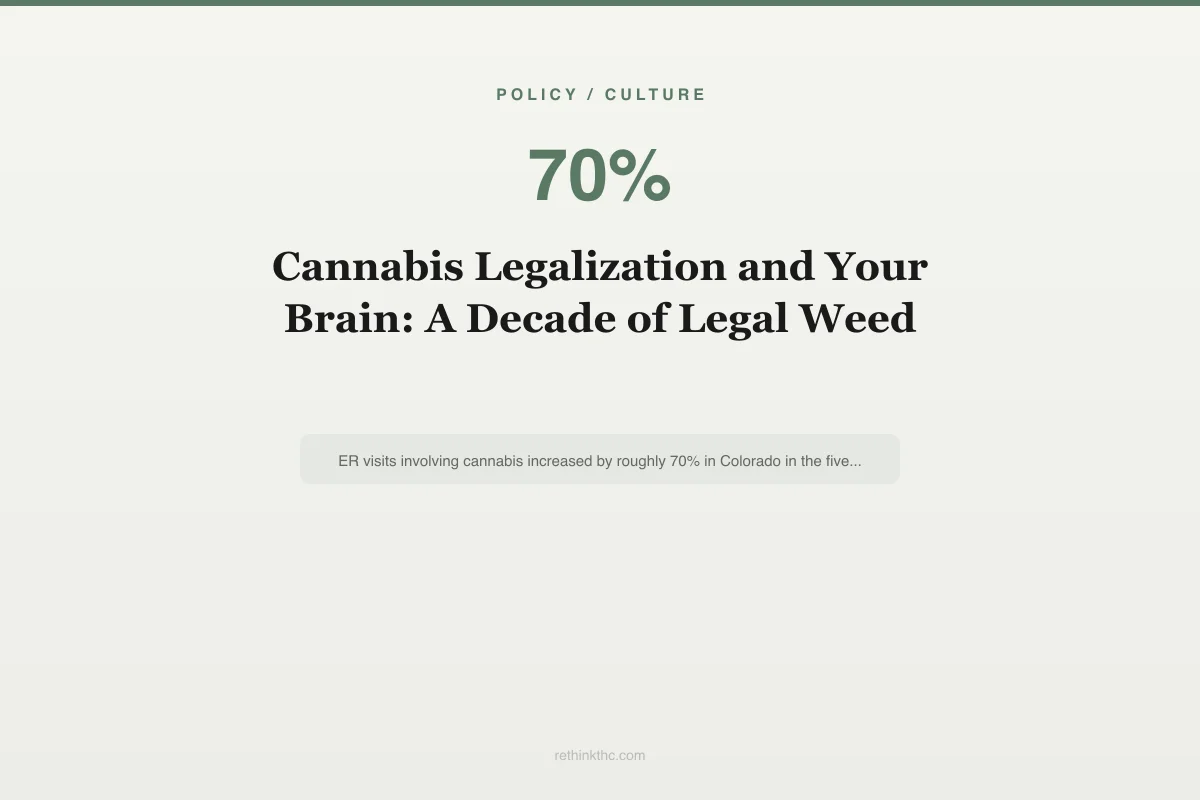
ER visits involving cannabis jumped roughly 70% in Colorado
What Changed About How People Use Cannabis
covered in detail
What This Means If You Live in a Legal State
covered in detail
Monte et al., Annals of Internal Medicine, 2019
 View as image ↗
Colorado legalized recreational cannabis in 2012. Washington followed months later. Over a decade has passed since those first legal sales, and the cannabis legalization effects health data that has accumulated since then is substantial enough to draw real conclusions. Not political talking points. Not speculation. Actual public health outcomes measured across millions of people and published in peer-reviewed journals.
This is not an argument for or against legalization. That debate is about policy, personal liberty, and economics, and reasonable people land in different places. If you are looking for a comprehensive overview of the current legal landscape, including federal-state conflicts, employment rights, and travel rules, see our complete guide to cannabis law and your rights. This article is about what the data actually shows happened to public health when legal cannabis became widely available. Some of the findings are reassuring. Some are concerning. All of them are worth understanding if you use cannabis or are thinking about it.
Key Takeaways
- Over a decade of cannabis legalization effects health data from states like Colorado and Washington shows measurable shifts in ER visits, product potency, and rates of cannabis use disorder
- ER visits involving cannabis jumped roughly 70% in Colorado in the five years after legalization — with edibles driving a disproportionate share of those visits
- Average THC potency in legal markets has climbed from about 12% to over 25% for flower, and concentrates routinely top 80% — fundamentally changing the risk profile of what people are actually using
- Cannabis use disorder rates have gone up in states with legal recreational markets — a 2022 study in JAMA Psychiatry found higher rates in legal states compared to non-legal states
- Youth use data is more mixed than headlines suggest — some legal states show flat or slightly declining teen use while others show modest increases
- A 2019 study in The Lancet Psychiatry found that daily use of high-potency cannabis was tied to a five-fold increase in first-episode psychosis risk — and legal markets have accelerated the push toward stronger products
Emergency Room Visits Went Up, and Edibles Were a Major Factor
A Decade of Legal Cannabis: What the Health Data Shows
~70% increase in Colorado in 5 years post-legalization
Edibles disproportionately represented — delayed onset leads to double-dosing
Annals of Internal Medicine, 2019
Flower: 12% → 25%+. Concentrates: 70–90% THC
Economic incentive — consumers and dispensaries compete on potency
ElSohly, Biological Psychiatry, 2016
Higher CUD rates in legal states vs non-legal states
Increased access + higher potency + normalization
JAMA Psychiatry, 2022
Some states flat/declining, others modest increases
More complex than headlines suggest — not a clear spike
Multiple state surveys
5x increased risk with daily high-potency use
Legal markets accelerated push toward stronger products
Lancet Psychiatry, 2019
This is not an argument for or against legalization. These are measured public health outcomes from peer-reviewed research. Some increases reflect better reporting in legal environments. But researchers who adjust for reporting bias still find genuine increases in adverse events.
One of the clearest signals in the post-legalization data is the increase in cannabis-related emergency room visits. A 2019 study published in the Annals of Internal Medicine examined ER data from a major Colorado hospital system and found that cannabis-related visits increased significantly after legalization. Visits linked to edible products were disproportionately represented relative to edible market share.
Normalization
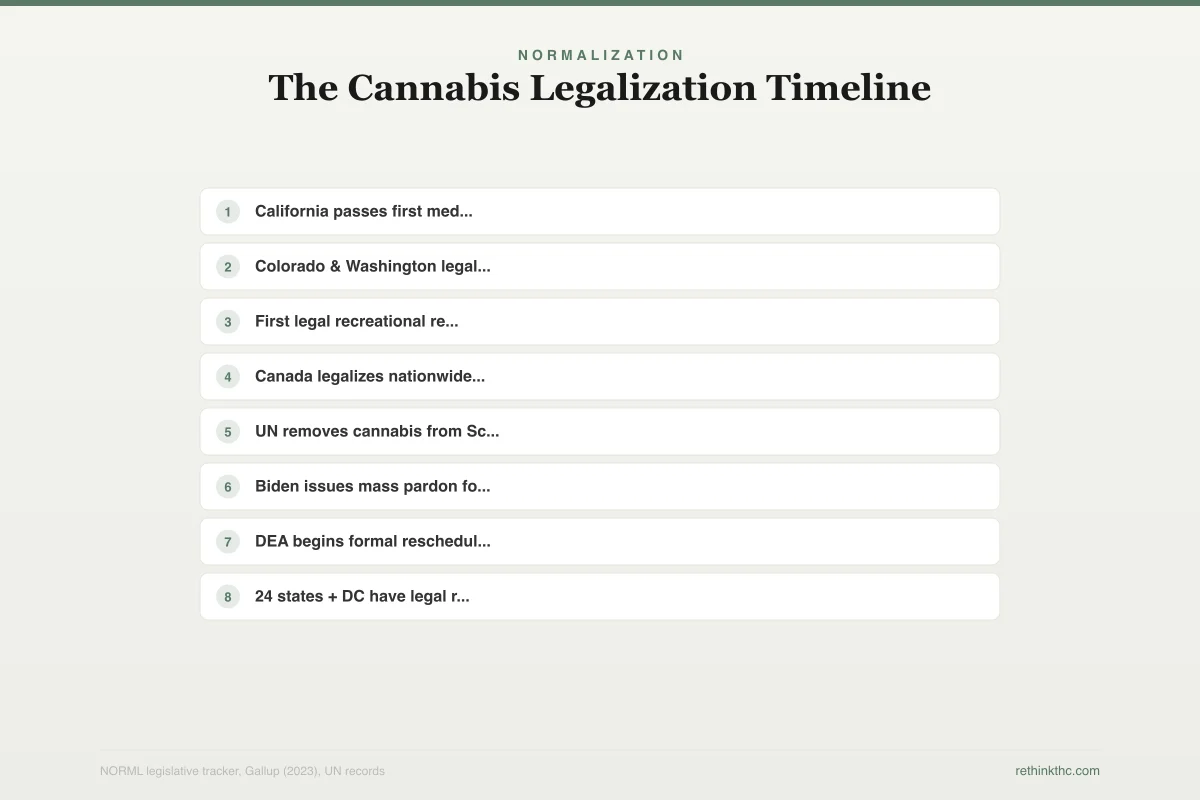
The Cannabis Legalization Timeline
Three decades from first medical law to near-majority recreational access
California passes first medical cannabis law (Prop 215)
Colorado & Washington legalize recreational use
First legal recreational retail sales begin in CO
Canada legalizes nationwide; Farm Bill legalizes hemp in US
UN removes cannabis from Schedule IV of 1961 Convention
Biden issues mass pardon for federal possession, orders scheduling review
DEA begins formal rescheduling review process
24 states + DC have legal recreational markets
From zero legal recreational states in 2010 to 24 by 2024 — normalization removes the friction that once slowed escalation
NORML legislative tracker, Gallup (2023), UN records
 View as image ↗
The pattern makes sense when you look at how edibles work. Edibles take 30 minutes to two hours to produce effects, which leads many people, especially new users, to take a second dose before the first one kicks in. The result is an unexpectedly intense experience that can include severe anxiety, vomiting, racing heart, and in some cases psychotic symptoms that send people to the emergency room.
A 2022 analysis from the Colorado Department of Public Health and Environment found that cannabis-related ER visits increased by approximately 70% in the five years following recreational legalization. Not all of these visits represent life-threatening emergencies. Many involve panic attacks, nausea, or disorientation that resolve on their own. But the volume is real, and it represents a measurable public health cost that did not exist at this scale before legalization.
It is worth noting that some of this increase likely reflects greater willingness to report cannabis use to medical professionals in a legal environment. When something is legal, people are more honest about it with their doctors. But researchers who have studied this adjustment factor still find a genuine increase in adverse events beyond what reporting bias alone would explain.
THC Potency Has Increased Dramatically in Legal Markets
If you used cannabis in the 1990s and you use it today, you are using a fundamentally different product. The average THC content in flower has roughly doubled, and concentrates have pushed potency into a range that did not exist in the illicit market a generation ago.
Data from the University of Mississippi's Potency Monitoring Program, which has tracked cannabis potency for decades, shows that average THC content in flower rose from about 4% in 1995 to approximately 12% by the time Colorado legalized in 2012. In legal markets, that number has continued climbing. By 2024, the average THC content in dispensary flower was above 25% in many states, and concentrates (dabs, shatter, live resin) routinely test between 70% and 90% THC.
This matters because THC potency directly affects health outcomes. Higher potency products are associated with faster development of tolerance, greater risk of cannabis use disorder, and increased likelihood of psychotic symptoms in vulnerable individuals. A 2019 study published in The Lancet Psychiatry found that daily use of high-potency cannabis was associated with a five-fold increase in the risk of first-episode psychosis compared to non-users.
Legal markets have not caused potency to increase from nothing. Potency was already rising in the illicit market. But legalization created economic incentives that accelerated the trend. Consumers want stronger products, dispensaries compete on THC percentage, and growers breed for maximum potency. The result is a market where the average product is significantly more potent than what most long-term users started with.
Cannabis Use Disorder Rates Have Increased in Legal States
This is one of the most important findings in the post-legalization data. A 2022 study published in JAMA Psychiatry by researcher Magdalena Cerda and colleagues found that states with legal recreational cannabis had higher rates of cannabis use disorder compared to states without legal access. The study used nationally representative data and controlled for pre-existing trends, making it one of the stronger pieces of evidence on this question.
Cannabis use disorder, or CUD, is the clinical term for problematic cannabis use that meets specific diagnostic criteria in the DSM-5. It includes symptoms like using more than intended, failed attempts to cut back, cravings, tolerance, and continued use despite negative consequences. Approximately 10% of people who use cannabis will develop CUD at some point, and that percentage rises to roughly 30% among daily users. For a deeper look at the science behind dependence, see is weed addictive according to science.
The increase in CUD rates in legal states likely reflects several overlapping factors. Greater availability and social acceptability lower the barrier to frequent use. Higher potency products accelerate tolerance and dependence. And reduced perception of risk means fewer people are monitoring their own use patterns for warning signs.
This does not mean that everyone who uses cannabis in a legal state will develop a problem. Most users do not. But the population-level shift is real and measurable, and it is worth understanding if you live in a legal state and use cannabis regularly.
Youth Use Data Is More Complicated Than Either Side Claims
Both sides of the legalization debate have strong opinions about what happened to teen use. Opponents predicted legalization would send youth use skyrocketing. Proponents argued that regulated markets would actually reduce access. The data suggests that neither prediction was entirely correct.
The National Survey on Drug Use and Health (NSDUH), which is the largest annual survey of substance use in the United States, has shown relatively stable rates of past-month cannabis use among 12 to 17 year olds nationally since legalization began. Some early-legalization states like Colorado saw slight increases in the years immediately after legalization, while others like Washington saw rates hold flat or slightly decline.
A 2023 systematic review published in the journal Addiction examined youth use data across multiple legal states and found no consistent evidence of a large increase in teen cannabis use attributable to legalization. The authors noted that results varied by state, age group, and time period, making broad generalizations unreliable.
What the data does suggest is a shift in perception. Surveys consistently show that teens in legal states perceive cannabis as less risky than teens in non-legal states. This gap between perception and evidence matters because perceived risk is one of the strongest predictors of whether a young person will try a substance. Even if current use rates have not spiked, declining risk perception may set the stage for future increases, particularly as edibles and vapes make cannabis use more discreet and accessible.
What Changed About How People Use Cannabis
Beyond the headline statistics, legalization has changed the practical landscape of cannabis use in ways that affect health outcomes.
Product diversity has exploded. Before legalization, most people smoked flower. Now the market includes edibles, vapes, concentrates, tinctures, topicals, and beverages. Each product type has a different onset time, duration, potency profile, and risk pattern. A person eating a 100mg edible is having a fundamentally different pharmacological experience than someone smoking a joint, even though both are "using cannabis."
Daily use has become more normalized. Data from the NSDUH shows that among adult cannabis users, the proportion who use daily or near-daily has increased over the past decade. Daily use is the single strongest predictor of developing cannabis use disorder, building significant tolerance, and experiencing withdrawal symptoms when stopping.
The line between medical and recreational has blurred. Many people in legal states use cannabis for sleep, anxiety, or pain management without a medical card or physician guidance. This self-medication pattern means that people are making dosing decisions without clinical input, often escalating use over time as tolerance builds.
What This Means If You Live in a Legal State
Living in a legal state means you have access to a wider range of products, better quality control, and accurate labeling compared to the illicit market. Those are genuine benefits of legalization. But it also means you are navigating an environment designed to make frequent use easy and socially acceptable.
If you use cannabis and want to make informed decisions, the post-legalization data points to a few things worth knowing. Higher potency products carry higher risk for dependence and adverse effects. Edibles require patience and conservative dosing, especially for inexperienced users. Daily use changes the risk calculation significantly compared to occasional use. And the fact that something is legal does not change its pharmacology. For practical strategies on managing your use in this environment, see quitting weed in a legal state. If you are looking for evidence-based guidance on reducing harm in legal markets, safer cannabis use guidelines offer concrete approaches to minimizing risk with high-potency products.
When to Seek Professional Help
If you have noticed that your cannabis use has increased since it became legal in your state, or if you have tried to cut back and found it difficult, that is worth paying attention to. Difficulty controlling use, needing more to get the same effect, and continuing to use despite negative consequences are all signs of cannabis use disorder.
You do not need to be in crisis to reach out. A conversation with a healthcare provider can help you understand where you fall on the spectrum and what your options are. If you are experiencing severe symptoms or need immediate support, contact SAMHSA's National Helpline at 1-800-662-4357 (free, confidential, 24/7) or text HOME to 741741 to reach the Crisis Text Line.
The Data Tells a Balanced Story
A decade of legal cannabis has produced a public health picture that is neither the catastrophe opponents predicted nor the harmless outcome proponents promised. ER visits are up. Potency is up. CUD rates are up. But youth use has not exploded, and the regulated market has brought transparency, testing, and tax revenue that the illicit market never provided.
Understanding what the data actually shows, rather than what either side of the debate wants it to show, puts you in a better position to make decisions about your own use. The science does not tell you what to do. It tells you what the tradeoffs are. What you do with that information is your call.
The Bottom Line
A decade of post-legalization health data from Colorado, Washington, and other states reveals measurable public health shifts. ER visits: cannabis-related visits increased ~70% in Colorado in 5 years post-legalization (2022 Colorado DPHE); edibles disproportionately represented due to delayed onset → overconsumption. Some increase attributable to greater reporting willingness in legal environments, but genuine increase confirmed beyond reporting bias. Potency: average flower THC rose from ~4% (1995) to ~12% (2012 legalization) to 25%+ (2024 dispensaries); concentrates 70-90% THC. Legal market economic incentives accelerated pre-existing potency trend. Di Forti 2019 (Lancet Psychiatry): daily high-potency use = 5x risk of first-episode psychosis. CUD rates: Cerda 2022 (JAMA Psychiatry) found higher CUD prevalence in legal vs non-legal states using nationally representative data with pre-trend controls. ~10% of all users develop CUD, ~30% of daily users. Greater availability + higher potency + reduced risk perception = population-level increase. Youth use: NSDUH data shows relatively stable 12-17 rates nationally; 2023 Addiction systematic review found no consistent large increase attributable to legalization. However, declining risk perception among teens in legal states is a leading indicator concern. Usage pattern shifts: product diversity explosion, daily use normalization (strongest CUD predictor), medical/recreational line blurred → self-medication without clinical guidance.
Has cannabis legalization increased drug use overall?
Adult cannabis use has increased in states with legal recreational markets, according to data from the National Survey on Drug Use and Health. Daily and near-daily use among adults has risen more sharply than occasional use. However, legalization has not been linked to significant increases in the use of other substances like alcohol, opioids, or stimulants at the population level.
Are emergency rooms seeing more cannabis patients since legalization?
Yes. Colorado data shows cannabis-related ER visits increased by approximately 70% in the five years after recreational legalization. Edible-related visits were disproportionately common, largely because delayed onset leads people to consume too much. Many of these visits involve anxiety, vomiting, or disorientation rather than life-threatening emergencies.
Do teens use more cannabis in states where it is legal?
The evidence is mixed. National survey data shows relatively stable teen cannabis use rates overall since legalization began. Some states saw slight increases while others held flat. However, teens in legal states consistently perceive cannabis as less risky, which researchers consider a potential leading indicator of future use increases.
Has the potency of legal cannabis changed over time?
Significantly. Average THC content in dispensary flower now exceeds 25% in many legal states, up from about 12% when Colorado legalized in 2012. Concentrates routinely test between 70% and 90% THC. This increase in potency has meaningful implications for tolerance development, dependence risk, and the likelihood of adverse effects.
Is cannabis use disorder more common in legal states?
A 2022 study in JAMA Psychiatry found higher rates of cannabis use disorder in states with legal recreational cannabis compared to non-legal states. Greater availability, higher potency products, and reduced perception of risk all likely contribute. Approximately 10% of all cannabis users and 30% of daily users develop CUD at some point.
Has legalization made cannabis safer through regulation and testing?
In some important ways, yes. Legal products are tested for pesticides, heavy metals, mold, and residual solvents, protections that do not exist in the illicit market. Accurate labeling also helps consumers understand what they are consuming. However, regulation has not addressed the potency escalation that drives much of the health risk. Legal markets have incentivized higher-THC products, and the average potency of dispensary products has increased significantly since legalization began. Regulation made the supply chain cleaner, but it did not make the products themselves less potent or less likely to cause dependence with heavy use.
Sources & References
- 1RTHC-06526·Georgiadis, Nikolaos et al. (2025). “Nearly one in four men who have sex with men use drugs during sex, including cannabis at 18%.” Drug and alcohol dependence.Study breakdown →PubMed →↩
- 2RTHC-01101·Berthet, Aurélie et al. (2016). “How to Tell If Someone Was Passively Exposed to Cannabis Versus Actually Smoked It.” Forensic science international.Study breakdown →PubMed →↩
- 3RTHC-08494·Miró, Òscar et al. (2026). “Despite increasing cannabis potency in Europe, the severity of emergency department visits for cannabis toxicity stayed the same over 10 years.” Addiction (Abingdon.Study breakdown →PubMed →↩
- 4RTHC-08672·Tummala, Sri et al. (2026). “Cannabis users had significantly higher rates of infection, nonunion, and reoperation after ankle fracture surgery.” Foot & ankle international.Study breakdown →PubMed →↩
- 5RTHC-06350·Diaby, Meman et al. (2025). “National survey maps how cannabis use methods vary by age, race, sex, and income in the US.” Journal of cannabis research.Study breakdown →PubMed →↩
- 6RTHC-06547·Glass, Joseph E et al. (2025). “Cannabis and tobacco use signal underlying social hardship even at low frequency.” Journal of general internal medicine.Study breakdown →PubMed →↩
- 7RTHC-04454·Chambers, Julia et al. (2023). “More Americans now believe cannabis smoking is safer than tobacco, but science doesn't fully support that view.” JAMA network open.Study breakdown →PubMed →↩
- 8RTHC-04179·Roehler, Douglas R et al. (2022). “US Cannabis Emergency Department Visits Increased 12% Annually from 2006 to 2014.” Drug and alcohol dependence.Study breakdown →PubMed →↩