Policy / Culture
24 States + DC
As of 2026, 24 states plus D.C. allow recreational cannabis but possession limits range from 1 to 2.5 ounces, and crossing state lines remains a federal offense even between two fully legal states.
NORML state legislative tracking, 2026
The Four Categories of State Cannabis Law
covered in detail
Recreational Possession Limits by State
covered in detail
Home Possession vs. Public Carry
covered in detail
NORML state legislative tracking, 2026
 View as image ↗
This is not legal advice. Cannabis laws change frequently, and this article reflects the general landscape as of early 2026. Always verify current laws in your specific state before making decisions. If you are facing charges, consult a licensed attorney.
The question "how much weed can I legally have?" sounds like it should have a simple answer. It does not. The answer depends on your state, whether you are in public or at home, whether you have a medical card, what form the cannabis is in, and in some states, whether the container is sealed. This guide breaks down the current landscape into categories that actually help you understand where you stand.
Key Takeaways
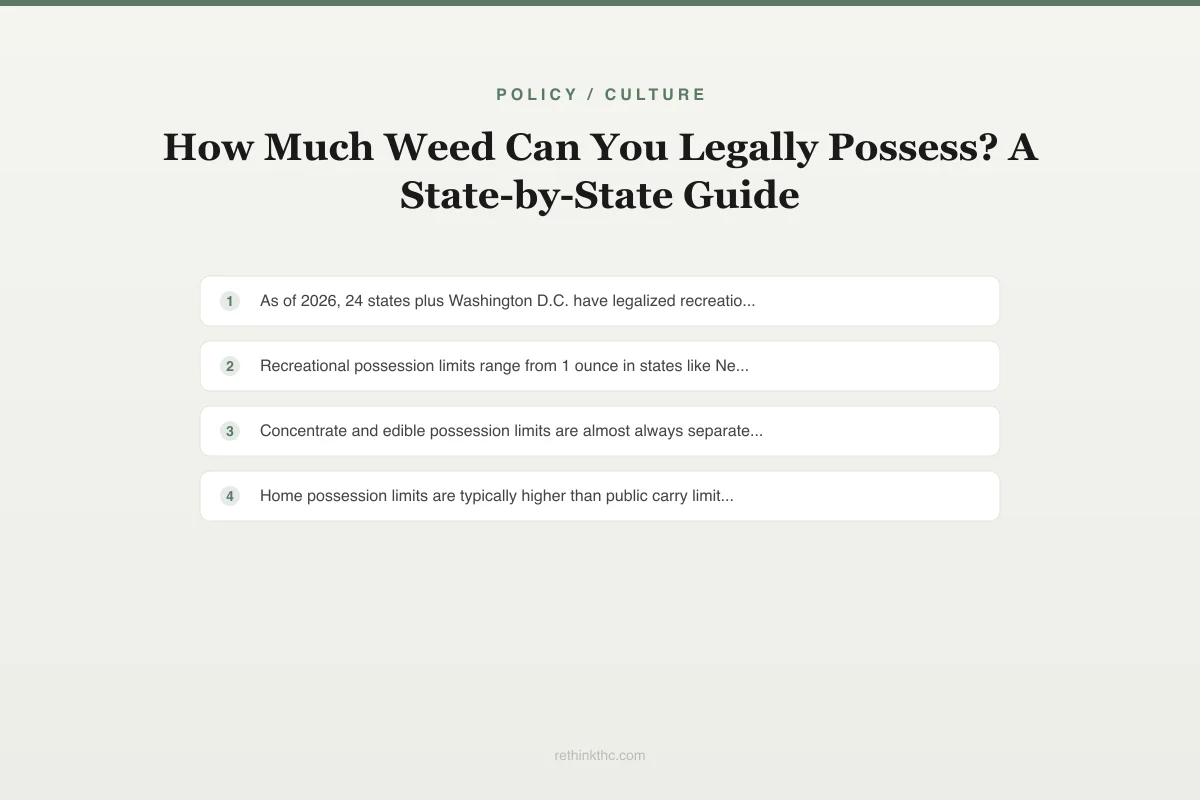
- As of 2026, 24 states plus Washington D.C. have legalized recreational cannabis for adults 21 and older — but every state sets its own possession limits
- Those limits range from 1 ounce in states like New York to 2.5 ounces in states like Michigan and Oregon
- Concentrate and edible limits are almost always separate from flower limits and measured differently — often in grams or milligrams of THC
- You can usually keep more at home than you can carry in public, with some states allowing up to 10 ounces at your residence
- Going even slightly over your state's possession limit can turn a civil fine into a criminal charge
- Cannabis is still federally Schedule I no matter what your state says, so crossing state lines with it is illegal even if both states have legalized — and enforcement corridors like I-70 through Kansas actively pull over travelers from legal states
The Four Categories of State Cannabis Law
Four Categories of State Cannabis Law (2026)
Federal reminder: Cannabis is still Schedule I federally. Crossing state lines with any amount is a federal crime — even between two legal states. Interstate enforcement corridors (I-70 through Kansas) actively target travelers from legal states.
As of 2026, every state falls into one of four broad categories regarding cannabis possession. Understanding which category your state occupies is the starting point for knowing your rights.
Fully Legal (Recreational) States
These states have legalized cannabis for recreational use by adults 21 and older. You do not need a medical card. You can purchase from licensed dispensaries and possess up to the state limit. As of 2026, this includes Alaska, Arizona, California, Colorado, Connecticut, Delaware, Hawaii, Illinois, Maryland, Massachusetts, Michigan, Minnesota, Missouri, Montana, Nevada, New Jersey, New Mexico, New York, Ohio, Oregon, Rhode Island, Vermont, Virginia, and Washington, plus Washington D.C.
Each of these states sets its own possession limits, purchase limits, and rules about where cannabis can be consumed. Legal does not mean unrestricted, and the details matter.
Medical Only States
These states allow cannabis possession only for patients with qualifying medical conditions and a valid medical cannabis card. States in this category include Arkansas, Florida, Louisiana, Mississippi, New Hampshire, North Dakota, Oklahoma, Pennsylvania, South Dakota, Utah, and West Virginia, among others. Medical possession limits are typically more generous than recreational limits in neighboring legal states, often ranging from 2.5 to 4 ounces of flower.
Decriminalized States
Some states have not legalized cannabis but have reduced penalties for small amounts to civil fines rather than criminal charges. North Carolina, for example, treats possession of up to half an ounce as a misdemeanor with a maximum $200 fine. Decriminalization is not legalization. You cannot legally purchase cannabis, you cannot possess large amounts, and the product is still confiscated.
Fully Illegal States
A shrinking but significant number of states still treat all cannabis possession as a criminal offense. As of 2026, Idaho, Kansas, Nebraska, and Wyoming remain in this category, though legislative efforts are ongoing in several of these states. Penalties vary but can include jail time even for first-time possession of small amounts.
Recreational Possession Limits by State
Here is where the specifics matter. Recreational possession limits for cannabis flower (the most common form) vary significantly.
One ounce states. New York, New Jersey, Connecticut, and several other states set the public possession limit at one ounce (28 grams) of flower. This is the most common single limit. One ounce is roughly enough to fill a medium sandwich bag.
One and a half ounce states. Maryland allows up to 1.5 ounces of flower for personal use, a limit that sits between the more conservative and more generous states.
Two ounce states. Colorado, Nevada, Illinois, and several others allow up to two ounces (56 grams) of flower in public possession. Colorado recently increased its limit from one ounce, reflecting the trend toward more generous allowances as programs mature.
Two and a half ounce states. Michigan and Oregon are among the most generous, allowing up to 2.5 ounces (about 71 grams) of flower for public possession.
Special cases. Washington D.C. allows possession but has no legal retail sales, creating the unusual situation where you can legally have cannabis but cannot legally buy it. This has led to the "gifting" economy, where cannabis is technically given away alongside the purchase of another item. Alaska allows one ounce in public but up to four ounces at home.
Home Possession vs. Public Carry
Most legal states distinguish between how much you can carry in public and how much you can keep at home. Home limits are consistently higher.
In Oregon, you can carry 2.5 ounces in public but keep up to 8 ounces at home. In Colorado, the home possession limit is two ounces (matching the public limit as of recent changes, though previous rules allowed more). Massachusetts allows one ounce in public but up to 10 ounces at home.
The logic is that storing cannabis at home poses less risk to public safety than carrying large amounts in public. Home possession limits are generally designed to allow consumers to purchase in bulk and store their supply without making frequent dispensary trips.
The catch: in most states, home-stored cannabis must be in a secure location, inaccessible to minors. Some states specify locked containers. If you have children in the home, the security requirements are taken more seriously by law enforcement, and failure to properly secure cannabis around minors can result in separate charges.
Concentrate Limits
Cannabis concentrates, including wax, shatter, live resin, vape cartridges, and oils, are almost always regulated separately from flower. Concentrate limits are measured in grams and are significantly lower by weight than flower limits.
Typical concentrate limits in legal states range from 5 to 8 grams for public possession. Colorado allows up to 8 grams of concentrate. California allows up to 8 grams. Illinois allows 5 grams.
The reason for the lower weight limit is potency. Concentrates typically contain 60 to 90 percent THC, compared to 15 to 30 percent for flower. Five grams of concentrate contains far more THC than five grams of flower, so the limits aim to roughly equalize the total THC allowed.
Some states also set limits for cannabis-infused products (edibles) in milligrams of THC rather than product weight. Illinois, for example, allows up to 500 milligrams of THC in edible form. This can be confusing because 500 milligrams of THC might be contained in a single large bag of gummies or spread across many packages.
Medical Card Holder Limits
If you have a valid medical cannabis card, your possession limits are typically higher than recreational limits, sometimes substantially so.
In Arizona, recreational users can possess one ounce, but medical patients can possess 2.5 ounces. In Michigan, recreational limits are 2.5 ounces, but medical patients can possess up to the same amount of usable cannabis plus additional amounts based on their plant count. In Florida, which is medical-only, patients are allotted a specific amount by their recommending physician, typically up to 2.5 ounces of flower per 35-day period.
Medical limits often come with purchase tracking. Dispensaries log your purchases against your allotted amount, and exceeding your allotment through multiple dispensary visits can trigger compliance issues.
Medical cards also provide access in states without recreational programs, allow purchase at age 18 instead of 21 in most states, and offer legal protections in employment and housing situations in some jurisdictions.
What Happens If You Exceed the Limit
Exceeding your state's possession limit does not automatically result in the same penalties as being in a prohibition state, but it does change the legal situation meaningfully.
Small overages. In many legal states, possessing slightly more than the limit (for example, 1.3 ounces in a 1-ounce state) is treated as a civil infraction or low-level misdemeanor. You may face a fine and confiscation of the excess amount. This is generally not an arrestable offense.
Significant overages. Possessing substantially more than the personal limit begins to look like distribution in the eyes of the law. Most states have a threshold where possession transitions from personal use to "possession with intent to distribute." This threshold varies but is often around double the personal limit. At that point, you are looking at potential felony charges.
Packaging and context matter. If you are over the limit and the cannabis is divided into small individual packages, accompanied by large amounts of cash, or found with scales and packaging materials, the distribution inference strengthens. Prosecutors look at the totality of the circumstances, not just the weight.
Concentrate overages. Because concentrates are high-value and high-potency, exceeding concentrate limits often triggers more aggressive enforcement than equivalent flower overages.
Notable 2025 and 2026 Changes
The cannabis legal landscape continues to shift. Several changes from 2025 into 2026 are worth noting.
Ohio's recreational program launched in 2024, with retail sales beginning in 2025. The state allows 2.5 ounces of flower and 15 grams of concentrate for adult use. The rollout has been slower than anticipated due to licensing delays, but possession has been legal since the law took effect.
Hawaii transitioned from medical-only to recreational legalization, with its program taking shape through 2025 and into 2026. The possession limit is set at one ounce of flower.
Florida's legalization ballot measure failed narrowly in 2024, keeping the state medical-only. However, legislative efforts continue, and the issue is expected to return to the ballot or be addressed legislatively.
Several states have increased their existing limits. Colorado moved from one ounce to two ounces for public possession. Oregon has maintained its generous 2.5-ounce public limit and 8-ounce home limit.
On the federal level, cannabis remains a Schedule I substance under the Controlled Substances Act, though rescheduling efforts have advanced through the DEA review process. Federal rescheduling to Schedule III would not directly change state possession limits, but it would reduce the federal conflict that creates complications around banking, taxation, and interstate issues.
Penalties in States Where Cannabis Is Still Illegal
For the states where any possession remains criminal, the penalties vary but can be severe.
In Idaho, possession of any amount under three ounces is a misdemeanor punishable by up to one year in jail and a $1,000 fine. Three ounces or more is a felony with up to five years.
In Kansas, first-offense possession of any amount is a misdemeanor with up to six months in jail. Second offense is a felony.
In Nebraska, first-offense possession of one ounce or less is an infraction with a $300 fine and no jail time, making it effectively decriminalized for small amounts. More than one ounce is a misdemeanor.
In Wyoming, possession of less than three ounces is a misdemeanor with up to 12 months in jail and a $1,000 fine.
These penalties can carry collateral consequences beyond the criminal sentence itself: impacts on employment, housing, student financial aid eligibility, professional licenses, and immigration status.
Practical Guidelines
Know your state's specific limits before purchasing or carrying cannabis. Dispensaries in legal states are not supposed to sell you more than your daily purchase limit, but if you visit multiple dispensaries in one day, you could accumulate more than the possession limit.
Keep cannabis in original dispensary packaging when possible. This provides proof of legal purchase and makes it easier to demonstrate that the amount is within legal limits if questioned.
If you live near a state border, be acutely aware of the neighboring state's laws. Possession that is perfectly legal on one side of a river or highway can be a criminal offense on the other side.
When traveling within a legal state, store cannabis securely in the trunk or rear cargo area, sealed and out of reach. Treat the possession limit as a hard ceiling, not a suggestion.
For medical patients, keep your medical card current and accessible separately from your cannabis. An expired card may not provide the legal protections you are counting on.
Above all, understand that possession limits exist on a spectrum. Being at or under the limit in a legal state is simple and safe. Being moderately over creates legal risk. Being significantly over puts you in distribution territory regardless of your intent. Managing your possession amount is one of the simplest and most effective ways to stay on the right side of the law.
The Bottom Line
2026 state-by-state cannabis possession limits covering all four legal categories. Four tiers: fully legal (24 states + DC), medical-only (AR, FL, LA, MS, NH, ND, OK, PA, SD, UT, WV+), decriminalized (reduced to civil fines), fully illegal (ID, KS, NE, WY). Recreational flower limits: 1oz (NY, NJ, CT), 1.5oz (MD), 2oz (CO, NV, IL), 2.5oz (MI, OR); home limits higher (OR 8oz, MA 10oz, AK 4oz). Concentrate limits: typically 5-8g (CO 8g, CA 8g, IL 5g); edibles measured by THC mg (IL 500mg). Medical limits higher: AZ 2.5oz vs 1oz recreational; FL 2.5oz per 35 days with purchase tracking. Home storage: must be secured, inaccessible to minors, some states require locked containers. Overage consequences: small = civil infraction/fine; significant = possession with intent to distribute (felony); packaging/context (individual bags, cash, scales) strengthens distribution inference. 2025-2026 changes: OH recreational launched (2.5oz flower, 15g concentrate); HI transitioned to recreational (1oz); FL ballot measure failed 2024; CO increased 1oz→2oz; federal rescheduling advancing but won't change state limits. Prohibition state penalties: ID up to 1yr jail any amount; KS 2nd offense = felony; WY up to 12mo. Collateral consequences: employment, housing, financial aid, professional licenses, immigration.
What is the most common recreational cannabis possession limit?
One ounce (28 grams) of flower is the most common public possession limit across recreational states. New York, New Jersey, Connecticut, and several others use this threshold. However, there is significant variation — Colorado and Nevada allow two ounces, while Michigan and Oregon allow up to 2.5 ounces. Home possession limits are typically higher, with Massachusetts allowing 10 ounces and Oregon allowing 8 ounces at home. Always check your specific state's current limits, as several states have increased their allowances in recent years. Colorado, for example, recently moved from one ounce to two ounces for public possession.
Are concentrate possession limits the same as flower limits?
No. Concentrate limits are always separate and lower by weight. Typical concentrate limits range from 5 to 8 grams for public possession — Colorado and California allow up to 8 grams, while Illinois allows 5 grams. The lower weight limit reflects the much higher potency of concentrates (60 to 90 percent THC versus 15 to 30 percent for flower), so the limits aim to roughly equalize the total THC allowed. Some states also set edible limits by THC milligrams rather than product weight — Illinois allows up to 500 milligrams of THC in edible form. Check your state for the specific concentrate and edible limits, as they are not always intuitive from the flower limit.
What happens if you get caught with slightly more than the legal limit?
In most legal states, possessing slightly more than the limit is treated as a civil infraction or low-level misdemeanor rather than a serious criminal charge. You may face a fine and confiscation of the excess amount but are unlikely to be arrested. However, significantly exceeding the personal limit — often around double — can trigger "possession with intent to distribute" charges, which are felonies in most jurisdictions. Context matters enormously: cannabis divided into individual packages, accompanied by large amounts of cash, or found with scales and packaging materials strengthens the distribution inference. The safest approach is to treat the possession limit as a hard ceiling rather than a guideline.
Can you carry cannabis across state lines if both states are legal?
No. Transporting cannabis across state lines is a federal offense regardless of the legal status in either state. Cannabis remains a Schedule I substance under the federal Controlled Substances Act, and interstate transport violates federal law even when traveling between two fully legal states. In practice, the greatest risk comes from crossing into states where cannabis is still illegal. Enforcement corridors like Interstate 70 through Kansas are well known for targeting vehicles with plates from neighboring legal states. If you must drive through a prohibition state, the only legally safe option is to not have cannabis in the vehicle at all.
Does a medical card give you higher possession limits?
Yes, in most states. Medical cannabis patients typically have higher possession limits than recreational users. In Arizona, recreational users can possess one ounce while medical patients can possess 2.5 ounces. In Florida (medical-only), patients are allotted up to 2.5 ounces of flower per 35-day period. Medical limits often come with purchase tracking — dispensaries log your purchases against your allotment, and exceeding it can trigger compliance issues. Medical cards also provide access in states without recreational programs, allow purchase at age 18 instead of 21, and offer legal protections in employment and housing situations in some jurisdictions. Keep your card current and accessible separately from your cannabis.
Can you visit multiple dispensaries in one day to get around purchase limits?
Technically you can visit multiple dispensaries, but if your cumulative purchases exceed the possession limit, you are breaking the law. Dispensaries in legal states are not supposed to sell you more than your daily purchase limit, but most states do not have real-time tracking systems that connect purchases across different dispensary chains. Accumulating more than the possession limit by visiting multiple locations puts you at risk — even though each individual purchase was legal, possessing the total amount is not. Some states are implementing seed-to-sale tracking systems that may eventually flag multi-dispensary purchases, but enforcement currently relies on possession limits at the point of contact with law enforcement.
Sources & References
- 1RTHC-00101·Watson, S J et al. (2000). “The Landmark 1999 Institute of Medicine Report: Medical Marijuana Has Promise but Smoking Is Not the Answer.” Archives of general psychiatry.Study breakdown →PubMed →↩
- 2RTHC-08306·Haley, Danielle F et al. (2026). “Recreational Cannabis Laws Linked to 9-11% Drop in Daily Opioid Use Among People Who Inject Drugs.” Drug and alcohol dependence.Study breakdown →PubMed →↩
- 3RTHC-08312·Hammond, Christopher J et al. (2026). “Cannabis Laws Linked to Increased Youth Suicide in Asian/Pacific Islander and Hispanic Populations.” American journal of preventive medicine.Study breakdown →PubMed →↩
- 4RTHC-08327·Hawkins, Summer Sherburne et al. (2026). “Cannabis Legalization Drives New Users Rather Than Heavier Use Among Existing Users.” American journal of preventive medicine.Study breakdown →PubMed →↩
- 5RTHC-08328·Hawkins, Summer Sherburne et al. (2026). “Edible Cannabis Use Surges 35% After Recreational Legalization.” Preventive medicine.Study breakdown →PubMed →↩
- 6RTHC-07850·Van Doren, Natalia et al. (2025). “Cannabis Legalization in California Was Linked to Changes in Alcohol Use — But the Direction Depends on Age.” Addiction (Abingdon.Study breakdown →PubMed →↩
- 7RTHC-07957·Winfield-Ward, Lauren et al. (2025). “How Cannabis Marketing Exposure Differs Across US States With Different Laws.” Drug and alcohol dependence.Study breakdown →PubMed →↩
- 8RTHC-07987·Xu, Carol et al. (2025). “Recreational Cannabis Laws Are Associated With People Sleeping About 5 Minutes Less.” AJPM focus.Study breakdown →PubMed →↩